Unit 12 · Waves and Optics · 3 teaching hours · 15 min read
Diffraction
What the syllabus asks for 3
- Diffraction from a single slit
- Diffraction pattern of image; Diffraction grating
- Resolving power of optical instruments
Stand inside a room in Bhaktapur with the shutters almost closed and the sunlight squeezing through does not stop at a sharp edge — it fans out. Light bends round obstacles and spreads after passing through narrow openings. This is diffraction, and it is the direct consequence of Huygens' secondary wavelets interfering with one another. It sets a hard limit on what any telescope or microscope can see, and it is the working principle of the diffraction grating, the most accurate instrument we have for measuring wavelength.
Diffraction is only noticeable when the width of the obstacle or aperture is comparable with the wavelength. Sound (\lambda \approx 1\ \text{m}) bends round a doorway easily; light (\lambda \approx 5\times10^{-7}\ \text{m}) needs a slit a fraction of a millimetre wide before the spreading can be seen.
12.1 Diffraction from a single slit
Diffraction is the bending of waves round the edges of an obstacle or aperture, and the resulting redistribution of intensity, when the size of the obstacle or aperture is comparable with the wavelength of the wave.
Two classes are distinguished:
| Fresnel diffraction | Fraunhofer diffraction | |
|---|---|---|
| Source and screen | at finite distance from the slit | effectively at infinity |
| Incident wavefront | spherical or cylindrical | plane |
| Lenses needed | none | collimating lens and focusing lens |
| Mathematics | difficult | simple |
Everything in this unit is Fraunhofer diffraction: parallel light in, parallel light out, brought to a focus by a converging lens.
Condition for the minima
Let a plane wavefront of wavelength \lambda fall normally on a slit AB of width a. By Huygens' principle every point of the slit sends out secondary wavelets. Consider those that leave at an angle \theta to the original direction; the lens brings them to a single point P on the screen. The wavelet from the bottom edge B travels farther than the one from the top edge A by
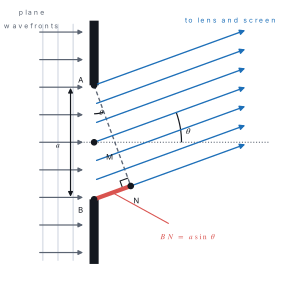
Imagine the slit divided into two halves, AM and MB, each of width a/2. Pair off a point in the top half with the point exactly a/2 below it in the bottom half. The path difference for such a pair is \frac{a}{2}\sin\theta.
Every pair cancels if that equals half a wavelength:
Every wavelet from the top half is then cancelled by its partner from the bottom half, and P is dark. Dividing the slit into four equal strips instead gives a\sin\theta = 2\lambda, into six strips a\sin\theta = 3\lambda, and so on. The general condition for a minimum is
Note that n = 0 is excluded: at \theta = 0 every wavelet arrives in phase and the centre is the brightest point of the pattern.
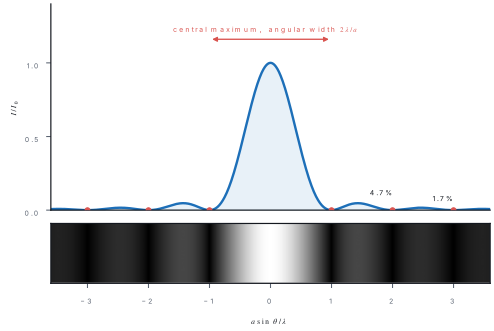
The secondary maxima lie roughly halfway between the minima, at
and they are very weak — the first is only about 4.7% of the central intensity, the second about 1.7%. The full intensity distribution is
Width of the central maximum
The first minima lie at \sin\theta = \pm\lambda/a. For small angles \sin\theta \approx \theta, so the angular half-width of the central maximum is \lambda/a and its angular width is
On a screen a distance D from the slit (or in the focal plane of a lens of focal length f), the linear width of the central bright band is
Students expect a narrower slit to give a narrower patch of light. The opposite is true: w \propto 1/a, so halving the slit width doubles the spread. Only when a \gg \lambda does the patch shrink to the geometrical shadow of the slit, which is why ray optics works for everyday apertures.
Problem. A slit 0.20\ \text{mm} wide is illuminated normally by light of wavelength 600\ \text{nm}. The diffraction pattern is observed on a screen 1.5\ \text{m} away. Find (a) the angular position of the first minimum, (b) the linear width of the central maximum, (c) the distance of the second minimum from the centre.
Solution.
(a) \sin\theta_1 = \dfrac{\lambda}{a} = \dfrac{600\times10^{-9}}{0.20\times10^{-3}} = 3.0\times10^{-3}, so \theta_1 = 3.0\times10^{-3}\ \text{rad} = 0.17^\circ.
(b) w = \dfrac{2\lambda D}{a} = 2 \times 3.0\times10^{-3} \times 1.5 = 9.0\times10^{-3}\ \text{m} = 9.0\ \text{mm}.
(c) \sin\theta_2 = 2\lambda/a = 6.0\times10^{-3}, so y_2 = D\tan\theta_2 \approx 1.5 \times 6.0\times10^{-3} = 9.0\ \text{mm}.
12.2 Diffraction pattern of image; Diffraction grating
The image of a slit
Geometrical optics says the image of an illuminated slit is a sharp bright rectangle. What is actually seen in the focal plane of the lens is a broad central bright band flanked by progressively fainter bands separated by dark lines — the pattern of the previous figure. Every optical image is really a diffraction pattern; a "point" image is never a point.
Interference and diffraction are both superposition effects, but the NEB expects you to be able to separate them:
| Interference (Young) | Diffraction (single slit) |
|---|---|
| Superposition of waves from two separate coherent sources | Superposition of secondary wavelets from different parts of the same wavefront |
| Fringes of equal width | Central band twice as wide as the rest |
| All bright fringes of equal intensity | Intensity falls off rapidly away from the centre |
| Dark fringes are perfectly dark | Minima are dark but the pattern never fully repeats |
| Bright: \Delta = n\lambda | Dark: a\sin\theta = n\lambda |
Diffraction grating
A diffraction grating is a glass or plastic plate ruled with a very large number of equidistant parallel lines; the ruled lines are opaque and the gaps between them act as slits. If there are N lines per metre, the distance from the centre of one slit to the centre of the next is the grating element
where e is the width of a transparent slit and b that of an opaque ruling. A good grating has 5000–15000 lines per centimetre, so d is a couple of micrometres.
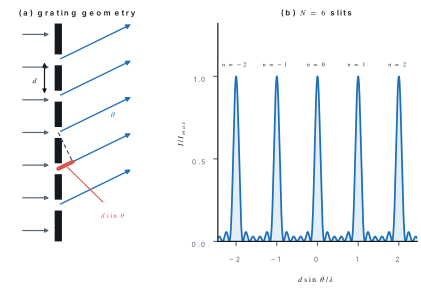
Plane monochromatic light falls normally on the grating. Take the parallel rays that leave every slit at an angle \theta; a lens brings them to one point. The path difference between the wavelets from any two adjacent slits is the same, namely d\sin\theta.
All N slits then reinforce one another only when this common path difference is a whole number of wavelengths:
This is the grating equation, and n is the order of the spectrum. Because N is huge (tens of thousands), the slightest departure from the condition throws the contributions of distant slits out of step, so the maxima are extremely sharp — which is what makes a grating a precision wavelength-measuring instrument.
Two consequences follow:
- Since \sin\theta \le 1, the highest order obtainable is n_{\max} = d/\lambda (rounded down to a whole number).
- For a given order, \sin\theta \propto \lambda, so white light is spread into a spectrum with violet closest to the centre and red furthest out — the opposite way round from a prism, where red is deviated least.
Problem. A plane diffraction grating has 5000 lines per centimetre. Light of wavelength 500\ \text{nm} falls normally on it. Find the angles of the first, second and third order maxima, and the highest order that can be observed.
Solution. The grating element is
From d\sin\theta = n\lambda, \sin\theta = n\lambda/d = n(0.25).
- n = 1: \sin\theta = 0.25, \theta_1 = 14.5^\circ
- n = 2: \sin\theta = 0.50, \theta_2 = 30.0^\circ
- n = 3: \sin\theta = 0.75, \theta_3 = 48.6^\circ
The highest order needs \sin\theta \le 1, i.e. n \le d/\lambda = 4. But n = 4 gives \sin\theta = 1, i.e. \theta = 90^\circ — light grazing along the grating, which cannot be collected. So only three orders are actually seen on each side of the centre.
12.3 Resolving power of optical instruments
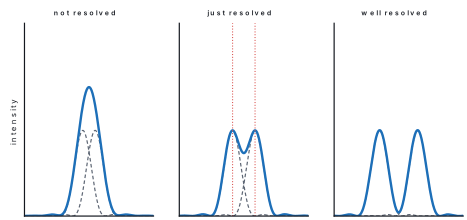
Because every image is a diffraction patch, two nearby stars produce two overlapping patches. If the patches overlap too much they merge into one and the stars cannot be told apart. Lord Rayleigh gave the practical dividing line.
Two point objects are said to be just resolved when the central maximum of the diffraction pattern of one falls exactly on the first minimum of the pattern of the other.
Telescope
For a circular aperture of diameter a the first dark ring of the diffraction pattern lies at an angle 1.22\lambda/a (the factor 1.22 comes from the circular shape; for a slit it would be 1). So two stars are just resolved when their angular separation is
and the resolving power of the telescope, defined as the reciprocal of the limit of resolution, is
A bigger objective therefore resolves better and collects more light — which is why research telescopes are built with mirrors metres across.
Microscope
For a microscope the useful quantity is the smallest separation x between two points in the object that can still be distinguished:
Here \theta is the half-angle of the cone of light entering the objective and \mu is the refractive index of the medium between object and objective. The product \mu\sin\theta is the numerical aperture. Two ways of improving a microscope follow at once: use shorter wavelengths (blue light, or electrons in an electron microscope), and raise \mu by putting a drop of cedar oil (\mu \approx 1.5) between the slide and the objective — oil immersion.
For a grating the corresponding quantity is the ability to separate two close wavelengths, and it works out to \lambda/\mathrm{d}\lambda = nN, where N is the total number of lines actually illuminated and n is the order.
Problem. A telescope objective has a diameter of 100\ \text{mm}. Taking the mean wavelength of light as 550\ \text{nm}, find (a) its limit of resolution and (b) the smallest distance between two objects on the Moon, 3.84\times10^{8}\ \text{m} away, that this telescope could just resolve.
Solution.
(a) \theta_{\min} = \dfrac{1.22\lambda}{a} = \dfrac{1.22 \times 550\times10^{-9}}{0.100} = 6.71\times10^{-6}\ \text{rad}
(b) For small angles the linear separation is x = r\theta_{\min}:
so about 2.6\ \text{km} — a small telescope cannot show anything on the Moon smaller than a large town.
Problem. An oil-immersion microscope objective works with light of wavelength 500\ \text{nm}, a half-angle of 60^\circ and oil of refractive index 1.5. Find the smallest separation it can resolve.
Solution. The numerical aperture is \mu\sin\theta = 1.5 \times \sin 60^\circ = 1.5 \times 0.866 = 1.299.
That is 235\ \text{nm} — smaller than a bacterium, but far larger than a virus, which is why viruses need an electron microscope.
Chapter summary
- Diffraction is the bending of light round edges, noticeable only when the aperture is comparable with \lambda. Fraunhofer diffraction uses plane waves.
- Single slit minima: a\sin\theta = n\lambda for n = \pm1, \pm2, \dots; secondary maxima near a\sin\theta = (n+\frac{1}{2})\lambda, of relative intensity 4.7%, 1.7%, …
- Intensity: I = I_0(\sin\beta/\beta)^2 with \beta = \pi a\sin\theta/\lambda.
- Central maximum: angular width 2\lambda/a, linear width 2\lambda D/a — it gets wider as the slit gets narrower.
- Grating element d = 1/N; grating equation d\sin\theta = n\lambda; highest order n_{\max} = d/\lambda; in each order violet is deviated least.
- Rayleigh criterion: just resolved when one central maximum sits on the other's first minimum.
- Telescope: \theta_{\min} = 1.22\lambda/a, R.P. = a/1.22\lambda. Microscope: x_{\min} = 1.22\lambda/2\mu\sin\theta. Grating: \lambda/\mathrm{d}\lambda = nN.
Practice questions
Group A — Multiple choice (1 mark each)
- In Fraunhofer diffraction at a single slit, the condition for the nth minimum is [1]aa\sin\theta = n\lambdaba\sin\theta = (2n+1)\lambda/2cd\sin\theta = n\lambdada\cos\theta = n\lambda
- The width of the central maximum in single-slit diffraction [1]aincreases with slit widthbdecreases with slit widthcdoes not depend on the slit widthdis always zero
- A grating has 2000 lines per centimetre. Its grating element is [1]a2 μmb5 μmc0.5 μmd20 μm
- The resolving power of a telescope can be increased by [1]aincreasing the wavelengthbincreasing the aperturecdecreasing the aperturedincreasing the eyepiece magnification
- Diffraction is most easily observed when the size of the aperture is [1]amuch larger than \lambdabcomparable with \lambdacexactly zerodinfinite
Answers to Group A
1. (a) — pairing the two halves of the slit gives a\sin\theta = n\lambda for darkness.
2. (b) — w = 2\lambda D/a, so w and a are inversely related.
3. (b) — d = 1\ \text{cm}/2000 = 5\times10^{-4}\ \text{cm} = 5\ \text{μm}.
4. (b) — R.P. = a/1.22\lambda, so a larger objective resolves better.
5. (b) — bending is appreciable only when the aperture is of the order of the wavelength.
Group B — Short answer (5 marks each)
- What is diffraction of light? Distinguish between interference and diffraction. [5]
- Derive the condition for minima in Fraunhofer diffraction at a single slit and hence obtain the width of the central maximum. [5]
- Light of wavelength 500\ \text{nm} falls normally on a slit of width 0.10\ \text{mm}. The pattern is seen on a screen 1.0\ \text{m} away. Find the distance between the first minima on the two sides of the centre. [5]
- What is a diffraction grating? Obtain the grating equation and explain why the maxima are sharp. [5]
Answers to Group B
1. Outline: diffraction = bending of light at an aperture comparable with \lambda, caused by superposition of secondary wavelets from one wavefront; interference involves two separate coherent sources. Compare fringe width, intensity of successive maxima and the darkness of the minima (see the table in §12.2).
3. \sin\theta_1 = \dfrac{\lambda}{a} = \dfrac{500\times10^{-9}}{1.0\times10^{-4}} = 5.0\times10^{-3}. Distance of one first minimum from the centre is y_1 = D\theta_1 = 1.0 \times 5.0\times10^{-3} = 5.0\ \text{mm}, so the separation of the two first minima (the width of the central maximum) is 2y_1 = 10\ \text{mm} = 1.0\ \text{cm}.
Group C — Long answer (8 marks each)
- (a) Explain Fraunhofer diffraction at a single slit and derive the positions of the minima. [5](b) Sketch the intensity distribution and state the Rayleigh criterion for resolution. [3]
- A diffraction grating has 6000 lines per centimetre and is illuminated normally by light of wavelength 600\ \text{nm}. Find(a) the grating element,(b) the angles of the first and second order maxima,(c) the highest order that can be seen, and(d) the smallest wavelength difference the grating can resolve in the second order if 8000 lines are illuminated. [8]
Answer to Group C question 2
(a) d = \dfrac{10^{-2}}{6000} = 1.667\times10^{-6}\ \text{m} = 1.667\ \text{μm}.
(b) \sin\theta = n\lambda/d with \lambda/d = 600\times10^{-9}/1.667\times10^{-6} = 0.36. For n = 1: \sin\theta_1 = 0.36, \theta_1 = 21.1^\circ. For n = 2: \sin\theta_2 = 0.72, \theta_2 = 46.1^\circ.
(c) n_{\max} = d/\lambda = 1/0.36 = 2.78, so the highest observable order is n = 2.
(d) \dfrac{\lambda}{\mathrm{d}\lambda} = nN = 2 \times 8000 = 16000, so
Practise more: Physics question bank