Unit 9 · Waves and Optics · 5 teaching hours · 15 min read
Acoustic phenomena
What the syllabus asks for 3
- Sound waves: Pressure amplitude
- Characteristics of sound: Intensity, loudness, quality and pitch
- Doppler's effect
Everything you hear — the pitch of a temple bell, the roar of a bus on the Ring Road, the rising whine of an ambulance as it passes — is a pressure wave arriving at your eardrum. This unit turns the everyday words loud, shrill and sweet into measurable physical quantities, and then works out what happens to a note when the source or the listener is moving.
Do not let intensity (I, in W m⁻²), intensity level (\beta, in dB) and loudness (L, a sensation) blur together. Intensity is energy per second per square metre; intensity level is a logarithmic comparison with a standard; loudness is what your ear reports. The exam tests the difference.
9.1 Sound waves: pressure amplitude
A sound wave can be described in two equivalent ways: by the displacement of the air particles, or by the excess pressure — the small amount by which the pressure rises above or falls below the steady atmospheric value.
Let a plane progressive wave travel along x with displacement
Consider a thin layer of air of original thickness \Delta x. When the wave passes, its two faces move by different amounts, so its new thickness is \Delta x + (\partial y/\partial x)\Delta x. The volume strain is therefore \partial y/\partial x, and by the definition of the bulk modulus B the excess pressure is
Differentiating y = a\sin(\omega t - kx) with respect to x,
so
The pressure amplitude is the largest value of \Delta P:
For a sound wave v = \sqrt{B/\rho}, so B = \rho v^{2}, and k = \omega/v. Substituting,
Two consequences matter. First, \Delta P contains \cos where y contains \sin: the pressure wave is a quarter of a wavelength out of step with the displacement wave. Where the displacement is zero the pressure change is greatest, and vice versa. Second, for a given displacement amplitude the pressure amplitude grows in proportion to the frequency.
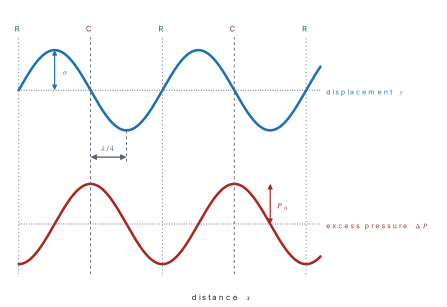
The ear is astonishingly sensitive. At 1 kHz the faintest audible sound has a root-mean-square pressure of only about 2\times10^{-5}\ \text{Pa} — one five-thousand-millionth of atmospheric pressure — which corresponds to a displacement amplitude of roughly 10^{-11}\ \text{m}, smaller than the diameter of an atom.
9.2 Characteristics of sound: intensity, loudness, quality and pitch
A musical note has three characteristics you can hear — loudness, pitch and quality — and each is governed by a measurable physical quantity.
Intensity
The intensity of sound at a point is the energy carried by the wave per second through unit area held perpendicular to the direction of propagation. Its SI unit is the watt per square metre (W m⁻²).
For a plane progressive wave the intensity works out to
So intensity depends on the square of the amplitude and the square of the frequency, and on the medium through \rho v. For a point source radiating power P uniformly in all directions, the energy at distance r is spread over a sphere of area 4\pi r^{2}:
This inverse-square law is why you must stand close to hear a soft speaker.
Intensity level and the decibel
The ear can cope with intensities spanning a factor of 10^{12}, so a logarithmic scale is used. Taking the standard reference I_0 = 10^{-12}\ \text{W m}^{-2} (roughly the threshold of hearing at 1 kHz), the intensity level is
| Sound | I (W m⁻²) | \beta (dB) |
|---|---|---|
| Threshold of hearing | 10^{-12} | 0 |
| Rustling leaves, soft whisper | 10^{-10} | 20 |
| Quiet room at night | 10^{-8} | 40 |
| Normal conversation | 10^{-6} | 60 |
| Busy Kathmandu street | 10^{-4} | 80 |
| Motorcycle horn at 1 m | 10^{-1} | 110 |
| Threshold of pain | 1 | 120 |
Doubling the intensity adds 10\log_{10}2 = 3.0\ \text{dB}; multiplying it by ten adds exactly 10 dB. Doubling the distance from a point source quarters the intensity, so the level falls by 10\log_{10}4 = 6.0\ \text{dB}. These three numbers answer most decibel questions without a calculator.
Loudness
Loudness is the sensation produced in the ear. It grows with intensity, but not in proportion to it: by the Weber–Fechner law the sensation is proportional to the logarithm of the stimulus,
Loudness also depends on frequency — the human ear is most sensitive between about 1 kHz and 5 kHz, so a 100 Hz note and a 3 kHz note of the same intensity do not sound equally loud. Loudness is measured in phon or sone, intensity level in decibels; they are not the same thing.
Two sounds of equal intensity can have very different loudness if their frequencies differ, and a sound can be perfectly measurable yet completely inaudible (an ultrasonic whistle). Never write "loudness = 10\log(I/I_0)" — that is the intensity level.
Pitch
Pitch is the sensation of how high or low a note is, and it is decided by frequency: the higher the frequency, the higher the pitch. A normal human ear responds from about 20 Hz to 20 000 Hz. Below 20 Hz is infrasonic (earthquake waves, elephant calls); above 20 kHz is ultrasonic (bat and dolphin echolocation, medical scanning).
Quality (timbre)
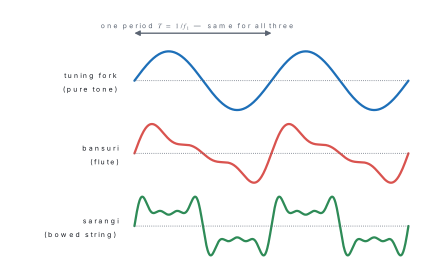
Two instruments playing the same note at the same loudness still sound different. A real instrument produces the fundamental plus a set of overtones, and the number of overtones and their relative intensities decide the shape of the resulting waveform. That shape is the quality or timbre.
| Characteristic | Physical quantity | Depends on |
|---|---|---|
| Loudness | intensity | square of amplitude, 1/r^{2}, sensitivity of ear |
| Pitch | frequency | frequency of the fundamental |
| Quality | waveform | number and relative intensity of overtones |
Problem. A sound wave of frequency 1000 Hz in air has a displacement amplitude of 1.0\times10^{-8}\ \text{m}. Taking \rho = 1.29\ \text{kg m}^{-3} and v = 340\ \text{m s}^{-1}, find (a) the pressure amplitude, (b) the intensity, and (c) the intensity level in decibels.
Solution.
(a) \omega = 2\pi f = 2\pi\times1000 = 6.283\times10^{3}\ \text{rad s}^{-1} and \rho v = 1.29\times340 = 438.6\ \text{kg m}^{-2}\text{s}^{-1}.
(b)
(c)
That is a little under 60 dB — the level of ordinary conversation — produced by air particles moving only a hundredth of a micrometre.
Problem. A small loudspeaker radiates 2.0 W of sound power uniformly in all directions. Find the intensity and the intensity level at 10 m, and the intensity level at 20 m.
Solution. At r = 10\ \text{m},
Doubling the distance to 20 m quarters the intensity, so the level falls by 10\log_{10}4 = 6.0\ \text{dB}:
9.3 Doppler's effect
The apparent change in the frequency of a wave observed when the source, the observer, or both are in motion relative to the medium is called the Doppler effect. The frequency emitted by the source never changes; only the frequency received changes.
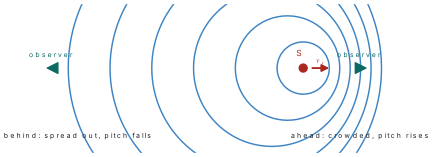
Let the source emit sound of frequency f, let v be the speed of sound in still air, v_s the speed of the source and v_o the speed of the observer.
Case 1: source moving towards a stationary observer. In one period T = 1/f the wave front advances vT but the source itself advances v_sT. The next wave front is therefore emitted from a point closer to the observer, and the waves are packed into a shorter wavelength:
The observer is at rest, so the waves reach her at speed v and
Case 2: observer moving towards a stationary source. Now the wavelength is unchanged, \lambda = v/f, but the observer runs into the waves, so their speed relative to her is v + v_o:
General case. Combining the two,
Use f' = \dfrac{v+v_o}{v-v_s}f always, and fix the signs by asking only one question: does this motion bring them closer?
- Observer moving towards the source: v_o is positive; moving away, negative.
- Source moving towards the observer: v_s is positive; moving away, negative.
Any approach makes the numerator bigger or the denominator smaller, so f'>f. If your answer disagrees with that check, you have a sign wrong.
| Situation | Apparent frequency |
|---|---|
| Source approaches, observer at rest | f' = \dfrac{v}{v-v_s}f |
| Source recedes, observer at rest | f' = \dfrac{v}{v+v_s}f |
| Observer approaches, source at rest | f' = \dfrac{v+v_o}{v}f |
| Observer recedes, source at rest | f' = \dfrac{v-v_o}{v}f |
| Both approach each other | f' = \dfrac{v+v_o}{v-v_s}f |
| Both recede from each other | f' = \dfrac{v-v_o}{v+v_s}f |
When there is no Doppler effect. If the source and observer move with the same velocity in the same direction, their separation is constant and f' = f. If the motion is perpendicular to the line joining them — the instant a train passes you broadside — there is no shift either. And a steady wind produces no change for a stationary source and observer, because it increases the speed of sound and the wavelength in exactly the same proportion.
Applications. Traffic police speed guns and weather radar; SONAR for measuring the speed of a submarine or shoal of fish; Doppler ultrasound (echocardiography) to measure the speed of blood in an artery; and, in astronomy, the red shift of light from distant galaxies, which is the evidence that the universe is expanding.
Problem. A train approaching a station sounds a whistle of frequency 640 Hz while moving at 20\ \text{m s}^{-1}. Taking the speed of sound as 340\ \text{m s}^{-1}, find the frequency heard by a stationary passenger on the platform (a) as the train approaches and (b) after it has passed. What is the change in frequency as the train goes by?
Solution.
(a) Source approaching, observer at rest, so v_s = +20\ \text{m s}^{-1}:
(b) Source receding, so v_s = -20\ \text{m s}^{-1}:
The pitch drops by 680 - 604.4 = 75.6\ \text{Hz} as the train passes — a fall of more than a musical tone, which is exactly what you hear.
Problem. Two vehicles approach each other on the Prithvi Highway. A jeep sounding a horn of frequency 400 Hz travels at 20\ \text{m s}^{-1}; a motorcycle comes towards it at 15\ \text{m s}^{-1}. Taking v = 340\ \text{m s}^{-1}, find the frequency heard by the motorcyclist.
Solution. Both are approaching, so both signs are positive: v_o = +15\ \text{m s}^{-1} and v_s = +20\ \text{m s}^{-1}.
The horn sounds about 44 Hz sharper than it really is.
Chapter summary
- Excess pressure \Delta P = -B\,\partial y/\partial x; the pressure amplitude is P_0 = Bak = \rho v\omega a = 2\pi\rho v f a.
- The pressure wave is \lambda/4 out of phase with the displacement wave: a displacement node is a pressure antinode.
- Intensity I = \frac{1}{2}\rho v\omega^{2}a^{2} = P_0^{2}/2\rho v, in W m⁻²; for a point source I = P/4\pi r^{2}, so I\propto 1/r^{2}.
- Intensity level \beta = 10\log_{10}(I/I_0) dB with I_0 = 10^{-12}\ \text{W m}^{-2}. Doubling I adds 3 dB; doubling the distance subtracts 6 dB.
- Loudness (Weber–Fechner, L = k\log I) is the sensation; pitch is set by frequency; quality is set by the overtones present, i.e. by the waveform.
- Doppler effect: f' = \dfrac{v+v_o}{v-v_s}f, with v_o and v_s counted positive when the motion brings source and observer closer.
- There is no Doppler shift for motion perpendicular to the line of sight, for equal velocities in the same direction, or for a steady wind.
Practice questions
Group A — Multiple choice (1 mark each)
- The pressure amplitude of a sound wave of displacement amplitude a and angular frequency \omega is [1]a\rho v ab\rho v\omega ac\rho v\omega^{2}ad\rho\omega a
- The displacement wave and the pressure wave in air differ in phase by [1]a0b\pi/4c\pi/2d\pi
- If the intensity of a sound is doubled, its intensity level increases by about [1]a2 dBb3 dBc6 dBd10 dB
- The quality of a musical note depends on [1]afrequencybamplitudecnumber and intensity of overtonesdspeed of sound
- A source and an observer move with the same velocity in the same direction. The apparent frequency is [1]agreater than fbless than fcequal to fdzero
Answers to Group A
1. (b) — P_0 = Bak and B=\rho v^{2}, k=\omega/v, giving \rho v\omega a.
2. (c) — \Delta P \propto \cos where y\propto\sin, a quarter cycle apart.
3. (b) — 10\log_{10}2 = 3.0\ \text{dB}.
4. (c) — the harmonic mixture fixes the waveform, and the waveform is the quality.
5. (c) — the separation does not change, so no wavefronts are gained or lost.
Group B — Short answer (5 marks each)
- Show that the pressure amplitude of a sound wave is P_0 = \rho v\omega a and explain why the pressure wave leads the displacement wave by a quarter of a wavelength. [5]
- Distinguish between intensity, intensity level and loudness of sound, giving the unit of each. [5]
- The intensity level of a sound is 70 dB. Find its intensity, and the new intensity level if the intensity is increased 100 times. [5]
- Explain how the pitch and the quality of a note are related to the physical properties of the sound wave. Why do a bansuri and a sarangi sounding the same note sound different? [5]
- A whistle of frequency 500 Hz is sounded on a car moving away from a stationary listener at 25\ \text{m s}^{-1}. Taking v = 340\ \text{m s}^{-1}, find the frequency heard. [5]
Answers to Group B
1. With y = a\sin(\omega t-kx), \Delta P = -B\,\partial y/\partial x = Bak\cos(\omega t-kx), so P_0 = Bak. Using B=\rho v^{2} and k=\omega/v gives P_0 = \rho v\omega a. The cosine leads the sine by \pi/2, which in space is a quarter wavelength.
3. \beta = 10\log_{10}(I/I_0) = 70 gives I/I_0 = 10^{7}, so I = 10^{7}\times10^{-12} = 1.0\times10^{-5}\ \text{W m}^{-2}. Multiplying the intensity by 100 = 10^{2} adds 10\log_{10}10^{2} = 20\ \text{dB}, giving \beta' = 90\ \text{dB}.
5. The source recedes, so v_s = -25\ \text{m s}^{-1}:
The whistle sounds about 34 Hz flatter than it really is.
Group C — Long answer (8 marks each)
- (a) State the Doppler effect and derive an expression for the apparent frequency when both the source and the observer are in motion along the line joining them. [5](b) Give two situations in which there is relative motion but no Doppler shift, and state two practical applications of the effect. [3]
- A point source emits sound uniformly with a power of 0.50 W.(a) Find the intensity and the intensity level at a distance of 5.0 m. [4](b) At what distance does the intensity level fall to 60 dB? [4] (Take I_0 = 10^{-12}\ \text{W m}^{-2}.)
Answer to Group C question 2
(a)
(b) A level of 60 dB means I' = 10^{6}I_0 = 1.0\times10^{-6}\ \text{W m}^{-2}. From I' = P/4\pi r'^{2},
So the level drops from 92 dB to 60 dB — a factor of about 1600 in intensity — between 5 m and about 200 m, exactly as the inverse-square law requires.
Practise more: Physics question bank