Question bank · 78 min read
Chemistry: Unit-wise Objective Question Bank
Group A of the Grade 12 Chemistry paper is eleven one-mark questions, all compulsory, and it is the cheapest part of the paper to win if you practise it the right way. This chapter walks through all twenty-one syllabus units in the order of the CDC curriculum. Every unit opens with a one-table digest of the facts the examiner keeps returning to, then sets a block of multiple-choice questions, and closes with an answer key in which each option is justified in one line — including the wrong-answer trap that the distractors were built to catch.
A tag such as (NEB 2081) or (NEB 2079 model) means that the question, or the same stem on the same topic, was actually set in that board paper or official model paper. Where the original print was garbled in the source we could reach, the options here are re-set but the stem and the answer are unchanged. Untagged questions are new, written to the syllabus and to the same pattern. There is no published per-unit marks grid for Grade 12 Chemistry, so teaching hours are used as a proxy for weight — not as a promise.
Across the papers of 2078 (model) to 2083, the eleven Group A questions come from six families: an equivalent weight or normality calculation; a Ksp, pH or Ka calculation; the order of a reaction from its half-life or rate law; a comparison of E° values; an identification of a transition-metal or heavy-metal fact; and the product of a named organic reaction. Organic chemistry carries 55 of the 128 teaching hours, and about seven of the eleven questions. Do each numerical on paper before you look at the options: the wrong options are built from arithmetic slips, not from ignorance of the chemistry.
5.1 Volumetric Analysis
| Idea | What you must be able to state |
|---|---|
| Equivalent weight | molar mass ÷ n-factor; the n-factor is the H⁺ or OH⁻ replaced, or the electrons exchanged, in that reaction |
| Acid | M ÷ basicity actually used (H₃PO₃ is dibasic; H₃PO₂ is monobasic) |
| Base | M ÷ acidity actually used |
| Salt | M ÷ total positive (or negative) charge |
| Oxidant or reductant | M ÷ electrons gained or lost per formula unit |
| KMnO₄ | 158/5 = 31.6 in acid; 158/3 = 52.7 in neutral or weak alkali; 158/1 = 158 in strong alkali |
| K₂Cr₂O₇ in acid | 294/6 = 49 |
| Oxalic acid crystals, H₂C₂O₄·2H₂O | M = 126, so equivalent weight = 63 |
| Molarity | moles of solute per litre of solution; changes with temperature |
| Molality | moles of solute per kg of solvent; independent of temperature |
| Normality | gram equivalents per litre = molarity × n-factor |
| ppm | mg of solute per kg of solution, which is mg L⁻¹ for dilute aqueous solutions |
| Primary standard | pure, stable, non-hygroscopic, high molar mass, exact formula: oxalic acid crystals, anhydrous Na₂CO₃, K₂Cr₂O₇ |
| Secondary standard | standardised against a primary one: NaOH, HCl, KMnO₄, Na₂S₂O₃ |
| Normality equation | N₁V₁ = N₂V₂ at the end point |
| Indicators | strong acid–strong base: phenolphthalein or methyl orange; strong acid–weak base (Na₂CO₃): methyl orange; weak acid–strong base: phenolphthalein; KMnO₄ is its own indicator |
| Mohr's method | Cl⁻ estimated with standard AgNO₃ and K₂CrO₄ indicator (brick-red Ag₂CrO₄ at the end point) |
- The equivalent weight of H₃PO₃ in the reaction 2NaOH + H₃PO₃ → Na₂HPO₃ + 2H₂O is (NEB 2078 model) [1]a82b41c27.3d20.5
- The normality of a 5 % (w/v) Na₂CO₃ solution, taking Na₂CO₃ as a dibasic base of molar mass 106, is (NEB 2083) [1]a0.94 Nb0.98 Nc0.47 Nd1.88 N
- To estimate chloride ion in tap water by volumetric analysis the standard solution used is (NEB 2082) [1]aBaCl₂bNaOHcK₂CrO₄ alonedAgNO₃
- For the titration of H₂SO₄ against Na₂CO₃ the indicator to be recommended is (NEB model set A) [1]amethyl orangebphenolphthaleinclitmus paperdstarch
- The equivalent weight of K₂Cr₂O₇ (M = 294) acting as an oxidising agent in acidic medium is [1]a294b98c49d42
- The equivalent weight of KMnO₄ (M = 158) in acidic medium is [1]a158b79c52.7d31.6
- A liquor ammonia sample is 25 % (w/w) NH₃ and has specific gravity 0.91. Its molarity is (NEB 2079 model) [1]a13.4 Mb14.7 Mc25 Md6.7 M
- 100 cc of N/2 HCl, 20 cc of N/10 HNO₃ and 50 cc of N/5 H₂SO₄ are mixed. The pH of the mixture is about (NEB model set A) [1]a0.30b0.44c0.56d1.00
- 3.15 g of oxalic acid crystals (H₂C₂O₄·2H₂O) are dissolved to make 500 mL of solution. Its normality is (NEB 2083) [1]a0.05 Nb0.10 Nc0.20 Nd0.50 N
- Which of the following is a primary standard substance? [1]aNaOHbKMnO₄cHCldoxalic acid crystals
- In the titration of oxalic acid against KMnO₄ in acidic medium the indicator is [1]aphenolphthaleinbmethyl orangecKMnO₄ itselfdstarch
- 25.0 mL of 0.100 N HCl exactly neutralises 20.0 mL of NaOH solution. The normality of the alkali is [1]a0.080 Nb0.125 Nc0.200 Nd0.500 N
Answers — Volumetric Analysis
1. (b) — H₃PO₃ is dibasic, and here both replaceable H are used (Na₂HPO₃), so E = 82/2 = 41. Option (a) forgets to divide; (c) divides by 3 because the formula has three H, but one of them is bonded to P and is not acidic.
2. (a) — 5 g per 100 mL = 50 g L⁻¹; equivalent weight = 106/2 = 53; N = 50/53 = 0.94. Option (c) is the molarity (50/106), which forgets the n-factor, and (d) doubles the n-factor.
3. (d) — Cl⁻ + Ag⁺ → AgCl↓. This is precipitation titration (Mohr's method), with K₂CrO₄ only as the indicator, so K₂CrO₄ alone cannot be the titrant.
4. (a) — Na₂CO₃ is a weak base; at complete neutralisation the solution holds H₂CO₃ (pH about 4), which methyl orange signals. Phenolphthalein changes colour at the half-way stage, NaHCO₃, so it would give a wrong end point.
5. (c) — Cr₂O₇²⁻ + 14H⁺ + 6e⁻ → 2Cr³⁺ + 7H₂O takes six electrons, so E = 294/6 = 49. Option (b) uses three electrons, the n-factor of dilute-acid reduction of a different oxidant.
6. (d) — MnO₄⁻ + 8H⁺ + 5e⁻ → Mn²⁺ + 4H₂O, so E = 158/5 = 31.6. Option (c) is the neutral-medium value (three electrons).
7. (a) — M = (10 × 0.91 × 25)/17 = 227.5/17 = 13.4 mol L⁻¹. Option (d) uses 34 as the molar mass, which is 2 × 17.
8. (b) — equivalents = 100 × 0.5 + 20 × 0.1 + 50 × 0.2 = 50 + 2 + 10 = 62 milli-equivalents in 170 mL, so N = 0.3647 and pH = −log 0.3647 = 0.44. Option (c) is the pH if the volumes were forgotten and the three normalities were simply averaged.
9. (b) — E = 126/2 = 63; N = (3.15/63)/0.5 = 0.05/0.5 = 0.10 N. Option (a) forgets that the volume is 0.5 L, not 1 L.
10. (d) — oxalic acid crystals are pure, stable and of exactly known formula. NaOH absorbs CO₂ and water, HCl is volatile, and KMnO₄ is reduced by traces of organic matter, so all three are secondary standards.
11. (c) — one drop of excess MnO₄⁻ makes the solution permanently pink, so KMnO₄ is a self-indicator. The solution is warmed to about 60–70 °C because the first reaction is slow at room temperature, and dilute H₂SO₄ supplies the H⁺ the half-reaction needs.
12. (b) — N₁V₁ = N₂V₂ gives N₂ = (0.100 × 25.0)/20.0 = 0.125 N. Option (a) inverts the ratio of the volumes.
5.2 Ionic Equilibrium
| Idea | What you must be able to state |
|---|---|
| Brønsted–Lowry acid / base | proton donor / proton acceptor; every acid has a conjugate base, and the stronger the acid the weaker its conjugate base |
| Lewis acid / base | electron-pair acceptor (BF₃, AlCl₃, H⁺) / donor (NH₃, OH⁻, H₂O) |
| Ostwald's dilution law | Ka = Cα²/(1 − α) ≈ Cα², so α = √(Ka/C); α rises on dilution; it fails for strong electrolytes |
| Ionic product of water | Kw = [H⁺][OH⁻] = 1 × 10⁻¹⁴ at 25 °C; it increases with temperature, because ionisation is endothermic |
| pH and pOH | pH = −log[H⁺]; pH + pOH = 14 at 25 °C |
| pH of a weak acid | [H⁺] = √(KaC) = Cα |
| Solubility product | AB: Ksp = s²; AB₂ or A₂B: Ksp = 4s³, so s = (Ksp/4)^(1/3) |
| Precipitation rule | precipitate forms when the ionic product exceeds Ksp |
| Common ion effect | adding a common ion lowers the solubility of a sparingly soluble salt and suppresses the ionisation of a weak electrolyte |
| Buffer | pH = pKa + log([salt]/[acid]); resists change on adding small amounts of acid or alkali |
| Indicators | methyl orange (3.1–4.4), methyl red (4.2–6.3), phenolphthalein (8.3–10.0) |
| Salt hydrolysis | strong acid + strong base: neutral; weak acid + strong base: alkaline; strong acid + weak base: acidic |
| Qualitative analysis | group II sulphides need low [S²⁻], so dilute HCl is added; group IV needs high [S²⁻], so NH₄OH/NH₄Cl is added |
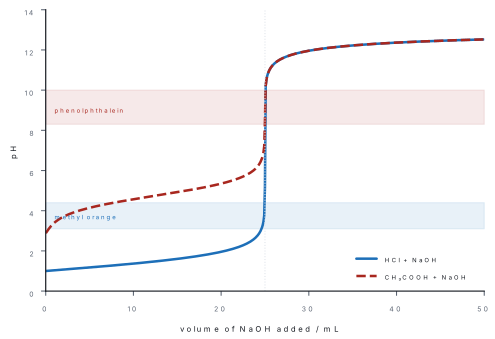
- The pH of 10⁻⁸ M aqueous HCl at 25 °C is (NEB 2079) [1]a8b7cslightly less than 7dmore than 8
- Equal volumes of 1 M NaNO₃ and 1 M KCl are mixed. The concentration of nitrate ions in the mixture is (NEB 2079) [1]a0.25 Mb0.5 Mc1 Md2 M
- The ionic product of water at 393 K is (NEB 2083) [1]agreater than 1 × 10⁻¹⁴bless than 1 × 10⁻¹⁴cequal to 1 × 10⁻¹⁴dequal to 1 × 10⁻⁷
- The pH of 10 mL of 1 × 10⁻⁷ M H₂SO₄ at 25 °C is (NEB model set B) [1]aexactly 7.00b6.62c7.30d6.70
- The solubility product of chalk (CaCO₃, M = 100) is 9.3 × 10⁻⁸. Its solubility is about (NEB 2078 model) [1]a3.05 × 10⁻⁴ g L⁻¹b3.05 × 10⁻² g L⁻¹c9.3 × 10⁻⁸ g L⁻¹d0.93 g L⁻¹
- For a sparingly soluble salt A₂B the solubility s is related to Ksp by (NEB model set A) [1]as = Ksp^(1/2)bs = (Ksp/2)^(1/3)cs = (Ksp/4)^(1/3)ds = (Ksp/27)^(1/4)
- The degree of ionisation of 0.01 M HCN (Ka = 4.8 × 10⁻¹⁰) is (NEB 2082) [1]a2.2 × 10⁻⁴b4.8 × 10⁻⁸c2.2 × 10⁻²d6.9 × 10⁻⁶
- A 0.1 M solution of ethanoic acid is 1.34 % ionised. Its dissociation constant is (NEB 2079 model) [1]a1.8 × 10⁻⁵b1.34 × 10⁻³c1.8 × 10⁻³d1.34 × 10⁻⁵
- A solution of KOH has pH 8. It is diluted 1000 times. The pH of the diluted solution is (NEB 2078 model) [1]a5b11c8djust above 7
- A buffer contains 0.2 M ethanoic acid and 0.1 M sodium ethanoate (pKa = 4.74). Its pH is [1]a4.74b5.04c4.44d4.14
- The conjugate base of H₂PO₄⁻ is [1]aH₃PO₄bHPO₄²⁻cPO₄³⁻dOH⁻
- Equal volumes of 2 × 10⁻⁴ M BaCl₂ and 2 × 10⁻⁴ M Na₂SO₄ are mixed (Ksp of BaSO₄ = 1 × 10⁻¹⁰). A precipitate [1]aforms, because the ionic product is 1 × 10⁻⁸bdoes not form, because the ionic product is 4 × 10⁻⁸cdoes not form, because both salts are solubledforms only on heating
- The aqueous solution of sodium ethanoate is [1]aacidicbalkalinecneutraldamphoteric
Answers — Ionic Equilibrium
1. (c) — the acid contributes 10⁻⁸ M H⁺, but water supplies about 9.5 × 10⁻⁸ M more, so [H⁺] = 1.05 × 10⁻⁷ and pH = 6.98. An acid can never give a pH of 8, which is the trap in option (a).
2. (b) — mixing doubles the volume and NaNO₃ is diluted from 1 M to 0.5 M. Neither KCl nor the spectator ions contribute nitrate. Option (c) forgets the dilution.
3. (a) — ionisation of water is endothermic, so Kw rises with temperature (about 3.8 × 10⁻¹³ at 100 °C). Kw = 10⁻¹⁴ is valid only at 25 °C.
4. (b) — [H⁺] from the acid is 2 × 10⁻⁷ and water adds a little more: [H⁺]² − 2 × 10⁻⁷[H⁺] − 10⁻¹⁴ = 0, so [H⁺] = 2.41 × 10⁻⁷ and pH = 6.62. Option (a) ignores the fact that H₂SO₄ gives two H⁺.
5. (b) — s = √(9.3 × 10⁻⁸) = 3.05 × 10⁻⁴ mol L⁻¹; multiplying by M = 100 gives 3.05 × 10⁻² g L⁻¹. Option (a) stops at mol L⁻¹.
6. (c) — A₂B gives 2s of A⁺ and s of B²⁻, so Ksp = (2s)²(s) = 4s³.
7. (a) — α = √(Ka/C) = √(4.8 × 10⁻¹⁰/0.01) = √(4.8 × 10⁻⁸) = 2.2 × 10⁻⁴. Option (c) uses √Ka alone.
8. (a) — Ka ≈ Cα² = 0.1 × (0.0134)² = 1.8 × 10⁻⁵. Option (d) squares only part of the expression.
9. (d) — 10⁻⁶ M OH⁻ becomes 10⁻⁹ M, which is far below the 10⁻⁷ M that water itself supplies, so the solution is essentially neutral: [OH⁻] = 1.005 × 10⁻⁷, pH = 7.002. A base can never be diluted into an acid (option a).
10. (c) — pH = 4.74 + log(0.1/0.2) = 4.74 − 0.30 = 4.44. Option (b) inverts the ratio of salt to acid.
11. (b) — the conjugate base is formed by removing one proton: H₂PO₄⁻ → HPO₄²⁻ + H⁺. Option (a) is the conjugate acid.
12. (a) — after mixing, [Ba²⁺] = [SO₄²⁻] = 1 × 10⁻⁴ M, so Qsp = 10⁻⁸ > 10⁻¹⁰ and BaSO₄ precipitates. Option (b) forgets to halve each concentration.
13. (b) — CH₃COO⁻ + H₂O ⇌ CH₃COOH + OH⁻; the salt of a weak acid and a strong base hydrolyses to an alkaline solution.
5.3 Chemical Kinetics
| Idea | What you must be able to state |
|---|---|
| Rate law | determined experimentally; it is never read off the balanced equation |
| Order | sum of the powers of concentration in the experimental rate law; can be 0, fractional or negative |
| Molecularity | number of species colliding in one elementary step; always 1, 2 or 3 — never zero or fractional |
| 2N₂O₅ → 4NO₂ + O₂ | rate = k[N₂O₅]: first order, although the coefficient is 2 |
| 2HI → H₂ + I₂ (on gold) | zero order, although two molecules react |
| Unit of k, zero order | mol L⁻¹ s⁻¹ |
| Unit of k, first order | s⁻¹ (independent of concentration unit) |
| Unit of k, second order | L mol⁻¹ s⁻¹ |
| First-order integrated form | k = (2.303/t) log(a/(a−x)) |
| First-order half-life | t½ = 0.693/k — independent of initial concentration |
| Zero-order half-life | t½ = a/2k — proportional to initial concentration |
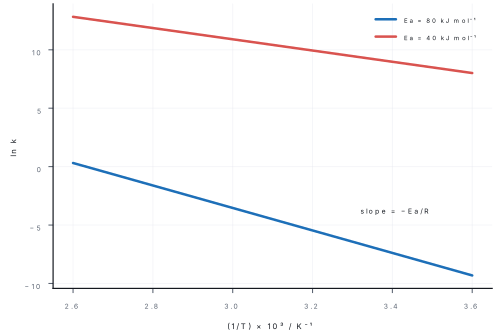
| Arrhenius equation | k = Ae^(−Ea/RT); ln k against 1/T is a straight line of slope −Ea/R |
| Temperature coefficient | rate roughly doubles for each 10 °C rise |
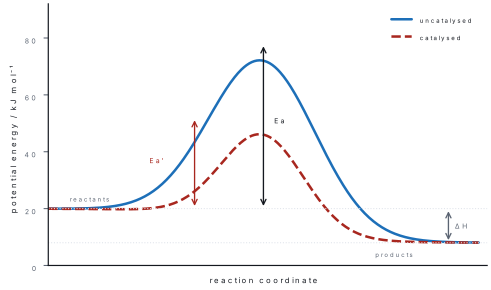
| Catalyst | lowers Ea by offering a new path; does not change ΔH, ΔG or K |
| Activated complex | the highest-energy arrangement at the top of the barrier |
| Homogeneous / heterogeneous / enzyme | NO + O₂ with NO₂; Haber process on Fe; sucrase on sucrose |
- The rate of a reaction doubles for every 10 °C rise in temperature. The rate at 100 °C compared with that at 10 °C is greater by a factor of (NEB 2079 model) [1]a128b256c512d1024
- For a first-order reaction the rate is 2.4 × 10⁻⁵ mol L⁻¹ s⁻¹ when the rate constant is 3.0 × 10⁻⁵ s⁻¹. The concentration of the reactant is (NEB 2078 model) [1]a0.8 mol L⁻¹b1.25 mol L⁻¹c0.4 mol L⁻¹d8.0 mol L⁻¹
- For a certain reaction the rate is equal to the rate constant. The order of the reaction is (NEB 2081) [1]azerobonectwodthree
- The half-life of a reaction is 50 s and does not depend on the initial concentration. The reaction is of (NEB 2082) [1]azero orderbfirst ordercsecond orderdthird order
- For 2N₂O₅ → 4NO₂ + O₂ the experimental rate law is rate = k[N₂O₅]. The order is [1]a0b1c2d3
- Which of the following can never be zero or fractional? [1]aorderbmolecularitycratedrate constant
- The unit of the rate constant of a second-order reaction is [1]as⁻¹bmol L⁻¹ s⁻¹cL mol⁻¹ s⁻¹dL² mol⁻² s⁻¹
- In the energy-profile diagram above, a catalyst changes [1]aΔH onlybEa onlycboth Ea and ΔHdneither
- In the Arrhenius plot of ln k against 1/T, the slope is [1]a−Ea/RbEa/Rc−Ea/2.303Rdln A
- A first-order reaction is 50 % complete in 10 s. The time for it to be 90 % complete is about [1]a18 sb20 sc33 sd50 s
- The action of sucrase on sucrose is an example of [1]ahomogeneous catalysisbheterogeneous catalysiscenzyme catalysisdautocatalysis
Answers — Chemical Kinetics
1. (c) — the rise is 90 °C, that is nine steps of 10 °C, so the factor is 2⁹ = 512. Option (d) comes from counting ten steps instead of nine.
2. (a) — rate = k[A], so [A] = 2.4 × 10⁻⁵ / 3.0 × 10⁻⁵ = 0.8 mol L⁻¹.
3. (a) — rate = k[A]⁰ = k only when the exponent is zero; the rate is then independent of concentration.
4. (b) — only for first order is t½ = 0.693/k, with no concentration term. For zero order t½ ∝ a and for second order t½ ∝ 1/a.
5. (b) — order comes from the experimental rate law, not from the balancing coefficients. Option (c) is the classic error of reading the 2 in 2N₂O₅ as the order.
6. (b) — molecularity counts the molecules colliding in a single elementary step, so it must be a whole number 1, 2 or 3. Order is an experimental quantity and may be zero or fractional.
7. (c) — the general unit is mol^(1−n) L^(n−1) s⁻¹; putting n = 2 gives L mol⁻¹ s⁻¹.
8. (b) — a catalyst opens a lower-energy route, lowering Ea in both directions, but reactants and products are unchanged so ΔH, ΔG and K are untouched.
9. (a) — ln k = ln A − Ea/RT. Option (c) would be the slope of a log₁₀ k plot.
10. (c) — k = 0.693/10 = 0.0693 s⁻¹, and t = (2.303/k) log 10 = 2.303/0.0693 = 33.2 s. It is not simply 5 × t½.
11. (c) — sucrase is an enzyme, a biological catalyst; the substrate must fit its active site.
5.4 Thermodynamics
| Statement | Form / value |
|---|---|
| First law | ΔU = q + w (w is work done on the system) |
| Isochoric process | ΔV = 0, so w = 0 and q(v) = ΔU |
| Isobaric process | q(p) = ΔH |
| Adiabatic process | q = 0, so ΔU = w |
| Isothermal process | ΔT = 0, so ΔU = 0 and q = −w |
| Cyclic process | ΔU = 0 and ΔH = 0 (both are state functions) |
| Free expansion into vacuum | p(ext) = 0, so w = 0 |
| Relation of ΔH and ΔU | ΔH = ΔU + Δn(g)RT |
| Exothermic reaction | ΔH negative; heat leaves the system |
| Endothermic reaction | ΔH positive; heat enters the system |
| Hess's law | ΔH of a reaction is the same by any route |
| Enthalpy of neutralisation, strong acid + strong base | −57.1 kJ mol⁻¹ (always, because it is really H⁺ + OH⁻ → H₂O) |
| Second law | entropy of the universe increases in every spontaneous change |
| Entropy order | S(gas) > S(liquid) > S(solid) |
| Gibbs equation | ΔG = ΔH − TΔS |
| Spontaneity criterion | ΔG < 0 spontaneous; ΔG = 0 equilibrium; ΔG > 0 non-spontaneous |
| ΔH −, ΔS + | spontaneous at all temperatures |
| ΔH +, ΔS − | non-spontaneous at all temperatures |
| ΔG° and K | ΔG° = −2.303RT log K; K > 1 needs ΔG° negative |
- Given C(s) + O₂(g) → CO₂(g), ΔH = −x kJ and CO(g) + ½O₂(g) → CO₂(g), ΔH = −y kJ, the enthalpy of formation of CO is (NEB 2079 model) [1]a(x + y) kJb(y − x) kJc(x − y) kJd(2x − y) kJ
- According to the Gibbs–Helmholtz equation, a process is spontaneous when (NEB 2082) [1]aΔG is positivebΔG is negativecΔG is zerodΔH is negative
- For a reaction at equilibrium, [1]aΔG = 0bΔG° = 0cΔH = 0dΔS = 0
- For an endothermic reaction [1]aΔH is negativebΔH is positivecΔU is zerodq is negative
- The heat absorbed by a system at constant volume is equal to [1]aΔHbΔUcΔGdΔS
- In an adiabatic process [1]aq = 0bw = 0cΔT = 0dΔU = 0
- For a cyclic process the change in internal energy is [1]aalways positivebalways negativeczerodequal to q
- The law that allows an unmeasurable enthalpy change to be obtained by adding known ones is [1]aHess's lawbLaplace's lawcfirst lawdRaoult's law
- Which has the highest entropy per mole? [1]aicebwatercsteamddry ice
- A reaction with ΔH negative and ΔS positive is [1]aspontaneous at all temperaturesbspontaneous only at low Tcspontaneous only at high Tdnever spontaneous
- If the equilibrium constant of a reaction is greater than 1, then ΔG° is [1]apositivebnegativeczerodequal to ΔH°
- The enthalpy of neutralisation of HCl by NaOH is −57.1 kJ mol⁻¹. For HNO₃ and KOH it is [1]a−57.1 kJ mol⁻¹b−114.2 kJ mol⁻¹c−28.5 kJ mol⁻¹dless negative
- The work done when a gas expands into a vacuum is [1]amaximumbzerocinfinitedequal to −ΔU
Answers — Thermodynamics
1. (b) — reverse the second equation and add it to the first: C + O₂ → CO₂ (−x) plus CO₂ → CO + ½O₂ (+y) gives C + ½O₂ → CO, so ΔHf = (y − x) kJ. Option (a) is the trap of adding the two combustion enthalpies instead of subtracting.
2. (b) — spontaneity is decided by the sign of ΔG at the actual conditions. Option (d) is the common trap: an exothermic reaction can still be non-spontaneous if TΔS opposes it strongly enough.
3. (a) — at equilibrium ΔG = 0. ΔG° is a fixed number for the standard state and equals −2.303RT log K, which is zero only in the special case K = 1.
4. (b) — the system absorbs heat, so its enthalpy rises and ΔH > 0. Sign conventions are worth one mark almost every year.
5. (b) — at constant volume no expansion work is done, so all the heat goes into internal energy.
6. (a) — "adiabatic" means no heat crosses the boundary; work may still be done, so ΔU is not zero.
7. (c) — internal energy is a state function and the system returns to its initial state.
8. (a) — Hess's law of constant heat summation, a direct consequence of enthalpy being a state function.
9. (c) — gases have far more positional and thermal disorder than liquids or solids. Dry ice is solid CO₂.
10. (a) — ΔG = ΔH − TΔS is negative for every T when ΔH < 0 and ΔS > 0.
11. (b) — from ΔG° = −2.303RT log K, log K > 0 requires ΔG° < 0.
12. (a) — both are strong acid plus strong base, so the reaction is the same one, H⁺ + OH⁻ → H₂O.
13. (b) — work = −p(ext)ΔV and the external pressure is zero, so no work is done however large the expansion.
5.5 Electrochemistry
| Item | Value or rule |
|---|---|
| Li⁺/Li | −3.05 V (strongest reducing metal in the table) |
| Zn²⁺/Zn | −0.76 V |
| Fe²⁺/Fe | −0.44 V |
| 2H⁺/H₂ (SHE) | 0.00 V by definition, at 1 M H⁺, 1 bar H₂, 298 K, Pt black |
| Cu²⁺/Cu | +0.34 V |
| Fe³⁺/Fe²⁺ | +0.77 V |
| Ag⁺/Ag | +0.80 V |
| F₂/F⁻ | +2.87 V (strongest oxidising agent) |
| More negative E° | better reducing agent, more reactive metal, displaces metals below it |
| Saturated calomel electrode | +0.242 V (1.0 M KCl +0.280 V; 0.1 M KCl +0.334 V) |
| Galvanic cell | anode negative, oxidation; cathode positive, reduction; ΔG negative |
| Electrolytic cell | anode positive, oxidation; cathode negative, reduction |
| Cell notation | anode ǀ anode solution ǁ cathode solution ǀ cathode (oxidation on the left) |
| E°cell | E°cathode − E°anode |
| Zn–Cu cell | 0.34 − (−0.76) = 1.10 V |
| Cu–Ag cell | 0.80 − 0.34 = 0.46 V |
| Free energy | ΔG° = −nFE°cell ; F = 96500 C mol⁻¹ |
| Nernst (298 K) | E = E° − (0.0591/n) log Q |
| Leclanché dry cell | ≈1.5 V, Zn anode, MnO₂/C cathode, not rechargeable |
| Lead storage battery | 2.0 V per cell, Pb anode, PbO₂ cathode, 38 % H₂SO₄; both plates become PbSO₄ on discharge |
| Ni–Cd cell | ≈1.2 V, rechargeable |
| H₂–O₂ fuel cell | product is water only; KOH electrolyte, porous carbon with Pt/Pd |
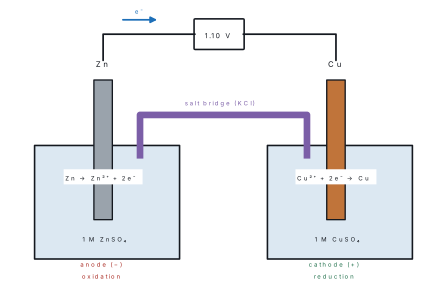
- Four metals P, Q, R and S have standard electrode potentials −0.76 V, +0.34 V, −2.71 V and +0.80 V respectively. The correct order of decreasing reactivity is (NEB 2081) [1]aS > Q > P > RbP > R > Q > ScR > P > Q > SdQ > S > R > P
- The standard electrode potentials of four elements are +0.34 V, −0.76 V, 0.00 V and −3.05 V. The order of decreasing reducing power is (NEB 2082) [1]a+0.34 > 0.00 > −0.76 > −3.05b−3.05 > −0.76 > 0.00 > +0.34c0.00 > +0.34 > −0.76 > −3.05d−0.76 > −3.05 > 0.00 > +0.34
- When a lead storage battery is discharged, [1]aH₂SO₄ is producedbPbSO₄ forms on both electrodescPb is depositeddthe density of the acid rises
- In a galvanic cell the anode is [1]apositive and the site of reductionbnegative and the site of oxidationcpositive and the site of oxidationdnegative and the site of reduction
- The standard electrode potential of the standard hydrogen electrode is [1]ameasured as 0.00 Vbfixed at 0.00 V by conventionc+0.76 Vdtemperature-dependent
- The standard emf of the cell Cu ǀ Cu²⁺ ǁ Ag⁺ ǀ Ag is [1]a0.46 Vb1.14 Vc1.10 Vd1.26 V
- The relation between standard free energy change and standard cell potential is [1]aΔG° = nFE°bΔG° = −nFE°cΔG° = −E°/nFdΔG° = nF/E°
- If the concentration of Zn²⁺ in the Daniell cell is increased, the cell potential [1]aincreasesbdecreasescis unchangeddbecomes zero
- The calomel electrode is used as [1]aa primary reference electrodeba secondary reference electrodecan indicator electrodeda gas electrode
- In a hydrogen–oxygen fuel cell the only product is [1]aCO₂bH₂OcH₂O₂dKOH
- If the half-reaction Ag⁺ + e⁻ → Ag is multiplied by 2, its E° value [1]adoublesbhalvescremains +0.80 Vdchanges sign
Answers — Electrochemistry
1. (c) — the more negative the reduction potential, the more readily the metal is oxidised, so reactivity falls as E° rises: R (−2.71) > P (−0.76) > Q (+0.34) > S (+0.80). Option (a) is the same list read the wrong way round, which is the usual slip.
2. (b) — reducing power increases as E° becomes more negative, so the most negative value heads the list.
3. (b) — discharge is Pb + PbO₂ + 2H₂SO₄ → 2PbSO₄ + 2H₂O: sulphuric acid is consumed and its density falls, which is why the acid density is used to test the state of charge.
4. (b) — in a galvanic cell electrons are pushed out of the anode, making it the negative terminal. In electrolysis the anode is connected to the positive terminal of the supply; oxidation still happens there, but the sign flips. This sign reversal is the single most-missed point in the unit.
5. (b) — it is an arbitrary zero assigned by agreement, not a measured quantity; all other potentials are measured against it.
6. (a) — E°cell = E°cathode − E°anode = 0.80 − 0.34 = 0.46 V. Option (c) is the Zn–Cu value.
7. (b) — the negative sign makes a positive cell potential correspond to a spontaneous reaction.
8. (b) — from the Nernst equation E = 1.10 − (0.0591/2) log([Zn²⁺]/[Cu²⁺]); raising the product-ion concentration lowers E.
9. (b) — it is a calibrated, easily maintained electrode whose potential (+0.242 V saturated) is known relative to SHE, which is the primary standard.
10. (b) — H₂ and O₂ combine to give only water, which is why fuel cells are attractive for pollution-free power.
11. (c) — electrode potential is an intensive property; it does not scale with the amount of substance, although ΔG° = −nFE° does.
"All transition metals and their compounds are coloured" is false, and zinc is not a transition element at all. Colour needs partially filled d orbitals for a d–d transition, so Sc³⁺ (3d⁰), Ti⁴⁺ (3d⁰), Cu⁺ (3d¹⁰) and Zn²⁺ (3d¹⁰) are all colourless. Zn, Cd and Hg have a complete d¹⁰ shell in the atom and in every stable ion they form, so by the IUPAC definition they are not transition elements — they sit in the d block but are not of it.
5.6 Transition Metals
| Point | Fact |
|---|---|
| General configuration | (n−1)d¹⁻¹⁰ ns¹⁻² |
| Definition | an element with an incompletely filled d subshell in the atom or in one of its stable ions |
| Zn, Cd, Hg | d¹⁰ in atom and ion → d-block but not transition metals |
| Anomalous configurations | Cr = 3d⁵4s¹, Cu = 3d¹⁰4s¹ (half-filled and filled sets are extra stable) |
| Highest oxidation state in the 3d series | +7, shown by manganese in KMnO₄ |
| Why variable oxidation states | (n−1)d and ns energies are close, so both sets of electrons are available |
| Why good catalysts | variable oxidation states and the ability to adsorb reactants on partly filled d orbitals |
| Source of colour | d–d electronic transition in a partly filled d subshell |
| Colourless ions | Sc³⁺, Ti⁴⁺, Cu⁺, Zn²⁺, Ag⁺ (all d⁰ or d¹⁰) |
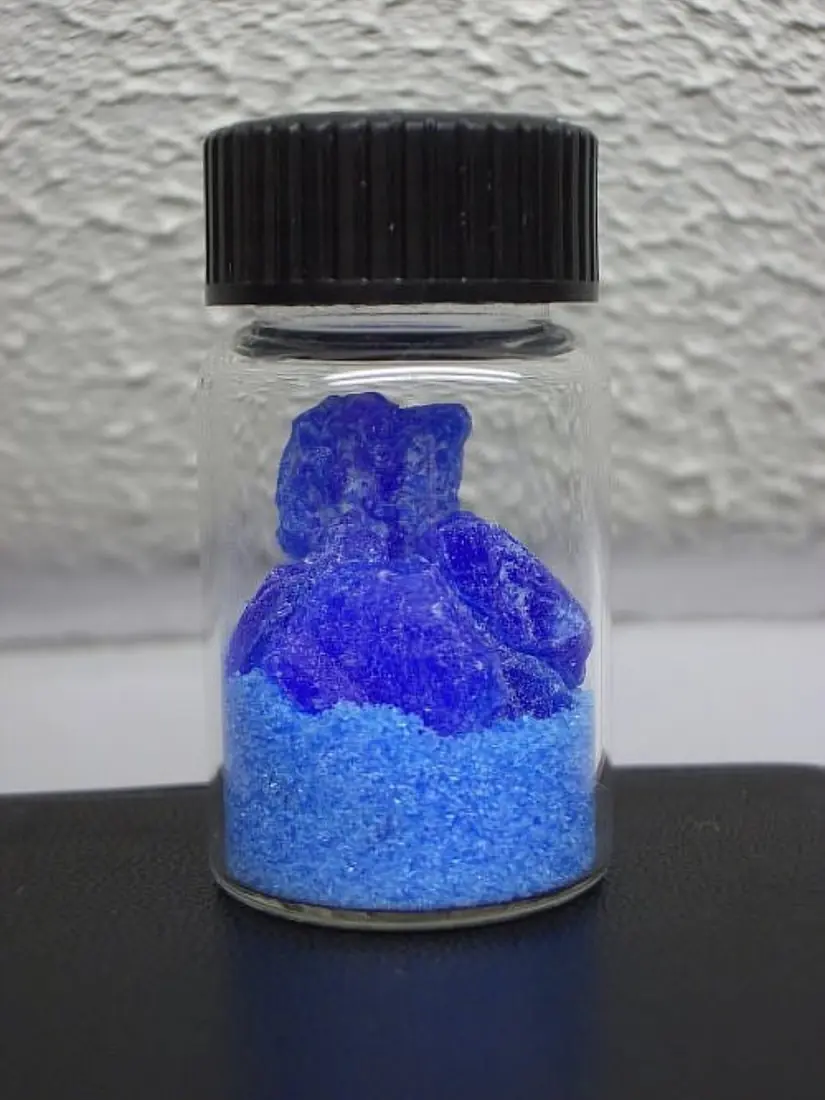
| Cu²⁺ | blue · Ni²⁺ green · Fe²⁺ pale green · Fe³⁺ yellow-brown · Mn²⁺ light pink · Cr³⁺ green |
| Ligand | a species with at least one lone pair that donates it to the central metal ion |
| Coordination number 6 | octahedral, d²sp³ or sp³d² |
| Coordination number 4 | tetrahedral (sp³) or square planar (dsp²) |
| [Ni(CN)₄]²⁻ | square planar, dsp², diamagnetic |
| [NiCl₄]²⁻ | tetrahedral, sp³, paramagnetic |
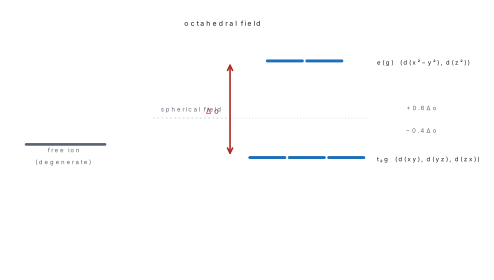
| Crystal field theory (octahedral) | the five d orbitals split into lower t₂g (3) and upper e(g) (2), separated by Δo |
| Strong-field ligands | CN⁻ > NO₂⁻ > NH₃ > H₂O > OH⁻ > F⁻ > Cl⁻ > Br⁻ > I⁻ (spectrochemical series) |
- The general electronic configuration of transition elements is (NEB 2078 model) [1]ans¹⁻²b(n−1)d¹⁻¹⁰ ns¹⁻²c(n−2)f¹⁻¹⁴ ns²dns² np¹⁻⁶
- Transition metals are good catalysts mainly because they (NEB 2081) [1]aare hard and densebshow variable oxidation states and have partly filled d orbitalschave high melting pointsdform coloured compounds
- Which ion imparts a green colour to its salts? (NEB 2081) [1]aZn²⁺bNi²⁺cSc³⁺dAg⁺
- The maximum oxidation state exhibited in the 3d transition series is (NEB 2082) [1]a+5b+6c+7d+8
- Which of the following ions is colourless in aqueous solution? [1]aCu²⁺bFe³⁺cZn²⁺dMn²⁺
- Zinc is not regarded as a transition element because [1]ait is softbit has a completely filled d subshell in the atom and in Zn²⁺cit is not a metaldit forms no compounds
- In an octahedral complex the d orbitals split into [1]atwo lower and three upperbthree lower and two uppercone lower and four upperdthey do not split
- The shape and hybridisation of [Ni(CN)₄]²⁻ are [1]atetrahedral, sp³bsquare planar, dsp²coctahedral, d²sp³dlinear, sp
Answers — Transition Metals
1. (b) — the d subshell of the penultimate shell is being filled while the outermost s holds one or two electrons. Option (c) is the configuration of the f-block.
2. (b) — variable oxidation states let the metal form unstable intermediates, and partly filled d orbitals let reactants adsorb on the surface. Colour (d) is a consequence of the same d orbitals, not the cause of catalysis.
3. (b) — Ni²⁺ is 3d⁸, partly filled, and absorbs in the red, appearing green. Zn²⁺, Sc³⁺ and Ag⁺ are all d¹⁰ or d⁰ and colourless.
4. (c) — manganese, 3d⁵4s², can lose all seven outer electrons, as in KMnO₄ and Mn₂O₇.
5. (c) — Zn²⁺ is 3d¹⁰, with no vacancy for a d–d transition. "All transition-metal ions are coloured" is the misconception this question is built on.
6. (b) — a transition element must have an incompletely filled d subshell in the atom or in a stable ion; zinc has neither.
7. (b) — the three t₂g orbitals lie between the axes and are stabilised by 0.4Δo, while the two e(g) orbitals point at the ligands and are raised by 0.6Δo.
8. (b) — CN⁻ is a strong-field ligand, so the 3d⁸ electrons pair up, freeing one 3d orbital for dsp² hybridisation; the ion is square planar and diamagnetic. With the weak-field Cl⁻ the same metal gives tetrahedral [NiCl₄]²⁻.
5.7 Studies of Heavy Metals
| Metal | Chief ores | Extraction route |
|---|---|---|
| Copper | copper pyrite CuFeS₂, cuprite Cu₂O (red), malachite CuCO₃·Cu(OH)₂ (green), azurite 2CuCO₃·Cu(OH)₂ (blue) | froth flotation → roasting → smelting to matte (Cu₂S + FeS) → bessemerisation → blister copper → electrolytic refining |
| Zinc | zinc blende ZnS, calamine ZnCO₃, zincite ZnO | froth flotation → roasting → reduction of ZnO with coke at 1673 K → distillation |
| Mercury | cinnabar HgS (bright red) | froth flotation → roasting in air, self-reduction: HgS + O₂ → Hg + SO₂ |
| Iron | haematite Fe₂O₃, magnetite Fe₃O₄, siderite FeCO₃, iron pyrite FeS₂ | blast furnace with coke and limestone; slag CaSiO₃ |
| Silver | argentite Ag₂S, horn silver AgCl | MacArthur–Forrest cyanide process; Ag recovered by adding zinc dust |
| Compound or test | Fact |
|---|---|
| Blue vitriol | CuSO₄·5H₂O — 100 °C gives the pale-blue monohydrate, 230 °C the white anhydrous salt, 720 °C black CuO |
| Red oxide / black oxide of copper | Cu₂O (cuprous oxide) / CuO (cupric oxide) |
| CuSO₄ + excess NH₄OH | deep blue [Cu(NH₃)₄]SO₄, tetraamminecopper(II) sulphate |
| CuSO₄ + KI | white Cu₂I₂ with brown iodine (Cu²⁺ oxidises I⁻) |
| Cu²⁺ + H₂S | black CuS |
| White vitriol | ZnSO₄·7H₂O |
| Philosopher's wool / Chinese white | ZnO — yellow when hot, white when cold |
| Zn + NaOH | Na₂ZnO₂ (sodium zincate) + H₂ — zinc is amphoteric |
| Calomel Hg₂Cl₂ | white, insoluble, non-poisonous, used in medicine; turns black with NH₃ |
| Corrosive sublimate HgCl₂ | white, soluble, violently poisonous; with NH₃ gives white Hg(NH₂)Cl |
| HgCl₂ + SnCl₂ (limited) | white Hg₂Cl₂; with excess SnCl₂ a grey deposit of Hg |
| HgCl₂ + KI (limited) | scarlet HgI₂; with excess KI, soluble K₂[HgI₄] (Nessler's reagent) |
| Blast-furnace slag | CaO + SiO₂ → CaSiO₃ |
| Iron and conc. HNO₃ | passivity — a thin oxide film stops further attack |
| Cast iron / wrought iron / steel | about 4 % C / under 0.25 % C / 0.25–2 % C |
| Steel making | Basic Oxygen (LD) process: O₂ blown at 1700 °C, about 40 min; Open Hearth: 8–10 h |
| Rust | hydrated ferric oxide Fe₂O₃·xH₂O; needs both air and water |
| Galvanising | zinc coating; zinc is anodic to iron so it corrodes first (sacrificial protection) |
| Lunar caustic | AgNO₃ |
| AgNO₃ + K₂CrO₄ | brick-red Ag₂CrO₄ (the end-point in Mohr's method) |
| Tollens' reagent | AgNO₃ + NaOH, then ammonia until the brown precipitate just dissolves: [Ag(NH₃)₂]OH |
- Which ore is concentrated by the froth flotation process? (NEB 2078 model) [1]ahaematitebzinc blendecbauxitedlimestone
- The Bessemer converter is used in the extraction of copper for (NEB 2079 model) [1]aconcentrating copper pyritebconverting copper matte into blister coppercroasting zinc blendedelectrolytic refining of copper
- The deep blue solution formed when excess NH₄OH is added to aqueous CuSO₄ contains (NEB 2082) [1]aCu(OH)₂b[Cu(NH₃)₄]SO₄cCuCl₂dCu₂O
- The chief ore of copper is [1]acupritebmalachiteccopper pyritedazurite
- Blue vitriol heated to 230 °C gives [1]aa white solidba black solidca red solidda green solid
- The red oxide of copper is [1]aCuObCu₂OcCuCO₃dCu(OH)₂
- The formula of zinc blende is [1]aZnCO₃bZnOcZnSdZnSO₄·7H₂O
- White vitriol is [1]aZnSO₄·7H₂ObFeSO₄·7H₂OcCuSO₄·5H₂OdNa₂SO₄·10H₂O
- Philosopher's wool is [1]aZnSbZnOcZnCl₂dZn(OH)₂
- Zinc dissolves in hot concentrated NaOH giving [1]aZnO and H₂Obsodium zincate and H₂cZnCl₂ and H₂dno reaction
- Cinnabar is the ore of [1]azincbsilvercmercurydcopper
- Which pair is correctly described? [1]aHg₂Cl₂, poisonousbHgCl₂, non-poisonouscHg₂Cl₂, non-poisonousdboth are non-poisonous
- Corrosive sublimate treated with excess KI solution gives [1]ascarlet HgI₂bK₂[HgI₄]cHg₂I₂dHgO
- Corrosive sublimate with a limited amount of SnCl₂ gives a [1]awhite precipitatebgrey precipitatecblack precipitatedyellow precipitate
- The chief ore of iron is [1]asideritebhaematiteciron pyritedmagnetite
- The slag formed in the blast furnace is [1]aCaObSiO₂cCaSiO₃dFeSiO₃
- Iron becomes passive with concentrated HNO₃ because [1]ano reaction occursba protective oxide layer formsciron nitrate is insolubledHNO₃ is a weak acid
- The carbon content of wrought iron is about [1]a4 %b2 %c0.8 %d0.2 %
- Iron is protected from rusting by coating it with zinc because zinc [1]ais cheaperbis more electropositive and corrodes firstcis harderddoes not conduct
- In the cyanide process, silver is precipitated from its complex by adding [1]acopperbzinc dustciron filingsdlead
- Silver nitrate solution added to potassium chromate gives a precipitate that is [1]awhitebyellowcbrick-reddblack
- Tollens' reagent is obtained when AgNO₃ solution is treated with [1]adilute HClbexcess ammonia solutioncNaCl solutiondKI solution
Answers — Studies of Heavy Metals
1. (b) — froth flotation works on sulphide ores, whose surfaces are wetted by oil rather than water. Haematite (oxide) is concentrated magnetically or by washing.
2. (b) — hot air blown through molten matte oxidises FeS to slag and then Cu₂S to blister copper: 2Cu₂S + 3O₂ → 2Cu₂O + 2SO₂, then 2Cu₂O + Cu₂S → 6Cu + SO₂.
3. (b) — ammonia first precipitates Cu(OH)₂, which then dissolves in excess ammonia as the deep blue tetraammine complex.
4. (c) — CuFeS₂ supplies most of the world's copper; the others are minor ores.
5. (a) — all five water molecules are lost by 230 °C, leaving white anhydrous CuSO₄. Black CuO needs about 720 °C.
6. (b) — cuprous oxide is red; cupric oxide CuO is black.
7. (c) — zinc blende is the sulphide; ZnCO₃ is calamine and ZnO is zincite.
8. (a) — "white vitriol" is the zinc salt; green vitriol is FeSO₄·7H₂O and blue vitriol is CuSO₄·5H₂O.
9. (b) — zinc oxide, which sublimes as a woolly white mass; it is yellow while hot and white on cooling.
10. (b) — Zn + 2NaOH → Na₂ZnO₂ + H₂↑; zinc reacts with both acids and alkalis because it is amphoteric.
11. (c) — HgS, bright red, roasted in air to give the metal directly.
12. (c) — calomel Hg₂Cl₂ is insoluble and harmless enough to have been used medicinally, while the soluble HgCl₂ is a violent poison. Solubility is what makes the difference.
13. (b) — excess iodide dissolves the scarlet HgI₂ formed first, giving potassium tetraiodomercurate(II), the basis of Nessler's reagent.
14. (a) — limited SnCl₂ reduces Hg(II) only as far as Hg(I), giving white Hg₂Cl₂; excess reduces it to grey metallic mercury.
15. (b) — haematite Fe₂O₃ contains about 70 % iron and is the main commercial source.
16. (c) — limestone decomposes to CaO, which takes up the silica gangue: CaO + SiO₂ → CaSiO₃.
17. (b) — the acid oxidises the surface to a thin, coherent film of Fe₃O₄ which seals the metal; this is why conc. HNO₃ can be carried in iron containers.
18. (d) — wrought iron is the purest commercial form, under 0.25 % carbon; cast iron holds about 4 %.
19. (b) — zinc has the more negative electrode potential, so it is oxidised in preference to iron; the protection continues even where the coating is scratched.
20. (b) — zinc is more electropositive than silver and displaces it: 2Na[Ag(CN)₂] + Zn → Na₂[Zn(CN)₄] + 2Ag.
21. (c) — Ag₂CrO₄ is brick-red; AgCl is white and AgI is yellow.
22. (b) — ammonia dissolves the brown Ag₂O first formed, giving the diamminesilver(I) ion that is reduced by aldehydes to a silver mirror.
Reagent and medium decide the product; the substrate alone does not. The same haloalkane gives an alcohol with aqueous KOH and an alkene with alcoholic KOH. KCN gives a nitrile, AgCN an isocyanide. Sn/HCl reduces nitrobenzene to aniline, Zn/NH₄Cl only to N-phenylhydroxylamine, and electrolytic reduction in conc. H₂SO₄ to p-aminophenol. When you read a question, read the reagent line and the solvent line before you look at the options.
5.8 Haloalkanes
| Reagent on R–X | Product |
|---|---|
| aqueous KOH | alcohol R–OH (substitution) |
| alcoholic KOH | alkene (elimination, Saytzeff product) |
| KCN (alcoholic) | alkyl cyanide R–CN → acid on hydrolysis |
| AgCN | alkyl isocyanide R–NC (isonitrile) |
| KNO₂ | alkyl nitrite R–O–N=O |
| AgNO₂ | nitroalkane R–NO₂ |
| alcoholic NH₃, heat and pressure | mixture of 1°, 2°, 3° amines and R₄N⁺X⁻ |
| R′ONa (Williamson) | ether R–O–R′ |
| R′SNa | thioether |
| Na in dry ether (Wurtz) | R–R, an alkane with an even number of carbons |
| Zn + HCl (or LiAlH₄) | alkane R–H |
| Mg in dry ether | Grignard reagent R–MgX |
| Point | Fact |
|---|---|
| Reactivity of C–X | R–I > R–Br > R–Cl > R–F (bond strength falls down the group) |
| SN1 substrate order | 3° > 2° > 1° > CH₃ (carbocation stability), two steps, racemisation |
| SN2 substrate order | CH₃ > 1° > 2° > 3° (steric hindrance), one step, inversion of configuration |
| Trichloromethane from ethanol | CH₃CH₂OH + bleaching powder / Cl₂ + NaOH |
| CHCl₃ + air and light | COCl₂, phosgene — deadly |
| Storage of CHCl₃ | dark bottles filled to the brim, with 1 % ethanol added |
| CHCl₃ + Zn / HCl | CH₂Cl₂ (reduction) |
| CHCl₃ + Ag powder, heat | C₂H₂ (ethyne) |
| CHCl₃ + conc. HNO₃ | CCl₃NO₂, chloropicrin (tear gas, insecticide) |
| CHCl₃ + propanone + dilute KOH | chloretone (a hypnotic) |
| CHCl₃ + aqueous NaOH, boil | HCOONa + 3NaCl |
| CHCl₃ + RNH₂ + alcoholic KOH | R–NC, the carbylamine test |
- Trichloromethane reduced in a neutral medium gives (NEB 2079 model) [1]aCH₄bCH₂Cl₂cCCl₄dCOCl₂
- Which haloalkane undergoes an SN1 reaction most readily? [1]aCH₃ClbCH₃CH₂Clc(CH₃)₂CHCld(CH₃)₃CCl
- Which substrate reacts fastest by the SN2 mechanism? [1]aCH₃BrbCH₃CH₂Brc(CH₃)₂CHBrd(CH₃)₃CBr
- 2-bromopropane heated with alcoholic KOH gives mainly [1]apropan-2-olbpropenecpropan-1-oldpropane
- Iodoethane warmed with alcoholic KCN gives [1]aethyl isocyanidebpropanenitrilecethylaminedethanol
- Bromoethane heated with AgNO₂ gives mainly [1]aethyl nitritebnitroethanecethanoldethene
- The Wurtz reaction of chloroethane with sodium in dry ether gives [1]aethanebpropanecbutanedethene
- Trichloromethane treated with concentrated nitric acid gives [1]achloropicrinbphosgenecchloretonedsodium formate
- Trichloromethane heated with silver powder gives [1]aethenebethynecmethanedethanol
- Trichloromethane is stored in dark bottles filled to the brim because in air and light it forms [1]aHClbphosgenecmethanoldchloropicrin
- The reagent that converts an alcohol into a haloalkane with gaseous by-products only is [1]aPCl₅bPCl₃cSOCl₂dconc. HCl
- The correct order of reactivity of haloalkanes towards nucleophilic substitution is [1]aRF > RCl > RBr > RIbRI > RBr > RCl > RFcRCl > RI > RBr > RFdall equal
- Hydrolysis of 2-bromo-2-methylpropane proceeds through [1]aSN2 with inversionbSN1 with racemisationcelimination onlyda free-radical path
Answers — Haloalkanes
1. (b) — reduction removes one chlorine: CHCl₃ + 2[H] → CH₂Cl₂ + HCl. Option (d) is the oxidation product formed in air.
2. (d) — SN1 goes through a carbocation, and the tertiary cation is the most stable, so the rate order follows carbocation stability.
3. (a) — SN2 needs the nucleophile to attack the back of the carbon; the less crowded that carbon is, the faster the reaction. The SN1 and SN2 orders are exact opposites, which is precisely what the examiner is testing.
4. (b) — alcoholic KOH favours elimination; aqueous KOH would have given propan-2-ol.
5. (b) — the cyanide ion of KCN, an ionic salt, attacks through carbon, giving the nitrile CH₃CH₂CN, which is propanenitrile.
6. (b) — AgNO₂ is largely covalent, so the nitrite attacks through nitrogen giving the nitroalkane; ionic KNO₂ would have given the nitrite ester.
7. (c) — two ethyl groups join, so the product has 2 × 2 = 4 carbons.
8. (a) — CHCl₃ + HNO₃ → CCl₃NO₂ + H₂O; chloropicrin is a tear gas.
9. (b) — two molecules lose six chlorines to the silver, joining as 2CHCl₃ + 6Ag → C₂H₂ + 6AgCl.
10. (b) — slow photo-oxidation gives carbonyl chloride; the ethanol added destroys any phosgene formed and the full bottle excludes air.
11. (c) — thionyl chloride gives SO₂ and HCl, both gases, so the haloalkane is left pure; this is Darzen's process.
12. (b) — the C–I bond is the weakest and breaks most easily; C–F is the strongest.
13. (b) — a tertiary substrate ionises to a planar carbocation which is attacked equally from both faces.
5.9 Haloarenes
| Point | Fact |
|---|---|
| Chlorobenzene from benzene | Cl₂ with anhydrous AlCl₃ or FeCl₃ (dark) |
| Sandmeyer reaction | C₆H₅N₂Cl + CuCl / HCl → C₆H₅Cl + N₂ |
| Gattermann reaction | C₆H₅N₂Cl + Cu powder / HCl → C₆H₅Cl + N₂ |
| Why haloarenes resist substitution | C–Cl has partial double-bond character by resonance, the carbon is sp², and the ring repels nucleophiles |
| Dow's process | C₆H₅Cl + NaOH at 623 K and 300 atm → phenol |
| Chlorobenzene + Na in dry ether | biphenyl (Fittig); with an alkyl halide, Wurtz–Fittig |
| Chlorobenzene + chloral, conc. H₂SO₄ | DDT |
| Directing effect of –Cl | ortho- and para-directing but deactivating |
| Reduction of chlorobenzene | Ni–Al alloy with NaOH gives benzene |
- Which compound reacts with chlorobenzene in the presence of concentrated H₂SO₄ to form DDT? (NEB 2081) [1]achloroformbtrichloroethanalctrichloroethanoic aciddtetrachloromethane
- Chlorobenzene is less reactive than chloroethane towards nucleophiles because [1]ait is aromaticbthe C–Cl bond has partial double-bond charactercchlorine is more electronegativedit is insoluble in water
- Benzenediazonium chloride warmed with CuCl and HCl gives chlorobenzene. The reaction is called [1]aGattermannbSandmeyercFittigdPerkin
- Chlorobenzene heated with sodium in dry ether gives [1]abenzenebtoluenecbiphenyldphenol
- Chlorobenzene is converted to phenol by NaOH at [1]a300 K and 1 atmb373 K and 5 atmc623 K and 300 atmd1000 K and 1 atm
- Nitration of chlorobenzene gives mainly [1]am-nitrochlorobenzenebo- and p-nitrochlorobenzenecnitrobenzenedpicric acid
Answers — Haloarenes
1. (b) — chloral, CCl₃CHO (trichloroethanal), condenses with two molecules of chlorobenzene.
2. (b) — the lone pair on chlorine is delocalised into the ring, shortening and strengthening the C–Cl bond; the sp² carbon also holds the halogen more tightly.
3. (b) — copper(I) chloride is the Sandmeyer reagent; copper powder alone would make it the Gattermann reaction.
4. (c) — two rings couple in the Fittig reaction.
5. (c) — the Dow process needs severe conditions precisely because the C–Cl bond is so unreactive.
6. (b) — chlorine deactivates the ring but still directs ortho and para through its lone pair; the para isomer predominates.
5.10 Alcohols
| Test or term | Result / meaning |
|---|---|
| Victor Meyer's test | 1° gives a blood-red solution, 2° blue, 3° colourless |
| Lucas test (conc. HCl + anhydrous ZnCl₂) | 3° turbid at once, 2° in about 5 min, 1° only on heating |
| Oxidation of 1° alcohol | aldehyde, then carboxylic acid (mass rises by 14 from alcohol to acid) |
| Oxidation of 2° alcohol | ketone, with the same number of carbons |
| Oxidation of 3° alcohol | resists; drastic conditions break the chain |
| Catalytic dehydrogenation | 1° → aldehyde, 2° → ketone, 3° → alkene; Cu at 573 K |
| Dehydration, conc. H₂SO₄ 443 K | ethene |
| Dehydration, conc. H₂SO₄ 413 K | ethoxyethane |
| Ease of dehydration | 3° > 2° > 1° |
| Rectified spirit | 95.6 % ethanol (the azeotrope with water) |
| Absolute alcohol | 100 % ethanol, from rectified spirit with quicklime |
| Denatured alcohol | ethanol made undrinkable with methanol, pyridine, CuSO₄ |
| Power alcohol | petrol blended with 5–25 % ethanol |
| Iodoform test | positive only for ethanol and for 2° alcohols with CH₃CH(OH)– |
| Test for ethanol | iodoform test; also the ester smell with CH₃COOH and conc. H₂SO₄ |
| Ethanol with neutral FeCl₃ | no colour (phenol gives violet) |
- An oxygen-containing compound on oxidation gives a carboxylic acid whose molecular mass is 14 units greater than that of the compound. The compound is (NEB 2079 model) [1]apropanalbpropan-1-olcpropan-2-oldpropanone
- In Victor Meyer's test a tertiary alcohol gives a solution that is [1]ablood redbblueccolourlessdgreen
- In the Lucas test, immediate turbidity at room temperature indicates [1]aa primary alcoholba secondary alcoholca tertiary alcoholda phenol
- Absolute alcohol is obtained from rectified spirit by distilling it with [1]aconc. H₂SO₄bquicklimecanhydrous ZnCl₂dNaOH
- Rectified spirit contains ethanol to the extent of [1]a100 %b95.6 %c90 %d40 %
- Power alcohol is [1]apure ethanolbethanol mixed with petrolcethanol with methanoldmethylated spirit
- Ethanol heated with concentrated H₂SO₄ at 413 K gives [1]aethenebethoxyethanecethanaldethyl hydrogen sulphate
- Oxidation of propan-2-ol with acidified K₂Cr₂O₇ gives [1]apropanalbpropanonecpropanoic aciddethanoic acid
- Which alcohol gives a yellow precipitate with I₂ and NaOH? [1]amethanolbpropan-1-olcpropan-2-old2-methylpropan-1-ol
- Ethanol passed over copper at 573 K gives [1]aethenebethanalcethanoic aciddethoxyethane
- Ethanol and phenol can be distinguished using [1]asodium metalbneutral FeCl₃ solutionclitmus paperdwarm water
Answers — Alcohols
1. (b) — a primary alcohol RCH₂OH → RCOOH gains one O (16) and loses two H (2), a net +14. An aldehyde would gain 16 and a ketone would not give an acid of the same chain at all.
2. (c) — the tertiary nitroalkane has no α-hydrogen, so it cannot form the nitrolic acid or pseudonitrole that give the colours.
3. (c) — tertiary alcohols form the most stable carbocation and react at once; primary alcohols need heating.
4. (b) — CaO takes up the last 4.4 % of water chemically, which simple distillation cannot remove because the mixture is an azeotrope.
5. (b) — 95.6 % by mass, the constant-boiling mixture with water.
6. (b) — a petrol–ethanol blend used as a motor fuel.
7. (b) — the lower temperature favours intermolecular dehydration to the ether; 443 K gives the alkene.
8. (b) — a secondary alcohol is oxidised to a ketone with no loss of carbon.
9. (c) — the iodoform test needs a CH₃CH(OH)– group (or CH₃CO–). Methanol and propan-1-ol have neither; ethanol is the one primary alcohol that responds.
10. (b) — copper catalyses dehydrogenation, not dehydration; a primary alcohol loses H₂ to give the aldehyde.
11. (b) — phenol gives a violet colour with neutral ferric chloride and ethanol gives none. Sodium reacts with both, so (a) cannot distinguish them.
5.11 Phenols
| Test or property | Result |
|---|---|
| Neutral FeCl₃ | violet colour (phenol) |
| Bromine water, excess | white precipitate of 2,4,6-tribromophenol |
| Libermann's test | NaNO₂ + conc. H₂SO₄, then water and alkali: deep blue turning red |
| Phthalein test | phthalic anhydride + conc. H₂SO₄, then NaOH: pink phenolphthalein |
| With Na | H₂ evolved (like alcohols) |
| With NaOH | sodium phenoxide — phenol is dissolved |
| With NaHCO₃ | no reaction — phenol is weaker than carbonic acid |
| Acidity order | carboxylic acid > carbonic acid > phenol > water > alcohol |
| Why phenol is acidic | the phenoxide ion is stabilised by resonance over the ring |
| Kolbe's reaction | sodium phenoxide + CO₂, 400 K, 4–7 atm, then H⁺ → salicylic acid |
| Reimer–Tiemann reaction | phenol + CHCl₃ + NaOH, then H⁺ → salicylaldehyde |
| From benzenediazonium chloride | warm with water: C₆H₅N₂Cl + H₂O → C₆H₅OH + N₂ + HCl |
| From benzene sulphonic acid | fuse with NaOH, then acidify |
| Nitration with conc. HNO₃ | picric acid, 2,4,6-trinitrophenol |
| Directing effect of –OH | strongly activating, ortho/para directing |
- Which reagent distinguishes phenol from a carboxylic acid? (NEB 2079 model) [1]asodium metalbsodium hydroxidecsodium hydrogen carbonatedneutral FeCl₃
- A compound X on boiling with water gives phenol and nitrogen gas. X is (NEB 2082) [1]anitrobenzenebbenzenediazonium chloridecanilinedbenzene sulphonic acid
- The reagent used in the Reimer–Tiemann reaction is [1]aCO₂ and NaOHbCHCl₃ and NaOHcCCl₄ and NaOHdCH₃Cl and AlCl₃
- Kolbe's reaction on sodium phenoxide gives [1]asalicylaldehydebsalicylic acidcbenzoic aciddpicric acid
- Phenol gives a violet colour with [1]aneutral FeCl₃bNaHCO₃cTollens' reagentdFehling's solution
- Phenol treated with excess bromine water gives [1]ao-bromophenolbp-bromophenolc2,4,6-tribromophenoldbromobenzene
- The correct order of acidic strength is [1]aethanol > phenol > ethanoic acidbethanoic acid > phenol > ethanolcphenol > ethanoic acid > ethanoldethanol > ethanoic acid > phenol
Answers — Phenols
1. (c) — a carboxylic acid liberates CO₂ with sodium hydrogen carbonate; phenol, being weaker than carbonic acid, does not. Both dissolve in NaOH and both react with sodium, so (a) and (b) fail. This "acidic enough for NaOH but not for NaHCO₃" line is the whole point of the question.
2. (b) — the diazonium group is displaced by water on warming, releasing nitrogen.
3. (b) — chloroform with alkali generates dichlorocarbene, which formylates the ring at the ortho position.
4. (b) — carbon dioxide under pressure gives sodium salicylate, and acidification gives salicylic acid, the raw material for aspirin.
5. (a) — the violet iron(III)–phenoxide complex; this is the standard identification test for a phenolic –OH.
6. (c) — the –OH group activates the ring so strongly that all three ortho/para positions are substituted, even in cold water and without a catalyst.
7. (b) — the carboxylate ion is stabilised by two equivalent oxygens, the phenoxide by the ring only, and the alkoxide not at all.
5.12 Ethers
| Point | Fact |
|---|---|
| General formula | R–O–R′, isomeric with alcohols (functional isomerism) |
| Williamson's synthesis | R–X + R′ONa → R–O–R′ + NaX; use a primary halide |
| Why not a 3° halide | elimination to the alkene takes over |
| Anisole | C₆H₅–O–CH₃, from sodium phenoxide + CH₃X |
| Ethoxyethane + cold HI | C₂H₅OH + C₂H₅I |
| Ethoxyethane + hot excess HI | 2C₂H₅I |
| Anisole + HI | phenol + CH₃I (never iodobenzene) |
| Ethers with air on long standing | explosive peroxides — test before distilling; store over iron wire or with an antioxidant |
| Basic character | the oxygen lone pairs make ethers dissolve in cold conc. H₂SO₄ or HCl as oxonium salts |
| Physical properties | low boiling point (no hydrogen bonding between ether molecules), very flammable, good solvents |
- Sodium phenoxide heated with methyl bromide gives (NEB 2079 model) [1]aphenolbanisolectoluenedbenzyl alcohol
- Williamson's synthesis works best when the halide used is [1]aprimarybsecondaryctertiarydaromatic
- Ethoxyethane treated with a limited amount of cold HI gives [1]atwo molecules of iodoethanebethanol and iodoethanecethene and waterdethanal
- Anisole heated with HI gives [1]aiodobenzene and methanolbphenol and iodomethanecbenzene and CH₃OHdphenol and methane
- Ethers must be tested before distillation because on long exposure to air they form [1]aalcoholsbaldehydescexplosive peroxidesdesters
Answers — Ethers
1. (b) — the phenoxide oxygen attacks the methyl carbon, giving methoxybenzene (anisole); this is the aromatic Williamson synthesis.
2. (a) — the alkoxide is a strong base as well as a nucleophile, so with 2° and 3° halides elimination competes and finally wins.
3. (b) — the iodide attacks the smaller alkyl group and the oxygen leaves as an alcohol; with excess hot HI that alcohol is converted to a second iodoethane.
4. (b) — attack always occurs at the alkyl carbon, never at the sp² ring carbon, so the aryl group keeps the oxygen.
5. (c) — auto-oxidation at the carbon next to oxygen gives peroxides which concentrate in the still and can detonate.
5.13 Aldehydes and Ketones
| Test | Aldehyde | Ketone |
|---|---|---|
| 2,4-DNP (Brady's reagent) | orange-red precipitate | orange-red precipitate |
| Tollens' reagent | silver mirror | no reaction |
| Fehling's solution | red-brown Cu₂O (aliphatic only) | no reaction |
| Schiff's reagent | pink restored | no colour |
| Iodoform (I₂ + NaOH) | only ethanal | only methyl ketones |
| Benzaldehyde with Fehling's | no reaction (aromatic aldehydes fail) | — |
| Reaction | Product / condition |
|---|---|
| Aldol condensation | needs an α-hydrogen; dilute NaOH gives a β-hydroxy carbonyl, then an α,β-unsaturated one |
| Cannizzaro reaction | needs no α-hydrogen; conc. NaOH; HCHO or C₆H₅CHO disproportionate to alcohol + salt |
| Clemmensen reduction | Zn–Hg + conc. HCl (acidic) → –CH₂– |
| Wolff–Kishner reduction | NH₂NH₂ then KOH/glycol (basic) → –CH₂– |
| Rosenmund reduction | RCOCl + H₂ over Pd–BaSO₄ poisoned with S → RCHO |
| With HCN | cyanohydrin, a 2-hydroxynitrile |
| With NaHSO₃ | white crystalline bisulphite adduct — used for purification |
| With NH₂OH | oxime |
| With NH₂NH₂ / phenylhydrazine / semicarbazide | hydrazone / phenylhydrazone / semicarbazone |
| With LiAlH₄ or NaBH₄ | alcohol (1° from aldehyde, 2° from ketone) |
| With PCl₅ | gem-dichloride |
| HCHO + NH₃ | urotropine (hexamethylenetetramine) |
| HCHO + phenol | bakelite |
| Formalin | 40 % aqueous HCHO |
| Ozonolysis of an alkene | two carbonyl compounds |
| Perkin condensation | C₆H₅CHO + (CH₃CO)₂O + CH₃COONa → cinnamic acid |
| Benzoin condensation | 2C₆H₅CHO + alcoholic KCN → benzoin |
| Benzaldehyde from toluene | Etard reaction, CrO₂Cl₂ in CS₂ |
| Acetophenone from benzene | C₆H₆ + CH₃COCl / anhydrous AlCl₃ (Friedel–Crafts acylation) |
- Benzene → X → Y; Y warmed with ethanoic anhydride and sodium ethanoate gives an acid. That acid is (NEB 2081) [1]abenzoic acidbcinnamic acidcsalicylic aciddphthalic acid
- Which compound gives a positive Tollens' test and a positive iodoform test? (NEB 2081) [1]amethanalbethanalcpropanonedpropanal
- A compound gives an orange-red precipitate with 2,4-DNP but no silver mirror with Tollens' reagent. It is [1]aan aldehydeba ketonecan alcoholda carboxylic acid
- Which compound does not reduce Fehling's solution? [1]amethanalbethanalcbenzaldehydedpropanal
- Tollens' reagent oxidises an aldehyde and deposits [1]acopperbsilvercCu₂OdAg₂O
- Which compound undergoes the Cannizzaro reaction? [1]aethanalbpropanalcmethanaldpropanone
- The aldol condensation is given only by carbonyl compounds having [1]aan α-hydrogenbno α-hydrogencan aromatic ringdtwo carbonyl groups
- Clemmensen's reduction is carried out with [1]aZn–Hg and conc. HClbNH₂NH₂ and KOHcLiAlH₄dH₂ and Pd–BaSO₄
- The Rosenmund reduction converts an acid chloride into [1]aan alcoholban aldehydecan alkaneda ketone
- Ethanal reacts with HCN to give [1]a2-hydroxypropanenitrilebethanenitrilecethylaminedethanoic acid
- The reagent used to purify an aldehyde through a crystalline addition compound is [1]aNaHSO₃bNaOHcNH₃dHCN
- Ozonolysis of but-2-ene followed by reductive work-up gives [1]atwo molecules of ethanalbtwo molecules of methanalcpropanonedbutanal
- Formalin is [1]a40 % aqueous methanalbpure methanalc40 % aqueous ethanaldmethanal in alcohol
- Methanal reacts with ammonia to give [1]aan oximeburotropineca hydrazonedan imine only
- Benzaldehyde with alcoholic KCN gives [1]abenzoinbmandelonitrilecbenzoic aciddcinnamic acid
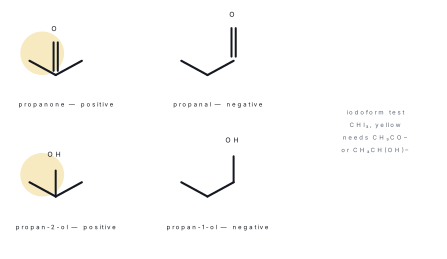
- Referring to the figure above, which pair gives a yellow precipitate with I₂ and NaOH? [1]apropanal and propan-1-olbpropanone and propan-2-olcpropanal and propan-2-oldall four
Answers — Aldehydes and Ketones
1. (b) — benzene is acylated or oxidised through to benzaldehyde (Y), and the Perkin condensation with ethanoic anhydride and sodium ethanoate gives 3-phenylprop-2-enoic acid, cinnamic acid.
2. (b) — ethanal is the only aldehyde carrying a CH₃CO– group, so it answers to both tests. Propanone gives iodoform but no mirror; methanal and propanal give a mirror but no iodoform.
3. (b) — 2,4-DNP detects the carbonyl group in both aldehydes and ketones, so it cannot distinguish them; only Tollens' can.
4. (c) — aromatic aldehydes do not reduce Fehling's solution, although they do give a silver mirror with Tollens'. This exception is examined almost every year.
5. (b) — free silver plates out on the glass as a mirror; Fehling's gives the red-brown Cu₂O instead.
6. (c) — methanal has no α-hydrogen, so it cannot enolise and instead disproportionates to methanol and sodium formate.
7. (a) — the base removes an α-hydrogen to form the carbanion that attacks the second carbonyl. Cannizzaro is exactly the opposite requirement.
8. (a) — zinc amalgam with concentrated HCl, so it is used for compounds stable to acid; Wolff–Kishner is the basic alternative.
9. (b) — the poisoned palladium catalyst stops the reduction at the aldehyde stage.
10. (a) — cyanide adds across the C=O to give the cyanohydrin CH₃CH(OH)CN.
11. (a) — the sodium bisulphite adduct crystallises out and is decomposed later with dilute acid or alkali to return the pure carbonyl compound.
12. (a) — the double bond breaks in the middle of the chain, giving two CH₃CHO molecules.
13. (a) — a 40 % solution in water, used as a preservative and disinfectant.
14. (b) — six molecules of methanal and four of ammonia give hexamethylenetetramine, used as a urinary antiseptic and in making RDX.
15. (a) — cyanide ion catalyses the coupling of two aromatic aldehyde molecules to give the α-hydroxy ketone benzoin.
16. (b) — the test needs CH₃CO– or CH₃CH(OH)–; propanal (CH₃CH₂CHO) and propan-1-ol have the methyl one carbon too far from the functional group.
5.14 Carboxylic Acid and its Derivatives
| Point | Fact |
|---|---|
| Acidity test | only carboxylic acids give CO₂ with NaHCO₃ — a brisk effervescence |
| Effect of –Cl | electron-withdrawing, raises acidity: CCl₃COOH > CHCl₂COOH > CH₂ClCOOH > CH₃COOH |
| Effect of –CH₃ | electron-releasing, lowers acidity: HCOOH > CH₃COOH > CH₃CH₂COOH |
| Distance effect | α-chlorobutanoic > β- > γ- (the inductive effect dies away) |
| Abnormal behaviour of HCOOH | it contains a –CHO group, so it reduces Tollens' and Fehling's |
| With LiAlH₄ | primary alcohol (NaBH₄ will not touch a –COOH) |
| With PCl₅ / PCl₃ / SOCl₂ | acid chloride |
| With P₂O₅ (or heat two molecules) | anhydride |
| With NH₃ then heat | amide |
| With alcohol and conc. H₂SO₄ | ester (esterification) |
| Hell–Volhard–Zelinsky | Cl₂ or Br₂ with red P → α-halo acid |
| Nitration of benzoic acid | m-nitrobenzoic acid (–COOH is meta-directing and deactivating) |
| Claisen condensation | two esters with sodium ethoxide → β-keto ester |
| Hofmann bromamide reaction | RCONH₂ + Br₂ + 4NaOH → RNH₂ with one carbon less |
| Amide | amphoteric — weakly basic at N, weakly acidic at the N–H |
| Reactivity of derivatives | acid chloride > anhydride > ester > amide |
| Saponification | ester + NaOH → soap (salt) + alcohol; irreversible |
| Grignard + CO₂ | acid with one carbon more |
| Nitrile hydrolysis | RCN + 2H₂O → RCOOH + NH₃ |
| Decarboxylation | sodium salt + soda lime → alkane with one carbon less |
- A compound C₃H₄O₄ on heating gives Y and CO₂; Y with P₂O₅ gives X. X is (NEB 2082) [1]aethanoic acidbethanoic anhydridecethanoyl chloridedethanamide
- The strongest acid among the following is [1]aCH₃COOHbCH₂ClCOOHcCHCl₂COOHdCCl₃COOH
- Methanoic acid reduces Tollens' reagent because it contains [1]aa –COOH groupban aldehyde groupctwo oxygen atomsdno alkyl group
- The reagent that gives brisk effervescence with ethanoic acid but not with phenol is [1]aNaOHbNa metalcNaHCO₃dneutral FeCl₃
- The Hell–Volhard–Zelinsky reaction introduces a halogen at the [1]aα-positionbβ-positioncγ-positiondcarbonyl carbon
- Claisen condensation of two molecules of ethyl ethanoate gives [1]aethyl acetoacetatebethanoic anhydridecbutanoic aciddethyl butanoate
- Ethanamide treated with bromine and NaOH gives [1]aethylaminebmethylaminecethanoic aciddethanenitrile
- The most reactive acid derivative towards nucleophilic acyl substitution is [1]aesterbamidecanhydridedacid chloride
- Ethanoic acid reduced with LiAlH₄ gives [1]aethanalbethanolcethanedethanamide
- Nitration of benzoic acid gives mainly [1]ao-nitrobenzoic acidbm-nitrobenzoic acidcp-nitrobenzoic aciddpicric acid
- Hydrolysis of an ester with NaOH is called [1]aesterificationbsaponificationcammonolysisdacylation
- An amide is described as amphoteric because it [1]adissolves in waterbreacts with both acids and baseschas a high boiling pointdis neutral to litmus
- Ethanenitrile on complete hydrolysis gives [1]aethanoic acidbethylaminecethanamide onlydethanol
- Ethylmagnesium bromide treated with dry CO₂ and then dilute acid gives [1]aethanoic acidbpropanoic acidcpropan-1-oldpropanone
Answers — Carboxylic Acid and its Derivatives
1. (b) — C₃H₄O₄ is propanedioic (malonic) acid; heating it loses CO₂ to give ethanoic acid (Y), and P₂O₅ dehydrates two molecules of that to ethanoic anhydride.
2. (d) — three chlorines pull the most electron density away from the carboxylate, stabilising the anion best.
3. (b) — HCOOH is the one acid in which the carboxyl carbon still carries a hydrogen, so it behaves partly as an aldehyde.
4. (c) — only an acid stronger than carbonic acid displaces CO₂ from a hydrogen carbonate; phenol is too weak.
5. (a) — the enol of the acid halide is halogenated next to the carbonyl.
6. (a) — the carbanion from one ester attacks the carbonyl of the other, giving the β-keto ester ethyl 3-oxobutanoate.
7. (b) — the Hofmann bromamide degradation loses the carbonyl carbon, so a two-carbon amide gives a one-carbon amine.
8. (d) — chloride is the best leaving group of the four and the carbonyl carbon is the most electrophilic.
9. (b) — lithium aluminium hydride is powerful enough to take the acid all the way down to the primary alcohol.
10. (b) — the carboxyl group withdraws electrons, deactivating the ring and directing meta.
11. (b) — alkaline hydrolysis gives the salt, which cannot react back with the alcohol, so the reaction goes to completion.
12. (b) — the lone pair on nitrogen gives a weak base and the N–H a weak acid, so amides form salts with both strong acids and sodium.
13. (a) — the nitrile passes through the amide and then the acid, with ammonia released.
14. (b) — the Grignard carbon attacks CO₂, so the chain grows by one carbon.
5.15 Nitro Compounds
| Reduction of nitrobenzene in | Product |
|---|---|
| Sn + conc. HCl (or Fe/HCl), acidic | aniline |
| Zn dust + NH₄Cl, neutral | N-phenylhydroxylamine |
| Na₃AsO₃ or As₂O₃, mildly alkaline | azoxybenzene |
| LiAlH₄ or Zn/NaOH (limited), alkaline | azobenzene |
| Zn dust + NaOH (excess), strongly alkaline | hydrazobenzene |
| Electrolytic reduction in conc. H₂SO₄ | p-aminophenol |
| Zn + H₂O, neutral | N-phenylhydroxylamine |
| Point | Fact |
|---|---|
| Nitroalkane preparation | R–X + AgNO₂ ; or alkane + HNO₃ vapour at 673–773 K |
| Nitroalkanes and nitrites | functional isomers (R–NO₂ has C–N, R–O–N=O has C–O) |
| Reduction of nitroalkane, Sn/HCl | primary amine |
| Nitrous acid test on nitroalkanes | 1° red (nitrolic acid salt), 2° blue (pseudonitrole), 3° no colour |
| Nitrobenzene preparation | benzene + conc. HNO₃ / conc. H₂SO₄ at 330 K |
| Directing effect of –NO₂ | strongly deactivating, meta-directing |
| Nitration of nitrobenzene | m-dinitrobenzene, and it needs fuming HNO₃ at 373 K |
| Uses | solvent, in explosives (TNT), as a starting point for aniline and dyes |
- Nitrobenzene → X → aniline. The reagent X is (NEB 2079 model) [1]aZn / NH₄ClbSn / conc. HClcNa₃AsO₃dZn / NaOH
- Electrolytic reduction of nitrobenzene in concentrated sulphuric acid gives (NEB 2078 model) [1]aanilinebazobenzenecp-aminophenoldhydrazobenzene
- Nitrobenzene reduced with zinc dust in a neutral medium gives [1]aanilinebN-phenylhydroxylaminecazoxybenzenedhydrazobenzene
- Nitration of nitrobenzene gives mainly [1]ao-dinitrobenzenebm-dinitrobenzenecp-dinitrobenzenedtrinitrobenzene
- In the nitrous acid test a secondary nitroalkane gives a [1]ared colourbblue colourcyellow colourdno colour
- Nitroethane and ethyl nitrite are [1]achain isomersbposition isomerscfunctional isomersdidentical
Answers — Nitro Compounds
1. (b) — tin with concentrated hydrochloric acid is the standard acidic reduction, and it takes the nitro group all the way to the amine.
2. (c) — the N-phenylhydroxylamine formed first rearranges in the strongly acidic medium (the Bamberger rearrangement) to p-aminophenol.
3. (b) — a neutral medium is only mildly reducing, so the reduction stops at the hydroxylamine stage.
4. (b) — –NO₂ withdraws electrons from the ortho and para positions, leaving meta as the least deactivated site.
5. (b) — the pseudonitrole gives a blue colour; the primary compound gives the red nitrolic acid salt and the tertiary compound, having no α-hydrogen, gives nothing.
6. (c) — both are C₂H₅NO₂, but one has a C–N bond and the other a C–O–N linkage, so they belong to different functional classes.
5.16 Amines
| Property or test | Fact |
|---|---|
| Basic order in water (aliphatic) | 2° > 1° > 3° > NH₃ (solvation and steric effects together) |
| Basic order in the gas phase | 3° > 2° > 1° > NH₃ (inductive effect alone) |
| pKb values | (C₂H₅)₂NH 3.0, C₂H₅NH₂ 3.3, NH₃ 4.75, C₆H₅NH₂ 9.38 |
| Why aniline is weakly basic | the nitrogen lone pair is delocalised into the ring, so it is far less available |
| Hinsberg / Hoffmann separation | Hoffmann's method uses diethyl oxalate: 1° gives a solid, 2° a liquid, 3° no reaction |
| Nitrous acid, 1° aliphatic | N₂ gas evolved, alcohol formed |
| Nitrous acid, 1° aromatic at 273–278 K | diazonium salt |
| Nitrous acid, 2° | yellow oily nitrosoamine |
| Nitrous acid, 3° aliphatic | a soluble salt, no gas |
| Carbylamine test | RNH₂ + CHCl₃ + alcoholic KOH → RNC, foul smell — 1° amines only |
| Diazotisation | C₆H₅NH₂ + NaNO₂ + HCl at 273–278 K → C₆H₅N₂Cl |
| Coupling | C₆H₅N₂Cl + phenol in alkali → orange azo dye |
| Aniline + bromine water | white 2,4,6-tribromoaniline, at once |
| Aniline nitration | acetylate first, nitrate, then hydrolyse, to get p-nitroaniline |
| Aniline and Friedel–Crafts | fails, because AlCl₃ bonds to the lone pair |
| 1° amine from a nitrile | LiAlH₄ or Na/C₂H₅OH; the amine has one carbon more |
| 1° amine from an amide | Hofmann bromamide; the amine has one carbon less |
- Which of the following is the most basic in aqueous solution? (NEB 2081) [1]aNH₃bC₆H₅NH₂cC₂H₅NH₂d(C₂H₅)₂NH
- A compound gives a foul-smelling product with chloroform and alcoholic KOH. It is (NEB 2082) [1]aa primary amineba secondary amineca tertiary aminedan amide
- Benzene → A → B → C, where B is aniline and C is benzenediazonium chloride. The step B → C is called (NEB 2082) [1]anitrationbdiazotisationccouplingdacylation
- A mixture of 1°, 2° and 3° amines is separated by Hoffmann's method using [1]adiethyl oxalatebbenzoyl chloridecnitrous aciddchloroform
- A secondary amine treated with nitrous acid gives [1]anitrogen gasban alcoholca yellow oily nitrosoamineda diazonium salt
- Aniline is less basic than ethylamine because in aniline [1]anitrogen is more electronegativebthe lone pair is delocalised into the ringcit is a liquiddit is insoluble in water
- Ethylamine treated with nitrous acid gives [1]aethanol and N₂ba diazonium saltca nitrosoaminednitroethane
- Aniline shaken with bromine water gives [1]ao-bromoanilinebp-bromoanilinec2,4,6-tribromoanilinedbromobenzene
- Aniline is acetylated before nitration in order to [1]aincrease its solubilitybcontrol the reaction and obtain the p-isomercmake it basicdremove the ring
- Benzenediazonium chloride coupled with phenol in alkaline medium gives [1]aan azo dyebchlorobenzenecbenzenednitrobenzene
- Ethanenitrile reduced with LiAlH₄ gives [1]amethylaminebethylaminecethanamidedethanol
Answers — Amines
1. (d) — in water the order is 2° > 1° > 3° > NH₃, so diethylamine leads. Aniline (b) is by far the weakest, because its lone pair is tied up in the ring.
2. (a) — the carbylamine (isocyanide) test is given only by primary amines; 2° and 3° amines give nothing.
3. (b) — nitrous acid generated in situ at 273–278 K converts the –NH₂ group into –N₂⁺Cl⁻.
4. (a) — the ester reacts differently with each class: a solid oxamide from the 1° amine, a liquid oxamic ester from the 2°, and nothing from the 3°.
5. (c) — the N–H of a secondary amine is nitrosated; there is no hydrogen left for the further steps that release nitrogen.
6. (b) — resonance delocalisation into the benzene ring reduces the electron density on nitrogen, so it accepts a proton much less readily.
7. (a) — the aliphatic diazonium ion is unstable even at low temperature and decomposes at once, releasing nitrogen quantitatively.
8. (c) — the strongly activating –NH₂ group substitutes all three available ortho and para positions without any catalyst.
9. (b) — acetylation reduces the activating power of the nitrogen and blocks oxidation by the nitrating mixture, so the para product can be isolated.
10. (a) — electrophilic attack by the diazonium ion at the para position of phenol gives p-hydroxyazobenzene, an orange dye.
11. (b) — the nitrile carbon is retained, so CH₃CN gives CH₃CH₂NH₂; the Hofmann route would have shortened the chain instead.
5.17 Organometallic Compounds
| Point | Fact |
|---|---|
| Definition | a compound containing at least one direct metal–carbon bond |
| Not organometallic | C₂H₅ONa, CH₃COONa (the metal is bonded to oxygen) |
| σ-bonded | RMgX, RLi, R₂Cd, R₄Pb, R₂SnCl₂ |
| π-bonded | Zeise's salt K[PtCl₃(C₂H₄)], ferrocene, Ni(CO)₄ |
| Zeise's salt | the first π-bonded organometallic compound prepared, containing ethene |
| Grignard reagent | R–MgX, made from R–X and Mg in dry ether |
| Grignard + water (or any active H) | alkane R–H — all glassware must be dry |
| Grignard + HCHO | primary alcohol |
| Grignard + RCHO | secondary alcohol |
| Grignard + ketone | tertiary alcohol |
| Grignard + CO₂ then H⁺ | carboxylic acid, one carbon more |
| Grignard + RCN then hydrolysis | ketone |
| Grignard + ester or acid chloride (excess) | tertiary alcohol |
| Nature of the M–C bond | polar covalent, with the carbon negative — hence a carbanion-like nucleophile |
- The first π-bonded organometallic compound to be synthesised, containing ethene, is (NEB 2078 model) [1]aferrocenebZeise's saltcnickel tetracarbonyldtetraethyllead
- Of CH₃MgI, Ni(CO)₄, C₂H₅Li, C₂H₅ONa and (C₄H₉)₂SnCl₂, the organometallic compounds are (NEB 2082) [1]aall fiveball except C₂H₅ONaconly CH₃MgI and C₂H₅Lidonly Ni(CO)₄
- To prepare a primary alcohol from a Grignard reagent, the carbonyl compound used must be (NEB 2081) [1]amethanalbethanalcpropanonedbenzaldehyde
- Ethylmagnesium bromide treated with water gives [1]aethanolbethanecethenedethanoic acid
- In a Grignard reagent the carbon attached to magnesium behaves as [1]aan electrophileba nucleophileca free radicalda neutral atom
Answers — Organometallic Compounds
1. (b) — K[PtCl₃(C₂H₄)]·H₂O, prepared by Zeise in 1830; the ethene is held side-on by its π electrons.
2. (b) — sodium ethoxide has a Na–O bond, not a Na–C bond, so it is simply a salt. Every other compound listed has a direct metal–carbon bond, including the carbonyl of nickel.
3. (a) — only methanal adds to give RCH₂OH; ethanal would give a secondary alcohol and propanone a tertiary one.
4. (b) — water is an acid towards the carbanion-like carbon, which is protonated to the alkane. This is why the ether and the apparatus must be perfectly dry.
5. (b) — magnesium is far more electropositive than carbon, so the carbon carries a partial negative charge and attacks electrophilic carbonyl carbons.
Gypsum does not make cement set faster; it slows it down. About 2–3 % of calcium sulphate is ground in with the clinker purely to retard the flash set caused by tricalcium aluminate, so that the concrete can be transported and placed. The same trap appears in the paper unit: pulping removes lignin, not cellulose, and it is the removal of lignin that lets the cellulose fibres bond to one another.
5.18 Chemistry in the service of mankind
| Item | Fact |
|---|---|
| Addition polymer | monomers add with no loss of small molecules: polythene, PVC, Teflon, polystyrene |
| Condensation polymer | a small molecule is eliminated at each step: nylon-6,6, bakelite, terylene |
| Teflon monomer | tetrafluoroethene, CF₂=CF₂ |
| PVC monomer | chloroethene (vinyl chloride) |
| Bakelite | phenol + methanal, a thermosetting condensation polymer |
| Nylon-6,6 | hexamethylenediamine + adipic acid |
| Elastomer | can be stretched and springs back: natural rubber, buna-S, neoprene |
| Fibre | strong, thread-forming, close-packed chains: nylon, terylene |
| Dyes by structure | azo, nitro, triphenylmethane, anthraquinone, indigoid |
| Dyes by application | acid, basic, direct, vat, mordant, disperse |
| Vat dye | indigo — reduced to a soluble leuco form, then air-oxidised on the fibre |
| Analgesic / antipyretic | aspirin, paracetamol |
| Antibiotic | penicillin, streptomycin |
| Antiseptic vs disinfectant | on living tissue (dettol) vs on surfaces (phenol, 1 %) |
| Tranquilliser | equanil, valium |
| Insecticide / herbicide / fungicide | DDT, malathion / 2,4-D / Bordeaux mixture |
- The monomer of Teflon is [1]atetrafluoroethenebchloroethenecethenedstyrene
- Which of the following is a condensation polymer? [1]apolythenebPVCcnylon-6,6dpolystyrene
- Bakelite is obtained from methanal and [1]aphenolbbenzenecanilinedurea
- Buna-S is an example of [1]aa fibreban elastomerca thermosetting plasticda natural polymer
- Indigo is applied to cloth as [1]aa vat dyeba basic dyeca mordant dyeda disperse dye
- Paracetamol is classified as [1]aan antibioticban antipyretic and analgesicca tranquilliserdan antiseptic
- 2,4-D is used as [1]aan insecticideba herbicideca fungicideda fertiliser
Answers — Chemistry in the service of mankind
1. (a) — polytetrafluoroethene is made by the addition polymerisation of CF₂=CF₂; the C–F bonds give it its non-stick, chemically inert surface.
2. (c) — nylon-6,6 loses a molecule of water at every amide link; the other three simply add.
3. (a) — phenol and methanal condense to a cross-linked, three-dimensional thermosetting network.
4. (b) — a butadiene–styrene copolymer with rubber-like elasticity.
5. (a) — indigo is insoluble, so it is reduced in a vat to the soluble leuco form, taken up by the fibre, and re-oxidised in air.
6. (b) — it lowers fever and relieves pain; it kills no microorganisms, so it is not an antibiotic.
7. (b) — 2,4-dichlorophenoxyacetic acid is a selective weedkiller that acts as a synthetic plant hormone.
5.19 Cement
| Item | Fact |
|---|---|
| Average composition | CaO 60–67 %, SiO₂ 17–25 %, Al₂O₃ 3–8 %, Fe₂O₃ 0.5–6 %, MgO 0.1–4 %, SO₃ 1–3 % |
| Calcareous raw material | limestone, chalk, marl |
| Argillaceous raw material | clay, shale, slate |
| Wet or dry process | slurry (wet) or dry meal fed into a rotary kiln |
| Drying zone | up to about 500 K — water driven off |
| Calcination zone | about 1173–1273 K — CaCO₃ → CaO + CO₂ |
| Clinkering (burning) zone | about 1673–1773 K — the silicates and aluminates form, clinker fuses into nodules |
| Final grinding | clinker + 2–3 % gypsum |
| Role of gypsum | retards setting, preventing a flash set |
| C₃S, tricalcium silicate | sets in about 7 days, gives early strength |
| C₂S, dicalcium silicate | slow, gives ultimate strength |
| C₃A, tricalcium aluminate | sets in minutes, generates most heat — the reason gypsum is needed |
| C₄AF, tetracalcium alumino-ferrite | gives the grey colour, contributes little strength |
| Hydraulic modulus | CaO / (SiO₂ + Al₂O₃ + Fe₂O₃), usually 1.8–2.2 |
| OPC | ordinary Portland cement, clinker + gypsum |
| PPC | Portland pozzolana cement, with 15–35 % fly ash or other pozzolana; more durable, less heat |
| Setting | hydration and hydrolysis, producing tobermorite gel and Ca(OH)₂ |
| Nepal | Himal Cement (Chobhar, 1974, the first), Hetauda, Udayapur ("Gaida"), Hongshi–Shivam, Argakhanchi, Palpa |
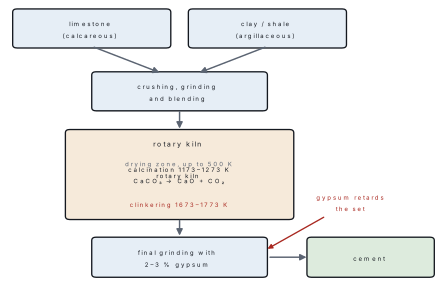
- The effect of adding calcium sulphate to cement is to (NEB 2078 model) [1]aaccelerate settingbretard settingcincrease the colourdreduce the cost
- The constituent mainly responsible for the early strength of cement is [1]aC₃SbC₂ScC₃AdC₄AF
- The clinkering zone of the rotary kiln operates at about [1]a500 Kb900 Kc1200 Kd1700 K
- Portland pozzolana cement contains pozzolanic material to the extent of [1]a2–3 %b15–35 %c50–60 %d70–80 %
- The calcareous raw material used in cement manufacture is [1]aclaybshaleclimestonedgypsum
- The first cement factory established in Nepal was at [1]aHetaudabUdayapurcChobhardNawalparasi
- In the flow-sheet above, the reaction CaCO₃ → CaO + CO₂ takes place in the [1]adrying zonebcalcination zonecclinkering zonedgrinding mill
Answers — Cement
1. (b) — gypsum reacts with tricalcium aluminate to form a coating of ettringite that delays hydration, giving workers time to place the concrete.
2. (a) — tricalcium silicate hydrates within about a week; C₂S continues for months and supplies the final strength.
3. (d) — about 1673–1773 K, hot enough to part-fuse the charge into clinker nodules.
4. (b) — the pozzolana replaces part of the clinker, lowering the heat of hydration and improving resistance to sulphates.
5. (c) — "calcareous" means lime-supplying; clay and shale are the argillaceous (silica and alumina) component.
6. (c) — Himal Cement at Chobhar, commissioned in 1974.
7. (b) — decarbonation of limestone is complete before the charge reaches the hottest, clinkering zone.
5.20 Paper and Pulp
| Item | Fact |
|---|---|
| Wood composition | cellulose about 40–50 %, hemicellulose 20–30 %, lignin 20–30 % |
| The fibre-forming component | cellulose |
| The component removed by pulping | lignin, the natural cement between the fibres |
| Why remove lignin | it is dark, it yellows in light, and it blocks fibre-to-fibre hydrogen bonding |
| Raw materials in Nepal | bamboo, sabai grass, lokta bark, bagasse, rice straw, waste paper |
| Mechanical pulping | grinding; yield 90–95 %, weak dark pulp, newsprint |
| Chemical pulping — sulphate (Kraft) | NaOH + Na₂S; strong pulp, any wood; yield 45–50 % |
| Chemical pulping — sulphite | Ca or Mg bisulphite with SO₂; easily bleached |
| Bleaching | Cl₂, ClO₂, H₂O₂ — to whiten and remove residual lignin |
| Beating and refining | fibrillates the fibres so they bond, giving strength |
| Sizing | rosin and alum — stops ink from spreading |
| Loading / filling | china clay, TiO₂, CaCO₃ — opacity and smoothness |
| Stages | pulping → bleaching → beating → sizing and loading → sheet forming on the wire → pressing → drying → calendering |
| GSM | grammage, grams per square metre — the main index of paper quality |
| Other quality tests | brightness, burst factor, tear factor, tensile strength, ash content |
- In the production of paper, removal of which component increases fibre-to-fibre bonding? (NEB 2078 model) [1]acellulosebhemicelluloseclignindresin
- The chemicals used in the Kraft (sulphate) process are [1]aNaOH and Na₂SbCa(HSO₃)₂ and SO₂cNaOCl and H₂O₂dHNO₃ and H₂SO₄
- Mechanical pulping gives a yield of about [1]a30 %b50 %c70 %d92 %
- Sizing of paper is carried out with [1]arosin and alumbchina claycchlorinedcaustic soda
- China clay is added to paper mainly to [1]awhiten and increase opacitybincrease tensile strengthcwaterproof itdbleach it
- The grammage of paper is expressed in [1]ag cm⁻³bg m⁻²ckg m⁻¹dmm
Answers — Paper and Pulp
1. (c) — lignin encrusts the fibres and prevents the hydrogen bonds between cellulose chains that give paper its strength. Removing cellulose would destroy the paper.
2. (a) — caustic soda with sodium sulphide dissolves lignin and gives an unusually strong ("kraft" means strength) pulp.
3. (d) — nothing is dissolved away, so almost all the wood is recovered; the price is a weak, dark, short-lived paper.
4. (a) — rosin precipitated by alum coats the fibres and makes the sheet resistant to the spread of aqueous ink.
5. (a) — fillers occupy the spaces between fibres, raising opacity and smoothness, although they slightly reduce strength.
6. (b) — grams per square metre; ordinary copier paper is about 70–80 GSM.
5.21 Nuclear Chemistry and Applications of Radioactivity
| Item | Fact |
|---|---|
| α particle | helium nucleus, ⁴₂He, charge +2, least penetrating, stopped by paper, deflected towards the negative plate |
| β particle | electron, charge −1, deflected more and towards the positive plate |
| γ radiation | electromagnetic, no charge, undeflected, most penetrating |
| α emission | mass number falls by 4, atomic number by 2 |
| β emission | mass number unchanged, atomic number rises by 1 |
| Becquerel (Bq) | one disintegration per second (the SI unit) |
| Curie (Ci) | 3.7 × 10¹⁰ Bq |
| Gray (Gy) | 1 J of energy absorbed per kg |
| Sievert (Sv) | the dose equivalent, allowing for the biological effect |
| Decay law | N = N₀e^(−λt) ; t½ = 0.693/λ |
| Fission | a heavy nucleus splits when struck by a slow neutron; a chain reaction follows |
| Fusion | light nuclei join at 10⁷ K or more; the energy source of the Sun |
| Reactor fuel / moderator / control rods / coolant | enriched ²³⁵U · graphite or D₂O · cadmium or boron · water, CO₂ or liquid sodium |
| Radiocarbon dating | ¹⁴C, half-life 5730 years; used for once-living material up to about 50 000 years |
| Medical isotopes | ⁶⁰Co (cancer therapy), ¹³¹I (thyroid), ³²P (blood disorders), ⁹⁹ᵐTc (imaging) |
| Industrial uses | thickness gauges, leak detection in pipes, food preservation, tracing engine wear |
| Harmful effects | ionisation of tissue, burns, cancer, genetic mutation |
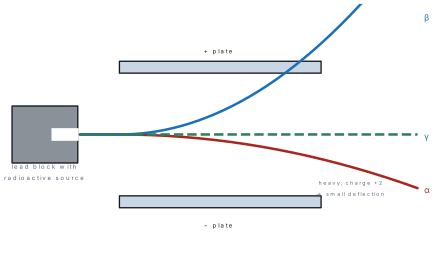
- In the figure above, the radiation that suffers the largest deflection is (NEB 2078 model) [1]aαbβcγdall are deflected equally
- One curie is equal to [1]a3.7 × 10¹⁰ Bqb3.7 × 10⁷ Bqc1 Bqd6.02 × 10²³ Bq
- When a nucleus emits an α particle, its atomic number [1]aincreases by 2bdecreases by 2cdecreases by 4dis unchanged
- The control rods of a nuclear reactor are made of [1]agraphitebcadmiumcuraniumdheavy water
- Radiocarbon dating uses an isotope of half-life [1]a12 hoursb5730 yearsc1600 yearsd4.5 × 10⁹ years
Answers — Nuclear Chemistry and Applications of Radioactivity
1. (b) — deflection depends on charge-to-mass ratio; the β particle is about 7300 times lighter than the α particle, so it bends far more, and towards the positive plate.
2. (a) — the curie was defined from the activity of one gram of radium-226.
3. (b) — the α particle carries away two protons and two neutrons, so Z falls by 2 and A by 4. Option (c) confuses the two numbers.
4. (b) — cadmium and boron absorb neutrons strongly and so control the chain reaction; graphite and heavy water are moderators, which slow neutrons rather than absorb them.
5. (b) — carbon-14 decays with a half-life of 5730 years, which suits archaeological time scales.
Chapter summary
- Group A is 11 questions for 11 marks, all compulsory, and in the most recent sittings the booklet is distributed thirty minutes into the paper, with the answers written on the ordinary answer sheet.
- Six families cover most of Group A in Chemistry: equivalent weight, Ksp and pH, order of reaction, comparison of E° values, reagent identification, and the products of named organic reactions.
- Equivalent weight = molar mass ÷ valency factor. The valency factor is the electrons transferred, or the replaceable H⁺ or OH⁻, in that particular reaction — not the valency of the metal.
- Order is experimental, molecularity is mechanistic. Never read the order off the balanced equation, and never let molecularity be zero or fractional.
- In a galvanic cell the anode is negative; in electrolysis it is positive. Oxidation happens at the anode in both.
- Colour in transition-metal compounds needs a partly filled d subshell, so Sc³⁺ and Zn²⁺ are colourless — and zinc is not a transition element at all.
- In organic chemistry the reagent and the medium decide the product: aqueous versus alcoholic KOH, KCN versus AgCN, and the six different media for reducing nitrobenzene.
- Phenol dissolves in NaOH but not in NaHCO₃; a carboxylic acid dissolves in both, with effervescence. That single line separates them.
- A positive iodoform test needs a CH₃CO– or CH₃CH(OH)– group; Tollens' and Fehling's separate aldehydes from ketones, and benzaldehyde is the standing exception to Fehling's.
- Work every numerical MCQ on paper to one decimal place before you look at the options — the distractors are built from the arithmetic slips, not from ignorance of the chemistry.
Sources and verification
Verified. The examination pattern (3 hours, full marks 75, Group A 11 × 1 = 11, Group B 8 × 5 = 40, Group C 3 × 8 = 24, all questions compulsory with internal alternatives only) is taken from the NEB Grade 12 Chemistry curriculum and specification grid published by the Curriculum Development Centre, Sanothimi, and matches the printed examination papers of 2081 and 2082. The teaching hours used to weight the questions — 8, 10, 7, 8, 7, 5, 15, 8, 3, 7, 4, 2, 10, 9, 3, 7, 2, 4, 4, 3, 2 for units 1 to 21, totalling 128 — are the CDC allocations in the same curriculum document. All chemical facts, reagents, conditions, colours and formulae have been checked against the Grade 12 Chemistry chapters in this same collection of notes, so that nothing in this question bank contradicts them. Every numerical answer was recomputed independently before the key was written.
Year tags. A tag such as (NEB 2081) appears only where the question comes from a Group A list that could be checked against a transcribed past paper for that year. Forty-three questions carry such a tag: eleven from the 2078 model set, ten from the 2079 model set, eleven from the 2081 paper and eleven from the 2082 paper. Every other question in this chapter is newly written to the syllabus and deliberately carries no year tag.
Not verified. Transcribed Chemistry board papers for 2078, 2079 and 2080 could not be reached as text, so no question is tagged with those three years except where a model set for 2078 or 2079 was available, and those are marked "model". Where a transcription recorded only the type of question — for instance "equivalent weight in a given reaction", or "which of these is the most basic" — the specific reaction and option set printed here are a faithful reconstruction in the same style, not a facsimile of the original wording; the year tag is kept because the topic and its position in Group A are attested. One further stem from the 2079 model set, asking for the product formed when a red-hot copper wire meets steam, has been left out of this chapter altogether: the Grade 12 textbook chapter on heavy metals lists no reaction between copper and steam, and the expected answer could not be confirmed against any independent source, so printing it with a key would have risked teaching something wrong. There is no officially published per-unit marks grid for Chemistry at Grade 12; the question counts here follow the CDC teaching hours, which are a reasonable proxy for weighting but not a guarantee of it.