Unit 1 · Compulsory Mathematics · 18 min read
Sets
What the syllabus asks for 6
- review of sets and set notation
- universal set and complement
- disjoint and overlapping sets
- subset, proper subset and number of subsets
- union, intersection and difference; Venn diagrams
- word problems with two sets
A set is a collection of things that are certainly known to belong together — the districts of Koshi Province, the prime numbers below 20, the students in your class who play football. Writing the members of a collection inside curly brackets and giving the collection a name turns it into something a mathematician can count, compare and reason with. This chapter reviews set notation and then works through the ideas that the Grade 8 syllabus tests: universal set and complement, disjoint and overlapping sets, subsets, and the operations of union and intersection with their Venn diagrams.
You should be able to write a set in listing and in set-builder form, find the number of subsets of a given set, count the members of a universal set and its complement, use the formula n(A\cup B)=n(A)+n(B)-n(A\cap B) and its rearrangement, draw and read a Venn diagram, and solve word problems about two groups.
1.1 Review of sets and set notation
A set is a well-defined collection of objects. "Well-defined" means that for any object it is clear whether it belongs to the collection or not. The set of districts of Nepal is well-defined; "the set of good students of a class" is not, because "good" has not been defined.
| Way of writing | Example | When to use it |
|---|---|---|
| Listing (roster) method | A=\{2,4,6,8\} | when the members are few |
| Set-builder method | A=\{x:x is an even number, x<10\} | when the rule is easier to state than the list |
| Description method | A is the set of even numbers less than 10 | in words, at the start of a sum |
The members of a set are written inside curly brackets and separated by commas. The symbol \in means "is a member of" and \notin means "is not a member of". So if A=\{2,4,6,8\}, then 4\in A and 7\notin A.
| Symbol | Reads as |
|---|---|
| n(A) | the number of members of A |
| \cup | union — everything in either set |
| \cap | intersection — only what is in both |
| ' | complement — everything outside, within the universal set |
| \subset | is a subset of |
| \emptyset or \{\ \} | the empty set, with no members |
Two sets are equal if they contain exactly the same members in any order: \{1,2,3\}=\{3,1,2\}. Two sets are equivalent if they have the same number of members but different members: \{a,b,c\} and \{1,2,3\} are equivalent but not equal.
1.2 Universal set and complement
When we discuss a problem we fix the largest set under consideration. This is the universal set, written U. It contains every member that the problem allows.
- If the problem is about the districts of Nepal, then U is the set of all 77 districts and a set of hill districts is a subset of it.
- If the problem is about whole numbers up to 20, then U is the set of whole numbers from 0 to 20.
The complement of A, written A', is the set of all members of U that are not in A.
Problem. Let U=\{1,2,3,4,5,6,7,8,9,10\} and A=\{2,4,6,8,10\}. Find A' and verify that n(U)=n(A)+n(A').
Solution. A' contains everything in U that is not in A:
Check: n(A)=5 and n(A')=5, so n(A)+n(A')=5+5=10=n(U). ✓
Note. A was the even numbers up to 10 and A' the odd ones. Together they make the whole universal set, and neither shares a member with the other.
1.3 Disjoint and overlapping sets
1.3.1 Venn diagrams
A Venn diagram shows the relationship between sets with figures. A rectangle stands for the universal set U and circles (or ovals) inside it stand for its subsets. The English mathematician John Venn used these diagrams in 1880, and they are named after him.
To read a Venn diagram, collect the members inside each circle (including the shared region) — that is the set. Everything written inside the rectangle, inside or outside the circles, belongs to U.
1.3.2 Disjoint and overlapping sets
The eight SAARC countries can be split into two football groups: A=\{Nepal, Pakistan, Bhutan, Sri Lanka\} and B=\{India, Afghanistan, Maldives, Bangladesh\}. No country is in both groups. But the set of landlocked SAARC countries, L=\{Nepal, Bhutan, Afghanistan\}, shares Nepal and Bhutan with A.
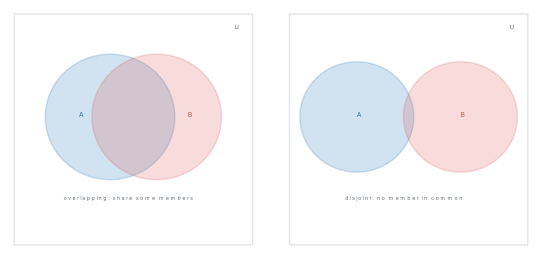
Two sets are disjoint if they have no common element, i.e. A\cap B=\{\ \}. In a Venn diagram their circles do not touch.
Two sets are overlapping if they have at least one common element and each also has at least one element that the other does not have. In a Venn diagram their circles cross each other.
So A and B above are disjoint, while A and L are overlapping.
- \{even numbers\} and \{odd numbers\} are disjoint: no number is both even and odd.
- \{football players\} and \{chess players\} of a school usually overlap, because some students play both.
Problem. M is the set of multiples of 3 up to 15 and N is the set of multiples of 6 up to 24. The universal set is the set of the first ten multiples of 3. (a) Write M and N by the listing method. (b) Write U. (c) Are M and N overlapping or disjoint? Why?
Solution. (a) M=\{3,6,9,12,15\} and N=\{6,12,18,24\}.
(b) U=\{3,6,9,12,15,18,21,24,27,30\}.
(c) 6 and 12 are in both sets, and each set also has members not in the other (3 is only in M, 18 only in N). So M and N are overlapping sets.
Venn diagram. Put 6, 12 in the shared region; 3, 9, 15 in the rest of M; 18, 24 in the rest of N; and 21, 27, 30 outside both circles, inside U.
Problem. U=\{multiples of 2 up to 20\}, P=\{factors of 10\}, Q=\{multiples of 5\} and R=\{multiples of 6\}, where P, Q, R are subsets of U. State the relationship between P and Q, and between Q and R.
Solution. Only members of U can be taken.
U=\{2,4,6,8,10,12,14,16,18,20\}, P=\{2,10\}, Q=\{10,20\}, R=\{6,12,18\}.
P and Q have the common member 10 → overlapping. Q and R have no common member → disjoint.
The factors of 10 are 1, 2, 5, 10, but here P=\{2,10\} only, because 1 and 5 are not in U (the multiples of 2). Always list a subset from the members of U.
Problem. A=\{0,1,2,3,4,5\}. List B = (add 1 to each member of A), C = (multiply each member of A by 2) and D = (the odd numbers of A). Which of these pairs are disjoint: B and C, C and D?
Solution. B=\{1,2,3,4,5,6\}, C=\{0,2,4,6,8,10\}, D=\{1,3,5\}.
B\cap C=\{2,4,6\}, so B and C are overlapping. C has only even numbers and D only odd ones, so C\cap D=\{\ \}: C and D are disjoint.
1.3.3 Union and intersection
- The union A\cup B is the set of all members that are in A, or in B, or in both. Counting it member by member, the shared members would be counted twice, so we must subtract them once:
- The intersection A\cap B is the set of members that are in both.
- If the sets are disjoint, n(A\cap B)=0 and the formula becomes n(A\cup B)=n(A)+n(B).
(1) What is n(A)? (2) What is n(B)? (3) Is the number given for "both" or for "at least one"? If the problem gives the number who like both, put it in the middle of the Venn diagram first and work outwards. If it gives the number who like at least one, that is n(A\cup B) and the middle must be found from the formula.
Problem. In a class of 40 students, 25 like football and 20 like cricket. Every student likes at least one of the two games. How many like both?
Solution. Here n(A\cup B)=40, because everyone likes at least one, n(A)=25 and n(B)=20. From the formula:
Answer. 5 students like both games.
Check. Only football =25-5=20; only cricket =20-5=15; both =5. Total =20+15+5=40 ✓.
Problem. In a survey of 50 households, 32 grow rice and 21 grow maize; 12 grow both. How many households grow neither?
Solution. First find the number growing at least one crop:
The rest grow neither:
Answer. 9 households grow neither.
Check. Only rice =32-12=20; only maize =21-12=9; both =12; neither =9. Total =20+9+12+9=50 ✓.
1.4 Subset
If every element of set A is also an element of set B, then A is a subset of B. We write A\subset B (read "A is a subset of B") or B\supset A ("B is a superset of A").
Shanti invites three friends, Dolma, Rakesh and Laxmi. The groups of friends she could take to a film are subsets of \{Dolma, Rakesh, Laxmi\} — all three, any two, any one, or none.
1.4.1 Proper and improper subsets
| Kind | Meaning | Symbol |
|---|---|---|
| Proper subset | made from some of the elements of A, so it has fewer elements than A | B\subset A |
| Improper subset | made from all the elements of A, i.e. the set A itself | B\subseteq A |
- The empty set \{\ \} is a subset of every set, and a proper subset of every set except itself.
- Every set is an improper subset of itself. Equal sets are improper subsets of one another.
Problem. Make all possible subsets of M=\{s,k,y\}, name them, and classify them as proper and improper.
Solution.
| Number of elements | Subsets |
|---|---|
| 0 | A=\{\ \} |
| 1 | B=\{s\}, C=\{k\}, D=\{y\} |
| 2 | E=\{s,k\}, F=\{s,y\}, G=\{k,y\} |
| 3 | H=\{s,k,y\} |
Proper subsets: A,B,C,D,E,F,G (7 subsets). Improper subset: H=\{s,k,y\} (1 subset). Total =8 subsets.
1.4.2 Number of subsets
Fill a table for sets with 1, 2, 3, … elements and a pattern appears: each new element doubles the number of subsets (every old subset can be taken with or without the new element).
| Number of elements n | Example | Number of subsets |
|---|---|---|
| 1 | \{mango\} | 2=2^1 |
| 2 | \{radish, pumpkin\} | 4=2^2 |
| 3 | \{bus, jeep, aeroplane\} | 8=2^3 |
| 4 | \{dog, cat, horse, cow\} | 16=2^4 |
| 5 | \{pigeon, crow, eagle, parrot, crane\} | 32=2^5 |
A set with n elements has 2^n subsets. Exactly one of them (the set itself) is improper, so it has 2^n-1 proper subsets.
A\subset B compares two sets. The symbol \in is for a single element: 3\in\{1,2,3\}, but \{3\}\subset\{1,2,3\}. Writing 3\subset\{1,2,3\} or \{3\}\in\{1,2,3\} is wrong.
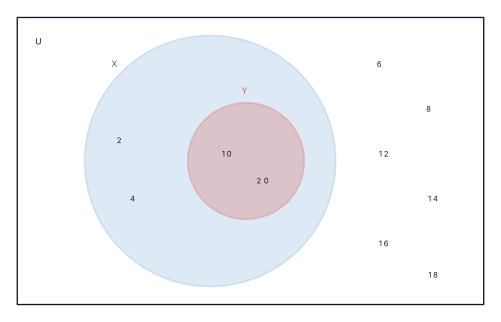
Problem. U=\{multiples of 2 up to 20\}, X=\{factors of 20\} and Y=\{multiples of 5\} are taken from U. Show X and Y in a Venn diagram and state the relationship.
Solution. U=\{2,4,6,\dots,20\}, X=\{2,4,10,20\}, Y=\{10,20\}.
Every element of Y is in X and X has more elements, so Y is a proper subset of X: Y\subset X. In the Venn diagram the circle Y is drawn completely inside the circle X (see the figure).
1.5 Word problems with a Venn diagram
The method is always the same.
- Draw a rectangle for U and two circles for the two sets.
- Put the number who belong to both in the middle region first.
- Subtract to find the rest of each circle.
- Find the number outside both by subtraction from n(U).
- Add up all the regions and check against n(U).
Problem. In a ward of 120 families, 70 use LPG, 55 use firewood and 30 use both. Find (a) the number using at least one fuel, (b) the number using only LPG, (c) the number using neither, and (d) the number using firewood but not LPG.
Solution. Let L be the families using LPG and W those using firewood. n(L)=70, n(W)=55, n(L\cap W)=30, n(U)=120.
(a) n(L\cup W)=70+55-30=95.
(b) Only LPG =70-30=40.
(c) Neither =120-95=25.
(d) Firewood but not LPG =55-30=25.
Check. 40+30+25+25=120 ✓, which is the whole universal set.
Note. Part (d) is a good trap: it asks for firewood only, not for firewood. Reading which region the question wants is worth more marks than the arithmetic.
1.6 Venn diagrams as a method, not a decoration
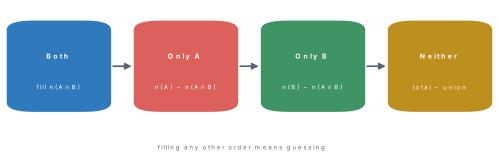
A Venn diagram is not an illustration drawn after the answer; it is the fastest way to the answer. Fill the overlap first, then work outwards.
| Phrase in the question | Region it means |
|---|---|
| both / and | A \cap B |
| at least one / either | A \cup B |
| only A | n(A) - n(A \cap B) |
| neither | total - n(A \cup B) |
| exactly one | n(A \cup B) - n(A \cap B) |
Question. In a class of 60 students, 38 play football, 29 play volleyball and 12 play neither. Find (i) how many play at least one game (ii) how many play both (iii) how many play only football.
Answer. (i) At least one = 60 - 12 = \textbf{48}. (ii) n(F \cup V) = n(F) + n(V) - n(F \cap V), so 48 = 38 + 29 - n(F \cap V), giving n(F \cap V) = 67 - 48 = \textbf{19}. (iii) Only football = 38 - 19 = \textbf{19}. Check: 19 + 19 + 10 + 12 = 60 ✓ (only football, both, only volleyball, neither).
Ask every student in the class two yes/no questions (for example: Do you walk to school? and Do you have a kitchen garden at home?). Fill a Venn diagram with the four regions and check that the four numbers add up to the class size. Then write three questions about your own diagram, of the "only", "both" and "neither" kind, and swap them with a partner.
Chapter summary
- A set is a well-defined collection; it is written by the listing method or the set-builder method.
- n(A) is the number of members; \in and \notin test membership.
- The universal set U is the largest set in the problem, and A' is everything in U that is not in A; n(U)=n(A)+n(A').
- Disjoint sets have no common member, so n(A\cap B)=0; overlapping sets share at least one.
- n(A\cup B)=n(A)+n(B)-n(A\cap B), and n(A\cap B)=n(A)+n(B)-n(A\cup B).
- A Venn diagram shows U as a rectangle and its subsets as circles.
- B\subset A (proper subset) if B is made of some elements of A; the set itself is the improper subset (A\subseteq A); \{\ \} is a subset of every set.
- A set with n members has 2^n subsets and 2^n-1 proper subsets.
- In a Venn diagram, fill the intersection first and work outwards, then check that all the regions add up to n(U).
Practice questions
Group A — Objective (1 mark each)
- If A=\{1,2,3\}, then n(A) is [1]a2b3c6d8
- The number of subsets of a set with 3 members is [1]a3b6c8d9
- If n(A)=20, n(B)=15 and n(A\cap B)=5, then n(A\cup B) is [1]a40b35c30d25
- Which of these is the empty set? [1]a\{odd numbers divisible by 2\}b\{0\}c\{prime numbers\}d\{even numbers\}
- If A and B are disjoint, then A\cap B is [1]aAbBc\emptysetdU
- If n(U)=50 and n(A)=32, then n(A') is [1]a18b82c32d50
Answers to Group A
1. (b) — three members.
2. (c) — 2^3=8.
3. (c) — 20+15-5=30.
4. (a) — no odd number is divisible by 2, so the set has no members.
5. (c) — disjoint sets have no common member.
6. (a) — 50-32=18.
Group B — Short answer (2 marks each)
- Write A=\{2,4,6,8,10\} in set-builder form and find n(A). [2]
- If U=\{1,2,3,\dots,12\} and A=\{3,6,9,12\}, find A'. [2]
- Find the number of proper subsets of a set with 5 members. [2]
- If n(A)=18, n(B)=24 and n(A\cup B)=36, find n(A\cap B). [2]
Answers to Group B
1. A=\{x:x is an even number and 2\le x\le10\}, and n(A)=5.
2. A'=\{1,2,4,5,7,8,10,11\} — everything in U except the multiples of 3.
3. 2^5-1=32-1=31.
4. n(A\cap B)=18+24-36=6.
Group C — Long answer (4 marks each)
- In a class of 45 students, 28 take mathematics, 22 take science and 10 take both. Find(a) how many take at least one of the two,(b) how many take neither, and(c) how many take mathematics only. Draw a Venn diagram and check your answer. [4]
- In a survey of 200 people, 120 read a newspaper, 90 listen to the radio and 40 do both. Find the number who do neither, and the number who use exactly one of the two. Show the working. [4]
Answers to Group C
1. (a) n(M\cup S)=28+22-10=40. (b) Neither =45-40=5. (c) Mathematics only =28-10=18. Venn diagram. A rectangle for 45 holding two overlapping circles; write 10 in the overlap, 18 in the mathematics-only region, 12 in the science-only region, and 5 outside both circles but inside the rectangle. Check. 18+10+12+5=45 ✓.
2. (a) n(N\cup R)=120+90-40=170, so neither =200-170=30. (b) Only newspaper =120-40=80; only radio =90-40=50; exactly one =80+50=130. Check. 80+40+50+30=200 ✓.
Extra practice — textbook-style questions
Group B (2 marks each)
1. If n(A) = 24, n(B) = 18 and n(A \cup B) = 35, find n(A \cap B).
2. A=\{2,4,6,8,10,12\}, B=\{1,3,5,7,9,11\}, D=\{5,6,7,8,10\}. State whether (a) A and B, (b) A and D are overlapping or disjoint, with reason.
3. A=\{3,5\} and B=\{2,4,7\}. (a) Write the proper subsets of A. (b) Which member must be added to A to make A and B overlapping? (give one)
4. M=\{x : x is a multiple of 5 less than 40\}. List M, and the set N formed by adding 3 to each element of M. Are M and N disjoint?
Group C (4 marks each)
5. Of 80 households, 52 keep goats, 41 keep poultry and 9 keep neither. Find how many keep both, and how many keep goats only.
6. Q=\{1,3,5\} and R=\{1,2,3\} are subsets of U=\{1,2,3,4,5\}. (a) Write all proper and improper subsets of Q. (b) Which proper subsets of Q and R are common? (c) Show Q and R in a Venn diagram.
Extra practice — answers
1. n(A \cap B) = 24 + 18 - 35 = 7.
2. (a) Disjoint — A has only even and B only odd numbers, no common element. (b) Overlapping — 6, 8, 10 are common.
3. (a) \{\ \}, \{3\}, \{5\} (2^2-1=3 proper subsets). (b) Add 2, 4 or 7, e.g. A=\{2,3,5\} shares 2 with B.
4. M=\{5,10,15,20,25,30,35\}; N=\{8,13,18,23,28,33,38\}. No element is common, so M and N are disjoint.
5. At least one = 80 - 9 = 71. Both = 52 + 41 - 71 = 22. Goats only = 52 - 22 = 30. Check: 30 + 22 + 19 + 9 = 80 ✓.
6. (a) Proper: \{\ \}, \{1\}, \{3\}, \{5\}, \{1,3\}, \{1,5\}, \{3,5\}; improper: \{1,3,5\}. (b) Q\cap R=\{1,3\}, so the common proper subsets are \{\ \}, \{1\}, \{3\}, \{1,3\}. (c) Write 1, 3 in the overlap, 5 in Q only, 2 in R only, and 4 outside both circles inside U.
Objective practice
Choose the correct answer. [5×1=5]
1. If n(A)=15, n(B)=11 and n(A\cap B)=6, then n(A\cup B) is (a) 20 (b) 26 (c) 32 (d) 9
2. A set with 5 elements has subsets numbering (a) 10 (b) 25 (c) 32 (d) 5
3. The set of vowels written in set-builder form is (a) \{a,e,i,o,u\} (b) \{x : x is a vowel\} (c) five vowels (d) \{1,2,3,4,5\}
4. "Students who play neither game" is written as (a) A\cup B (b) A\cap B (c) (A\cup B)' (d) A-B
5. If A\subseteq B then A\cap B is (a) A (b) B (c) \emptyset (d) A\cup B
Objective practice — answers
1. (a) — 15+11-6=20.
2. (c) — 2^5=32.
3. (b) — the set-builder form.
4. (c) — the complement of the union.
5. (a) — every member of A is in B.
Practise more: Mathematics question bank