Unit 16 · Compulsory Mathematics · 11 min read
Solid Objects
What the syllabus asks for 4
- prisms and pyramids: faces, edges and vertices
- nets of solids
- surface area of prisms and pyramids
- volume of prisms and pyramids
A box, a milk carton, a pyramid-shaped temple roof: all are solids with flat faces, and every one of them can be cut out of a sheet of paper using a net. This chapter counts faces, edges and vertices, unfolds the solids into nets, and then does the arithmetic that matters in a workshop — how much material is needed to make the box, and how much it holds.
You should be able to count and name the faces, edges and vertices of a prism and a pyramid, draw a net of a cube, a cuboid and a triangular prism, find the surface area of a cuboid, a cube and a triangular prism, and find the volume of a prism and a pyramid.
16.1 Prisms and pyramids
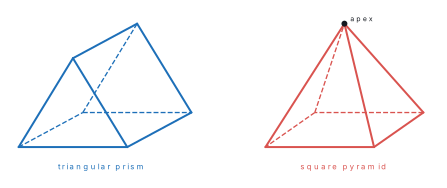
A prism is a solid with two parallel, congruent faces called its bases (top and bottom); the other faces, called lateral surfaces, are rectangles. A prism is named after the shape of its base: triangular prism, rectangular prism (cuboid), and so on.
A pyramid is a solid with a polygon as its base and triangular faces that meet at one common vertex, the apex. It is named after its base: triangular pyramid (tetrahedron), square pyramid, rectangular pyramid, hexagonal pyramid. If the base is a regular polygon, the triangular faces are congruent.
| Solid | Faces | Edges | Vertices |
|---|---|---|---|
| Cube (square prism with all edges equal) | 6 squares | 12 | 8 |
| Cuboid (rectangular prism) | 6 rectangles | 12 | 8 |
| Triangular prism | 5 (2 triangles, 3 rectangles) | 9 | 6 |
| Hexagonal prism | 8 (2 hexagons, 6 rectangles) | 18 | 12 |
| Square pyramid | 5 (1 square, 4 triangles) | 8 | 5 |
| Triangular pyramid (tetrahedron) | 4 triangles | 6 | 4 |
For any such solid, the counts obey Euler's relation:
Check it on the cube: 6+8-12=2 ✓. On the square pyramid: 5+5-8=2 ✓.
Problem. A prism has a base that is a regular octagon. How many faces, edges and vertices does it have? Check with Euler's relation.
Solution. The two ends are octagons, and there is one rectangular face for each of the eight sides. So
Each of the 8 base edges appears at each end, so there are 16 base edges, plus the 8 side edges:
There are 8 vertices at each end:
Check. F+V-E=10+16-24=2 ✓.
16.2 Nets
A net is a flat shape that folds up into a solid. Cutting a net out of card and folding it is the quickest way to be sure you have the right one.
| Solid | Net |
|---|---|
| Cube | six squares in a cross; there are eleven different nets of a cube |
| Cuboid | six rectangles: two of each of the three sizes |
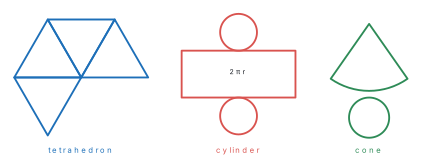
| Triangular prism | two triangles and three rectangles in a row |
| Square pyramid | one square with a triangle attached to each side |
| Cylinder | two circles and one rectangle whose length is the circumference |
| Tetrahedron | four equilateral triangles (a big triangle split into four) |
| Cone | a sector of a circle and one circle |
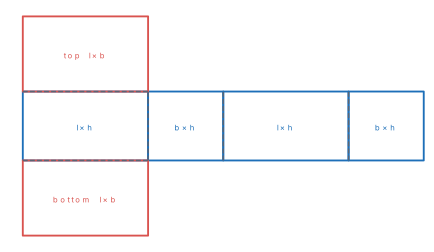
Six squares will not make a cube unless they are joined in one of the eleven correct arrangements. Two squares that overlap when folded, or a gap that cannot close, both give a wrong net. Count the faces first (a cube needs 6, a cuboid 6, a triangular prism 5), then check that the joins can actually fold.
Problem. Explain whether each arrangement of six squares folds into a cube: (a) four squares in a row with one square above the second and one below the second; (b) six squares in a straight row; (c) a 2 × 3 rectangle of squares.
Solution. (a) Yes. The row of four wraps round to form the four side faces, and the squares above and below become the top and bottom.
(b) No. Folding the row closes four faces into a ring; the fifth and sixth squares fall on top of faces already used, and two faces of the cube stay open.
(c) No. Three squares meet at the middle of each long side, so when folded two squares overlap and one face is missing.
16.3 Surface area
The surface area is the total area of every face, and it is what you need to know to buy paint, cloth or cardboard.
| Solid | Surface area |
|---|---|
| Cube of side a | 6a^2 |
| Cuboid l\times b\times h | 2(lb+bh+hl) |
| Triangular prism (base triangle b, height h_t, length L) | 2\times\frac12 b h_t+(\text{perimeter of base})\times L |
| Square pyramid (base side a, slant height l) | a^2+2al |
| Cylinder | 2\pi r(r+h) |
Problem. A closed box measures 20 cm by 15 cm by 10 cm. Find its total surface area and its volume.
Solution. Take l=20, b=15 and h=10 cm.
Answer. 1300 cm² of card; volume 3000 cm³.
Check. The six faces are two of 300 cm², two of 150 cm² and two of 200 cm², giving 600+300+400=1300 ✓. The volume is the base area 300\times the height 10=3000 ✓.
Problem. A cube of side 12 cm is painted all over. Find the area painted, and the volume.
Solution. S=6a^2=6\times144=864 cm².
Answer. 864 cm²; 1728 cm³.
Check. Each face is 12\times12=144 cm², and six of them give 864 ✓.
16.4 Volume of a prism and a pyramid
The factor \frac13 is not a mystery: three pyramids of the same base and height fill exactly one prism. A cube can be cut into three congruent square pyramids with the same apex.
| Solid | Volume |
|---|---|
| Cube of side a | a^3 |
| Cuboid l\times b\times h | lbh |
| Triangular prism (base b, triangle height h_t, length L) | \frac12bh_t\times L |
| Square pyramid (base side a, height h) | \frac13a^2h |
| Cylinder | \pi r^2h |
Problem. A triangular prism has a base that is a right-angled triangle with legs 6 cm and 8 cm, and a length of 15 cm. Find its volume and its total surface area.
Solution. Volume. Area of the triangular base =\frac12\times6\times8=24 cm², so
Surface area. Two triangular ends: 2\times24=48 cm². The hypotenuse is \sqrt{6^2+8^2}=10 cm, so the perimeter of the base is 6+8+10=24 cm and the three rectangular faces total 24\times15=360 cm².
Answer. Volume 360 cm³; surface area 408 cm².
Check. The two triangular ends are 48 of the 408; the three rectangles are 6\times15=90, 8\times15=120 and 10\times15=150, which add to 360 ✓.
Problem. A square pyramid has a base of side 10 m and a height of 12 m. Find its volume.
Solution.
Answer. 400 m³.
Check. The enclosing prism would have volume 100\times12=1200 m³, and a third of it is 400 ✓.
The area of the triangular base is 24 cm². The surface area of the whole prism is 408 cm². The volume is 360 cm³. Substituting a base area where a surface area is wanted, or forgetting to multiply by the length, are the two commonest errors here. Label each quantity with its unit as you work — cm² and cm³ look different, and that is the point.
Chapter summary
- A prism has two identical parallel ends and rectangular sides; a pyramid has one base and triangular sides meeting at an apex.
- F+V-E=2 for every such solid.
- A net is a flat pattern that folds into the solid; a cube has eleven nets.
- Cube surface area 6a^2, volume a^3; cuboid surface area 2(lb+bh+hl), volume lbh.
- Volume of a prism = base area \times length; volume of a pyramid =\frac13\times base area \times height.
- Surface area is in square units, volume in cubic units, and the two are never interchangeable.
Practice questions
Group A — Objective (1 mark each)
- The number of faces of a cuboid is [1]a4b6c8d12
- The number of vertices of a square pyramid is [1]a4b5c6d8
- Volume of a cuboid 5\times4\times3 cm is [1]a12 cm³b47 cm³c60 cm³d94 cm³
- Total surface area of a cube of side 5 cm is [1]a25 cm²b125 cm²c150 cm²d30 cm²
- The volume of a pyramid is that of a prism with the same base and height [1]athe same asbone half ofcone third ofdtwice
- In a triangular prism, the shape of the side faces is [1]atrianglebrectanglecsquaredcircle
Answers to Group A
1. (b) — six rectangular faces.
2. (b) — four at the base plus the apex.
3. (c) — 5\times4\times3=60.
4. (c) — 6\times25=150.
5. (c) — one third.
6. (b) — rectangles joining the two triangular ends.
Group B — Short answer (2 marks each)
- Write the number of faces, edges and vertices of a triangular prism, and check with Euler's relation. [2]
- Find the volume and total surface area of a cuboid 8 cm by 5 cm by 4 cm. [2]
- Find the volume of a square pyramid of base side 6 cm and height 10 cm. [2]
- How much sheet metal is needed for a closed cube of side 25 cm, and what is its volume? [2]
Answers to Group B
1. F=5, E=9, V=6; F+V-E=5+6-9=2 ✓.
2. V=8\times5\times4=160 cm³; S=2(40+20+32)=184 cm².
3. V=\frac13\times36\times10=120 cm³.
4. S=6\times625=3750 cm²; V=25^3=15\,625 cm³.
Group C — Long answer (4 marks each)
- A closed box is 1.2 m long, 80 cm wide and 60 cm high. Find its volume in cubic metres and its total surface area in square metres. How much would it cost to paint the outside at Rs 120 per square metre? [4]
- A water tank is in the shape of a cuboid 2 m by 1.5 m by 1 m. How many litres does it hold? If a bucket holds 15 litres, how many buckets fill the tank? [4]
Answers to Group C
1. Convert everything to metres: l=1.2, b=0.8, h=0.6.
Cost =4.32\times120=\text{Rs }518.40. Check. The six faces are two of 0.96 m², two of 0.48 m² and two of 0.72 m²: 1.92+0.96+1.44=4.32 ✓. 2. V=2\times1.5\times1=3 m³. Since 1 m³ =1000 litres, the tank holds 3000 litres. Number of buckets =3000\div15=200. Check. 200\times15=3000 ✓.
Objective practice
Choose the correct answer. [5×1=5]
1. A cube has edges numbering (a) 6 (b) 8 (c) 12 (d) 16
2. Euler's relation for a solid is (a) F + V - E = 2 (b) F + E - V = 2 (c) F - V + E = 2 (d) F + V + E = 2
3. A triangular prism has faces numbering (a) 4 (b) 5 (c) 6 (d) 9
4. The volume of a cube of edge 6 cm is (a) 36 cm³ (b) 72 cm³ (c) 216 cm³ (d) 108 cm³
5. The total surface area of a cube of edge 5 cm is (a) 25 cm² (b) 125 cm² (c) 150 cm² (d) 100 cm²
Objective practice — answers
1. (c) — 12 edges.
2. (a) — F + V - E = 2.
3. (b) — two triangles and three rectangles.
4. (c) — 6^3 = 216 cm³.
5. (c) — 6 \times 5^2 = 150 cm².
Practise more: Mathematics question bank