Unit 18 · Compulsory Mathematics · 11 min read
Tessellation
What the syllabus asks for 4
- tessellation and its use in design
- regular tessellation
- semi-regular tessellation
- symmetry in tessellation
Tessellation is the covering of a surface with shapes, without gaps and without overlaps. It is the mathematics behind tiled floors, brick walls, honeycomb and much of the decoration on Nepali temples and dhunge dhara spouts. The surprising result of the chapter is that only three regular polygons can do the job on their own, and the reason is a single angle sum.
You should be able to explain what a tessellation is, decide which regular polygons tessellate and prove it with angles, describe a semi-regular tessellation, and identify the symmetry used in a tiling.
18.1 Tessellation
A tessellation, or tiling, is a pattern of shapes that covers a plane completely with no gaps and no overlapping.
The condition is simple. At every vertex where the shapes meet, the angles that come together must fill a full turn:
And each shape that is not at the edge of the pattern must fit its neighbour exactly, so its sides must match. That is all that is needed.
| Kind of tessellation | What it uses |
|---|---|
| Regular | one kind of regular polygon repeated |
| Semi-regular (Archimedean) | two or more kinds of regular polygon, arranged the same way at every vertex |
| Irregular | polygonal tiles that are not regular, often chosen so that copies interlock |
| Monohedral | one tile shape used throughout, transformed by translation, rotation and reflection |
18.2 Which regular polygons tessellate?
At each vertex, k copies of a regular polygon with interior angle \theta must fit, so
We already know the interior angle of a regular n-gon: \theta=\frac{(n-2)180°}{n}.
| Polygon | n | Interior angle | Can it fill 360°? |
|---|---|---|---|
| Equilateral triangle | 3 | 60° | yes — six fit: 6\times60=360 |
| Square | 4 | 90° | yes — four fit: 4\times90=360 |
| Regular pentagon | 5 | 108° | no — 3\times108=324, 4\times108=432 |
| Regular hexagon | 6 | 120° | yes — three fit: 3\times120=360 |
| Regular octagon | 8 | 135° | no — 2\times135=270, 3\times135=405 |
So exactly three regular polygons tessellate on their own: the equilateral triangle, the square and the regular hexagon. The reason each time is that the interior angle divides 360° exactly.
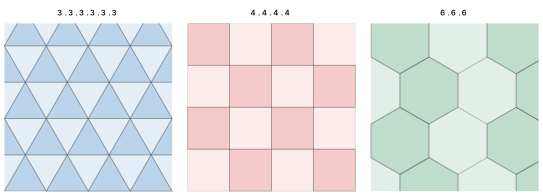
Naming a tessellation. Choose one vertex. Going round it, write the number of sides of each polygon that meets there, separated by dots. So the triangle tessellation is 3.3.3.3.3.3 (six triangles), the square tessellation is 4.4.4.4 and the hexagon tessellation is 6.6.6.
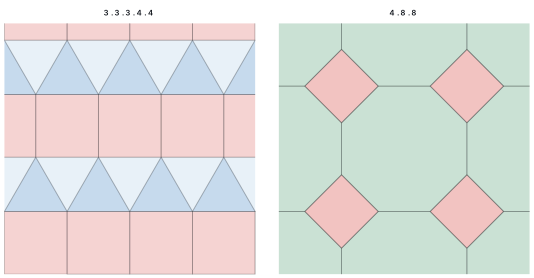
A regular tessellation is made of congruent copies of one regular polygon (3.3.3.3.3.3, 4.4.4.4 and 6.6.6). A semi-regular tessellation is made of two or more kinds of regular polygon, with the same arrangement at every vertex (for example 3.3.3.4.4 or 4.8.8).
Problem. A regular octagon has an interior angle of 135°. Show that it cannot tessellate on its own.
Solution. At a vertex we should need k octagons with
But k must be a whole number, because a whole number of tiles must meet at the vertex. 2\frac23 is impossible.
Checking the nearest whole numbers: 2\times135=270° leaves a gap of 90°, and 3\times135=405° overlaps by 45°.
Answer. A regular octagon cannot tessellate alone. It can be used in a semi-regular tessellation together with a square: 135+135+90=360°, so two octagons and one square meet at every vertex.
Check. 135+135+90=360 ✓, which is exactly the condition.
Problem. Can one regular triangle, one regular hexagon and one square meet at a vertex without a gap?
Solution. The angles are 60°, 120° and 90°. Their sum is
which is less than 360°, so there is a gap of 90° at the vertex. If another square is added, the total becomes 270+90=360° ✓.
Answer. Three tiles alone leave a gap; a triangle, a hexagon and two squares (60+120+90+90) fit exactly.
Check. 60+120+90+90=360 ✓.
A pattern with a tiny gap or a tiny overlap is not a tessellation. This is why the test is arithmetic and not artistic: the angles at a vertex must add to exactly 360°. A sketch that "looks about right" proves nothing.
18.3 Semi-regular tessellations
In a semi-regular tessellation two or more kinds of regular polygon are used, and the arrangement of tiles round every vertex is the same. There are exactly eight of them.
| Vertex arrangement | Angles | Sum |
|---|---|---|
| 3.3.3.3.6 | 4\times60+120 | 360 |
| 3.3.3.4.4 | 3\times60+2\times90 | 360 |
| 3.3.4.3.4 | 60+60+90+60+90 | 360 |
| 3.4.6.4 | 60+90+120+90 | 360 |
| 3.6.3.6 | 60+120+60+120 | 360 |
| 3.12.12 | 60+150+150 | 360 |
| 4.6.12 | 90+120+150 | 360 |
| 4.8.8 | 90+135+135 | 360 |
The notation lists the number of sides of the tiles met, in order, going round the vertex. So 4.8.8 means a square, an octagon and an octagon.
Problem. At every vertex of a semi-regular tessellation there are one equilateral triangle, two squares and one other regular polygon, in the order 3.4.?.4. Find the missing polygon and name the tessellation.
Solution. Angles already used: 60°+90°+90°=240°. Remaining angle =360°-240°=120°, which is the interior angle of a regular hexagon (since \frac{(6-2)\times180°}{6}=120°). The tessellation is 3.4.6.4.
In 4.8.8, the numbers are the sides of the polygons in order round one vertex. Adding the interior angles of those polygons must give 360°: 90+135+135=360 ✓. Use that as the check for any vertex arrangement you meet.
18.4 Symmetry in tessellation
Tessellations are built from the three transformations you already know.
| Transformation | What it does in a tiling |
|---|---|
| Translation | slides the tile to the next position; the commonest in brick and tile patterns |
| Reflection | mirrors the tile across a line, giving a pattern with a mirror symmetry |
| Rotation | turns the tile about a vertex; hexagonal tilings have 6-fold rotation about each vertex |
| Glide reflection | a reflection followed by a slide — found in brick walls and many mandala borders |
A tiling is periodic if a translation by some fixed distance brings the pattern onto itself. Every tiling in this chapter is periodic.
Chapter summary
- A tessellation covers a plane with no gaps and no overlaps; at every vertex the angles add to exactly 360°.
- Exactly three regular polygons tessellate alone: the equilateral triangle (6\times60°), the square (4\times90°) and the regular hexagon (3\times120°).
- A polygon tessellates alone only if its interior angle divides 360° exactly.
- Regular pentagons and octagons cannot tessellate alone; an octagon can be used with a square (135+135+90=360).
- In semi-regular tessellations the same arrangement of two or more regular polygons occurs at every vertex, written as a list such as 4.8.8.
- Tilings use translation, reflection, rotation and glide reflection, and a periodic tiling repeats by translation.
Practice questions
Group A — Objective (1 mark each)
- At a vertex of a tessellation the angles add up to [1]a90°b180°c270°d360°
- The interior angle of a regular hexagon is [1]a60°b90°c108°d120°
- Which regular polygon does not tessellate on its own? [1]atrianglebsquarecpentagondhexagon
- The number of squares meeting at a vertex in a square tessellation is [1]a3b4c5d6
- 4.8.8 means that at a vertex there are [1]atwo squares and an octagonba square and two octagonscfour squares and an octagondeight squares
- The interior angle of a regular octagon is [1]a120°b135°c144°d150°
Answers to Group A
1. (d) — a full turn, else there is a gap or an overlap.
2. (d) — \frac{(6-2)180}{6}=120.
3. (c) — 108° does not divide 360°.
4. (b) — 360\div90=4.
5. (b) — the order is one square then two octagons.
6. (b) — \frac{(8-2)180}{8}=135.
Group B — Short answer (2 marks each)
- Show that an equilateral triangle tessellates and state how many meet at a vertex. [2]
- Why does a regular pentagon fail to tessellate? [2]
- What is a semi-regular tessellation? Give one example of a vertex arrangement. [2]
- Name the transformation that turns one brick in a wall into the next, and the one that makes a mirror pattern. [2]
Answers to Group B
1. The interior angle of an equilateral triangle is 60°, and 360\div60=6, so six triangles meet at each vertex and the angles add to 6\times60=360° ✓.
2. The interior angle of a regular pentagon is 108°. 360\div108=3\frac13, which is not a whole number; three pentagons give 324° and leave a 36° gap, while four overlap. So a pentagon cannot fill the vertex.
3. A tessellation using two or more kinds of regular polygon, in the same arrangement at every vertex. Example: 4.8.8, where one square and two octagons meet, 90+135+135=360°.
4. One brick to the next is a translation (a glide reflection also occurs in a normal brick wall, because alternate courses are offset). A mirror pattern is a reflection.
Group C — Long answer (4 marks each)
- For each of the regular triangle, square, hexagon and octagon, calculate the interior angle, and decide whether it tessellates alone. Show the arithmetic in a table and explain the rule you used. [4]
- Design a semi-regular tessellation using squares and equilateral triangles. Show by angle arithmetic that the arrangement works at every vertex, draw a patch of it, and describe the symmetry of the pattern. [4]
Answers to Group C
1.
| Polygon | Interior angle | 360\div\theta | Tessellates alone? |
|---|---|---|---|
| Triangle | 60° | 6 | yes |
| Square | 90° | 4 | yes |
| Hexagon | 120° | 3 | yes |
| Octagon | 135° | 2\frac23 | no |
Rule. A regular polygon tessellates on its own exactly when \frac{360°}{\text{interior angle}} is a whole number, because a whole number of identical tiles has to meet at each vertex — there can be no part of a tile. 2. Angle arithmetic. Three triangles and two squares: 3\times60+2\times90=180+180=360° ✓. So the arrangement 3.3.3.4.4 works at every vertex. Patch. Draw a row of squares side by side. Along the top edge of the row draw a strip of equilateral triangles (alternately pointing up and down), then another row of squares on top, and so on. Check one vertex: three triangle angles (180°) plus two square angles (180°) fill the point ✓. Symmetry. The pattern repeats by translation both across and upwards, and it has mirror lines — for example the vertical line through the centre of any square.
Extra practice — textbook-style questions
1. A semi-regular tessellation uses one square and two copies of another regular polygon at each vertex. Name the polygon.
2. A vertex has one equilateral triangle, two squares and one other regular polygon. Find the other polygon.
3. Name by vertex notation the tessellation made of regular hexagons only.
Extra practice — answers
1. 360°-90°=270°, shared by two equal angles: 135° each, which is the interior angle of a regular octagon (4.8.8).
2. 360°-60°-90°-90°=120°, the interior angle of a regular hexagon (3.4.6.4).
3. 6.6.6 — three hexagons meet at each vertex (3\times120°=360°).
Objective practice
Choose the correct answer. [5×1=5]
1. A tessellation is an arrangement with (a) gaps only (b) overlaps only (c) no gaps and no overlaps (d) curved tiles only
2. Which regular polygon does not tessellate by itself? (a) equilateral triangle (b) square (c) regular pentagon (d) regular hexagon
3. Three regular hexagons meet at a point because (a) 3 \times 120° = 360° (b) 3 \times 108° = 324° (c) they are curved (d) they are small
4. The number of equilateral triangles meeting at a point in a tessellation is (a) 3 (b) 4 (c) 5 (d) 6
5. A honeycomb is a natural example of a tessellation of (a) squares (b) hexagons (c) pentagons (d) octagons
Objective practice — answers
1. (c) — the plane is covered exactly.
2. (c) — 108° does not divide 360°.
3. (a) — the angles fill 360° exactly.
4. (d) — 6 \times 60° = 360°.
5. (b) — hexagons.
Practise more: Mathematics question bank