Unit 15 · Compulsory Mathematics · 12 min read
Congruency and Similarity
What the syllabus asks for 4
- congruent figures and congruent triangles
- tests of congruence (SSS, SAS, ASA, RHS)
- similar figures and similar triangles
- ratio of areas of similar triangles
Two figures are congruent when they are exactly the same shape and the same size, so that one can be placed on the other and fit perfectly. They are similar when they are the same shape but not necessarily the same size, so that one is an enlargement of the other. Both ideas are tests: given a few measurements, they let you say that two triangles must match without measuring everything.
You should be able to state the five tests of congruence (SSS, SAS, ASA, AAS, RHS), the conditions for two triangles to be similar, use corresponding parts of congruent triangles in a proof, and use the ratio of areas and sides of similar triangles.
15.1 Congruent figures
Two figures are congruent if they have exactly the same shape and size. When triangles ABC and PQR are congruent we write
and the order of the letters matters: it tells you which vertex matches which. So A matches P, B matches Q and C matches R, and therefore AB=PQ, BC=QR, CA=RP, and the corresponding angles are equal.
Corresponding parts of congruent triangles are equal — usually written CPCTC, and used as the reason in every proof of this chapter.
\triangle ABC\cong\triangle PQR says AB corresponds to PQ. If the congruence is really with \triangle QRP, then AB corresponds to QR and the statement is false as written. Examiners deduct for a wrong order even when the figure is right.
15.2 The tests of congruence
To prove two triangles congruent you need only three matched facts, and the three must be in one of these five patterns.
| Test | What must match | Why it works |
|---|---|---|
| SSS | all three sides | only one triangle can be built from three given sides |
| SAS | two sides and the included angle | the angle fixes the shape between the sides |
| ASA | two angles and the side between them | the side and the two angles at its ends fix the triangle |
| AAS | two angles and a side not between them | the third angle is forced (angles add to 180°), so it becomes ASA |
| RHS | a right angle, the hypotenuse and one other side | in a right triangle the third side follows by Pythagoras |
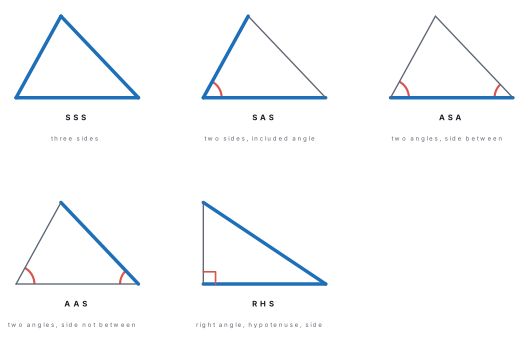
Two sides and a non-included angle do not fix a triangle: two different triangles can often be drawn with the same two sides and the same angle somewhere else. Congruence must be proved with SSS, SAS, ASA, AAS or RHS — never with "SSA", which does not exist.
Problem. In the figure, AB=AC and D is the midpoint of BC. Prove that \triangle ABD\cong\triangle ACD, and hence that AD is perpendicular to BC.
Solution.
Given. AB=AC and BD=DC (D is the midpoint).
To prove. \triangle ABD\cong\triangle ACD and \angle ADB=90°.
Proof.
| Statement | Reason |
|---|---|
| AB=AC | given |
| BD=DC | D is the midpoint of BC |
| AD=AD | common side |
| \triangle ABD\cong\triangle ACD | SSS |
| \angle ADB=\angle ADC | corresponding parts of congruent triangles |
Now \angle ADB+\angle ADC=180°, because BDC is a straight line. Equal angles adding to 180° are each 90°, so \angle ADB=90° and therefore AD\perp BC. ∎
What it shows. In an isosceles triangle the line from the apex to the midpoint of the base is perpendicular to the base — and it also bisects the apex angle, since it makes the two triangles congruent.
Problem. Two triangles have \angle B=\angle Q, \angle C=\angle R and BC=QR. Prove the triangles congruent.
Solution.
Proof. In a triangle the angles add to 180°, so
Since \angle B=\angle Q and \angle C=\angle R, it follows that \angle A=\angle P. We now have \angle B=\angle Q, BC=QR (the side between them) and \angle C=\angle R. Therefore
Note. We never measured \angle A; it was forced by the angle sum. This is why ASA works with only two angles.
Check. The equal side must be the one lying between the two equal angles. Here BC lies between angles B and C ✓.
Problem. \triangle ABC\cong\triangle XYZ with AB=(1.5x-1.5) cm and XY=(x+0.5) cm. Find x and the length of AB.
Solution. Corresponding sides of congruent triangles are equal, so 1.5x-1.5=x+0.5 → 0.5x=2 → x=4. AB=1.5\times4-1.5=4.5 cm (and XY=4+0.5=4.5 cm ✓).
Problem. In the figure, D is the midpoint of AB and CD\perp AB. Prove that \triangle ACD\cong\triangle BCD.
Solution.
| Statement | Reason |
|---|---|
| \angle ADC=\angle BDC=90° | CD\perp AB (given) |
| AD=BD | D is the midpoint of AB |
| CD=CD | common side |
| \triangle ACD\cong\triangle BCD | SAS (side AD, included right angle, side CD) |
So AC=BC (corresponding sides of congruent triangles).
15.3 Similar figures
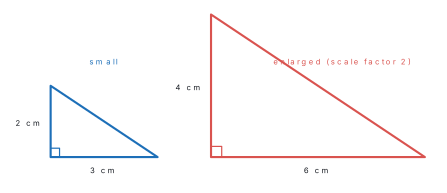
Two figures are similar if they have the same shape, even if they differ in size. One is an enlargement of the other by a fixed scale factor.
For two similar triangles:
- the three angles of one equal the three angles of the other, and
- the three pairs of corresponding sides are in the same ratio.
where k is the scale factor.
Conditions for two triangles to be similar.
| Condition | Meaning |
|---|---|
| AA (or AAA) | two angles of one equal two angles of the other; the third follows |
| SSS similarity | the three pairs of sides are in the same ratio |
| SAS similarity | two pairs of sides are in the same ratio and the included angles are equal |
Problem. Triangles ABC and PQR are similar, with AB=6 cm, BC=9 cm and PQ=4 cm. Find QR.
Solution. Corresponding sides are in the same ratio:
Cross-multiplying: 6\times QR=36, so QR=6 cm.
Answer. 6 cm.
Check. The scale factor is \frac{6}{4}=1.5, and 9\div1.5=6 ✓ — the same answer from the other direction.
Problem. Two similar triangles have corresponding sides in the ratio 2:5. Find the ratio of their areas.
Solution. For similar figures, the ratio of areas is the square of the ratio of corresponding sides:
Answer. 4:25.
Note. The enlarged triangle has sides 2.5 times as long but an area 6.25 times as large. This is why a map of twice the scale needs four times the paper, and why a model house has far less surface than the house it copies.
Two triangles with sides 3, 4, 5 and 6, 8, 10 are similar but not congruent. Every pair of congruent triangles is similar, but the reverse is false. Read the question: "find the length" usually means similar, "prove equal" means congruent.
Problem. In triangles ABC and DEF, \angle A=50°, \angle B=70°, \angle D=50° and \angle E=70°. Prove the triangles similar and write the ratio of corresponding sides.
Solution. Two angles of the first equal two angles of the second: \angle A=\angle D and \angle B=\angle E. So
The third angles are equal too: \angle C=\angle F=180-120=60°. The ratio of corresponding sides is
Check. The matched order is A with D, B with E, C with F — because those are the equal angles. Writing the correspondence in the wrong order gives wrong ratios.
Chapter summary
- Congruent figures have the same shape and size; similar figures have the same shape at different sizes.
- The tests of congruence are SSS, SAS, ASA, AAS and RHS; there is no SSA test.
- The order of the letters in \triangle ABC\cong\triangle PQR gives the correspondence, and corresponding parts of congruent triangles are equal.
- Two triangles are similar if two angles match (AA), or if the three pairs of sides are in the same ratio (SSS similarity), or if two pairs of sides are in the same ratio with equal included angles (SAS similarity).
- In similar triangles, corresponding sides are in the same ratio k and areas are in the ratio k^2.
Practice questions
Group A — Objective (1 mark each)
- Two triangles are congruent if [1]atwo angles are equalball three sides are equalcthey have the same areadthey look alike
- Which of these is not a test of congruence? [1]aSSSbSAScSSAdRHS
- In SAS the given angle must be [1]aany anglebthe largest anglecbetween the two given sidesda right angle
- If two triangles are similar with sides in the ratio 3:4, the ratio of their areas is [1]a3:4b9:16c6:8d4:3
- Two triangles with all three angles equal are [1]aalways congruentbalways similarcnever similardequal in area
- Congruent figures have [1]athe same shape onlybthe same size onlycthe same shape and sizedthe same area only
Answers to Group A
1. (b) — that is the SSS test.
2. (c) — SSA does not determine a triangle uniquely.
3. (c) — the angle must be the included one.
4. (b) — the area ratio is the square of the side ratio.
5. (b) — equal angles give the same shape, hence similarity; sizes may differ.
6. (c) — same shape and same size.
Group B — Short answer (2 marks each)
- State the five tests of congruence, naming the parts each uses. [2]
- \triangle ABC\cong\triangle PQR with AB=7 cm, BC=9 cm and \angle B=55°. Write down the other measurements you can. [2]
- Two similar triangles have corresponding sides 8 cm and 12 cm. Find the scale factor and the ratio of their areas. [2]
- In two triangles \angle A=\angle D=65° and \angle B=\angle E=45°. Prove the triangles similar and state the third pair of equal angles. [2]
Answers to Group B
1. SSS — all three sides. SAS — two sides and the included angle. ASA — two angles and the side between them. AAS — two angles and a side not between them. RHS — the right angle, the hypotenuse and one other side.
2. Because the order of the letters gives the correspondence, P matches A, Q matches B and R matches C. So PQ=AB=7 cm, QR=BC=9 cm, and \angle Q=\angle B=55°. We also know RP=CA, \angle P=\angle A and \angle R=\angle C (with \angle P+\angle R=180°-55°=125°), although their values are not given.
3. Scale factor =\frac{12}{8}=1.5; ratio of areas =\left(\frac{8}{12}\right)^2=\frac{64}{144}=\frac49, that is 4:9.
4. Two angles of one equal two angles of the other, so the triangles are similar by AA. The third pair is \angle C=\angle F=180-(65+45)=70°.
Group C — Long answer (4 marks each)
- In a quadrilateral ABCD, the diagonal AC bisects both \angle A and \angle C. Prove that \triangle ABC\cong\triangle ADC and hence that AB=AD and CB=CD. [4]
- A vertical pole 2 m high casts a shadow 3 m long at the same time as a tower casts a shadow 21 m long. Using similar triangles, find the height of the tower, and state which angles you used. [4]
Answers to Group C
1. Given. \angle BAC=\angle DAC and \angle BCA=\angle DCA (the diagonal bisects both angles). To prove. \triangle ABC\cong\triangle ADC, so AB=AD and CB=CD.
| Statement | Reason |
|---|---|
| \angle BAC=\angle DAC | given, AC bisects \angle A |
| AC=AC | common side |
| \angle BCA=\angle DCA | given, AC bisects \angle C |
| \triangle ABC\cong\triangle ADC | ASA |
| AB=AD and CB=CD | corresponding parts of congruent triangles |
The side AC used in the ASA test is the one lying between the two pairs of equal angles ✓. 2. Let the sun's rays make the same angle with the ground for both objects, so \angle(\text{ray, ground}) is equal; and both the pole and the tower stand vertically, so each makes a right angle with the ground. The two triangles therefore have two equal angles and are similar by AA.
Answer. The tower is 14 m high. Angles used. The right angle at the base of each object and the angle between the sun's ray and the ground — the AA condition. Check. The scale factor of the shadows is 21\div3=7, so the heights must also be in the ratio 7:1, and 14=7\times2 ✓.
Objective practice
Choose the correct answer. [5×1=5]
1. Which test does not prove two triangles congruent? (a) SSS (b) SAS (c) AAA (d) ASA
2. In two similar triangles the corresponding sides are (a) equal (b) proportional (c) perpendicular (d) unrelated
3. Triangles with sides 5, 12, 13 cm and 10, 24, 26 cm are (a) congruent (b) similar only (c) neither (d) equal in area
4. The RHS test applies to (a) all triangles (b) right-angled triangles (c) isosceles triangles (d) equilateral triangles
5. If two figures are congruent then they are (a) also similar (b) never similar (c) similar only if squares (d) equal in perimeter but not area
Objective practice — answers
1. (c) — equal angles fix the shape, not the size.
2. (b) — proportional.
3. (b) — the ratio is 1:2, so similar but not congruent.
4. (b) — right angle, hypotenuse and one side.
5. (a) — congruent figures are similar with ratio 1.
Practise more: Mathematics question bank