Unit 12 · Compulsory Mathematics · 12 min read
Equation and Graph
What the syllabus asks for 4
- linear equations in one variable
- simultaneous linear equations
- inequality and its graph on the number line
- graph of a linear equation
An equation is a balance: whatever you do to one side you must do to the other. A graph is a picture of every pair of values that keeps the balance. Putting the two together turns algebra into something you can see — the point where two lines cross is the solution of the two equations, and an inequality is simply a region of the graph rather than a line.
You should be able to solve a linear equation in one variable, solve two simultaneous linear equations, plot the graph of a linear equation from a table of values, and show an inequality on a number line and read a solution from a graph.
12.1 Linear equations in one variable
A linear equation has the variable to the first power only. Solving means isolating the variable by doing the same thing to both sides.
Method.
- Clear any fractions by multiplying every term by the LCM of the denominators.
- Remove brackets by multiplying out.
- Collect all the variable terms on one side and all the constants on the other.
- Divide by the coefficient of the variable.
- Check by substituting back.
Problem. Solve 3(x-2)+5=2x+4.
Solution. Expand the bracket:
Subtract 2x from both sides and add 1:
Answer. x=5.
Check. Left side: 3(5-2)+5=9+5=14. Right side: 2(5)+4=14 ✓.
Problem. Solve \frac{2x-1}{3}=\frac{x+2}{2}.
Solution. Multiply both sides by the LCM 6:
Answer. x=8.
Check. Left: \frac{16-1}{3}=5. Right: \frac{10}{2}=5 ✓.
12.2 Simultaneous linear equations
Two equations in two unknowns are simultaneous; the solution is the pair of values that satisfies both at once.
12.2.1 The elimination method
Make the coefficients of one variable equal in size, then add or subtract the equations to remove it.
Problem. Solve x+y=10 and x-y=4.
Solution. The coefficients of y are +1 and -1, so adding eliminates y:
Substituting into x+y=10 gives 7+y=10, so y=3.
Answer. x=7, y=3.
Check. 7+3=10 ✓ and 7-3=4 ✓.
Problem. Solve 2x+3y=13 and 3x-2y=0.
Solution. Step 1 — make the x coefficients equal. Multiply the first equation by 3 and the second by 2:
Step 2 — subtract.
Step 3 — substitute. From 3x-2y=0: 3x=6, so x=2.
Answer. x=2, y=3.
Check. 2(2)+3(3)=4+9=13 ✓ and 3(2)-2(3)=0 ✓.
12.2.2 The substitution method
Make one variable the subject of one equation and put it into the other.
Problem. Solve y=2x+1 and 3x+y=11.
Solution. y is already the subject, so substitute:
Then y=2(2)+1=5.
Answer. x=2, y=5.
Check. 5=2(2)+1 ✓ and 3(2)+5=11 ✓.
Problem. The sum of two numbers is 25 and their difference is 7. Find the numbers.
Solution. Let the numbers be x and y, with x>y. Then
Adding: 2x=32, so x=16; then y=25-16=9.
Answer. 16 and 9.
Check. 16+9=25 ✓ and 16-9=7 ✓.
When you subtract one equation from another, every term of the subtracted equation changes sign. From 6x+9y=39 minus 6x-4y=0 you get 13y=39, but only if the second equation is read as -(6x-4y)=-6x+4y. Writing 9y-4y=5y is the classic error. Subtract in brackets, every time.
12.3 The graph of a linear equation
An equation such as y=2x+1 has infinitely many solutions — one for each value of x. Plotting them all gives a straight line, and two points are enough to fix it (a third is a check).
Method.
- Make a table of values, choosing convenient values of x (often -1, 0, 1, 2).
- Plot the points on graph paper.
- Join them with a straight line and label it with its equation.
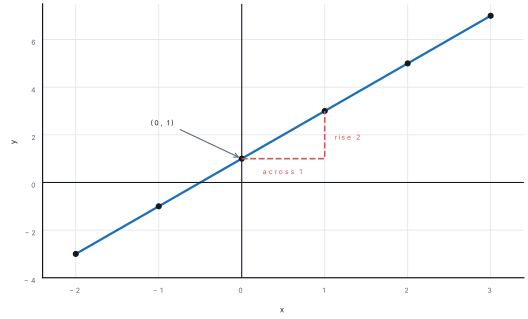
| Table for y=2x+1 | ||||
|---|---|---|---|---|
| x | -1 | 0 | 1 | 2 |
| y | -1 | 1 | 3 | 5 |
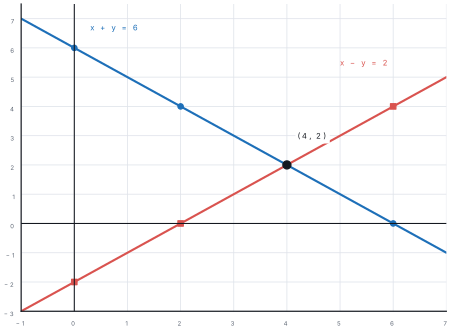
Problem. Draw the graphs of x+y=6 and y=x-2 on the same axes and read off the solution.
Solution. Table for x+y=6, that is y=6-x: when x=0, y=6; when x=2, y=4; when x=6, y=0. Table for y=x-2: when x=0, y=-2; when x=2, y=0; when x=6, y=4.
Plot both lines. They cross at (4,2).
Answer. x=4, y=2.
Check. 4+2=6 ✓ and 2=4-2 ✓. At the crossing point both equations hold, which is exactly what the solution means.
Problem. A father's present age is 10 years more than twice his daughter's age. The difference between their ages is 25 years. Find their ages by the graphical method.
Solution. Let the father be x years and the daughter y years. x=2y+10 … (i) and x-y=25 … (ii).
| From (i), x=2y+10 | |||
|---|---|---|---|
| y | 0 | 5 | 15 |
| x | 10 | 20 | 40 |
| From (ii), x=y+25 | |||
|---|---|---|---|
| y | 0 | 5 | 15 |
| x | 25 | 30 | 40 |
Plotting both lines, they meet at the point where y=15, x=40.
Answer. Father 40 years, daughter 15 years. Check. 2\times15+10=40 ✓ and 40-15=25 ✓.
Drawing a graph takes five minutes and gives the answer only as accurately as your paper allows. Use the elimination or substitution method to get the exact answer, and draw the graph to confirm that the two lines really do meet at that point. The examiner is looking for both.
12.4 Inequality and its graph
An inequality compares two expressions with <, >, \le or \ge. It is solved exactly like an equation, with one important exception.
From -2x>6 the solution is x<-3, not x>-3. Dividing by -2 flips the inequality sign. This does not happen when you add or subtract, only when you multiply or divide by a negative number.
Drawing the solution on a number line.
- For x<3, draw an open circle at 3 and shade to the left.
- For x\le3, draw a filled circle at 3 and shade to the left.
- For x\ge-1, draw a filled circle at -1 and shade to the right.
Problem. Solve 3x-5\le7 and show the solution on a number line.
Solution. Add 5 to both sides: 3x\le12. Divide by 3 (positive, so the sign does not change): x\le4.
On the number line, put a filled circle at 4 and shade everything to the left, including 4.
Check. Try x=4: 3(4)-5=7\le7 ✓ (allowed, because of the \le sign). Try x=5: 15-5=10>7 ✗, correctly outside the shaded region.
Problem. Solve 5-2x<11 and graph the solution.
Solution. Subtract 5: -2x<6. Divide by -2, reversing the sign: x>-3.
On the number line, put an open circle at -3 and shade to the right.
Check. Try x=0: 5-0=5<11 ✓, and 0 is inside the region. Try x=-4: 5+8=13<11 is false ✗, correctly excluded.
12.5 Quadratic equations by factorisation
An equation such as x-4=0 is linear (highest power of x is 1). An equation in one variable whose highest power is 2, written ax^2+bx+c=0 with a\ne0, is a quadratic equation. It usually has two solutions, called its roots.
Key fact. If the product of two factors is zero, at least one of them is zero: if pq=0 then p=0 or q=0.
Method. Bring everything to one side (=0), factorise, set each factor equal to zero and solve.
Problem. Solve (a) x^2-6x+8=0 (b) 4x^2-25=0 (c) x^2-3x=0.
Solution. (a) x^2-4x-2x+8=0 → x(x-4)-2(x-4)=0 → (x-4)(x-2)=0. Either x-4=0, so x=4; or x-2=0, so x=2. Roots: 4 and 2.
(b) (2x)^2-5^2=0 → (2x+5)(2x-5)=0. Either 2x+5=0, so x=-\frac52; or 2x-5=0, so x=\frac52. x=\pm2\frac12.
(c) x(x-3)=0, so x=0 or x=3.
Check (a). 4^2-6(4)+8=16-24+8=0 ✓ and 2^2-12+8=0 ✓.
In x^2-3x=0, dividing both sides by x gives only x=3 and loses the root x=0. Factorise instead.
Problem. Find the quadratic equation whose roots are 2 and 3.
Solution. x=2 gives x-2=0 and x=3 gives x-3=0. So
(x-2)(x-3)=0 → x^2-3x-2x+6=0 → x^2-5x+6=0.
Chapter summary
- Two simultaneous equations are solved graphically by plotting both lines; the point where they cross gives x and y.
-
A quadratic equation ax^2+bx+c=0 is solved by factorising and putting each factor equal to zero; roots p, q give (x-p)(x-q)=0.
-
A linear equation is solved by clearing fractions, expanding brackets, collecting like terms and dividing by the coefficient.
- Simultaneous equations are solved by elimination (make one coefficient match, then add or subtract) or substitution (make one variable the subject).
- A linear equation has infinitely many solutions, and its graph is a straight line; two points fix the line and a third checks it.
- The solution of two simultaneous equations is the coordinates of the point where their graphs cross.
- An inequality is solved like an equation, but multiplying or dividing by a negative number reverses the sign.
- On a number line, an open circle means the value is excluded and a filled circle means it is included.
Practice questions
Group A — Objective (1 mark each)
- The solution of x+7=12 is [1]a5b-5c19d-19
- If 2x=18, then x is [1]a36b9c16d\frac{1}{9}
- The solution of x+y=12, x-y=2 is [1]ax=7, y=5bx=5, y=7cx=6, y=6dx=10, y=2
- The graph of y=3x-2 crosses the y-axis at [1]a(0,-2)b(-2,0)c(0,3)d(3,0)
- The solution of -3x>9 is [1]ax>3bx<-3cx>-3dx<3
- The point (1,4) lies on the line [1]ay=x+3by=2x-1cy=3x+1dy=4x-1
Answers to Group A
1. (a) — subtract 7 from both sides.
2. (b) — divide by 2.
3. (a) — adding gives 2x=14, so x=7 and y=5.
4. (a) — put x=0.
5. (b) — dividing by -3 reverses the sign.
6. (a) — 1+3=4 ✓.
Group B — Short answer (2 marks each)
- Solve 5x-3=2x+9. [2]
- Solve x+y=15, x-y=3. [2]
- Solve \frac{x}{3}+\frac{x}{4}=7. [2]
- Solve 2x+5\ge11 and show the solution on a number line. [2]
Answers to Group B
1. 3x=12, so x=4.
2. Adding: 2x=18, so x=9 and y=6.
3. Multiply by 12: 4x+3x=84, so 7x=84 and x=12.
4. 2x\ge6, so x\ge3: a filled circle at 3 with the shading to the right.
Group C — Long answer (4 marks each)
- Solve 3x+2y=16 and 2x-y=6 by the elimination method, and check both equations. [4]
- The sum of the ages of a father and his son is 48 years. In 6 years the father will be three times as old as the son. Find their present ages. [4]
Answers to Group C
1. Step 1 — make the y coefficients match. The second equation times 2 gives 4x-2y=12. Step 2 — add (the y terms have opposite signs):
Step 3 — substitute into 2x-y=6: 8-y=6, so y=2. Answer. x=4, y=2. Check. 3(4)+2(2)=12+4=16 ✓ and 2(4)-2=6 ✓. 2. Let the father's age be f and the son's s years.
In 6 years the father is f+6 and the son s+6, and f+6=3(s+6), that is f=3s+12. Substituting into the first equation: 3s+12+s=48, so 4s=36 and s=9; then f=48-9=39. Answer. The father is 39 and the son is 9. Check. In 6 years they are 45 and 15, and 45=3\times15 ✓.
Extra practice — textbook-style questions
1. Solve graphically: x+y=5, x-y=3.
2. Solve: (a) x^2+x-6=0 (b) 9y^2-16=0 (c) 2x^2-x=0.
3. Find the quadratic equation whose roots are -1 and 2.
4. There are cats and hens in a yard: 10 heads and 26 legs in all. How many of each?
Extra practice — answers
1. For y=5-x: (0, 5), (5, 0); for y=x-3: (3, 0), (5, 2). The lines meet at (4,1), so x=4, y=1. Check: 4+1=5, 4-1=3 ✓.
2. (a) (x+3)(x-2)=0, x=-3 or 2. (b) (3y+4)(3y-4)=0, y=\pm\frac43. (c) x(2x-1)=0, x=0 or \frac12.
3. (x+1)(x-2)=0, i.e. x^2-x-2=0.
4. Cats c, hens h: c+h=10, 4c+2h=26. Subtracting twice the first: 2c=6, so c=3, h=7. Check: 12+14=26 legs ✓.
Objective practice
Choose the correct answer. [5×1=5]
1. The solution of 4x - 9 = 2x + 7 is (a) 4 (b) 8 (c) 16 (d) -8
2. The slope of the line y = -2x + 5 is (a) 5 (b) -2 (c) 2 (d) -5
3. The line y = 3x - 6 cuts the y-axis at (a) (0,3) (b) (0,-6) (c) (2,0) (d) (-6,0)
4. If \frac{x}{5} + 2 = 7, then x is (a) 15 (b) 20 (c) 25 (d) 45
5. The graph of y = 4 is a line that is (a) parallel to the x-axis (b) parallel to the y-axis (c) through the origin (d) slanting
Objective practice — answers
1. (b) — 2x = 16, so x = 8.
2. (b) — the coefficient of x.
3. (b) — put x = 0.
4. (c) — \frac{x}{5} = 5, so x = 25.
5. (a) — every point has y = 4, so it is horizontal.
Practise more: Mathematics question bank