Unit 4 · Compulsory Mathematics · 13 min read
Ratio and Proportion
What the syllabus asks for 5
- ratio and its simplification
- proportion: means and extremes
- continued proportion
- direct and inverse proportion
- word problems of ratio and proportion
A ratio compares two quantities of the same kind; a proportion says that two ratios are equal. These two ideas are behind almost every practical calculation — sharing a profit, mixing mortar, reading a map, or working out how much rice a family of six needs for a month. This chapter works through the definitions, then the two kinds of variation that make the difference between a sum that takes one line and a sum that is done backwards.
You should be able to write a ratio in its lowest terms, divide a quantity in a given ratio, test whether four numbers are in proportion, find the fourth proportional and the mean proportional, and solve direct and inverse variation problems.
4.1 Ratio
A ratio compares two quantities of the same kind by division. The ratio of a to b is written a:b and read "a is to b", where
The two quantities must be in the same unit. A ratio has no unit, because it is one quantity divided by another of the same kind.
| Statement | Ratio |
|---|---|
| 15 kg to 25 kg | 15:25=3:5 |
| 500 m to 2 km | 500:2000=1:4 (convert to the same unit first) |
| 45 minutes to 2 hours | 45:120=3:8 |
Simplification. Divide every term by their highest common factor. A ratio is usually written with whole numbers and in its lowest terms.
A ratio of 500 m to 2 km must be written 500:2000, not 500:2. Comparing a number of metres with a number of kilometres is comparing two different things and gives a meaningless ratio — the commonest single error in this chapter.
4.1.1 Dividing a quantity in a given ratio
Add the terms of the ratio to find the number of equal parts, then give each share as its term out of that total.
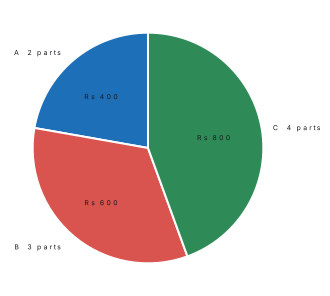
Problem. Two partners invest Rs 60,000 and Rs 90,000 and make a profit of Rs 45,000, shared in the ratio of their investments. Find each partner's share.
Solution. The ratio of investments is
The total number of parts is 2+3=5. Each part is worth
The shares are 2\times9000=\text{Rs }18\,000 and 3\times9000=\text{Rs }27\,000.
Check. 18\,000+27\,000=45\,000 ✓, and 18\,000:27\,000=2:3 ✓.
Problem. A sum of Rs 2,400 is to be divided among three people in the ratio 3:4:5. Find each share.
Solution. Total parts =3+4+5=12, so one part is 2400\div12=\text{Rs }200.
Check. 600+800+1000=2400 ✓.
4.1.2 Word problems on ratio
The usual method: write the quantities as ax and bx (the ratio times a common multiplier x), form an equation from the condition, and solve for x.
Problem. Mohammad and Abdul invested in a factory in the ratio 2:3. If Mohammad invested Rs 2,00,000, how much did Abdul invest?
Solution. Let the investments be 2x and 3x. 2x=2\,00\,000, so x=1\,00\,000. Abdul's investment =3x=3\times1\,00\,000= Rs 3,00,000.
Problem. The present ages of Bishal and Dhaniya are in the ratio 4:5. After 4 years the ratio will be 5:6. Find their present ages.
Solution. Let the present ages be 4x and 5x years. After 4 years they are 4x+4 and 5x+4.
Cross-multiplying: 6(4x+4)=5(5x+4), so 24x+24=25x+20, giving x=4.
Bishal =4\times4= 16 years, Dhaniya =5\times4= 20 years.
Check. After 4 years: 20:24=5:6 ✓.
Problem. The angles of a triangle are in the ratio 2:3:4. Find them.
Solution. Let the angles be 2x, 3x, 4x. The angles of a triangle add to 180°: 2x+3x+4x=180°, so 9x=180° and x=20°. The angles are 40°, 60° and 80°.
Problem. What number must be added to 4 and 5 so that their ratio becomes 5:6?
Solution. Let the number be y. Then \frac{4+y}{5+y}=\frac56. 6(4+y)=5(5+y) → 24+6y=25+5y → y=1.
Check. \frac{4+1}{5+1}=\frac56 ✓.
4.2 Proportion
Four quantities a, b, c, d are in proportion if
In the statement a:b=c:d, the outer terms a and d are the extremes and the inner terms b and c are the means. The fundamental property of a proportion is
Three quantities a, b, c are in continued proportion if a:b=b:c, so that b^2=ac. Then b is the mean proportional between a and c, and
Problem. Are (a) 4, 6, 10, 15 and (b) 3, 5, 6, 12 in proportion?
Solution. (a) Extremes: 4\times15=60; means: 6\times10=60. Equal, so yes. (b) Extremes: 3\times12=36; means: 5\times6=30. Not equal, so no.
Problem. Find x if 6:9=10:x.
Solution. By the property of proportion, the product of the extremes equals the product of the means:
Answer. x=15.
Check. 6:9=2:3 and 10:15=2:3 ✓. The two ratios are equal.
Problem. Find the mean proportional between 4 and 25.
Solution. If b is the mean proportional, then b^2=4\times25=100, so b=10 (taking the positive root, since lengths are positive).
Answer. 10.
Check. 4:10=2:5 and 10:25=2:5 ✓, so 4, 10 and 25 are in continued proportion.
Problem. If \frac{x}{5}=\frac{12}{20}, find x.
Solution. Cross-multiplying: 20x=5\times12=60, so x=3.
Answer. x=3.
Check. \frac{3}{5}=0.6 and \frac{12}{20}=0.6 ✓. Notice that 12:20=3:5 — the second ratio was already the first in disguise.
4.3 Direct and inverse variation
Two quantities are in direct variation when they increase or decrease together in the same ratio, written x\propto y and x=ky.
| Direct variation | Inverse variation |
|---|---|
| x\propto y, so x=ky | x\propto\frac1y, so x=\frac{k}{y} |
| \frac{x_1}{y_1}=\frac{x_2}{y_2} | x_1y_1=x_2y_2 |
| more goods, more money | more workers, less time |
| more days, more wages | faster speed, less time |
| more rice, more people fed | more taps, less time to fill a tank |
| constant is the unit rate | constant is the total work |
The constant k is found from the pair of values given in the problem; once it is known, the second pair can be calculated.
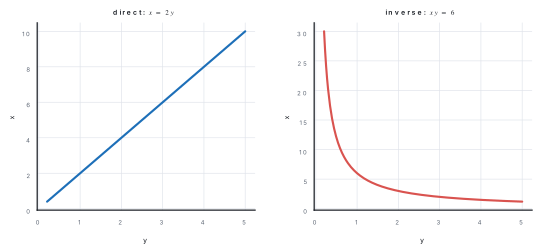
Problem. If 5 kg of rice costs Rs 400, what will 8 kg cost?
Solution. More rice costs more money, so this is direct variation. Find the cost of 1 kg first:
Then 8\times80=\text{Rs }640.
Answer. Rs 640.
Check. 400:640=5:8 ✓, which is the ratio of the quantities. The unit rate is the constant of variation.
Problem. Six workers can build a wall in 12 days. How long will 9 workers take, working at the same rate?
Solution. More workers means less time, so this is inverse variation, and the total work is constant:
With 9 workers, the time is
Answer. 8 days.
Check. 6\times12=9\times8=72 ✓. Note the answer is less than 12, which is what "more workers" must give — a quick way to catch a reversed calculation.
Ask the question in words: if one quantity gets bigger, does the other get bigger or smaller? Bigger–bigger means direct, bigger–smaller means inverse. Almost every lost mark in this chapter comes from setting up a direct variation when the quantities move in opposite directions.
4.4 Map scale and similar figures
A map scale is a ratio of a length on the map to the real length, with both in the same unit. A scale of 1:50\,000 means 1 cm on the map represents 50 000 cm, that is 500 m or 0.5 km, on the ground.
Problem. On a map with scale 1:25\,000, two towns are 6 cm apart. Find the real distance in kilometres.
Solution. The real distance is 6\times25\,000=150\,000 cm.
Answer. 1.5 km.
Check. At this scale, 1 cm represents 25\,000 cm =0.25 km, so 6 cm is 6\times0.25=1.5 km ✓.
4.5 Sharing in a given ratio
| Task | Method |
|---|---|
| Simplify a ratio | divide both terms by their HCF; make units the same first |
| Share x in m:n | shares are \frac{m}{m+n}x and \frac{n}{m+n}x |
| Compound ratio of a:b and c:d | ac : bd |
| Mean proportional between a and b | \sqrt{ab} |
| Check a proportion a:b = c:d | ad = bc (product of extremes = product of means) |
Question. Rs 7,000 is shared among A, B and C so that A : B = 2 : 3 and B : C = 4 : 5. Find each share.
Answer. Make the B-terms equal (LCM of 3 and 4 is 12). A : B = 2:3 = 8:12; B : C = 4:5 = 12:15. So A : B : C = 8 : 12 : 15, giving 8 + 12 + 15 = 35 parts. One part = \frac{7000}{35} = Rs 200. A = 8\times200= Rs 1,600, B = 12\times200= Rs 2,400, C = 15\times200= Rs 3,000.
Check: 1600+2400+3000=7000 ✓.
Take a simple recipe (say, rice and water in the ratio 1 : 2, or tea with milk, water and sugar). Write the ratio, then scale it for 4 people and for 15 people. Cook or prepare it if you can, and compare with the recipe for one. Discussion: Which ingredients scale in direct proportion and which do not (spices, cooking time)?
Chapter summary
- A ratio compares two quantities of the same kind and has no unit; write both in the same unit and simplify by the HCF.
- To divide a quantity in the ratio a:b:c, add the terms, find one part, then multiply.
- Four quantities are in proportion if a:b=c:d, which holds exactly when ad=bc.
- Three quantities are in continued proportion if a:b=b:c, and then the mean proportional is b=\sqrt{ac}.
- Direct variation: x\propto y, x=ky, \frac{x_1}{y_1}=\frac{x_2}{y_2}; both quantities rise together.
- Inverse variation: x\propto\frac1y, xy=k, x_1y_1=x_2y_2; one rises as the other falls.
- A map scale is a ratio, so both lengths must be converted to the same unit before multiplying.
Practice questions
Group A — Objective (1 mark each)
- The ratio 250 g to 1 kg in its lowest terms is [1]a250:1b1:4c4:1d1:250
- If a:b=c:d, then [1]aab=cdbad=bccac=bdda+b=c+d
- The mean proportional between 9 and 16 is [1]a12b25c144d7
- More workers, less time is an example of [1]adirect variationbinverse variationcproportiondcontinued proportion
- If 3 pens cost Rs 45, then 7 pens cost [1]aRs 90bRs 105cRs 135dRs 63
- On a map of scale 1:100\,000, 3 cm represents [1]a3 kmb30 kmc0.3 kmd300 km
Answers to Group A
1. (b) — 250:1000=1:4.
2. (b) — the product of the extremes equals the product of the means.
3. (a) — \sqrt{9\times16}=12.
4. (b) — one quantity rises as the other falls.
5. (b) — one pen is Rs 15, so seven cost Rs 105.
6. (a) — 3\times100\,000=300\,000 cm =3 km.
Group B — Short answer (2 marks each)
- Express the ratio 45\text{ min}:2\text{ hr} in its lowest terms. [2]
- Find x if x:8=9:12. [2]
- Divide Rs 5,400 in the ratio 2:3:4. [2]
- If 8 men can do a job in 15 days, how long will 12 men take? [2]
Answers to Group B
1. 45:120=3:8.
2. 12x=72, so x=6.
3. Total parts =9, one part =600; shares Rs 1200, Rs 1800 and Rs 2400.
4. Total work =8\times15=120 man-days; with 12 men the time is 120\div12=10 days.
Group C — Long answer (4 marks each)
- A sum of money is divided between two brothers in the ratio 5:7. If the elder brother receives Rs 8,400, find the total sum and the younger brother's share. [4]
- A truck covers a certain distance in 6 hours at 40 km/h. How long will it take at 60 km/h? State what kind of variation this is, find the constant, and verify the answer. [4]
Answers to Group C
1. The elder brother's share is the 7-part share: 7\text{ parts}=\text{Rs }8400, so 1 part =8400\div7=\text{Rs }1200. The younger brother gets 5\times1200=\text{Rs }6000, and the total is 6000+8400=\text{Rs }14\,400. Check. 6000:8400=5:7 ✓ and 6000+8400=14\,400 ✓.
2. Kind. Faster speed means less time, so this is inverse variation (\text{speed}\times\text{time}= constant distance). Constant. The distance is 40\times6=240 km. Time at 60 km/h. 240\div60=4 hours. Verify. 40\times6=240 and 60\times4=240 ✓ — the product is the same, as inverse variation requires, and the time fell from 6 hours to 4 as the speed rose.
Extra practice — textbook-style questions
1. Find the ratio of (a) 3 kg and 80 g (b) 2 hours and 45 minutes (c) Rs 5 and 90 paisa.
2. A map is drawn to a scale 1:4000. Two places are 4 cm apart on the map. Find the real distance.
3. Two numbers are in the ratio 3:4. If 5 is added to each, the ratio becomes 4:5. Find the numbers.
4. What should be subtracted from 24 and 30 to make the ratio 2:3?
5. If 12 notebooks cost Rs 600, how many notebooks can be bought for Rs 900?
6. Find the mean proportional between 8 and 18.
Extra practice — answers
1. (a) 3000:80=75:2 (b) 120:45=8:3 (c) 500:90=50:9.
2. 4\times4000=16\,000 cm =160 m.
3. \frac{3x+5}{4x+5}=\frac45 → 15x+25=16x+20 → x=5; the numbers are 15 and 20. Check: 20:25=4:5 ✓.
4. \frac{24-y}{30-y}=\frac23 → 72-3y=60-2y → y=12. Check: 12:18=2:3 ✓.
5. \frac{600}{900}=\frac{12}{x} → x=\frac{900\times12}{600}=18 notebooks.
6. \sqrt{8 \times 18} = \sqrt{144} = 12.
Objective practice
Choose the correct answer. [5×1=5]
1. If 4:7=x:35, then x is (a) 15 (b) 20 (c) 25 (d) 28
2. The mean proportional between 9 and 16 is (a) 12 (b) 12.5 (c) 25 (d) 144
3. Rs 960 shared in the ratio 5:7 gives the larger share (a) Rs 400 (b) Rs 480 (c) Rs 560 (d) Rs 600
4. The compound ratio of 3:4 and 2:5 is (a) 5:9 (b) 3:10 (c) 6:9 (d) 1:20
5. 40 minutes : 2 hours in simplest form is (a) 40:2 (b) 1:3 (c) 2:5 (d) 1:5
Objective practice — answers
1. (b) — x=\frac{4\times35}{7}=20.
2. (a) — \sqrt{144}=12.
3. (c) — \frac{7}{12}\times960=560.
4. (b) — \frac{6}{20}=3:10.
5. (b) — 40:120=1:3.
Practise more: Mathematics question bank