Unit 19 · Compulsory Mathematics · 11 min read
Transformation
What the syllabus asks for 4
- translation
- reflection and axes of reflection
- rotation about a point
- enlargement and scale factor
A transformation moves a shape without changing what it is made of. Slide a booking form across the desk, look at it in the mirror, spin it round, or make a photocopy at 150 % — those are the four transformations of this chapter: translation, reflection, rotation and enlargement. The first three leave the shape the same size; the fourth changes it, and everything about the arithmetic of enlargement follows from one ratio.
You should be able to describe a translation as a vector, reflect a point or a figure in the axes and in simple lines, rotate a figure about a point through 90°, 180° or 270°, enlarge a figure by a given scale factor, and state the coordinates of the image in each case.
19.1 Translation
A translation slides every point of a figure the same distance in the same direction. Nothing is turned, nothing is flipped and the size does not change, so the image is congruent to the object.
A translation is described by a pair of numbers: a movement of a units in the x-direction and b units in the y-direction, written as the column (a,b) read downwards.
Problem. Translate the point A(2,3) by 4 units to the right and 5 units down. Find the image, and translate the same point 3 units left and 2 units up.
Solution. Right and down: (2+4,\;3-5)=(6,-2).
Left and up: (2-3,\;3+2)=(-1,5).
Answer. (6,-2) and (-1,5).
Check. For the first, the point moves from quadrant I into quadrant IV, because it has gone down past the x-axis: 3-5=-2 ✓. For the second, it moves from quadrant I into quadrant II, because x becomes negative ✓.
Problem. A triangle has vertices A(1,1), B(4,1), C(1,3). Find the vertices of its image under a translation of 2 units right and 3 units up, and say what kind of figure the image is.
Solution.
The image has a horizontal side A'B' of length 3 and a vertical side A'C' of length 2, exactly as the original.
Answer. A'(3,4), B'(6,4), C'(3,6); a right-angled triangle congruent to the original.
Check. AB=4-1=3 and A'B'=6-3=3 ✓; the side lengths are unchanged, as a translation must leave them.
Sliding a shape to the right does not change which way it faces. A common error is to "translate" a figure and draw it turned round. Check that the image is parallel to the object: the corresponding sides must point in the same directions.
19.2 Reflection
A reflection flips a figure across a line, the mirror line or axis. The image is congruent to the object, but the two face opposite ways.
| Mirror line | Rule | Example: (2,5) goes to |
|---|---|---|
| x-axis (y=0) | y changes sign | (2,-5) |
| y-axis (x=0) | x changes sign | (-2,5) |
| line y=x | coordinates swap | (5,2) |
| line y=-x | coordinates swap and both change sign | (-5,-2) |
| line x=a | x becomes 2a-x | for x=3: (4,5) |
| line y=b | y becomes 2b-y | for y=1: (2,-3) |
A point on the mirror line does not move at all — it is its own image.
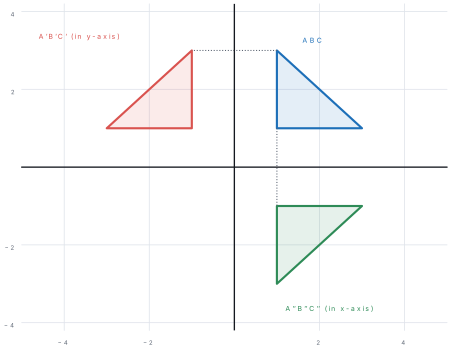
Problem. A triangle has vertices A(2,1), B(5,1), C(2,4). Reflect it in the x-axis and then in the y-axis, and give the coordinates of both images.
Solution. In the x-axis, y changes sign:
In the y-axis, x changes sign:
Answer. As above.
Check. AB=3 and A'B'=5-2=3 ✓; A''B''=3 ✓. Reflection never changes lengths.
Problem. Find the image of P(3,7) in the line y=x and show that the mirror line passes through the midpoint of PP'.
Solution. Reflection in y=x swaps the coordinates, so P'=(7,3).
Midpoint of PP' =\left(\frac{3+7}{2},\frac{7+3}{2}\right)=(5,5), and (5,5) lies on y=x ✓.
19.3 Rotation
A rotation turns a figure about a fixed point, the centre of rotation, through a given angle and in a given direction (clockwise or anticlockwise). The image is congruent to the object, and the orientation changes.
Three things describe a rotation: the centre, the angle and the direction. Anticlockwise is the positive direction (+90°) and clockwise (the way the hands of a clock move) is the negative direction (-90°).
Drawing a rotation with protractor and compasses. To rotate A through +90° about O: join OA; at O draw \angle AOB=90° anticlockwise; with centre O and radius OA cut OB at A'. Then A' is the image.
The rotations most often asked for are about the origin O(0,0).
| Rotation about the origin | Rule | (3,2) goes to |
|---|---|---|
| +90° (anticlockwise) | (-y,x) | (-2,3) |
| 180° | (-x,-y) | (-3,-2) |
| -90° (clockwise) | (y,-x) | (2,-3) |
| 270° anticlockwise | (y,-x) | (2,-3) |
Problem. A point A(3,2) is rotated about the origin through 90° anticlockwise. Find the image. Then rotate the same point through 180°.
Solution. For 90° anticlockwise, (x,y)\to(-y,x):
For 180°, (x,y)\to(-x,-y):
Check. In every rotation about the origin, the distance from the origin does not change: OA=\sqrt{9+4}=\sqrt{13}, OA'=\sqrt{4+9}=\sqrt{13} ✓ and OA''=\sqrt{9+4}=\sqrt{13} ✓. That is the quickest test that a rotation has been done correctly.
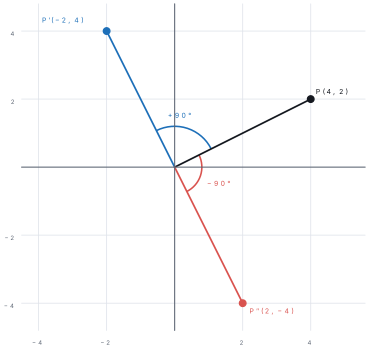
Problem. The vertices of a triangle are A(1,0), B(3,0), C(1,2). Rotate it 90° anticlockwise about the origin and give the image.
Solution. Apply (-y,x) to each vertex:
Check. AB=2 and A'B'=3-1=2 ✓; AC=2 and A'C'=2 ✓. The sides are unchanged, and the right angle at A is still a right angle at A' ✓.
A 90° clockwise rotation and a 270° anticlockwise rotation give the same image, but a 90° anticlockwise rotation does not. Read the direction, and check the sign of the result against the quadrant it should land in: starting from (3,2) in quadrant I and turning anticlockwise, the image must be in quadrant II, so (-2,3) is right and (2,-3) would be wrong.
19.4 Enlargement
An enlargement changes the size of a figure by a scale factor k about a centre of enlargement. The image is similar to the object, not congruent (unless k=1).
For an enlargement with centre the origin and scale factor k:
| Scale factor | Effect |
|---|---|
| k>1 | the figure grows |
| 0<k<1 | the figure shrinks |
| k=1 | the figure is unchanged |
| k negative | the image is on the other side of the centre and inverted |
With a scale factor k:
- every length of the image =k\times the corresponding length of the object;
- the area of the image =k^2\times the area of the object.
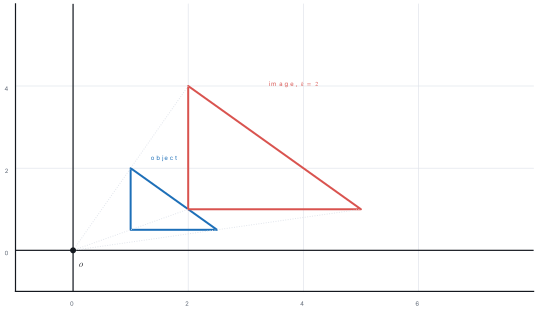
Problem. A triangle has vertices A(1,1), B(3,1), C(1,2). Enlarge it with centre the origin and scale factor 3. Find the image and the ratio of the areas.
Solution. Multiply every coordinate by 3:
The object's area is \frac12\times2\times1=1 square unit, and the image's area is \frac12\times6\times3=9 square units.
Answer. A'(3,3), B'(9,3), C'(3,6); areas are in the ratio 1:9, which is 1^2:3^2.
Check. A'B'=6 and AB=2, so the scale factor is 3 ✓, and the area ratio is 3^2=9 ✓.
Problem. Enlarge P(4,6) with centre the origin and scale factor \frac12.
Solution. (4\times\frac12,\;6\times\frac12)=(2,3).
Check. The distance from the origin halves: OP=\sqrt{16+36}=\sqrt{52}, and OP'=\sqrt{4+9}=\sqrt{13}=\frac{1}{2}\sqrt{52} ✓.
A translation moves a figure without changing its size; an enlargement changes its size without moving its angles. A common error is to add the scale factor to each coordinate instead of multiplying: from A(2,3) with k=3 the image is (6,9), not (5,6).
Chapter summary
- Translation slides a figure: (x,y)\to(x+a,y+b); the image is congruent and faces the same way.
- Reflection flips it in a mirror line: in the x-axis y changes sign, in the y-axis x changes sign, in y=x the coordinates swap.
- Rotation turns it about a centre: about the origin, 90° anticlockwise is (-y,x), 180° is (-x,-y) and 270° anticlockwise (or 90° clockwise) is (y,-x).
- Enlargement multiplies every coordinate by the scale factor k; lengths become k times and areas k^2 times as large.
- Translation, reflection and rotation give congruent images; enlargement gives a similar image.
Practice questions
Group A — Objective (1 mark each)
- A translation of 3 units right and 2 units up sends (1,4) to [1]a(4,6)b(4,2)c(-2,2)d(3,6)
- Reflection in the x-axis sends (2,5) to [1]a(2,-5)b(-2,5)c(5,2)d(-2,-5)
- Reflection in the y-axis sends (3,-4) to [1]a(-3,-4)b(3,4)c(-3,4)d(4,-3)
- Rotation of 180° about the origin sends (5,-2) to [1]a(-5,2)b(5,2)c(2,-5)d(-2,5)
- An enlargement with scale factor 4 makes the area [1]a4 timesb8 timesc16 timesdunchanged
- Which transformation always gives a congruent image? [1]atranslationbenlargementcbothdneither
Answers to Group A
1. (a) — add 3 to x and 2 to y.
2. (a) — y changes sign.
3. (a) — x changes sign.
4. (a) — both coordinates change sign.
5. (c) — the area ratio is the square of the scale factor.
6. (a) — an enlargement changes the size unless k=1.
Group B — Short answer (2 marks each)
- Translate A(-1,3) by 5 units right and 4 units down. [2]
- Reflect (4,-3) in the line y=x. [2]
- Rotate (2,5) through 90° anticlockwise about the origin. [2]
- Enlarge (3,4) with scale factor 2 about the origin and state the new distance from the origin. [2]
Answers to Group B
1. (-1+5,\;3-4)=(4,-1).
2. The coordinates swap: (-3,4).
3. (-y,x)=(-5,2).
4. (6,8); the distance doubles from 5 to 10.
Group C — Long answer (4 marks each)
- A triangle has vertices A(1,1), B(4,1) and C(1,3). (i) Reflect it in the y-axis and give the image. (ii) Find the area of both triangles and compare them. [4]
- A square has vertices (1,1), (3,1), (3,3) and (1,3). Enlarge it with centre the origin and scale factor 3, give the image vertices, and find the ratio of the areas of the image and the object. [4]
Answers to Group C
1. (i) Reflection in the y-axis changes the sign of x: A'(-1,1), B'(-4,1), C'(-1,3). (ii) The object has a horizontal side AB=3 and a vertical side AC=2, so \text{area}=\frac12\times3\times2=3 square units. The image has A'B'=3 and A'C'=2, so its area is also 3 square units. Conclusion. The areas are equal, which is what a reflection must give: it is a rigid motion, so every length and every area is unchanged, even though the figure faces the other way.
2. Multiply every coordinate by 3:
The object is a square of side 2, so its area is 4 square units. The image is a square of side 6, so its area is 36 square units.
Check. The side ratio is 6:2=3:1, and the area ratio must be the square of that, 9:1 ✓.
Objective practice
Choose the correct answer. [5×1=5]
1. The image of (5, -3) after reflection in the x-axis is (a) (-5,-3) (b) (5,3) (c) (-5,3) (d) (3,5)
2. Translation by \binom{-2}{3} maps (4,1) to (a) (2,4) (b) (6,4) (c) (2,-2) (d) (-8,3)
3. Rotation through 180° about the origin maps (x,y) to (a) (-x,y) (b) (x,-y) (c) (-x,-y) (d) (y,x)
4. Which transformation does not preserve size? (a) reflection (b) rotation (c) translation (d) enlargement
5. Reflection in the y-axis maps (x,y) to (a) (x,-y) (b) (-x,y) (c) (-x,-y) (d) (y,x)
Objective practice — answers
1. (b) — the sign of y changes.
2. (a) — (4-2,\,1+3).
3. (c) — both signs change.
4. (d) — an enlargement changes the size.
5. (b) — the sign of x changes.
Practise more: Mathematics question bank