Unit 3 · Compulsory Mathematics · 13 min read
Rational and Irrational Numbers
What the syllabus asks for 4
- rational numbers and decimal expansion
- irrational numbers and surds
- scientific notation of numbers
- simplification of numbers in scientific notation
Every fraction you can write as \frac{p}{q}, with p and q integers and q not zero, is a rational number, and as a decimal it either stops or repeats. But some numbers cannot be written that way at all: \sqrt{2} has a decimal expansion that goes on for ever without repeating, and so does \pi. This chapter sorts numbers into these two families, shows how to work with square roots, and introduces the scientific notation used for very large and very small quantities.
You should be able to decide whether a number is rational or irrational, convert a terminating or recurring decimal into a fraction, simplify surds and rationalise a simple denominator, write a number in scientific notation and multiply or divide numbers written that way.
3.1 Rational numbers
A rational number is a number that can be written in the form \frac{p}{q}, where p and q are integers and q\ne0. Every integer is rational, because 5=\frac51; every terminating decimal is rational, because 0.25=\frac{25}{100}=\frac14.
A rational number in its lowest terms, when written as a decimal, either
- terminates, such as \frac{3}{8}=0.375, or
- recurs, such as \frac13=0.333\dots and \frac{5}{11}=0.454545\dots
| Decimal | Fraction | Type |
|---|---|---|
| 0.75 | \frac34 | terminating |
| 0.2 | \frac15 | terminating |
| 0.\overline{3} | \frac13 | recurring, one digit |
| 0.\overline{27} | \frac{3}{11} | recurring, two digits |
The bar over the digits means those digits repeat for ever: 0.\overline{27}=0.272727\dots
3.1.1 Turning a recurring decimal into a fraction
Problem. Express 0.\overline{7} as a fraction in its lowest terms.
Solution. Let x=0.\overline{7}=0.777\dots Then 10x=7.777\dots
Subtract the first from the second:
Check. 7\div9=0.777\dots ✓. Dividing by 9 gives a single repeating digit, which is why the answer has 9 in the denominator.
Problem. Express 0.\overline{45} as a fraction in its lowest terms.
Solution. Let x=0.\overline{45}=0.454545\dots and multiply by 100, because two digits repeat:
Subtracting x:
Check. 5\div11=0.4545\dots ✓. The rule is: one repeating digit means multiply by 10 and subtract, two digits by 100, and so on.
0.333\dots repeats, so it is rational: \frac13. A number such as 0.101001000100001\dots, where the gap between the 1's grows, does not repeat, and it is irrational. "Goes on for ever" alone does not make a number irrational; "goes on for ever without repeating" does.
3.2 Irrational numbers
An irrational number cannot be written as a fraction of two integers. Its decimal expansion goes on for ever without repeating.
| Number | Why it is irrational |
|---|---|
| \sqrt{2}=1.41421356\dots | no fraction squares to exactly 2 |
| \sqrt{3}=1.73205080\dots | likewise |
| \pi=3.14159265\dots | the ratio of a circle's circumference to its diameter |
Numbers of the form \sqrt{n} where n is a positive integer that is not a perfect square are irrational. So \sqrt{2}, \sqrt{3}, \sqrt{5}, \sqrt{7}, \sqrt{8} and \sqrt{10} are all irrational, while \sqrt{1}, \sqrt{4}, \sqrt{9} and \sqrt{16} are rational because they are 1, 2, 3 and 4.
A surd is an irrational root left in its exact form, such as \sqrt{2} or 3\sqrt{5}. We keep them in that form rather than replacing them with a rounded decimal, so that no accuracy is lost.
The last rule is the one used to simplify: take any perfect square you can find out of the root.
Problem. Simplify \sqrt{72} and \sqrt{50}+\sqrt{18}.
Solution. Look for the largest perfect-square factor.
For the sum, simplify each first:
Like surds may be added, just as like terms are:
Answer. \sqrt{72}=6\sqrt{2} and \sqrt{50}+\sqrt{18}=8\sqrt{2}.
Check. 8\sqrt{2}=8\times1.414=11.31, and \sqrt{50}+\sqrt{18}=7.071+4.243=11.314 ✓.
Problem. Simplify \frac{6}{\sqrt{3}}.
Solution. A surd is not left in a denominator. Multiply the numerator and the denominator by \sqrt{3} — that is, by 1 in a useful form:
Answer. 2\sqrt{3}.
Check. 2\sqrt{3}=3.464 and 6\div\sqrt{3}=6\div1.732=3.464 ✓.
3.2.1 Showing \sqrt{2}, \sqrt{3}, \sqrt{5} on the number line
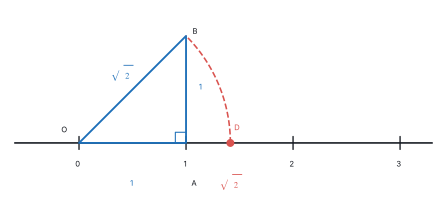
\sqrt{2}=1.41421\dots never ends, so we cannot mark it by measuring a decimal. Instead we use Pythagoras' theorem (h^2=p^2+b^2) to build a length of exactly \sqrt{2} units.
- Draw a number line and mark 0 (point O) and 1 (point A).
- At A draw AB\perp OA with AB=1 unit.
- Join OB. Then OB=\sqrt{1^2+1^2}=\sqrt{2} units.
- With O as centre and OB as radius, draw an arc to cut the number line at D. Then OD=OB=\sqrt{2}, so D is the point \sqrt{2}.
For \sqrt{3}, draw a perpendicular of 1 unit at the point \sqrt{2} (at the end of OB): the new hypotenuse is \sqrt{(\sqrt{2})^2+1^2}=\sqrt{3}. For \sqrt{5}, use a triangle with base 2 and height 1: \sqrt{2^2+1^2}=\sqrt{5}.
To place a surd, find the perfect squares on either side of the number inside it. For \sqrt{20}: 16<20<25, so 4<\sqrt{20}<5. For a closer answer, 4.4^2=19.36 and 4.5^2=20.25, so \sqrt{20}\approx4.47. This costs ten seconds and is the standard way to check a surd answer.
3.3 Scientific notation
Scientific notation writes a number as a product of a number between 1 and 10 and a power of 10:
| Number | In scientific notation |
|---|---|
| 45,000 | 4.5\times10^4 |
| 320,000,000 | 3.2\times10^8 |
| 0.0006 | 6\times10^{-4} |
| 0.00000072 | 7.2\times10^{-7} |
Rules for the index. Moving the decimal point n places to the left multiplies the number by 10^n and gives index +n; moving it n places to the right gives index -n.
3.3.1 Multiplying and dividing
Multiply the first parts and add the indices; divide the first parts and subtract the indices.
If the first part is not between 1 and 10 after the operation, adjust it: 12\times10^3=1.2\times10^4.
3.3.2 Adding and subtracting
Two numbers can be added or subtracted in scientific notation only when they have the same power of 10. If the powers differ, rewrite one of them first.
Problem. Simplify (a) 3.4\times10^2+4.57\times10^3 (b) 1.33\times10^5-4.9\times10^4.
Solution. (a) Make both powers 10^3: 3.4\times10^2=0.34\times10^3.
0.34\times10^3+4.57\times10^3=(0.34+4.57)\times10^3=4.91\times10^3
Check: 340+4570=4910=4.91\times10^3 ✓.
(b) 4.9\times10^4=0.49\times10^5, so
1.33\times10^5-0.49\times10^5=(1.33-0.49)\times10^5=0.84\times10^5=8.4\times10^4
Check: 133000-49000=84000 ✓.
Problem. Write (a) 4.579\times10^6 and (b) 3.579\times10^{-4} as ordinary decimal numbers.
Solution. (a) Positive index: move the point 6 places to the right. 4.579\times10^6=4.579\times1\,000\,000=4\,579\,000.
(b) Negative index: 10^{-4}=\frac{1}{10^4}, so move the point 4 places to the left. 3.579\times10^{-4}=\frac{3.579}{10\,000}=0.0003579.
Problem. One tanker holds 1.5\times10^4 litres and another holds 7.0\times10^3 litres. Find the total in scientific notation.
Solution. 7.0\times10^3=0.70\times10^4. Total =(1.5+0.70)\times10^4=2.2\times10^4 litres (=22\,000 litres).
Problem. Simplify \frac{(4\times10^6)\times(3\times10^{-2})}{6\times10^2}.
Solution. Multiply in the numerator first: the first parts give 4\times3=12, and the indices add: 6+(-2)=4. So the numerator is 12\times10^4.
Now divide: \frac{12}{6}=2, and the indices subtract: 4-2=2.
Check. The numerator is 4\,000\,000\times0.03=120\,000, and 120\,000\div600=200 ✓.
Problem. Light travels at 3\times10^8 m/s. How far does it travel in one day?
Solution. Seconds in a day: 24\times60\times60=86\,400=8.64\times10^4 s.
Answer. About 2.59\times10^{13} m, which is 25.92 billion kilometres.
Check. One light year is about 9.46\times10^{12} km, that is 9.46\times10^{15} m, and a day is \frac{1}{365} of a year, so the daily distance should be about 2.6\times10^{13} m ✓.
3.4 Placing numbers on the number line
Rational and irrational numbers together fill the number line with no gaps. Any point on the line is a real number, and every real number is either rational or irrational.
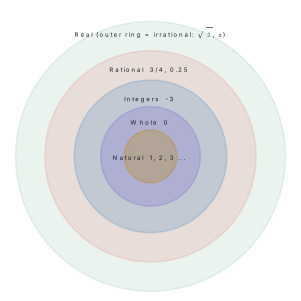
The real numbers R are the union of the rational numbers Q and the irrational numbers Ir: R=Q\cup Ir. Q and Ir are disjoint, since no number is both. The sets sit inside one another: N\subset W\subset Z\subset Q\subset R and Ir\subset R.
| Statement | True or false | Reason |
|---|---|---|
| Every integer is rational | true | 5=\frac51 |
| Every rational number is an integer | false | \frac12 is not an integer |
| \sqrt{9} is irrational | false | \sqrt{9}=3, an integer |
| \pi is rational | false | its decimal never repeats |
| 0 is rational | true | 0=\frac01 |
3.5 The number line as a map of the number system
Every number you will meet in Grade 8 has a home on the number line, and the line shows at a glance which sets sit inside which.
| Set | Symbol used in class | Members | Not members |
|---|---|---|---|
| Natural numbers | N | 1, 2, 3, \ldots | 0, -2, \frac{1}{2} |
| Whole numbers | W | 0, 1, 2, \ldots | -2, \frac{1}{2} |
| Integers | Z | \ldots, -2, -1, 0, 1, 2, \ldots | \frac{1}{2}, \sqrt{3} |
| Rational numbers | Q | \frac{p}{q}, q \neq 0; terminating or recurring decimals | \sqrt{2}, \pi |
| Irrational numbers | — | non-terminating, non-recurring decimals | \frac{22}{7} (it is rational) |
\frac{22}{7} is rational; it is only an approximation of \pi, which is irrational. And \sqrt{9} = 3 is rational — a square root is irrational only when the number under it is not a perfect square.
Question. Classify each number as rational or irrational, giving a reason: (i) 0.\overline{27} (ii) \sqrt{45} (iii) \sqrt{49} (iv) 3.141141114\ldots
Answer. (i) Rational — a recurring decimal; indeed 0.\overline{27} = \frac{27}{99} = \frac{3}{11}. (ii) Irrational — 45 is not a perfect square, and \sqrt{45} = 3\sqrt{5}. (iii) Rational — \sqrt{49} = 7 = \frac{7}{1}. (iv) Irrational — the decimal neither terminates nor settles into a repeating block.
Take a two-metre strip of chart paper. Mark -5 to 5 at 10 cm intervals. Now place these numbers as accurately as you can, writing each on a small card and pinning it: -\frac{7}{2}, -\sqrt{2}, 0.75, \frac{5}{3}, \sqrt{5}, \pi, \frac{22}{7}. Discussion: \pi and \frac{22}{7} land almost on the same spot. How far apart are they really? (Work to four decimal places.)
Chapter summary
- A rational number is \frac{p}{q} with q\ne0; as a decimal it terminates or recurs.
- A recurring decimal becomes a fraction by multiplying by 10, 100 or 1000 for one, two or three repeating digits, subtracting, and solving.
- An irrational number never repeats and cannot be written as a fraction; \sqrt{n} is irrational unless n is a perfect square.
- A surd is an exact irrational root; simplify by taking out the largest perfect-square factor, and add only like surds.
- Rationalise a denominator by multiplying the top and bottom by the surd.
- \sqrt{2}, \sqrt{3}, \sqrt{5} are marked on a number line with right triangles (Pythagoras) and an arc from 0.
- R=Q\cup Ir, and Q and Ir are disjoint.
- Scientific notation is a\times10^n with 1\le a<10; to add or subtract, first make the powers of 10 equal; multiply by multiplying the first parts and adding the indices, divide by dividing and subtracting.
Practice questions
Group A — Objective (1 mark each)
- Which of these is irrational? [1]a\frac34b0.\overline{6}c\sqrt{16}d\sqrt{5}
- 0.00045 in scientific notation is [1]a45\times10^{-5}b4.5\times10^{-4}c4.5\times10^{4}d0.45\times10^{-3}
- \sqrt{50} simplified is [1]a5\sqrt{2}b2\sqrt{5}c25\sqrt{2}d10\sqrt{5}
- 0.\overline{3} as a fraction is [1]a\frac{3}{10}b\frac13c\frac{30}{100}d\frac{3}{100}
- (2\times10^3)\times(4\times10^2) equals [1]a8\times10^5b6\times10^5c8\times10^6d8\times10^1
- \frac{9}{\sqrt{3}} simplified is [1]a3\sqrt{3}b\sqrt{27}c3d9\sqrt{3}
Answers to Group A
1. (d) — 5 is not a perfect square.
2. (b) — the decimal point moves four places to the right.
3. (a) — 50=25\times2.
4. (b) — 9x=3 gives x=\frac13.
5. (a) — 2\times4=8 and 3+2=5.
6. (a) — \frac{9\sqrt{3}}{3}=3\sqrt{3}.
Group B — Short answer (2 marks each)
- Write 0.\overline{6} and 0.\overline{18} as fractions. [2]
- Simplify \sqrt{48} and \sqrt{12}+\sqrt{27}. [2]
- Write 0.000000573 in scientific notation and write 6.4\times10^{-3} as a decimal. [2]
- Show that \sqrt{2} lies between 1.4 and 1.5. [2]
Answers to Group B
1. x=0.\overline{6} gives 9x=6, so x=\frac69=\frac23. x=0.\overline{18} gives 99x=18, so x=\frac{18}{99}=\frac{2}{11}.
2. \sqrt{48}=\sqrt{16\times3}=4\sqrt{3}. And \sqrt{12}=2\sqrt{3}, \sqrt{27}=3\sqrt{3}, so the sum is 5\sqrt{3}.
3. 0.000000573=5.73\times10^{-7}; and 6.4\times10^{-3}=0.0064.
4. 1.4^2=1.96 and 1.5^2=2.25. Since 1.96<2<2.25, taking square roots gives 1.4<\sqrt{2}<1.5.
Group C — Long answer (4 marks each)
- Express 2.\overline{3} (the digit 3 repeating after a whole part of 2) as a fraction in its lowest terms. [4]
- Simplify \frac{(5\times10^{-3})\times(6\times10^7)}{3\times10^4} and give the answer both in scientific notation and as an ordinary number. Explain each step. [4]
Answers to Group C
1. Let x=2.\overline{3}=2.333\dots Then 10x=23.333\dots Subtracting: 10x-x=23.333\dots-2.333\dots, so 9x=21 and x=\frac{21}{9}=\frac{7}{3}. Check. 7\div3=2.333\dots ✓. The whole part is removed automatically by the subtraction, because both numbers have the same fractional part.
2. Step 1 — multiply in the numerator. First parts: 5\times6=30. Indices: -3+7=4. So the numerator is 30\times10^4. Step 2 — divide. First parts: \frac{30}{3}=10. Indices: 4-4=0. So the result is 10\times10^0=10. Step 3 — put it in scientific notation. 10=1\times10^1. Answer. 1\times10^1, which is the ordinary number 10. Check. The numerator is 0.005\times60\,000\,000=300\,000, and 300\,000\div30\,000=10 ✓.
Extra practice — textbook-style questions
1. Write true or false: (a) The sets of rational and irrational numbers are disjoint. (b) The set of whole numbers and the set of integers are the same. (c) \sqrt{4} is irrational.
2. Reduce to fractions: (a) 0.\overline{24} (b) 4.\overline{78} (c) 0.\overline{132}.
3. Write in scientific notation: (a) 101000 (b) 0.00671 (c) 74171.7.
4. Simplify and write in scientific notation: (a) 1.2\times10^5+5.35\times10^6 (b) \frac{8.4\times10^{-4}}{1.2\times10^{-3}}.
5. How many tanks, each of capacity 1.5\times10^3 litres, are needed to store 9.0\times10^6 litres of petrol?
6. Show \sqrt{5} on a number line.
Extra practice — answers
1. (a) True (b) False — integers also contain -1,-2,\dots (c) False — \sqrt{4}=2.
2. (a) 100x-x=24, so x=\frac{24}{99}=\frac{8}{33}. (b) x=4.7878\dots, 100x=478.78\dots, 99x=474, x=\frac{474}{99}=\frac{158}{33}. (c) 1000x-x=132, x=\frac{132}{999}=\frac{44}{333}.
3. (a) 1.01\times10^5 (b) 6.71\times10^{-3} (c) 7.41717\times10^4.
4. (a) 0.12\times10^6+5.35\times10^6=5.47\times10^6. (b) \frac{8.4}{1.2}\times10^{-4-(-3)}=7\times10^{-1}.
5. \frac{9.0\times10^6}{1.5\times10^3}=6\times10^3=6000 tanks.
6. Mark O at 0 and A at 2. At A draw AB\perp OA, AB=1. Then OB=\sqrt{2^2+1^2}=\sqrt{5}. With centre O and radius OB, draw an arc to cut the number line at D; D represents \sqrt{5}\approx2.24.
Objective practice
Choose the correct answer. [5×1=5]
1. Which of these is irrational? (a) 0.25 (b) \frac{3}{7} (c) \sqrt{9} (d) \sqrt{11}
2. \frac{22}{7} is (a) irrational (b) rational (c) an integer (d) a whole number
3. 0.\overline{3} as a fraction is (a) \frac{3}{10} (b) \frac{1}{3} (c) \frac{3}{11} (d) \frac{33}{100}
4. Every integer is (a) a natural number (b) a whole number (c) a rational number (d) irrational
5. 4.54\times10^{-3}-2.4\times10^{-3} equals (a) 2.14\times10^{-3} (b) 2.14\times10^{0} (c) 2.14\times10^{-6} (d) 6.94\times10^{-3}
Objective practice — answers
1. (d) — 11 is not a perfect square.
2. (b) — it is a ratio of two integers.
3. (b) — \frac{3}{9}=\frac{1}{3}.
4. (c) — every integer can be written as \frac{p}{1}.
5. (a) — same power of 10, so subtract the first parts: 4.54-2.4=2.14.
Practise more: Mathematics question bank