Unit 6 · Compulsory Mathematics · 13 min read
Unitary Method
What the syllabus asks for 4
- the unitary method
- application of direct variation
- application of inverse variation
- mixed problems; time and work, time and distance
The unitary method is the habit of finding the value of one first. If 7 kg of rice costs Rs 560, then 1 kg costs Rs 80, and any other quantity can be found in one multiplication. When the quantities move in opposite directions — workers and days, taps and time, speed and time — the same habit works, but the "one" you find is a single unit of work, not of price.
You should be able to find the unit value and use it, decide whether a problem is a direct or an inverse variation, solve problems about time and work, and solve problems about time, speed and distance.
6.1 The unitary method in direct variation
Method. Find the value of one unit by division, then multiply by the number of units required.
Problem. If 8 litres of milk cost Rs 720, what do 15 litres cost?
Solution. Cost of 1 litre =720\div8=\text{Rs }90.
Cost of 15 litres =15\times90=\text{Rs }1350.
Answer. Rs 1,350.
Check. 720:1350=8:15 ✓ — the ratio of the quantities equals the ratio of the costs, which is what direct variation means.
Problem. A car covers 156 km in 3 hours at a steady speed. How far will it go in 7 hours, and how long will it take to cover 260 km?
Solution. Distance in 1 hour =156\div3=52 km.
In 7 hours: 7\times52=364 km.
For 260 km: 260\div52=5 hours.
Answer. 364 km; 5 hours.
Check. 52\times5=260 ✓, and the speed 52 km/h is the same throughout.
In a sum such as "5 men dig 20 m in a day; how much will 8 men dig?", the quick temptation is to write 20\times\frac85 without thinking. That happens to be right here, because it is a direct variation. In a time-and-work sum the same reflex gives an answer in the wrong direction. Always ask first whether the quantities rise together or move oppositely.
6.2 The unitary method in inverse variation
When one quantity increases and the other decreases in proportion, find the total (the constant) instead of the unit rate.
Problem. 12 men can complete a piece of work in 10 days. How many days will 15 men take to do the same work?
Solution. Total work =12\times10=120 man-days.
With 15 men, the time is 120\div15=8 days.
Answer. 8 days.
Check. 12\times10=15\times8=120 ✓. The answer is smaller than 10, as it must be when more men are put on the same work.
Problem. 8 men working 6 hours a day finish a job in 15 days. How many days will 10 men take, working 9 hours a day?
Solution. Total work in man-hours:
With 10 men at 9 hours a day, the daily work is 10\times9=90 man-hours.
Answer. 8 days.
Check. 10\times9\times8=720 ✓ — the same total work as 8\times6\times15.
Problem. Two taps fill a tank in 12 hours and 18 hours respectively. How long will they take to fill it together?
Solution. Work in "tank per hour". The first tap fills \frac{1}{12} of the tank in an hour, the second \frac{1}{18}.
Together in one hour:
of the tank. So the whole tank takes
Answer. 7 hours 12 minutes.
Check. In 7.2 hours the first tap supplies \frac{7.2}{12}=0.6 of the tank and the second \frac{7.2}{18}=0.4, and 0.6+0.4=1 ✓. The answer must lie between 6 hours (if both were as fast as the first) and 12 hours.
Problem. A barrack has food for 200 soldiers for 30 days. How many soldiers must be transferred so that the food lasts 40 days?
Solution. Fewer soldiers → food lasts longer: inverse variation. Food =200\times30=6000 soldier-days. Soldiers who can be fed for 40 days =\frac{6000}{40}=150. Soldiers to transfer =200-150= 50.
Problem. 20 workers can finish a job in 15 days. How many more workers must be added to finish it in 12 days?
Solution. Work =20\times15=300 worker-days. Workers needed for 12 days =\frac{300}{12}=25. Workers to add =25-20= 5.
6.2.1 Problems with three quantities (compound variation)
When three quantities change at once, compare the unknown with each other quantity separately, keeping the rest fixed, and decide direct (D) or inverse (I) each time. Then:
- for a direct pair, multiply by the new value over the old value;
- for an inverse pair, multiply by the old value over the new value.
Problem. 10 people earn Rs 1,60,000 in 20 days. How much will 15 people earn in 10 days at the same rate?
Solution.
| People | Days | Income (Rs) |
|---|---|---|
| 10 | 20 | 1,60,000 |
| 15 | 10 | x |
More people → more income (D). More days → more income (D).
Unitary check. One person in one day earns \frac{1\,60\,000}{10\times20}= Rs 800; 15 people in 10 days earn 800\times15\times10= Rs 1,20,000 ✓.
Problem. 30 workers build a 600 m wall in 20 days. How long a wall will 15 workers build in 18 days?
Solution. Workers and length: D. Days and length: D.
Problem. 10 people build a bamboo shelter in 14 days working 8 hours a day. How many hours a day must 7 people work to build the same shelter in 16 days?
Solution. Fewer people → more hours per day (I). More days → fewer hours per day (I).
Check. Total work =10\times14\times8=1120 person-hours, and 7\times16\times10=1120 ✓.
6.3 Time, speed and distance
Remember the unit conversions: 1 km =1000 m, 1 hour =60 minutes =3600 seconds, so 1 m/s =3.6 km/h.
Problem. A bus travels at 54 km/h. Express this in m/s and find how far it goes in 25 seconds.
Solution. 54\text{ km/h}=54\times\frac{1000}{3600}=54\times\frac{5}{18} =15 m/s.
Distance in 25 s =15\times25=375 m.
Answer. 15 m/s; 375 m.
Check. 375 m in 25 s is 15 m/s, and 15\times3.6=54 km/h ✓.
Problem. A man walks 4 km at 5 km/h and then travels 12 km by bus at 40 km/h. Find his total time and his average speed for the whole journey.
Solution. Walking time =\frac{4}{5}=0.8 h.
Bus time =\frac{12}{40}=0.3 h.
Total time =1.1 h =1 hour 6 minutes.
Total distance =16 km, so
Answer. 1.1 hours; about 14.55 km/h.
Check. The average speed must lie between 5 and 40 km/h and must be much closer to 5, because the walking took nearly three times as long as the bus ride. It is 14.55, well below the midpoint of 22.5 ✓.
For a journey of 4 km at 5 km/h and 12 km at 40 km/h, the average speed is not \frac{5+40}{2}=22.5 km/h. Average speed is \frac{\text{total distance}}{\text{total time}}. It equals the simple mean only when the two speeds are used for equal times, which is rare.
6.4 Direct and inverse variation side by side
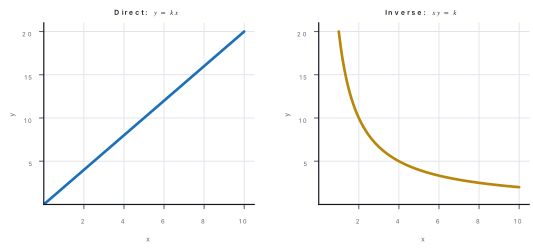
The whole unitary method rests on one question: does the second quantity rise or fall when the first rises? Answer that, and the arithmetic follows.
| Situation | Type | Rule |
|---|---|---|
| More pens, more cost | direct | \frac{\text{cost}}{\text{pens}} constant |
| More workers, less time | inverse | workers × time constant |
| More speed, less time (fixed distance) | inverse | speed × time constant |
| More days, more wages | direct | \frac{\text{wages}}{\text{days}} constant |
| More taps, less filling time | inverse | taps × time constant |
Question. 12 workers build 150 m of wall in 10 days. How many days will 15 workers take to build 225 m of the same wall?
Answer. Work with one worker and one day at a time. In one day 12 workers build \frac{150}{10} = 15 m, so one worker builds \frac{15}{12} = 1.25 m a day. 15 workers build 15 \times 1.25 = 18.75 m a day. Days needed = \frac{225}{18.75} = \textbf{12 days}. Check: more workers but much more wall, so more days than 10 — the answer is believable.
Visit a shop and note the price of the same item in three pack sizes (say rice in 1 kg, 5 kg and 25 kg). Work out the price per kilogram in each case. Discussion: Which pack is cheapest per kilogram? Why do shops price it that way? Is the biggest pack always the better buy for a small family?
Chapter summary
- In direct variation, find the value of one unit by division and multiply.
- With three quantities, compare the unknown with each one separately (D: new/old, I: old/new) and multiply.
- In inverse variation, find the constant total (man-days, man-hours, speed × time) and divide by the new value.
- \text{total work}=\text{workers}\times\text{days}; with hours, \text{work}=\text{workers}\times\text{hours per day}\times\text{days}.
- For taps or pipes, work in "fraction of the tank per hour" and add the fractions; the time is the reciprocal of the sum.
- \text{speed}=\frac{\text{distance}}{\text{time}}; 1 m/s =3.6 km/h.
- Average speed =\frac{\text{total distance}}{\text{total time}}, never the simple average of the speeds.
Practice questions
Group A — Objective (1 mark each)
- If 6 books cost Rs 450, the cost of 1 book is [1]aRs 60bRs 75cRs 90dRs 45
- More men on the same job means less time. This is [1]adirect variationbinverse variationcproportiondunitary
- 36 km/h in m/s is [1]a10b12c6d3.6
- If a man walks 3 km in 45 minutes, his speed is [1]a3 km/hb4 km/hc5 km/hd6 km/h
- 10 workers finish a job in 8 days. 16 workers will take [1]a4 daysb5 daysc6 daysd12.8 days
- A car covers 150 km in 2.5 hours. Its speed is [1]a50 km/hb60 km/hc65 km/hd75 km/h
Answers to Group A
1. (b) — 450\div6=75.
2. (b) — inverse variation.
3. (a) — 36\div3.6=10.
4. (b) — 45 min =\frac34 h, and 3\div\frac34=4 km/h.
5. (b) — total =80 man-days, and 80\div16=5 days.
6. (b) — 150\div2.5=60.
Group B — Short answer (2 marks each)
- If 9 kg of potatoes cost Rs 315, find the cost of 14 kg. [2]
- 18 men can build a wall in 20 days. How many men are needed to build it in 12 days? [2]
- A train travels 240 km in 3 hours. Find its speed in km/h and in m/s. [2]
- One tap fills a tank in 6 hours and another in 12 hours. How long will they take together? [2]
Answers to Group B
1. 1 kg costs 315\div9=\text{Rs }35; 14 kg cost 14\times35=\text{Rs }490.
2. Total work =18\times20=360 man-days; men needed =360\div12=30.
3. Speed =240\div3=80 km/h; in m/s, 80\div3.6=22.2 m/s.
4. In one hour they fill \frac{1}{6}+\frac{1}{12}=\frac{3}{12}=\frac{1}{4} of the tank, so together they take 4 hours.
Group C — Long answer (4 marks each)
- 15 workers can dig a canal 90 m long in 12 days. How long will 20 workers take to dig a canal 120 m long, working at the same rate? [4]
- A bus leaves a town at 7:00 a.m. and travels at 45 km/h. A car leaves the same town at 9:00 a.m. and travels along the same road at 60 km/h. At what time will the car catch the bus? [4]
Answers to Group C
1. This is a double unitary-method problem. First find the work per worker per day: 90 m in 15\times12=180 worker-days, so 90\div180=0.5 m per worker per day. For 120 m with 20 workers: the work needed is 120\div0.5=240 worker-days, and 240\div20=12 days. Check. 20\times12=240 worker-days, and 240\times0.5=120 m ✓.
2. By 9:00 a.m. the bus has travelled 45\times2=90 km and is 90 km ahead. The car gains on the bus at the rate 60-45=15 km/h. The time to close 90 km at 15 km/h is \frac{90}{15}=6 hours. So the car catches the bus at 9:00 a.m. + 6 hours = 3:00 p.m. Check. By 3:00 p.m. the bus has travelled 8 hours at 45 km/h =360 km, and the car has travelled 6 hours at 60 km/h =360 km ✓. Both cover the same distance, as they must at the meeting point.
Extra practice — textbook-style questions
1. Write D (direct) or I (inverse): (a) diameter of a circle and its circumference (b) number of students in a hostel and the number of days the food lasts (c) speed of a vehicle and time for a fixed distance.
2. If 4 dozen pens cost Rs 576, how many pens can be bought for Rs 228?
3. 12 workers can do a job in 14 days. If 21 more workers are added, how many days will the job take?
4. 4 men earn Rs 28,000 in 10 days. How much will 6 men earn in 15 days?
5. 20 workers can finish a job in 15 days. After 6 days, 5 workers leave. In how many more days will the rest finish it?
Extra practice — answers
1. (a) D (b) I (c) I.
2. 48 pens cost Rs 576, so 1 pen costs Rs 12; Rs 228 buys 228\div12=19 pens.
3. Work =12\times14=168 worker-days; with 12+21=33 workers, days =\frac{168}{33}=5\frac{1}{11}\approx5.09 days.
4. One man per day earns \frac{28\,000}{4\times10}= Rs 700; 700\times6\times15= Rs 63,000.
5. Total =300 worker-days; done in 6 days =120; left =180; 15 workers need \frac{180}{15}=12 more days.
Objective practice
Choose the correct answer. [5×1=5]
1. If 10 workers finish a job in 12 days, 15 workers will take (a) 6 days (b) 8 days (c) 18 days (d) 20 days
2. Speed and time for a fixed distance are in (a) direct proportion (b) inverse proportion (c) no relation (d) equal ratio
3. 7 pens cost Rs 210; 12 pens cost (a) Rs 300 (b) Rs 330 (c) Rs 360 (d) Rs 420
4. In direct variation, the quantity that stays constant is (a) the product xy (b) the ratio y/x (c) the sum (d) the difference
5. A tap fills a tank in 5 hours; in 2 hours it fills (a) \frac{1}{5} (b) \frac{2}{5} (c) \frac{3}{5} (d) \frac{1}{2}
Objective practice — answers
1. (b) — \frac{10\times12}{15}=8 days.
2. (b) — their product is constant.
3. (c) — one pen Rs 30, so 12\times30=360.
4. (b) — the ratio stays constant.
5. (b) — \frac{2}{5} of the tank.
Practise more: Mathematics question bank