Unit 13 · Compulsory Mathematics · 13 min read
Lines and Angles
What the syllabus asks for 4
- straight lines, rays and angles
- pairs of angles: complementary, supplementary, adjacent, vertically opposite
- parallel lines and a transversal
- corresponding, alternate and co-interior angles
Two straight lines that never meet, a transversal that cuts them, and the eight angles that appear: that picture contains almost every angle fact you will need in geometry. The whole chapter is really one idea — when a transversal crosses parallel lines, four angles come out equal in one way and four in another, and recognising which is which settles a question in one line.
You should be able to name and use complementary, supplementary, adjacent and vertically opposite angles, state the conditions for two lines to be parallel, and find unknown angles using corresponding angles, alternate angles and co-interior angles.
13.1 Points, lines and angles
| Term | Meaning |
|---|---|
| Point | a position with no size, named with a capital letter |
| Line | a straight path that extends for ever in both directions |
| Line segment | a part of a line with two end points |
| Ray | a part of a line with one end point |
| Angle | the figure formed by two rays with a common end point, the vertex |
An angle is measured in degrees, from 0° to 360°, using a protractor. Angles are named by three letters with the vertex in the middle, as in \angle ABC.
| Kind of angle | Size |
|---|---|
| Acute | between 0° and 90° |
| Right | exactly 90° |
| Obtuse | between 90° and 180° |
| Straight | exactly 180° |
| Reflex | between 180° and 360° |
13.2 Pairs of angles
| Pair | Relation | Example |
|---|---|---|
| Complementary | they add to 90° | 35° and 55° |
| Supplementary | they add to 180° | 110° and 70° |
| Adjacent | they share a vertex and a common arm, without overlapping | the two angles on either side of a line |
| Vertically opposite | they are formed by two intersecting lines, and they are equal | the two angles opposite each other at a crossing |
| Linear pair | two adjacent angles that together make a straight line; they add to 180° | the two angles on one side of a straight line |
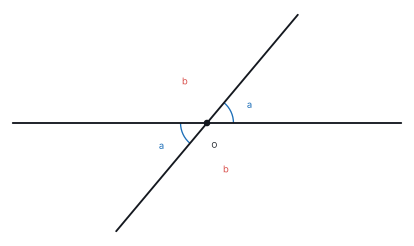
Problem. Two angles are supplementary. One of them is 40° more than the other. Find both.
Solution. Let the smaller be x; then the larger is x+40. Because they are supplementary,
Answer. 70° and 110°.
Check. 70+110=180 ✓ and 110-70=40 ✓.
Problem. Two straight lines cross. One of the four angles is 65°. Find the other three, giving a reason for each.
Solution. The angle vertically opposite 65° is also 65° (vertically opposite angles are equal). Each of the other two is supplementary to 65°, so each is 180-65=115°; and they are equal to each other because they are vertically opposite.
Answer. 65°, 115°, 115°.
Check. 65+115+65+115=360 ✓, which is the angle sum round a point.
In a figure with three angles on one side of a straight line, the equation is x+2x+3x=180, not 360. The 360° belongs to the angles round a point. Read whether the arms close a full turn or only a half turn before you add.
13.3 Parallel lines and a transversal
A transversal is a line that cuts two or more other lines. When it cuts two parallel lines, eight angles are formed, and they fall into three named pairs.
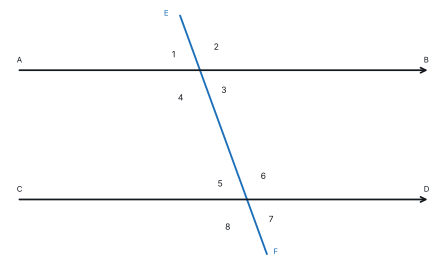
Two straight lines in a plane are parallel if they never meet however far they are extended; the perpendicular distance between them is the same everywhere. We write AB ∥ CD.
A transversal is a line that cuts two or more lines at different points. The four angles between the two lines are interior angles (∠3, ∠4, ∠5, ∠6 in the figure); the other four are exterior angles.
- Alternate angles: a pair of non-adjacent interior angles on opposite sides of the transversal (∠3 and ∠5, ∠4 and ∠6).
- Corresponding angles: a pair of non-adjacent angles on the same side of the transversal, one interior and one exterior (∠1 and ∠5, ∠2 and ∠6, ∠3 and ∠7, ∠4 and ∠8).
- Co-interior angles: a pair of non-adjacent interior angles on the same side of the transversal (∠3 and ∠6, ∠4 and ∠5).
| Pair | Position | Relation |
|---|---|---|
| Corresponding angles | same side of the transversal, same side of their own line (the "F" shape) | equal |
| Alternate angles | opposite sides of the transversal, between the two lines (the "Z" shape) | equal |
| Co-interior angles | same side of the transversal, between the two lines (the "C" shape) | supplementary, adding to 180° |
Conditions for two lines to be parallel. Two lines are parallel if
- a pair of corresponding angles is equal, or
- a pair of alternate angles is equal, or
- a pair of co-interior angles adds to 180°.
Problem. In the figure, AB ∥ CD and ∠2 =110°. Find angles 1, 3, 4, 5, 6, 7 and 8, giving a reason for each.
Solution.
| Angle | Value | Reason |
|---|---|---|
| ∠1 | 180°-110°=70° | ∠1 and ∠2 are a linear pair |
| ∠3 | 70° | vertically opposite to ∠1 |
| ∠4 | 110° | vertically opposite to ∠2 |
| ∠5 | 70° | alternate to ∠3 (AB ∥ CD) |
| ∠6 | 110° | alternate to ∠4 |
| ∠7 | 70° | corresponding to ∠3 |
| ∠8 | 110° | corresponding to ∠4 |
Check. ∠4 and ∠5 are co-interior: 110°+70°=180° ✓.
Problem. Two parallel lines are cut by a transversal. A pair of co-interior angles are 3x and 2x+20. Find x and the size of each angle.
Solution. Co-interior angles are supplementary:
The angles are 3(32)=96° and 2(32)+20=84°.
Answer. x=32; the angles are 96° and 84°.
Check. 96+84=180 ✓, as co-interior angles must.
Problem. A transversal cuts two lines. A pair of alternate angles are 75° and 78°. Are the two lines parallel? Give a reason.
Solution. Alternate angles are equal only when the lines are parallel. Here 75°\ne78°, so the alternate angles are not equal.
Answer. The lines are not parallel; they meet on the side where the angles open out. The test for parallel lines is exactly the equality of such a pair.
Problem. A transversal cuts lines AB and CD. A pair of alternate angles measure (3x-50)° and (x+10)°. For what value of x are AB and CD parallel? Find the angles.
Solution. For AB ∥ CD the alternate angles must be equal: 3x-50=x+10 → 2x=60 → x=30. Each angle =30+10=40° (and 3\times30-50=40° ✓).
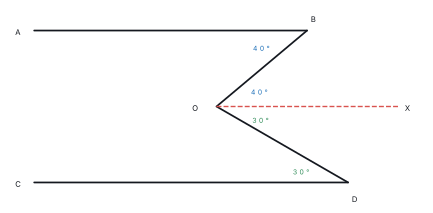
Problem. In the figure, AB ∥ CD, ∠ABO =40° and ∠CDO =30°. Find ∠BOD.
Solution. Through O draw OX ∥ AB. Then OX ∥ CD too.
∠BOX = ∠ABO =40° (alternate angles, AB ∥ OX)
∠XOD = ∠CDO =30° (alternate angles, CD ∥ OX)
∠BOD = ∠BOX + ∠XOD =40°+30°=70°.
Students often use a co-interior pair as if it must be equal. The shapes are the reminder: F (corresponding) means equal and the two angles are on the same side of both lines; Z (alternate) means equal and the angles are on opposite sides of the transversal; C (co-interior) means they add up to 180°. Sketch the letter next to the angle before you decide.
13.4 Reasons are the marks
In a geometry answer the number is worth one mark; the reason is worth the rest. Every statement should carry the name of the rule that justifies it.
| Statement | Reason to write |
|---|---|
| \angle a = \angle b | vertically opposite angles |
| \angle a + \angle b = 180° | angles on a straight line (linear pair) |
| \angle a = \angle b (parallel lines) | corresponding angles |
| \angle a = \angle b (parallel lines, opposite sides) | alternate angles |
| \angle a + \angle b = 180° (parallel lines, same side) | co-interior angles |
| \angle A + \angle B + \angle C = 180° | angle sum of a triangle |
| exterior = sum of two opposite interior | exterior angle property |
Question. Two parallel lines are cut by a transversal. One angle is 116°. Find the other seven, with reasons.
Answer. Vertically opposite to 116°: \textbf{116°} — vertically opposite angles. On the straight line with it: 180° - 116° = \textbf{64°} — linear pair; and its vertically opposite is \textbf{64°}. On the second parallel line, the corresponding angle is \textbf{116°} — corresponding angles; its vertically opposite is \textbf{116°}. The remaining two are \textbf{64°} each — co-interior with 116° (116° + 64° = 180°) and vertically opposite.
Find five real examples of parallel lines cut by a transversal in or near the school: the lines of a football pitch, a ladder against a wall, railings, the bars of a window grille, a zebra crossing. Sketch each, measure two angles with a protractor, and name the rule that connects them.
Chapter summary
- Complementary angles add to 90°; supplementary angles add to 180°; angles round a point add to 360°.
- Vertically opposite angles are equal; angles in a linear pair are supplementary.
- When a transversal cuts two parallel lines: corresponding angles are equal, alternate angles are equal, and co-interior angles add to 180°.
- Two lines are parallel if any one of those three conditions holds.
- Remember the shapes: F for corresponding, Z for alternate, C for co-interior.
Practice questions
Group A — Objective (1 mark each)
- The complement of 40° is [1]a40°b50°c140°d60°
- The supplement of 125° is [1]a55°b65°c235°d45°
- An angle of 100° is [1]aacutebrightcobtusedreflex
- Vertically opposite angles are [1]asupplementarybcomplementarycequaldalways 90°
- When a transversal cuts two parallel lines, alternate angles are [1]aequalbsupplementaryccomplementarydunequal
- Co-interior angles add up to [1]a90°b180°c270°d360°
Answers to Group A
1. (b) — 90-40=50.
2. (a) — 180-125=55.
3. (c) — between 90° and 180°.
4. (c) — equal.
5. (a) — equal, and that is the test for parallel lines.
6. (b) — 180°.
Group B — Short answer (2 marks each)
- Two angles are complementary and one is four times the other. Find both. [2]
- Two straight lines intersect and one angle is 42°. Find the other three. [2]
- A transversal cuts two parallel lines. A pair of corresponding angles are 2x+10 and 70. Find x. [2]
- State whether the lines are parallel: a pair of co-interior angles measure 110° and 60°. [2]
Answers to Group B
1. x+4x=90, so 5x=90 and x=18°; the angles are 18° and 72°.
2. 42° (vertically opposite), 138° and 138° (each supplementary to 42°).
3. 2x+10=70, so 2x=60 and x=30.
4. 110+60=170\ne180, so they are not parallel.
Group C — Long answer (4 marks each)
- Two parallel lines are cut by a transversal. One of the co-interior angles is 4x-15 and the other is 2x+45. Find the value of x and the size of every angle in the figure. [4]
- In the figure, angle 1 and angle 5 are corresponding angles and angle 1 is 70°. Find angles 2, 3, 4, 5, 6, 7 and 8, stating the reason for each, and verify that the sum of the angles round the two vertices is 360° each. [4]
Answers to Group C
1. Co-interior angles are supplementary:
The angles are 4(25)-15=85° and 2(25)+45=95°. Every acute angle in the figure is 85° and every obtuse angle is 95°, because corresponding and alternate angles are equal and each angle is supplementary to the one beside it. Check. 85+95=180 ✓, and round either vertex 85+95+85+95=360 ✓. 2. With angle 1 =70°: angle 2 =110° (linear pair with 1); angle 3 =70° (vertically opposite to 1); angle 4 =110° (vertically opposite to 2); angle 5 =70° (corresponding to angle 1); angle 6 =110° (linear pair with 5, or corresponding to 2); angle 7 =70° (vertically opposite to 5); angle 8 =110° (vertically opposite to 6). Check. At the upper vertex: 70+110+70+110=360 ✓. At the lower vertex: 70+110+70+110=360 ✓. Every acute angle in the figure is 70° and every obtuse one is 110°, which is exactly what two parallel lines force: angles 1 and 3 are vertically opposite, 1 and 5 are corresponding, 3 and 5 are vertically opposite again, and each of 2, 4, 6, 8 is the supplement of one of them.
Extra practice
Group B (2 marks)
14. Two angles of a triangle are 42° and 78°. Find the third angle and the exterior angle at that vertex.
15. Find each exterior angle of a regular polygon of 12 sides.
Group C (4 marks)
16. In a parallelogram PQRS, \angle P = 72°. Find the other three angles with reasons.
Extra practice — answers
14. Third angle = 180° - 120° = 60°; exterior angle = 180° - 60° = 120° (which equals 42° + 78°, the exterior angle property).
15. \frac{360°}{12} = 30°.
16. \angle R = \angle P = 72° — opposite angles of a parallelogram are equal. \angle Q = 180° - 72° = 108° — co-interior angles between the parallel sides are supplementary. \angle S = \angle Q = 108° — opposite angles. Check: 72 + 108 + 72 + 108 = 360°.
Objective practice
Choose the correct answer. [5×1=5]
1. Angles on a straight line add up to (a) 90° (b) 180° (c) 270° (d) 360°
2. Vertically opposite angles are (a) supplementary (b) complementary (c) equal (d) right angles
3. Two parallel lines cut by a transversal: co-interior angles are (a) equal (b) supplementary (c) complementary (d) unrelated
4. The exterior angle of a triangle equals (a) the sum of the two opposite interior angles (b) the third angle (c) 90° (d) half the sum
5. Two angles of a triangle are 50° and 60°; the third is (a) 60° (b) 70° (c) 80° (d) 110°
Objective practice — answers
1. (b) — 180°.
2. (c) — equal.
3. (b) — they add to 180°.
4. (a) — the exterior angle property.
5. (b) — 180°-110°=70°.
Practise more: Mathematics question bank