Unit 8 · Compulsory Mathematics · 15 min read
Area and Volume
What the syllabus asks for 5
- area of triangles
- area of quadrilaterals (parallelogram, rhombus, trapezium)
- area of a circle and its parts
- surface area and volume of a cylinder
- area and volume problems of the SEE type
Mensuration is arithmetic done with a ruler. A farmer measures a field in bigha, a mason orders sand by the cubic metre, and a painter buys tin by the square metre — all three are using the formulas in this chapter. The work is to know which formula fits the shape, to keep the units consistent, and to remember that an area is measured in square units and a volume in cubic units.
You should be able to find the area of a triangle, a parallelogram, a rhombus and a trapezium, find the area and the circumference of a circle and the area of a sector, and find the curved surface area, total surface area and volume of a cylinder.
8.1 Area of triangles
For a triangle with base b and perpendicular height h:
The height must be perpendicular to the base you choose. A triangle has three possible base-height pairs, and all three give the same area.
A right-angled triangle is half of a rectangle (cut along a diagonal), so its area is \frac12\times base \times perpendicular. Any triangle can be cut by its height into two right-angled triangles, which is why \frac12bh works for every triangle.
Problem. A triangle has sides 6 m, 8 m and 10 m. Show that it is right-angled, find its area, and find the height drawn to the 10 m side.
Solution. 6^2+8^2=36+64=100=10^2, so by the converse of Pythagoras' theorem the angle between the 6 m and 8 m sides is 90°.
Taking 10 m as the base: \frac12\times10\times h=24, so h=4.8 m.
Answer. 24 m²; height on the longest side 4.8 m.
8.1.1 Equilateral and isosceles triangles
In equilateral \triangle ABC draw AD\perp BC. AD bisects BC, so BD=DC=\frac a2.
Step 1 — Pythagoras in \triangle ADC. AD^2=AC^2-DC^2=a^2-\frac{a^2}{4}=\frac{3a^2}{4}
Step 2 — take the square root. AD=\frac{\sqrt{3}}{2}a
Step 3 — use \frac12bh. Area =\frac12\times a\times\frac{\sqrt{3}}{2}a
Result.
Draw AD\perp BC; it bisects the base, so DC=\frac b2.
AD^2=a^2-\frac{b^2}{4}=\frac{4a^2-b^2}{4}, so AD=\frac{\sqrt{4a^2-b^2}}{2}.
Area =\frac12\times b\times\frac{\sqrt{4a^2-b^2}}{2}, which gives
Problem. Find the area of (a) an equilateral triangle of side 6 cm, (b) an isosceles triangle with equal sides 13 cm and base 10 cm.
Solution. (a) Area =\frac{\sqrt{3}}{4}\times6^2=\frac{\sqrt{3}}{4}\times36=9\sqrt{3}\approx15.59 cm².
(b) Area =\frac{10}{4}\sqrt{4\times13^2-10^2}=\frac{10}{4}\sqrt{676-100}
=\frac{10}{4}\sqrt{576}=\frac{10}{4}\times24=60 cm².
Check (b). Height =\sqrt{13^2-5^2}=12 cm, and \frac12\times10\times12=60 ✓.
In a triangle with sides 5 m, 4 m and 3 m, the area is not \frac12\times5\times4. The 4 m side is not perpendicular to the 5 m side. Draw the triangle, identify the right angle, and use the two sides that form it: here 4 and 3 give \frac12\times4\times3=6 m². Substituting a sloping side for the height is the classic mensuration error.
8.2 Area of quadrilaterals
| Shape | Diagram | Area |
|---|---|---|
| Rectangle | length l, breadth b | l\times b |
| Square | side a | a^2 |
| Parallelogram | base b, height h | b\times h |
| Rhombus | diagonals d_1, d_2 | \frac12 d_1 d_2 |
| Trapezium | parallel sides a, b, height h | \frac12(a+b)h |
| Kite | diagonals d_1, d_2 | \frac12 d_1 d_2 |
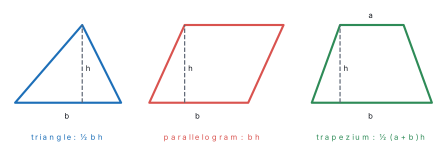
Problem. (a) A trapezium has parallel sides 12 m and 8 m and a distance of 5 m between them. Find its area. (b) A rhombus has diagonals 16 cm and 12 cm. Find its area and the length of one side.
Solution. (a)
(b)
The diagonals of a rhombus bisect each other at right angles, so each side is the hypotenuse of a right triangle with legs 8 cm and 6 cm:
Answer. (a) 50 m². (b) area 96 cm², side 10 cm.
Check. (b) The four sides are equal at 10 cm, so the perimeter is 40 cm; and \frac12\times16\times12=96 ✓.
8.2.1 Any quadrilateral: a diagonal and two heights
A diagonal d cuts any quadrilateral into two triangles. If the perpendiculars from the other two vertices to the diagonal are h_1 and h_2,
The rhombus formula \frac12d_1d_2 is the special case where h_1+h_2=d_2.
Problem. (a) In quadrilateral PQRS the diagonal PR =12 cm, and the perpendiculars from Q and S to PR are 5 cm and 4 cm. Find its area. (b) A parallelogram has area 120 cm² and base 15 cm. Find its height.
Solution. (a) Area =\frac12\times12\times(5+4)=6\times9=54 cm².
(b) b\times h=120, so 15h=120 and h=8 cm.
Problem. A rectangular park 120 m × 110 m contains a volleyball court 18 m × 9 m. Find the area of the park excluding the court.
Solution. Park =120\times110=13\,200 m². Court =18\times9=162 m². Remaining area =13\,200-162=13\,038 m².
8.3 Area and circumference of a circle
For a circle of radius r:
Take \pi=\frac{22}{7} unless a question says otherwise.
| Part | Meaning | Formula |
|---|---|---|
| Diameter | the chord through the centre | d=2r |
| Sector | the region between two radii and an arc | area =\frac{\theta}{360°}\times\pi r^2 |
| Arc | the curved length of a sector | length =\frac{\theta}{360°}\times2\pi r |
| Semicircle | half the circle | area =\frac12\pi r^2 |
Cut a circle of radius r into many equal sectors (16, 32, …) and arrange them head-to-tail. They form a shape that is almost a parallelogram (a rectangle, if the pieces are very thin).
- Its height is the radius, r.
- Its base is half the circumference: \frac12\times2\pi r=\pi r.
So area = base \times height =\pi r\times r=\pi r^2. Since r=\frac d2, area =\frac{\pi d^2}{4} as well.
Problem. The area of a circle is 5544 cm². Find its radius (\pi=\frac{22}{7}).
Solution. \frac{22}{7}r^2=5544, so r^2=\frac{5544\times7}{22}=1764 and r=\sqrt{1764}=42 cm.
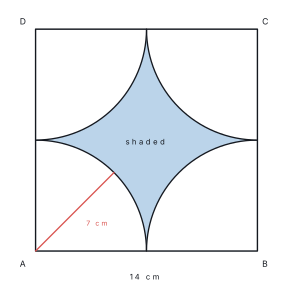
Problem. ABCD is a square of side 14 cm. At each corner a quarter circle of radius 7 cm is cut out. Find the area of the remaining (shaded) part (\pi=\frac{22}{7}).
Solution. Square =14\times14=196 cm². Four quarter circles of radius 7 cm make one full circle: \frac{22}{7}\times7\times7=154 cm². Shaded area =196-154=42 cm².
Problem. A circle has radius 7 cm. Find its circumference and area. Then find the area of a sector of the same circle that subtends 90° at the centre.
Solution. Circumference =2\times\frac{22}{7}\times7=44 cm.
Sector:
Answer. 44 cm; 154 cm²; the quarter sector is 38.5 cm².
Check. The sector is a quarter of the circle, and \frac{154}{4}=38.5 ✓.
Problem. A circular garden of radius 14 m has a path 1 m wide all round it, outside the garden. Find the area of the path.
Solution. The path is the ring between two circles: the inner radius is 14 m and the outer radius is 14+1=15 m.
Answer. About 91.14 m².
Check. The whole outer circle is \frac{22}{7}\times225=707.14 m² and the garden is \frac{22}{7}\times196=616 m²; the difference is 91.14 m² ✓. Always subtract the two circles rather than multiplying the circumference by the width, which would overestimate.
8.4 Surface area and volume of a cylinder
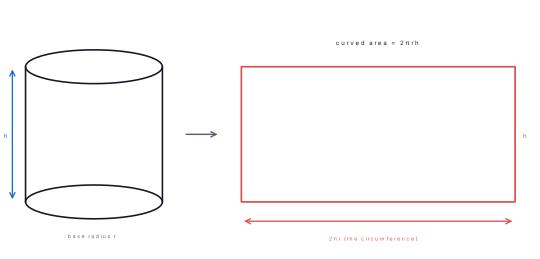
A cylinder has two circular ends and one curved surface. Think of a tin of ghee or a water tank.
| Quantity | Formula |
|---|---|
| Curved (lateral) surface area | 2\pi rh |
| Total surface area | 2\pi r(r+h) |
| Volume | \pi r^2h |
where r is the radius of the base and h the height. The volume of any prism is \text{area of base}\times\text{height}, which is where \pi r^2h comes from: the base is a circle.
Problem. A cylindrical water tank has a radius of 70 cm and a height of 1.5 m. Find its volume in litres and the area of sheet metal needed to make it (with a closed top).
Solution. Keep the units consistent: r=70 cm =0.7 m, h=1.5 m.
Since 1 m³ =1000 litres, the volume is 2,310 litres.
Answer. 2,310 litres; about 9.68 m² of sheet.
Check. The base area is 1.54 m² and the height is 1.5 m, so 1.54\times1.5=2.31 m³ ✓.
An area is in m² and a volume in m³. Multiplying a length by an area gives a volume; adding a length to an area is meaningless and always wrong. Before substituting, write every length in the same unit — mixing centimetres with metres is the second commonest error in mensuration.
8.5 Choosing the right formula
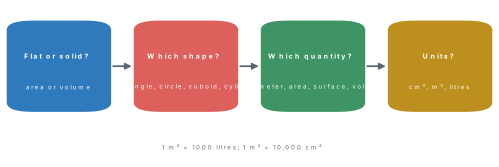
Most lost marks in mensuration come from reaching for the wrong formula, not from arithmetic. Decide three things first: flat or solid, which shape, which quantity.
| Shape | Perimeter / circumference | Area | Volume | Surface area |
|---|---|---|---|---|
| Rectangle | 2(l+b) | lb | — | — |
| Square | 4l | l^2 | — | — |
| Triangle | sum of sides | \frac{1}{2}bh | — | — |
| Circle | 2\pi r | \pi r^2 | — | — |
| Cuboid | — | — | lbh | 2(lb+bh+lh) |
| Cube | — | — | l^3 | 6l^2 |
| Cylinder | — | — | \pi r^2h | curved 2\pi rh; total 2\pi r(r+h) |
Question. A hall is 12 m long, 9 m wide and 4 m high. It has two doors of 2 m × 1.2 m and four windows of 1.5 m × 1 m. Find (i) the area of the four walls to be painted (ii) the cost of painting at Rs 95 per m².
Answer. (i) Four walls = 2h(l+b) = 2 \times 4 \times (12+9) = 168 m². Openings = 2(2 \times 1.2) + 4(1.5 \times 1) = 4.8 + 6 = 10.8 m². Area to paint = 168 - 10.8 = \textbf{157.2 m}^2. (ii) Cost = 157.2 \times 95 = \textbf{Rs 14,934}.
Question. A cylindrical tank of diameter 1.4 m and height 1.5 m is filled to three-quarters of its height. How many litres does it hold? Take \pi = \frac{22}{7}.
Answer. r = 0.7 m; filled height = \frac{3}{4} \times 1.5 = 1.125 m. V = \pi r^2 h = \frac{22}{7} \times 0.49 \times 1.125 = 1.7325 m³. 1 m³ = 1000 litres, so the tank holds 1,732.5 litres.
In groups, measure the length, breadth and height of your classroom, and the size of every door and window. Work out (a) the floor area, (b) the area of the four walls less the openings, (c) the volume of air in the room. Then find the cost of painting the walls at the local rate, and compare the groups' answers — differences will come from measurement, not from the formula.
Chapter summary
- Triangle: \frac12 bh; equilateral \frac{\sqrt{3}}{4}a^2; isosceles \frac b4\sqrt{4a^2-b^2}.
- Any quadrilateral with diagonal d and offsets h_1,h_2: \frac12d(h_1+h_2).
- Shaded area = whole figure - unshaded part.
- Rectangle lb; square a^2; parallelogram bh; rhombus and kite \frac12 d_1d_2; trapezium \frac12(a+b)h.
- Circle: circumference 2\pi r, area \pi r^2; sector area \frac{\theta}{360°}\pi r^2; arc length \frac{\theta}{360°}2\pi r.
- Cylinder: curved surface 2\pi rh, total surface 2\pi r(r+h), volume \pi r^2h.
- A ring or path is the difference of two circles, not a circumference times a width.
- Areas are in square units and volumes in cubic units, and all lengths must be in the same unit.
Practice questions
Group A — Objective (1 mark each)
- The area of a triangle with base 12 cm and height 5 cm is [1]a17 cm²b30 cm²c60 cm²d34 cm²
- The area of a rhombus with diagonals 8 cm and 6 cm is [1]a24 cm²b48 cm²c14 cm²d12 cm²
- The area of a trapezium with parallel sides 10 m and 6 m and height 4 m is [1]a32 m²b64 m²c240 m²d40 m²
- The circumference of a circle of radius 7 cm is [1]a22 cmb44 cmc154 cmd49 cm
- The volume of a cylinder of radius 3 cm and height 10 cm is (take \pi=3.14) [1]a282.6 cm³b94.2 cm³c30 cm³d188.4 cm³
- 1 m³ in litres is [1]a10b100c1000d10000
Answers to Group A
1. (b) — \frac12\times12\times5=30.
2. (a) — \frac12\times8\times6=24.
3. (a) — \frac12(10+6)\times4=32.
4. (b) — 2\times\frac{22}{7}\times7=44.
5. (a) — 3.14\times9\times10=282.6.
6. (c) — one cubic metre is 1000 litres.
Group B — Short answer (2 marks each)
- Find the area of a triangle whose base is 16 m and height 9 m. [2]
- Find the area of a circle of diameter 28 cm. [2]
- Find the curved surface area and the volume of a cylinder of radius 7 cm and height 10 cm. [2]
- A trapezium has area 84 cm² and parallel sides 10 cm and 14 cm. Find the distance between them. [2]
Answers to Group B
1. \frac12\times16\times9=72 m².
2. r=14 cm, so area =\frac{22}{7}\times196=616 cm².
3. Curved surface =2\times\frac{22}{7}\times7\times10=440 cm²; volume =\frac{22}{7}\times49\times10=1540 cm³.
4. \frac12(10+14)h=84, so 12h=84 and h=7 cm.
Group C — Long answer (4 marks each)
- A rectangular field is 60 m long and 40 m wide. A circular pond of radius 7 m is dug inside it. Find the area of the field that remains, and the length of fencing needed around the whole field. [4]
- A cylindrical tank of radius 1.4 m and height 2 m is full of water. Find its volume in litres. If water is drawn off at 20 litres a minute, how long will the tank take to empty? [4]
Answers to Group C
1. Area of the field. 60\times40=2400 m². Area of the pond. \frac{22}{7}\times7^2=154 m². Remaining area. 2400-154=2246 m². Fencing. The fence runs round the rectangle, so its length is the perimeter: 2(60+40)=200 m. Check. The pond takes up 154 m² out of 2400 m², about 6.4 %, so the remaining area must be a little under 2400 ✓.
2. Volume. \pi r^2h=\frac{22}{7}\times1.4^2\times2 =\frac{22}{7}\times1.96\times2=12.32 m³. Since 1 m³ =1000 litres, the tank holds 12,320 litres. Time. At 20 litres a minute, \frac{12\,320}{20}=616 minutes, that is 10 hours 16 minutes. Check. 616 minutes is about 10.3 hours; at 20 litres a minute the tank loses 1200 litres an hour, and 12\,320\div1200=10.27 hours ✓.
Extra practice
Group B (2 marks)
14. Find the total surface area of a cuboid 8 cm × 5 cm × 3 cm.
15. The circumference of a circle is 88 cm. Find its radius (\pi = \frac{22}{7}).
Group C (4 marks)
16. A room 6 m × 5 m × 3.5 m is to be carpeted on the floor at Rs 450 per m² and painted on the four walls at Rs 110 per m², with one door 2 m × 1 m. Find the total cost.
Extra practice — answers
14. 2(lb + bh + lh) = 2(40 + 15 + 24) = 158 cm².
15. 2\pi r = 88 \Rightarrow r = \frac{88 \times 7}{2 \times 22} = 14 cm.
16. Floor = 30 m²; carpet = 30 \times 450 = Rs 13,500. Walls = 2 \times 3.5 \times (6+5) = 77 m²; less the door 2 m² gives 75 m²; paint = 75 \times 110 = Rs 8,250. Total = Rs 21,750.
Objective practice
Choose the correct answer. [5×1=5]
1. The area of a circle of radius 7 cm (\pi=\frac{22}{7}) is (a) 44 cm² (b) 154 cm² (c) 49 cm² (d) 22 cm²
2. The volume of a cuboid 5 cm × 4 cm × 3 cm is (a) 12 cm³ (b) 60 cm³ (c) 94 cm³ (d) 47 cm³
3. 1 m³ equals (a) 100 litres (b) 1000 litres (c) 10 litres (d) 10,000 litres
4. The area of the four walls of a room is (a) lb (b) 2h(l+b) (c) 2(lb+bh+lh) (d) lbh
5. If the radius of a circle is doubled, its area becomes (a) double (b) three times (c) four times (d) unchanged
Objective practice — answers
1. (b) — \frac{22}{7}\times49=154 cm².
2. (b) — 5\times4\times3=60 cm³.
3. (b) — 1000 litres.
4. (b) — 2h(l+b).
5. (c) — area varies as the square of the radius.
Practise more: Mathematics question bank