Unit 7 · Compulsory Mathematics · 12 min read
Simple Interest
What the syllabus asks for 4
- principal, rate, time and simple interest
- amount and the interest formula
- finding rate or time when the others are known
- simple interest in daily life: saving and borrowing
When you keep money in a bank, the bank pays you for the use of it; when you borrow money, you pay the lender. That payment is interest, and the amount borrowed or deposited is the principal. At this level the interest is simple: it is a fixed percentage of the original sum for each year, so it grows in a straight line and never earns interest on itself. This chapter works the formula in every direction and ends with the practical arithmetic of saving and borrowing.
You should be able to use I=\frac{PTR}{100}, find the amount A=P+I, and find any one of principal, rate or time when the other quantities are known.
7.1 The simple interest formula
- Principal (P): the sum of money borrowed, lent or deposited.
- Interest (I): the extra money paid for using the principal for a fixed time.
- Rate of interest (R): the interest on Rs 100 for 1 year. "8 % per annum" means Rs 8 interest on every Rs 100 each year.
- Time (T): the period for which the money is borrowed or deposited.
- Amount (A): principal + interest.
We use the meaning of the rate, R % per annum, and change one quantity at a time.
Step 1. Interest on Rs 100 for 1 year = Rs R (meaning of the rate).
Step 2. Interest on Rs 1 for 1 year = Rs \frac{R}{100}.
Step 3. Interest on Rs P for 1 year = Rs \frac{P\times R}{100}.
Step 4. Interest on Rs P for T years = Rs \frac{P\times T\times R}{100}.
Result.
Problem. Somaya borrows Rs 20,000 at 10 % per annum for vegetable farming. Find the interest for 2 years by the unitary method.
Solution. Interest on Rs 100 for 1 year = Rs 10. Interest on Rs 1 for 1 year = Rs \frac{10}{100}. Interest on Rs 20,000 for 1 year = Rs \frac{10\times20\,000}{100}= Rs 2,000. Interest on Rs 20,000 for 2 years =2\times2000= Rs 4,000.
| Symbol | Meaning | Unit |
|---|---|---|
| P | principal, the sum deposited or borrowed | rupees |
| T | time | years |
| R | rate of interest per year | percent per annum |
| I | simple interest | rupees |
| A | amount =P+I | rupees |
Note that R is a yearly rate, so the time must be in years. Six months is T=\frac12 year, and eight months is T=\frac{8}{12}=\frac23 year.
If T is left in months, the answer will be wrong by a factor of 12. Convert first, then substitute: 9 months is T=0.75 years, 15 months is T=1.25 years.
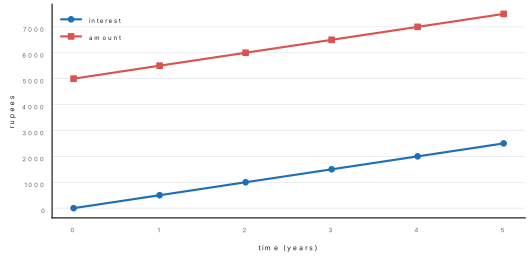
Problem. Find the simple interest and the amount on Rs 5,000 for 3 years at 10 % per annum.
Solution. P=5000, T=3, R=10.
Answer. Interest Rs 1,500; amount Rs 6,500.
Check. 10 % of 5000 is 500 a year, and 3 years gives 3\times500=1500 ✓ — simple interest is the same every year.
Problem. Find the simple interest on Rs 8,400 for 9 months at 8 % per annum.
Solution. Convert the time: T=\frac{9}{12}=0.75 years.
Answer. Rs 504.
Check. One year's interest would be 0.08\times8400=\text{Rs }672; nine months is \frac34 of a year, so 672\times0.75=504 ✓.
7.2 Finding principal, rate or time
The same formula is rearranged. Write it in the triangle form and cover the quantity you want:
Problem. A sum of Rs 6,000 earns Rs 1,080 as simple interest in 3 years. Find the rate percent per annum.
Solution.
Answer. 6 % per annum.
Check. 6 % of 6000 is 360 a year, and 3\times360=1080 ✓.
Problem. What sum will earn Rs 900 as simple interest in 2 years at 7.5 % per annum?
Solution.
Answer. Rs 6,000.
Check. 7.5 % of 6000 is 450 a year, and two years give 900 ✓.
Problem. In how many years will Rs 12,000 earn Rs 2,160 as simple interest at 9 % per annum?
Solution.
Answer. 2 years.
Check. 9 % of 12,000 is 1,080 a year, and 2\times1080=2160 ✓.
Problem. A sum becomes Rs 7,200 in 4 years at 5 % simple interest per annum. Find the principal.
Solution. The amount is A=P+I, and I=\frac{PTR}{100}=\frac{P\times4\times5}{100}=0.2P. So
Answer. Rs 6,000.
Check. I=0.2\times6000=\text{Rs }1200, and 6000+1200=7200 ✓.
When the amount is given rather than the interest, express A as a multiple of P: A=P\left(1+\frac{TR}{100}\right). For T=4 and R=5, the factor is 1+\frac{20}{100}=1.2, so P=\frac{A}{1.2}. This saves a step and avoids solving two equations.
7.3 Simple interest in daily life
- Saving. Rs 20,000 in a fixed deposit at 9 % for 2 years earns \frac{20000\times2\times9}{100}=\text{Rs }3600. A cooperative at 11 % would earn Rs 4,400, i.e. Rs 800 more — this is the whole reason people compare rates.
- Borrowing. A loan of Rs 50,000 at 12 % for 18 months costs \frac{50\,000\times1.5\times12}{100}=\text{Rs }9000 in interest, so the borrower repays Rs 59,000 in total. Borrowing for longer at the same rate costs proportionally more.
- Comparing offers. The offer with the smaller rate × time is cheaper, even if its rate is higher. Rs 50,000 for 1 year at 15 % costs Rs 7,500; for 2 years at 12 % it costs Rs 12,000.
Problem. Adira saves Rs 40,000 in a bank at 5 % per annum. The bank deducts 5 % of the interest as income tax. How much will she receive after 4 years?
Solution. I=\frac{40\,000\times4\times5}{100}= Rs 8,000.
Tax =5\% of 8000=\frac{5}{100}\times8000= Rs 400.
Interest received =8000-400= Rs 7,600.
Amount received =40\,000+7600= Rs 47,600.
The 5 % tax is taken from the interest (Rs 8,000), not from the amount (Rs 48,000). Taking 5 % of Rs 48,000 would wrongly give a tax of Rs 2,400.
Problem. In how many years will a sum become three times itself at 10 % simple interest per annum?
Solution. Let the principal be P. Then A=3P, so I=3P-P=2P.
Most real loans charge compound interest, or a flat rate on the whole sum while the balance falls, which is much more expensive than simple interest suggests. The simple interest formula is the correct tool for the questions in this book and for a rough comparison; for an actual loan, read the repayment schedule.
7.4 Reading the interest formula four ways
One formula, four questions. Whichever quantity is missing, rearrange and substitute.
Question. A sum of Rs 16,000 amounts to Rs 20,800 in 4 years at simple interest. (i) Find the rate. (ii) In how many years would the same sum earn Rs 9,600 at that rate?
Answer. (i) I = 20800 - 16000 = 4800. R = \frac{100 \times 4800}{16000 \times 4} = \frac{480000}{64000} = \textbf{7.5 \%} per annum. (ii) T = \frac{100 \times 9600}{16000 \times 7.5} = \frac{960000}{120000} = \textbf{8 years}.
Question. Ram puts Rs 20,000 in a bank at 6 % and Sita puts Rs 15,000 in a cooperative at 9 %, both for 3 years. Who earns more, and by how much?
Answer. Ram: I = \frac{20000 \times 3 \times 6}{100} = Rs 3,600. Sita: I = \frac{15000 \times 3 \times 9}{100} = Rs 4,050. Sita earns Rs 450 more, although she deposited Rs 5,000 less — the rate mattered more than the principal here.
Collect the current interest rate for a savings account from a commercial bank, a development bank and a local cooperative. For a deposit of Rs 25,000 over 2 years, work out the simple interest in each case and rank them. Discussion: A higher rate usually comes with higher risk. What else besides the rate would you check before depositing money?
Chapter summary
- I=\frac{PTR}{100} and A=P+I, with T always in years.
- Rearranged: P=\frac{100I}{TR}, R=\frac{100I}{PT}, T=\frac{100I}{PR}.
- When the amount is given, use A=P\left(1+\frac{TR}{100}\right) and solve for P.
- Simple interest is the same every year, so it grows in a straight line.
- Income tax on interest is a percent of the interest only; amount received =P+I-\text{tax}.
- Comparing two offers means comparing P\times T\times R, not the rate alone.
Practice questions
Group A — Objective (1 mark each)
- The simple interest on Rs 4,000 at 5 % for 2 years is [1]aRs 200bRs 400cRs 800dRs 1,000
- If P= Rs 5,000, T=2 years and I= Rs 800, the rate is [1]a6%b7%c8%d10%
- The amount on Rs 2,500 at 8 % for 3 years is [1]aRs 2,600bRs 3,100cRs 3,500dRs 600
- 18 months expressed in years is [1]a1.8b1.5c18d0.18
- The simple interest on Rs 10,000 at 12 % for 5 years is [1]aRs 1,200bRs 3,600cRs 6,000dRs 12,000
- If the interest is Rs 900, P= Rs 3,000 and R=10\%, then T is [1]a2 yearsb3 yearsc4 yearsd5 years
Answers to Group A
1. (b) — \frac{4000\times2\times5}{100}=400.
2. (c) — R=\frac{100\times800}{5000\times2}=8\%.
3. (b) — I=600, so A=2500+600=3100.
4. (b) — \frac{18}{12}=1.5.
5. (c) — 5\times1200=6000.
6. (b) — T=\frac{100\times900}{3000\times10}=3 years.
Group B — Short answer (2 marks each)
- Find the simple interest on Rs 7,500 for 2 years at 6 % per annum. [2]
- Find the principal that earns Rs 1,260 in 3 years at 7 % per annum. [2]
- Find the rate at which Rs 9,000 earns Rs 1,620 in 2 years. [2]
- In how many years will Rs 15,000 earn Rs 4,500 at 10 % per annum? [2]
Answers to Group B
1. I=\frac{7500\times2\times6}{100}=\text{Rs }900.
2. P=\frac{100\times1260}{3\times7}=\text{Rs }6000.
3. R=\frac{100\times1620}{9000\times2}=9\%.
4. T=\frac{100\times4500}{15\,000\times10}=3 years.
Group C — Long answer (4 marks each)
- Rs 12,000 is deposited at 8 % per annum for 2 years in bank A, and the same sum at 9 % per annum for 18 months in bank B. Which deposit earns more interest, and by how much? [4]
- A sum of money becomes Rs 7,800 in 3 years at 10 % simple interest per annum. Find the principal and the interest earned. If the same sum is then invested at 8 % per annum for 2 years 6 months, what amount will it become? [4]
Answers to Group C
1. Bank A. I=\frac{12\,000\times2\times8}{100}=\text{Rs }1920. Bank B. T=1.5 years, so I=\frac{12\,000\times1.5\times9}{100}=\text{Rs }1620. Bank A earns more, by 1920-1620=\text{Rs }300. Check. P\times T\times R: A gives 12\,000\times2\times8=192\,000 and B gives 12\,000\times1.5\times9=162\,000; A is bigger ✓.
2. Principal. I=\frac{P\times3\times10}{100}=0.3P, and A=P+I=P+0.3P=1.3P. So P=\frac{7800}{1.3}=\text{Rs }6000, and the interest earned is 7800-6000=\text{Rs }1800. Second part. T=2.5 years, so I=\frac{6000\times2.5\times8}{100}=\text{Rs }1200, and the amount is 6000+1200=\text{Rs }7200. Check. 10 % of 6000 is 600 a year, and three years give 3\times600=1800, so the amount is 6000+1800=7800 ✓. For the second part, 8 % of 6000 is 480 a year, and 2.5 years give 2.5\times480=1200 ✓. Note that the same principal earns less here, because both the rate and the time are lower.
Extra practice
Group B (2 marks)
11. Find the simple interest on Rs 7,500 for 2 years at 8 % per annum.
12. What principal earns Rs 2,400 in 3 years at 8 % per annum?
Group C (4 marks)
13. A man borrows Rs 30,000 at 12 % per annum and repays the whole amount after 2 years 6 months. Find the interest and the total repayment.
Extra practice — answers
11. I = \frac{7500 \times 2 \times 8}{100} = Rs 1,200.
12. P = \frac{100 \times 2400}{3 \times 8} = Rs 10,000.
13. T = 2.5 years. I = \frac{30000 \times 2.5 \times 12}{100} = Rs 9,000; total repayment = 30000 + 9000 = Rs 39,000.
Objective practice
Choose the correct answer. [5×1=5]
1. The simple interest on Rs 4,000 for 2 years at 10 % is (a) Rs 400 (b) Rs 800 (c) Rs 1,000 (d) Rs 80
2. Rs 5,000 becomes Rs 6,500 in 3 years; the rate is (a) 5 % (b) 8 % (c) 10 % (d) 12 %
3. In the formula I=\frac{PTR}{100}, P stands for (a) percentage (b) principal (c) profit (d) period
4. The time for Rs 2,000 to earn Rs 600 at 10 % is (a) 2 years (b) 3 years (c) 4 years (d) 5 years
5. Simple interest is called "simple" because (a) it is small (b) it is the same every year (c) it needs no formula (d) it is monthly
Objective practice — answers
1. (b) — \frac{4000\times2\times10}{100}=800.
2. (c) — I=1500; R=\frac{100\times1500}{5000\times3}=10 %.
3. (b) — the principal.
4. (b) — T=\frac{100\times600}{2000\times10}=3 years.
5. (b) — interest is computed on the principal only.
Practise more: Mathematics question bank