Unit 17 · Compulsory Mathematics · 12 min read
Coordinates
What the syllabus asks for 3
- the coordinate plane and plotting points
- distance between two points on the axes and in the plane
- simple shapes drawn from coordinates
A coordinate is a pair of numbers that says exactly where a point is: how far across and how far up. With that one idea, geometry becomes arithmetic — a shape is a list of points, a distance is a subtraction and a square root, and a straight line is an equation. This chapter fixes the vocabulary, shows how to plot and read points, and shows how to find the distance between two of them.
You should be able to plot a point given its coordinates, name the quadrant a point lies in, find the distance between two points on the same horizontal or vertical line and between any two points using the distance formula, and identify a simple shape from the coordinates of its vertices.
17.1 The coordinate plane
Two number lines crossing at right angles make the coordinate plane. The horizontal line is the x-axis, the vertical line is the y-axis, and their crossing point O is the origin, with coordinates (0,0).
A point is written as an ordered pair (x,y):
- the x-coordinate (abscissa) is how far the point is from the y-axis, positive to the right;
- the y-coordinate (ordinate) is how far it is from the x-axis, positive upwards.
The axes divide the plane into four quadrants, numbered anticlockwise from the top right.
| Quadrant | x | y | Example |
|---|---|---|---|
| I (top right) | positive | positive | (3,4) |
| II (top left) | negative | positive | (-3,4) |
| III (bottom left) | negative | negative | (-3,-4) |
| IV (bottom right) | positive | negative | (3,-4) |
A point on an axis belongs to no quadrant: (5,0) lies on the x-axis and (0,-2) on the y-axis.
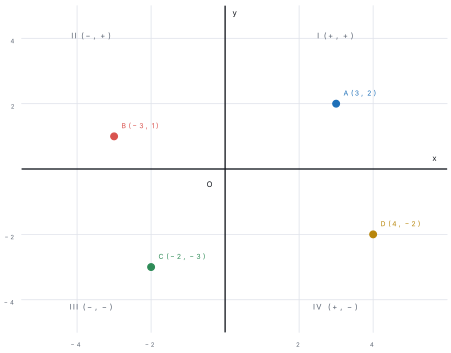
(3,4) and (4,3) are different points. Always write x first. When plotting, go across from the y-axis first and then up or down from the x-axis — doing it in the other order swaps every point in the figure.
17.2 Distance between two points
17.2.1 Points on the same horizontal or vertical line
If two points have the same y-coordinate, the distance between them is the difference of their x-coordinates. If they have the same x-coordinate, it is the difference of their y-coordinates. Take the positive value in each case.
Problem. Find the distance between (a) A(2,3) and B(7,3), and (b) C(2,3) and D(2,-4).
Solution. (a) The y-coordinates are equal, so AB=7-2=5 units.
(b) The x-coordinates are equal, so CD=3-(-4)=7 units.
Check. In (a) both points lie on the line y=3; in (b) both lie on x=2 ✓. For (b), the subtraction 3-(-4)=7 shows why the sign must be handled carefully — the points are on opposite sides of the x-axis.
17.2.2 Pythagoras' theorem — the tool we need
In a right-angled triangle with perpendicular p, base b and hypotenuse h (the side opposite the right angle):
If the three sides of a triangle satisfy this, the triangle is right-angled.
Problem. (a) A right-angled triangle has perpendicular 6 cm and base 8 cm. Find the hypotenuse x. (b) The hypotenuse of a right triangle is 26 cm and one side is 10 cm. Find the other side. (c) Is the triangle with sides 7, 7 and 10 cm right-angled?
Solution. (a) x^2=6^2+8^2=36+64=100, so x=10 cm.
(b) x^2=26^2-10^2=676-100=576, so x=24 cm.
(c) Longest side 10: 10^2=100 but 7^2+7^2=98. Since 100\ne98, it is not right-angled.
17.2.3 Any two points: the distance formula
From A and B drop perpendiculars AP and BQ to the x-axis, and draw AC\perp BQ.
Step 1 — horizontal side. AC=PQ=OQ-OP=x_2-x_1.
Step 2 — vertical side. BC=BQ-CQ=BQ-AP=y_2-y_1.
Step 3 — Pythagoras in right-angled \triangle ACB. AB^2=AC^2+BC^2=(x_2-x_1)^2+(y_2-y_1)^2
Result.
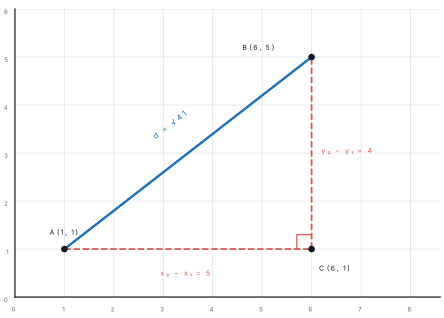
Problem. Find the distance between A(1,1) and B(6,5).
Solution.
Answer. About 6.4 units.
Check. The horizontal difference is 5 and the vertical is 4, so the distance must be between 5 and 7 (it is the hypotenuse of a 5-4-right triangle), and 6.4 lies in that interval ✓.
Problem. The distance between A(2,3) and B(7,y) is 13 units. Find the possible values of y.
Solution.
Squaring both sides: 169=25+(y-3)^2, so (y-3)^2=144 and y-3=\pm12.
Answer. y=15 or y=-9.
Check. y=15: d=\sqrt{25+144}=\sqrt{169}=13 ✓. y=-9: d=\sqrt{25+(-12)^2}=\sqrt{169}=13 ✓. Two answers, one above A and one below — and both are correct, because a circle of radius 13 about A meets the line x=7 twice.
Problem. The centre of a circle is A(4,6) and P(10,8) is a point on the circle. Find the radius.
Solution. Radius =AP=\sqrt{(10-4)^2+(8-6)^2}=\sqrt{36+4}=\sqrt{40}=2\sqrt{10}\approx6.32 units.
Problem. (a) P lies on the x-axis 5 units from the origin (positive side) and Q lies on the y-axis 4 units from the origin (positive side). Find PQ. (b) On a map, A is at (4,7) and B at (7,3), and 1 unit represents 55 km. Find the real distance AB.
Solution. (a) On the x-axis y=0, so P(5,0); on the y-axis x=0, so Q(0,4). PQ=\sqrt{(0-5)^2+(4-0)^2}=\sqrt{25+16}=\sqrt{41} units.
(b) AB=\sqrt{(7-4)^2+(3-7)^2}=\sqrt{9+16}=5 units, so the real distance is 5\times55=275 km.
17.3 Shapes from coordinates
A set of points can be joined to make a shape, and the coordinates tell you what kind it is.
| Shape | What to check |
|---|---|
| Square | four equal sides and one right angle; diagonals equal and bisecting |
| Rectangle | opposite sides equal, adjacent sides perpendicular |
| Parallelogram | opposite sides equal and parallel (equal in both directions) |
| Rhombus | four equal sides |
| Right triangle | the squares of two sides add to the square of the longest |
| Isosceles triangle | two sides equal |
| Collinear points | the slopes between consecutive pairs are all equal |
Problem. The points A(0,0), B(4,0), C(4,3) and D(0,3) are joined in order. What shape is ABCD? Find its perimeter and area.
Solution. The four sides are
Opposite sides are equal, and AB is horizontal while BC is vertical, so the angle at B is a right angle. The figure is a rectangle.
Perimeter =4+3+4+3=14 units, and area =4\times3=12 square units.
Check. The diagonal AC=\sqrt{(4-0)^2+(3-0)^2}=\sqrt{25}=5, and the diagonals of a rectangle are equal, so BD must also be 5: from B(4,0) to D(0,3), BD=\sqrt{16+9}=5 ✓.
Problem. Show that the triangle with vertices P(1,1), Q(5,1) and R(1,4) is right-angled, and find its area.
Solution. Compute the three sides:
Now test: 3^2+4^2=9+16=25=5^2. Since the squares of the two shorter sides add to the square of the longest, the angle between PQ and PR is a right angle, so the triangle is right-angled at P.
Check. PQ is horizontal and PR is vertical, so they are perpendicular by inspection as well as by Pythagoras ✓.
Four equal sides give a rhombus, not necessarily a square. Four equal sides with one right angle (or with equal diagonals) give a square. Check the angles, not only the lengths.
17.4 Reading a point in four quadrants
| Task | Rule |
|---|---|
| Plot (x, y) | x along the horizontal axis first, then y |
| Distance from the origin | \sqrt{x^2 + y^2} |
| Distance between two points | \sqrt{(x_2-x_1)^2 + (y_2-y_1)^2} |
| Point on the x-axis | y = 0, e.g. (5, 0) |
| Point on the y-axis | x = 0, e.g. (0, -3) |
| Midpoint of a segment | \left(\frac{x_1+x_2}{2}, \frac{y_1+y_2}{2}\right) |
Question. For P(2, 3) and Q(8, 11), find (i) the distance PQ (ii) the midpoint of PQ.
Answer. (i) PQ = \sqrt{(8-2)^2 + (11-3)^2} = \sqrt{36 + 64} = \sqrt{100} = \textbf{10 units}. (ii) Midpoint = \left(\frac{2+8}{2}, \frac{3+11}{2}\right) = \textbf{(5, 7)}.
Question. Find the area of the triangle with vertices A(1,1), B(5,1) and C(1,6).
Answer. AB is horizontal with length 5 - 1 = 4; AC is vertical with length 6 - 1 = 5; the angle at A is a right angle. Area = \frac{1}{2} \times 4 \times 5 = \textbf{10 square units}.
In pairs, each student hides a "treasure" at a lattice point on a grid from -6 to 6 and writes down its coordinates. Partners take turns guessing a point; the hider answers only with the distance to the treasure, worked out with the distance formula. Three correct distances are usually enough to locate it.
Chapter summary
- A point is written (x,y), x first; the axes divide the plane into four quadrants, and the signs of the coordinates decide which.
- On a horizontal line the distance is the difference of the x-coordinates; on a vertical line it is the difference of the y-coordinates.
- For any two points, d=\sqrt{(x_2-x_1)^2+(y_2-y_1)^2}, which is Pythagoras' theorem.
- Joining points and comparing the side lengths and the angles identifies the shape; equal sides alone give a rhombus, not a square.
- A triangle is right-angled exactly when the squares of two sides add to the square of the third.
Practice questions
Group A — Objective (1 mark each)
- The point (-2,5) lies in quadrant [1]aIbIIcIIIdIV
- The distance between (0,0) and (3,4) is [1]a5b7c12d25
- The point (0,-6) lies [1]aon the x-axisbon the y-axiscin quadrant IIIdat the origin
- The distance between (2,7) and (9,7) is [1]a5b7c9d14
- The distance formula is a form of [1]athe area formulabPythagoras' theoremcthe cosine ruledEuler's relation
- (4,3) and (3,4) are [1]athe same pointbdifferent pointscboth on the x-axisdboth in quadrant II
Answers to Group A
1. (b) — x negative, y positive.
2. (a) — \sqrt{9+16}=5.
3. (b) — x=0 means the point is on the y-axis.
4. (b) — 9-2=7.
5. (b) — the differences of the coordinates are the legs of a right triangle.
6. (b) — the order matters.
Group B — Short answer (2 marks each)
- Plot A(1,2), B(4,2) and C(4,6) and find the length of BC. [2]
- Find the distance between (-2,-3) and (3,9). [2]
- In which quadrant does each of (5,-2), (-4,-6) and (-1,7) lie? [2]
- Find the distance of the point (6,8) from the origin. [2]
Answers to Group B
1. BC is vertical, so BC=6-2=4 units.
2. d=\sqrt{(3+2)^2+(9+3)^2}=\sqrt{25+144}=\sqrt{169}=13.
3. (5,-2) — quadrant IV; (-4,-6) — quadrant III; (-1,7) — quadrant II.
4. \sqrt{36+64}=\sqrt{100}=10.
Group C — Long answer (4 marks each)
- The points A(-2,1), B(2,1), C(2,-2) and D(-2,-2) are joined in order. Identify the shape, find its perimeter and area, and find the length of a diagonal. [4]
- Show that P(0,0), Q(6,0) and R(0,8) form a right-angled triangle, find its area, and find the length of the hypotenuse. [4]
Answers to Group C
1. AB=2-(-2)=4 and BC=1-(-2)=3, with AB horizontal and BC vertical, so the figure is a rectangle 4 units by 3 units. Perimeter =2(4+3)=14 units; area =4\times3=12 square units. Diagonal =\sqrt{4^2+3^2}=\sqrt{25}=5 units. Check. The other diagonal is also 5 ✓, as a rectangle's diagonals are equal.
2. PQ=6 (horizontal), PR=8 (vertical), and QR=\sqrt{(6-0)^2+(0-8)^2}=\sqrt{36+64}=10. Since 6^2+8^2=36+64=100=10^2, the angle at P is a right angle and the triangle is right-angled at P. Area =\frac12\times6\times8=24 square units. Hypotenuse =QR=10 units. Check. PQ lies along the x-axis and PR along the y-axis, so they meet at 90° ✓, and the hypotenuse is the side opposite the right angle, which is QR.
Extra practice
Group B (2 marks)
11. State the quadrant of (-7, 4) and of (5, -9).
12. Find the distance of (-6, 8) from the origin.
Group C (4 marks)
13. P(2,-1), Q(6,-1) and R(6,4) are the vertices of a triangle. Find (i) PQ (ii) QR (iii) PR (iv) the area of the triangle.
Extra practice — answers
11. (-7,4) is in the second quadrant; (5,-9) is in the fourth.
12. \sqrt{36+64} = 10 units.
13. (i) PQ = 6 - 2 = 4 units (horizontal). (ii) QR = 4 - (-1) = 5 units (vertical). (iii) PR = \sqrt{4^2 + 5^2} = \sqrt{41} \approx 6.4 units. (iv) The right angle is at Q, so area = \frac{1}{2} \times 4 \times 5 = 10 square units.
Objective practice
Choose the correct answer. [5×1=5]
1. The point (0, -4) lies on (a) the x-axis (b) the y-axis (c) the first quadrant (d) the third quadrant
2. The distance of (9, 12) from the origin is (a) 15 (b) 21 (c) 3 (d) \sqrt{21}
3. The midpoint of (2, 6) and (8, 10) is (a) (10, 16) (b) (5, 8) (c) (3, 2) (d) (6, 4)
4. (-6, -2) lies in quadrant (a) I (b) II (c) III (d) IV
5. The distance between (1, 2) and (4, 6) is (a) 5 (b) 7 (c) 25 (d) \sqrt{7}
Objective practice — answers
1. (b) — x = 0, so it is on the y-axis.
2. (a) — \sqrt{81 + 144} = 15.
3. (b) — \left(\frac{2+8}{2}, \frac{6+10}{2}\right).
4. (c) — both coordinates negative.
5. (a) — \sqrt{9 + 16} = 5.
Practise more: Mathematics question bank