Unit 10 · Compulsory Mathematics · 13 min read
Algebraic Expressions
What the syllabus asks for 4
- review of factorisation
- highest common factor of algebraic expressions
- lowest common multiple
- factorisation by grouping and by using identities
An algebraic expression is arithmetic with letters in it, and factorising is the art of writing it as a product instead of a sum. That single change is what makes it possible to cancel, to solve and to see structure. This chapter reviews the vocabulary, then works through the highest common factor and the lowest common multiple of expressions, factorisation by taking out a common factor and by grouping, and the three standard identities that every later chapter depends on.
You should be able to name the terms, coefficient and degree of an expression, find the HCF and LCM of two or more expressions, factorise by taking out a common factor and by grouping, and use the identities (a\pm b)^2, a^2-b^2 in both directions.
10.1 Terms, coefficients and like terms
An algebraic expression is a combination of constants and variables joined by +, - and \times. In 5x^2-3x+7:
- the terms are 5x^2, -3x and 7;
- the coefficient of x^2 is 5 and of x is -3;
- the constant term is 7;
- the degree of the expression is 2, the highest power of the variable.
Like terms have the same variable raised to the same power and can be added or subtracted: 5x^2+3x^2=8x^2, but 5x^2+3x cannot be combined.
When you collect like terms in 7x-3x+2x, the answer is 6x, not 12x. The sign belongs to the term that follows it. Writing each term with its sign before collecting removes an entire family of mistakes.
10.2 Highest common factor of expressions
The HCF of two or more expressions is the product of every factor common to all of them, each taken to its lowest power.
Method. Factorise each expression completely, write the common factors with their smallest indices, and multiply.
Problem. Find the HCF of 12x^3y^2 and 18x^2y^4.
Solution. Factorise each:
Common to both: one 2, one 3, x^2 and y^2.
Check. \frac{12x^3y^2}{6x^2y^2}=2x ✓ and \frac{18x^2y^4}{6x^2y^2}=3y^2 ✓ — both quotients are whole expressions, as they must be for a common factor.
Problem. Find the HCF of 8a^2b, 12ab^2 and 20a^2b^2.
Solution. Numbers: HCF of 8, 12 and 20 is 4. For a: the smallest power is a^1. For b: the smallest power is b^1.
Check. Dividing each by 4ab gives 2a, 3b and 5ab ✓, none of which has a further common factor.
10.3 Lowest common multiple of expressions
The LCM is the product of every factor that appears in any of the expressions, each taken to its highest power.
Problem. Find the LCM of 6x^2y and 9xy^3.
Solution. Numbers: LCM of 6 and 9 is 18. For x: highest power x^2. For y: highest power y^3.
Check. Using the product rule (here the product is 6x^2y\times9xy^3=54x^3y^4): \text{LCM}=\frac{54x^3y^4}{3xy}=18x^2y^3 ✓, agreeing with the direct answer.
Problem. For 4a^3b^2 and 10a^2b^3, find both the HCF and the LCM, and verify that \text{HCF}\times\text{LCM} equals the product of the two expressions.
Solution. HCF: numbers 2, a^2, b^2, so \text{HCF}=2a^2b^2.
LCM: numbers 20, a^3, b^3, so \text{LCM}=20a^3b^3.
Product of the expressions: 4a^3b^2\times10a^2b^3=40a^5b^5. They agree ✓.
10.4 Factorisation by taking out a common factor
The first thing to look for in any expression is a factor common to every term. The distributive law then works backwards:
Problem. Factorise 4x^3-8x^2.
Solution. The HCF of the two terms is 4x^2, so
Check. Expanding: 4x^2\times x-4x^2\times2=4x^3-8x^2 ✓. Always expand your answer back — it takes ten seconds and it is the only complete check in factorising.
Problem. Factorise 3a(x+y)+5b(x+y).
Solution. The whole bracket (x+y) is common:
Answer. (x+y)(3a+5b).
10.5 Factorisation by grouping
When there is no common factor to all four terms, group them in pairs, take a common factor out of each pair, and hope for a common bracket.
Problem. Factorise 6x^2+9x+4x+6.
Solution. Group the first two and the last two:
Now (2x+3) is common:
Answer. (2x+3)(3x+2).
Check. Expanding: 6x^2+4x+9x+6=6x^2+13x+6 ✓, which is the original.
Problem. Factorise a^2-ab+ac-bc.
Solution. Group as (a^2-ab)+(ac-bc):
Answer. (a-b)(a+c).
Check. Expanding: a^2+ac-ab-bc ✓.
Note. If the second group had been written as (ac-bc)=c(a-b), the brackets matched. If they come out matching with opposite signs, take the minus sign out of the whole group, which reverses both terms inside it.
From x^2-5x-3x+15 the grouping gives x(x-5)-3(x-5), not x(x-5)+3(x-5). Factorising -3x+15 as -3(x-5) is correct; as +3(x-5) it is not, because 3(x-5)=3x-15. When the last two terms have a minus before the third, put the minus outside the bracket.
10.6 The standard identities
The three identities below are used in both directions: to expand a product, and to factorise a sum.
| Identity | Expanded form |
|---|---|
| (a+b)^2 | a^2+2ab+b^2 |
| (a-b)^2 | a^2-2ab+b^2 |
| (a+b)(a-b) | a^2-b^2 |
Problem. Factorise 9x^2-16y^2.
Solution. Both terms are perfect squares: 9x^2=(3x)^2 and 16y^2=(4y)^2. Using a^2-b^2=(a+b)(a-b),
Answer. (3x+4y)(3x-4y).
Check. Expanding: 9x^2-12xy+12xy-16y^2=9x^2-16y^2 ✓.
Problem. Expand (2x+5)^2.
Solution. With a=2x and b=5:
Answer. 4x^2+20x+25.
Check. Put x=1: the original is 7^2=49, and the answer is 4+20+25=49 ✓.
Problem. Evaluate 103\times97 and 102^2 without a calculator.
Solution. Write each as an identity.
Check. 103\times97=9991 ✓ and 102\times102=10\,404 ✓.
Problem. Factorise 2x^3-8x completely.
Solution. Take out the common factor 2 first, then recognise a difference of two squares:
Answer. 2x(x+2)(x-2).
Check. Expanding: 2x(x^2-4)=2x^3-8x ✓. Notice that "completely" is not satisfied by 2x(x^2-4); the bracket still factorises.
10.6.1 Perfect squares and the blank term
An expression a^2\pm2ab+b^2 is a perfect square. To decide what must go in a blank, compare with a^2+2ab+b^2:
- the middle term is 2\times\sqrt{\text{first}}\times\sqrt{\text{last}};
- the last term is \left(\frac{\text{middle}}{2\sqrt{\text{first}}}\right)^2.
Problem. Fill the blank so that each is a perfect square: (a) x^2+\ \dots\ +16 (b) 9a^2-\ \dots\ +49b^2 (c) p^2+\ \dots\ +\frac{1}{p^2}.
Solution. (a) x^2+16=x^2+4^2, so the middle term is 2\times x\times4=8x: x^2+8x+16=(x+4)^2.
(b) 9a^2=(3a)^2, 49b^2=(7b)^2, so the middle term is 2\times3a\times7b=42ab: 9a^2-42ab+49b^2=(3a-7b)^2.
(c) Middle term =2\times p\times\frac1p=2: p^2+2+\frac{1}{p^2}=\left(p+\frac1p\right)^2.
Problem. Factorise (a) 4x^2+12x+9 (b) 36a^2-48ab+16b^2.
Solution. (a) 4x^2+12x+9=(2x)^2+2\times2x\times3+3^2=(2x+3)^2.
(b) 36a^2-48ab+16b^2=(6a)^2-2\times6a\times4b+(4b)^2=(6a-4b)^2
=[2(3a-2b)]^2=4(3a-2b)^2.
Problem. Factorise 16x^2+40x+25-y^2.
Solution. The first three terms form a perfect square:
16x^2+40x+25=(4x)^2+2\times4x\times5+5^2=(4x+5)^2.
So the expression is (4x+5)^2-y^2=(4x+5+y)(4x+5-y).
10.8 Factorising x^2+bx+c
Expanding (x+p)(x+q)=x^2+(p+q)x+pq. So to factorise x^2+bx+c we look for two numbers p and q with
then split the middle term and group.
| Sign of c | What to look for | Signs of the two numbers |
|---|---|---|
| c positive | product c, sum b | both the same sign as b |
| c negative | product c, difference |b| | opposite signs; the bigger one takes the sign of b |
Problem. Factorise (a) x^2+5x+6 (b) x^2-6x+5.
Solution. (a) Product 6, sum 5: the numbers are 2 and 3. x^2+5x+6=x^2+3x+2x+6=x(x+3)+2(x+3)=(x+3)(x+2).
(b) Product 5, sum -6: the numbers are -1 and -5. x^2-6x+5=x^2-5x-x+5=x(x-5)-1(x-5)=(x-5)(x-1).
Check (b). (x-5)(x-1)=x^2-x-5x+5=x^2-6x+5 ✓.
Problem. Factorise (a) x^2+5x-6 (b) x^2-6x-16.
Solution. (a) Product -6, so the numbers have opposite signs and difference 5: 6 and 1, with the bigger one positive: +6 and -1. x^2+5x-6=x^2+6x-x-6=x(x+6)-1(x+6)=(x+6)(x-1).
(b) Product -16, difference 6: 8 and 2, bigger one negative: -8 and +2. x^2-6x-16=x^2-8x+2x-16=x(x-8)+2(x-8)=(x-8)(x+2).
Check (b). (x-8)(x+2)=x^2+2x-8x-16=x^2-6x-16 ✓.
For x^2-6x-16, the pair +8,-2 also has product -16, but its sum is +6, not -6. Always check the sum of the pair against the middle coefficient, sign included.
10.9 HCF and LCM of expressions that need factorising
When the expressions are not single terms, factorise each one completely first. Then
- HCF = product of the common factors;
- LCM = common factors \times the remaining factors.
Problem. Find the HCF of x^2+6x+8, x^2-4 and x^2+4x+4.
Solution. First =x^2+4x+2x+8=x(x+4)+2(x+4)=(x+2)(x+4). Second =x^2-2^2=(x+2)(x-2). Third =x^2+2\cdot x\cdot2+2^2=(x+2)^2=(x+2)(x+2).
The only factor common to all three is (x+2), so HCF =x+2.
Problem. Find the LCM of 3x^3-15x^2 and 2x^3-50x.
Solution. First =3x^2(x-5)=3\times x\times x\times(x-5). Second =2x(x^2-25)=2\times x\times(x+5)(x-5).
Common factors: x(x-5). Remaining factors: 3\times x from the first and 2\times(x+5) from the second.
LCM =x(x-5)\times3x\times2(x+5)=6x^2(x-5)(x+5).
Problem. Find the LCM of x^2+x-20 and x^2-25.
Solution. First =x^2+5x-4x-20=x(x+5)-4(x+5)=(x+5)(x-4). Second =(x+5)(x-5).
Common factor (x+5); remaining factors (x-4) and (x-5). LCM =(x+5)(x-4)(x-5).
10.7 The three identities as areas
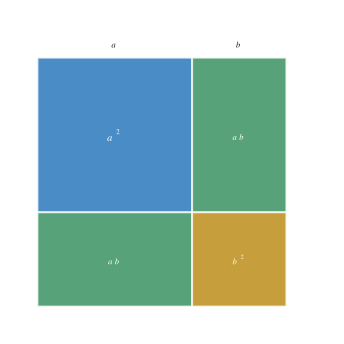
| Identity | Expanded form | Used for |
|---|---|---|
| (a+b)^2 | a^2 + 2ab + b^2 | squaring a sum, mental arithmetic (102^2) |
| (a-b)^2 | a^2 - 2ab + b^2 | squaring a difference (98^2) |
| a^2 - b^2 | (a+b)(a-b) | factorising, quick products (53 \times 47) |
Question. Evaluate without a calculator: (i) 103^2 (ii) 97^2 (iii) 56 \times 44.
Answer. (i) (100+3)^2 = 10000 + 600 + 9 = \textbf{10609}. (ii) (100-3)^2 = 10000 - 600 + 9 = \textbf{9409}. (iii) (50+6)(50-6) = 2500 - 36 = \textbf{2464}.
Question. Factorise 2x^2 - 18.
Answer. Take out the common factor first: 2(x^2 - 9). Now use the difference of two squares: 2(x+3)(x-3). Note: always look for the common factor before reaching for an identity.
Cut squares of side a, squares of side b and rectangles a \times b from card (take a = 6 cm, b = 4 cm). Arrange them to build a square of side (a+b) and count what you used: one a^2, two ab, one b^2. Then try to build (a+b)^2 using only a^2 and b^2 — you cannot, and that is the proof that (a+b)^2 \neq a^2 + b^2.
Chapter summary
- Terms, coefficient, constant and degree describe the parts of an expression; only like terms can be combined.
- \text{HCF}: every factor common to all the expressions, to its lowest power.
- \text{LCM}: every factor appearing in any expression, to its highest power.
- For two expressions, \text{HCF}\times\text{LCM}= product of the expressions.
- ab+ac=a(b+c); group four terms in pairs when no single factor is common to all of them.
- The standard identities in both directions: (a\pm b)^2=a^2\pm2ab+b^2 and (a+b)(a-b)=a^2-b^2.
- x^2+bx+c: find two numbers with product c and sum b, split the middle term and group.
- For HCF and LCM of polynomials, factorise each expression completely first.
- Factorise completely: take out the common factor first, then look for an identity, then check by expanding.
Practice questions
Group A — Objective (1 mark each)
- The coefficient of x in 7x^2-4x+3 is [1]a7b-4c3d4
- The HCF of 6x^2 and 9x^3 is [1]a3x^2b3x^3c18x^3d54x^5
- The LCM of 4a and 6a^2 is [1]a2ab12a^2c24a^3d6a
- x^2-9 factorised is [1]a(x-3)^2b(x+3)^2c(x+3)(x-3)dx(x-9)
- (a+3)^2 equals [1]aa^2+9ba^2+6a+9ca^2+3a+9da^2-6a+9
- 4x^3-8x^2 factorised is [1]a4x^2(x-2)b4x(x^2-2)c2x(2x^2-4)d8x^2(x-1)
Answers to Group A
1. (b) — the term is -4x.
2. (a) — common numbers 3, and the lower power x^2.
3. (b) — LCM of 4 and 6 is 12, and the higher power is a^2.
4. (c) — a difference of two squares.
5. (b) — a^2+2(a)(3)+3^2.
6. (a) — the HCF of the two terms is 4x^2.
Group B — Short answer (2 marks each)
- Find the HCF of 8a^2b and 12ab^2. [2]
- Find the LCM of 5x^3y and 10xy^2. [2]
- Factorise a^2+ab+ac+bc. [2]
- Factorise 25m^2-49n^2. [2]
Answers to Group B
1. 4ab.
2. 10x^3y^2.
3. a(a+b)+c(a+b)=(a+b)(a+c).
4. (5m)^2-(7n)^2=(5m+7n)(5m-7n).
Group C — Long answer (4 marks each)
- Factorise x^2+7x+12 by finding two numbers whose product is 12 and whose sum is 7, and check by expanding. [4]
- If the HCF of two expressions is 3x^2y and their LCM is 18x^3y^2, and one of the expressions is 6x^2y^2, find the other expression. [4]
Answers to Group C
1. The two numbers are 3 and 4, because 3\times4=12 and 3+4=7. So
Check by expanding: x^2+4x+3x+12=x^2+7x+12 ✓. Why it works. Expanding (x+p)(x+q) gives x^2+(p+q)x+pq, so the sum of the two numbers must be the coefficient of x and their product the constant term. A quick mental test on the factors of 12 — 1\times12, 2\times6, 3\times4 — immediately gives the pair whose sum is 7. 2. For two expressions, \text{HCF}\times\text{LCM}=\text{product of the two expressions}. So
The known expression is 6x^2y^2, so the other is
Check. HCF of 6x^2y^2 and 9x^3y: numbers—3; x—x^2; y—y; so 3x^2y ✓. LCM: numbers—18; x—x^3; y—y^2; so 18x^3y^2 ✓.
Extra practice
Group B (2 marks)
11. Expand (3x - 5)^2.
12. Evaluate 104 \times 96 using an identity.
Group C (4 marks)
13. Factorise completely: (i) 3x^2 - 27 (ii) x^2 + 10x + 25 (iii) 4a^2-9b^2 (iii) 4a^2 - 9b^2.
14. Factorise: (i) x^2-x-20 (ii) 9r^2+60r+100 (iii) a^2-12a+36-b^2.
15. Find the HCF and the LCM of x^2-y^2 and xy-y^2.
Extra practice — answers
11. 9x^2 - 30x + 25.
12. (100+4)(100-4) = 10000 - 16 = 9984.
13. (i) 3(x^2-9) = 3(x+3)(x-3). (ii) (x+5)^2. (iii) (2a+3b)(2a-3b).
14. (i) product -20, sum -1: -5 and 4, so (x-5)(x+4). (ii) (3r)^2+2\cdot3r\cdot10+10^2=(3r+10)^2. (iii) (a-6)^2-b^2=(a-6+b)(a-6-b).
15. x^2-y^2=(x+y)(x-y) and xy-y^2=y(x-y). HCF =x-y; LCM =y(x+y)(x-y).
Objective practice
Choose the correct answer. [5×1=5]
1. (x-4)^2 expands to (a) x^2-16 (b) x^2-8x+16 (c) x^2+8x+16 (d) x^2-4x+16
2. x^2-49 factorises as (a) (x-7)^2 (b) (x+7)(x-7) (c) (x+49)(x-1) (d) (x+7)^2
3. 101^2 by an identity is (a) 10201 (b) 10001 (c) 11201 (d) 10101
4. x^2+9x+20 factorises as (a) (x+4)(x+5) (b) (x+2)(x+10) (c) (x+1)(x+20) (d) (x+3)(x+6)
5. 3x^2-12 factorises completely as (a) 3(x^2-4) (b) 3(x+2)(x-2) (c) (3x+6)(x-2) (d) 3(x-2)^2
Objective practice — answers
1. (b) — (a-b)^2=a^2-2ab+b^2.
2. (b) — difference of two squares.
3. (a) — (100+1)^2=10000+200+1.
4. (a) — 4+5=9, 4\times5=20.
5. (b) — common factor first, then the identity.
Practise more: Mathematics question bank