Unit 5 · Compulsory Mathematics · 12 min read
Profit and Loss
What the syllabus asks for 4
- cost price, selling price, profit and loss
- profit percent and loss percent
- marked price and discount
- commission
Every shopkeeper in your bazaar is doing this chapter in their head all day: buy at one price, sell at another, and hope the difference covers the rent. The mathematics is short — four formulas — but the words matter, because profit percent is always measured against the cost while discount percent is always measured against the marked price. Mixing those two up is the classic mistake of this unit.
You should be able to find profit or loss and express it as a percentage of the cost price, find the selling price or cost price from a given percentage, calculate a discount and a marked price, and work out commission.
5.1 Cost price, selling price, profit and loss
- Cost price (CP) is the price at which an article is bought, including any expense of bringing it.
- Selling price (SP) is the price at which it is sold.
- If SP > CP, the difference is profit: \text{profit}=\text{SP}-\text{CP}.
- If SP < CP, the difference is loss: \text{loss}=\text{CP}-\text{SP}.
Percentages are always measured against the cost price:
Rearranged, these let you find a price from a percentage:
Profit and loss percent: cost price. Discount percent: marked price. Whatever the question gives as a percentage, the denominator is the price that percentage was measured against. Write that sentence at the top of your answer before you start the arithmetic.
Problem. A shopkeeper buys a bag for Rs 1,200 and sells it for Rs 1,380. Find the profit and the profit percent.
Solution. Profit =\text{SP}-\text{CP}=1380-1200=\text{Rs }180.
Answer. Profit Rs 180; profit percent 15 %.
Check. 15 % of 1200 is 0.15\times1200=180 ✓.
Problem. A trader buys 25 kg of apples at Rs 80 per kg and sells them at a loss of 12 %. Find the total cost price and the selling price.
Solution. \text{CP}=25\times80=\text{Rs }2000.
Loss =12\% of 2000=\frac{12}{100}\times2000=\text{Rs }240.
Answer. Cost price Rs 2,000; selling price Rs 1,760.
Check. \frac{240}{2000}\times100=12\% ✓. Equivalently, SP is 88 % of CP: 0.88\times2000=1760 ✓.
Problem. By selling a bicycle for Rs 6,900 a dealer makes a profit of 15 %. Find the cost price.
Solution. Using the formula,
Answer. Rs 6,000.
Check. 15 % of 6000 is 900, and 6000+900=6900 ✓.
If a bicycle sold at 15 % profit brings Rs 6,900, the cost price is 6900\div1.15=6000 and not 6900-15\% of 6900 (which is 5,865). The percentage is measured on the cost, and the cost is the unknown — so the selling price must be divided, not reduced.
5.2 Marked price and discount
Shops do not usually sell at the price printed on the label. The printed price is the marked price (MP), also called the list price, and the reduction allowed is the discount.
A discount is measured on the marked price, while profit and loss are measured on the cost price. A sale can therefore show a big discount and still be profitable, which is exactly what shopkeepers rely on.
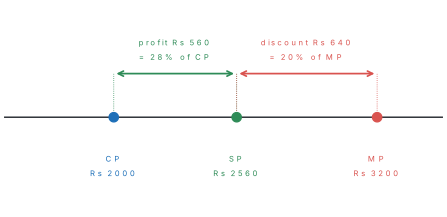
Problem. The marked price of a jacket is Rs 3,200 and a discount of 20 % is allowed. Find the selling price. If the shopkeeper had bought it for Rs 2,000, find his profit percent.
Solution. Discount =20\% of 3200=\frac{20}{100}\times3200=\text{Rs }640.
Profit =2560-2000=\text{Rs }560.
Answer. Selling price Rs 2,560; profit 28 %.
Check. SP is 80 % of MP: 0.8\times3200=2560 ✓. And 2560:2000=1.28, which is a 28 % profit on the cost ✓. Note that a 20 % discount still left a 28 % profit — the two percentages are on different bases.
Problem. After a discount of 15 %, a watch sells for Rs 2,125. Find its marked price.
Solution. \text{SP}=85\% of MP, so
Answer. Rs 2,500.
Check. 15 % of 2500 is 375, and 2500-375=2125 ✓.
Problem. An iron marked Rs 1,800 is sold for Rs 1,530. Find the discount percent.
Solution. Discount =1800-1530= Rs 270.
Problem. Nabin buys a mobile at 8 % discount and pays Rs 22,080. Find the marked price.
Solution. Let MP =100x. Then discount =8x and SP =100x-8x=92x.
92x=22\,080, so x=240 and MP =100x= Rs 24,000.
Check. 8 % of 24,000 =1920; 24\,000-1920=22\,080 ✓.
Problem. Jujuman buys a computer for Rs 36,000. He marks it 25 % above the cost price and then sells it at a 25 % discount. Find (a) the marked price, (b) the discount, (c) the selling price, (d) his profit or loss percent.
Solution. (a) MP =36\,000+25\% of 36\,000=36\,000+9000= Rs 45,000.
(b) Discount =25\% of 45\,000= Rs 11,250.
(c) SP =45\,000-11\,250= Rs 33,750.
(d) SP < CP, so there is a loss. Loss =36\,000-33\,750= Rs 2,250.
Note. "25 % up, then 25 % off" does not bring the price back to the cost: the 25 % discount is taken on the bigger number (MP), so he makes a loss.
5.3 Commission
A commission is a payment to an agent for selling something on someone else's behalf, and it is a percentage of the sale value.
Problem. An agent sells a plot of land for Rs 18,00,000 and charges a commission of 2 %. How much does the owner receive?
Solution. Commission =\frac{2}{100}\times18\,00\,000=\text{Rs }36\,000.
The owner receives 18\,00\,000-36\,000=\text{Rs }17\,64\,000.
Answer. Commission Rs 36,000; the owner receives Rs 17,64,000.
Check. 17\,64\,000+36\,000=18\,00\,000 ✓.
5.4 Marked price, discount and VAT in order
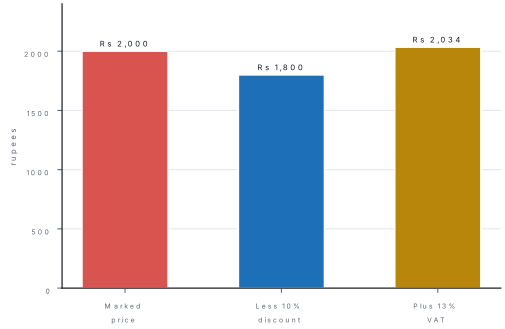
The order of operations is where most marks are lost: discount comes off the marked price, VAT goes on to what is left.
| Quantity | Formula | Always on |
|---|---|---|
| Profit | S.P. - C.P. | — |
| Profit per cent | \frac{\text{profit}}{\text{C.P.}}\times100 | cost price |
| Loss per cent | \frac{\text{loss}}{\text{C.P.}}\times100 | cost price |
| Discount | \frac{d}{100}\times \text{M.P.} | marked price |
| VAT | \frac{v}{100}\times \text{(M.P. after discount)} | discounted price |
Question. A shopkeeper buys a fan for Rs 3,000, marks it 25 % above cost, allows a 12 % discount and charges 13 % VAT. Find (i) the marked price (ii) the price after discount (iii) the amount the customer pays (iv) the shopkeeper's profit per cent.
Answer. (i) M.P. = 3000 + 25\% of 3000 = 3000 + 750 = Rs 3,750. (ii) Discount = 12\% of 3750 = 450; price after discount = Rs 3,300. (iii) VAT = 13\% of 3300 = 429; customer pays = Rs 3,729. (iv) The shopkeeper keeps Rs 3,300 (VAT goes to the government), so profit = 3300 - 3000 = 300 and profit per cent = \frac{300}{3000}\times100 = 10 %.
Bring home a shop bill with VAT on it. Check three things: the price before VAT, the VAT amount, and whether VAT is 13 % of the pre-VAT total. Then work out what the bill would have been with a 10 % discount applied first. Discussion: Why is taking the bill the customer's duty as well as the shopkeeper's?
Chapter summary
- \text{profit}=\text{SP}-\text{CP} when SP exceeds CP; \text{loss}=\text{CP}-\text{SP} when CP exceeds SP.
- Profit percent and loss percent are measured against the cost price.
- \text{SP}=\text{CP}(1\pm\frac{\%}{100}); \text{CP}=\frac{100\times\text{SP}}{100\pm\%}.
- \text{discount}=\text{MP}-\text{SP}, and discount percent is measured against the marked price.
- \text{SP}=\text{MP}(1-\frac{\text{discount}\%}{100}).
- A sale can give a discount and a profit at the same time, because the two percentages are measured on different bases.
- Commission is a percentage of the sale value and is paid to the agent.
Practice questions
Group A — Objective (1 mark each)
- Profit percent is calculated on the [1]aselling pricebmarked priceccost priceddiscount
- Discount percent is calculated on the [1]aselling pricebmarked priceccost pricedprofit
- An article bought for Rs 500 is sold for Rs 450. The loss percent is [1]a10%b11%c12.5%d50%
- If CP is Rs 800 and profit is 25 %, the SP is [1]aRs 825bRs 1000cRs 1025dRs 1200
- MP Rs 1,000 with a 30 % discount gives an SP of [1]aRs 970bRs 700cRs 300dRs 1300
- A 5 % commission on a sale of Rs 40,000 is [1]aRs 200bRs 2000cRs 500dRs 8000
Answers to Group A
1. (c) — cost price.
2. (b) — marked price.
3. (a) — \frac{50}{500}\times100=10\%.
4. (b) — 800\times1.25=1000.
5. (b) — 1000\times0.7=700.
6. (b) — \frac{5}{100}\times40\,000=2000.
Group B — Short answer (2 marks each)
- Find the profit percent when an article bought for Rs 2,500 is sold for Rs 2,800. [2]
- The selling price of an article is Rs 1,440 at a loss of 10 %. Find its cost price. [2]
- Find the selling price after a discount of 12 % on a marked price of Rs 4,000. [2]
- An agent gets a commission of Rs 2,250 on a sale of Rs 45,000. Find the rate of commission. [2]
Answers to Group B
1. Profit =300; profit percent =\frac{300}{2500}\times100=12\%.
2. \text{CP}=\frac{100\times1440}{90}=\text{Rs }1600.
3. Discount =480, so SP =4000-480=\text{Rs }3520.
4. Rate =\frac{2250}{45000}\times100=5\%.
Group C — Long answer (4 marks each)
- A shopkeeper marks his goods 40 % above the cost price and then allows a discount of 20 % on the marked price. Find his profit percent, and explain why the profit is not 20 %. [4]
- A dealer sold two mobile phones for Rs 9,000 each. On one he made a profit of 20 % and on the other a loss of 20 %. Find his total profit or loss, and explain the result. [4]
Answers to Group C
1. Take CP = Rs 100. Then \text{MP}=100\times1.40=\text{Rs }140, and the discount is 20 % of the marked price: 0.20\times140=\text{Rs }28, so \text{SP}=140-28=\text{Rs }112. Profit =112-100=\text{Rs }12, that is 12 % on the cost. Why not 20 %. The 40 % is added to the cost price while the 20 % discount comes off the marked price, which is the larger number: 0.40\times100=40, but 0.20\times140=28, so only 12 remains. Percentages added and subtracted in this way only cancel when they are measured on the same base.
2. First phone (20 % profit). \text{CP}=\frac{100\times9000}{120}=\text{Rs }7500; profit =1500. Second phone (20 % loss). \text{CP}=\frac{100\times9000}{80}=\text{Rs }11\,250; loss =2250. Total. \text{CP}=7500+11\,250=\text{Rs }18\,750, and \text{SP}=9000+9000=\text{Rs }18\,000. So there is a net loss of Rs 750, which is \frac{750}{18\,750}\times100=4\% of the total cost. Explanation. The loss is worked on a larger cost price than the profit, so the two do not cancel. Equal percentage profit and loss on equal selling prices always gives a net loss of \frac{x^2}{100}\% — here \frac{20^2}{100}=4\% ✓.
Extra practice — textbook-style questions
1. A sweater is sold for Rs 1,075 after a 14 % discount. Find its marked price.
2. A torch bought for Rs 1,400 is marked 40 % above the cost price and sold at a 20 % discount. Find the MP, the discount, the SP and the profit.
3. Rahaman marks a suitcase at Rs 6,000 and allows a 15 % discount; he still makes a profit of Rs 500. Find the SP, the CP and the profit percent.
4. VAT of Rs 338 was charged at 13 %. Find the price before VAT.
Extra practice — answers
1. SP =86\% of MP, so MP =\frac{1075\times100}{86}= Rs 1,250.
2. MP =1400+560= Rs 1,960; discount =20\% of 1960= Rs 392; SP =1960-392= Rs 1,568; profit =1568-1400= Rs 168 (12 %).
3. Discount =15\% of 6000=900; SP = Rs 5,100; CP =5100-500= Rs 4,600; profit percent =\frac{500}{4600}\times100\approx10.87\%.
4. Price = \frac{338\times100}{13} = Rs 2,600.
Objective practice
Choose the correct answer. [5×1=5]
1. An article bought for Rs 600 and sold for Rs 690 gives a profit of (a) 10 % (b) 15 % (c) 20 % (d) 9 %
2. Profit per cent is calculated on the (a) selling price (b) marked price (c) cost price (d) discount
3. VAT is charged on the (a) marked price (b) price after discount (c) cost price (d) profit
4. A watch marked Rs 2,000 sold at 20 % discount costs (a) Rs 1,600 (b) Rs 1,800 (c) Rs 2,400 (d) Rs 400
5. If the cost price is Rs 800 and the loss is 15 %, the selling price is (a) Rs 680 (b) Rs 720 (c) Rs 920 (d) Rs 640
Objective practice — answers
1. (b) — profit 90; \frac{90}{600}\times100=15 %.
2. (c) — on the cost price.
3. (b) — on the discounted price.
4. (a) — 2000-400=1600.
5. (a) — 800-120=680.
Practise more: Mathematics question bank