Unit 11 · Compulsory Mathematics · 9 min read
Algebraic Fraction
What the syllabus asks for 4
- simplification of algebraic fractions
- addition and subtraction of algebraic fractions
- multiplication and division of algebraic fractions
- equations involving algebraic fractions
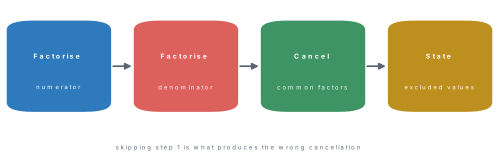
An algebraic fraction is a fraction whose top, bottom or both contain letters. Everything you already do with number fractions — cancelling, taking a common denominator, multiplying and dividing — works in exactly the same way, with one extra step in front: factorise first. Nothing can be cancelled until the top and bottom are written as products, because cancelling is division and division only removes whole factors.
You should be able to reduce an algebraic fraction to its lowest terms, add and subtract algebraic fractions by finding the LCM of the denominators, multiply and divide them, and solve a simple equation that contains fractions.
11.1 Reducing a fraction to its lowest terms
Method. Factorise the numerator and the denominator completely, cancel the common factors, and write what is left.
Problem. Simplify \frac{12x^3y^2}{18x^2y^4}.
Solution. Divide the numbers by their HCF 6, and subtract indices on the letters:
Answer. \frac{2x}{3y^2}.
Check. Put x=2, y=1: the original is \frac{12\times8}{18\times4}=\frac{96}{72}=\frac43, and the answer is \frac{2\times2}{3}=\frac43 ✓.
Problem. Simplify \frac{x^2-9}{x^2+6x+9}.
Solution. Factorise both parts:
Answer. \frac{x-3}{x+3}, with x\ne-3.
Check. Put x=0: the original is \frac{-9}{9}=-1, and the answer is \frac{-3}{3}=-1 ✓.
You may not cancel the x^2 in \frac{x^2+4}{x^2+9} to get \frac49. The x^2 is not a factor of either top or bottom; it is only one of two terms. Only terms multiplied together can be cancelled. Write both parts as products first, then cancel.
11.2 Adding and subtracting algebraic fractions
11.2.1 Same denominator
If the denominators are already the same, add or subtract the numerators and keep the denominator; then factorise and cancel if you can.
Problem. Simplify (a) \frac{3a}{a+3}+\frac{9}{a+3} (b) \frac{x^2}{x+y}-\frac{y^2}{x+y}.
Solution. (a) \frac{3a+9}{a+3}=\frac{3(a+3)}{a+3}=3.
(b) \frac{x^2-y^2}{x+y}=\frac{(x+y)(x-y)}{x+y}=x-y.
11.2.2 Different denominators
Method.
- Factorise every denominator.
- Find the LCM of the denominators — this is the common denominator.
- Rewrite each fraction with that denominator, multiplying top and bottom by whatever is missing.
- Add or subtract the numerators.
- Simplify, and factorise and cancel if possible.
Problem. Simplify \frac{3}{x}+\frac{5}{y}.
Solution. The LCM of x and y is xy.
Answer. \frac{3y+5x}{xy}.
Check. Put x=1, y=1: the original is 3+5=8, and the answer is \frac{3+5}{1}=8 ✓.
Problem. Simplify \frac{2}{x-1}-\frac{1}{x+1}.
Solution. The LCM of (x-1) and (x+1) is their product, (x-1)(x+1).
Subtracting the numerators:
Answer. \frac{x+3}{x^2-1}.
Check. Put x=2: the original is \frac21-\frac13=\frac53, and the answer is \frac{5}{4-1}=\frac53 ✓.
In \frac{2}{x-1}-\frac{1}{x+1} the second numerator is (x-1), and the sign in front of it is a minus. The numerator therefore becomes 2(x+1)\mathbf{-}(x-1)=2x+2-x+1=x+3, not 2x+2-x-1=x+1. Whenever a fraction is subtracted, put the numerator in brackets before you subtract it.
Problem. Simplify \frac{1}{x}+\frac{1}{2x}+\frac{1}{3x}.
Solution. The LCM of x, 2x and 3x is 6x. Rewrite each:
Answer. \frac{11}{6x}.
Check. Put x=1: 1+\frac12+\frac13=\frac{11}{6} ✓.
Problem. Simplify \frac{1}{x^2-4}+\frac{1}{x+2}.
Solution. Factorise the first denominator: x^2-4=(x-2)(x+2). The LCM is (x-2)(x+2).
Answer. \frac{x-1}{x^2-4}.
Check. Put x=3: the original is \frac15+\frac15=\frac25, and the answer is \frac{2}{9-4}=\frac25 ✓.
Problem. Simplify \frac{x}{x^2+3x+2}-\frac{2}{x^2-1}.
Solution. Factorise the denominators: x^2+3x+2=(x+1)(x+2) and x^2-1=(x+1)(x-1). LCM =(x+1)(x+2)(x-1).
Check. Put x=2: original =\frac{2}{12}-\frac{2}{3}=-\frac12; answer =\frac{-2}{4\times1}=-\frac12 ✓.
11.3 Multiplying and dividing
Multiplication is the easiest operation: multiply the numerators, multiply the denominators, then cancel.
Division: turn the second fraction upside down and multiply.
Problem. Simplify \frac{x^2-4}{x+3}\times\frac{x+3}{x-2}.
Solution. Factorise the difference of squares: x^2-4=(x-2)(x+2). Then
after cancelling (x-2) and (x+3).
Answer. x+2.
Check. Put x=4: the original is \frac{12}{7}\times\frac{7}{2}=6, and the answer is 6 ✓.
Problem. Simplify \frac{a^2-b^2}{a+b}\div\frac{a-b}{a}.
Solution. Invert and multiply, having factorised a^2-b^2=(a+b)(a-b):
Answer. a.
Check. Put a=3, b=1: the original is \frac{8}{4}\div\frac{2}{3} =2\times\frac32=3, and the answer is a=3 ✓.
Problem. Simplify \frac{x^2-6x+9}{x^2+3x+2}\div\frac{x^2-5x+6}{x^2-x-2}.
Solution. Factorise every part: x^2-6x+9=(x-3)^2, x^2+3x+2=(x+1)(x+2), x^2-5x+6=(x-2)(x-3), x^2-x-2=(x-2)(x+1).
Check. Put x=0: original =\frac92\div\frac{6}{-2}=\frac92\div(-3)=-\frac32; answer =\frac{-3}{2} ✓.
11.4 Equations containing fractions
Clear the denominators by multiplying every term by the LCM, then solve the resulting simple equation.
Problem. Solve \frac{x}{2}+\frac{x}{3}=5.
Solution. The LCM of 2 and 3 is 6. Multiply every term by 6:
Answer. x=6.
Check. \frac62+\frac63=3+2=5 ✓.
Problem. Solve \frac{3}{x}=\frac{5}{x+2}.
Solution. Cross-multiplying removes both denominators:
Answer. x=3.
Check. \frac33=1 and \frac{5}{5}=1 ✓.
Note. Always state the values the variable may not take: here x\ne0 and x\ne-2, and x=3 is allowed.
Put a convenient number — 1, 2 or 3 — into the original expression and into your answer and see whether they agree. It takes fifteen seconds and it catches the sign errors, the mis-copied terms and the wrong LCM, which is where nearly all the marks in this chapter are lost.
11.5 Why factorising comes first
An algebraic fraction is simplified by factorising and cancelling common factors — never by cancelling across a plus or minus sign.
\frac{x+3}{x} does not simplify to 3. You may cancel only a factor of the whole numerator against a factor of the whole denominator. Since x+3 is a sum, not a product, nothing cancels.
Question. Simplify \dfrac{x^2 - 4}{x^2 + 5x + 6} and state the values of x for which it is undefined.
Answer. Numerator = (x+2)(x-2). Denominator = (x+2)(x+3). Cancelling (x+2): \dfrac{x-2}{x+3}. The original denominator is zero at x = -2 and x = -3, so the expression is undefined at x = -2 and x = -3.
Question. Simplify \dfrac{2}{x-1} + \dfrac{3}{x+2}.
Answer. LCM of the denominators is (x-1)(x+2).
Each line below contains one mistake. Working in pairs, find it and write the correct simplification. (i) \frac{x+5}{5} = x (ii) \frac{x^2-9}{x-3} = x-3 (iii) \frac{2x}{2x+4} = \frac{1}{4} (iv) \frac{1}{x} + \frac{1}{y} = \frac{1}{x+y}
Chapter summary
- Factorise the top and bottom before cancelling anything; only factors cancel.
- The LCM of the denominators is the common denominator; multiply top and bottom by whatever each fraction is missing.
- When subtracting, put the second numerator in brackets and distribute the minus sign.
- Multiply fractions straight across; divide by inverting the second fraction.
- Solve a fractional equation by multiplying every term by the LCM, and state the values the variable may not take.
- Check every answer numerically in the original expression.
Practice questions
Group A — Objective (1 mark each)
- \frac{6x^2}{3x} in its lowest terms is [1]a2xb2x^2c3xd18x^3
- \frac{1}{x}+\frac{1}{y} equals [1]a\frac{2}{x+y}b\frac{x+y}{xy}c\frac{1}{xy}d\frac{xy}{x+y}
- \frac{x^2-1}{x-1} simplifies to [1]ax-1bx+1cx^2d1
- \frac ab\div\frac cd equals [1]a\frac{ac}{bd}b\frac{ad}{bc}c\frac{ab}{cd}d\frac{bd}{ac}
- In \frac{x^2+4}{x^2+9} you may cancel [1]ax^2b4 and 9cnothingdx^4
- If \frac{x}{3}=4, then x is [1]a7b12c\frac43d1
Answers to Group A
1. (a) — divide numbers and subtract indices.
2. (b) — the common denominator is xy.
3. (b) — x^2-1=(x+1)(x-1).
4. (b) — invert and multiply.
5. (c) — the x^2 terms are not factors.
6. (b) — multiply both sides by 3.
Group B — Short answer (2 marks each)
- Simplify \frac{15a^3b^2}{25a^2b^4}. [2]
- Simplify \frac{2}{x}+\frac{3}{2x}. [2]
- Simplify \frac{x^2-16}{x+4}. [2]
- Solve \frac{x}{4}+\frac{x}{6}=5. [2]
Answers to Group B
1. \frac{3a}{5b^2}.
2. \frac{4}{2x}+\frac{3}{2x}=\frac{7}{2x}.
3. \frac{(x+4)(x-4)}{x+4}=x-4.
4. Multiply by 12: 3x+2x=60, so 5x=60 and x=12.
Group C — Long answer (4 marks each)
- Simplify \frac{3}{x-2}-\frac{2}{x+1}, giving the answer as a single fraction, and check with x=3. [4]
- Simplify \frac{x^2-9}{x^2+5x+6}\times\frac{x+2}{x-3} and state the values of x for which the expression is not defined. [4]
Answers to Group C
1. The LCM of (x-2) and (x+1) is (x-2)(x+1).
Check with x=3: the original is \frac31-\frac{2}{4}=3-0.5=2.5, and the answer is \frac{10}{9-3-2}=\frac{10}{4}=2.5 ✓. Note the brackets around 2(x-2): without them the numerator would be 3x+3-2x-4=x-1, which is wrong. 2. Factorise everything first: x^2-9=(x-3)(x+3) and x^2+5x+6=(x+2)(x+3). So
Answer. 1. Not defined when the original denominators vanish: x\ne-2, x\ne-3 and x\ne3. At every other value the expression equals 1, which is consistent: the numerator and denominator are the same product written in a different order.
Extra practice
Group B (2 marks)
11. Simplify: \dfrac{x^2 - 16}{x + 4}.
12. Simplify: \dfrac{3a}{4} - \dfrac{a}{6}.
Group C (4 marks)
13. Simplify \dfrac{x^2 + 7x + 12}{x^2 - 9} and state where it is undefined.
Extra practice — answers
11. \frac{(x+4)(x-4)}{x+4} = x - 4 (for x \neq -4).
12. LCM 12: \frac{9a - 2a}{12} = \frac{7a}{12}.
13. Numerator = (x+3)(x+4); denominator = (x+3)(x-3). Cancelling: \frac{x+4}{x-3}. Undefined at x = 3 and x = -3. Answers to the spot-the-error activity. (i) \frac{x+5}{5} does not simplify — 5 is not a factor of x+5. (ii) \frac{(x+3)(x-3)}{x-3} = x+3. (iii) \frac{2x}{2(x+2)} = \frac{x}{x+2}. (iv) \frac{1}{x}+\frac{1}{y} = \frac{x+y}{xy}.
Objective practice
Choose the correct answer. [5×1=5]
1. \dfrac{x^2-25}{x+5} simplifies to (a) x-5 (b) x+5 (c) x-25 (d) x^2-5
2. \dfrac{x+3}{x} simplifies to (a) 3 (b) x+3 (c) it does not simplify (d) \frac{3}{x}
3. \dfrac{1}{a}+\dfrac{1}{b} equals (a) \frac{1}{a+b} (b) \frac{a+b}{ab} (c) \frac{2}{ab} (d) \frac{ab}{a+b}
4. \dfrac{x^2-9}{x^2+5x+6} is undefined at (a) x=3 only (b) x=-2 and x=-3 (c) x=2 (d) nowhere
5. \dfrac{5a}{6}-\dfrac{a}{3} equals (a) \frac{a}{2} (b) \frac{4a}{3} (c) \frac{a}{6} (d) \frac{7a}{6}
Objective practice — answers
1. (a) — cancel (x+5).
2. (c) — a sum, not a product, so nothing cancels.
3. (b) — common denominator ab.
4. (b) — the denominator is (x+2)(x+3).
5. (a) — \frac{5a-2a}{6}=\frac{a}{2}.
Practise more: Mathematics question bank