Unit 2 · Compulsory Mathematics · 12 min read
Whole Numbers
What the syllabus asks for 4
- review of the decimal number system and place value
- binary number system: conversion to and from decimal
- quinary and other bases
- addition, subtraction and multiplication in base 2 and base 5
The number system you use every day has ten digits, 0 to 9, and we call it decimal or base ten. Nothing is special about ten; it is only the number of fingers people happen to have. A computer uses two digits because a switch is either off or on, and a clock has used twelves and sixties for as long as anyone can remember. This chapter shows how to write the same quantity in different bases and how to do arithmetic in them.
You should be able to explain what a place value means in any base, convert a binary or quinary number into decimal and back, convert between any two bases through decimal, and add, subtract and multiply numbers in base 2 and base 5.
2.1 Place value in the decimal system
In the decimal system the value of a digit depends on its position. Moving one place to the left multiplies the value by 10.
Every base works the same way with a different multiplier. In base 2 (binary) only the digits 0 and 1 are allowed, and each place is worth twice the one on its right. In base 5 (quinary) only 0–4 are allowed.
| Base | Allowed digits | Place values |
|---|---|---|
| 10 | 0–9 | \dots,10^3,10^2,10^1,10^0 |
| 5 | 0–4 | \dots,5^3,5^2,5^1,5^0 |
| 2 | 0, 1 | \dots,2^3,2^2,2^1,2^0 |
| Power | 2 to that power | 5 to that power |
|---|---|---|
| 2^0,5^0 | 1 | 1 |
| 2^1,5^1 | 2 | 5 |
| 2^2,5^2 | 4 | 25 |
| 2^3,5^3 | 8 | 125 |
| 2^4,5^4 | 16 | 625 |
| 2^5,5^5 | 32 | 3125 |
| 2^6 | 64 | — |
| 2^7 | 128 | — |
| 2^8 | 256 | — |
| 2^9 | 512 | — |
The decimal system is also called the Hindu–Arabic numeration system. The binary system is used in computers and electric circuits, where a switch has only two states: ON (1) and OFF (0).
A number in another base carries its base as a small subscript (suffix): (1011)_2 or 1011_2 is binary, (243)_5 or 243_5 is quinary. A number with no suffix is decimal. A digit 2, 3 or 4 can never appear in a binary number, and 5–9 never in a quinary number — so (1021)_2 and (375)_5 are impossible.
2.1.1 Expanded form in powers of 2 and of 5
To express a decimal number as powers of 2, break it into the largest powers of 2 that fit; for powers of 5, use 125, 25, 5, 1.
Problem. Express 43 in powers of 2 and 59 in powers of 5.
Solution. 43=32+8+2+1
=1\times2^5+0\times2^4+1\times2^3+0\times2^2+1\times2^1+1\times2^0
So 43=(101011)_2.
59=2\times25+1\times5+4
=2\times5^2+1\times5^1+4\times5^0
So 59=(214)_5.
In the expansion of 43 there is no 16 and no 4, but 0\times2^4 and 0\times2^2 must still be written. If you drop them, the binary number becomes 1111_2=15, which is wrong.
2.2 Conversion from another base to decimal
Rule. Expand the number by place values and add.
Problem. Convert (1101)_2 into decimal.
Solution. Write the place values under the digits:
Answer. (1101)_2=(13)_{10}.
Check. Count upwards in binary and see where it lands: 1, 10, 11, 100, 101, 110, 111, 1000, 1001, 1010, 1011, 1100, 1101 — that is the 13th number, counting the first as 1 in decimal. Agrees.
Problem. Convert (342)_5 into decimal.
Solution.
Answer. (342)_5=(97)_{10}.
Check. The largest power used is 5^2=25, and 3\times25=75; the remainder 97-75=22 is 4\times5+2, which is the last two digits ✓.
2.3 Conversion from decimal to another base
Rule. Divide repeatedly by the base and read the remainders from the bottom upwards.
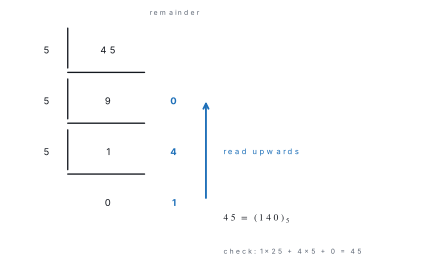
Problem. Convert (45)_{10} into binary.
Solution. Divide by 2 and record each remainder.
| Division | Remainder |
|---|---|
| 45 ÷ 2 = 22 | 1 |
| 22 ÷ 2 = 11 | 0 |
| 11 ÷ 2 = 5 | 1 |
| 5 ÷ 2 = 2 | 1 |
| 2 ÷ 2 = 1 | 0 |
| 1 ÷ 2 = 0 | 1 |
Reading the remainders from the bottom upwards:
Check. 32+0+8+4+0+1=45 ✓.
Problem. Convert (323)_{10} into base 5.
Solution.
| Division | Remainder |
|---|---|
| 323 ÷ 5 = 64 | 3 |
| 64 ÷ 5 = 12 | 4 |
| 12 ÷ 5 = 2 | 2 |
| 2 ÷ 5 = 0 | 2 |
So (323)_{10}=(2243)_5.
Check. 2\times125+2\times25+4\times5+3=250+50+20+3=323 ✓.
At the last division the quotient becomes 0, and the number you divided (1, or 2, or whatever is left) is itself the final remainder. Leaving it out is the commonest error in base conversion. The number of digits is the number of divisions, counting that last line.
2.4 Conversion between two non-decimal bases
To change from one base to another, go through decimal. The two steps are "expand" and then "divide".
Problem. Convert (10110)_2 into base 5.
Solution. Step 1: to decimal.
Step 2: to base 5. Divide 22 by 5: 22\div5=4 remainder 2, then 4\div5=0 remainder 4. Reading upwards, (22)_{10}=(42)_5.
Answer. (10110)_2=(42)_5.
Check. 4\times5+2=22 ✓, which matches the decimal value found in step 1.
2.4.1 Comparing numbers written in different bases
Numbers in different bases cannot be compared digit by digit. Convert both to decimal first.
Problem. Which of (110011)_2 and (144)_5 is larger? Find their difference.
Solution. (110011)_2=32+16+0+0+2+1=51
(144)_5=1\times25+4\times5+4=25+20+4=49
Since 51>49, (110011)_2 is larger. Difference =51-49=2.
Problem. Convert (43)_5 into binary.
Solution. Step 1: (43)_5=4\times5+3=23.
Step 2: 23\div2=11 r 1, 11\div2=5 r 1, 5\div2=2 r 1, 2\div2=1 r 0, 1\div2=0 r 1. Reading upwards, 23=(10111)_2.
Answer. (43)_5=(10111)_2. Check: 16+4+2+1=23 ✓.
2.5 Arithmetic in other bases
Add, subtract and multiply exactly as in decimal, but carry and borrow with the base instead of with ten.
- In base 2, 1+1=10: write 0 and carry 1.
- In base 5, 4+3=12: write 2 and carry 1, because 7 is 1 five and 2 units.
Problem. Add (1011)_2 and (1101)_2.
Solution. Write them one under the other and add column by column from the right.
| Position | Work | Written | Carry |
|---|---|---|---|
| units | 1+1=2=(10)_2 | 0 | 1 |
| twos | 1+0+1=2=(10)_2 | 0 | 1 |
| fours | 0+1+1=2=(10)_2 | 0 | 1 |
| eights | 1+1+1=3=(11)_2 | 1 | 1 |
| sixteens | carry only | 1 | 0 |
So (1011)_2+(1101)_2=(11000)_2.
Check in decimal. 1011_2=11 and 1101_2=13; 11+13=24, and 11000_2=16+8=24 ✓.
Problem. Subtract (213)_5 from (402)_5.
Solution. Work column by column from the right. Borrowing 1 from the next place gives 5 (not 10) to the place on its right.
- Units: 2-3 is not possible. The fives digit is 0, so first borrow 1 from the twenty-fives place: 4\to3, and the fives place becomes 5. Now borrow 1 from the fives place: 5\to4, and the units become 2+5=7. 7-3=4.
- Fives: 4-1=3.
- Twenty-fives: 3-2=1.
So (402)_5-(213)_5=(134)_5.
Check in decimal. 402_5=4\times25+0+2=102 and 213_5=2\times25+5+3=58; 102-58=44. And 134_5=25+15+4=44 ✓.
Problem. Multiply (23)_5 by (4)_5.
Solution. 3\times4=12; in base 5, 12=2\times5+2, so write 2 and carry 2. Then 2\times4=8, plus the carry 2 gives 10; in base 5, 10=2\times5+0, so write 0 and carry 2. The final carry is 2.
So (23)_5\times(4)_5=(202)_5.
Check in decimal. 23_5=13 and 4_5=4; 13\times4=52. And 202_5=2\times25+0+2=52 ✓.
Every base conversion and every base calculation can be checked by converting to decimal, doing the arithmetic there, and converting back. In an examination it costs thirty seconds and it catches a slipped carry, which is where nearly all the marks are lost in this chapter.
2.6 Properties of whole numbers at a glance
| Property | Addition | Multiplication |
|---|---|---|
| Closure | a + b is a whole number | a \times b is a whole number |
| Commutative | a + b = b + a | a \times b = b \times a |
| Associative | (a+b)+c = a+(b+c) | (ab)c = a(bc) |
| Identity | a + 0 = a | a \times 1 = a |
| Distributive | — | a(b+c) = ab + ac |
Subtraction and division are not closed on whole numbers: 3 - 5 and 3 \div 5 both leave the set.
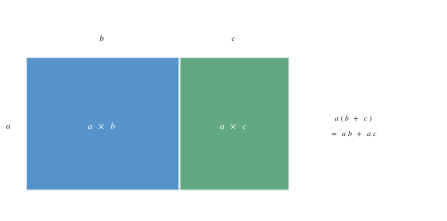
Question. Evaluate mentally, naming the property used: (i) 47 \times 25 \times 4 (ii) 98 \times 7 (iii) 36 + 58 + 64
Answer. (i) Associative: 47 \times (25 \times 4) = 47 \times 100 = \textbf{4700}. (ii) Distributive: (100 - 2) \times 7 = 700 - 14 = \textbf{686}. (iii) Commutative and associative: (36 + 64) + 58 = 100 + 58 = \textbf{158}.
In pairs, time each other for one minute on ten products such as 25 \times 16, 99 \times 8, 48 + 37 + 52. After the first round, discuss which property made each one quick, then repeat. Nearly every pair improves on the second attempt — the gain comes from choosing the property, not from calculating faster.
Chapter summary
- A number in base b uses only the digits 0 to b-1, and each place is worth b times the place on its right.
- To convert to decimal, expand by place values and add.
- To convert from decimal, divide repeatedly by the base and read the remainders from the bottom upwards.
- To convert between two other bases, go through decimal in two steps.
- To compare numbers in different bases, change both to decimal first.
- In base 2: 1+1=10, and the place values are 1, 2, 4, 8, 16, …
- In base 5: 4+1=10, and the place values are 1, 5, 25, 125, …
- Add, subtract and multiply as in decimal but carry and borrow with the base.
- Always check a base calculation by converting to decimal.
Practice questions
Group A — Objective (1 mark each)
- The decimal value of (1101)_2 is [1]a11b13c15d26
- The number of digits allowed in base 5 is [1]a4b5c6d10
- (25)_{10} in binary is [1]a11001b10101c11010d10011
- The place value of the third digit from the right in base 5 is [1]a5b10c25d125
- (1000)_2 in decimal is [1]a4b8c16d1000
- 1+1 in binary is written as [1]a2b10c11d0
Answers to Group A
1. (b) — 8+4+0+1=13.
2. (b) — 0, 1, 2, 3 and 4 are the only digits used.
3. (a) — 16+8+1=25.
4. (c) — 5^2=25.
5. (b) — 2^3=8.
6. (b) — two is written as 1 two and 0 units.
Group B — Short answer (2 marks each)
- Convert (101101)_2 into decimal. [2]
- Convert (243)_5 into decimal. [2]
- Convert (100)_{10} into binary and into base 5. [2]
- Add (1101)_2 and (1011)_2. [2]
Answers to Group B
1. 32+0+8+4+0+1=45.
2. 2\times25+4\times5+3=50+20+3=73.
3. In binary: 64+32+4=100, so (1100100)_2. In base 5: 100=4\times25, so (400)_5.
4. 1101_2=13 and 1011_2=11; the sum is 24, which is (11000)_2.
Group C — Long answer (4 marks each)
- Convert (4321)_5 into decimal and then into binary, showing both steps. [4]
- Perform 10101_2-1101_2 and 34_5\times3_5, and check each answer by converting to decimal. [4]
Answers to Group C
1. To decimal. 4\times125+3\times25+2\times5+1=500+75+10+1=586. To binary. Divide 586 by 2 repeatedly: remainders 0, 1, 0, 1, 0, 0, 1, 0, 0, 1 read upwards give 1001001010_2. Check: 512+64+8+2=586 ✓.
2. 10101_2=21 and 1101_2=13, so the difference is 8, which is (1000)_2. For the product, 34_5=3\times5+4=19 and 3_5=3, so the product is 57. Converting 57 into base 5: 57\div5=11 r 2, 11\div5=2 r 1, 2\div5=0 r 2, so (212)_5. Check: 2\times25+1\times5+2=57 ✓.
Extra practice — textbook-style questions
1. State the number system: (a) (10011)_2 (b) 350 (c) (4023)_5.
2. Write 546 in expanded form using powers of 10.
3. Express 25 as powers of 2 and as powers of 5.
4. Convert (512)_{10} and (7521)_{10} into the quinary system.
5. Convert (142013)_5 into decimal.
6. Which of (1101)_2 and (24)_5 is larger? Find their difference.
7. Convert (10101)_2 into quinary and (144)_5 into binary.
Extra practice — answers
1. (a) binary (b) decimal (c) quinary.
2. 546=5\times10^2+4\times10^1+6\times10^0.
3. 25=16+8+1=1\times2^4+1\times2^3+0\times2^2+0\times2^1+1\times2^0=(11001)_2; 25=1\times5^2+0\times5^1+0\times5^0=(100)_5.
4. 512\div5=102 r 2, 102\div5=20 r 2, 20\div5=4 r 0, 4\div5=0 r 4, so 512=(4022)_5. Similarly 7521=(220041)_5 (remainders 1, 4, 0, 0, 2, 2 read upwards). Check: 2\times3125+2\times625+0+0+4\times5+1=6250+1250+20+1=7521 ✓.
5. 1\times3125+4\times625+2\times125+0\times25+1\times5+3=3125+2500+250+0+5+3=5883.
6. (1101)_2=13, (24)_5=14; (24)_5 is larger by 1.
7. (10101)_2=21=4\times5+1=(41)_5. (144)_5=49=32+16+1=(110001)_2.
Objective practice
Choose the correct answer. [5×1=5]
1. The smallest whole number is (a) -1 (b) 0 (c) 1 (d) there is none
2. 17\times(10+3)=170+51 illustrates the (a) commutative property (b) associative property (c) distributive property (d) identity property
3. Which operation is not closed on whole numbers? (a) addition (b) multiplication (c) subtraction (d) none
4. The identity element for multiplication is (a) 0 (b) 1 (c) -1 (d) 10
5. 125\times8\times7 is quickest as (a) (125\times8)\times7 (b) 125\times(8\times7) (c) 8\times(125\times7) (d) any order is equally quick
Objective practice — answers
1. (b) — whole numbers start at 0.
2. (c) — distributive over addition.
3. (c) — 3-5 leaves the set.
4. (b) — 1.
5. (a) — 125\times8=1000 first.
Practise more: Mathematics question bank