Unit 14 · Compulsory Mathematics · 14 min read
Plane Figures
What the syllabus asks for 5
- triangles: classification and properties
- quadrilaterals and their properties
- construction of triangles and quadrilaterals
- polygons: interior and exterior angles
- the circle: radius, chord, arc, sector
A plane figure is a flat shape: a triangle, a quadrilateral, a polygon, a circle. Geometry at this level is mostly bookkeeping with two facts — the angles of a triangle add to 180°, and the angles of a polygon follow from splitting it into triangles. Everything else is a consequence, and the figures are what make those consequences visible.
You should be able to classify triangles and quadrilaterals and state their properties, find the interior and exterior angles of a polygon, construct a triangle or a quadrilateral from given measurements, and use the vocabulary of the circle.
14.1 Triangles
A triangle is a closed figure with three sides and three angles. Its three interior angles always add to 180°, and any exterior angle equals the sum of the two interior opposite angles.
| Classified by sides | Property |
|---|---|
| Equilateral | all three sides equal, all three angles 60° |
| Isosceles | two sides equal, and the angles opposite them equal |
| Scalene | no sides equal, no angles equal |
| Classified by angles | Property |
|---|---|
| Acute-angled | all three angles less than 90° |
| Right-angled | one angle is 90°; the side opposite it is the hypotenuse |
| Obtuse-angled | one angle more than 90° |
Properties verified in class (by cutting, folding and measuring):
- The three angles of any triangle add to 180° (tear off the corners and put them together: they make a straight angle).
- All three angles of an equilateral triangle are equal, so each is 180°\div3=60°.
- The base angles of an isosceles triangle (the angles opposite the equal sides) are equal.
- In a right-angled isosceles triangle each base angle is \frac{180°-90°}{2}=45°.
Problem. In a triangle the angles are in the ratio 2:3:4. Find each angle and classify the triangle.
Solution. Let the angles be 2x, 3x and 4x. Their sum is 180°:
The angles are 40°, 60° and 80°. All three are less than 90°, so the triangle is acute-angled.
Check. 40+60+80=180 ✓, and the ratios 40:60:80=2:3:4 ✓.
Problem. In an isosceles triangle the vertex angle is 40°. Find the base angles.
Solution. The two base angles are equal; let each be x. Then
Answer. Each base angle is 70°.
Check. 40+70+70=180 ✓. The vertex angle is the odd one out, and the two angles opposite the equal sides are equal.
14.2 Quadrilaterals
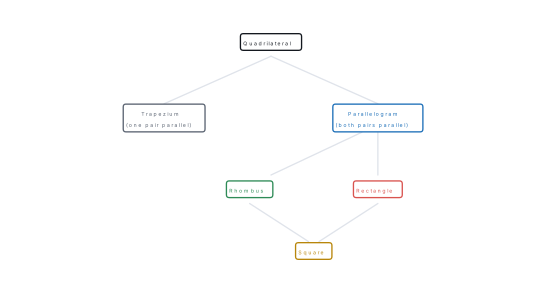
A quadrilateral has four sides and four angles, and its angles add to 360°.
| Quadrilateral | Sides | Angles | Diagonals |
|---|---|---|---|
| Parallelogram | both pairs of opposite sides parallel and equal | opposite angles equal; adjacent angles supplementary | bisect each other |
| Rectangle | parallelogram with a right angle | all four angles 90° | equal and bisect each other |
| Square | rectangle with all sides equal | all four angles 90° | equal, bisect at right angles |
| Rhombus | parallelogram with all sides equal | opposite angles equal | bisect each other at right angles |
| Trapezium | exactly one pair of opposite sides parallel | angles on the same side of a leg supplementary | — |
| Kite | two pairs of adjacent equal sides | one pair of opposite angles equal | cross at right angles |
Diagonal properties to remember.
- Rhombus: the diagonals bisect each other at right angles, and each diagonal bisects the angles at its ends.
- Kite: the diagonals cut at right angles; the longer diagonal bisects the shorter one (the shorter is not bisected by the longer).
- Trapezium: only one pair of opposite sides is parallel, so a trapezium is not a parallelogram. In an isosceles trapezium the non-parallel sides are equal.
- Every square is a rhombus, but not every rhombus is a square.
Problem. The diagonals of rhombus PQRS meet at O. If ∠PQO =35°, find ∠POQ, ∠QPO and ∠PQR.
Solution. ∠POQ =90° (diagonals of a rhombus cut at right angles). In \triangle POQ: ∠QPO =180°-90°-35°=55°. ∠PQR =2\times∠PQO =70° (the diagonal QS bisects ∠PQR).
Problem. Three angles of a quadrilateral are 85°, 95° and 110°. Find the fourth.
Solution. The four angles add to 360°, so the fourth is
Answer. 70°.
Check. 85+95+110+70=360 ✓.
Problem. In a parallelogram, one angle is 65°. Find the other three and state the property you used each time.
Solution. The opposite angle is 65° (opposite angles of a parallelogram are equal). Each of the other two is the supplement: 180-65=115° (adjacent angles of a parallelogram are supplementary), and they are equal to each other by the opposite-angle property.
Answer. 65°, 115°, 115°.
Check. 65+115+65+115=360 ✓.
14.3 Polygons
A polygon is a closed plane figure bounded by straight sides. A polygon is regular when all its sides and all its angles are equal.
For a polygon with n sides:
The first formula comes from splitting the polygon into triangles by drawing all the diagonals from one vertex: an n-sided polygon gives n-2 triangles.
| Polygon | Sides n | Sum of interior angles | Each angle (regular) |
|---|---|---|---|
| Triangle | 3 | 180° | 60° |
| Quadrilateral | 4 | 360° | 90° |
| Pentagon | 5 | 540° | 108° |
| Hexagon | 6 | 720° | 120° |
| Octagon | 8 | 1080° | 135° |
| Decagon | 10 | 1440° | 144° |
Problem. Each exterior angle of a regular polygon is 24°. Find the number of sides, the sum of the interior angles, and each interior angle.
Solution. The exterior angles add to 360°, so
Sum of interior angles: (15-2)\times180=13\times180=2340°.
Each interior angle: \frac{2340}{15}=156°, or equivalently 180-24=156°.
Answer. 15 sides; 2340°; 156°.
Check. 156+24=180 ✓ — an interior and its exterior angle form a linear pair.
Problem. The sum of the interior angles of a polygon is 1260°. Find the number of sides.
Solution. (n-2)\times180=1260, so n-2=7 and n=9.
Answer. A nonagon, with 9 sides.
Check. (9-2)\times180=1260 ✓.
A polygon has one exterior angle at each vertex, and those n angles add to 360° for every polygon, regular or not. The fact that an interior angle and its own exterior angle add to 180° is a separate statement about the same vertex. Do not confuse the two.
14.4 Construction
Constructions are done with a ruler and a pair of compasses, and every line must be drawn, not estimated.
| To construct | Given | Method |
|---|---|---|
| A triangle | three sides (SSS) | draw one side, then arcs of the other two lengths from its ends |
| A triangle | two sides and the included angle (SAS) | draw the included angle with a protractor or compasses, then mark off both sides |
| A triangle | two angles and a side (ASA) | draw the side, then the two angles at its ends |
| A quadrilateral | four sides and one diagonal | draw the diagonal, then construct the two triangles on either side |
| A right angle | — | bisect a straight angle with compasses |
(1) Draw the given side first and label it with its length. (2) Keep the compass opening unchanged while striking a pair of arcs. (3) Draw arcs long enough to cross clearly — a faint arc gives a faint intersection. (4) Mark every given measurement on the figure and leave all construction arcs in place; an erased construction loses the method marks even if the figure is right.
14.4.1 Constructing a rectangle and a parallelogram
The Grade 8 textbook asks for these constructions (ruler, compasses and protractor). Always draw a rough sketch with the measurements first.
Rectangle ABCD with AB = 6 cm, AD = 4 cm. 1. Draw AB = 6 cm. 2. At A and at B construct angles of 90°. 3. Cut AD = 4 cm and BC = 4 cm on these lines. 4. Join DC. Check: DC should measure 6 cm.
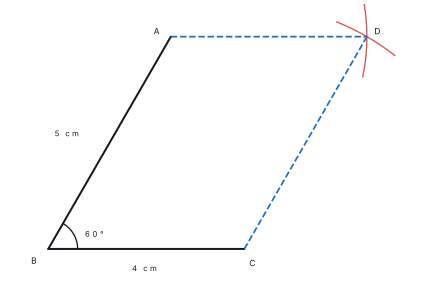
Parallelogram — three cases. (Opposite sides of a parallelogram are equal, so after drawing two adjacent sides the fourth vertex is found with two arcs.)
| Given | Steps |
|---|---|
| two adjacent sides and the included angle (AB = 5 cm, BC = 4 cm, ∠B = 60°) | draw BC; make 60° at B; cut BA = 5 cm; from A arc 4 cm, from C arc 5 cm; they meet at D |
| two adjacent sides and a diagonal (AB = 5 cm, BC = 4 cm, AC = 6 cm) | draw AC; from A arc 5 cm and from C arc 4 cm to get B; then from A arc 4 cm and from C arc 5 cm on the other side to get D |
| a side, a diagonal and the angle between them | draw the side, make the angle, cut the diagonal on it; complete with two arcs as above |
14.5 The circle
| Term | Meaning |
|---|---|
| Centre | the fixed point inside the circle |
| Radius | the distance from the centre to any point on the circle |
| Chord | a line segment joining two points on the circle |
| Diameter | a chord through the centre, equal to 2r |
| Arc | a part of the circle's boundary |
| Sector | the region between two radii and an arc |
| Segment | the region between a chord and an arc |
| Circumference | the whole distance round the circle, 2\pi r |
Results worth knowing.
- A diameter is the longest chord.
- A perpendicular from the centre to a chord bisects the chord.
- Equal chords are at equal distances from the centre.
- The angle in a semicircle is a right angle.
Problem. A chord of length 16 cm is drawn in a circle of radius 10 cm. Find the distance of the chord from the centre.
Solution. The perpendicular from the centre bisects the chord, so half the chord is 8 cm. That, the radius and the distance d form a right triangle with the radius as the hypotenuse:
Answer. 6 cm from the centre.
Check. \sqrt{6^2+8^2}=\sqrt{36+64}=10 ✓, which is the radius.
Chapter summary
- The angles of a triangle add to 180°; an exterior angle equals the sum of the two interior opposite angles.
- Equilateral, isosceles and scalene are classified by sides; acute, right and obtuse by angles.
- The angles of a quadrilateral add to 360°; a parallelogram has equal opposite angles and supplementary adjacent angles, and its diagonals bisect each other.
- For a polygon of n sides: interior angles sum to (n-2)\times180°; exterior angles always sum to 360°.
- The perpendicular from the centre to a chord bisects the chord; the angle in a semicircle is 90°.
- Constructions are done with ruler and compasses, with every arc left in place.
Practice questions
Group A — Objective (1 mark each)
- The sum of the angles of a triangle is [1]a90°b180°c270°d360°
- An equilateral triangle has each angle equal to [1]a45°b60°c90°d120°
- The sum of the angles of a quadrilateral is [1]a180°b270°c360°d540°
- Each interior angle of a regular hexagon is [1]a60°b108°c120°d135°
- The sum of the exterior angles of any polygon is [1]a180°b360°c540°dn\times180°
- The longest chord of a circle is its [1]aradiusbarccdiameterdtangent
Answers to Group A
1. (b) — 180°.
2. (b) — 180\div3=60.
3. (c) — 360°.
4. (c) — \frac{(6-2)180}{6}=120.
5. (b) — 360° for every polygon.
6. (c) — the diameter passes through the centre.
Group B — Short answer (2 marks each)
- Two angles of a triangle are 55° and 65°. Find the third and say what kind of triangle it is. [2]
- Find the sum of the interior angles of a decagon. [2]
- In a parallelogram one angle is 72°. Find the other three angles. [2]
- A chord of length 24 cm is 5 cm from the centre of a circle. Find the radius. [2]
Answers to Group B
1. 180-(55+65)=60°; all angles are less than 90°, so it is acute-angled.
2. (10-2)\times180=1440°.
3. The opposite angle is 72° and the other two are each 180-72=108°.
4. Half the chord is 12 cm, so r=\sqrt{12^2+5^2}=\sqrt{169}=13 cm.
Group C — Long answer (4 marks each)
- Each interior angle of a regular polygon is 150°. Find the number of sides, each exterior angle, and the sum of the interior angles. [4]
- Construct a triangle ABC in which BC=6 cm, AB=4.5 cm and \angle B=60°. Measure AC and the other two angles, and check that the angles add to 180°. [4]
Answers to Group C
1. If each interior angle is 150°, each exterior angle is 180-150=30°. The exterior angles add to 360°, so n=\frac{360}{30}=12 sides. The sum of the interior angles is (12-2)\times180=1800°. Check. \frac{1800}{12}=150° ✓, which is the given interior angle, so the answer is consistent.
2. Construction. Draw BC=6 cm with a ruler. At B, construct an angle of 60° (an equilateral triangle on BC gives it exactly with compasses). With centre B and radius 4.5 cm, strike an arc on that ray; call the intersection A. Join AC. Measurements. AC\approx5.4 cm, \angle A\approx74° and \angle C\approx46°. Check. 60+74+46=180 ✓. The construction is the SAS case, and it always gives exactly one triangle, which is why the two measurements agree from any correct drawing. The side opposite the 60° angle is the one you were asked to measure, and it is the middle length, as it must be.
Extra practice — textbook-style questions
1. True or false? Correct the false ones. (a) All the angles of an isosceles triangle are equal. (b) All rhombuses are squares. (c) The diagonals of a rhombus bisect each other at right angles. (d) All trapeziums are parallelograms.
2. Find the sum of the interior angles and each interior angle of a regular octagon.
3. Find each exterior angle of a regular polygon with 9 sides.
4. Construct a rectangle PQRS with PQ = 7 cm and QR = 4 cm.
Extra practice — answers
1. (a) False — only the two base angles are equal. (b) False — all squares are rhombuses, not the other way round. (c) True. (d) False — a trapezium has only one pair of parallel sides.
2. Sum =(8-2)\times180°=1080°; each angle =\frac{1080°}{8}=135°.
3. \frac{360°}{9}=40°.
4. Draw PQ = 7 cm; make 90° at P and Q; cut PS = QR = 4 cm; join SR (it measures 7 cm).
Objective practice
Choose the correct answer. [5×1=5]
1. The sum of the interior angles of a quadrilateral is (a) 180° (b) 270° (c) 360° (d) 540°
2. Each interior angle of a regular pentagon is (a) 72° (b) 108° (c) 120° (d) 135°
3. A quadrilateral with all sides equal and no right angle is a (a) square (b) rhombus (c) rectangle (d) trapezium
4. The diagonals of a rectangle are (a) equal and bisect each other (b) perpendicular (c) unequal (d) parallel
5. The number of sides of a regular polygon whose exterior angle is 36° is (a) 8 (b) 9 (c) 10 (d) 12
Objective practice — answers
1. (c) — 360°.
2. (b) — \frac{(5-2)180°}{5} = 108°.
3. (b) — a rhombus.
4. (a) — equal and bisecting.
5. (c) — \frac{360°}{36°} = 10.
Practise more: Mathematics question bank