Chapter 10 · Heat and Thermodynamics · 3 questions in the paper · 37 min read
Ideal Gas and Thermodynamics
What the syllabus asks for 3
- Ideal-gas equation; kinetic theory: pressure, rms speed and energy of molecules
- First law of thermodynamics: isothermal, adiabatic, isochoric and isobaric processes; molar heat capacities
- Second law of thermodynamics: internal-combustion engines, refrigerators and entropy
This is the heaviest chapter in the Heat area: 3 of the 50 Physics questions come from it (our estimate from the official 7-question weightage of the area). Three kinds of question are set. The gas law — a state change, a density, an rms speed, a ratio of speeds. The first law — the four processes, the work done, and the molar heat capacities. And the second law — engine efficiency, refrigerator COP, and why no engine can be perfect. Almost every mark here comes from getting the sign convention right once and then applying one table.
- PV = nRT = NkT; every other form (P = \rho RT/M, P_1V_1/T_1 = P_2V_2/T_2), and R = N_Ak = 8.31 J mol⁻¹ K⁻¹.
- Kinetic theory: P = \frac{1}{3}\rho c_{rms}^2; c_{rms} = \sqrt{3RT/M} = \sqrt{3kT/m}; average translational KE = \frac{3}{2}kT per molecule.
- Degrees of freedom: 3, 5, 6 for monatomic, diatomic, polyatomic; C_v = \frac{f}{2}R, C_p = C_v + R, \gamma = 1 + 2/f.
- First law Q = \Delta U + W, with W the work done by the gas; \Delta U = nC_v\Delta T in every process.
- The four processes: W, Q, \Delta U and the molar heat capacity of each; isothermal W = nRT\ln(V_2/V_1); adiabatic PV^\gamma = const.
- Second law: no engine turns all its heat into work; \eta = 1 - Q_2/Q_1 \le 1 - T_2/T_1; refrigerator COP = Q_2/W.
- Entropy never decreases in an isolated system; \Delta S = Q/T for a reversible change.
10.1 Ideal-gas equation; kinetic theory: pressure, rms speed and energy of molecules
The ideal gas
A real gas at low pressure and moderate temperature behaves almost like an ideal gas. The model makes five assumptions:
- A gas is a large number of identical molecules in random motion.
- The molecules are point-like — their own volume is negligible beside the volume of the container.
- No intermolecular forces except during a collision (so there is no potential energy of interaction).
- Collisions with each other and with the walls are perfectly elastic — kinetic energy is conserved.
- Between collisions the molecules move in straight lines, and the collision time is negligible beside the time between collisions.
Assumption 3 is the important one: with no potential energy, the internal energy of an ideal gas is entirely kinetic, and depends only on temperature.
The gas laws and the equation of state
| Law | Held constant | Statement |
|---|---|---|
| Boyle's | T | PV = constant |
| Charles's | P | V/T = constant |
| Pressure (Gay-Lussac's) | V | P/T = constant |
| Avogadro's | P, T | V \propto n |
Combining them gives the ideal-gas equation:
| Symbol | Meaning | Value |
|---|---|---|
| R | universal gas constant | 8.31 J mol⁻¹ K⁻¹ |
| k | Boltzmann constant | 1.38\times10^{-23} J K⁻¹ |
| N_A | Avogadro number | 6.02\times10^{23} mol⁻¹ |
| n | number of moles, m/M | mol |
and R = N_Ak, k = R/N_A. Since n = m/M, the density of a gas is
so at a fixed pressure and temperature a denser gas is a heavier gas — carbon dioxide sinks, hydrogen rises. For a fixed mass of gas, PV/T is constant:
One mole of any ideal gas occupies 22.4 L at STP (273 K, 1 atm) and 22.7 L at 1 bar. Temperatures in the gas equation must be in kelvin — every time.
Dalton's law of partial pressures: in a mixture of non-reacting gases, the total pressure is the sum of the pressures each gas would exert alone: P = P_1 + P_2 + \dots For each gas P_iV = n_iRT, so the mole fraction fixes the share of the pressure.
Problem. A balloon contains 2.0 g of helium (M = 4.0 g mol⁻¹) at 27 °C and a pressure of 1.0\times10^5 Pa. Find the volume and the number of molecules. (R = 8.31 J mol⁻¹ K⁻¹.)
Solution. n = 2.0/4.0 = 0.50 mol and T = 300 K, so V = \dfrac{nRT}{P} = \dfrac{0.50\times8.31\times300}{1.0\times10^5} = 1.25\times10^{-2} m³ = 12.5 L. The number of molecules is N = nN_A = 0.50\times6.02\times10^{23} = 3.01\times10^{23}.
Note that the identity of the gas enters only through M; at the same P, V and T, every gas has the same number of molecules (Avogadro).
Kinetic theory: where the pressure comes from
Pressure is the average force per unit area from molecules hammering the walls. Each molecule of mass m and velocity component v_x hits a wall, rebounds with -v_x, and delivers momentum 2mv_x. The derivation is short and worth following once.
Starting point. N molecules of mass m in a cubical box of side L; we want the pressure on one wall.
Setting up. Take one molecule moving with velocity component v_x towards the wall. It rebounds elastically, so its momentum change is 2mv_x.
Step 1 — how often it hits that wall. It must travel 2L (there and back), so the time between hits is 2L/v_x, and the number of hits per second is v_x/2L.
Step 2 — force from one molecule. Force = momentum change × hits per second = 2mv_x\cdot\dfrac{v_x}{2L} = \dfrac{mv_x^2}{L}.
Step 3 — add all molecules. The total force on the wall is \dfrac{m}{L}\sum v_x^2, and the pressure is force/area with area L^2: P = \dfrac{m}{L^3}\sum v_x^2 = \dfrac{mN}{V}\overline{v_x^2}.
Step 4 — use isotropy. The motion is random in direction, so \overline{v_x^2} = \overline{v_y^2} = \overline{v_z^2}, and c^2 = v_x^2+v_y^2+v_z^2 gives \overline{v_x^2} = \frac{1}{3}\overline{c^2}.
Result.
What it means. Pressure is the kinetic energy density of the molecules, times \frac{2}{3}. The conditions are the five ideal-gas assumptions; the result is exact for them, and a good approximation for real gases at low pressure.
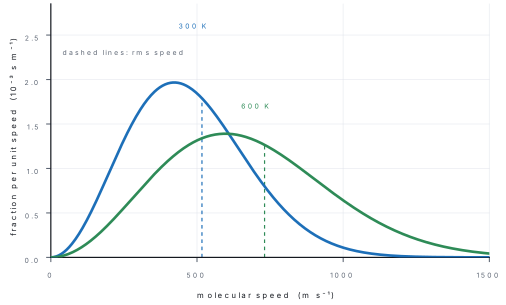
c_{rms} = \sqrt{\overline{c^2}} is not the average speed. For the Maxwell distribution
in the ratio 1.41 : 1.60 : 1.73. Only c_{rms} appears in P = \frac{1}{3}\rho c_{rms}^2. A question that says "average speed" wants c_{avg}; one that says "rms" wants c_{rms}.
rms speed and kinetic energy
Squaring c_{rms} = \sqrt{3RT/M} and combining it with PV = nRT:
Three consequences, each of which is a standard question:
- At the same temperature, lighter molecules move faster: c_{rms}\propto 1/\sqrt{M}. Hydrogen (M = 2) moves four times as fast as oxygen (M = 32). This is why hydrogen and helium escape the Earth's atmosphere and nitrogen and oxygen do not.
- c_{rms}\propto\sqrt{T}: to double the rms speed you must quadruple the absolute temperature.
- Average kinetic energy of one molecule is \frac{1}{2}m\overline{c^2} = \frac{3}{2}kT, independent of the gas. For one mole it is \frac{3}{2}RT, and for n moles the total translational kinetic energy is \frac{3}{2}nRT = \frac{3}{2}PV.
Degrees of freedom and molar heat capacities
A degree of freedom is one independent way a molecule can store energy. By the law of equipartition, each degree of freedom carries \frac{1}{2}kT per molecule on average.
| Gas | Example | Degrees of freedom f | C_v | C_p | \gamma |
|---|---|---|---|---|---|
| Monatomic | He, Ne, Ar | 3 (all translational) | \frac{3}{2}R = 12.5 | \frac{5}{2}R = 20.8 | 1.67 |
| Diatomic | H₂, O₂, N₂ | 5 (3 + 2 rotational) | \frac{5}{2}R = 20.8 | \frac{7}{2}R = 29.1 | 1.40 |
| Polyatomic | NH₃, CH₄ | 6 (3 + 3 rotational) | 3R = 24.9 | 4R = 33.3 | 1.33 |
(Units J mol⁻¹ K⁻¹.) A diatomic molecule has two rotational axes because rotation about the bond axis carries almost no energy. At high temperature the bond can also vibrate, adding two more degrees of freedom and lowering γ towards 1.29 — not needed for the paper, but it explains why γ is not exactly 1.40 for real air.
f = 3 \Rightarrow \gamma = 1.67; f = 5 \Rightarrow \gamma = 1.40; f = 6 \Rightarrow \gamma = 1.33. Monatomic is the biggest γ, polyatomic the smallest — because more ways to store energy means more heat needed for the same temperature rise, so C_v is larger and the ratio C_p/C_v smaller.
Problem. At 300 K, compare the rms speeds and the average kinetic energies of hydrogen (M = 2 g mol⁻¹) and oxygen (M = 32 g mol⁻¹).
Solution. c_{rms} = \sqrt{3RT/M}, so \dfrac{c_{H_2}}{c_{O_2}} = \sqrt{\dfrac{32}{2}} = 4. Hydrogen molecules move four times as fast. The average kinetic energy is \frac{3}{2}kT for both, because it depends only on T: \frac{3}{2}(1.38\times10^{-23})(300) = 6.2\times10^{-21} J each. A heavier molecule is slower but carries more mass, and the two effects cancel exactly.
10.2 First law of thermodynamics: isothermal, adiabatic, isochoric and isobaric processes; molar heat capacities
The first law and the sign convention
The first law is conservation of energy written for a gas:
Q = heat supplied to the gas; \Delta U = rise in its internal energy; W = work done by the gas on its surroundings.
This is the convention used throughout this book, and the one in the NEB syllabus. Learn it as a sentence: heat in = rise in internal energy + work out. Equivalently \Delta U = Q - W.
Two conventions, one answer
Some books write \Delta U = Q + W with W the work done on the gas. The physics is identical; only the sign of W differs. In an MCQ, decide from the wording: "work done by the gas" is positive when the gas expands. If a question says "work done on the gas is 100 J", then W = -100 J in our convention, so \Delta U = Q + 100.
For an ideal gas, U depends only on T, so in every process whatsoever
This is the single most useful line in the chapter: it holds for isothermal, adiabatic, isobaric, isochoric and any crooked path on the P–V diagram.
Work done by a gas
Work is force × displacement, and for a piston of area A pushed through dx the force is PA, so dW = PA\,dx = P\,dV:
On a P–V diagram this is the area under the curve. Work is positive when the volume increases (expansion) and negative when it decreases (compression). For a closed cycle, the net work is the area enclosed by the loop — positive if the cycle runs clockwise.
The four processes
| Process | Held constant | Condition | Work W by gas | \Delta U | Q | Molar heat capacity |
|---|---|---|---|---|---|---|
| Isothermal | T | PV = const | nRT\ln\frac{V_2}{V_1} | 0 | =W | infinite |
| Adiabatic | no heat flow | PV^\gamma = const | nC_v(T_1-T_2) | nC_v\Delta T | 0 | zero |
| Isochoric | V | W = 0 | 0 | nC_v\Delta T | nC_v\Delta T | C_v |
| Isobaric | P | W = P\Delta V | nR\Delta T | nC_v\Delta T | nC_p\Delta T | C_p |
Read the table as four answers to one question: where does the heat go? At constant volume it all becomes internal energy. At constant pressure some of it leaks away as work, so more heat is needed for the same temperature rise — that is exactly why C_p > C_v.
Isothermal process
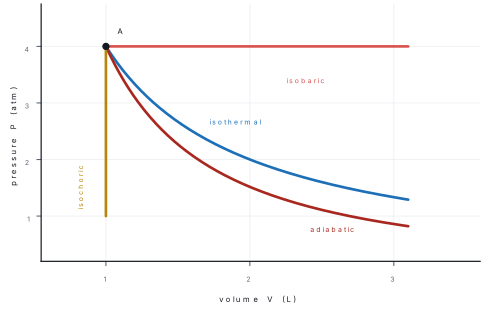
Temperature constant, so \Delta U = 0 and the first law gives Q = W. Since P = nRT/V,
The process must be slow, so that heat can flow in or out and keep the temperature equal to the surroundings throughout. The molar heat capacity of an isothermal process is formally infinite: heat flows but \Delta T = 0.
Adiabatic process
No heat enters or leaves (Q = 0), so \Delta U = -W: the gas does work at the expense of its own internal energy. From Q = 0 and \Delta U = nC_v\Delta T,
Combining PV = nRT with dU + P\,dV = 0 gives the adiabatic relations
Starting point. In an adiabatic process Q = 0, so the first law reads dU + P\,dV = 0. We want the relation between P and V.
Step 1 — write dU. For an ideal gas dU = nC_v\,dT.
Step 2 — get dT from the gas law. Differentiating PV = nRT at constant n: P\,dV + V\,dP = nR\,dT, so n\,dT = (P\,dV + V\,dP)/R.
Step 3 — substitute into the first law. \dfrac{C_v}{R}(P\,dV + V\,dP) + P\,dV = 0.
Step 4 — clear the fraction and collect. Multiplying by R: C_vP\,dV + C_vV\,dP + RP\,dV = 0, that is (C_v+R)P\,dV + C_vV\,dP = 0. Since C_v + R = C_p, C_pP\,dV + C_vV\,dP = 0.
Step 5 — divide by C_vPV. \gamma\dfrac{dV}{V} + \dfrac{dP}{P} = 0.
Step 6 — integrate. \gamma\ln V + \ln P = constant, i.e. \ln(PV^\gamma) = constant.
Result. PV^\gamma = constant.
Conditions. An ideal gas with constant γ, taken through a reversible (quasi-static) adiabatic process. For a real, fast compression the relation is only approximate.
An adiabatic expansion therefore cools the gas (rising air cools and forms cloud over the Annapurnas), and an adiabatic compression heats it (a bicycle pump warms up; a diesel engine ignites its fuel with no spark at all).
Both can be "fast" or "slow", but they differ in one physical fact: in an adiabatic process no heat crosses the boundary, so the temperature must change. Students who write T_1 = T_2 in an adiabatic expansion lose every mark in the question.
Adiabatic versus isothermal curves
Both curves fall as V increases, but the adiabatic one falls faster. Differentiate PV = const: the isothermal slope is -P/V. Differentiate PV^\gamma = const: the adiabatic slope is -\gamma P/V. Since \gamma > 1, the adiabatic curve is steeper by a factor γ — the two curves cross at the starting point, with the adiabatic below the isothermal for an expansion and above it for a compression.
Mayer's relation and the molar heat capacities
Starting point. Heat the same n moles of gas through the same \Delta T, once at constant volume and once at constant pressure, and compare the heat needed.
Step 1 — constant volume. No work is done (W = 0), so all the heat becomes internal energy: Q_v = \Delta U = nC_v\Delta T.
Step 2 — constant pressure. The gas expands and does work W = P\Delta V = nR\Delta T (using PV = nRT at constant P). The same internal energy change is needed, so Q_p = \Delta U + W = nC_v\Delta T + nR\Delta T.
Step 3 — compare. By definition Q_p = nC_p\Delta T, so nC_p\Delta T = nC_v\Delta T + nR\Delta T.
Result.
What it means. The extra heat at constant pressure pays for the work of expansion. Because R > 0, C_p is always larger than C_v — and the difference is the same R for every ideal gas, monatomic or not.
The molar heat capacity of a process in general is C = C_v + \dfrac{R}{1-x} for a path PV^x = constant; the table above is the four values worth memorising: C_v (isochoric), C_p (isobaric), \infty (isothermal), 0 (adiabatic).
Problem. 2.0 mol of an ideal gas expands isothermally at 300 K from 10 L to 20 L. Find the work done, the heat supplied and the change in internal energy.
Solution. \Delta U = 0 (isothermal), so Q = W. W = nRT\ln\dfrac{V_2}{V_1} = 2\times8.31\times300\times\ln 2 = 4986\times0.693 = 3.46\times10^3 J. So W = Q = 3.46 kJ and \Delta U = 0.
The gas absorbed 3.46 kJ of heat and turned all of it into work. That is allowed for an isothermal process — but only because the gas is not a cyclic engine: it has expanded once and cannot repeat without being compressed back.
Problem. 1.0 mol of monatomic gas (\gamma = 1.67) expands adiabatically from 300 K to 200 K. Find the work done by the gas and the drop in internal energy.
Solution. Q = 0, so W = -\Delta U = nC_v(T_1-T_2) with C_v = \frac{3}{2}R = 12.5 J mol⁻¹ K⁻¹. W = 1.0\times12.5\times100 = 1.25\times10^3 J. The internal energy falls by the same 1.25 kJ — the gas paid for the work out of its own thermal energy, which is why it cooled.
Cyclic processes
A cyclic process returns the gas to its starting state, so \Delta U = 0 over the cycle and Q_{net} = W_{net} = the area enclosed on the P–V diagram. This is exactly how a heat engine works, and it is where the second law enters.
10.3 Second law of thermodynamics: internal-combustion engines, refrigerators and entropy
The second law
The first law forbids nothing that actually happens: it would happily allow a cup of tea to heat itself by cooling the room, or an engine to turn the whole of its heat into work. The second law says which of those energy-conserving processes actually occur.
Kelvin–Planck statement. No cyclic engine can convert all the heat it absorbs from a single reservoir into work; some heat must be rejected to a colder sink.
Clausius statement. Heat cannot flow by itself from a colder body to a hotter one; work must be done to make it happen.
The two statements are equivalent: an engine that violated one could be used to violate the other. Both are statements about direction — energy conservation alone does not fix the direction of a process, and the second law does.
Heat engines
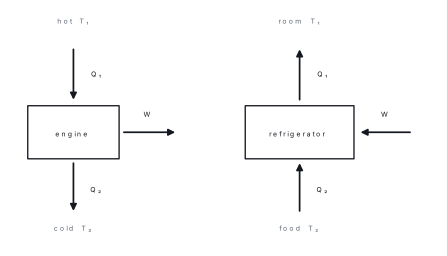
A heat engine takes heat Q_1 from a hot reservoir at T_1, converts part of it into work W, and rejects the rest Q_2 to a cold sink at T_2. By the first law over a cycle, W = Q_1 - Q_2. The efficiency is
The Carnot engine is the best possible engine between two temperatures: it uses two isothermal and two adiabatic steps, all reversible. For it Q_2/Q_1 = T_2/T_1, so
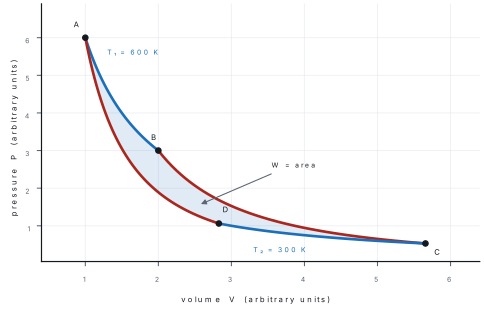
\eta = 1 - T_2/T_1 needs absolute temperatures. An engine working between 27 °C and 127 °C has T_1 = 400 K and T_2 = 300 K, so \eta = 1 - 300/400 = 25\%, not 1 - 27/127 = 79\%. The wrong calculation always gives a number that looks impressive and is impossible — a useful check in itself.
Problem. A Carnot engine works between 500 K and 300 K and absorbs 1000 J per cycle from the hot reservoir. Find its efficiency, the work done and the heat rejected.
Solution. \eta = 1 - \dfrac{300}{500} = 0.40 = 40\%. W = \eta Q_1 = 0.40\times1000 = 400 J. Q_2 = Q_1 - W = 600 J.
No engine operating between these two temperatures can beat 40 %; a real engine with friction and heat losses will be well below it.
Refrigerators and heat pumps
A refrigerator is a heat engine run backwards: work W is supplied to pump heat Q_2 out of the cold space and reject Q_1 = Q_2 + W to the warm room. Its performance is measured by the coefficient of performance
A heat pump is the same machine used the other way round: what you want is Q_1, the heat delivered to the warm space, so its COP is Q_1/W = T_1/(T_1-T_2), which is exactly COP_{fridge} + 1. That is why a heat pump can deliver more heat than the electrical energy it consumes — it is moving heat, not making it.
Problem. A refrigerator keeps its compartment at 250 K and rejects heat to a kitchen at 300 K. What is the best possible COP, and how much heat can it remove per joule of electrical work?
Solution. \text{COP} = \dfrac{T_2}{T_1-T_2} = \dfrac{250}{50} = 5. With 1 J of work it removes up to 5 J from the food and delivers 6 J to the kitchen. This is why a refrigerator is a heat pump for the room: leave the door open and the room warms, because the 6 J rejected exceeds the 1 J consumed.
Internal-combustion engines
An internal-combustion engine burns fuel inside the cylinder, so the hot gas itself is the working substance. The four-stroke cycle:
| Stroke | What happens | Valves |
|---|---|---|
| Induction (suction) | Piston moves down, air–fuel mixture is drawn in | inlet open |
| Compression | Piston moves up, mixture compressed adiabatically and heated | both closed |
| Power (expansion) | Spark ignites the mixture; hot gas pushes the piston down | both closed |
| Exhaust | Piston moves up, burnt gas pushed out | exhaust open |
The petrol engine approximates the Otto cycle (two adiabatic and two isochoric steps), whose ideal efficiency is
where r = V_1/V_2 is the compression ratio. Higher compression means higher efficiency, which is why a diesel engine (compression ratio 15–20, fuel ignited by the heat of compression alone) is more efficient than a petrol engine (ratio 8–10). Real efficiencies are 25–30 % for petrol and 35–40 % for diesel — far below the Carnot limit, because of friction, heat lost through the cylinder walls, incomplete combustion and the energy carried away by the exhaust.
Entropy
Entropy S is a measure of the disorder of a system. For a reversible change at temperature T,
and Boltzmann's form is S = k\ln W, where W is the number of microscopic ways the state can be arranged.
The second law in its entropy form: the entropy of an isolated system never decreases. For a reversible process \Delta S = 0; for every real (irreversible) process \Delta S > 0. Heat flowing from a hot body to a cold one increases the total entropy; the reverse would decrease it and never happens by itself. An engine cannot be perfect because the heat it must reject carries entropy away, and that entropy has to go somewhere.
| Statement | What it forbids |
|---|---|
| Kelvin–Planck | an engine with \eta = 1 |
| Clausius | a refrigerator with no work input |
| Entropy | any spontaneous process that lowers the entropy of an isolated system |
Formula and fact sheet
| Topic | Formula or fact |
|---|---|
| Ideal gas | PV = nRT = NkT; R = 8.31 J mol⁻¹ K⁻¹, k = 1.38\times10^{-23} J K⁻¹ |
| Other forms | P = \rho RT/M; \rho = PM/RT; P_1V_1/T_1 = P_2V_2/T_2 |
| Constants | R = N_Ak; N_A = 6.02\times10^{23}; 1 mol = 22.4 L at STP |
| Kinetic pressure | P = \frac{1}{3}\rho c_{rms}^2 = \frac{1}{3}\frac{mN}{V}\overline{c^2} |
| Speeds | c_{rms} = \sqrt{3RT/M} = \sqrt{3kT/m} = \sqrt{3P/\rho}; c_{avg} = \sqrt{8RT/\pi M}; c_{mp} = \sqrt{2RT/M} |
| Speed ratio | c_{mp} : c_{avg} : c_{rms} = 1.41 : 1.60 : 1.73 |
| Kinetic energy | \frac{3}{2}kT per molecule; \frac{3}{2}RT per mole; total \frac{3}{2}nRT = \frac{3}{2}PV |
| Degrees of freedom | monatomic 3, diatomic 5, polyatomic 6 |
| Heat capacities | C_v = \frac{f}{2}R; C_p = C_v + R; \gamma = 1 + 2/f |
| γ values | 1.67 (monatomic), 1.40 (diatomic), 1.33 (polyatomic) |
| First law | Q = \Delta U + W; W = work by the gas; \Delta U = nC_v\Delta T always |
| Work | W = \int P\,dV = area under the P–V curve |
| Isothermal | \Delta U = 0, Q = W = nRT\ln(V_2/V_1), PV = const, C = \infty |
| Adiabatic | Q = 0, W = nC_v(T_1-T_2) = \frac{P_1V_1-P_2V_2}{\gamma-1}, PV^\gamma = const, C = 0 |
| Isochoric | W = 0, Q = \Delta U = nC_v\Delta T, C = C_v |
| Isobaric | W = nR\Delta T, Q = nC_p\Delta T, C = C_p |
| Slopes on P–V | isothermal -P/V; adiabatic -\gamma P/V (steeper by γ) |
| Cycle | \Delta U = 0, Q_{net} = W_{net} = enclosed area |
| Engine | \eta = W/Q_1 = 1 - Q_2/Q_1; Carnot \eta = 1 - T_2/T_1 (kelvin) |
| Refrigerator | COP = Q_2/W = T_2/(T_1-T_2); heat pump COP = T_1/(T_1-T_2) |
| Otto cycle | \eta = 1 - 1/r^{\gamma-1} |
| Entropy | \Delta S = Q/T (reversible); \Delta S \ge 0 for an isolated system; S = k\ln W |
Chapter summary
- PV = nRT = NkT; R = N_Ak; P = \rho RT/M. Temperature must be in kelvin, and one mole of any gas occupies 22.4 L at STP.
- Kinetic theory gives P = \frac{1}{3}\rho c_{rms}^2, hence c_{rms} = \sqrt{3RT/M}: at the same temperature the lighter gas is faster, and doubling c_{rms} needs four times the absolute temperature.
- Average translational kinetic energy is \frac{3}{2}kT per molecule whatever the gas; the internal energy of an ideal gas depends only on T.
- Degrees of freedom 3, 5, 6 give C_v = \frac{f}{2}R, C_p = C_v + R and γ = 1.67, 1.40, 1.33. C_p > C_v because the extra heat at constant pressure does work.
- First law: Q = \Delta U + W with W done by the gas; \Delta U = nC_v\Delta T in every process.
- Isothermal: \Delta U = 0, Q = W = nRT\ln(V_2/V_1). Adiabatic: Q = 0, W = -\Delta U, PV^\gamma constant, and the curve is γ times steeper. Isochoric: W = 0, all the heat goes to internal energy. Isobaric: W = nR\Delta T, Q = nC_p\Delta T.
- A cycle has \Delta U = 0, so Q_{net} = W_{net} = the area enclosed.
- \eta = 1 - Q_2/Q_1 \le 1 - T_2/T_1, with kelvin temperatures; a real engine is always below the Carnot value.
- A refrigerator moves heat with COP = Q_2/W = T_2/(T_1-T_2); run with the door open it warms the room.
- The entropy of an isolated system never decreases; that is the second law in one line.
Practice questions
Set A — Recall (28 questions)
- For n moles of an ideal gas the equation of state isaPV = nRT^2bPV = nRTcP/V = nRTdPV = nR/T
- The value of the universal gas constant R isa8.31 J mol⁻¹ K⁻¹b1.38 × 10⁻²³ J K⁻¹c6.02 × 10²³ mol⁻¹d4.18 J cal⁻¹
- The volume occupied by 1 mole of an ideal gas at STP is abouta11.2 Lb24.0 Lc2.24 Ld22.4 L
- The pressure of an ideal gas of density ρ isa\rho c_{rms}^2b\frac{1}{2}\rho c_{rms}^2c\frac{1}{3}\rho c_{rms}^2d3\rho c_{rms}^2
- The rms speed of molecules of molar mass M at temperature T isa\sqrt{2RT/M}b\sqrt{3RT/M}c\sqrt{RT/M}d3RT/M
- The average translational kinetic energy of one gas molecule isakTb½kTc(5/2)kTd(3/2)kT
- The number of degrees of freedom of a monatomic gas molecule isa3b5c6d2
- At ordinary temperature a diatomic gas molecule hasa2b3c5d7 degrees of freedom
- For a monatomic ideal gas, γ = Cp/Cv isa1.40b1.67c1.33d1.00
- For a diatomic ideal gas at room temperature, γ is abouta1.40b1.67c1.33d1.20
- Mayer's relation for an ideal gas isaCp + Cv = RbCp/Cv = RcCp − Cv = γdCp − Cv = R
- Taking Q as heat supplied to the gas and W as work done by it, the first law isaQ = W − ΔUbΔU = Q + WcQ = ΔU + WdW = Q + ΔU
- For an ideal gas taken through an isothermal processaQ = 0bΔU = 0cW = 0dΔU = Q
- In an adiabatic processaQ = 0bW = 0cΔU = 0dP is constant
- In an isochoric process the work done by the gas isaPΔVbnRT ln(V₂/V₁)cnCpΔTdzero
- In an isobaric process the work done by the gas isazerobnCvΔTcPΔVdnCpΔT
- The work done by n moles of gas in a reversible isothermal expansion from V₁ to V₂ isanCv(T₂ − T₁)bnRT ln(V₂/V₁)cP(V₂ − V₁)dnR(T₂ − T₁)
- For a reversible adiabatic process in an ideal gasaPV^γ = constantbPV = constantcP/V = constantdPV^(1/γ) = constant
- The Kelvin–Planck statement of the second law says that no engine canaabsorb heat from a hot bodybreject heat to a cold bodycwork in cyclesdconvert all the heat absorbed into work
- The efficiency of a Carnot engine working between T₁ and T₂ isa1 − T₁/T₂bT₂/T₁c1 − T₂/T₁d(T₁ − T₂)/T₂
- The coefficient of performance of a refrigerator isaW/Q₁bQ₂/WcW/Q₂dQ₁/W
- The SI unit of entropy isaJ K⁻¹bJcJ kg⁻¹ K⁻¹dW K⁻¹
- The entropy change in a reversible adiabatic process isapositivebnegativecinfinitedzero
- The universal gas constant R is equal toaN_A/kbk/N_AcN_AkdN_A + k
- The SI unit of molar heat capacity isaJ K⁻¹bJ mol⁻¹ K⁻¹cJ kg⁻¹ K⁻¹dmol K⁻¹
- For an ideal gas the internal energy depends only on itsatemperaturebpressurecvolumeddensity
- An ideal gas expands into a vacuum inside a thermally insulated container. Its temperaturearisesbfallscfalls to zerodstays the same
- A petrol engine works on theaCarnot cyclebdiesel cyclecOtto cycledRankine cycle
Answers and explanations — Set A
1. (b) — the equation of state is PV = nRT. Option (a) has T squared, and (d) divides by T instead of multiplying.
2. (a) — R = 8.31 J mol⁻¹ K⁻¹. Option (b) is Boltzmann's constant and (c) is Avogadro's number.
3. (d) — at 273 K and 1 atm, V = RT/P = 8.31 × 273/1.01 × 10⁵ = 22.4 × 10⁻³ m³ = 22.4 L.
4. (c) — from kinetic theory P = ⅓ρc²ᵣₘₛ. The factor ⅓ comes from the three directions of motion.
5. (b) — c_rms = √(3RT/M). Option (a) is the most probable speed and (c) is missing the 3.
6. (d) — three translational degrees of freedom at ½kT each. Option (c) would be the total energy including rotation.
7. (a) — a point atom can move in three independent directions only.
8. (c) — three translational plus two rotational; rotation about the bond carries no energy.
9. (b) — f = 3 gives γ = 1 + 2/3 = 1.67. Option (a) is the diatomic value.
10. (a) — f = 5 gives γ = 1 + 2/5 = 1.40, which is why air is treated as γ = 1.4.
11. (d) — Cp − Cv = R; the difference is the work done in expanding at constant pressure.
12. (c) — heat in = rise in internal energy + work out.
13. (b) — the temperature does not change, and for an ideal gas U depends only on T, so ΔU = 0.
14. (a) — "adiabatic" means no heat crosses the boundary. W is not zero unless the volume is fixed.
15. (d) — W = PΔV and ΔV = 0 at constant volume.
16. (c) — at constant pressure the work is PΔV = nRΔT.
17. (b) — integrating P = nRT/V over the volume gives nRT ln(V₂/V₁).
18. (a) — PV^γ = constant; the exponent is γ, greater than 1, so the curve is steeper than an isotherm.
19. (d) — a cyclic engine must reject some heat to a sink; 100 % conversion is forbidden.
20. (c) — η = 1 − T₂/T₁ with absolute temperatures. Option (a) has the ratio upside down.
21. (b) — COP is what you get (heat removed) divided by what you pay (work).
22. (a) — entropy is heat divided by temperature, J/K.
23. (d) — Q = 0, so ΔS = Q/T = 0. A reversible adiabatic process is isentropic.
24. (c) — R = N_Ak, the gas constant per mole is Avogadro's number times the constant per molecule.
25. (b) — heat per mole per kelvin.
26. (a) — with no intermolecular potential energy, U is purely kinetic and therefore depends only on T.
27. (d) — Q = 0 (insulated) and W = 0 (expanding against nothing), so ΔU = 0 and T is unchanged.
28. (c) — the Otto cycle: two adiabatic and two isochoric steps.
Set B — Understanding (17 questions)
- Hydrogen (M = 2) and oxygen (M = 32) are at the same temperature. The rms speed of hydrogen molecules isa16 times that of oxygenbone quarter of that of oxygenc4 times that of oxygendthe same as that of oxygen
- A gas is heated at constant pressure. The heat supplied is used toaraise the internal energy onlybdo work onlycraise the temperature onlydraise the internal energy and do work of expansion
- On a P–V diagram the adiabatic curve through a point is steeper than the isothermal curve becauseathe adiabatic process is always slowerbthe pressure falls faster when no heat enters to keep T constantcthe temperature rises during an adiabatic expansiondγ is less than 1
- Cp is greater than Cv because at constant pressureathe gas does work as it expandsbthe temperature rises fastercno heat is supplieddthe gas becomes denser
- A gas is compressed adiabatically. Its temperatureafalls, because Q = 0bstays the samecrises, because the work done on it raises its internal energydfalls, because the volume decreases
- An ideal gas undergoes free expansion into a vacuum. Which is correct?aQ > 0 and W > 0bQ = 0, W = 0 and ΔU = 0cQ = 0 and W > 0dΔU > 0
- The efficiency of a real heat engine is always less than the Carnot efficiency becauseathe second law forbids engines altogetherba Carnot cycle cannot be drawncheat cannot be rejected to a sinkdof friction, heat losses and irreversible processes
- A refrigerator is run with its door open in a closed, insulated room. The roomawarms upbcools downcstays at the same temperaturedcools first, then warms
- For any process in an isolated system, the entropyaalways decreasesbstays constantcnever decreasesdbecomes zero
- No heat engine can have an efficiency of 100 % becauseafuels burn incompletelybit would have to reject no heat at allcfriction can never be removeddthe working substance would freeze
- The same gas is heated through the same ΔT, once at constant volume and once at constant pressure. The heat needed isagreater at constant pressurebgreater at constant volumecthe same in both casesdzero at constant pressure
- The rms speed of gas molecules becomes double when the absolute temperature isadoubledbhalvedcmade eight timesdmade four times
- The average translational kinetic energy of gas molecules depends onathe gas and its pressurebonly the absolute temperatureconly the volumedthe molar mass of the gas
- A gas is heated at constant volume. All the heat suppliedadoes work of expansionbis lost to the surroundingscraises the internal energydis converted into entropy
- In a cyclic process the net heat supplied to the gas equalsathe net work done by itbthe change in its internal energyczero in every casedthe heat rejected
- In an isobaric expansion of an ideal gas, the fraction of the heat supplied that appears as work isa1b1/γcγd(γ − 1)/γ
- Heat flows by itself from a hot body to a cold one. The reverse transferanever happens in any devicebhappens only if work is done on the systemchappens if the temperature difference is smalldhappens in an isolated system
Answers and explanations — Set B
1. (c) — c_rms ∝ 1/√M, so the ratio is √(32/2) = 4. Option (a) is the ratio of the molar masses, not of the speeds.
2. (d) — at constant pressure the gas expands, so some heat becomes work and the rest raises U; Q = nCpΔT accounts for both.
3. (b) — the isothermal slope is −P/V and the adiabatic slope is −γP/V; with γ > 1 the adiabatic falls faster.
4. (a) — the extra heat Cp − Cv = R per mole is exactly the work of expansion PΔV = RΔT.
5. (c) — Q = 0, so ΔU = −W; compressing means W < 0, hence ΔU > 0 and T rises. This is how a diesel engine ignites its fuel.
6. (b) — no heat crosses the insulated wall and the gas pushes against nothing, so W = 0; ΔU = 0 and T is unchanged.
7. (d) — the Carnot efficiency is the reversible limit; friction, heat leaks and finite-time operation all cost real engines.
8. (a) — the refrigerator delivers Q₁ = Q₂ + W to the room, and Q₁ exceeds the electrical work W, so the room gains net energy.
9. (c) — the second law: ΔS ≥ 0 for an isolated system, with equality only for reversible processes.
10. (b) — η = 1 − Q₂/Q₁ = 1 needs Q₂ = 0, i.e. no heat rejected, which the Kelvin–Planck statement forbids.
11. (a) — Cp > Cv, because at constant pressure part of the heat becomes work of expansion.
12. (d) — c_rms ∝ √T, so doubling the speed needs T multiplied by 4.
13. (b) — ½m c²_rms = (3/2)kT, which contains T and nothing else.
14. (c) — no expansion means W = 0, so Q = ΔU entirely.
15. (a) — ΔU = 0 over a complete cycle, so Q = W; the work is the area enclosed by the loop.
16. (d) — W/Q = nRΔT/(nCpΔT) = R/Cp = (γ − 1)/γ, which is 0.4 for a monatomic gas.
17. (b) — that is the Clausius statement: a refrigerator must be driven by work.
Set C — Application (11 questions)
- 2.0 mol of an ideal gas expands isothermally at 300 K from 10 L to 20 L. The work done isa1.73 kJb3.46 kJc4.99 kJd6.93 kJ
- The rms speed of oxygen molecules (M = 32 g mol⁻¹) at 300 K is abouta279 m s⁻¹b394 m s⁻¹c483 m s⁻¹d683 m s⁻¹
- The average translational kinetic energy of a gas molecule at 300 K isa6.2 × 10⁻²¹ Jb4.1 × 10⁻²¹ Jc2.1 × 10⁻²¹ Jd1.2 × 10⁻²⁰ J
- 1.0 mol of monatomic gas expands adiabatically from 300 K to 200 K. The work done by the gas isa2.08 kJb0.83 kJc1.66 kJd1.25 kJ
- A Carnot engine works between 500 K and 300 K. Its efficiency isa20 %b60 %c40 %d80 %
- A Carnot engine works between 127 °C and 27 °C. Its efficiency isa25 %b40 %c21 %d79 %
- A refrigerator works between 250 K and 300 K. Its maximum coefficient of performance isa0.2b5c6d1.2
- An engine takes 800 J from its hot reservoir and delivers 200 J of work per cycle. The heat rejected per cycle isa200 Jb400 Jc600 Jd1000 J
- A fixed mass of gas at 27 °C is heated at constant volume until its pressure doubles. Its new temperature isa327 °Cb54 °Cc600 °Cd150 °C
- The heat needed to raise the temperature of 2.0 mol of a diatomic gas by 20 K at constant pressure isa832 Jb1.16 kJc333 Jd2.32 kJ
- 2.0 mol of an ideal gas is heated through 100 K at constant pressure. The work done by the gas isa0.83 kJb2.08 kJc1.16 kJd1.66 kJ
Answers and explanations — Set C
1. (b) — W = nRT ln(V₂/V₁) = 2 × 8.31 × 300 × ln 2 = 4986 × 0.693 = 3.46 kJ. Option (d) uses ln 4 by mistake.
2. (c) — c_rms = √(3RT/M) = √(3 × 8.31 × 300/0.032) = √(2.34 × 10⁵) = 483 m s⁻¹. Option (b) is the most probable speed √(2RT/M).
3. (a) — (3/2)kT = 1.5 × 1.38 × 10⁻²³ × 300 = 6.2 × 10⁻²¹ J. Option (b) is kT, which omits the 3/2.
4. (d) — Q = 0, so W = nCv(T₁ − T₂) = 1 × 12.5 × 100 = 1.25 kJ. Option (a) wrongly uses Cp.
5. (c) — η = 1 − 300/500 = 0.40. Option (b) is Q₂/Q₁ = T₂/T₁, the fraction rejected, not the efficiency.
6. (a) — convert first: T₁ = 400 K, T₂ = 300 K, so η = 1 − 300/400 = 25 %. Option (d) is the °C blunder, 1 − 27/127; option (c) is the ratio 27/127 itself.
7. (b) — COP = T₂/(T₁ − T₂) = 250/50 = 5. Option (c) is the heat pump COP, which is one larger.
8. (c) — Q₂ = Q₁ − W = 800 − 200 = 600 J. The efficiency is 25 %, but the question asks for the heat rejected.
9. (a) — at constant V, P ∝ T, so T doubles from 300 K to 600 K, which is 327 °C. Option (b) doubles the Celsius reading instead.
10. (b) — Q = nCpΔT = 2 × 29.1 × 20 = 1.16 kJ. Option (a) uses Cv, which would be right only at constant volume; (c) is only the work nRΔT; (d) doubles ΔT.
11. (d) — W = PΔV = nRΔT = 2 × 8.31 × 100 = 1.66 kJ. Option (b) is the heat nCpΔT, (c) is nCvΔT, and (a) is nRΔT for 1 mol.