Chapter 18 · Modern Physics · 3 questions in the paper · 36 min read
Electrons and Photons
What the syllabus asks for 3
- Motion of an electron in electric and magnetic fields
- J. J. Thomson's experiment and Millikan's oil-drop experiment
- Photons and the photoelectric effect: laws and Einstein's equation
Modern Physics carries 12 of the 50 Physics questions (official MEC weightage), and we estimate about 3 come from this chapter. They divide into two halves. The first half is the electron as a particle: how a beam of electrons bends in an electric or a magnetic field, how Thomson weighed its charge against its mass, and how Millikan caught the charge itself. The second half is the photon: E = hf, p = h/\lambda, and the photoelectric effect, where the particle picture of light was forced on physics. Both halves are formula-light and idea-heavy, so the marks go to the student who can say why, not only what.
- Electron in a field along its motion: accelerated, v=\sqrt{2eV/m}.
- Electron in a transverse electric field: a parabolic path, y=\frac{1}{2}at^2=\frac{eEx^2}{2mv^2} — the oscilloscope.
- Electron in a magnetic field: a circle of radius r=\frac{mv}{eB}; the period T=\frac{2\pi m}{eB} does not depend on speed.
- Thomson's crossed fields: undeflected when eE=evB, so v=E/B and then e/m=\frac{E}{B^2r}.
- Millikan: a charged drop held stationary has qE=mg; every charge found is a whole multiple of e.
- Photon energy E=hf=hc/\lambda and momentum p=h/\lambda; hc\approx1240 eV nm.
- The four experimental laws of the photoelectric effect, and exactly why the wave theory fails each.
- Einstein's equation hf=\phi+K_{max}; threshold f_0=\phi/h; stopping potential eV_0=K_{max}; the V_0–f line with slope h/e and intercept -\phi/e.
- Intensity sets the number of photons, hence the saturation current; frequency sets the energy of each photon, hence the stopping potential.
18.1 Motion of an electron in electric and magnetic fields
An electron carries charge -e=-1.6\times10^{-19} C and mass m=9.11\times10^{-31} kg. In a field it obeys Newton's second law with the Lorentz force
The electric part acts along the field line (backwards, because the charge is negative); the magnetic part acts at right angles to both \vec v and \vec B. That single difference in direction produces two completely different paths.
18.1.1 Field along the motion: acceleration
If the electron starts from rest and falls through a potential difference V, the work done on it is eV and this becomes kinetic energy:
For V=1000 V this gives v=1.87\times10^{7} m s⁻¹ — about 6 % of the speed of light, so the classical formula is still acceptable here. Notice the two proportionalities that the paper likes: v\propto\sqrt{V} and K\propto V. Doubling the voltage multiplies the speed by \sqrt{2}, not by 2.
The same formula is used in reverse in an X-ray tube or a cathode-ray tube: the accelerating voltage fixes the energy of every electron in the beam, and therefore the shortest X-ray wavelength the tube can produce.
18.1.2 Transverse electric field: the parabolic path
Now let the electron enter with velocity v perpendicular to a uniform field between two parallel plates. This is the deflector of a cathode-ray oscilloscope.
Inside the plates the electron feels a constant force eE at right angles to its velocity. The motion is exactly the projectile problem of Chapter 1, with g replaced by a=eE/m:
- along the plates: uniform velocity v (no force in that direction), so x=vt and t=x/v;
- across the plates: uniform acceleration a=eE/m starting from zero perpendicular velocity.
Therefore
which is a parabola. At the exit from plates of length L the deflection is
and the beam then travels in a straight line, so on a screen a distance D beyond the plates the total deflection is y=y_1+D\tan\theta.
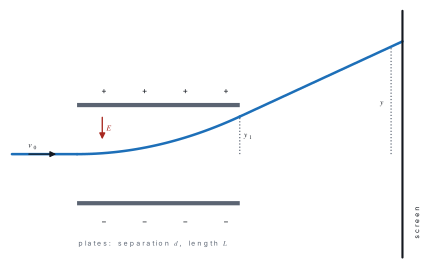
Setting up. Plates of length L and separation d carry a deflecting voltage V_d, so E=V_d/d. The beam was accelerated through V_a, so \frac{1}{2}mv^2=eV_a.
Step 1 — time in the field. The horizontal velocity does not change, so t=L/v.
Step 2 — sideways acceleration. a=eE/m=eV_d/(md).
Step 3 — deflection at the exit. y_1=\frac{1}{2}at^2 =\frac{eV_d}{2md}\cdot\frac{L^2}{v^2}.
Step 4 — put in the speed. From \frac{1}{2}mv^2=eV_a, mv^2=2eV_a. Substituting,
Result. y_1=\dfrac{V_dL^2}{4dV_a}, and the spot deflection is proportional to it.
What it means. The charge and mass of the electron have cancelled. A cathode-ray tube therefore deflects by an amount fixed by its geometry and its voltages alone, which is why an oscilloscope can be calibrated in volts per centimetre. The same cancellation is why the tube works the same with any charged particle of the same energy per charge.
Problem. In a cathode-ray tube the deflecting plates are 2.0 cm long and 1.0 cm apart, and the beam is accelerated through 1000 V. Find the deflection at the exit when the deflecting voltage is 100 V.
Solution. y_1=\dfrac{V_dL^2}{4dV_a} =\dfrac{100\times(0.020)^2}{4\times0.010\times1000} =\dfrac{100\times4.0\times10^{-4}}{40}=1.0\times10^{-3} m =1.0 mm.
Check. At 200 V the spot moves to 2.0 mm: the deflection is linear in V_d, which is the property the instrument is sold on.
y_1 does not depend on e/m, and it does not depend on the speed separately — the speed is already fixed by V_a. What it does depend on is 1/V_a: increasing the accelerating voltage makes the beam stiffer and the spot deflection smaller. Students often say "a faster electron is deflected more"; the opposite is true.
18.1.3 Magnetic field: the circular path
A charge moving in a magnetic field feels F=evB\sin\theta, always perpendicular to \vec v. A force perpendicular to the velocity does no work: it changes the direction of motion but never the speed or the kinetic energy. The path is therefore a circle at constant speed, and the magnetic force supplies the centripetal force:
The period follows at once:
which contains no v: all electrons of the same charge and mass take the same time for one turn, however fast they are moving. Faster electrons simply travel a bigger circle. This is the principle of the cyclotron.
If the velocity has a component along \vec B as well as across it, the across part makes a circle and the along part carries the particle forward at constant speed; the two together trace a helix.
| Field | Force on the electron | Path | Speed |
|---|---|---|---|
| \vec E parallel to \vec v | eE, along the line | straight line, accelerated | changes |
| \vec E perpendicular to \vec v | eE, constant | parabola | constant along the plates, v_y grows |
| \vec B perpendicular to \vec v | evB, always perpendicular to \vec v | circle | constant |
| \vec B at an angle to \vec v | evB\sin\theta | helix | constant |
Problem. An electron moves at 1.0\times10^{7} m s⁻¹ perpendicular to a field of 1.0\times10^{-2} T. Find the radius of its path and the time for one revolution.
Solution. r=\dfrac{mv}{eB} =\dfrac{9.11\times10^{-31}\times1.0\times10^{7}}{1.6\times10^{-19}\times1.0\times10^{-2}} =\dfrac{9.11\times10^{-24}}{1.6\times10^{-21}}=5.7\times10^{-3} m =5.7 mm.
T=\dfrac{2\pi r}{v}=\dfrac{2\pi\times5.69\times10^{-3}}{1.0\times10^{7}} =3.6\times10^{-9} s.
Check. The same T comes from 2\pi m/eB alone, so an electron at twice the speed would circle a radius of 11 mm in the same 3.6 ns.
In the same field, r=mv/qB. At the same speed, r\propto m/q; at the same accelerating voltage, r\propto\sqrt{m/q}; at the same kinetic energy, r\propto\sqrt{m/q} as well, because p=\sqrt{2mK}. An alpha particle and a proton with equal speeds have radii in the ratio 2:1 (charge-to-mass ratio halved), and the ratio of their periods is also 2:1.
18.2 J. J. Thomson's experiment and Millikan's oil-drop experiment
18.2.1 Cathode rays and thermionic emission
When a high voltage is applied across a gas at low pressure in a discharge tube, a stream of particles leaves the cathode and travels in straight lines. These cathode rays were shown to be deflected towards the positive plate, to blacken a photographic plate, to make certain minerals fluoresce and to ionise the gas they passed through — so they are streams of negative particles.
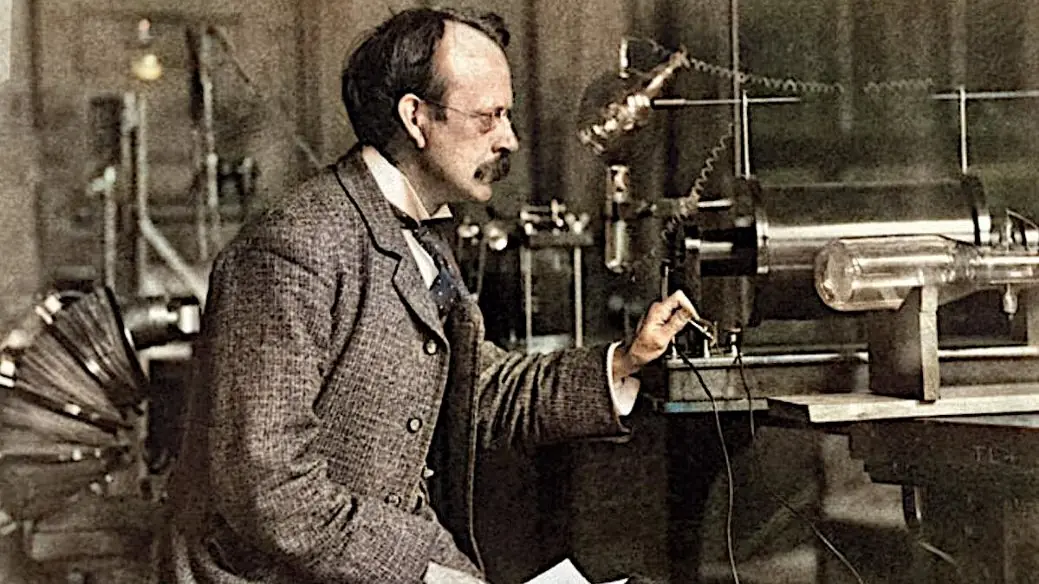
In 1897 J. J. Thomson measured the ratio of their charge to their mass. The ratio came out at about 1.76\times10^{11} C kg⁻¹, more than a thousand times the value for a hydrogen ion (9.58\times10^{7} C kg⁻¹). Since the value did not change when the gas in the tube or the metal of the cathode was changed, these particles must be a common constituent of all matter. They were named electrons.
Electrons are also freed by heating: a metal filament heated to about 2000 °C or more emits electrons from its surface. This is thermionic emission, the source of electrons in a cathode-ray tube, an X-ray tube and the old valve radios. It works because the electrons in a hot metal have a distribution of energies, and the fastest of them have enough energy to escape the attraction of the positive ions they leave behind.
18.2.2 The crossed-field measurement of e/m
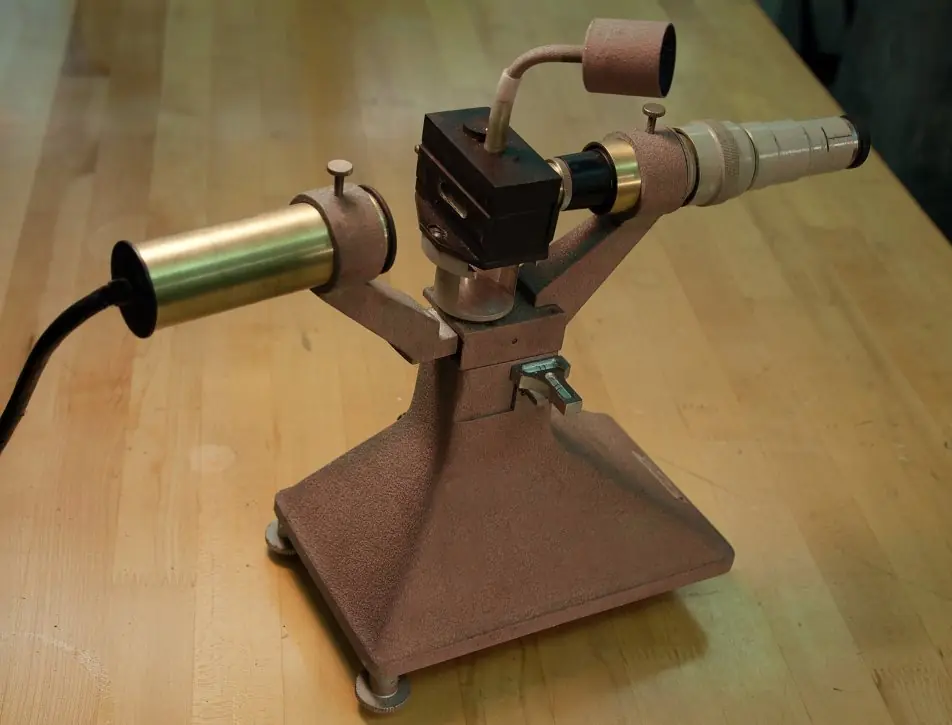
Thomson's tube had two sets of deflectors at right angles: an electric field E between plates, and a magnetic field B from a coil, arranged so that the two forces on the electron were opposite.
- Both fields on. The electric force eE and the magnetic force evB pull in opposite directions. Adjust the fields until the spot returns to zero. Then the forces balance and the electron travels in a straight line:
- Electric field off. Only the magnetic force acts, so the electron moves in a circle of radius r, which is measured from the position of the spot on the fluorescent screen. Then
Every quantity on the right is measured, so e/m is found without knowing e or m separately. Thomson's number was about 1.76\times10^{11} C kg⁻¹ (modern value 1.759\times10^{11}).
Thomson measured the ratio e/m, not e and not m. From e/m alone the electron could be a particle of small charge and tiny mass or of large charge and larger mass. The mass was only pinned down once Millikan measured e (from 1909 onwards); then m=e/(e/m)=1.6\times10^{-19}/1.76\times10^{11}=9.1\times10^{-31} kg.
18.2.3 Millikan's oil-drop experiment
Millikan's apparatus sprays a fine mist of oil into a chamber between two horizontal plates. The droplets are charged by friction in the nozzle and by X-rays that ionise the air. A microscope with a graduated eyepiece watches one drop.
- Field off. The drop falls, and air resistance quickly makes it fall at a steady terminal velocity. Stokes' law, 6\pi\eta rv_t=mg, then gives the radius r of the drop, and hence its mass from the density of the oil.
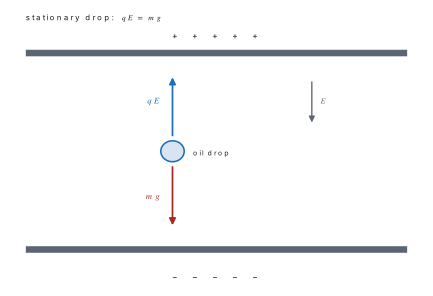
- Field on. The plates are charged so that the electric force on the drop acts upwards. The voltage is adjusted until the drop hangs stationary.
Why stationary? Because a stationary drop has zero velocity, so the viscous drag is zero (drag depends on speed). The only vertical forces left are the electric force and the weight, and they must balance exactly:
There is no drag term and no correction for speed to worry about — that is the whole elegance of holding the drop still.
The result was not a number but a pattern. However the drop was charged, and however many times it was recharged with X-rays, the charge always came out as
Millikan never found a fraction of the smallest charge. That is the experimental basis of quantisation of charge: electric charge exists only in whole multiples of the elementary charge e.
The upward force must balance the apparent weight, mg minus the buoyancy of the air, because the drop is in air and not in vacuum. For an oil drop of density 900 kg m⁻³ the buoyancy correction is about 0.1 %, which is why most textbook treatments simply write qE=mg. If a question gives the density of air, subtract the buoyancy.
| Thomson | Millikan | |
|---|---|---|
| Measured | e/m | e |
| Method | deflection of an electron beam in crossed E and B | a charged oil drop held stationary in an electric field |
| Key relation | e/m=E/(B^2r) | q=mg/E |
| What it proved | electrons are a universal constituent of matter | charge is quantised in units of e |
| Gave, with the other | m=e/(e/m)=9.1\times10^{-31} kg | the size of the elementary charge |
Problem. In a Thomson tube the beam is undeflected when E=3.4\times10^{4} V m⁻¹ and B=2.0\times10^{-3} T. With the electric field off, the beam moves in a circle of radius 4.8 cm in the same field. Find e/m.
Solution. v=E/B=3.4\times10^{4}/2.0\times10^{-3}=1.7\times10^{7} m s⁻¹.
\dfrac{e}{m}=\dfrac{v}{Br}=\dfrac{1.7\times10^{7}}{2.0\times10^{-3}\times0.048} =\dfrac{1.7\times10^{7}}{9.6\times10^{-5}}=1.8\times10^{11} C kg⁻¹.
Check. This is within 2 % of the accepted 1.76\times10^{11} C kg⁻¹ — the small difference is the precision of the data, not a different particle.
Problem. An oil drop of mass 3.2\times10^{-15} kg is held stationary between plates 1.0 cm apart with a potential difference of 200 V. Find the charge on the drop and the number of electrons it carries (g=10 m s⁻²).
Solution. E=V/d=200/0.010=2.0\times10^{4} V m⁻¹.
q=\dfrac{mg}{E}=\dfrac{3.2\times10^{-15}\times10}{2.0\times10^{4}} =1.6\times10^{-18} C.
n=q/e=1.6\times10^{-18}/1.6\times10^{-19}=10 electrons.
18.3 Photons and the photoelectric effect: laws and Einstein's equation
18.3.1 The photon
Planck had supposed that the atoms in a hot body emit energy in packets of size hf. Einstein went further in 1905: light itself is made of packets. A photon is a quantum of electromagnetic radiation, with energy and momentum
with h=6.63\times10^{-34} J s and c=3.0\times10^{8} m s⁻¹. A useful working form is E(\text{eV})=1240/\lambda(\text{nm}), because hc=1.99\times10^{-25} J m \approx1240 eV nm.
Three properties that questions turn on:
- A photon has zero rest mass, but it does have momentum h/\lambda; when it is absorbed or emitted, momentum is conserved.
- A photon is uncharged, so it is not deflected by electric or magnetic fields. (Gravity bends light, but not through the Lorentz force.)
- The intensity of a beam is the number of photons crossing unit area per second times the energy of each: I=Nhf/At. Bright red light and dim red light differ in N, not in hf. Red light and blue light differ in hf, not necessarily in N.
18.3.2 Thermionic emission and the work function
Electrons in a metal are bound by the attraction of the positive ions. To pull one out of the surface, even from the least tightly bound states, takes a definite minimum energy. That minimum is the work function \phi of the metal:
The work function \phi of a metal is the minimum energy needed to remove an electron from its surface to a point just outside, at rest. It is a property of the metal, quoted in electron volts (1 eV =1.6\times10^{-19} J).
| Metal | \phi (eV) | Threshold \lambda_0=1240/\phi (nm) | Which light ejects electrons |
|---|---|---|---|
| Caesium | 2.14 | 579 | visible (green and shorter) |
| Sodium | 2.28 | 544 | visible |
| Zinc | 4.3 | 288 | ultraviolet only |
| Copper | 4.7 | 264 | ultraviolet only |
The work function is not the same as the ionisation energy of a free atom, and it is not the same for every crystal face of the same metal. For the paper, remember the order of magnitude: a few electron volts, which corresponds to visible or near ultraviolet light.
18.3.3 The photoelectric effect and its four laws
When light of sufficiently high frequency falls on a clean metal surface, electrons are emitted from it. This is the photoelectric effect, and the emitted electrons are photoelectrons. The effect is used in light meters, in photomultiplier tubes and in the automatic doors of a supermarket.
The experiments give four laws.
| Law | Statement |
|---|---|
| 1. Threshold frequency | For each metal there is a minimum frequency f_0 below which no electrons are emitted at all, however intense the light and however long it shines. |
| 2. Maximum kinetic energy | K_{max} of the photoelectrons increases with the frequency of the light and depends on the metal; it does not depend on the intensity. |
| 3. Current and intensity | For f>f_0, the number of photoelectrons emitted per second — the saturation current — is directly proportional to the intensity of the light. |
| 4. Instantaneity | Emission begins within about 10^{-9} s of the light arriving, even when the intensity is so low that only one photon arrives at a time. |
18.3.4 Why the wave theory fails
In the wave picture, light delivers energy continuously to the electrons in the metal. A weak wave simply takes longer to deliver the same energy. That picture makes three predictions, and all three are wrong.
| Wave theory predicts | What is observed | Which law is broken |
|---|---|---|
| Any frequency will do, given enough intensity or enough time: the electron can accumulate the work function from many small instalments. | Below f_0 there is no emission at all, even with a very intense beam. | Law 1 |
| A brighter beam delivers more energy per second, so electrons should leave faster. | K_{max} is unchanged when the intensity is increased; only the number of electrons grows. | Law 2 |
| A very faint beam should need a measurable time to build up 2 eV or so on one electron. | Emission starts at once, within 10^{-9} s. | Law 4 |
The third row is worth a number. At an intensity of 10^{-6} W m⁻², the power falling on one atom (area about 10^{-20} m²) is 10^{-26} W. To collect a work function of 2 eV =3.2\times10^{-19} J at that rate would take 3.2\times10^{7} s, about a year. No such delay is ever seen.
Only law 3 is consistent with the wave theory as well, so it cannot be used to choose between the two pictures. The other three decide the argument, and they decide it for the particle picture.
18.3.5 Einstein's equation
Einstein's postulate is that one photon is absorbed by one electron, whole. The photon's energy pays the work function first, and whatever is left becomes the electron's kinetic energy:
This single equation contains all four laws:
- If hf<\phi there is no energy left over, so no electron can escape: threshold.
- K_{max} rises linearly with f and is fixed by \phi for that metal: law 2.
- A brighter beam has more photons, so more electrons per second: law 3.
- Absorption is a single event, so there is no build-up time: law 4.
The threshold frequency and threshold wavelength follow by putting K_{max}=0:
18.3.6 Stopping potential and the V₀–f graph
The fastest photoelectrons can be stopped by making the collector electrode negative. The smallest retarding potential that just stops the current is the stopping potential V_0, and it measures the maximum kinetic energy directly:
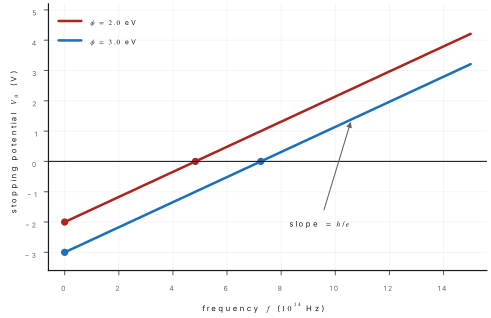
So a graph of V_0 against f is a straight line:
- slope =h/e, the same for every metal — this is how Millikan measured h;
- intercept on the V_0 axis =-\phi/e;
- intercept on the f axis =f_0=\phi/h.
18.3.7 Intensity, saturation current and stopping potential
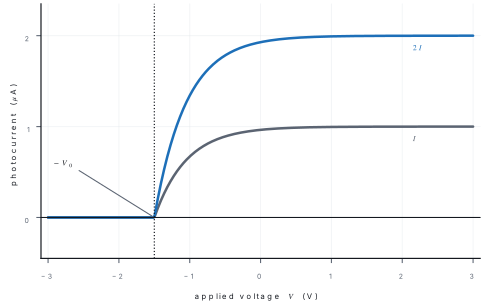
Two knobs, two different effects. This is the most examined idea in the chapter.
| Change made | Saturation current | Stopping potential | K_{max} |
|---|---|---|---|
| Intensity doubled, f fixed | doubles | unchanged | unchanged |
| Frequency increased, intensity fixed | may fall slightly (fewer photons per second if the source power is fixed) | rises | rises |
| Metal changed to one with larger \phi, same light | about the same, if f is still above the new threshold; zero if it is not | falls | falls |
| Distance from the lamp increased | falls (inverse square) | unchanged | unchanged |
- Work function in eV against joules. \phi=2.0 eV is 3.2\times10^{-19} J. If you put 2.0 into hf-\phi with hf in joules, you get nonsense. Convert first: E(\text{eV})=1240/\lambda(\text{nm}) is the safe route.
- "No emission below threshold, however intense." Intensity adds photons, not energy per photon. A thousand dim red photons cannot do what one ultraviolet photon does.
- Stopping potential is a magnitude. K_{max}=eV_0 uses the size of the retarding voltage. The applied voltage that stops the current is -V_0; the stopping potential is quoted as a positive number, and on the graph the current reaches zero at -V_0.
Problem. Light of wavelength 400 nm falls on a metal of work function 2.5 eV. Find the photon energy, the maximum kinetic energy of the photoelectrons, the stopping potential and the threshold wavelength.
Solution. E=\dfrac{1240}{400}=3.1 eV.
K_{max}=3.1-2.5=0.6 eV =0.6\times1.6\times10^{-19}=9.6\times10^{-20} J.
V_0=K_{max}/e=0.6 V.
\lambda_0=\dfrac{1240}{2.5}=496 nm \approx 500 nm, so this light (400 nm) is just beyond the threshold and the electrons come off slowly.
Problem. A sodium lamp emits 100 W of light of wavelength 589 nm. How many photons does it emit per second?
Solution. E=\dfrac{hc}{\lambda}=\dfrac{6.63\times10^{-34}\times3.0\times10^{8}}{589\times10^{-9}} =3.38\times10^{-19} J.
N=\dfrac{P}{E}=\dfrac{100}{3.38\times10^{-19}}=3.0\times10^{20} photons per second.
Check. 3\times10^{20} photons per second from a 100 W lamp sounds enormous, and it is — which is why a beam of ordinary brightness still delivers its energy in countless separate packets.
- Convert \lambda to energy in eV with 1240/\lambda (nm).
- Subtract \phi in eV. A negative answer means no emission — that is the answer, and no further work is needed.
- The remainder is K_{max} in eV, and numerically the same number is V_0 in volts.
- If the question gives V_0 and f, the slope of the line is h/e and the intercept is -\phi/e; if it gives two metals, the lines are parallel.
Formula and fact sheet
| Quantity | Formula or value |
|---|---|
| Charge and mass of electron | e=1.6\times10^{-19} C, m=9.11\times10^{-31} kg, e/m=1.76\times10^{11} C kg⁻¹ |
| Speed after acceleration | v=\sqrt{2eV/m}, v\propto\sqrt{V} |
| Transverse electric field | y=\frac{1}{2}at^2=\frac{eEx^2}{2mv^2}; y_1=\frac{eEL^2}{2mv^2}; \tan\theta=\frac{eEL}{mv^2} |
| Oscilloscope deflection | y_1=\frac{V_dL^2}{4dV_a} — independent of e/m |
| Magnetic force | F=evB\sin\theta, perpendicular to \vec v, does no work |
| Radius in a magnetic field | r=\frac{mv}{eB}=\frac{p}{eB}=\frac{\sqrt{2mK}}{eB} |
| Period in a magnetic field | T=\frac{2\pi m}{eB}, independent of speed |
| Thomson | undeflected: eE=evB, v=E/B; then e/m=\frac{E}{B^2r} |
| Millikan | stationary drop: qE=mg, q=\frac{mgd}{V}; q=ne |
| Planck's constant | h=6.63\times10^{-34} J s; hc=1.99\times10^{-25} J m \approx1240 eV nm |
| Photon energy | E=hf=\frac{hc}{\lambda}; E(\text{eV})=\frac{1240}{\lambda(\text{nm})} |
| Photon momentum | p=\frac{h}{\lambda}=\frac{E}{c}; rest mass zero |
| Einstein's equation | hf=\phi+K_{max}; K_{max}=eV_0 |
| Threshold | f_0=\frac{\phi}{h}, \lambda_0=\frac{hc}{\phi}=\frac{1240}{\phi(\text{eV})} nm |
| V_0–f line | V_0=\frac{h}{e}f-\frac{\phi}{e}; slope h/e=4.14\times10^{-15} V s; intercept -\phi/e |
| Work functions | Cs 2.14, Na 2.28, Zn 4.3, Cu 4.7 eV (approximate) |
| Intensity against current | saturation current \propto intensity; V_0 independent of intensity |
| Wave-theory failures | no threshold, energy should grow with intensity, and a measurable time lag should exist |
Chapter summary
- An electron in a field along its velocity is accelerated: eV=\frac{1}{2}mv^2, so v\propto\sqrt{V}.
- In a transverse electric field the path is a parabola, y=eEx^2/(2mv^2); the oscilloscope deflection V_dL^2/(4dV_a) does not contain e/m, and it falls when the accelerating voltage rises.
- In a magnetic field the path is a circle of radius r=mv/eB, traced at constant speed; the period 2\pi m/eB is the same for every speed. A velocity component along \vec B turns the circle into a helix.
- Thomson used crossed fields: balance gives v=E/B, and the radius in the magnetic field alone gives e/m=E/(B^2r)=1.76\times10^{11} C kg⁻¹. He measured a ratio, and its constancy proved electrons are in all matter.
- Millikan held a charged drop stationary, so the drag vanished and qE=mg. Every charge was a whole multiple of e=1.60\times10^{-19} C: charge is quantised.
- A photon has energy hf=hc/\lambda and momentum h/\lambda, zero rest mass and no charge. 1240/\lambda(\text{nm}) gives the energy in eV.
- The photoelectric laws: a threshold frequency; K_{max} set by frequency and metal only; current proportional to intensity; emission instantaneous. The wave theory fails the first, second and fourth.
- Einstein: hf=\phi+K_{max}. Hence f_0=\phi/h, \lambda_0=hc/\phi, and eV_0=hf-\phi.
- The V_0–f graph is a straight line of slope h/e and intercept -\phi/e; different metals give parallel lines.
- Intensity changes the number of photons and so the saturation current; it never changes the energy per photon, so it never changes V_0.
Practice questions
Set A — Recall (28 questions)
- Cathode rays are deflected towards the positive plate of an electric field, which shows that they areaunchargedbpositively chargedcnegatively chargeddelectromagnetic waves
- An electron moving parallel to a uniform electric field isadeflected sidewaysbaccelerated along the fieldcmade to move in a circledunaffected by the field
- An electron moving perpendicular to a uniform magnetic field follows a path that is aaparabolabstraight linechelixdcircle
- If the speed of an electron moving perpendicular to a magnetic field is doubled, the radius of its path becomesahalfbthe samectwicedfour times
- The time period of an electron moving in a uniform magnetic field is independent of itsaspeedbmasscchargedmagnetic field
- In Thomson's experiment the electron beam is undeflected when the electric and magnetic forces balance. The speed of the electrons is thenaE/BbB/EcEBdE/B^2
- The specific charge e/m of cathode rays measured by Thomson is abouta1.76\times10^{8} C kg⁻¹b9.1\times10^{-31} C kg⁻¹c1.6\times10^{-19} C kg⁻¹d1.76\times10^{11} C kg⁻¹
- Millikan's oil-drop experiment was designed to measure theacharge-to-mass ratio of the electronbcharge of the electroncmass of the electrondspeed of light
- In Millikan's experiment the drop is held stationary so thatathe viscous drag is zero and qE=mgbthe drop evaporates slowlycthe buoyancy becomes zerodthe drop becomes uncharged
- The charge on an oil drop in Millikan's experiment is alwaysaexactly ebany continuous valuecan integral multiple of ednegative
- The work function of a metal isathe maximum kinetic energy of a photoelectronbthe energy of an incident photoncthe energy needed to ionise a free atomdthe minimum energy needed to remove an electron from the surface
- The energy of a photon of frequency f isahfbh/fcf/hdhf^2
- The momentum of a photon of wavelength \lambda isah\lambdabh/\lambdachfdhc/\lambda
- The rest mass of a photon isa9.1\times10^{-31} kgbh/c^2czerodinfinite
- Photoelectric emission from a given metal takes place only when the incident light hasalarge intensityblong durationclarge wavelengthdfrequency at least equal to the threshold frequency
- The stopping potential in a photoelectric experiment measures theamaximum kinetic energy of the photoelectronsbwork function of the metalcthreshold frequencydsaturation current
- The slope of the graph of stopping potential against frequency isahbh/ece/hd\phi/e
- The intercept made by the V_0–f line on the V_0 axis isa\phi/ebf_0ch/ed-\phi/e
- For light of frequency above threshold, the saturation photocurrent depends on theafrequencybwork functioncintensitydstopping potential
- The threshold wavelength for a metal of work function \phi isahc/\phib\phi/hcch/\phidc/f
- When the intensity of light is increased at a fixed frequency above threshold, the quantity that does NOT change is theanumber of photons per secondbsaturation currentcnumber of photoelectrons per seconddmaximum kinetic energy of the photoelectrons
- Photoelectric emission starts almost instantaneously becausealight travels very fastbthe energy of a photon is absorbed as a wholecelectrons are free inside the metaldthe metal is hot
- Thermionic emission is the emission of electrons from a metal byaheating itbshining light on itcapplying a magnetic fielddcooling it
- The deflection of the beam in a cathode-ray oscilloscope is directly proportional to theadeflecting voltagebsquare of the deflecting voltagecplate separationdaccelerating voltage
- An electron at rest in a uniform electric field begins to moveaalong the fieldbperpendicular to the fieldcin a circledopposite to the field
- The number of photons emitted per second by a source of power P and frequency f isaP/hfbPhfcP/fdhf/P
- The photoelectric current becomes zero when the applied potential equalsa+V_0bzeroc-V_0dthe threshold potential
- Which of the following is NOT a property of photons?athey travel at the speed of light in vacuumbthey carry momentumcthey are deflected by a magnetic fielddtheir energy is hf
Answers and explanations — Set A
1. (c) — cathode rays bend towards the positive plate, so they carry negative charge. That is the observation Thomson built on.
2. (b) — the force -e\vec E is along the field line for an electron, so the electron accelerates along the field (opposite to \vec E); there is no sideways force.
3. (d) — the magnetic force is always perpendicular to \vec v, so it acts as a centripetal force and the path is a circle. A helix needs a velocity component along \vec B.
4. (c) — r=mv/eB, so r\propto v; twice the speed gives twice the radius, in the same time period.
5. (a) — T=2\pi m/eB contains no v: fast electrons circle in bigger circles but take the same time.
6. (a) — balance means eE=evB, so v=E/B. Option (b) is the reciprocal, which has the wrong units.
7. (d) — 1.76\times10^{11} C kg⁻¹, about 1836 times the value for a hydrogen ion. (b) is the electron's mass, not its specific charge.
8. (b) — Millikan measured e; e/m was Thomson's measurement.
9. (a) — at rest the drop has no viscous drag, so the only forces are qE up and mg down; they balance.
10. (c) — every drop carried a whole number of elementary charges; that is the quantisation result.
11. (d) — the work function is a minimum escape energy from the surface, a few eV for metals.
12. (a) — Planck's relation E=hf; h/f would have units of J s².
13. (b) — p=h/\lambda, the de Broglie relation applied to a photon; hc/\lambda is the energy.
14. (c) — a photon has no rest mass, yet it carries momentum h/\lambda and energy hf.
15. (d) — a single photon must supply at least \phi, so hf\ge\phi; intensity cannot help.
16. (a) — eV_0=K_{max}, so the stopping potential is a direct measure of the fastest electrons' energy.
17. (b) — V_0=(h/e)f-\phi/e, so the slope is h/e=4.14\times10^{-15} V s.
18. (d) — putting f=0 gives V_0=-\phi/e; the intercept is negative because energy must be supplied.
19. (c) — current counts electrons, and the number of electrons follows the number of photons, i.e. the intensity.
20. (a) — setting hc/\lambda_0=\phi gives \lambda_0=hc/\phi.
21. (d) — K_{max}=hf-\phi depends only on frequency and metal; the other three all grow with intensity.
22. (b) — absorption is a single photon-electron event, so no build-up time is needed; that is what the wave picture cannot explain.
23. (a) — heating gives the fastest electrons enough energy to escape the surface; light gives photoelectric emission instead.
24. (a) — y_1=V_dL^2/(4dV_a) is linear in V_d and in 1/V_a, which is why the tube can be calibrated.
25. (d) — the force on a negative charge is opposite to \vec E, so a stationary electron accelerates against the field.
26. (a) — each photon carries hf, so N=P/hf.
27. (c) — the retarding potential must be -V_0; at +V_0 the electrons are accelerated, not stopped.
28. (c) — a photon is uncharged, so the Lorentz force on it is zero; the other three statements are true.
Set B — Understanding (17 questions)
- An electron enters a uniform electric field at right angles to it. Its path inside the field is a parabola becauseaits speed stays constantbthe force is constant and perpendicular to its initial velocitycthe force increases with distancedthe field does work at a constant rate
- An electron and a proton enter the same magnetic field with the same speed, perpendicular to the field. The ratio of the radii of their paths, r_e:r_p, isa1:1b1836:1c1:1836d1:43
- The magnetic force on a moving electron can never change itsadirection of motionbmomentumckinetic energydvelocity
- In Thomson's tube, the electric and magnetic deflections are arranged to be opposite. This arrangement is used because itaallows the speed to be found from the balanced fieldsbdoubles the deflectioncmeasures the charge directlydremoves the need for a vacuum
- The value of e/m for cathode rays is the same whatever gas is in the tube and whatever metal is the cathode. This shows thataall gases contain hydrogenbthe particles are photonscthe tube is always at the same pressuredthe particles are a common constituent of all matter
- X-rays are passed through the chamber in Millikan's experiment in order toamake the oil glowbionise the air so that drops become chargedcheat the oildincrease the viscosity of the air
- In Millikan's experiment the terminal velocity of a drop is measured with the field off in order to find theacharge on the dropbviscosity of the oilcelectric fielddradius and hence mass of the drop
- The intensity of light falling on a photocell is doubled while its frequency is kept the same. Thenathe stopping potential doublesbthe saturation current doubles and the stopping potential is unchangedcboth doubledneither changes
- For a metal of work function 2.0 eV, light of wavelength 700 nm produces no photoelectrons becauseathe intensity is too lowbthe photons are too fewceach photon has less energy than the work functiondthe metal is not clean
- Two metals have work functions 2.0 eV and 3.0 eV. Their V_0–f graphs areathe same linebcurvesclines of different slopesdparallel lines with different intercepts
- A photon of energy 3 eV strikes a metal whose work function is 4 eV. The result isaan electron leaves with 1 eVban electron leaves with 7 eVcno electron leaves, and the photon is not absorbed by a bound electrondtwo electrons leave
- The stopping potential does not depend on the intensity of the light becauseaintensity does not change the number of photonsbthe current is always saturatedcthe work function changes with intensitydintensity changes only the number of photons, not the energy of each
- Light of frequency just above the threshold falls on a metal. If the frequency is now doubled, the maximum kinetic energy of the photoelectronsadoublesbis unchangedcmore than doublesdbecomes four times
- In a cathode-ray tube, increasing the accelerating voltage while the deflecting voltage is fixed makes the spot deflectionalargerbzerocunchangeddsmaller
- A beam of electrons and a beam of protons are accelerated through the same potential difference and then enter the same magnetic field. The radius of the proton path is larger becauseathe proton has more chargebthe proton has larger momentum for the same energycthe proton moves fasterdthe field is weaker on the proton
- The wave theory of light cannot explain the threshold frequency because, in that theory,aenergy is carried in packetsbelectrons are wavesclight has no momentumdenergy arrives continuously, so any frequency should work
- In the graph of stopping potential against frequency, the intercept on the frequency axis givesathe work function in joulesbPlanck's constantcthe threshold frequencydthe charge on the electron
Answers and explanations — Set B
1. (b) — a constant force at right angles to the velocity is exactly the projectile condition: uniform motion along the field-free direction and uniform acceleration across it give y\propto x^2.
2. (c) — r=mv/eB at the same speed gives r\propto m, so the electron's radius is 1/1836 of the proton's. (d) is the ratio of the square roots, which would apply at the same energy with equal charges — not here.
3. (c) — the force is perpendicular to \vec v, so it does no work; speed and kinetic energy stay constant while the direction changes.
4. (a) — with both fields on and no deflection, eE=evB gives v=E/B; the magnetic field alone then gives e/m. Neither field alone can give both.
5. (d) — the same e/m from every gas and every cathode means the particles are not fragments of a particular element; they are present in all matter.
6. (b) — X-rays ionise the air molecules, and the ions attach to the oil drops and charge them, so the charge can be varied at will.
7. (d) — at terminal velocity Stokes' law balances the weight, which gives the radius, and the density gives the mass — needed before q=mg/E can be used.
8. (b) — doubling the intensity doubles the photon arrival rate, hence the saturation current; the energy of each photon, and so V_0, is set by the frequency alone.
9. (c) — 1240/700=1.8 eV, less than the 2.0 eV work function, so no single photon can free an electron. More of them cannot help.
10. (d) — the slope is h/e for every metal, so the lines are parallel; the intercept -\phi/e differs.
11. (c) — a photon is absorbed whole and cannot pay the 4 eV work function; a bound electron does not absorb part of a photon.
12. (d) — K_{max}=hf-\phi contains no intensity term; intensity only multiplies the number of photons.
13. (c) — K=hf-\phi; doubling f gives 2hf-\phi=2(hf-\phi)+\phi, which is more than twice the original.
14. (d) — y_1=V_dL^2/(4dV_a), so a larger V_a means a smaller deflection; the beam is stiffer.
15. (b) — at the same energy p=\sqrt{2mK} is larger for the proton (1836 times the mass, so about 43 times the momentum), and r=p/eB.
16. (d) — continuous absorption means the required energy can always be accumulated, so a threshold should not exist; the observed threshold needs the photon picture.
17. (c) — V_0=0 at f=f_0=\phi/h; the work function is the intercept on the V_0 axis divided by e.
Set C — Application (11 questions)
- The energy of a photon of wavelength 500 nm is abouta1.2 eVb3.1 eVc4.1 eVd2.5 eV
- The momentum of a photon of wavelength 500 nm is abouta6.6\times10^{-34} kg m s⁻¹b1.3\times10^{-27} kg m s⁻¹c2.5\times10^{-27} kg m s⁻¹d1.5\times10^{-36} kg m s⁻¹
- The threshold wavelength for a metal of work function 2.5 eV is abouta248 nmb310 nmc496 nmd620 nm
- Light of wavelength 300 nm falls on a metal of work function 2.0 eV. The maximum kinetic energy of the photoelectrons is abouta1.1 eVb4.1 eVc6.2 eVd2.1 eV
- Light of wavelength 400 nm falls on a metal of work function 2.5 eV. The stopping potential isa0.6 Vb0.3 Vc2.5 Vd3.1 V
- A source emits 100 W of light of wavelength 589 nm. The number of photons emitted per second is abouta3.0\times10^{20}b3.0\times10^{18}c5.9\times10^{20}d1.7\times10^{26}
- An electron is accelerated from rest through 1000 V. Its speed is abouta1.9\times10^{6} m s⁻¹b3.5\times10^{7} m s⁻¹c6.0\times10^{7} m s⁻¹d1.9\times10^{7} m s⁻¹
- An electron moves at 1.0\times10^{7} m s⁻¹ perpendicular to a field of 1.0\times10^{-2} T. The radius of its path is abouta0.57 mmb57 mmc5.7 mmd570 mm
- In a Thomson tube the beam is undeflected with E=3.4\times10^{4} V m⁻¹ and B=2.0\times10^{-3} T. With the electric field off the beam circles with radius 4.8 cm. The value of e/m is abouta1.8\times10^{9} C kg⁻¹b1.8\times10^{11} C kg⁻¹c1.8\times10^{10} C kg⁻¹d3.5\times10^{11} C kg⁻¹
- An oil drop of mass 3.2\times10^{-15} kg is held stationary between plates 1.0 cm apart at 200 V. The charge on the drop is (g=10 m s⁻²)a1.6\times10^{-19} Cb3.2\times10^{-18} Cc6.4\times10^{-19} Cd1.6\times10^{-18} C
- In a cathode-ray tube the plates are 2.0 cm long and 1.0 cm apart, and the beam is accelerated through 1000 V. With 100 V across the plates the deflection at the exit isa0.5 mmb2.0 mmc1.0 mmd4.0 mm
Answers and explanations — Set C
1. (d) — E=1240/500=2.48 eV \approx2.5 eV. (b) is the value for 400 nm.
2. (b) — p=h/\lambda=6.63\times10^{-34}/5.0\times10^{-7}=1.3\times10^{-27} kg m s⁻¹. (a) is h itself, and (d) divides by \lambda twice.
3. (c) — \lambda_0=1240/2.5=496 nm. 620 nm is the threshold for a 2.0 eV metal.
4. (d) — 1240/300=4.13 eV, so K_{max}=4.13-2.0=2.1 eV. (b) forgets to subtract the work function.
5. (a) — 1240/400=3.1 eV; K_{max}=3.1-2.5=0.6 eV, so V_0=0.6 V. (d) is the photon energy, not the stopping potential.
6. (a) — E=3.38\times10^{-19} J, so N=100/3.38\times10^{-19}=3.0\times10^{20} s⁻¹.
7. (d) — v=\sqrt{2eV/m}=\sqrt{2(1.6\times10^{-19})(1000)/9.11\times10^{-31}}=1.87\times10^{7} m s⁻¹.
8. (c) — r=mv/eB=(9.11\times10^{-31})(10^{7})/(1.6\times10^{-19})(10^{-2})=5.7\times10^{-3} m =5.7 mm.
9. (b) — v=E/B=1.7\times10^{7} m s⁻¹, then e/m=v/(Br)=1.7\times10^{7}/(2.0\times10^{-3}\times0.048)=1.8\times10^{11} C kg⁻¹, the electron value.
10. (d) — E=V/d=2.0\times10^{4} V m⁻¹; q=mg/E=(3.2\times10^{-15})(10)/(2.0\times10^{4})=1.6\times10^{-18} C, which is 10 electrons.
11. (c) — y_1=V_dL^2/(4dV_a)=100(0.020)^2/(4\times0.010\times1000)=1.0\times10^{-3} m =1.0 mm.