Chapter 5 · Mechanics · 2 questions in the paper · 30 min read
Circular Motion and Simple Harmonic Motion
What the syllabus asks for 4
- Angular quantities; centripetal acceleration and force
- Motion in a horizontal and in a vertical circle
- Simple harmonic motion: displacement, velocity, acceleration, restoring force, energy, period and frequency
- Simple pendulum and spring–mass system; forced oscillation and resonance
Circular motion and simple harmonic motion (SHM) are the two great repeating motions of mechanics, and they are close relatives: SHM is the shadow of uniform circular motion on a diameter. Of the 10 Mechanics questions (official weightage), we estimate about 2 come from this chapter. The favourites are the minimum speed in a vertical circle, banking and friction on curved roads, the velocity and acceleration of SHM at a given displacement, energy in SHM, and how the period of a pendulum or a spring changes — on the Moon, in a lift, or with a cut spring.
- v = r\omega, \omega = 2\pi/T = 2\pi f; centripetal acceleration v^2/r = \omega^2r towards the centre; it does no work.
- Level road v_{max} = \sqrt{\mu rg}; banking \tan\theta = v^2/rg; hump of a bridge v = \sqrt{gr}.
- Vertical circle on a string: v_{top} \ge \sqrt{gr}, v_{bottom} \ge \sqrt{5gr}; T_{bottom} - T_{top} = 6mg.
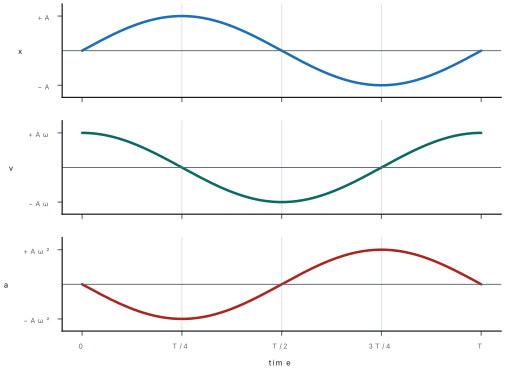
- SHM: a = -\omega^2x; v = \omega\sqrt{A^2 - x^2}; v_{max} = A\omega, a_{max} = A\omega^2; phases 0, \pi/2, \pi.
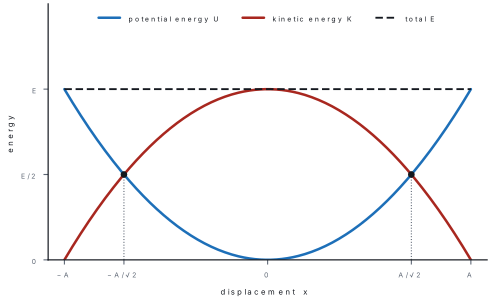
- Energy \frac{1}{2}m\omega^2A^2; KE = PE at x = A/\sqrt{2}; energy oscillates at twice the frequency.
- T = 2\pi\sqrt{l/g} and T = 2\pi\sqrt{m/k}: what each depends on, and springs in series and parallel.
- Forced oscillation and resonance: amplitude is largest when the driving frequency equals the natural frequency.
5.1 Angular quantities; centripetal acceleration and force
Angular quantities
| Quantity | Definition | SI unit | Link with linear quantity |
|---|---|---|---|
| Angular displacement \theta | angle swept by the radius: \theta = s/r | rad | arc s = r\theta |
| Angular velocity \omega | \omega = d\theta/dt; uniform: \omega = 2\pi/T = 2\pi f | rad s⁻¹ | v = r\omega |
| Angular acceleration \alpha | \alpha = d\omega/dt | rad s⁻² | tangential a_t = r\alpha |
| Time period T / frequency f | time for one revolution / revolutions per second | s / Hz | f = 1/T |
1 revolution = 2π rad = 360°. For a machine turning at N rpm, \omega = 2\pi N/60 rad s⁻¹. Hands of a clock: second hand 2\pi/60 rad s⁻¹, minute hand 2\pi/3600, hour hand 2\pi/43\,200 (ratios 60 : 1 between second and minute hands, 12 : 1 between minute and hour hands). The Earth spins at about 7.3 × 10⁻⁵ rad s⁻¹. All points of a rigid rotating body have the same \omega but speeds v = r\omega that grow with distance from the axis.
Centripetal acceleration and force
In uniform circular motion the speed is constant but the direction of the velocity changes all the time, so the body accelerates. The acceleration points along the radius towards the centre (centripetal) and has magnitude
By the second law there must be a net inward force, the centripetal force:
The centripetal force is not a new kind of force: it is whichever real force (or resultant) points to the centre — the tension in a string, friction on a turning car, gravity on a satellite, the electric pull on an electron in Bohr's atom, the normal reaction of a wall.
| In uniform circular motion | Constant? |
|---|---|
| speed, kinetic energy, angular velocity, magnitude of acceleration | yes |
| velocity, linear momentum, acceleration (directions change) | no |
| angular momentum about the centre | yes |
| work done by the centripetal force | always zero (force ⟂ velocity) |
If the speed also changes (non-uniform circular motion), there is a tangential acceleration a_t = dv/dt as well, and the total acceleration is \sqrt{a_c^2 + a_t^2}.
"Centrifugal force" mv^2/r, pointing outward, appears only to an observer in the rotating frame — it is a pseudo force, not the reaction to the centripetal force. When the string of a whirling stone breaks, the stone flies off along the tangent, not radially outward.
Problem. A 0.5 kg stone tied to a 1 m string is whirled in a horizontal circle at 2 revolutions per second. Find its speed, its acceleration and the tension (ignore gravity's effect on the string).
Solution. \omega = 2\pi f = 4\pi rad s⁻¹; v = r\omega = 4\pi = 12.6 m s⁻¹; a = \omega^2r = 16\pi^2 = 158 m s⁻²; T = ma = 79 N. Doubling the rate of turning would make the tension four times as large.
5.2 Motion in a horizontal and in a vertical circle
Horizontal circles
| Situation | Force supplying mv^2/r | Result |
|---|---|---|
| Car on a level curved road | friction, \mu mg at most | v_{max} = \sqrt{\mu rg} (independent of mass) |
| Road banked at angle \theta, no friction needed | horizontal component of the normal reaction, N\sin\theta | \tan\theta = \frac{v^2}{rg} |
| Banked road with friction \mu | normal reaction and friction together | v_{max} = \sqrt{rg\frac{\mu + \tan\theta}{1 - \mu\tan\theta}} |
| Cyclist rounding a bend | friction; he leans inward at angle \theta from the vertical | \tan\theta = \frac{v^2}{rg} |
| Conical pendulum (string length L at angle \theta to vertical) | horizontal component of tension: T\sin\theta = mv^2/r, T\cos\theta = mg | \tan\theta = \frac{v^2}{rg}; period 2\pi\sqrt{L\cos\theta/g} |
| Rider on the vertical wall of a "well of death" | normal reaction of the wall; friction \mu N holds up the weight | v_{min} = \sqrt{rg/\mu} |
Banking lets vehicles turn without depending on friction, which is why outer edges of curves on highways and railway tracks (the outer rail) are raised.
Vertical circle
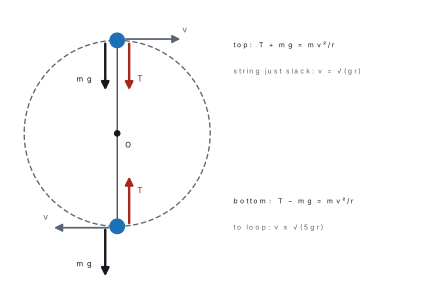
A body of mass m on a string of length r whirled in a vertical circle: gravity helps at the top and opposes at the bottom, and the speed changes around the circle (energy conservation: v_{bottom}^2 = v_{top}^2 + 4gr).
| Point of the circle (string) | Tension | Least speed to complete the loop |
|---|---|---|
| Top | T_{top} = \frac{mv_{top}^2}{r} - mg | \sqrt{gr} (string just slack, T_{top} = 0) |
| Horizontal (side) | T = \frac{mv^2}{r} | \sqrt{3gr} |
| Bottom | T_{bottom} = \frac{mv_{bottom}^2}{r} + mg | \sqrt{5gr} |
| Difference | T_{bottom} - T_{top} = 6mg (for any speed that completes the loop) |
If the body is on a light rigid rod instead of a string, the rod can push as well as pull, so the body need only reach the top: v_{top} \ge 0 and v_{bottom} \ge \sqrt{4gr} = 2\sqrt{gr}. A bucket of water swung in a vertical circle does not spill if v_{top} \ge \sqrt{gr} — at that speed the water's weight alone supplies the centripetal force.
Over a hump and through a dip. A car at the top of a convex bridge of radius r: N = mg - mv^2/r (it feels lighter), and it leaves the road when v = \sqrt{gr}. At the bottom of a dip: N = mg + mv^2/r (it presses harder). A pilot pulling out of a dive feels the same extra weight.
Problem. (g = 10 m s⁻²) (a) Find the greatest speed of a car on a level curve of radius 100 m if \mu = 0.4. (b) At what angle should a curve of radius 45 m be banked for 15 m s⁻¹? (c) A 0.2 kg stone on a 1 m string has speed 8 m s⁻¹ at the bottom of a vertical circle. Find its speed and the tension at the top, and the tension at the bottom.
Solution. (a) v = \sqrt{\mu rg} = \sqrt{400} = 20 m s⁻¹ = 72 km h⁻¹. (b) \tan\theta = 225/450 = 0.5, \theta = 26.6^{\circ}. (c) v_{top}^2 = 64 - 4(10)(1) = 24, v_{top} = 4.9 m s⁻¹ (above \sqrt{gr} = 3.2, so the loop is completed). T_{top} = 0.2(24) - 2 = 2.8 N; T_{bottom} = 0.2(64) + 2 = 14.8 N. The difference, 12 N, is 6mg.
5.3 Simple harmonic motion: displacement, velocity, acceleration, restoring force, energy, period and frequency
A body executes simple harmonic motion when its acceleration (equivalently, the restoring force on it) is directly proportional to its displacement from a fixed mean position and always directed towards that position: F = -kx, a = -\omega^2x.
The solution of a = -\omega^2x is
| Term | Meaning |
|---|---|
| A | amplitude — the greatest displacement from the mean position |
| \omega t + \phi | phase — tells the position and direction of motion at time t |
| \phi | initial phase (epoch) — the phase at t = 0 |
| \omega = \sqrt{k/m} | angular frequency (rad s⁻¹) |
| T = 2\pi/\omega | period; f = 1/T = \omega/2\pi is the frequency (Hz) |
Every SHM is periodic, but not every periodic motion is SHM (the Earth's orbit, a bouncing ball). SHM is the projection of uniform circular motion on a diameter: a point moving round a circle of radius A at angular speed \omega has a shadow on a diameter that moves exactly as x = A\sin(\omega t + \phi).
Velocity and acceleration
| At the mean position (x = 0) | At an extreme (x = \pm A) | |
|---|---|---|
| Speed | maximum, v_{max} = A\omega | zero |
| Acceleration and restoring force | zero | maximum, a_{max} = A\omega^2, F_{max} = kA |
| Kinetic energy | maximum | zero |
| Potential energy | zero (minimum) | maximum |
Phase relations: velocity leads displacement by \pi/2; acceleration leads velocity by \pi/2; acceleration and displacement are in antiphase (\pi apart). The v–x graph is an ellipse (a circle if v is plotted in units of \omega); the a–x graph is a straight line of slope -\omega^2 through the origin.
Energy in SHM
With k = m\omega^2:
The total energy is constant and proportional to the square of the amplitude and to the square of the frequency. K = U when x = A/\sqrt{2}. At x = A/2, U = E/4 and K = 3E/4. Kinetic and potential energy each vary periodically with twice the frequency of the motion (period T/2), because each reaches its maximum twice per cycle.
Problem. A particle moves as x = 0.1\sin(4\pi t) (metres, seconds). Find the amplitude, frequency, period, maximum speed and maximum acceleration.
Solution. A = 0.1 m; \omega = 4\pi rad s⁻¹, so f = \omega/2\pi = 2 Hz and T = 0.5 s. v_{max} = A\omega = 0.4\pi = 1.26 m s⁻¹; a_{max} = A\omega^2 = 1.6\pi^2 = 15.8 m s⁻².
From the mean position, the particle reaches x = A/2 in T/12 (since \sin\omega t = \frac{1}{2} at \omega t = \pi/6) and then needs another T/6 to reach x = A. It moves fastest near the middle and slowly near the ends — so a pendulum spends most of its time near the extremes.
A particle in SHM has total energy 16 J. At a displacement of half the amplitude (x = A/2), find the kinetic and potential energies.
Potential energy varies as x² and equals the total at x = A, so at A/2 it is (1/2)² = ¼ of the total: PE = 4 J, KE = 12 J. The same square law settles the favourite variants: KE = PE when x = A/√2 (≈ 0.71A, not at A/2), and at x = A/√2 the speed is vmax/√2. Most wrong answers here come from treating PE as proportional to x instead of x².
T = 2π√(l/g) contains no mass and no amplitude (for small swings): a heavier bob or a slightly wider swing does not change the period — the two most common distractors in this unit. What does change it: length, g (longer on the Moon/top of a mountain, shorter in a lift accelerating upward... where effective g becomes g + a) and, for the spring–mass system instead, the mass and the spring constant.
5.4 Simple pendulum and spring–mass system; forced oscillation and resonance
Simple pendulum
A point mass (bob) on a light, inextensible string of length l, displaced by a small angle \theta, feels a restoring force mg\sin\theta \approx mg\theta = mg\,x/l along its arc. This is SHM with \omega^2 = g/l:
valid for small amplitudes (a few degrees). T does not depend on the mass of the bob, nor (for small swings) on the amplitude — the isochronism of the pendulum. l is measured from the point of suspension to the centre of the bob.
| Change | Effect on T = 2\pi\sqrt{l/g} |
|---|---|
| Length × 4 | T × 2 (T \propto \sqrt{l}) |
| Heavier bob, same length | no change |
| On the Moon (g/6) | T \times \sqrt{6} \approx 2.45 |
| Lift accelerating up at a (or descending and slowing) | T = 2\pi\sqrt{l/(g + a)} — shorter |
| Lift accelerating down at a | T = 2\pi\sqrt{l/(g - a)} — longer |
| Freely falling lift or orbiting satellite | no restoring force: no oscillation (T \to \infty) |
| Summer (metal rod expands) | l rises, T rises: a pendulum clock loses time |
| Clock taken up Mount Everest or down a deep mine | g smaller, T longer: the clock loses time |
The seconds pendulum has a period of 2 s (each swing 1 s); its length is l = gT^2/4\pi^2 \approx 0.99 m for g = 9.8 m s⁻² (exactly 1 m if g = \pi^2 m s⁻²).
Spring–mass system
A mass m on a spring of force constant k (Hooke's law F = -kx):
- T does not depend on g: the same on the Moon, in a lift or on a slope (horizontal or vertical spring alike).
- For a vertical spring with static extension e = mg/k: T = 2\pi\sqrt{e/g}.
- To double T, put on four times the mass.
| Springs combined | Effective force constant | Period with mass m |
|---|---|---|
| Two springs k_1, k_2 in series | \frac{1}{k} = \frac{1}{k_1} + \frac{1}{k_2} (two equal: k/2) | larger (\sqrt{2}T for two equal) |
| Two springs in parallel | k = k_1 + k_2 (two equal: 2k) | smaller (T/\sqrt{2} for two equal) |
| Spring cut into n equal pieces | each piece has nk (half a spring is twice as stiff) | one piece: T/\sqrt{n} |
Problem. (a) A pendulum beats exactly 2 s on Earth. What is its period on the Moon, where g is one-sixth? (b) A 1 kg mass on a spring of force constant 400 N m⁻¹. Find the period. (c) A mass hung on a vertical spring stretches it by 9.8 cm. Find the period of vertical oscillation (g = 9.8 m s⁻²).
Solution. (a) T \propto 1/\sqrt{g}: 2\sqrt{6} = 4.9 s. (b) T = 2\pi\sqrt{1/400} = \pi/10 = 0.31 s. (c) T = 2\pi\sqrt{e/g} = 2\pi\sqrt{0.098/9.8} = 2\pi(0.1) = 0.63 s. A spring clock would keep the same time on the Moon; a pendulum clock would not.
T = 2\pi\sqrt{l/g} depends on g but not on mass; T = 2\pi\sqrt{m/k} depends on mass but not on g. Options that mix these up — "the pendulum's period doubles if the mass is doubled", "the spring's period changes on the Moon" — are the usual traps.
Damped, free and forced oscillations; resonance
- Free (natural) oscillation: a system displaced and released oscillates at its own natural frequency f_0, fixed by its build (\sqrt{k/m}/2\pi or \sqrt{g/l}/2\pi).
- Damped oscillation: friction and air resistance take energy away, so the amplitude decreases with time (the frequency stays almost the same). Shock absorbers in vehicles damp the oscillations of the springs on purpose.
- Forced oscillation: a periodic external force drives the system; after a while it oscillates at the frequency of the driving force, not at its own.
- Resonance: when the driving frequency equals (or is very close to) the natural frequency, the system absorbs energy most readily and the amplitude becomes maximum. The smaller the damping, the taller and sharper the resonance peak.
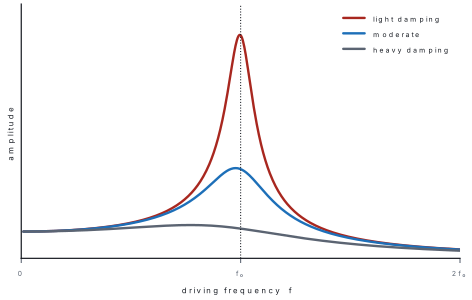
Examples of resonance: a swing pushed in step with its own rhythm goes higher and higher; soldiers break step when marching across a suspension bridge so that their rhythm cannot drive it at its natural frequency; a singer's sustained note at the right pitch can shatter a wine glass; a radio or TV set is tuned by adjusting the natural frequency of its circuit to that of the station (electrical resonance, Chapter 16); in an earthquake, buildings whose natural frequency matches the frequency of the ground shaking sway most violently.
Formula and fact sheet
| Topic | Formula or fact |
|---|---|
| Angular quantities | \theta = s/r; \omega = 2\pi/T = 2\pi f = 2\pi N/60; v = r\omega; a_t = r\alpha |
| Centripetal | a = v^2/r = \omega^2r = v\omega; F = mv^2/r; does no work |
| Level road | v_{max} = \sqrt{\mu rg} |
| Banking / cyclist / conical pendulum | \tan\theta = v^2/rg; conical pendulum T = 2\pi\sqrt{L\cos\theta/g} |
| Banked road with friction | v_{max} = \sqrt{rg(\mu + \tan\theta)/(1 - \mu\tan\theta)} |
| Hump / dip | N = mg \mp mv^2/r; leaves a hump at v = \sqrt{gr} |
| Vertical circle (string) | v_{top} \ge \sqrt{gr}, v_{side} \ge \sqrt{3gr}, v_{bottom} \ge \sqrt{5gr}; T_b - T_t = 6mg |
| Vertical circle (rod) | v_{bottom} \ge 2\sqrt{gr} |
| SHM | a = -\omega^2x; x = A\sin(\omega t + \phi); v = \omega\sqrt{A^2 - x^2} |
| SHM maxima | v_{max} = A\omega (mean position); a_{max} = A\omega^2 (extremes) |
| Phases | v leads x by \pi/2; a and x differ by \pi |
| SHM energy | E = \frac{1}{2}m\omega^2A^2 = \frac{1}{2}kA^2; K = U at A/\sqrt{2}; energies vary at 2f |
| Simple pendulum | T = 2\pi\sqrt{l/g}; seconds pendulum T = 2 s, l \approx 0.99 m; in lift g \to g \pm a |
| Spring–mass | T = 2\pi\sqrt{m/k} = 2\pi\sqrt{e/g}; series 1/k = 1/k_1 + 1/k_2; parallel k_1 + k_2; n pieces nk each |
| Resonance | driving frequency = natural frequency → maximum amplitude; less damping, sharper peak |
Chapter summary
- In uniform circular motion speed is constant but velocity is not; the acceleration v^2/r = \omega^2r points to the centre, and the centripetal force does no work.
- The centripetal force is supplied by a real force: friction on a level road (v_{max} = \sqrt{\mu rg}), the normal reaction on a banked road (\tan\theta = v^2/rg), tension, gravity.
- In a vertical circle on a string the least speeds are \sqrt{gr} at the top and \sqrt{5gr} at the bottom; the tension is greatest at the bottom, by 6mg more than at the top.
- SHM: acceleration = -\omega^2\times displacement; x = A\sin(\omega t + \phi), v = \omega\sqrt{A^2 - x^2}; speed is greatest at the mean position, acceleration at the extremes.
- Total energy \frac{1}{2}m\omega^2A^2 is constant; KE = PE at x = A/\sqrt{2}; each form of energy oscillates at twice the frequency.
- Simple pendulum T = 2\pi\sqrt{l/g} (independent of mass, depends on g); spring T = 2\pi\sqrt{m/k} (depends on mass, independent of g).
- Springs in series are softer, in parallel stiffer; half a spring is twice as stiff.
- Forced oscillations take the driver's frequency; at resonance (driving frequency = natural frequency) the amplitude is greatest, more sharply so with less damping.
Practice questions
Set A — Recall (22 questions)
- The SI unit of angular velocity isarad s⁻¹bm s⁻¹crad s⁻²drev
- For a body in uniform circular motion, the quantity that stays constant is itsavelocitybaccelerationcspeeddlinear momentum
- The centripetal acceleration of a body moving with speed v in a circle of radius r isav/rbv^{2}rcvr^{2}dv^{2}/r
- The centripetal acceleration of a body in uniform circular motion is directedaalong the tangentbtowards the centrecaway from the centredperpendicular to the plane of the circle
- The work done by the centripetal force on a body in one complete revolution isamv^{2}b2\pi rFczerod\frac{1}{2}mv^{2}
- Centrifugal force isaa pseudo force observed in a rotating framebthe reaction to the centripetal forceca real force that pulls bodies outwarddanother name for gravity
- The least speed that a stone on a string of length r must have at the highest point to complete a vertical circle isazerob\sqrt{gr}c\sqrt{3gr}d\sqrt{5gr}
- The least speed that a stone on a string of length r must have at the lowest point to complete a vertical circle isa\sqrt{2gr}b\sqrt{gr}c\sqrt{3gr}d\sqrt{5gr}
- A road is banked at angle θ so that vehicles can turn at speed v on a curve of radius r without needing friction. Thena\tan\theta = v^{2}/rgb\sin\theta = v^{2}/rgc\tan\theta = rg/v^{2}d\cos\theta = v^{2}/rg
- The greatest speed at which a car can take a level curve of radius r, if the coefficient of friction is μ, isa\mu rgb\sqrt{rg/\mu}c\sqrt{\mu rg}d\sqrt{\mu g/r}
- A motion is simple harmonic when the acceleration isaconstantbproportional to the displacement and directed towards the mean positioncproportional to the velocitydproportional to the square of the displacement
- In SHM, the speed of the particle is greatestaat the extreme positionsbhalfway between the mean and an extremecnowhere — it is constantdat the mean position
- In SHM, the acceleration of the particle is greatestaat the extreme positionsbat the mean positionchalfway between the mean and an extremednowhere — it is constant
- The phase difference between the displacement and the acceleration of a particle in SHM isazerobπ/4cπ/2dπ
- The total energy of a particle in SHM is proportional to theaamplitudebsquare of the amplitudecsquare root of the amplitudedcube of the amplitude
- The period of a simple pendulum of length l isa2\pi\sqrt{g/l}b2\pi\sqrt{l/g}c\frac{1}{2\pi}\sqrt{l/g}d2\pi lg
- The period of a mass m attached to a spring of force constant k isa2\pi\sqrt{k/m}b\frac{1}{2\pi}\sqrt{m/k}c2\pi\sqrt{mk}d2\pi\sqrt{m/k}
- The period of a seconds pendulum isa2 sb1 sc0.5 sd60 s
- Resonance occurs when the frequency of the driving forceais twice the natural frequencybis half the natural frequencycequals the natural frequency of the systemdis zero
- In a damped oscillation, with timeathe frequency increases steadilybthe amplitude decreasescthe amplitude increasesdthe total energy stays constant
- The phase difference between the velocity and the displacement of a particle in SHM isaπbzerocπ/2d2π
- The angular velocity ω of a body completing one revolution in time T isa2\pi TbT/2\pic\pi/Td2\pi/T
Answers and explanations — Set A
1. (a) — angle (radian) per second. rad s⁻² is angular acceleration.
2. (c) — the direction of motion changes all the time, so velocity, momentum and the acceleration vector change; only the speed (and KE) stay constant.
3. (d) — a = v^2/r = \omega^2r.
4. (b) — it is centre-seeking (centripetal); the velocity is along the tangent.
5. (c) — the force is perpendicular to the velocity at every instant, so it does no work in any part of the motion.
6. (a) — it is a fictitious force felt in a rotating (non-inertial) frame; the centripetal force has no outward "reaction" acting on the same body.
7. (b) — at the top the string is just slack when mg = mv^2/r, giving v = \sqrt{gr}. Zero is the answer for a rigid rod.
8. (d) — energy: v_b^2 = v_t^2 + 4gr = gr + 4gr = 5gr.
9. (a) — N\cos\theta = mg and N\sin\theta = mv^2/r; dividing, \tan\theta = v^2/rg.
10. (c) — friction supplies the centripetal force: \mu mg = mv^2/r, so v = \sqrt{\mu rg}.
11. (b) — the defining condition of SHM: a = -\omega^2x.
12. (d) — v = \omega\sqrt{A^2 - x^2} is greatest, A\omega, at x = 0.
13. (a) — |a| = \omega^2|x| is greatest, A\omega^2, at x = \pm A, where the particle is momentarily at rest.
14. (d) — a = -\omega^2x: acceleration is always opposite to displacement, a phase difference of \pi.
15. (b) — E = \frac{1}{2}m\omega^2A^2; double the amplitude, four times the energy.
16. (b) — T = 2\pi\sqrt{l/g} for small swings. (a) has l and g the wrong way round: \sqrt{l/g} has the unit of time, \sqrt{g/l} of frequency.
17. (d) — \omega = \sqrt{k/m}, so T = 2\pi/\omega = 2\pi\sqrt{m/k}.
18. (a) — a seconds pendulum takes 1 s for each swing, so its full period is 2 s.
19. (c) — at resonance the driver is in step with the natural oscillation and the amplitude is greatest.
20. (b) — resistive forces remove energy, so the amplitude dies away; the frequency changes very little.
21. (c) — v = A\omega\cos(\omega t + \phi) = A\omega\sin(\omega t + \phi + \pi/2): velocity leads displacement by \pi/2.
22. (d) — one revolution is 2\pi rad in time T, so \omega = 2\pi/T.
Set B — Understanding (14 questions)
- A car turns a corner on a level road. The centripetal force on it is provided byathe weight of the carbthe normal reaction of the roadcthe friction between the tyres and the roaddthe engine
- The speed of a body moving in a circle of fixed radius is doubled. The centripetal force needed becomesatwicebhalfcfour timesdone quarter
- For a stone whirled in a vertical circle on a string, the tension at the lowest point exceeds that at the highest point bya6mgb2mgc4mgdmg
- A pendulum clock that keeps correct time in Kathmandu is taken to the top of Mount Everest. There it willagain time, because g is smallerbkeep correct timecstop completelydlose time, because g is smaller
- A mass–spring system and a simple pendulum both have a period of 1 s on the Earth. On the Moon,aboth periods are unchangedbthe spring's period is unchanged and the pendulum's increasescthe pendulum's period is unchanged and the spring's increasesdboth periods increase
- A simple pendulum is suspended in a lift. Its period decreases when the liftamoves up with uniform velocitybaccelerates downwardcfalls freelydaccelerates upward
- A simple pendulum is suspended in a freely falling lift. It willaoscillate with its usual periodboscillate fastercnot oscillate at alldoscillate more slowly but still regularly
- In SHM of amplitude A, the kinetic and potential energies are equal at a displacement ofaA/2bA/√2cA/4dA
- The amplitude of a particle in SHM is doubled, with no other change. Its periodais unchanged and its total energy becomes four timesbdoubles and its energy doublescis halved and its energy becomes four timesdis unchanged and its energy doubles
- A mass m on a spring of force constant k oscillates with period T. The spring is cut into two equal halves and the same mass is hung from one half. The new period isa√2 Tb2TcT/√2dT/2
- A particle executes SHM with frequency f. Its kinetic energy varies periodically with frequencyaf/2bfc4fd2f
- Soldiers are ordered to break step when crossing a suspension bridge so thatathe bridge is not set into resonancebthe bridge carries less weightcthey reach the other side fasterdfriction on the bridge is reduced
- For a particle in SHM, the graph of acceleration against displacement isaa parabolaba circleca straight line of positive slope through the originda straight line of negative slope through the origin
- A car goes over the top of a convex (humped) bridge at speed v. The normal force of the road on the car there isagreater than its weightbless than its weightcequal to its weightdzero at any speed
Answers and explanations — Set B
1. (c) — on a level road only static friction acts towards the centre; that is why cars skid on wet or icy bends.
2. (c) — F = mv^2/r; doubling v makes F four times.
3. (a) — T_b = mv_b^2/r + mg, T_t = mv_t^2/r - mg and v_b^2 - v_t^2 = 4gr; subtracting gives 6mg.
4. (d) — g is smaller on the summit, so T = 2\pi\sqrt{l/g} is longer; the clock ticks fewer times per hour and loses time. (a) has the right reason but the wrong result.
5. (b) — T = 2\pi\sqrt{m/k} does not contain g; T = 2\pi\sqrt{l/g} grows when g falls.
6. (d) — accelerating upward, the effective g is g + a, so T = 2\pi\sqrt{l/(g + a)} is shorter. Uniform velocity changes nothing.
7. (c) — in free fall the effective g is zero, so there is no restoring force; the bob stays wherever it is relative to the lift.
8. (b) — \frac{1}{2}m\omega^2x^2 = \frac{1}{2}m\omega^2(A^2 - x^2) gives x^2 = A^2/2. At A/2, U is only one quarter of E.
9. (a) — the period of SHM is independent of amplitude; the energy \frac{1}{2}m\omega^2A^2 goes as A^2.
10. (c) — half a spring has force constant 2k, so T' = 2\pi\sqrt{m/2k} = T/\sqrt{2}.
11. (d) — K = \frac{1}{2}m\omega^2A^2\cos^2(\omega t) and \cos^2 repeats twice per cycle, so KE oscillates at 2f.
12. (a) — a regular marching rhythm close to the bridge's natural frequency could build up a dangerously large resonant oscillation.
13. (d) — a = -\omega^2x is a straight line through the origin with slope -\omega^2.
14. (b) — at the top, mg - N = mv^2/r, so N = mg - mv^2/r; the car feels lighter and loses contact if v reaches \sqrt{gr}.
Set C — Application (12 questions)
- A 0.5 kg stone tied to a string 1 m long is whirled in a horizontal circle at 2 revolutions per second. The tension in the string is abouta2 Nb79 Nc6.3 Nd158 N
- A car moves at 10 m s⁻¹ round a curve of radius 20 m. Its centripetal acceleration isa5 m s⁻²b2 m s⁻²c0.5 m s⁻²d200 m s⁻²
- The coefficient of friction between the tyres and a level road is 0.4. The greatest speed at which a car can take a curve of radius 100 m is (g = 10 m s⁻²)a50 m s⁻¹b4 m s⁻¹c32 m s⁻¹d20 m s⁻¹
- A curve of radius 40 m is banked at 45°. The speed at which a car can take it with no need for friction is (g = 10 m s⁻²)a400 m s⁻¹b20 m s⁻¹c14 m s⁻¹d28 m s⁻¹
- A stone tied to a string 2 m long is to be whirled in a vertical circle (g = 10 m s⁻²). The least speed it must have at the lowest point isa4.5 m s⁻¹b7.7 m s⁻¹c10 m s⁻¹d20 m s⁻¹
- A car crosses the top of a humped bridge whose radius of curvature is 40 m (g = 10 m s⁻²). It just loses contact with the road at a speed ofa20 m s⁻¹b400 m s⁻¹c6.3 m s⁻¹d40 m s⁻¹
- The displacement of a particle is x = 0.05\sin(10t) metres (t in s). Its maximum acceleration isa0.5 m s⁻²b50 m s⁻²c0.05 m s⁻²d5 m s⁻²
- A particle executes SHM of amplitude 10 cm and period π s. Its speed when it is 6 cm from the mean position isa8 cm s⁻¹b12 cm s⁻¹c16 cm s⁻¹d20 cm s⁻¹
- A 1 kg mass oscillates on a spring of force constant 400 N m⁻¹. Its period is abouta0.05 sb0.31 sc3.14 sd0.63 s
- A pendulum has a period of 2 s on the Earth. On the Moon, where g is one-sixth of its value on Earth, its period is abouta4.9 sb12 sc0.82 sd2 s
- A 0.1 kg particle executes SHM with amplitude 0.1 m and angular frequency 10 rad s⁻¹. Its total energy isa0.5 Jb0.005 Jc0.1 Jd0.05 J
- A particle in SHM has a period of 2.4 s. The least time it takes to move from the mean position to half the amplitude isa0.6 sb0.4 sc0.2 sd1.2 s
Answers and explanations — Set C
1. (b) — \omega = 2\pi f = 4\pi rad s⁻¹; T = m\omega^2r = 0.5(16\pi^2)(1) = 79 N. (c) uses \omega instead of \omega^2.
2. (a) — a = v^2/r = 100/20 = 5 m s⁻². (c) is v/r, (b) is r/v and (d) is vr; only v^2/r has the unit of acceleration.
3. (d) — v = \sqrt{\mu rg} = \sqrt{0.4\times100\times10} = 20 m s⁻¹ (72 km h⁻¹). (c) forgets \mu; (a) divides by \mu instead of multiplying.
4. (b) — v = \sqrt{rg\tan\theta} = \sqrt{40\times10\times1} = 20 m s⁻¹. (a) forgets the square root.
5. (c) — v_{min} = \sqrt{5gr} = \sqrt{5\times10\times2} = 10 m s⁻¹. (a) is \sqrt{gr}, the least speed at the top, and (b) is \sqrt{3gr}, at the side.
6. (a) — contact is lost when mg = mv^2/r: v = \sqrt{gr} = \sqrt{400} = 20 m s⁻¹.
7. (d) — A = 0.05 m, \omega = 10 rad s⁻¹; a_{max} = A\omega^2 = 0.05\times100 = 5 m s⁻². (a) is the maximum speed A\omega.
8. (c) — \omega = 2\pi/T = 2 rad s⁻¹; v = \omega\sqrt{A^2 - x^2} = 2\sqrt{100 - 36} = 16 cm s⁻¹. (a) forgets to multiply by \omega.
9. (b) — T = 2\pi\sqrt{m/k} = 2\pi\sqrt{1/400} = 2\pi/20 = 0.31 s.
10. (a) — T \propto 1/\sqrt{g}: T = 2\sqrt{6} = 4.9 s. (b) multiplies by 6 instead of \sqrt{6}; (c) divides.
11. (d) — E = \frac{1}{2}m\omega^2A^2 = \frac{1}{2}(0.1)(100)(0.01) = 0.05 J.
12. (c) — x = A\sin\omega t = A/2 at \omega t = \pi/6, i.e. t = T/12 = 2.4/12 = 0.2 s. (b) is T/6, the time from A/2 on to A.