Chapter 6 · Mechanics · 1 question in the paper · 32 min read
Gravitation
What the syllabus asks for 3
- Newton's law of gravitation; acceleration due to gravity and its variation
- Gravitational field strength, potential and potential energy
- Satellites: orbital velocity, period, energy, escape velocity, geostationary orbit
Gravitation is the one force that never switches off: it holds the Moon in its orbit, keeps your feet on the ground in Kathmandu and makes a dropped stone fall the same way everywhere on Earth. Of the 10 Mechanics questions in the Physics paper (official weightage), we estimate about 1 comes from this chapter. It is almost always a comparison rather than a calculation: g at a height against g at a depth, escape speed against orbital speed, or a "which statement is true" about the energy of a satellite. Learn the two variation formulas and the sign of the energy, and the mark is quick.
- F = Gm_1m_2/r^2 and g = GM/R^2; G = 6.67\times10^{-11} N m² kg⁻².
- Height: g_h = g\left(\frac{R}{R+h}\right)^2; depth: g_d = g\left(1-\frac{d}{R}\right) — linear, not inverse-square.
- Latitude: g_\lambda = g - R\omega^2\cos^2\lambda; least at the equator, greatest at the poles.
- Field strength GM/r^2 (N kg⁻¹); potential -GM/r (J kg⁻¹); potential energy -GMm/r.
- Orbital speed v = \sqrt{GM/r}; period T = 2\pi\sqrt{r^3/GM}, so T^2 \propto r^3.
- Satellite energy: K = GMm/2r, U = -GMm/r, E = -GMm/2r — the total is negative.
- Escape speed v_e = \sqrt{2GM/R} = \sqrt{2gR} = 11.2 km s⁻¹, and v_e = \sqrt{2}\,v_{orbital}.
- Geostationary orbit: period 24 h, above the equator, west to east, height about 36,000 km.
6.1 Newton's law of gravitation; acceleration due to gravity and its variation
The inverse-square law
Every particle of matter attracts every other particle with a force proportional to the product of their masses and inversely proportional to the square of the distance between them. The force acts along the line joining the particles.
Here m_1 and m_2 are the masses, r the distance between their centres, and G the universal gravitational constant:
In vector form, the force on m_1 due to m_2 is \vec F_{12} = -\frac{Gm_1m_2}{r^2}\hat r, where \hat r points from m_1 to m_2; the minus sign is what makes the force attractive.
| Property | Meaning |
|---|---|
| Universal | The same value of G everywhere, for every pair of masses |
| Always attractive | There is no gravitational repulsion |
| Mutual | The two forces are an action–reaction pair, equal and opposite, on different bodies |
| Central | Acts along the line joining the centres |
| Conservative | Work done depends only on the end points, so a potential energy exists |
| Independent of the medium | No medium is needed; it is not weakened by a vacuum |
| Long range, weakest | Infinite range, but about 10^{36} times weaker than the electrostatic force between two protons |
The law was stated for point masses. It also holds, exactly, for two uniform spheres with r measured between their centres — a result Newton proved with the shell theorem. That is why we may treat the whole Earth as a point at its centre.
g at the surface of a planet
For a body of mass m on the surface of a planet of mass M and radius R, the gravitational force is its weight:
So g is fixed by the planet, not by the falling body: a feather and a hammer have the same g (they fall differently only because of air resistance). With M = \frac{4}{3}\pi R^3\rho,
Two planets of the same density have surface gravities proportional to their radii.
| Body | g (m s⁻²) |
|---|---|
| Earth (mean) | 9.8 |
| Moon | 1.62 |
| Mars | 3.7 |
| Jupiter | 24.8 |
| Sun | 274 |
On the Moon g is about one-sixth of the Earth's, so a 60 kg astronaut weighs about 590 N on Earth but only 97 N on the Moon — the mass is 60 kg in both places.
Variation with altitude
At a height h above the surface the distance from the centre is R+h, so
For h \ll R we may expand:
so a small height lowers g by the fraction 2h/R. The exact formula must be used when h is comparable with R.
| Height | g_h |
|---|---|
| h = R | g/4 |
| h = 2R | g/9 |
| h = 3R | g/16 |
| h \to \infty | 0 |
Variation with depth — and the mistake almost everyone makes
At a depth d below the surface the body is at distance R-d from the centre. The temptation is to write g_d = GM/(R-d)^2, which would make g increase with depth. That is wrong: the matter outside radius R-d does not pull on the body at all, so the mass that matters is smaller too.
Shell theorem. A uniform spherical shell exerts no net gravitational force on a particle anywhere inside it. So at depth d only the sphere of radius R-d matters; the shell of thickness d outside that radius pulls equally in all directions and cancels.
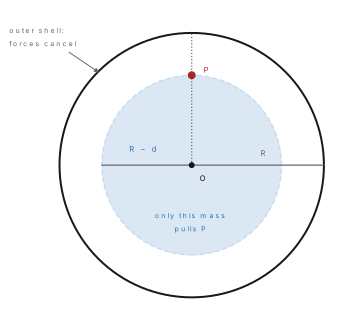
Assuming the Earth has uniform density \rho,
The variation with depth is linear: g falls steadily from g at the surface to zero at the centre.
| Depth | g_d |
|---|---|
| d = R/4 | 3g/4 |
| d = R/2 | g/2 |
| d = 3R/4 | g/4 |
| d = R | 0 |
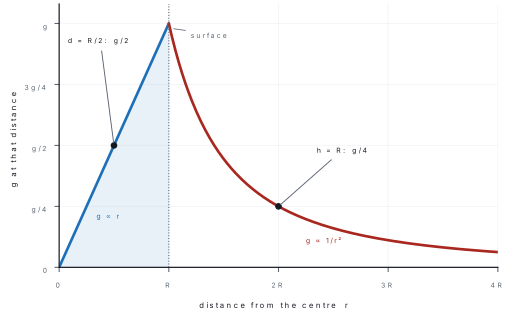
At a height h the whole Earth still pulls, so g falls as (R/(R+h))^2. At a depth d the outer shell stops pulling, so g falls as (R-d)/R. A 1 % drop needs d = 0.01R \approx 64 km but only h \approx 0.005R \approx 32 km. Any option that uses (R-d)^2 in the denominator is a distractor built on exactly this error.
The real Earth is denser at the core, so g actually stays close to 9.8 and even rises slightly down to the core–mantle boundary before falling to zero. The linear law g_d = g(1-d/R) is the one the syllabus and the paper use, and it is exact only for a uniform sphere.
Variation with latitude and the shape of the Earth
A body at latitude \lambda is not at rest in an inertial frame: it goes round the Earth's axis once a day in a circle of radius R\cos\lambda, with angular speed \omega = 2\pi/(24\times3600) = 7.27\times10^{-5} rad s⁻¹. Part of gravity must supply this centripetal acceleration, which points towards the axis. Resolving along the local vertical gives the effective value:
- At the poles (\lambda = 90^{\circ}): \cos\lambda = 0, so g is unchanged — maximum.
- At the equator (\lambda = 0^{\circ}): the reduction is greatest, R\omega^2 \approx 0.034 m s⁻².
The Earth is also slightly oblate — the equatorial radius (6378 km) is larger than the polar radius (6357 km) — which lowers g at the equator further. The two effects together give about 9.78 m s⁻² at the equator and 9.83 m s⁻² at the poles. A body taken from the equator to a pole therefore loses a little weight but keeps its mass.
Problem. Taking R = 6400 km, at what depth and at what height is g less than its surface value by 1 %?
Solution. Depth: g_d = g(1-d/R), so d/R = 0.01 and d = 0.01\times6400 = 64 km.
Height: g_h = g(R/(R+h))^2. For a 1 % drop, R/(R+h) = \sqrt{0.99} = 0.995, so h = 6400(1/0.995 - 1) = 32.2 km. The approximation 2h/R = 0.01 gives the same 32 km.
The height needed is half the depth: near the surface the inverse-square fall is twice as fast as the linear one.
Problem. A student of mass 70 kg is weighed at the equator and at a pole. Taking R = 6.4\times10^6 m and the rotation period as 24 h, find the difference in weight caused by the Earth's rotation alone.
Solution. \omega = 2\pi/T = 2\pi/86400 = 7.27\times10^{-5} rad s⁻¹.
At the equator the reduction is R\omega^2 = (6.4\times10^6)(7.27\times10^{-5})^2 = 0.034 m s⁻².
So \Delta W = m\Delta g = 70\times0.034 = 2.4 N. The weight at the pole is about 686 N, so rotation changes it by only 0.35 % — a real effect, but a small one. The rest of the pole–equator difference comes from the Earth's flattening.
Height: square in the denominator — falls fast, g/4 at h = R. Depth: linear — falls slowly, zero at the centre. Latitude: cosine squared — no effect at the poles, largest at the equator.
6.2 Gravitational field strength, potential and potential energy
Field strength
The gravitational field strength at a point is the gravitational force per unit mass placed there:
Its magnitude is GM/r^2 and its SI unit is N kg⁻¹, which is identical to m s⁻² — the field strength is the local acceleration of free fall. Near the Earth's surface it is 9.8 N kg⁻¹ downwards.
Field lines point towards the mass, radially. Their density shows the strength: close to the Earth the lines are crowded, far away they are spread out. Field lines never cross (a point cannot have two directions of force), and they are perpendicular to the equipotential surfaces.
"Do not confuse GM/r^2 with GM/r." The field is force per unit mass (N kg⁻¹) and falls as 1/r^2; the potential is energy per unit mass (J kg⁻¹) and falls as 1/r. At the surface, E_g = g = 9.8 N kg⁻¹ while V = -gR = -6.3\times10^7 J kg⁻¹.
Potential
The gravitational potential at a point is the work done per unit mass by an external agent in bringing a small test mass from infinity to that point, without acceleration.
The zero is chosen at infinity. Because gravity attracts, the agent does negative work as the mass comes in from infinity, so V is negative everywhere at a finite distance and rises towards zero at infinity.
| Quantity | Expression | Unit | Sign |
|---|---|---|---|
| Field strength | GM/r^2 | N kg⁻¹ | magnitude, direction towards M |
| Potential | -GM/r | J kg⁻¹ | always negative |
| Potential energy of m | -GMm/r | J | always negative |
The field is the negative gradient of the potential:
so on a graph of V against r the field is minus the slope. Moving along an equipotential surface requires zero work, because the displacement is perpendicular to the force.
Potential energy
The change in potential energy when a mass moves from r_1 to r_2 is
Moving away from the Earth (r_2 > r_1) makes \Delta U positive: the external agent must do work. Moving towards the Earth makes it negative: gravity does the work.
For a small height h above the surface, put r_1 = R and r_2 = R+h:
So the familiar mgh is only the near-surface approximation of -GMm/r. It fails when h is a large fraction of R.
Sign conventions that decide the answer
- U = 0 at infinity, and U is negative at every finite distance.
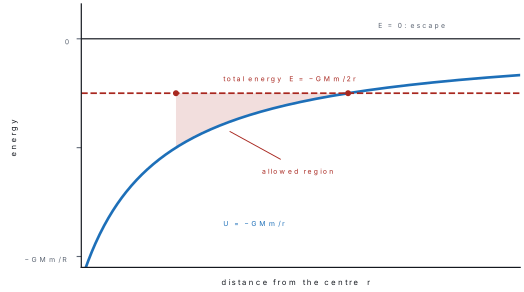
- A bound body (a satellite, the Moon) has negative total energy.
- "Increases" always means becomes less negative when a body moves outward.
- The work done by gravity is -\Delta U; the work done by an external agent is +\Delta U. The paper often asks for one and offers the other.
Field and potential inside a sphere
| Region | Field | Potential |
|---|---|---|
| Inside a thin shell | 0 | constant, -GM/R (same as the surface) |
| Inside a uniform solid sphere, radius r | GMr/R^3 | -\frac{GM}{2R^3}(3R^2 - r^2) |
| At the centre of a solid sphere | 0 | -3GM/2R (minimum) |
Inside a shell the field is zero but the potential is not zero: no force is needed to move about inside, yet work was needed to bring the mass from infinity to the shell. This distinction is a favourite "which statement is true" question.
| Distance from the centre | E_g (N kg⁻¹) | V (J kg⁻¹) |
|---|---|---|
| R (surface) | 9.8 | -6.3\times10^7 |
| 2R | 2.45 | -3.1\times10^7 |
| 3R | 1.09 | -2.1\times10^7 |
| \infty | 0 | 0 |
Doubling the distance quarters the field but only halves the magnitude of the potential — the 1/r^2 against 1/r difference again.
Problem. A body of mass 5 kg is on the Earth's surface (R = 6400 km, g = 9.8 m s⁻²). Find (i) the potential and field at a distance 2R from the centre, and (ii) the work needed to take the body from the surface to that point.
Solution. With GM = gR^2:
(i) V = -GM/(2R) = -gR/2 = -(9.8)(6.4\times10^6)/2 = -3.1\times10^7 J kg⁻¹. E_g = GM/(2R)^2 = g/4 = 2.45 N kg⁻¹, towards the Earth.
(ii) U_1 = -GMm/R = -mgR = -(5)(9.8)(6.4\times10^6) = -3.14\times10^8 J. U_2 = -GMm/2R = -1.57\times10^8 J. Work by the agent = U_2 - U_1 = 1.57\times10^8 J.
Note that mgh would give 5\times9.8\times6.4\times10^6 = 3.14\times10^8 J — twice the true answer, because h = R is not small.
6.3 Satellites: orbital velocity, period, energy, escape velocity, geostationary orbit
A satellite stays in a circular orbit because gravity supplies exactly the centripetal force it needs. There is no "centrifugal force" pushing it out; the single force is the pull of the Earth, directed to the centre.
Orbital velocity
For a satellite of mass m in a circular orbit of radius r (measured from the Earth's centre) at speed v:
The mass of the satellite cancels: a 1 kg CubeSat and a 400-tonne space station at the same radius move at the same speed. Near the surface (r \approx R),
Higher orbits are slower: v \propto 1/\sqrt{r}.
Newton's cannonball. Fire a ball horizontally from a very high mountain. It lands a short way off; fired faster, it lands farther; at 7.9 km s⁻¹ the ground curves away as quickly as the ball falls and it never lands. An orbit is not a place where gravity is absent — it is a fall that never reaches the ground.
Period
The satellite covers 2\pi r in one period T, so v = 2\pi r/T:
Squaring, T^2 = \frac{4\pi^2}{GM}r^3, so
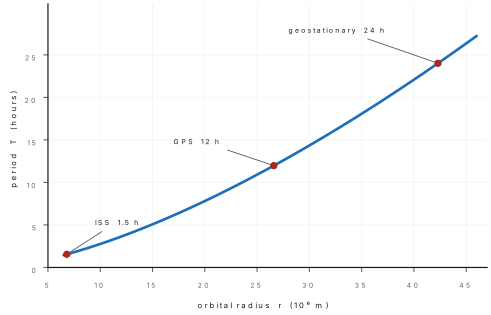
which is Kepler's third law. For a satellite skimming the surface, T = 2\pi\sqrt{R/g} = 84.6 min — the lowest possible orbital period around the Earth.
| Orbit | Radius | Period |
|---|---|---|
| Surface-skimming | R | 84.6 min |
| 400 km (ISS) | 1.06R | about 1.5 h |
| GPS | 26\,600 km | about 12 h |
| Geostationary | 42\,200 km | 24 h |
| Moon | 3.84\times10^8 m | 27.3 days |
Energy of a satellite
Three relations follow at once, and the paper uses all three:
- The total energy is negative: the satellite is bound.
- The binding energy — the energy needed to remove it to infinity — is +GMm/2r.
- As r increases, K and the magnitude of U both decrease, but E becomes less negative, that is, it increases. Moving a satellite to a higher orbit costs energy even though it ends up moving more slowly.
Students remember "higher is slower" and then conclude "higher has less energy". Both statements are true but about different quantities: K decreases, E increases. To lift a satellite from r_1 to r_2 the rocket must supply \frac{GMm}{2}\left(\frac{1}{r_1}-\frac{1}{r_2}\right).
Escape velocity
The escape velocity is the minimum speed at the surface needed to just reach infinity. At infinity both K and U are zero, so the total energy at launch must be at least zero:
For the Earth, v_e = \sqrt{2(9.8)(6.4\times10^6)} = 1.12\times10^4 m s⁻¹ = 11.2 km s⁻¹.
| Feature | Orbital speed | Escape speed |
|---|---|---|
| Formula | \sqrt{GM/r} | \sqrt{2GM/R} |
| Earth value | 7.9 km s⁻¹ | 11.2 km s⁻¹ |
| Depends on | radius of the orbit | mass and radius of the planet |
| Depends on satellite mass | no | no |
| Direction | along the orbit | any direction (ignoring air and rotation) |
Since v_e = \sqrt{2}\,\sqrt{GM/R} = \sqrt{2}\,v_{orb} at the surface, the escape speed is 1.414 times the orbital speed. That ratio \sqrt{2} is one of the most reliable one-mark questions in the chapter.
Escape speed does not depend on the mass of the escaping body, and (in the idealised problem) not on the direction of projection — a stone thrown horizontally at 11.2 km s⁻¹ escapes just as a vertical one does, though the ground gets in the way.
Geostationary orbit
A geostationary satellite stays above the same point of the Earth. For that it must satisfy three conditions:
- Period 24 h — actually one sidereal day, 23 h 56 min 4 s, the time for one rotation relative to the stars.
- Above the equator — an orbit over any other latitude would drift north and south.
- West to east, the same sense as the Earth's rotation.
Putting T = 86400 s into r = (GMT^2/4\pi^2)^{1/3} gives r = 4.22\times10^7 m, so the height above the surface is
There is only one geostationary radius, so all such satellites share a single ring — the geostationary belt. Their orbital speed is about 3.1 km s⁻¹. They are used for television, telephone and weather satellites, because a dish on the ground can be fixed pointing at one spot.
| Geostationary | Polar (sun-synchronous) | |
|---|---|---|
| Orbit | equatorial, circular | passes over the poles |
| Period | 24 h | about 90–100 min |
| Height | 36,000 km | 600–1000 km |
| Ground track | fixed point | whole Earth as it turns |
| Used for | communication, weather | remote sensing, mapping, spy satellites |
Why launches go east, and from low latitudes
A point on the equator is already moving east at R\omega = 465 m s⁻¹ because of the Earth's rotation (check: 6.4\times10^6 \times 7.27\times10^{-5}). A rocket launched eastward from near the equator starts with that speed for free, so it needs less fuel to reach 7.9 km s⁻¹. A launch from a higher latitude gets less help (the speed is 465\cos\lambda m s⁻¹), and a polar launch gets none at all. This is why space agencies build launch sites as close to the equator as they can, and why almost all communication satellites are launched eastward.
Weightlessness in orbit
An astronaut in the International Space Station is not outside gravity: at 400 km, g = 9.8(6400/6800)^2 = 8.7 m s⁻², only 11 % less than on the ground. The station and the astronaut are both falling freely with the same acceleration, so the floor never pushes on them. The normal reaction is zero, and that is what "weightlessness" means. The same thing happens for a few seconds in a lift whose cable snaps.
Problem. A satellite orbits at a height 2R above the Earth's surface (R = 6400 km, g = 9.8 m s⁻²). Find its orbital speed and period.
Solution. Here r = 3R, so v = \sqrt{GM/3R} = \sqrt{gR/3} = 7.9/\sqrt{3} = 4.6 km s⁻¹.
T = 2\pi\sqrt{(3R)^3/GM} = 2\pi\sqrt{27R/g} = 84.6\sqrt{27} min = 84.6\times5.20 = 440 min \approx 7.3 h.
Check with Kepler: the surface-skimming period is 84.6 min at r = R; at r = 3R the period is 3^{3/2} = 5.2 times larger.
Problem. A planet has twice the mass and half the radius of the Earth. Find its escape speed in terms of the Earth's 11.2 km s⁻¹.
Solution. v_e \propto \sqrt{M/R}, so
The escape speed is 2\times11.2 = 22.4 km s⁻¹. A smaller radius more than makes up for the larger mass, because the body starts deeper in the potential well.
Formula and fact sheet
| Topic | Formula or fact |
|---|---|
| Newton's law | F = Gm_1m_2/r^2, attractive, along the joining line |
| Gravitational constant | G = 6.67\times10^{-11} N m² kg⁻²; [M^{-1}L^3T^{-2}] |
| Surface gravity | g = GM/R^2 = \frac{4}{3}\pi G\rho R |
| Height | g_h = g(R/(R+h))^2 \approx g(1-2h/R); h=R \Rightarrow g/4 |
| Depth | g_d = g(1-d/R); d=R \Rightarrow 0; d=R/2 \Rightarrow g/2 |
| Latitude | g_\lambda = g - R\omega^2\cos^2\lambda; equator least, poles greatest |
| Field strength | E_g = GM/r^2, N kg⁻¹; E_g = -dV/dr |
| Potential | V = -GM/r, J kg⁻¹; zero at infinity; -gR at the surface |
| Potential energy | U = -GMm/r; \Delta U = GMm(1/r_1 - 1/r_2); mgh if h \ll R |
| Inside a shell | E_g = 0, V = -GM/R (constant) |
| Inside a solid sphere | E_g = GMr/R^3; V = -\frac{GM}{2R^3}(3R^2-r^2) |
| Orbital speed | v = \sqrt{GM/r} = \sqrt{gR^2/r}; 7.9 km s⁻¹ at the surface |
| Period | T = 2\pi\sqrt{r^3/GM}; T^2 \propto r^3; 84.6 min at the surface |
| Satellite energy | K = GMm/2r, U = -GMm/r, E = -GMm/2r = -K |
| Binding energy | GMm/2r |
| Escape speed | v_e = \sqrt{2GM/R} = \sqrt{2gR}; 11.2 km s⁻¹; v_e = \sqrt{2}v_{orb} |
| Geostationary | T = 24 h, equatorial, west→east, h \approx 36{,}000 km, v \approx 3.1 km s⁻¹ |
| Useful numbers | R = 6.4\times10^6 m; M = 6\times10^{24} kg; GM = gR^2 = 4.0\times10^{14} m³ s⁻² |
Chapter summary
- Every mass attracts every other with F = Gm_1m_2/r^2; the force is always attractive, mutual, central and conservative.
- Surface gravity is g = GM/R^2; it belongs to the planet, not to the falling body.
- With height g_h = g(R/(R+h))^2 (inverse square); with depth g_d = g(1-d/R) (linear, because the outer shell pulls equally all round). g is zero at the centre.
- Rotation reduces g most at the equator: g_\lambda = g - R\omega^2\cos^2\lambda; the poles have the largest g and the equator the smallest.
- Field strength GM/r^2 is a vector in N kg⁻¹; potential -GM/r is a scalar in J kg⁻¹, zero at infinity and negative everywhere else.
- Potential energy is -GMm/r; mgh is only its near-surface approximation. The work by an external agent is +\Delta U.
- Orbital speed \sqrt{GM/r} and period 2\pi\sqrt{r^3/GM}: higher orbits are slower, and T^2 \propto r^3.
- Satellite energy: K = GMm/2r, U = -GMm/r, E = -GMm/2r. The total is negative and equals -K; raising the orbit increases E but decreases K.
- Escape speed \sqrt{2GM/R} = 11.2 km s⁻¹ is \sqrt{2} times the surface orbital speed and is independent of the body's mass.
- A geostationary satellite needs 24 h, the equatorial plane and west-to-east motion; its height is about 36,000 km.
Practice questions
Set A — Recall (20 questions)
- The SI unit of gravitational potential isaJ kg⁻¹bN kg⁻¹cJ kgdN m² kg⁻²
- The value of the universal gravitational constant in SI units isa9.8 N m² kg⁻²b6.67 × 10⁻¹¹ N kg⁻¹c6.02 × 10²³ N m² kg⁻²d6.67 × 10⁻¹¹ N m² kg⁻²
- At the centre of the Earth, the value of the acceleration due to gravity isamaximumbequal to its surface valueczerodinfinite
- At a depth d below the Earth's surface, the acceleration due to gravity isag(1-2d/R)bg(R/(R-d))^2cg\sqrt{1-d/R}dg(1-d/R)
- The gravitational potential at infinity is taken to beazerob-GM/Rcinfinited+GM/R
- The escape velocity from the Earth's surface is abouta7.9 km s⁻¹b11.2 km s⁻¹c2.4 km s⁻¹d3.0 × 10⁸ m s⁻¹
- For a satellite in a circular orbit close to the Earth's surface, the ratio of escape speed to orbital speed isa1b2c√2d1/√2
- The period of a geostationary satellite isa12 hb24 hc1 hd365 days
- The height of a geostationary satellite above the Earth's surface is abouta3600 kmb36,000 kmc360 kmd3,60,000 km
- The total energy of a satellite of mass m in a circular orbit of radius r isaGMm/2rb-GMm/2rc-GMm/rdGMm/r
- Which of the following forces is conservative?africtionbair resistancecgravitational forcedthrust of a rocket
- The SI unit of gravitational field strength isaN kg⁻¹bJ kg⁻¹cN m² kg⁻²dkg N⁻¹
- If M is the mass and R the radius of the Earth, the acceleration due to gravity at its surface isaGM/RbGM/R^2cGM^2/RdGMR^2
- Compared with its value at the poles, the value of g at the equator isagreaterbthe samecsmallerdzero
- Kepler's third law for satellites states thataT^2 \propto r^3bT \propto rcT^2 \propto rdT^3 \propto r^2
- The gravitational potential energy of two point masses separated by a distance r isa-Gm_1m_2/rb+Gm_1m_2/rc-Gm_1m_2/r^2dGm_1m_2r
- The work done in moving a mass along an equipotential surface isamghbinfinitecequal to the potentialdzero
- For a satellite in a circular orbit, the potential energy U and kinetic energy K are related byaU = KbU = 2KcU = -2KdU = -K/2
- The escape velocity of a body from the Earth depends onaits massbthe direction of projectioncthe mass and radius of the Earthdits mass and direction of projection
- The value of g at a height equal to the Earth's radius isag/2bg/4cg/8dg/9
Answers and explanations — Set A
1. (a) — potential is work per unit mass, J kg⁻¹. N kg⁻¹ is field strength, and N m² kg⁻² is G.
2. (d) — G = 6.67\times10^{-11} N m² kg⁻². The value 9.8 is g (a local acceleration), and option (b) carries the wrong units for G.
3. (c) — at the centre the mass inside the body's radius is zero, so by the shell theorem the pull is zero.
4. (d) — only the sphere of radius R-d pulls, giving g(R-d)/R = g(1-d/R). Option (b) is the common error of applying the height formula downwards.
5. (a) — the zero of potential is chosen at infinity; at every finite distance it is negative.
6. (b) — \sqrt{2gR} = \sqrt{2(9.8)(6.4\times10^6)} = 11.2 km s⁻¹. 7.9 km s⁻¹ is the orbital speed.
7. (c) — v_e/v_{orb} = \sqrt{2GM/R}\div\sqrt{GM/R} = \sqrt{2}.
8. (b) — geostationary means "fixed relative to the ground", which needs one rotation per day, 24 h.
9. (b) — the orbital radius is 42,200 km, so the height above the 6400 km radius is about 36,000 km.
10. (b) — E = K + U = GMm/2r - GMm/r = -GMm/2r.
11. (c) — gravity depends only on position, so the work it does is path-independent. Friction, drag and rocket thrust are not.
12. (a) — field strength is force per unit mass, N kg⁻¹, numerically equal to m s⁻².
13. (b) — weight mg = GMm/R^2 gives g = GM/R^2.
14. (c) — rotation supplies part of the centripetal acceleration at the equator, and the equatorial radius is larger; both reduce g there.
15. (a) — T^2 = (4\pi^2/GM)r^3 for every satellite about the same central mass.
16. (a) — with zero at infinity the energy is -Gm_1m_2/r; the positive sign would mean repulsion.
17. (d) — the displacement is perpendicular to the field, so \vec F\cdot\vec s = 0 everywhere along the path.
18. (c) — U = -GMm/r and K = GMm/2r, so U = -2K. Equivalently E = -K.
19. (c) — v_e = \sqrt{2GM/R} contains only the planet's mass and radius; the body's mass cancels and the direction does not enter.
20. (b) — g_h = g(R/(R+R))^2 = g/4.
Set B — Understanding (13 questions)
- At a height equal to the Earth's radius g is g/4. At a depth equal to the Earth's radius it isazerobg/4cg/2dinfinite
- Two satellites of different masses move in the same circular orbit. They have the sameakinetic energy and the same speedbkinetic energy but different speedscperiod and different speedsdspeed but different kinetic energies
- Which statement about a satellite in a circular orbit is TRUE?aits kinetic energy is negativebits total energy is negativecits potential energy is positivedits total energy is zero
- As a satellite moves from a lower circular orbit to a higher one, itsaspeed and total energy both increasebspeed increases and total energy decreasescspeed and total energy both decreasedspeed decreases and total energy increases
- The weightlessness felt by an astronaut in an orbiting spacecraft is becauseag is zero in spacebthere is no gravity beyond the atmospherecthe spacecraft moves at the escape speeddthe spacecraft and the astronaut fall together with the same acceleration
- If the Earth shrank to half its present radius with no change in mass, g at its new surface would bea4gb2gcg/2dunchanged
- At what depth below the Earth's surface is g half its surface value?aR/4bR/√2cR/2dR
- At what height above the surface is g half its surface value? (R = Earth's radius)aR/2b(√2 − 1)Rc2RdR
- At the centre of a uniform solid sphere the gravitational field is zero, but the gravitational potential there isazerobminimumcmaximumdinfinite
- The escape velocity from the Moon is much smaller than from the Earth mainly because the Moon hasano atmosphereba longer daycsmaller mass and radiusda smaller orbital speed
- If the radius of a satellite's circular orbit is doubled, its period becomesa2 timesb√2 timesc4 timesd2√2 times
- The gravitational potential at a point inside a thin spherical shell isazerobinversely proportional to the distance from the centrecconstant and equal to its value at the surfaceddirectly proportional to the distance from the centre
- A body is projected vertically upward with a speed equal to half the escape velocity. The maximum height reached is (R = Earth's radius)aR/3bR/4cR/2dR
Answers and explanations — Set B
1. (a) — the depth formula is g(1-d/R); at d = R it gives zero. The height case keeps the whole Earth pulling, so it only falls to g/4.
2. (d) — v = \sqrt{GM/r} has no mass in it, so the speeds are equal; K = GMm/2r is proportional to the satellite's mass, so the kinetic energies differ.
3. (b) — E = -GMm/2r is negative for every bound orbit. K is positive and U is negative, so (a) and (c) are impossible.
4. (d) — v \propto 1/\sqrt{r} falls, while E = -GMm/2r becomes less negative, that is, it rises.
5. (d) — g at 400 km is still 8.7 m s⁻²; the astronaut floats because both craft and astronaut are in free fall, so the normal reaction vanishes.
6. (a) — g = GM/R^2; halving R multiplies g by 1/(1/2)^2 = 4.
7. (c) — 1-d/R = 1/2 gives d = R/2. The linear law makes this exact.
8. (b) — R/(R+h) = 1/\sqrt{2} gives R+h = R\sqrt{2}, so h = (\sqrt{2}-1)R.
9. (b) — V = -3GM/2R at the centre, more negative than the surface value -GM/R; the potential is least (most negative) there.
10. (c) — v_e = \sqrt{2GM/R}; the Moon's M is 1/81 and R about 1/3.7 of the Earth's, so v_e falls to 2.4 km s⁻¹. The absence of an atmosphere is a consequence, not the cause.
11. (d) — T \propto r^{3/2}, so doubling r multiplies T by 2^{3/2} = 2\sqrt{2}.
12. (c) — inside a shell the field is zero, so the potential does not change with position; it keeps the surface value -GM/R.
13. (a) — energy: \frac{1}{2}(v_e/2)^2 = \frac{1}{4}\frac{GM}{R}. Then \frac{GM}{R}-\frac{GM}{R+h} = \frac{GM}{4R}, giving R+h = 4R/3 and h = R/3.
Set C — Application (10 questions)
- Taking R = 6400 km, the value of g at a height of 1600 km is abouta7.8 m s⁻²b4.9 m s⁻²c6.3 m s⁻²d8.7 m s⁻²
- Taking R = 6400 km, at what depth is g 1 % less than at the surface?a32 kmb128 kmc640 kmd64 km
- Taking R = 6400 km, at what height is g approximately 1 % less than at the surface?a64 kmb32 kmc128 kmd640 km
- A planet has four times the mass and four times the radius of the Earth. Its escape velocity isa11.2 km s⁻¹b5.6 km s⁻¹c22.4 km s⁻¹d44.8 km s⁻¹
- The orbital speed of a satellite at a height equal to half the Earth's radius (R = 6400 km, g = 9.8 m s⁻²) is abouta5.6 km s⁻¹b7.9 km s⁻¹c6.5 km s⁻¹d9.8 km s⁻¹
- A satellite orbits at a height equal to the Earth's radius. Its period is abouta2 hb4 hc8 hd24 h
- The energy needed to lift a 100 kg body from the Earth's surface to a height equal to the Earth's radius is about (R = 6400 km, g = 9.8 m s⁻²)a6.3 × 10⁹ Jb1.6 × 10⁹ Jc6.3 × 10⁸ Jd3.1 × 10⁹ J
- The escape velocity from the Moon (M = 7.35 × 10²² kg, R = 1.74 × 10⁶ m, G = 6.67 × 10⁻¹¹ N m² kg⁻²) is abouta1.2 km s⁻¹b2.4 km s⁻¹c4.8 km s⁻¹d11.2 km s⁻¹
- Taking GM = 4.0 × 10¹⁴ m³ s⁻², the radius of a geostationary orbit is abouta4.2 × 10⁷ mb3.6 × 10⁷ mc6.4 × 10⁶ md1.4 × 10⁸ m
- A 500 kg satellite orbits at a distance 2R from the Earth's centre (R = 6400 km, g = 9.8 m s⁻²). Its total energy isa+7.8 × 10⁹ Jb−1.6 × 10¹⁰ Jc−7.8 × 10⁹ Jd−3.9 × 10⁹ J
Answers and explanations — Set C
1. (c) — r = 6400+1600 = 8000 km, so g_h = 9.8(6400/8000)^2 = 9.8(0.64) = 6.3 m s⁻². This is g/1.5625, not g/2.
2. (d) — d = 0.01R = 64 km. The linear depth law puts the 1 % point twice as deep as the height law does.
3. (b) — 2h/R = 0.01 gives h = 32 km (exactly 32.2 km). Option (a) is the depth answer — the classic swap.
4. (a) — v_e \propto \sqrt{M/R}; both M and R are multiplied by 4, so the ratio is \sqrt{4/4} = 1 and v_e is unchanged at 11.2 km s⁻¹.
5. (c) — r = 1.5R, so v = \sqrt{gR^2/1.5R} = \sqrt{gR/1.5} = 7.9/1.225 = 6.5 km s⁻¹.
6. (b) — T = 84.6\sqrt{2^3} = 84.6\times2.83 = 239 min = 4.0 h.
7. (d) — \Delta U = GMm(1/R - 1/2R) = mgR/2 = 100(9.8)(3.2\times10^6) = 3.1\times10^9 J. Using mgh with h = R would double it.
8. (b) — v_e = \sqrt{2GM/R} = \sqrt{2(6.67\times10^{-11})(7.35\times10^{22})/1.74\times10^6} = \sqrt{5.6\times10^6} = 2.4 km s⁻¹.
9. (a) — r = (GMT^2/4\pi^2)^{1/3} = (4.0\times10^{14}(86400)^2/39.5)^{1/3} = 4.2\times10^7 m. Option (b) is the height above the surface, not the radius.
10. (c) — E = -GMm/2r = -mgR^2/(2)(2R) = -mgR/4 = -(500)(9.8)(6.4\times10^6)/4 = -7.8\times10^9 J.