Chapter 20 · Modern Physics · 3 questions in the paper · 29 min read
Nuclear Physics and Radioactivity
What the syllabus asks for 4
- The nucleus: charge, size, mass and density; mass defect, binding energy per nucleon and E = mc²
- Nuclear fission and fusion
- Radioactivity: alpha, beta and gamma rays; the decay law, half-life and mean life; carbon dating
- Medical uses of nuclear radiation and its health hazards
Nuclear physics is the heaviest chapter of Modern Physics: the area carries 12 of the 50 Physics questions, and we estimate about 3 come from here — more than any other modern topic. The paper asks for the size and density of a nucleus, a mass defect or binding-energy calculation, the difference between fission and fusion, the three radiations, and — above all — the half-life. The half-life questions are the easiest marks in the chapter if you count in halves rather than reach for the exponential, and the easiest to lose if you forget that a half-life does not change with temperature, pressure or chemical combination.
- R = R_0A^{1/3} with R_0 \approx 1.2 fm, and why nuclear density is the same for every nucleus.
- Mass defect, \Delta E = \Delta m\,c^2, and the conversion 1 u = 931.5 MeV.
- The binding-energy-per-nucleon curve: peak at iron, fission of heavy nuclei, fusion of light nuclei.
- Fission and fusion, one example of each, and why each releases energy.
- Alpha, beta and gamma: charge, mass, penetration, ionising power, deflection in a field.
- N = N_0e^{-\lambda t}, T_{1/2} = 0.693/\lambda, \tau = 1/\lambda, activity A = \lambda N.
- Carbon dating as a half-life calculation.
- Medical uses (diagnosis vs therapy) and the hazards of ionising radiation.
20.1 The nucleus: charge, size, mass and density; mass defect, binding energy and E = mc²
What is inside the nucleus
A nucleus of element X is written ^{A}_{Z}X, where Z is the atomic number (the number of protons) and A the mass number (protons + neutrons). The neutrons number N = A - Z. Protons and neutrons together are nucleons.
| Property | Value or rule |
|---|---|
| Charge | +Ze; the electron cloud carries -Ze, so the atom is neutral |
| Radius | R = R_0A^{1/3}, R_0 \approx 1.2 fm (1\ \text{fm} = 10^{-15} m) |
| Volume | \frac{4}{3}\pi R^3 = \frac{4}{3}\pi R_0^3A \propto A |
| Density | \rho = \dfrac{3m}{4\pi R_0^3} \approx 2.3\times10^{17} kg m⁻³ |
| Mass of proton | 1.007276 u = 938.3 MeV/c^2 |
| Mass of neutron | 1.008665 u = 939.6 MeV/c^2 |
| Mass of electron | 0.000549 u = 0.511 MeV/c^2 |
The key point about the radius formula is the cube root. If A becomes eight times larger, the radius only doubles. So the volume is proportional to A, and the density is the same for every nucleus — about 2.3\times10^{17} kg m⁻³, some 10^{14} times the density of water. A teaspoon of nuclear matter would weigh about a billion tonnes.
The formula gives the radius. A question that asks for the diameter wants 2R_0A^{1/3}. And R_0 is about 1.2 fm; if a question gives 1.1 or 1.3 fm, use the value given.
Problem. Find the radius and density of a ^{238}U nucleus (R_0 = 1.2 fm).
Solution. A^{1/3} = 238^{1/3} = 6.20, so R = 1.2\times6.20 = 7.4 fm. Density \rho = \dfrac{3(1.66\times10^{-27})}{4\pi(1.2\times10^{-15})^3} = 2.3\times10^{17} kg m⁻³. The same answer comes from any nucleus — that is the point of R \propto A^{1/3}.
Mass defect and binding energy
A nucleus weighs less than the sum of its separate protons and neutrons. The missing mass is the mass defect:
The missing mass has become binding energy, the energy that would be needed to pull the nucleus apart:
This is Einstein's mass–energy relation E = mc^2 applied to the nucleus: mass and energy are two forms of the same thing, related by the square of the speed of light. A mass of 1 u corresponds to
so the practical rule is energy in MeV = mass defect in u × 931.5.
When atomic masses are used instead of nuclear masses, the electron masses cancel if you use the mass of the hydrogen atom in place of the proton:
Setting up. A ^4He nucleus has 2 protons and 2 neutrons. m_H = 1.007825 u, m_n = 1.008665 u, and the atomic mass of ^4He is 4.002603 u.
Step 1 — mass of the separate parts. 2(1.007825) + 2(1.008665) = 2.015650 + 2.017330 = 4.032980 u.
Step 2 — mass defect. \Delta m = 4.032980 - 4.002603 = 0.030377 u.
Step 3 — convert to energy. E_b = 0.030377 \times 931.5 = 28.3 MeV.
Step 4 — per nucleon. 28.3/4 = 7.07 MeV per nucleon.
What it means. Each nucleon in helium is bound by about 7 MeV, which is why helium is unusually stable for such a light nucleus.
The binding-energy-per-nucleon curve
Plot E_b/A against A and you get the most important graph in nuclear physics.
- It rises steeply for the lightest nuclei: deuterium 1.1, helium-4 7.07, carbon-12 7.68, oxygen-16 7.98 MeV per nucleon.
- It reaches a broad maximum of about 8.8 MeV near iron-56 (and nickel-62 is marginally higher — the difference is small and not examinable).
- It then falls slowly for heavy nuclei: lead about 7.9, uranium-238 about 7.6.
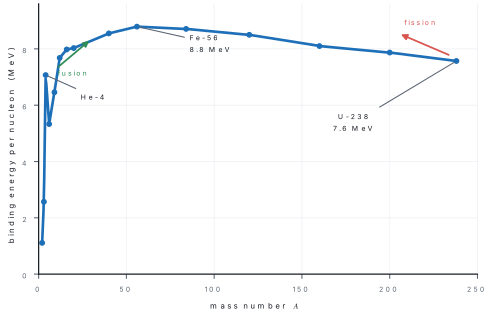
Why the curve matters. A system tends towards the lowest energy, which means the highest binding energy per nucleon. Any change that moves a nucleus up the curve releases energy.
- Fusion of light nuclei (moving towards the peak) releases energy — the Sun runs this way.
- Fission of heavy nuclei (splitting into two mid-mass fragments nearer the peak) releases energy — reactors and bombs run this way.
- Iron is the end of the road. You cannot get energy by fusing iron into heavier nuclei, because that moves down the curve. This is why massive stars develop iron cores and then collapse.
A high binding energy means the nucleus is hard to break apart, so it is stable. The energy is released when the nucleus forms, not stored for later use. When students say "the nucleus contains 28 MeV of binding energy", they mean the nucleus is bound by 28 MeV relative to its separated nucleons.
20.2 Nuclear fission and fusion
Fission
Nuclear fission is the splitting of a heavy nucleus into two medium-mass nuclei, with the release of two or three neutrons and about 200 MeV of energy.
A typical reaction:
Check the bookkeeping: mass numbers 235 + 1 = 141 + 92 + 3 = 236; charges 92 = 56 + 36. Both are conserved.
The energy appears because the fragments have higher binding energy per nucleon (about 8.5 MeV) than uranium-238 (7.6 MeV). The mass lost is about 0.2 u per fission, which is 0.2 \times 931.5 \approx 200 MeV.
Chain reaction. Each fission releases 2–3 neutrons, which can trigger further fissions. If on average more than one neutron succeeds, the reaction is self-sustaining. The minimum mass needed to sustain it is the critical mass; below it too many neutrons escape.
| Reactor part | Job | Material |
|---|---|---|
| Fuel | provides fissile nuclei | enriched uranium (U-235) |
| Moderator | slows neutrons so they are captured more easily | heavy water, graphite, ordinary water |
| Control rods | absorb neutrons and hold the rate steady | boron, cadmium |
| Coolant | carries heat to the turbine | water, CO₂ |
| Shield | absorbs radiation | thick concrete |
Fusion
Nuclear fusion is the joining of light nuclei into a heavier one, with the release of energy. It is the source of the Sun's energy.
In the Sun the proton–proton chain combines four protons into one helium nucleus, with two positrons and two neutrinos:
Why fusion needs a very high temperature. Both nuclei are positively charged, so they repel each other. To get close enough for the short-range strong force to act, they must approach at high speed — which means a temperature of the order of 10^7 K. This is the Coulomb barrier, and it is why fusion is hard to sustain on Earth.
| Fission | Fusion | |
|---|---|---|
| What happens | heavy nucleus splits | light nuclei join |
| Fuel | uranium-235, plutonium-239 | deuterium, tritium |
| Energy per event | about 200 MeV | about 17.6 MeV (D–T) |
| Energy per nucleon | about 0.85 MeV | about 3.5 MeV |
| Needs | a critical mass and a neutron | extremely high temperature |
| Where | reactors, weapons | stars; experimental reactors |
Fission releases energy because the fragments are more tightly bound than the parent. Fusion releases energy because the product is more tightly bound than the reactants. Both are "moving up the curve". Fusing nuclei heavier than iron absorbs energy instead.
20.3 Radioactivity: alpha, beta and gamma rays; the decay law, half-life and mean life; carbon dating
The three radiations
Radioactivity is the spontaneous emission of radiation from an unstable nucleus. It was discovered by Becquerel in 1896 and studied by Marie and Pierre Curie. It is a nuclear process: it does not depend on temperature, pressure or chemical combination, because the energy involved is millions of times larger than chemical energies.
| Property | Alpha (\alpha) | Beta (\beta^-) | Gamma (\gamma) |
|---|---|---|---|
| Nature | helium nucleus ^{4}_{2}He | electron e^- | photon |
| Charge | +2e | -e | 0 |
| Mass | 4 u | \approx 1/1836 u | 0 |
| Speed | \sim 0.05c | up to \sim 0.99c | c |
| Ionising power | very strong | moderate | weak |
| Penetration | a few cm of air, stopped by paper | a few mm of aluminium | needs cm of lead or concrete |
| Deflection in an electric field | towards the negative plate | towards the positive plate | none |
| Effect on nucleus | A falls by 4, Z falls by 2 | Z rises by 1 (for \beta^-) | no change |
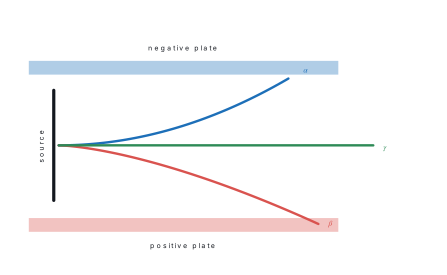
Alpha decay reduces both A and Z:
Beta-minus decay converts a neutron into a proton inside the nucleus:
A is unchanged and Z rises by one. The emitted electron is created at the moment of decay — it was not orbiting the nucleus.
Beta-plus decay converts a proton into a neutron, emitting a positron:
Gamma emission is a photon emitted when an excited daughter nucleus drops to a lower energy state. It changes neither A nor Z.
Students often say "the nucleus contains electrons". It does not. In \beta^- decay a neutron turns into a proton, an electron and an antineutrino: n \to p + e^- + \bar\nu_e. The electron is born in the decay. The continuous beta energy spectrum (the electron rarely gets the full available energy) was the evidence that a second particle, the neutrino, carries the rest.
The decay law
Radioactive decay is random: we cannot say when a particular nucleus will decay, only the probability per unit time, \lambda, the decay constant. For N nuclei,
The activity A is the number of decays per second:
Its SI unit is the becquerel (Bq), one decay per second. The older unit, the curie (Ci), is 3.7\times10^{10} Bq — roughly the activity of 1 g of radium-226.
Half-life and mean life
The half-life T_{1/2} is the time for half of the nuclei (or half the activity) to decay. Putting N = N_0/2 in the decay law:
The mean life \tau is the average lifetime of a nucleus:
After n half-lives the fraction left is (1/2)^n:
| Half-lives elapsed | Fraction remaining | Fraction decayed |
|---|---|---|
| 0 | 1 | 0 |
| 1 | 1/2 | 1/2 |
| 2 | 1/4 | 3/4 |
| 3 | 1/8 | 7/8 |
| 4 | 1/16 | 15/16 |
| n | 2^{-n} | 1 - 2^{-n} |
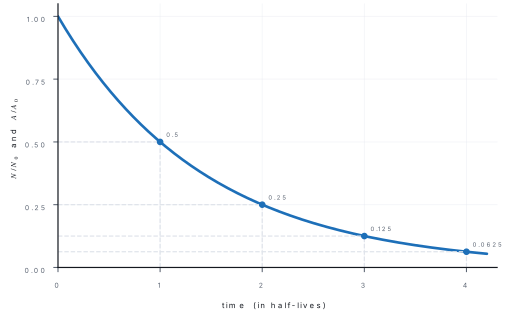
T_{1/2} does not change with temperature, pressure, chemical state, or whether the element is free or in a compound. Chemical reactions involve electron energies of a few eV; nuclear decay involves MeV. Heating a radium salt does not make it decay faster.
Problem. A sample has an activity of 6400 Bq and a half-life of 5 days. What is its activity after 20 days?
Solution. 20/5 = 4 half-lives. Activity = 6400/2^4 = 6400/16 = 400 Bq. No logarithms needed — count the halvings.
Problem. A source contains 4.0\times10^{15} nuclei and has an activity of 2.0\times10^{8} Bq. Find the decay constant and the half-life.
Solution. \lambda = A/N = 2.0\times10^8/4.0\times10^{15} = 5.0\times10^{-8} s⁻¹. T_{1/2} = 0.693/\lambda = 1.4\times10^7 s \approx 160 days.
Carbon dating
Carbon-14 is produced in the upper atmosphere when cosmic-ray neutrons strike nitrogen-14:
Living things take in carbon continuously, so the ratio of ^{14}C to ^{12}C in their tissue stays at the atmospheric value (about 1 part in 10^{12}). When the organism dies, intake stops and the ^{14}C decays with a half-life of 5730 years. Measuring the remaining activity gives the time since death.
Problem. A bone sample has 25 % of the ^{14}C activity of living tissue. How old is it? (T_{1/2} = 5730 yr)
Solution. 25\% = 1/4 = (1/2)^2, so two half-lives have passed: t = 2\times5730 = 11{,}460 years.
The method works up to about 50,000 years (about nine half-lives), beyond which the remaining activity is too small to measure reliably. It also assumes the atmospheric ^{14}C ratio has stayed constant; calibration with tree rings and other methods corrects for the small variations.
Parent–daughter chains
A radioactive nucleus usually decays into another radioactive nucleus, and so on, until a stable one is reached. These are the decay series:
| Series | Parent | Stable end | Half-life of parent |
|---|---|---|---|
| Uranium | ^{238}U | ^{206}Pb | 4.5\times10^9 yr |
| Thorium | ^{232}Th | ^{208}Pb | 1.4\times10^{10} yr |
| Actinium | ^{235}U | ^{207}Pb | 7.0\times10^8 yr |
If the parent has N_0 nuclei at t = 0 and the daughter is stable, the number of daughter nuclei at time t is the number that have decayed:
At t = T_{1/2} half the parent has become daughter; as t \to \infty all of it does. In a long chain the slowest step controls the overall rate, and after enough time the whole chain reaches secular equilibrium, in which every member decays at the same activity.
20.4 Medical uses of nuclear radiation and its health hazards
Diagnosis
Diagnosis uses small doses to see inside the body. The radiation must be penetrating enough to escape and be detected outside.
| Technique | Radiation | What it shows |
|---|---|---|
| X-ray radiograph | X-rays | bones, lungs, dental work |
| CT scan | X-rays from many angles | cross-sectional images |
| Bone scan | ^{99m}Tc (γ, T_{1/2} 6 h) | bone tumours, fractures |
| PET scan | ^{18}F in glucose (β⁺, T_{1/2} 110 min) | metabolic activity, cancer |
| Thyroid scan | ^{131}I (γ and β) | thyroid function |
A tracer should be a gamma emitter with a short half-life: gamma rays escape the body, and a short half-life keeps the dose low. Alpha emitters are a poor choice for tracers because alpha particles are stopped inside the body and deposit all their energy in a small volume.
Therapy
Therapy uses large doses to destroy tissue — usually a tumour.
- External radiotherapy: a beam of gamma rays from cobalt-60 is aimed at the tumour from several directions, so the tumour receives a high dose while each patch of healthy skin receives less.
- Brachytherapy: a sealed source is placed inside or next to the tumour.
- Targeted therapy: radioactive iodine-131 is taken up by thyroid cells, so it irradiates the thyroid from inside — useful for hyperthyroidism and thyroid cancer.
The difference between diagnosis and therapy is dose and intent: the same isotope can do both, but at very different activities.
Hazards
Ionising radiation damages cells by breaking chemical bonds, especially in DNA.
| Effect | When | Examples |
|---|---|---|
| Somatic (in the exposed person) | soon after a large dose | skin burns, nausea, hair loss, radiation sickness |
| Long-term somatic | years later | leukaemia, thyroid and lung cancer, cataracts |
| Genetic | in the next generation | mutations in germ cells |
Dose units. The gray (Gy) is the absorbed energy per unit mass (1 Gy = 1 J kg⁻¹). The sievert (Sv) is the equivalent dose, which allows for the fact that alpha particles do more biological damage per joule than gamma rays. Natural background radiation gives about 2–3 mSv per year.
Protection. Three rules:
- Time — spend as little time near the source as possible.
- Distance — dose falls as 1/r^2, so doubling the distance quarters it.
- Shielding — lead for gamma, plastic or paper for beta, and never alpha emitters inside the body.
Workers wear film badges or electronic dosimeters, and hospitals follow the ALARA principle: doses as low as reasonably achievable.
A smoke detector contains a tiny americium-241 source and is safe because the alpha particles cannot escape the casing. A diagnostic tracer is safe because the activity is small and the half-life short. The hazard comes from dose, not from the mere presence of a radioactive atom.
Formula and fact sheet
| Quantity | Formula or value |
|---|---|
| Nuclear radius | R = R_0A^{1/3}, R_0 \approx 1.2 fm |
| Nuclear density | \rho \approx 2.3\times10^{17} kg m⁻³, independent of A |
| Mass defect | \Delta m = Zm_H + (A-Z)m_n - M_{atom} |
| Binding energy | E_b = \Delta m\,c^2; 1 u = 931.5 MeV |
| BE per nucleon | maximum 8.8 MeV near Fe-56 |
| Fission | ^{235}U + n → Ba + Kr + 3n + 200 MeV |
| Fusion | ^{2}H + ^{3}H → ^{4}He + n + 17.6 MeV |
| Sun's chain | 4 ^{1}H → ^{4}He + 2e⁺ + 2ν + 26.7 MeV |
| Alpha decay | A \to A-4, Z \to Z-2 |
| Beta-minus | A same, Z \to Z+1; n \to p + e^- + \bar\nu |
| Beta-plus | A same, Z \to Z-1; p \to n + e^+ + \nu |
| Gamma | A and Z unchanged |
| Decay law | N = N_0e^{-\lambda t}; A = \lambda N |
| Half-life | T_{1/2} = 0.693/\lambda |
| Mean life | \tau = 1/\lambda = 1.44\,T_{1/2} |
| After n half-lives | N = N_0/2^n |
| Activity unit | 1 Bq = 1 decay s⁻¹; 1 Ci = 3.7\times10^{10} Bq |
| Carbon-14 | T_{1/2} = 5730 yr; useful to ~50,000 yr |
| Dose | 1 Gy = 1 J kg⁻¹; equivalent dose in Sv |
| Background | about 2–3 mSv per year |
Chapter summary
- The nucleus has Z protons and A-Z neutrons; R = R_0A^{1/3}, so volume \propto A and density is the same for all nuclei (2.3\times10^{17} kg m⁻³).
- A nucleus is lighter than its parts by \Delta m; the missing mass is the binding energy, E_b = \Delta m c^2, with 1 u = 931.5 MeV.
- Binding energy per nucleon peaks near iron-56 at 8.8 MeV. Fusion of light nuclei and fission of heavy nuclei both move nuclei up this curve and release energy.
- Fission: a heavy nucleus splits into two mid-mass fragments plus neutrons, releasing about 200 MeV; a chain reaction needs a critical mass.
- Fusion: light nuclei join, releasing energy; it needs about 10^7 K to overcome the Coulomb barrier, and powers the Sun.
- Alpha is a helium nucleus (A-4, Z-2), beta is an electron or positron (Z\pm1), gamma is a photon (no change). Alpha ionises most and penetrates least; gamma is the reverse.
- N = N_0e^{-\lambda t}, T_{1/2} = 0.693/\lambda, \tau = 1/\lambda; after n half-lives a fraction 2^{-n} remains. Half-life is unaffected by temperature or chemical state.
- Activity A = \lambda N, measured in becquerels; 1 Ci = 3.7\times10^{10} Bq.
- Carbon dating uses the 5730-year half-life of carbon-14; 25 % activity means two half-lives, about 11,460 years.
- Diagnosis uses small doses of gamma emitters; therapy uses large doses to kill cells. Hazards are somatic and genetic; protection is time, distance and shielding.
Practice questions
Set A — Recall (25 questions)
- The radius of a nucleus of mass number A is proportional toaAbA^2cA^{2/3}dA^{1/3}
- One atomic mass unit (1 u) is equivalent in energy toa931.5 MeVb13.6 eVc1 MeVd0.511 MeV
- The binding energy of a nucleus equals theamass of the nucleusbtotal KE of nucleonscmass defect × c²denergy of electrons
- The binding energy per nucleon is maximum for nuclei nearaheliumbiron (A ≈ 56)curaniumdhydrogen
- In alpha decay, the daughter nucleus has, compared with the parent,aZ − 2, A − 4bZ + 2, A + 4cZ − 1, same Adthe same Z and A
- In beta-minus decay, the atomic numberadecreases by 1bdecreases by 2cis unchanged in value but A fallsdincreases by 1
- The decay law for radioactive nuclei isaN = N_0 e^{\lambda t}bN = N_0 e^{-\lambda t}cN = N_0/(1+\lambda t)dN = N_0 - \lambda t
- Half-life is related to the decay constant byaT_{1/2} = \lambda/0.693bT_{1/2} = 1/\lambda exactlycT_{1/2} = 0.693/\lambdadT_{1/2} = 0.693\lambda
- The mean life of a radioactive nucleus equalsaT_{1/2}b1.44\,T_{1/2}c0.693\,T_{1/2}d2\,T_{1/2}
- The unit of activity (SI) is theabecquerelbcuriecgraydsievert
- Carbon dating uses the isotopeaC-12bC-13cC-11dC-14 (half-life 5730 yr)
- In a nuclear reactor, the moderator serves toaabsorb neutronsbcool the fuel onlycslow down neutronsdstart fusion
- The energy released per fission of U-235 is abouta200 MeVb200 eVc17.6 MeVd2 MeV
- The Sun's energy comes mainly fromafissionbchemical burningcfusion of hydrogen into heliumdgravitational collapse only at present
- Gamma rays areaelectronsbelectromagnetic photons of nuclear originchelium nucleidprotons
- The radiation stopped by a sheet of paper isagammabbetacX-raysdalpha
- Absorbed dose is measured inabecquerelsbcuriescgray (1 Gy = 1 J kg⁻¹)dTesla
- The isotope most used as a medical tracer (pure gamma, ~6 h half-life) isaCo-60bTc-99mcU-235dRa-226
- The continuous energy spectrum of beta particles is explained by the simultaneous emission of aa(anti)neutrino sharing the energybsecond electroncphotondproton
- Which particle starts the fission of U-235?aprotonbalphacelectrond(slow) neutron
- Isotopes of an element have the same number ofaneutronsbprotonscnucleonsdelectrons in ions always
- The density of nuclear matter (across all nuclei) is approximatelyaproportional to Abthat of steelcproportional to Zdconstant (~10^{17} kg m⁻³)
- In PET scanning, the detected 511 keV photons come fromanuclear fissionbX-ray tubescannihilation of a positron with an electrondbremsstrahlung only
- The half-life of a radioactive isotope can be changed byanone of these (it is a nuclear constant)bpressurecchemical combinationdheating
- Control rods in a reactor are made of materials such as boron or cadmium because theyareflect neutronsbslow neutronscabsorb neutrons stronglydproduce neutrons
Answers and explanations — Set A
1. (d) — R = R_0A^{1/3}: volume ∝ A at constant density.
2. (a) — 1\ \mathrm{u} \times c^2 = 931.5 MeV; (d) 0.511 MeV is the electron's rest energy.
3. (c) — the vanished mass is the binding energy, E = \Delta m c^2.
4. (b) — ≈ 8.8 MeV per nucleon near Fe-56/Ni-62.
5. (a) — the α carries away 2 protons and 2 neutrons.
6. (d) — a neutron becomes a proton: Z + 1, A unchanged.
7. (b) — exponential decay: each nucleus has the same decay probability per second, λ.
8. (c) — T_{1/2} = \ln 2/\lambda.
9. (b) — \tau = 1/\lambda = T_{1/2}/0.693 = 1.44\,T_{1/2}.
10. (a) — 1 Bq = 1 decay per second; the curie (3.7\times10^{10} Bq) is the older unit.
11. (d) — C-14, replenished by cosmic rays in life, decaying after death.
12. (c) — slow (thermal) neutrons fission U-235 best; rods (b-option confusion) absorb.
13. (a) — about 200 MeV, mostly the fragments' KE.
14. (c) — the proton–proton chain fusing H into He at 1.5\times10^7 K in the core.
15. (b) — high-energy photons emitted by de-exciting nuclei.
16. (d) — α, massive and doubly charged, spends itself within ~40 μm of tissue or a paper sheet.
17. (c) — gray is absorbed dose; sievert is weighted dose (risk).
18. (b) — Tc-99m: 140 keV γ, 6 h half-life, versatile chemistry — the workhorse of nuclear medicine.
19. (a) — the antineutrino (in β⁻) takes a variable share (Pauli's prophecy, confirmed 1956).
20. (d) — a thermal neutron tips U-235 into fission; the 2–3 emitted neutrons sustain the chain.
21. (b) — same Z, different N: same element, (nearly) same chemistry.
22. (d) — radius ∝ A^{1/3} ⇒ constant nuclear density, \sim 10^{17} kg m⁻³.
23. (c) — e^+e^- \to 2\gamma, each 511 keV, back-to-back: PET's coincidence signature.
24. (a) — λ is fixed by the nucleus; ordinary physical/chemical means do not touch it.
25. (c) — boron-10 and cadmium greedily capture neutrons, throttling the chain.
Set B — Understanding (15 questions)
- Fusing two light nuclei or splitting a heavy one both release energy because both processes move the productsato lower BE per nucleonbto the same Acto higher BE per nucleon (towards iron)dapart magnetically
- If a nucleus's actual mass were greater than the sum of its nucleons' masses, the nucleus wouldabe extra stablebemit unlimited energycemit gamma onlydbe unbound — it could not exist as a bound system
- Alpha particles are dangerous mainly when the source is inside the body, because externally theyacannot pass the dead outer skin (but ionize densely where they stop)bare too fastcbecome gammaddecay instantly
- A sample shows one-eighth of its original activity after 15 days. Its half-life isa15 daysb5 daysc3 daysd45 days
- In beta-minus decay the emitted electron comes fromathe electron cloudbthe nucleus's stored electrons (there are none resident)canother atomdinside the nucleus, where a neutron changes into a proton
- Why does a reactor need a minimum (critical) mass of fuel?ato be heavy enoughbneutrons must cause fission faster than they escape or are absorbedcto slow neutronsdto shield radiation
- Two samples have the same number of radioactive atoms; one has twice the half-life of the other. Its initial activity isatwicebthe samechalf (A = \lambda N, longer life = smaller λ)dfour times
- Tc-99m (half-life 6 h) is preferred over a long-lived gamma emitter for a scan mainly becauseathe patient’s radiation dose ends quickly (and its γ suits the camera)bit is cheapercit has no gammadit is stable
- Gamma emission usually follows alpha or beta decay because the daughter nucleus is leftawith missing electronsbin an excited energy state, which then de-excitescnegatively chargeddwith too many neutrons only
- Fusion on earth is harder to achieve than fission chiefly because the fusing nuclei mustaovercome their mutual electrostatic repulsion (needing ~10^8 K)bbe radioactivecfind electronsdlose neutrons first
- The BE-per-nucleon curve is fairly flat between A = 30 and A = 170. This tells us the nuclear forceaacts between all pairs equally over any distancebweakens with Z onlycis electromagneticdsaturates — each nucleon binds only its near neighbours
- In carbon dating, the clock starts when the organism dies because only then does it stopaabsorbing neutronsbdecaying C-12cabsorbing C-14 (exchanging carbon with the environment)dbeing irradiated by the Sun at all
- Standing twice as far from a small gamma source reduces the dose rate toaone quarter (inverse-square law)bone halfcone eighthdzero
- A nucleus {}^{238}_{92}U emits an alpha and then two beta-minus particles (in some order with gammas). The final nucleus hasaZ = 90, A = 234bZ = 94, A = 234cZ = 88, A = 230dZ = 92, A = 234 (an isotope of uranium)
- After ten half-lives, a radioactive sample is considered nearly safe/decayed away because the fraction remaining is abouta10 %b0.1 % (1/2^{10} \approx 1/1024)c1 %d50 %
Answers and explanations — Set B
1. (c) — products sit higher on the BE/A curve; the gain in binding is paid out as energy.
2. (d) — positive "binding energy" would mean it falls apart for free: bound systems must mass less than their parts.
3. (a) — α's range is tens of μm in tissue: paper/dead skin stops them outside, but inhaled radon daughters deposit that dense ionization in lung tissue (weighting factor 20).
4. (b) — 1/8 = three halvings in 15 days: T_{1/2} = 5 days.
5. (d) — n \to p + e^- + \bar\nu_e creates the electron at the moment of decay; nuclei contain no electrons (d's caveat). Electron-cloud electrons (a) are unaffected apart from the changed Z.
6. (b) — criticality is neutron bookkeeping: production must at least balance escape + absorption, which needs enough fuel volume per surface.
7. (c) — slower decayer, fewer decays per second from the same stock.
8. (a) — in a day it is ~94 % gone: good pictures, minimal residual dose.
9. (b) — decay often lands the daughter on an upper rung of its own ladder; γ is the step down. ^{99m}Tc's "m" is exactly such a metastable rung.
10. (a) — two positive nuclei must be thrown together hard enough for the strong force (range ~fm) to grab: hence thermonuclear temperatures.
11. (d) — if every nucleon bound every other, BE would grow with the number of pairs (~A^2) and BE/A would keep rising with A; saturation (near-neighbour-only) flattens it, letting Coulomb's Z^2 drag win at large A.
12. (c) — while alive, intake replenishes C-14 as fast as it decays; death stops the exchange.
13. (a) — point source: intensity \propto 1/r^2 — the cheapest shielding is distance.
14. (d) — α: (90, 234); each β⁻: Z + 1 keeping A → (92, 234): back to uranium, a lighter isotope. (This is why decay chains meander.)
15. (b) — (1/2)^{10} = 1/1024 \approx 0.1\%: the ten-half-life rule of hospital waste stores.
Set C — Application (10 questions)
- The mass defect of the helium-4 nucleus is 0.0304 u. Its binding energy is abouta2.83 MeVb28.3 MeVc283 MeVd7.1 MeV
- A radioactive sample has a half-life of 5 days. The fraction remaining after 20 days isa1/4b1/8c1/16d1/32
- The decay constant of an isotope with half-life 3.8 days (radon-222) is abouta0.18 day⁻¹b5.5 day⁻¹c0.26 day⁻¹d3.8 day⁻¹
- A sample contains 10^{20} nuclei with decay constant 10^{-6} s⁻¹. Its activity isa10^{6} Bqb10^{26} Bqc10^{10} Bqd10^{14} Bq
- A wooden artifact shows C-14 activity equal to 1/16 of that of living wood. Its age is abouta5730 yearsb11 460 yearsc22 920 yearsd45 840 years
- Fission of one U-235 nucleus releases 200 MeV. The energy from complete fission of 1 g of U-235 (\approx 2.56\times10^{21} nuclei) is abouta8.2\times10^{10} Jb8.2\times10^{7} Jc8.2\times10^{13} Jd200 J
- A nucleus has binding energy 492 MeV and mass number 56 (Fe). The BE per nucleon is abouta4.9 MeVb7.6 MeVc28 MeVd8.8 MeV
- The activity of a source falls from 800 MBq to 100 MBq in 24 days. Its half-life isa3 daysb8 daysc6 daysd12 days
- A nucleus of mass number 27 has a radius of about (R_0 = 1.2 fm)a3.6 fmb1.2 fmc10.8 fmd32 fm
- How much mass disappears when 931.5 MeV of energy is released in a nuclear reaction?a1 kgb1 uc500 ud0.001 u
Answers and explanations — Set C
1. (b) — 0.0304 \times 931.5 = 28.3 MeV in total; (d) 7.1 MeV is per nucleon — read which is asked.
2. (c) — 20 days = 4 half-lives: (1/2)^4 = 1/16.
3. (a) — \lambda = 0.693/3.8 = 0.18 day⁻¹.
4. (d) — A = \lambda N = 10^{-6}\times10^{20} = 10^{14} Bq.
5. (c) — four halvings: 4\times5730 = 22\,920 years.
6. (a) — 2.56\times10^{21}\times200\times1.6\times10^{-13}\ \mathrm{J} = 8.2\times10^{10} J (about a day's output of a megawatt — from a gram). (c) is the per-kg value.
7. (d) — 492/56 = 8.8 MeV — the curve's summit.
8. (b) — 800 → 100 is three halvings (800, 400, 200, 100) in 24 days: 8 days each (I-131's, as it happens).
9. (a) — R = 1.2\times27^{1/3} = 1.2\times3 = 3.6 fm.
10. (b) — by definition of the conversion: 1 u of mass ↔ 931.5 MeV.