Chapter 12 · Waves and Optics · 3 questions in the paper · 40 min read
Ray Optics: Reflection, Refraction and Dispersion
What the syllabus asks for 4
- Reflection at curved mirrors: mirror formula and magnification
- Refraction at plane surfaces, critical angle and total internal reflection; refraction through a prism
- Lenses: lens formula, lens maker's formula, power and combinations
- Dispersion, chromatic aberration and achromatism
Ray optics is the chapter of straight lines: rays, normals, angles and images. The Waves and Optics area carries 8 of the 50 Physics questions (official MEC weightage), and we estimate about 3 of them come from this chapter. Almost every question is one of five calculations — a mirror or lens position, an apparent depth, a critical angle, a prism deviation, or the power of a combination — and almost every lost mark comes from a sign.
- The Cartesian sign convention, once: distances from the pole or optical centre, positive along the incident light. Concave mirror f<0, convex mirror f>0; convex lens f>0, concave lens f<0; a real object has u<0.
- Mirror: \frac{1}{v} + \frac{1}{u} = \frac{1}{f}, m = -\frac{v}{u}, R = 2f.
- Lens: \frac{1}{v} - \frac{1}{u} = \frac{1}{f}, m = \frac{v}{u}.
- Refraction: \mu = c/v, \mu_1\sin i = \mu_2\sin r; apparent depth = real depth /\mu; \sin C = 1/\mu; TIR needs dense \to rare and i > C.
- Prism: A = r_1 + r_2, \delta = i_1 + i_2 - A, \mu = \frac{\sin((A+\delta_m)/2)}{\sin(A/2)}, thin prism \delta = (\mu-1)A.
- Lens maker: \frac{1}{f} = (\mu-1)\left(\frac{1}{R_1} - \frac{1}{R_2}\right); power P = 1/f in dioptre.
- Combinations: P = P_1 + P_2 in contact only; separated by d, P = P_1 + P_2 - dP_1P_2.
- Dispersion: \mu falls as \lambda rises, so violet deviates most; \omega = \frac{\mu_v - \mu_r}{\mu_y - 1}; achromatism needs \frac{\omega_1}{f_1} + \frac{\omega_2}{f_2} = 0.
12.1 Reflection at curved mirrors: mirror formula and magnification
The laws of reflection
- The angle of incidence equals the angle of reflection: i = r.
- The incident ray, the reflected ray and the normal at the point of incidence lie in the same plane.
Both angles are measured from the normal, not from the surface.
A spherical mirror is part of a hollow sphere. Its pole P is the centre of its surface, its centre of curvature C the centre of that sphere, and its principal focus F the point where rays parallel to the principal axis converge (concave) or appear to diverge from (convex) after reflection. The radius of curvature is R = 2f, and the focal length is half the radius — a fact worth memorising on its own.
| Concave mirror | Convex mirror | |
|---|---|---|
| Reflecting surface | inner (hollow) side | outer (bulging) side |
| Effect on parallel rays | converges them to F | diverges them, as if from F behind |
| Focal length | real focus, in front | virtual focus, behind |
| Images | real or virtual, depending on the object distance | always virtual, erect, diminished |
| Uses | shaving mirror, headlight reflector, dentist's mirror, solar cooker | rear-view mirror, security mirror, blind corners |
Take the pole (mirror) or optical centre (lens) as the origin, and the principal axis as the x-axis. Measure every distance from the origin, and take the direction of the incident light as positive.
For a mirror the light travels towards the mirror, so the object side is negative: u<0 for a real object, and a real image in front of the mirror also has v<0. A concave mirror has its focus in front, so f<0; a convex mirror has its focus behind, so f>0.
Heights are positive above the axis. A positive magnification means an erect image; a negative magnification means an inverted one.
The mirror formula
u is the object distance, v the image distance, f the focal length, h the object height and h' the image height. The formula holds for concave and convex mirrors alike, for real and virtual objects and images, provided the signs are put in correctly. It is accurate only for paraxial rays (a small aperture).
Setting up. An object BQ stands on the axis, its foot B at distance u from the pole and its tip Q at height h. A ray from Q parallel to the axis hits the mirror at M and reflects through F; a second ray from Q through F reflects parallel to the axis. They meet at Q', the image tip, at distance v from the pole with height h' above the image foot B'. Take all lengths as magnitudes for now.
Step 1 — the ray through the focus. The triangles Q'B'F and MPF are similar (MP is the mirror height where the parallel ray strikes). The parallel ray keeps its height, so MP = h, and
Step 2 — the ray through the pole. The triangles Q'B'P and QBP are similar, because the ray through the pole is undeviated and the two verticals are parallel:
Step 3 — equate the two expressions.
Step 4 — divide every term by uvf.
Result. \dfrac{1}{v} + \dfrac{1}{u} = \dfrac{1}{f}.
What it means. The magnitudes above were used only for a real image of a concave mirror. Because every distance is measured from the pole with a sign, the same equation covers virtual images, convex mirrors and virtual objects without change — provided the signs go in. Conditions: paraxial rays only (small aperture), and a thin mirror.
The sign convention written down before substitution, the formula, the substitution with signs, and the statement "real, inverted, magnified" — not just a number. A bare answer of "30 cm" earns half the marks; "30 cm in front of the mirror, real and inverted" earns all of them.
Where the image forms
For a concave mirror:
| Object position | Image position | Nature |
|---|---|---|
| at infinity | at F | real, inverted, highly diminished (a point) |
| beyond C | between F and C | real, inverted, diminished |
| at C | at C | real, inverted, same size (m = -1) |
| between C and F | beyond C | real, inverted, magnified |
| at F | at infinity | real, inverted, infinitely magnified |
| between F and P | behind the mirror | virtual, erect, magnified |
A convex mirror gives a virtual, erect, diminished image between P and F for every real object, which is exactly why it is used as a rear-view mirror: a wide field of view in a small, upright image.
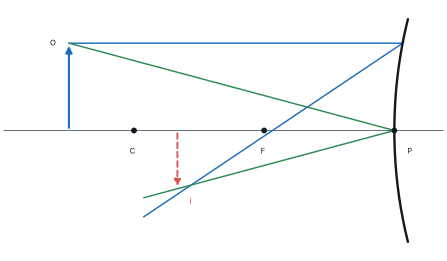
Problem. An object is 15 cm in front of a concave mirror of focal length 10 cm. Find the position, nature and magnification of the image.
Solution. Convention: u = -15 cm, f = -10 cm. \dfrac{1}{v} = \dfrac{1}{f} - \dfrac{1}{u} = -\dfrac{1}{10} + \dfrac{1}{15} = \dfrac{-3+2}{30} = -\dfrac{1}{30}, so v = -30 cm. The image is 30 cm in front of the mirror — real (negative v), and m = -\dfrac{v}{u} = -\dfrac{-30}{-15} = -2: inverted and twice the size.
- Concave f is negative in this convention. Using f = +10 with u = -15 gives v = +6 — a virtual image where a real one belongs.
- A positive v means behind the mirror: the image is virtual and cannot be caught on a screen.
- m = -v/u, not v/u. The minus sign is what tells you the image is inverted.
- R = 2f, so a mirror of radius 40 cm has f = 20 cm, not 40.
12.2 Refraction at plane surfaces, critical angle and TIR; refraction through a prism
Refraction and Snell's law
Refraction is the change in direction of light when it crosses a boundary between two transparent media, caused by a change in its speed. The frequency does not change; the wavelength does.
\mu is the absolute refractive index of a medium (relative to vacuum), c the speed of light in vacuum and v the speed in that medium. For two media, \dfrac{\sin i}{\sin r} = \dfrac{\mu_2}{\mu_1} = \dfrac{v_1}{v_2}: light bends towards the normal on entering a denser medium and away from it on leaving.
| Medium | \mu | Speed of light (m s⁻¹) |
|---|---|---|
| vacuum / air | 1 (1.0003) | 3.0\times10^8 |
| water | 1.33 | 2.25\times10^8 |
| crown glass | 1.52 | 1.97\times10^8 |
| diamond | 2.42 | 1.24\times10^8 |
Real and apparent depth
A pool looks shallower than it is, and a coin at the bottom of a glass of water looks raised. The rule is simple:
so the shift is t\left(1 - \dfrac{1}{\mu}\right) for a layer of thickness t.
Setting up. An object O lies a real depth d below a plane surface; the observer is in air above. Take a ray from O that reaches the surface at a small angle of incidence i (measured in the liquid) and leaves at angle r in air.
Step 1 — Snell's law. \mu\sin i = 1\cdot\sin r.
Step 2 — small angles. For a ray close to the normal, \sin i \approx \tan i and \sin r \approx \tan r, so \mu\tan i = \tan r.
Step 3 — geometry. If the ray leaves the surface a horizontal distance x from the point above the object, then \tan i = x/d and \tan r = x/d', where d' is where the backward extension of the emergent ray meets the vertical.
Step 4 — substitute. \mu\dfrac{x}{d} = \dfrac{x}{d'}, so d' = d/\mu.
Result. The object appears at the apparent depth d/\mu, i.e. raised.
Conditions. Near-normal viewing, observer in the rarer medium, flat surface. Viewing at a steep angle makes the bottom look curved and the simple rule fails.
Problem. A water tank is 4.0 m deep (\mu = 4/3). How deep does it look from directly above? How much does the bottom appear to be raised?
Solution. d' = d/\mu = 4.0/(4/3) = 3.0 m. Shift = 4.0 - 3.0 = 1.0 m, which also follows from t(1 - 1/\mu) = 4(1 - 3/4) = 1 m.
Through a slab. A ray crossing a parallel-sided glass slab emerges parallel to its original direction but displaced sideways by
The slab changes the path but not the direction — that is why a window pane does not distort what you see through it.
Critical angle and total internal reflection
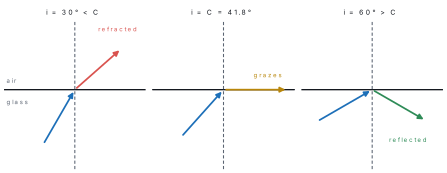
When light travels from a denser to a rarer medium it bends away from the normal, so the angle of refraction is larger than the angle of incidence. At a particular angle of incidence the refracted ray grazes the surface (r = 90^{\circ}); beyond it there is no refracted ray at all and the light is totally internally reflected.
| Medium | \mu | Critical angle |
|---|---|---|
| water | 1.33 | 48.6° |
| crown glass | 1.52 | 41.1° |
| flint glass | 1.62 | 38.1° |
| diamond | 2.42 | 24.4° |
Two conditions for TIR, and both are needed:
- light must be travelling from a denser to a rarer medium;
- the angle of incidence must exceed the critical angle.
A larger \mu means a smaller critical angle, which is why diamond sparkles: its critical angle is only 24.4°, so most light entering it is totally reflected several times before escaping.
Where TIR is used
- Optical fibres. A core of high \mu is surrounded by a cladding of slightly lower \mu; light entering at a small angle strikes the core–cladding boundary at an angle far above the critical angle and is totally reflected again and again, following the fibre around bends with almost no loss. This carries telephone, internet and TV signals, and lets an endoscope look inside the body.
- Mirage. On a hot road the air near the ground is hotter and less dense, so its \mu is slightly lower than the cooler air above. Rays from the sky bend gradually and are totally reflected near the ground, so the road appears to be covered with water.
- Prism periscope and binoculars. A right-angled isosceles prism reflects light through 90° (or 180°) by TIR at its hypotenuse, where i = 45^{\circ} exceeds the critical angle of glass. Prisms are used instead of mirrors because there is no silvering to tarnish and no double image from a front and a back surface.
- Diamond sparkle, and the light pipe used to carry light into a room.
Refraction through a prism
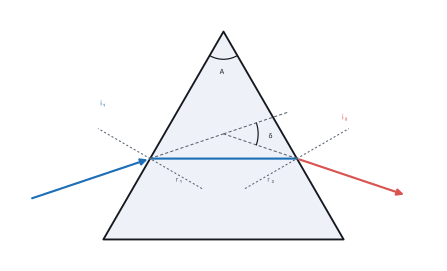
A prism is a transparent body with two plane refracting faces meeting at the refracting angle A (the angle of the prism). A ray entering one face and leaving the other is bent twice, both times towards the base, through a total angle of deviation \delta.
where i_1 is the angle of incidence at the first face, r_1 the angle of refraction there, r_2 the angle of incidence at the second face and i_2 the angle of emergence.
Setting up. The ray meets the first face at Q and leaves the second face at R. The normals at Q and R meet at N, and A is the apex.
Step 1 — the quadrilateral. In quadrilateral AQNR the angles at Q and R are 90^{\circ} each, so \angle QNR = 180^{\circ} - A.
Step 2 — the triangle QNR. Its angles are r_1, r_2 and 180^{\circ} - A, and they add to 180^{\circ}:
Step 3 — deviation at each face. At the first face the ray is turned by i_1 - r_1; at the second by i_2 - r_2. The two turns are in the same sense, so
Result. A = r_1 + r_2 and \delta = i_1 + i_2 - A.
Conditions. A triangular prism in air, with the ray crossing both faces (not totally reflected at the second).
Minimum deviation
As the angle of incidence is increased from zero, \delta first falls, reaches a minimum \delta_m, then rises again. At the minimum the path is symmetrical: the ray passes through the prism parallel to the base, and
so i = \dfrac{A + \delta_m}{2}, and Snell's law at either face gives the prism formula
For a thin prism (A a few degrees) the sines can be replaced by their angles, and the result collapses to
which is the form used for small-angle prisms in spectacles and rangefinders.
Problem. A prism of angle 60° gives a minimum deviation of 30°. Find \mu.
Solution. i = \dfrac{A+\delta_m}{2} = \dfrac{60+30}{2} = 45^{\circ} and r = A/2 = 30^{\circ}, so \mu = \dfrac{\sin 45^{\circ}}{\sin 30^{\circ}} = \dfrac{0.707}{0.500} = 1.41.
- \delta = i_1 + i_2 - A is not \delta_m; it is the deviation for that particular ray. Only at minimum deviation is i_1 = i_2.
- At minimum deviation r = A/2, not A. Using r = 60^{\circ} in the formula gives nonsense.
- The thin-prism result \delta = (\mu-1)A is a small-angle approximation. It is good to about 1 % for A below 10°, and \delta comes out in whatever unit A is given in — degrees with degrees, radians with radians.
12.3 Lenses: lens formula, lens maker's formula, power and combinations
A lens is a transparent medium bounded by two refracting surfaces. A convex (biconvex) lens is thicker at the middle and converges parallel rays to a real focus; a concave (biconcave) lens is thinner at the middle and diverges them, so its focus is virtual.
| Convex (converging) | Concave (diverging) | |
|---|---|---|
| Shape | thicker at the centre | thinner at the centre |
| Effect on parallel rays | converges to a real focus | diverges, as if from a virtual focus |
| Focal length (convention) | positive | negative |
| Power | positive | negative |
| Images of a real object | real or virtual, depending on distance | always virtual, erect, diminished |
The lens formula
With the same Cartesian convention as §12.1 (distances from the optical centre, positive along the incident light, real object u<0):
Note the difference from the mirror: a minus before 1/u, and no minus in m. For a convex lens with u = -30 cm and f = 20 cm, \frac{1}{v} = \frac{1}{20} - \frac{1}{30} = \frac{1}{60}, so v = +60 cm — a real image 60 cm beyond the lens, with m = 60/(-30) = -2: inverted and twice as large.
| Object position (convex lens) | Image position | Nature |
|---|---|---|
| at infinity | at F | real, inverted, a point |
| beyond 2F | between F and 2F | real, inverted, diminished |
| at 2F | at 2F | real, inverted, same size (m = -1) |
| between F and 2F | beyond 2F | real, inverted, magnified |
| at F | at infinity | real, inverted, infinitely magnified |
| between F and the lens | same side | virtual, erect, magnified |
A concave lens gives a virtual, erect, diminished image between the lens and F for every real object.
The lens maker's formula
The focal length of a thin lens is fixed by its material and its two surfaces:
R_1 is the radius of the first surface (the one the light meets first) and R_2 the second, each positive if that surface bulges towards the incident light. For a biconvex lens R_1 > 0 and R_2 < 0, so both terms add; for a biconcave lens R_1 < 0 and R_2 > 0, so f comes out negative.
Power
The power of a lens is the reciprocal of its focal length in metres:
A converging lens has positive power, a diverging lens negative. f = +25 cm gives P = +4 D; f = -50 cm gives P = -2 D. Opticians write a prescription in dioptres because powers, unlike focal lengths, simply add.
Combinations of lenses
In contact. For thin lenses touching each other, the powers add:
so a +5 D and a -2 D lens in contact behave as a single +3 D lens of focal length 100/3 = 33.3 cm.
Separated by a distance d. The formula changes:
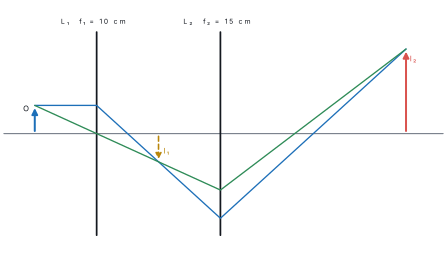
with d in metres. The extra term appears because the second lens receives the image of the first as its object, and the two lens equations combine to give -\dfrac{d}{f_1f_2}. A +5 D and a -5 D lens in contact give P = 0 (no net power), but separated by 20 cm they give P = 0 - (0.2)(5)(-5) = +5 D — a converging combination. The separation term is not a detail; it is the whole answer.
Magnification of a combination is the product: m = m_1\times m_2.
Problem. A convex lens of power +5 D and a concave lens of power −2 D are placed in contact. Find the power and focal length of the combination, and its nature.
Solution. P = P_1 + P_2 = 5 + (-2) = +3 D. f = 1/P = 1/3\ \text{m} = 33.3 cm, positive, so the combination is converging. The two lenses share the same axis and the same image position; only the powers add.
Problem. A convex lens of power +5 D and a concave lens of power -5 D are mounted on one axis, 20 cm apart. Find the equivalent power and focal length, and compare with the result when they touch.
Solution. In contact, P = 5 + (-5) = 0 and f = \infty: the pair behaves like a plain glass plate. Separated by d = 0.20 m, P = P_1 + P_2 - dP_1P_2 = 0 - (0.20)(5)(-5) = +5 D, so f = 1/5 = 0.20 m = 20 cm, converging. Moving the lenses apart has turned a powerless pair into a +5 D combination — the separation term is as large as either power.
- P = P_1 + P_2 holds only in contact. Separated by d, the power is P_1 + P_2 - dP_1P_2. Two lenses of +5 D and -5 D are powerless in contact but +5 D when 20 cm apart.
- A converging lens in water is weaker. The lens maker's formula uses \mu_{\text{lens}}/\mu_{\text{medium}} - 1, not \mu - 1. Glass (\mu = 1.5) in water (\mu = 4/3) has 1/f smaller by a factor \dfrac{1.5/1.333 - 1}{1.5 - 1} = \dfrac{0.125}{0.5} = \frac{1}{4}, so the focal length becomes four times longer. A lens of \mu less than the liquid's would even change from converging to diverging.
- m = v/u, not -v/u, for a lens. The mirror formula has the minus; the lens formula does not.
12.4 Dispersion, chromatic aberration and achromatism
Dispersion
Dispersion is the splitting of white light into its component colours by refraction. It happens because the refractive index of a material is not the same for all wavelengths: it is largest for violet and smallest for red.
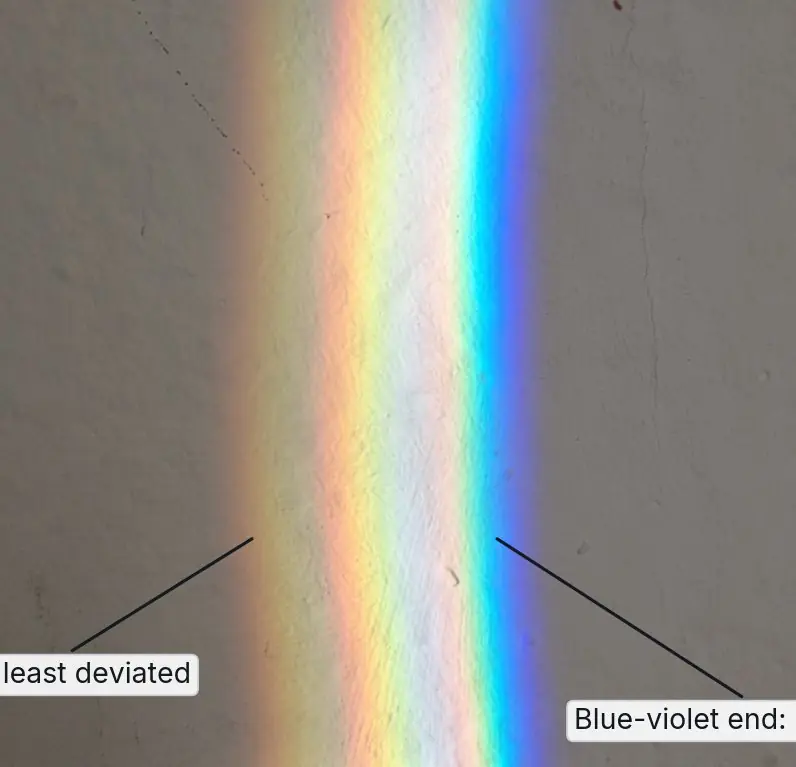
Since \delta = (\mu-1)A for a thin prism, violet is deviated most and red least, so a prism spreads white light into a band — the spectrum, in the order VIBGYOR (violet, indigo, blue, green, yellow, orange, red) from the most deviated end.
The physical reason is speed: in glass, violet travels more slowly than red, so it bends more. In vacuum all colours travel at the same speed and there is no dispersion.
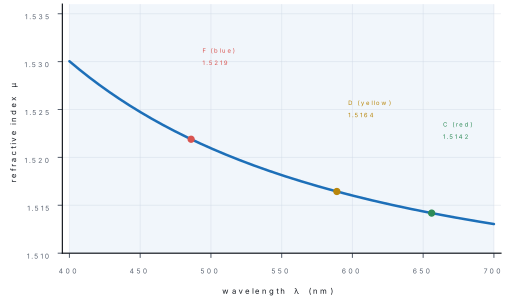
Two numbers describe the spreading:
| Quantity | Formula | Meaning |
|---|---|---|
| Angular dispersion | \delta_v - \delta_r = (\mu_v - \mu_r)A | the angle between the violet and red rays after a thin prism |
| Dispersive power | \omega = \dfrac{\mu_v - \mu_r}{\mu_y - 1} | how strongly the material spreads colours, independent of A |
\omega is a property of the material alone — about 0.017 for crown glass and 0.030 for flint glass. That is why flint glass is used for the dispersing prism of a spectrometer and crown glass for the lenses.
Chromatic aberration
A lens behaves like a stack of prisms, so it too disperses. Rays of different colours come to focus at different points: violet focuses nearest the lens (it is bent most) and red farthest. This defect is chromatic aberration.
- Longitudinal (axial) aberration: the images lie along the axis at different distances, so a white object has a coloured blur.
- Lateral (transverse) aberration: the images have different sizes, so the edges of a white object are fringed with colour even when the centre is sharp.
A mirror does not suffer from chromatic aberration: reflection does not depend on wavelength. That is why large astronomical telescopes are reflectors.
Achromatism
A combination of two lenses can cancel the dispersion while keeping some net power. For two thin lenses in contact, the condition for an achromatic doublet is
The powers must have opposite signs — one converging, one diverging — and the ratio of focal lengths must equal the inverse ratio of dispersive powers. Since flint glass has about twice the dispersive power of crown glass, the flint element must have about twice the focal length of the crown element, and therefore half its power. The combination is achromatic but not free of spherical aberration, and its net power is only about half that of the converging element alone.
Problem. A glass has \mu_v = 1.53, \mu_r = 1.51 and \mu_y = 1.52. Find its dispersive power and the angular dispersion of a 10° prism of this glass.
Solution. \omega = \dfrac{1.53-1.51}{1.52-1} = \dfrac{0.02}{0.52} = 0.038. Angular dispersion = (\mu_v - \mu_r)A = 0.02\times10^{\circ} = 0.2^{\circ}.
Write the convention first, then list the three knowns with signs, then choose the formula. In a combination question ask at once: in contact or separated? In a "which defect" question ask: lens or mirror? These two questions settle most of the chapter.
Formula and fact sheet
| Topic | Formula or fact |
|---|---|
| Reflection | i = r; angles from the normal; R = 2f |
| Mirror formula | \frac{1}{v} + \frac{1}{u} = \frac{1}{f}; m = -\frac{v}{u} |
| Sign convention | origin at pole/optical centre; + along the incident light; real object u<0; concave mirror f<0; convex mirror f>0 |
| Concave mirror images | beyond C: between F and C, real inverted diminished; at C: at C, same size; between C and F: beyond C, magnified; inside F: virtual erect magnified |
| Convex mirror | always virtual, erect, diminished, between P and F |
| Refractive index | \mu = c/v; \mu_1\sin i = \mu_2\sin r; \frac{\sin i}{\sin r} = \frac{\mu_2}{\mu_1} |
| Apparent depth | d' = d/\mu; shift = t(1 - 1/\mu) |
| Slab | emergent ray parallel; lateral shift = t\sin(i-r)/\cos r |
| Critical angle | \sin C = 1/\mu; water 48.6°, crown glass 41.1°, diamond 24.4° |
| TIR | denser \to rarer and i > C |
| Prism | A = r_1 + r_2; \delta = i_1 + i_2 - A |
| Minimum deviation | r = A/2, i = (A+\delta_m)/2, \mu = \frac{\sin((A+\delta_m)/2)}{\sin(A/2)} |
| Thin prism | \delta = (\mu-1)A |
| Lens formula | \frac{1}{v} - \frac{1}{u} = \frac{1}{f}; m = \frac{v}{u} |
| Lens maker | \frac{1}{f} = (\mu-1)\left(\frac{1}{R_1} - \frac{1}{R_2}\right) |
| Power | P = 1/f (m); dioptre; convex +, concave - |
| Lenses in contact | P = P_1 + P_2; \frac{1}{f} = \frac{1}{f_1} + \frac{1}{f_2}; m = m_1m_2 |
| Lenses separated | P = P_1 + P_2 - dP_1P_2 |
| Lens in water | \frac{1}{f} = \left(\frac{\mu_l}{\mu_m}-1\right)\left(\frac{1}{R_1}-\frac{1}{R_2}\right); glass in water: f becomes 4 times |
| Dispersion | \mu falls as \lambda rises; violet deviates most; VIBGYOR |
| Dispersive power | \omega = \frac{\mu_v-\mu_r}{\mu_y-1}; angular dispersion = (\mu_v-\mu_r)A |
| Achromatism | \frac{\omega_1}{f_1} + \frac{\omega_2}{f_2} = 0; crown + flint, opposite signs |
| Chromatic aberration | violet focus nearest the lens; mirrors are free of it |
Chapter summary
- The Cartesian convention fixes everything: origin at the pole or optical centre, positive along the incident light; a real object has u<0, a concave mirror f<0, a convex lens f>0.
- Mirror: \frac{1}{v}+\frac{1}{u}=\frac{1}{f} and m=-\frac{v}{u}; R = 2f; a convex mirror is always virtual, erect and diminished.
- Refraction: \mu = c/v and \mu_1\sin i = \mu_2\sin r; frequency is unchanged at a boundary, wavelength and speed are not.
- Apparent depth = d/\mu; a slab shifts the ray sideways without changing its direction; \sin C = 1/\mu, and TIR needs dense-to-rare plus i>C.
- Prism: A = r_1+r_2 and \delta = i_1+i_2-A; at minimum deviation the ray is symmetrical and \mu = \sin((A+\delta_m)/2)/\sin(A/2); a thin prism gives \delta = (\mu-1)A.
- Lens: \frac{1}{v}-\frac{1}{u}=\frac{1}{f}, m=\frac{v}{u}, \frac{1}{f}=(\mu-1)(1/R_1-1/R_2), P = 1/f in dioptres.
- In contact P = P_1+P_2; separated by d, P = P_1+P_2-dP_1P_2. A converging lens in water has a longer focal length — about four times longer for glass.
- Dispersion: \mu falls as \lambda rises, so violet bends most; \omega measures the spread; a crown–flint doublet with \omega_1/f_1+\omega_2/f_2=0 is achromatic, and mirrors never show chromatic aberration.
Practice questions
Set A — Recall (28 questions)
- The mirror formula isa\frac{1}{v} + \frac{1}{u} = \frac{1}{f}b\frac{1}{v} - \frac{1}{u} = \frac{1}{f}c\frac{1}{v} + \frac{1}{u} = \frac{1}{2f}dv + u = f
- The magnification produced by a spherical mirror isav/ub-u/vc-v/uduv
- In the Cartesian sign convention, the focal length of a concave mirror isapositivebnegativeczerodinfinite
- A convex mirror always forms an image that isareal and invertedbreal and erectcvirtual and magnifieddvirtual, erect and diminished
- An object placed at the centre of curvature of a concave mirror forms its image atathe centre of curvaturebthe focuscinfinitydthe pole
- An object placed at the focus of a concave mirror forms its image atathe centre of curvaturebthe polecinfinitydthe focus
- The refractive index of a medium is defined asav/cbc/vccvdc + v
- The critical angle C for a medium of refractive index \mu is given bya\cos C = 1/\mub\tan C = 1/\muc\sin C = \mud\sin C = 1/\mu
- Total internal reflection occurs when light travelsafrom a denser to a rarer medium beyond the critical anglebfrom a rarer to a denser mediumcnormally across a boundarydexactly at the critical angle
- The apparent depth of a tank of real depth d, viewed from above, isa\mu dbd/\mu^2cd/\mudd(\mu - 1)
- For a prism, the angle of deviation isai_1 + i_2 + Abi_1 + i_2 - AcA - i_1 - i_2di_1 - i_2 + A
- At the angle of minimum deviation, the ray inside the prism isaalong the basebperpendicular to the basecalong the normaldparallel to the base
- The relation between the angles of a prism isaA = r_1 + r_2bA = r_1 - r_2cA = i_1 + i_2dA = \delta + r_1
- For a thin prism of angle A and refractive index \mu, the deviation isa(\mu + 1)Ab\mu Ac(\mu - 1)AdA/\mu
- The power of a lens isafb1/fcf^2d1/f^2
- The SI unit of the power of a lens is theametrebwattcjouleddioptre
- The lens maker's formula isa\frac{1}{f} = (\mu - 1)\left(\frac{1}{R_1} - \frac{1}{R_2}\right)b\frac{1}{f} = (\mu + 1)\left(\frac{1}{R_1} + \frac{1}{R_2}\right)c\frac{1}{f} = (\mu - 1)\left(\frac{1}{R_1} + \frac{1}{R_2}\right)df = (\mu - 1)(R_1 - R_2)
- The power of two thin lenses in contact isaP_1 - P_2bP_1P_2cP_1 + P_2d(P_1 + P_2)/2
- Dispersion of light by a prism occurs becauseathe prism is triangularbthe refractive index depends on wavelengthcall colours travel at the same speed in vacuumdlight travels in straight lines
- In the spectrum from a glass prism, the colour deviated most isaredbyellowcgreendviolet
- Chromatic aberration is a defect ofalensesbplane mirrorscspherical mirrorsdvacuum
- Achromatism is the removal ofaspherical aberrationbcomacchromatic aberrationdastigmatism
- The dispersive power of a material isa(\mu_v - \mu_r)/\mu_yb(\mu_v - \mu_r)/(\mu_y - 1)c(\mu_y - 1)/(\mu_v - \mu_r)d(\mu_v + \mu_r)/(\mu_y - 1)
- The image formed by a plane mirror isareal and invertedbreal and erectcvirtual and diminisheddvirtual, erect and the same size
- The refractive index of water is 4/3. The speed of light in water isa4.0\times10^8 m s⁻¹b3.0\times10^8 m s⁻¹c2.25\times10^8 m s⁻¹d1.33\times10^8 m s⁻¹
- A prism periscope works on the principle ofatotal internal reflectionbdispersioncdiffractiondrefraction at a plane surface
- The focal length of a plane mirror isazerobinfinitecequal to its radiusdhalf its radius
- For a convex lens the focal length is taken asanegativebzerocinfinitedpositive
Answers and explanations — Set A
1. (a) — \frac{1}{v}+\frac{1}{u}=\frac{1}{f} for every spherical mirror. Option (b) is the lens formula, where the sign before 1/u differs.
2. (c) — m = h'/h = -v/u. The minus sign is what marks an inverted image; dropping it is the commonest error in the chapter.
3. (b) — a concave mirror has its focus in front of it, on the side from which the light comes, which is the negative direction in the convention.
4. (d) — the reflected rays always diverge, so the image is virtual, erect and smaller than the object, lying between the pole and the focus.
5. (a) — u = -2f gives v = -2f: the image is at C, real, inverted and the same size.
6. (c) — u = -f gives 1/v = 0, so v = \infty: the reflected rays are parallel.
7. (b) — \mu = c/v, the ratio of the speed in vacuum to the speed in the medium. It is always at least 1.
8. (d) — at the critical angle the refracted ray grazes the surface, so r = 90^{\circ} and \mu\sin C = 1\cdot\sin 90^{\circ} = 1.
9. (a) — both conditions are needed: denser to rarer, and beyond C. At exactly C the ray grazes the surface rather than being reflected.
10. (c) — the object appears raised to d/\mu. Option (a) would make the tank look deeper, which never happens.
11. (b) — the ray is turned by (i_1-r_1) and again by (i_2-r_2), and r_1+r_2 = A, giving \delta = i_1+i_2-A.
12. (d) — the symmetrical path at minimum deviation passes parallel to the base of the prism.
13. (a) — in the quadrilateral formed by the two normals and the two faces, \angle QNR = 180^{\circ}-A, and the triangle QNR gives r_1+r_2 = A.
14. (c) — for small angles \delta = (\mu-1)A; the deviation grows with \mu and with the prism angle.
15. (b) — power is the reciprocal of the focal length in metres, P = 1/f.
16. (d) — one dioptre is one reciprocal metre, \text{D} = \text{m}^{-1}.
17. (a) — \frac{1}{f} = (\mu-1)\left(\frac{1}{R_1}-\frac{1}{R_2}\right), with R_2 negative for a biconvex lens so that the two terms add.
18. (c) — powers add for thin lenses in contact. They do not multiply and they do not subtract.
19. (b) — \mu varies with \lambda, so each colour leaves the prism at a slightly different angle. In vacuum all colours travel at the same speed.
20. (d) — violet has the shortest wavelength and the largest refractive index, so it is deviated most.
21. (a) — refraction depends on wavelength, so lenses disperse; mirrors reflect all wavelengths equally.
22. (c) — an achromatic doublet brings two colours to the same focus, removing chromatic aberration.
23. (b) — \omega = (\mu_v-\mu_r)/(\mu_y-1), a pure number characteristic of the material.
24. (d) — a plane mirror gives a virtual, erect image of the same size, as far behind the mirror as the object is in front.
25. (c) — v = c/\mu = 3.0\times10^8/(4/3) = 2.25\times10^8 m s⁻¹.
26. (a) — light strikes the hypotenuse at 45°, which exceeds the critical angle of glass (about 42°), so it is totally reflected through 90°.
27. (b) — a plane mirror has infinite radius, so f = R/2 is infinite: parallel rays come back parallel.
28. (d) — a convex lens converges light to a real focus on the far side, the positive direction.
Set B — Understanding (17 questions)
- A concave mirror is used as a shaving mirror because, with the face inside the focus, it givesaa real inverted imageba virtual diminished imageca virtual erect magnified imageda real erect image
- A convex mirror is used as a rear-view mirror because itagives an erect diminished image with a wide field of viewbgives a magnified imagecforms a real image on a screendhas a very long focal length
- A fish looking up through a still water surface sees the whole sky within a cone of semi-vertical anglea90°b41.8°c60°d48.6°
- A ray passes through a rectangular glass slab. The emergent ray isadeviated towards the basebparallel to the incident raycperpendicular to the incident raydtotally reflected
- A ray falls normally on one face of an equilateral prism of \mu = 1.5. At the second face itaemerges with a small deviationbpasses straight throughcis totally reflecteddis absorbed
- A converging lens is immersed in water. Its focal lengthaincreasesbdecreasescstays the samedbecomes zero
- A lens of power +5 D and a lens of power -5 D are placed in contact. The combination behaves asaa convex lens of 10 Dba concave lens of 10 Dca plane mirrorda plane glass plate of zero power
- The focal length of a lens is 25 cm. Its power isa+25 Db+4 Dc+0.25 Dd-4 D
- Chromatic aberration in a telescope objective is reduced by usingaan achromatic doubletba longer tubeca larger apertureda plane mirror
- Violet light is deviated more than red by a glass prism because in glassaviolet has a longer wavelengthbred travels more slowlycviolet travels more slowlydboth travel at the same speed
- An object is placed between the pole and the focus of a concave mirror. The image isareal, inverted and magnifiedbreal, inverted and diminishedcvirtual, erect and diminisheddvirtual, erect and magnified
- With a convex lens, an object at 2F gives an image that isaat F and magnifiedbat 2F, the same size and invertedcat infinitydvirtual and erect
- A converging lens forms a real image of the same size as the object when the object is ata2fbfcf/2dinfinity
- The power of a lens is -2.5 D. Its focal length isa+40 cmb-25 cmc-40 cmd+25 cm
- Lenses of power +4 D and -6 D are in contact. The focal length of the combination isa+50 cmb-50 cmc+12.5 cmd-12.5 cm
- A glass slab of thickness t and refractive index \mu shifts an object seen through it byat\mubt/\muct(\mu - 1)dt(1 - 1/\mu)
- The splitting of white light into its colours by a prism is calledadispersionbdeviationcdiffractiondscattering
Answers and explanations — Set B
1. (c) — inside the focus a concave mirror gives a virtual, erect, magnified image, so the face looks larger and the right way up.
2. (a) — a convex mirror always gives an erect, diminished image between P and F, and its wide field of view shows more traffic.
3. (d) — the cone is bounded by rays at the critical angle, C = \sin^{-1}(1/1.33) = 48.6^{\circ}; beyond that the fish sees only the reflection of the water.
4. (b) — the two refractions at parallel faces are equal and opposite, so the ray emerges parallel to its original direction, only shifted sideways.
5. (c) — normal incidence gives r_1 = 0, so r_2 = A = 60^{\circ}, which exceeds the critical angle 41.8^{\circ}; the ray is totally reflected inside the prism.
6. (a) — the lens maker's formula uses \mu_{\text{lens}}/\mu_{\text{medium}}-1, which is smaller in water, so 1/f falls and f rises (four times for glass in water).
7. (d) — powers add: +5-5 = 0, so the combination has infinite focal length and acts like a plane parallel plate.
8. (b) — P = 1/f = 1/0.25 = +4 D. The power is positive because the lens is converging.
9. (a) — a doublet made of two glasses of different dispersive power brings two colours to a common focus.
10. (c) — smaller speed means larger refractive index, and a larger \mu means a larger deviation.
11. (d) — inside the focus the reflected rays diverge; traced backwards they give a virtual, erect, magnified image behind the mirror.
12. (b) — u = -2f gives v = +2f on the other side, with m = -1: same size, inverted, real.
13. (a) — m = v/u = -1 needs v = -u = 2f, so the object must be at 2f and the image at 2f on the other side.
14. (c) — f = 1/P = 1/(-2.5) = -0.40 m = -40 cm: a diverging lens.
15. (b) — P = 4-6 = -2 D, so f = 1/(-2) = -0.5 m = -50 cm.
16. (d) — the apparent thickness is t/\mu, so the object appears raised by t - t/\mu = t(1-1/\mu).
17. (a) — dispersion is the splitting by wavelength; deviation is the bending of the whole beam, and diffraction is the spreading by an obstacle.
Set C — Application (12 questions)
- An object is 15 cm in front of a concave mirror of focal length 10 cm. The image is formed ata6 cm in front of the mirrorb30 cm in front of the mirrorc20 cm in front of the mirrord45 cm in front of the mirror
- An object is 10 cm in front of a concave mirror of focal length 15 cm. The image isareal, 6 cm from the mirrorbreal, 30 cm from the mirrorcvirtual, 6 cm from the mirrordvirtual, 30 cm from the mirror
- An object is 10 cm in front of a convex mirror of focal length 15 cm. The image is formeda6 cm behind the mirrorb30 cm behind the mirrorc6 cm in front of the mirrord15 cm behind the mirror
- A water tank is 4 m deep (\mu = 4/3). The bottom appears to be at a depth ofa5.33 mb4 mc3 md1 m
- The critical angle for a medium of refractive index 1.5 is abouta30°b42°c49°d60°
- A prism of angle 60° gives a minimum deviation of 30°. Its refractive index isa1.50b1.73c1.33d1.41
- A thin prism of angle 6° is made of glass of \mu = 1.5. Its deviation isa3°b6°c9°d1.5°
- A convex lens of focal length 20 cm forms the image of an object 30 cm away ata12 cmb50 cmc60 cmd10 cm
- A biconvex lens of \mu = 1.5 has radii of curvature 20 cm and 30 cm. Its focal length isa12 cmb30 cmc10 cmd24 cm
- Lenses of power +5 D and -2 D are in contact. The power and focal length of the combination area7 D, 14.3 cmb3 D, 33.3 cmc3 D, 3.0 cmd-3 D, -33.3 cm
- A convex lens of power +5 D and a concave lens of power -5 D are separated by 20 cm. The power of the combination isazerob-5 Dc+5 Dd+10 D
- A convex lens of focal length 20 cm in air (\mu = 1.5) is placed in water (\mu = 4/3). Its focal length becomesa80 cmb20 cmc26.7 cmd5 cm
Answers and explanations — Set C
1. (b) — u = -15, f = -10: \frac{1}{v} = -\frac{1}{10}+\frac{1}{15} = -\frac{1}{30}, so v = -30 cm, i.e. 30 cm in front. Option (a) comes from dropping a sign.
2. (d) — u = -10, f = -15: \frac{1}{v} = -\frac{1}{15}+\frac{1}{10} = +\frac{1}{30}, so v = +30 cm. A positive v is behind the mirror: virtual, and m = +3, erect and magnified.
3. (a) — u = -10, f = +15: \frac{1}{v} = \frac{1}{15}+\frac{1}{10} = \frac{1}{6}, so v = +6 cm behind the mirror, virtual and erect with m = +0.6.
4. (c) — d' = d/\mu = 4/(4/3) = 3 m. The bottom appears 1 m higher than it is.
5. (b) — \sin C = 1/1.5 = 0.667, so C = 41.8^{\circ}, about 42°.
6. (d) — \mu = \frac{\sin 45^{\circ}}{\sin 30^{\circ}} = \frac{0.707}{0.500} = 1.41. Option (b), \sqrt{3} = 1.73, would need a minimum deviation of 60°.
7. (a) — \delta = (\mu-1)A = 0.5\times6^{\circ} = 3^{\circ}.
8. (c) — \frac{1}{v} = \frac{1}{20}-\frac{1}{30} = \frac{1}{60}, so v = +60 cm; m = 60/(-30) = -2.
9. (d) — \frac{1}{f} = 0.5\left(\frac{1}{20}+\frac{1}{30}\right) = 0.5\times\frac{5}{60} = \frac{1}{24}, so f = 24 cm. Option (a) comes from forgetting the (\mu-1) factor.
10. (b) — P = 5-2 = +3 D and f = 1/3 m = 33.3 cm. The powers add because the lenses touch.
11. (c) — in contact the power would be zero, but separated by d = 0.2 m, P = 0 - (0.2)(5)(-5) = +5 D. The separation term revives the power.
12. (a) — the factor (\mu-1) becomes (\mu/1.333 - 1) = 0.125, one quarter of 0.5, so 1/f is quartered and f is four times larger: 80 cm.