Chapter 19 · Modern Physics · 2 questions in the paper · 29 min read
Atomic Physics and X-rays
What the syllabus asks for 3
- Bohr's theory of the hydrogen atom: energy levels and spectral series
- de Broglie waves and the uncertainty principle
- X-rays: production, properties and uses; Bragg's law
Modern Physics carries 12 of the 50 Physics questions (official MEC weightage), and we estimate about 2 come from this chapter. They are almost always one Bohr-model calculation — an orbit radius, an energy, a wavelength or a series name — and one X-ray fact, usually the Duane–Hunt limit \lambda_{min} = hc/eV or Bragg's law. Both halves reward a small number of remembered results, and both punish the two standard confusions: putting the Lyman series in the visible, and calling the K_\alpha line the shortest wavelength in the X-ray spectrum.
- Bohr's three postulates, and the quantisation condition mvr = nh/2\pi.
- The hydrogen results: r_n \propto n^2, v_n \propto 1/n, E_n = -13.6/n^2 eV.
- The five named series, the level each ends on, and the region each lies in.
- Ionisation energy 13.6 eV; first excitation 10.2 eV; the Rydberg formula.
- de Broglie's relation \lambda = h/p and the uncertainty principle, as statements with one consequence.
- X-ray production, the continuous and characteristic spectra, \lambda_{min} = hc/eV.
- Bragg's law 2d\sin\theta = n\lambda and Moseley's law qualitatively.
19.1 Bohr's theory of the hydrogen atom: energy levels and spectral series
Why the Rutherford atom had to be replaced
Rutherford's experiment (1911) put a tiny positive nucleus at the centre of the atom, with electrons outside it. That picture has a fatal flaw in classical physics. An electron moving in a circle is accelerating, and an accelerating charge radiates energy. So the electron should lose energy continuously, spiral into the nucleus in about 10^{-11} s, and the light it emitted should form a continuous spectrum that changes as the orbit shrinks.
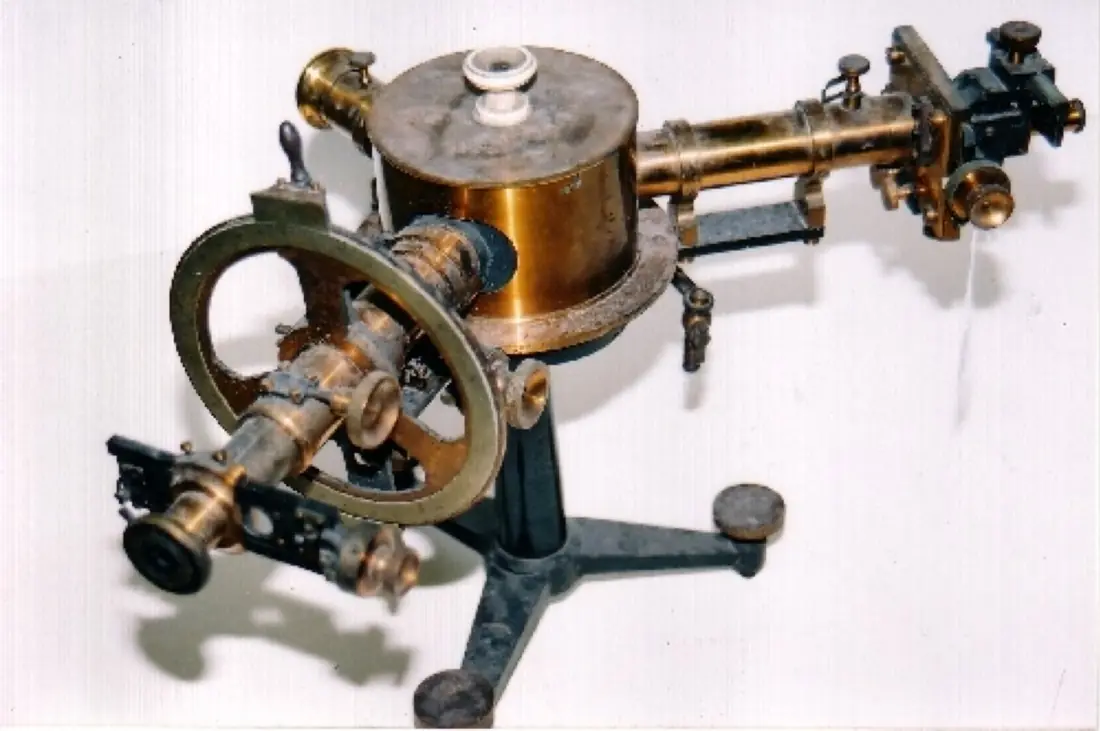
Neither happens. Atoms are stable, and a hydrogen discharge emits a spectrum of sharp lines — a few fixed wavelengths, not a smear. Niels Bohr (1913) kept the nuclear model and added three postulates that remove both contradictions.
- Stationary states. An electron can revolve round the nucleus only in certain allowed orbits, and while it is in one of them it does not radiate, even though it is accelerating.
- Quantisation of angular momentum. The allowed orbits are those for which the angular momentum is a whole-number multiple of h/2\pi: mvr = nh/2\pi, n = 1, 2, 3, \dots
- Quantum jumps. Radiation is emitted or absorbed only when the electron moves between two allowed orbits, and one photon carries the whole energy difference: hf = E_2 - E_1.
The integer n is the principal quantum number. The orbit with n = 1 is the ground state; n = 2, 3, \dots are excited states.
The radius, speed and energy
The electron of charge -e moves in a circle of radius r round a nucleus of charge +e. The Coulomb attraction supplies the centripetal force.
Setting up. Let m be the electron mass, v its speed, r the orbit radius, and k = 1/4\pi\varepsilon_0. Two equations hold: force balance and angular-momentum quantisation.
Step 1 — force balance. The Coulomb force is the centripetal force:
Step 2 — quantisation. From mvr = nh/2\pi, the speed is v = nh/(2\pi mr).
Step 3 — substitute. Squaring the speed and putting it into Step 1:
Step 4 — put in the numbers. With h = 6.63\times10^{-34} J s, m = 9.11\times10^{-31} kg, e = 1.6\times10^{-19} C and k = 9\times10^9 N m² C⁻², the bracket is 0.529\times10^{-10} m. So
where a_0 = 0.529 Å is the Bohr radius.
Step 5 — the speed. Putting r_n back into v = nh/(2\pi mr) gives
Step 6 — the energy. Kinetic energy K = \frac{1}{2}mv^2 = ke^2/2r; potential energy U = -ke^2/r. So U = -2K and
Result. r_n \propto n^2, v_n \propto 1/n, E_n \propto -1/n^2, with E_1 = -13.6 eV.
What it means. The negative sign means the electron is bound: 13.6 eV must be supplied to remove it from the ground state. The energy levels crowd together as n grows and reach zero at n = \infty, where the electron is free.
| Quantity in state n | Depends on n as | Ground-state value |
|---|---|---|
| Radius r_n | n^2 | 0.529 Å |
| Speed v_n | 1/n | 2.19\times10^6 m s⁻¹ |
| Kinetic energy K_n | 1/n^2 | 13.6 eV |
| Potential energy U_n | -1/n^2 | −27.2 eV |
| Total energy E_n | -1/n^2 | −13.6 eV |
| Angular momentum L_n | n | h/2\pi |
| Time period T_n | n^3 | 1.5\times10^{-16} s |
Note the useful pair U = 2E and K = -E: the potential energy is twice the total energy, and the kinetic energy is minus the total energy. In the ground state K = 13.6 eV, U = -27.2 eV, E = -13.6 eV.
Ionisation energy is the energy to take the electron from its present level to n = \infty: 13.6 eV from the ground state, but only 3.4 eV from n = 2. Excitation energy is the energy to lift it to the next level: 10.2 eV from n = 1 to n = 2, and 12.09 eV from n = 1 to n = 3. An electron in the ground state cannot absorb a photon of 12 eV — photons are absorbed whole, and 12 eV matches no gap. It can absorb 10.2 eV, 12.09 eV, 12.75 eV, … exactly.
The spectral series
A downward jump from level n_2 to a lower level n_1 emits a photon of energy 13.6(1/n_1^2 - 1/n_2^2) eV. In wavelength form this is the Rydberg formula:
with n_2 > n_1. Each fixed n_1 gives a series; within a series n_2 runs from n_1 + 1 upward, and the lines crowd together towards the series limit at n_2 = \infty, where \lambda_{limit} = 1/(R/n_1^2).
| Series | Ends on n_1 | Region | First line \lambda | Series limit |
|---|---|---|---|---|
| Lyman | 1 | ultraviolet | 121.6 nm (Ly-α) | 91.2 nm |
| Balmer | 2 | visible (and near UV) | 656.3 nm (Hα, red) | 364.6 nm |
| Paschen | 3 | infrared | 1875 nm | 820 nm |
| Brackett | 4 | infrared | 4050 nm | 1458 nm |
| Pfund | 5 | infrared | 7460 nm | 2279 nm |
The visible hydrogen lines all belong to the Balmer series: Hα (656 nm, red), Hβ (486 nm, blue-green), Hγ (434 nm, violet) and Hδ (410 nm, violet). The series limit of Balmer, 364.6 nm, is the shortest wavelength the series can reach.
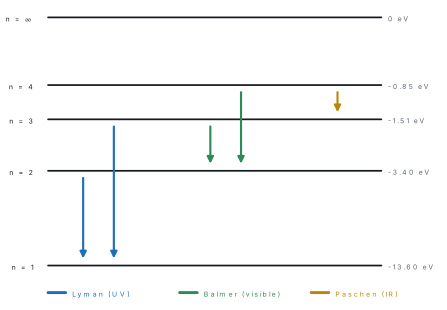
Lyman Balmer Paschen Brackett Pfund — “Little Boys Play Basketball Perfectly”. The ending level is the position in the list: Lyman 1, Balmer 2, Paschen 3, Brackett 4, Pfund 5.
Number of lines. An electron falling from level n can take any downward jump, and each pair of levels gives one line. The number of possible lines is
so a gas of atoms in the n = 4 state can emit 6 different wavelengths.
Problem. Find the energy and wavelength of the photon emitted when a hydrogen atom drops from n = 3 to n = 2.
Solution. E = 13.6(1/2^2 - 1/3^2) = 13.6(1/4 - 1/9) = 1.89 eV. Using 1240\ \text{eV nm} = hc: \lambda = 1240/1.89 = 656 nm — the red Hα line, in the visible.
Problem. A hydrogen atom is in the n = 2 state. What is the longest wavelength that can ionise it?
Solution. Ionisation from n = 2 needs 0 - (-3.4) = 3.4 eV. The longest wavelength corresponds to exactly this energy: \lambda = 1240/3.4 = 365 nm — the Balmer limit, in the near ultraviolet. Any photon of 365 nm or shorter will do; a longer one cannot.
Successes and limits of the Bohr model
Bohr's model gets the hydrogen spectrum exactly right, explains why atoms are stable, predicts the correct ionisation energy, and gives the right size for the atom. It fails for everything with more than one electron (helium onward), cannot explain the relative brightness of spectral lines, says nothing about fine structure or the splitting of lines in a magnetic field (the Zeeman effect), and assumes sharp circular orbits that quantum mechanics does not allow. It is a half-way house: correct energies, wrong picture.
19.2 de Broglie waves and the uncertainty principle
Matter waves
In 1924 Louis de Broglie proposed that if light waves can behave as particles (photons, Chapter 18), then particles should behave as waves. A particle of momentum p = mv has a de Broglie wavelength
For a particle of kinetic energy K (non-relativistic), p = \sqrt{2mK}, so
For an electron accelerated from rest through a potential difference V, K = eV and
with V in volts. At 100 V the wavelength is 1.23 Å — about the spacing of atoms in a crystal, which is why electrons diffract from crystals.
| Object | Speed | de Broglie wavelength |
|---|---|---|
| Electron, 100 V | 5.9\times10^6 m s⁻¹ | 1.23 Å |
| Electron, 10 kV | 5.9\times10^7 m s⁻¹ | 0.123 Å |
| Proton, same 100 V | 1.4\times10^5 m s⁻¹ | 2.9\times10^{-12} m |
| Cricket ball, 0.16 kg | 30 m s⁻¹ | 1.4\times10^{-34} m |
The last line is the important one. A cricket ball has a wavelength 10^{20} times smaller than a nucleus, so no experiment can detect its wave nature. Wave behaviour matters only when \lambda is comparable to the size of the obstacles or openings in the experiment — for electrons in crystals, for neutrons in diffraction experiments, for atoms in interferometers.
The first evidence came from Davisson and Germer (1927): a beam of electrons reflected from a nickel crystal produced a diffraction pattern with maxima at angles given by Bragg's law, exactly as waves would. Electron microscopes are the practical application: a 100 kV electron has \lambda \approx 0.004 nm, thousands of times shorter than visible light, so the resolution is thousands of times better.
Bohr's orbits explained. A de Broglie wave going round an orbit must fit a whole number of wavelengths, otherwise it cancels itself: 2\pi r = n\lambda = nh/mv. Rearranged, mvr = nh/2\pi — Bohr's quantisation condition is just the condition for a standing wave round the nucleus.
Problem. Find the de Broglie wavelength of an electron accelerated through 100 V.
Solution. K = eV = 1.6\times10^{-17} J. p = \sqrt{2mK} = \sqrt{2(9.11\times10^{-31})(1.6\times10^{-17})} = 5.4\times10^{-24} kg m s⁻¹. \lambda = h/p = 6.63\times10^{-34}/5.4\times10^{-24} = 1.2\times10^{-10} m = 1.2 Å. (The shortcut \sqrt{150/100} = 1.22 Å gives the same.)
Heisenberg's uncertainty principle
A wave does not have a sharp position, so a particle described by a matter wave cannot have both a sharp position and a sharp momentum. Heisenberg (1927) made this precise:
The product of the uncertainties in position and momentum of a particle can never be smaller than h/4\pi. There is a companion relation between energy and time,
Here \hbar = h/2\pi = 1.055\times10^{-34} J s. The principle is not a statement about clumsy instruments; it is a property of nature. Measuring the position precisely (small \Delta x) forces a large spread of momentum, and vice versa.
An order-of-magnitude consequence. Confine an electron to a region the size of an atom, \Delta x \approx 10^{-10} m. Then
That is the same order as the electron's orbital speed. So an electron in an atom cannot be pictured as a particle moving along a definite path; only a probability cloud has meaning. Confine the same electron to a nucleus (\Delta x \approx 10^{-14} m) and the minimum speed becomes 6\times10^9 m s⁻¹ — greater than the speed of light. Electrons cannot exist inside nuclei; the electrons emitted in beta decay are created at the moment of decay.
It does not say that a particle has a definite position and momentum that we simply do not know. It says the pair has no simultaneous definite values. It also does not stop us measuring one of them exactly — only both at once. And \Delta E \Delta t \ge \hbar/2 explains the natural width of spectral lines: a state that lives only 10^{-8} s has an energy uncertain by about 10^{-7} eV.
19.3 X-rays: production, properties and uses; Bragg's law
The Coolidge tube
X-rays are produced when fast electrons strike a heavy metal target. In a modern Coolidge tube:
- a tungsten filament (cathode) is heated by a small current and emits electrons by thermionic emission;
- a high voltage (typically 20–150 kV) accelerates these electrons towards the anode, a heavy metal such as tungsten or molybdenum;
- the tube is evacuated, so the electrons travel without colliding with gas;
- more than 99 % of the electron energy becomes heat in the anode, which is therefore cooled (often a rotating anode spreads the heat).
The tube current (filament heating) controls the number of electrons, hence the intensity of the X-rays. The tube voltage controls the energy of each electron, hence the penetrating power (hardness) and the shortest wavelength.
The two spectra
An X-ray tube emits a superposition of two distinct spectra.
1. Continuous spectrum (bremsstrahlung). An electron passing close to a nucleus is decelerated and radiates the lost energy as a photon. The energy lost can be anything from zero up to the whole kinetic energy eV, so the spectrum is continuous. The most energetic photon occurs when the electron loses all its energy in one collision:
This is the Duane–Hunt limit. It depends only on the tube voltage, not on the target metal.
2. Characteristic spectrum. If the bombarding electron knocks out an inner (K-shell) electron, an electron from a higher shell falls down and emits a photon of fixed energy. These are the sharp K-series lines: K_\alpha (from L to K) and K_\beta (from M to K). Their wavelengths are a fingerprint of the target element and do not change when the tube voltage changes (as long as the voltage is high enough to remove a K electron at all).
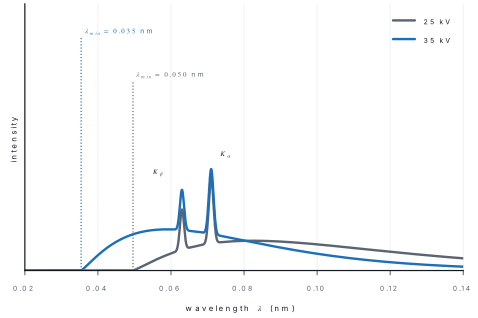
The K_\alpha line is not the shortest wavelength in the spectrum. The continuous cut-off \lambda_{min} is always shorter, because it comes from an electron losing all its energy at once, while K_\alpha comes from a transition with a fixed, smaller energy. In the figure the cut-off is at 0.035 nm and K_\alpha at 0.071 nm.
Properties of X-rays
| Property | Consequence |
|---|---|
| Electromagnetic waves, wavelength about 0.01–10 nm | travel at c, obey reflection, refraction, diffraction, polarisation |
| No charge | not deflected by electric or magnetic fields (unlike cathode rays) |
| High photon energy | ionise gases, blacken photographic film, cause fluorescence |
| Penetrate matter | absorbed more by dense, high-Z material (bone, lead) than by flesh |
| Produced by electron bombardment | originate in the electron cloud, not the nucleus |
| Harmful to living tissue | ionisation damages DNA; shielding and dose limits needed |
Soft X-rays have long wavelength and low penetrating power; hard X-rays have short wavelength and high penetrating power. Raising the tube voltage makes the beam harder.
Uses
- Diagnosis: radiographs of bone and teeth, mammography, CT scans, angiography. Absorption depends on density and atomic number, so bone (Z high) shows white against soft tissue.
- Therapy: high-energy X-rays destroy cancer cells; the beam is aimed from several directions so the tumour receives a high dose and healthy tissue less.
- Industry: checking welds and castings for internal cracks, scanning luggage.
- Science: X-ray crystallography (Bragg), identifying elements by their characteristic lines (Moseley), X-ray fluorescence analysis.
Bragg's law
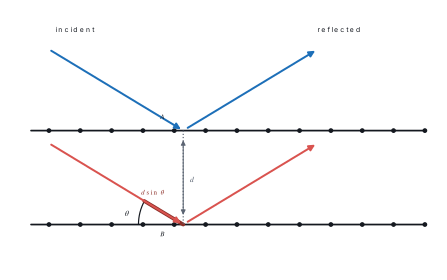
Crystals have layers of atoms separated by a distance d comparable to the X-ray wavelength. X-rays scattered from successive layers interfere. The ray from the second layer travels an extra distance 2d\sin\theta, where \theta is measured from the planes, not from the normal.
where d is the spacing between the reflecting planes, \theta the glancing angle between the ray and the plane, and n = 1, 2, 3, \dots the order of reflection.
Problem. X-rays of wavelength 0.154 nm are reflected from a crystal whose plane spacing is 0.282 nm. Find the glancing angle for the first-order maximum.
Solution. n = 1: \sin\theta = \lambda/(2d) = 0.154/(2\times0.282) = 0.273. \theta = \sin^{-1}(0.273) = 15.8^{\circ}.
Problem. An X-ray tube runs at 40 kV. Find the shortest wavelength emitted, and state what happens to it if the voltage is doubled.
Solution. \lambda_{min} = hc/eV = 1240\ \text{eV nm}/(4.0\times10^4\ \text{eV}) = 0.031 nm. Doubling the voltage doubles eV, so \lambda_{min} halves to 0.0155 nm. The target metal does not enter the calculation.
Moseley's law
Moseley (1913) measured the K_\alpha frequencies of many elements and found
where Z is the atomic number, a is a constant and b \approx 1 for the K series. The frequency of the characteristic line therefore rises steadily with atomic number — the line is a fingerprint of the element. This is how Moseley established that atomic number, not atomic mass, is the real ordering number of the elements, and it is the basis of X-ray fluorescence identification. You are not expected to use the equation numerically, only to know that \sqrt{f} is linear in Z and that the line is characteristic of the element.
Formula and fact sheet
| Quantity | Formula or value |
|---|---|
| Angular momentum | mvr = nh/2\pi, n = 1, 2, 3, \dots |
| Bohr radius | r_n = 0.529\,n^2 Å; a_0 = 0.529 Å |
| Speed | v_n = 2.19\times10^6/n m s⁻¹ = c/(137n) |
| Energy | E_n = -13.6/n^2 eV = -2.18\times10^{-18}/n^2 J |
| Energy relations | K = -E, U = 2E, U = -2K |
| Ionisation energy | 13.6 eV from n=1; 13.6/n^2 eV from level n |
| Excitation | 10.2 eV (1→2), 12.09 eV (1→3), 12.75 eV (1→4) |
| Rydberg | 1/\lambda = R(1/n_1^2 - 1/n_2^2), R = 1.097\times10^7 m⁻¹ |
| Photon energy shortcut | E = 1240/\lambda with E in eV, \lambda in nm |
| Lines from level n | n(n-1)/2 |
| Series | Lyman 1 (UV), Balmer 2 (visible), Paschen 3, Brackett 4, Pfund 5 (IR) |
| Balmer lines | Hα 656 nm, Hβ 486 nm, Hγ 434 nm, Hδ 410 nm; limit 365 nm |
| Lyman limit | 91.2 nm |
| de Broglie | \lambda = h/p = h/mv = h/\sqrt{2mK} |
| Electron through V | \lambda \approx \sqrt{150/V} Å |
| Uncertainty | \Delta x\Delta p \ge h/4\pi; \Delta E\Delta t \ge h/4\pi |
| X-ray cut-off | \lambda_{min} = hc/eV = 1240/V nm with V in volts |
| Bragg | 2d\sin\theta = n\lambda (\theta from the planes) |
| Moseley | \sqrt{f} = a(Z - b), b \approx 1 for K series |
| X-ray range | about 0.01–10 nm; c; undeflected by fields |
Chapter summary
- Bohr kept the nuclear atom and added stationary states, mvr = nh/2\pi, and photon emission on a jump, hf = E_2 - E_1.
- For hydrogen r_n = 0.529n^2 Å, v_n = 2.19\times10^6/n m s⁻¹ and E_n = -13.6/n^2 eV; the ground state is bound by 13.6 eV.
- A downward jump n_2 \to n_1 emits 1/\lambda = R(1/n_1^2 - 1/n_2^2); each n_1 names a series.
- Lyman ends on n = 1 and is ultraviolet; Balmer ends on n = 2 and is the only visible series; Paschen, Brackett and Pfund are infrared.
- The number of lines from level n is n(n-1)/2; lines crowd to a series limit.
- de Broglie: \lambda = h/p; an electron at 100 V has \lambda \approx 1.2 Å, small enough to diffract from crystals, which is the evidence for matter waves.
- \Delta x\Delta p \ge h/4\pi: confinement increases momentum spread, which is why electrons cannot live in nuclei and why atomic orbits are not sharp paths.
- X-rays come from a Coolidge tube: thermionic electrons accelerated onto a heavy target; over 99 % of the energy becomes heat.
- The continuous spectrum is bremsstrahlung and cuts off at \lambda_{min} = hc/eV; the characteristic lines are inner-shell transitions and do not move with voltage. K_\alpha is never the shortest wavelength.
- Bragg's law 2d\sin\theta = n\lambda measures crystal spacings; Moseley's \sqrt{f} = a(Z-b) makes the characteristic line an element fingerprint.
Practice questions
Set A — Recall (23 questions)
- Bohr's quantisation condition for the allowed orbits of the hydrogen atom isamvr = nhbmvr = nh/2\picmvr = n\hbar/2dmvr^2 = nh/2\pi
- The radius of the nth Bohr orbit of hydrogen is proportional toanb1/ncn^2d1/n^2
- The energy of the hydrogen atom in the state with principal quantum number n isa-13.6/n^2 eVb-13.6n^2 eVc-13.6/n eVd13.6/n^2 eV
- The ionisation energy of a hydrogen atom in its ground state isa3.4 eVb10.2 eVc27.2 eVd13.6 eV
- The first excitation energy of hydrogen isa3.4 eVb10.2 eVc12.09 eVd13.6 eV
- The Lyman series of hydrogen lies in theavisible regionbinfrared regioncultraviolet regiondmicrowave region
- The Balmer series of hydrogen ends on the levelan = 2bn = 1cn = 3dn = 4
- The series of hydrogen that ends on n = 3 is theaLyman seriesbBalmer seriescPaschen seriesdBrackett series
- The series limit of the Balmer series is abouta91.2 nmb121.6 nmc656 nmd365 nm
- The value of the Rydberg constant is abouta1.097\times10^7 m⁻¹b1.097\times10^5 m⁻¹c6.63\times10^{-34} m⁻¹d3.29\times10^{15} m⁻¹
- The angular momentum of the electron in the ground state of hydrogen isazerobh/2\pichd2h/\pi
- The de Broglie wavelength of a particle of mass m and speed v isahvbmv/hch/(mv^2)dh/mv
- For an electron accelerated through a potential difference V, the de Broglie wavelength is proportional toaVb1/Vc1/\sqrt{V}d\sqrt{V}
- The uncertainty principle states thataposition and momentum can both be measured exactlyb\Delta x\Delta p \ge h/4\picenergy is always uncertaind\Delta x\Delta p \le h/4\pi
- In a Coolidge X-ray tube, electrons are produced byathermionic emissionbphotoelectric emissioncfield emissiondsecondary emission
- The continuous X-ray spectrum is produced byatransitions between inner shellsbthe nucleus breaking upcionisation of the target atomsddeceleration of electrons in the target
- Characteristic X-rays are produced whenaelectrons are decelerated by nucleibouter electrons are removedcan inner-shell vacancy is filleddthe target is heated
- The shortest wavelength in an X-ray spectrum depends onathe tube voltage onlybthe target material onlycboth voltage and targetdthe filament current
- X-rays are not deflected by an electric or magnetic field because theyatravel at the speed of lightbare unchargedchave very short wavelengthdhave high energy
- Bragg's law for X-ray diffraction isad\sin\theta = n\lambdab2d\cos\theta = n\lambdacd\cos\theta = n\lambdad2d\sin\theta = n\lambda
- Moseley's law relates the frequency of a characteristic X-ray line toathe atomic massbthe tube voltagecthe atomic numberdthe tube current
- The penetrating power of an X-ray beam is increased byaincreasing the filament currentbincreasing the tube voltagecusing a thicker targetdcooling the anode
- The energy of a photon of wavelength 620 nm is abouta2.0 eVb1.0 eVc3.1 eVd4.0 eV
Answers and explanations — Set A
1. (b) — the allowed angular momenta are h/2\pi, 2h/2\pi, … so mvr = nh/2\pi. Option (a) misses the 2\pi.
2. (c) — r_n = 0.529n^2 Å, so the radius grows as the square of the quantum number.
3. (a) — E_n = -13.6/n^2 eV; the negative sign shows the electron is bound.
4. (d) — removing the electron from n=1 to n=\infty takes 0-(-13.6) = 13.6 eV.
5. (b) — the gap from n=1 to n=2 is 13.6(1-1/4) = 10.2 eV. The 3.4 eV in (a) is the ionisation energy from n=2.
6. (c) — every Lyman line ends on n=1, and the largest gaps give the shortest wavelengths, in the ultraviolet.
7. (a) — Balmer lines are jumps from higher levels down to n=2; that is why the visible hydrogen lines are Balmer lines.
8. (c) — Paschen lines end on n=3 and lie in the infrared.
9. (d) — the limit is the jump \infty \to 2: 1240/3.4 = 365 nm. The 656 nm in (c) is Hα, the first line, not the limit.
10. (a) — R = 1.097\times10^7 m⁻¹; (d) is cR, a frequency.
11. (b) — n=1 gives L = h/2\pi, not zero.
12. (d) — \lambda = h/p = h/mv; (b) is the inverse, which would have units of m⁻¹ s.
13. (c) — K = eV and \lambda = h/\sqrt{2mK}, so \lambda \propto 1/\sqrt{V}.
14. (b) — the product of the two uncertainties cannot be less than h/4\pi.
15. (a) — the tungsten filament is heated and electrons boil off it (thermionic emission).
16. (d) — bremsstrahlung: electrons lose any fraction of their energy on passing near a nucleus.
17. (c) — an inner-shell electron is knocked out, a higher electron falls in, and the fixed energy gap gives a sharp line.
18. (a) — \lambda_{min} = hc/eV contains only the voltage; the target sets the characteristic lines.
19. (b) — X-rays are photons, with no charge, so the Lorentz force on them is zero.
20. (d) — the extra path is 2d\sin\theta, measured from the planes.
21. (c) — \sqrt{f} = a(Z-b); the line frequency tracks atomic number.
22. (b) — a higher voltage gives each electron more energy, so shorter wavelengths and a harder beam. Filament current changes intensity, not hardness.
23. (a) — E = 1240/620 = 2.0 eV.
Set B — Understanding (14 questions)
- According to classical electromagnetism, the electron in Rutherford's atom shouldastay in a fixed orbit foreverbmove in a straight linecradiate continuously and spiral into the nucleusdemit only certain fixed wavelengths
- In the Balmer series, which transition emits the longest wavelength?a3 \to 2b4 \to 2c5 \to 2d\infty \to 2
- The ratio of the energy of the n=2 state to that of the n=1 state of hydrogen isa1/2b2c4d1/4
- When the principal quantum number of a hydrogen atom is doubled, its radius and speed becomea2r, 2vb4r, v/2c2r, v/2d4r, 2v
- A hydrogen atom is in the n=4 state. The number of different wavelengths it can emit while returning to the ground state isa3b4c6d10
- A hydrogen atom in the ground state absorbs a photon of energy 10.2 eV. The atomamoves to n=2bis ionisedcmoves to n=3dis unchanged
- A hydrogen atom in the ground state is offered a photon of energy 11.0 eV. The atomais ionised, and the electron leaves with 11.0 eVbmoves to n=2cis ionised, and the electron leaves with 0.6 eVdis unchanged
- An electron and a proton have the same speed. The de Broglie wavelength of the electron isashorter than that of the protonblonger than that of the protoncequal to that of the protondzero
- The uncertainty principle implies that an electron cannot be confined inside a nucleus becauseathe nucleus is positively chargedbthe electron would be attracted to the protonscthe momentum uncertainty would demand a speed above cda nucleus is too small to contain any particle
- If the voltage across an X-ray tube is doubled, the cut-off wavelengthahalvesbdoublescstays the samedbecomes four times
- Compared with the K_\alpha line, the K_\beta line hasaa longer wavelength and lower energybthe same wavelengthca longer wavelength but higher energyda shorter wavelength and higher energy
- The filament current of an X-ray tube is increased while the voltage is kept fixed. The result isaa shorter \lambda_{min}ba longer \lambda_{min}cmore intense X-rays at the same wavelengthsda change in the characteristic wavelengths
- In Bragg reflection, if the glancing angle is increased from the first-order to the second-order maximum, then \sin\theta becomesahalf as largebtwice as largecthe samedfour times as large
- The target of an X-ray tube is made of a heavy metal because a heavy targetagives a higher X-ray yieldbproduces a higher voltagecis easier to cooldemits only characteristic lines
Answers and explanations — Set B
1. (c) — an accelerating charge radiates; the electron would lose energy and spiral in within about 10^{-11} s, so atoms could not exist.
2. (a) — the smallest energy gap in a series gives the longest wavelength. 3\to2 is the smallest gap in Balmer; \infty\to2 gives the series limit, the shortest wavelength.
3. (d) — E_2 = -13.6/4 = -3.4 eV and E_1 = -13.6 eV, so E_2/E_1 = 1/4. Both are negative; the ratio is not 4.
4. (b) — r \propto n^2 so the radius is four times; v \propto 1/n so the speed is halved.
5. (c) — n(n-1)/2 = 4\times3/2 = 6: the jumps 4→1, 4→2, 4→3, 3→1, 3→2, 2→1.
6. (a) — 10.2 eV is exactly E_2 - E_1, so the atom is excited to n=2 and the photon is absorbed completely.
7. (d) — a photon is absorbed only if its energy equals a gap exactly. 11.0 eV is above the 10.2 eV gap but below 13.6 eV and matches no gap, so it passes by and the atom is unchanged.
8. (b) — \lambda = h/mv; at the same speed the lighter electron has the longer wavelength.
9. (c) — confining an electron to 10^{-14} m forces \Delta v \sim 6\times10^9 m s⁻¹, greater than c, which is impossible.
10. (a) — \lambda_{min} = hc/eV, so doubling V halves \lambda_{min}.
11. (d) — K_\beta falls from the M shell, a bigger energy gap than from L, so its photon has more energy and a shorter wavelength.
12. (c) — filament current sets the number of electrons, hence intensity; the wavelengths (including \lambda_{min}) are set by the voltage and the target.
13. (b) — 2d\sin\theta = n\lambda with fixed d and \lambda gives \sin\theta \propto n, so it doubles.
14. (a) — a high-Z target stops the electrons in a short distance and converts a larger fraction of their energy into X-rays, so the yield is higher.
Set C — Application (9 questions)
- The wavelength of the photon emitted in the transition n=3 \to n=2 of hydrogen is abouta122 nmb486 nmc656 nmd820 nm
- The energy needed to excite a hydrogen atom from n=2 to n=3 is abouta1.9 eVb3.4 eVc10.2 eVd13.6 eV
- The radius of the n=2 orbit of hydrogen isa0.53 Åb1.06 Åc4.24 Åd2.12 Å
- The speed of the electron in the n=2 orbit of hydrogen is abouta2.2\times10^6 m s⁻¹b1.1\times10^6 m s⁻¹c4.4\times10^6 m s⁻¹d5.5\times10^5 m s⁻¹
- An X-ray tube operates at 30 kV. The shortest wavelength it emits is abouta0.041 nmb0.41 nmc0.0041 nmd4.1 nm
- X-rays of wavelength 0.10 nm are diffracted by crystal planes of spacing 0.20 nm. The first-order glancing angle isa30°b45°c60°d14.5°
- The de Broglie wavelength of an electron accelerated through 400 V is abouta1.2 Åb0.61 Åc2.4 Åd4.9 Å
- The ionisation energy of a hydrogen atom in the n=2 state isa6.8 eVb10.2 eVc3.4 eVd13.6 eV
- A photon of wavelength 0.10 nm strikes a stationary electron. The momentum of the photon isa6.6\times10^{-25} kg m s⁻¹b6.6\times10^{-24} kg m s⁻¹c2.0\times10^{-24} kg m s⁻¹d3.3\times10^{-24} kg m s⁻¹
Answers and explanations — Set C
1. (c) — E = 13.6(1/4-1/9) = 1.89 eV; \lambda = 1240/1.89 = 656 nm (Hα). 122 nm is Lyman-α and 486 nm is Hβ (4\to2).
2. (a) — 13.6(1/4-1/9) = 1.89 eV. This equals the photon energy of the 3\to2 line, as it must.
3. (d) — r_2 = 0.529\times2^2 = 2.12 Å.
4. (b) — v_2 = 2.19\times10^6/2 = 1.1\times10^6 m s⁻¹.
5. (a) — \lambda_{min} = 1240/30000 = 0.0413 nm.
6. (d) — \sin\theta = 0.10/(2\times0.20) = 0.25, so \theta = 14.5^{\circ}. The glancing angle is measured from the planes, not from the normal.
7. (b) — \lambda = \sqrt{150/400} = \sqrt{0.375} = 0.61 Å.
8. (c) — from n=2 the electron needs 0-(-3.4) = 3.4 eV; 13.6 eV is from the ground state.
9. (b) — p = h/\lambda = 6.63\times10^{-34}/1.0\times10^{-10} = 6.6\times10^{-24} kg m s⁻¹.