Chapter 22 · Modern Physics · 2 questions in the paper · 26 min read
Particle Physics and Recent Trends
What the syllabus asks for 3
- Particles and antiparticles; leptons and quarks; the Higgs boson
- Nanotechnology
- The Big Bang theory and Hubble's law
The last chapter of the Physics paper looks outward twice: inward to the smallest objects we know, and outward to the whole universe. Modern Physics carries 12 of the 50 Physics questions (official MEC weightage), and we estimate about 2 come from here. The paper asks for the inventory — six quarks, six leptons, which particles make a proton, which force is carried by which boson — and for the evidence behind the Big Bang, especially Hubble's law. Nothing needs a long calculation; what it needs is precision, because this is the area where careless books print sentences that are simply false.
- Six quarks (u, d, c, s, t, b) with charges +\frac{2}{3} and -\frac{1}{3}; six leptons (e, μ, τ and their neutrinos); antiparticles for every particle.
- Hadrons: baryons are three quarks (p = uud, n = udd), mesons are a quark–antiquark pair (\pi^+=u\bar d).
- The four interactions, their exchange bosons, ranges and approximate relative strengths.
- The Higgs boson: quantum of the Higgs field, about 125 GeV/c^2, found at CERN in 2012; it gives mass to fundamental particles, not to everything.
- Nanotechnology: the 1–100 nm scale, why the properties change, and two or three real applications.
- The Big Bang: expansion, the CMB at 2.7 K, redshift, v=H_0d, and the age estimate 1/H_0\approx14 Gyr (accepted age 13.8 Gyr).
22.1 Particles and antiparticles; leptons and quarks; the Higgs boson
22.1.1 The inventory
By the 1970s the hundreds of particles found in cosmic rays and accelerators had been reduced to a small list of fundamental particles — particles with no known internal structure. This list is the Standard Model.
| Family | Members | Charge | Notes |
|---|---|---|---|
| Quarks (6) | up, down, charm, strange, top, bottom | +\frac{2}{3} (u, c, t); -\frac{1}{3} (d, s, b) | feel the strong force; never found alone |
| Leptons (6) | electron, muon, tau | -1 | feel the weak force and, if charged, electromagnetism |
| electron neutrino, muon neutrino, tau neutrino | 0 | almost massless; feel only the weak force | |
| Gauge bosons | photon, gluon, W^+, W^-, Z^0 | 0, 0, ±1, 0 | carry the forces |
| Higgs boson | H^0 | 0 | gives mass to the fundamental particles |
The quarks and leptons come in three generations of increasing mass: (u, d, e, \nu_e), then (c, s, μ, \nu_\mu), then (t, b, τ, \nu_\tau). Ordinary matter uses only the first generation plus the muon and neutrinos made in cosmic-ray showers and radioactive decays.

22.1.2 Antiparticles
For every particle there is an antiparticle with the same mass and opposite charge (and opposite quantum numbers). The antiparticle of the electron is the positron (e^+); of the proton, the antiproton; of the neutrino, the antineutrino; of a quark, the antiquark.
Two processes matter for the paper:
- Annihilation. A particle and its antiparticle can disappear, their mass-energy appearing as radiation. An electron and a positron at rest give two photons, each of energy m_ec^2=0.511 MeV, travelling in opposite directions so that momentum is conserved. Two photons, not one: a single photon could not carry away zero momentum.
- Pair production. A photon of sufficient energy near a nucleus can create an electron–positron pair. The minimum energy is 2m_ec^2=1.02 MeV, and any excess becomes kinetic energy of the pair. A single photon in empty space cannot do this — momentum conservation again requires a third body, the nucleus.
Problem. An electron and a positron, both nearly at rest, annihilate. Find the energy of each photon in joules and the wavelength of the radiation.
Solution. The total rest energy is 2m_ec^2=1.02 MeV, shared equally, so each photon has 0.511 MeV =0.511\times10^{6}\times1.6\times10^{-19}=8.2\times10^{-14} J.
\lambda=\dfrac{hc}{E}=\dfrac{1.99\times10^{-25}}{8.2\times10^{-14}} =2.4\times10^{-12} m =2.4 pm.
Check. 2.4 pm is a gamma ray, far shorter than any X-ray tube produces. The two photons must also travel in opposite directions, so that the total momentum stays zero.
An antiparticle has positive mass and positive energy. Only its charge and its other quantum numbers are reversed. Antimatter does not fall upwards, and it does not have negative energy. It annihilates with matter because particle number is not conserved in that interaction, not because the masses cancel.
22.1.3 Quarks and hadrons
Quarks are never found in isolation. They are held by the strong force, whose carrier is the gluon, and the force grows as quarks are pulled apart: separating two quarks creates a new quark–antiquark pair rather than a free quark. This is confinement, and it is why every experiment sees only combinations of quarks.
| Combination | Name | Examples |
|---|---|---|
| three quarks (qqq) | baryon | proton uud, neutron udd, \Lambda (uds), \Omega^- (sss) |
| quark + antiquark (q\bar q) | meson | \pi^+=u\bar d, \pi^-=\bar ud, K^+=u\bar s |
Both classes are hadrons — particles that feel the strong force. The charges work out exactly:
Notice that the neutron is neutral even though all three of its quarks are charged: the charges simply add to zero. That is a favourite exam trap.
Baryon number is a conserved quantity: each quark has B=+\frac{1}{3}, each antiquark -\frac{1}{3}. A proton or neutron therefore has B=+1, a meson has B=0, and in any reaction the total baryon number is unchanged. This is why the proton cannot decay into a positron and a pion, for example: those have B=0, and B must be conserved. No proton decay has ever been observed (the experimental limit on its lifetime is beyond 10^{34} years).
22.1.4 The four fundamental interactions
| Interaction | Exchange boson | Range | Relative strength | Acts on |
|---|---|---|---|---|
| Strong | gluon (8 kinds) | about 10^{-15} m (a nucleon) | 1 | quarks and therefore hadrons |
| Electromagnetic | photon | infinite (1/r^2) | about 10^{-2} | all charged particles |
| Weak | W^+, W^-, Z^0 | about 10^{-18} m | about 10^{-6} | all quarks and leptons |
| Gravitational | graviton (not yet observed) | infinite | about 10^{-38} | everything with mass-energy |
The numbers in the strength column are approximate and depend on which pair of particles is being compared; they are meant only to rank the forces. Two protons in a nucleus repel each other electrically and are held together by the strong force, which is about a hundred times stronger at nuclear distances. Gravity, weaker than the strong force by some 38 powers of ten, only becomes important when a very large mass is collected together — which is why it rules the planets and the galaxies but not the nucleus.
The weak interaction is the one responsible for beta decay: a neutron turns into a proton by emitting a W^-, which becomes an electron and an antineutrino. It is weak in strength but essential — without it the Sun could not burn hydrogen by the proton–proton chain.
Quarks: up down, charm strange, top bottom — "up down, charm strange, top bottom" in pairs. Leptons: the three charged ones (e, μ, τ) and their three neutrinos. Bosons: gluon for glue (strong), photon for electromagnetism, W/Z for the weak force, and the Higgs on its own.
22.1.5 The Higgs boson
Most of the Standard Model works with massless particles. But the W and Z bosons are heavy (80.4 and 91.2 GeV/c^2), and quarks and leptons have mass. The Higgs mechanism explains this: the universe is filled with a field — the Higgs field — and particles that interact with it behave as if they have mass. The Higgs boson is the quantum of that field, the ripple that can be produced in a collision.
The Higgs boson was discovered at CERN's Large Hadron Collider in 2012, with a mass of about 125 GeV/c^2 — about 133 times the mass of a proton. Higgs and Englert shared the 2013 Nobel Prize for the theory.
It gives mass to fundamental particles — the W and Z bosons, the quarks and the charged leptons — through their interaction with the field. It does not give mass to the photon or the gluon (they remain massless), and it is not the source of most of the mass of a proton or a neutron. About 99 % of a nucleon's mass is the energy of the gluon field and of the confined quarks, converted by E=mc^2. Saying "the Higgs gives mass to everything" is wrong, and it is exactly the sort of sentence a sloppy book prints.
One more honest qualification: in the original Standard Model the neutrinos are massless, but neutrino oscillation (one flavour turning into another) shows that they have small, different masses. That is a known gap between the simplest version of the model and experiment, and it is why neutrino physics is an active field.
22.2 Nanotechnology
22.2.1 The scale
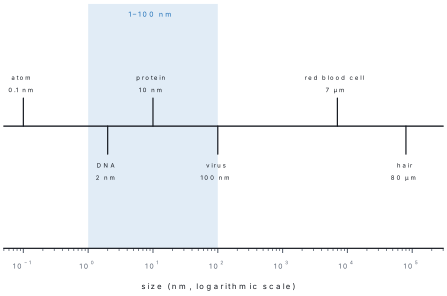
A nanometre is 10^{-9} m — one millionth of a millimetre. Nanotechnology is the design and use of structures with at least one dimension between about 1 nm and 100 nm. For comparison:
| Object | Size |
|---|---|
| hydrogen atom | about 0.1 nm |
| width of a DNA double helix | about 2 nm |
| a typical protein | 5–10 nm |
| a small virus | 20–300 nm |
| gate length in a modern processor | a few nm |
| red blood cell | about 7 000 nm (7 μm) |
| human hair | about 80 000 nm (80 μm) |
22.2.2 Why the properties change
Two things happen when a piece of material is made very small.
- Surface dominates. The fraction of atoms on the surface grows as 1/r. A 10 nm particle has roughly a fifth of its atoms on the surface, so surface chemistry — catalysis, adhesion, dissolution — controls its behaviour.
- Quantum effects appear. When the particle is smaller than the electron's quantum wavelength, the allowed energies become discrete, and the colour, melting point and electrical behaviour change with size. Gold nanoparticles, for example, are red or purple rather than golden, and their colour depends on their diameter.
22.2.3 Real applications
- Medicine — targeted drug delivery. Drugs are packaged in liposomes or polymer nanoparticles of 50–200 nm, which can pass through leaky tumour blood vessels and release the drug where it is needed, reducing side effects. Several such formulations are in clinical use.
- Water treatment. Nanoscale iron particles and nanomembranes remove arsenic and other contaminants from groundwater. This matters in the Terai, where arsenic in tube-well water is a real public-health problem.
- Materials and coatings. Titanium dioxide and zinc oxide nanoparticles make transparent sunscreens that block ultraviolet light; carbon nanotubes and graphene add strength and conductivity to composites; quantum dots are used as colour converters in some displays.
- Electronics. Transistor gates are now a few nanometres long, and this is nanotechnology in mass production, not in a laboratory.
Most "nanotechnology" in the market is materials — particles, coatings, composites — not tiny machines. Medical nanorobots that repair the body from inside are research ideas, not products. A question that offers "nanobots that cure all diseases" as an option is offering a distractor. Also, nanoparticles are not automatically safe: their large surface area makes some of them more reactive and potentially more toxic than the bulk material, which is why regulation exists.
The instruments that made the field possible are the scanning tunnelling microscope (STM, 1981) and the atomic force microscope (AFM), which can image and even move individual atoms.
22.3 The Big Bang theory and Hubble's law
22.3.1 The evidence
The Big Bang theory says that the universe was once far hotter and denser than it is now, and that it has been expanding and cooling ever since. It is supported by three independent observations.
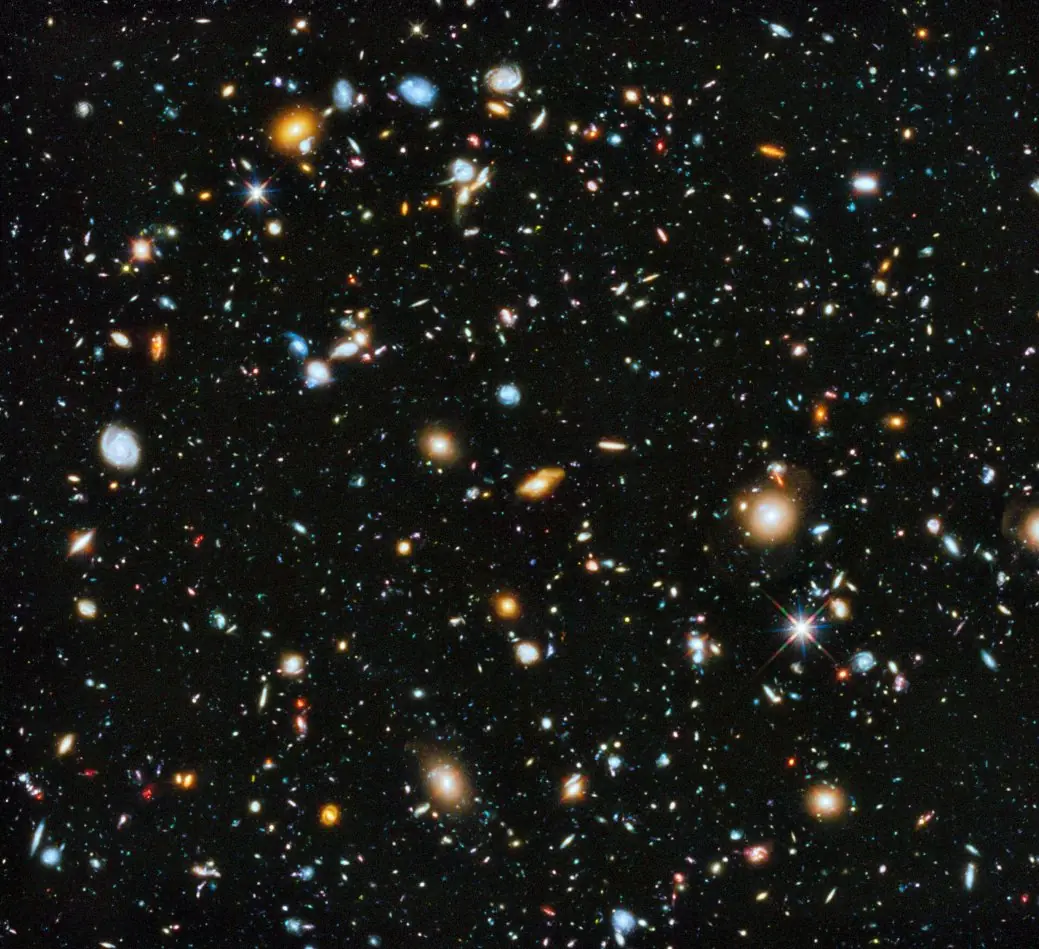
- The expansion. Distant galaxies recede from us, and the farther one is, the faster it recedes.
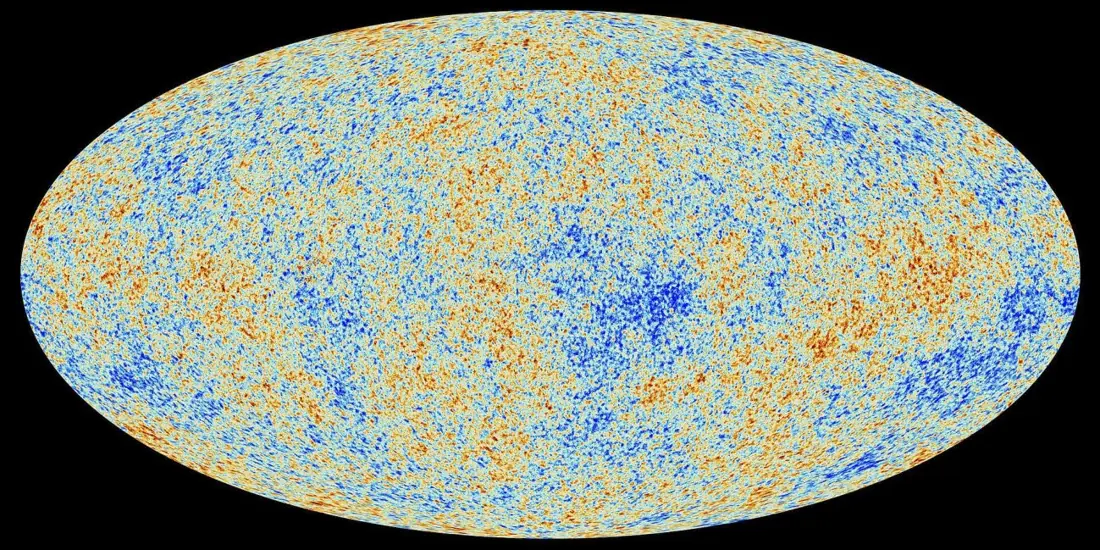
- The cosmic microwave background (CMB). A faint radiation fills all of space, with a nearly perfect blackbody spectrum at 2.725 K. It is the cooled remnant of the hot, opaque plasma that filled the universe until about 380 000 years after the beginning, when atoms formed and light could travel freely.
- The light elements. The observed abundances of hydrogen, helium-4 (about 25 % by mass), deuterium and lithium match the predictions of nuclear reactions in the first few minutes.
The CMB was found by accident by Penzias and Wilson in 1965 and mapped in detail by COBE, WMAP and Planck. Its tiny temperature ripples (about one part in 10^{5}) are the seeds from which galaxies grew.
22.3.2 Redshift
Light from a receding source is stretched to longer wavelengths. The redshift is
For small redshifts (small compared with 1) the recession speed is
so z=0.01 means about 3000 km s⁻¹. For large redshifts this linear formula fails and the full relativistic relation is needed; the paper only uses the small-z form.
The cosmological redshift is not quite a Doppler shift through space: space itself is expanding while the light travels, so the wavelength is stretched all the way along the path. For exam purposes the difference does not matter, but the correct picture is "expansion of space", not "galaxies rushing through space".
22.3.3 Hubble's law
In 1929 Hubble found that the recession speed of a galaxy is proportional to its distance:
where H_0 is the Hubble constant. Its measured value is about 70 km s⁻¹ Mpc⁻¹ (different methods give 67–73; the disagreement is the "Hubble tension"). One megaparsec is 3.09\times10^{22} m, or 3.26 million light years.
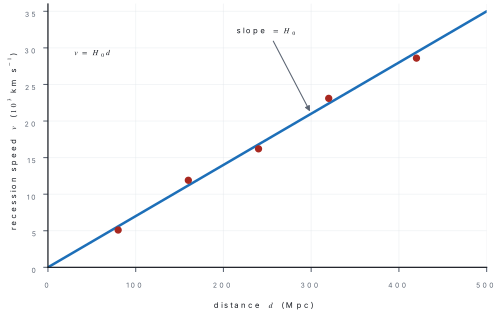
The law does not mean that we are at the centre. Every observer, in every galaxy, sees the same proportional recession: the expansion is uniform, like raisins moving apart in a rising loaf of bread. There is no centre and no edge.
22.3.4 The age of the universe
If the expansion had always had its present rate, a galaxy now at distance d would have been at our position a time d/v=1/H_0 ago. So 1/H_0 is a rough estimate of the age:
The accepted age is 13.8 billion years, slightly less than 14 Gyr because the expansion was faster in the past (the galaxies were braking under their mutual gravity) and is speeding up now under dark energy. The estimate 1/H_0 is therefore an upper limit for a universe whose expansion is slowing, and a rough figure in any case. Quote it as "about 14 billion years", and quote the accepted value as 13.8.
| Quantity | Value (approximate) |
|---|---|
| Age of the universe | 13.8 Gyr |
| Hubble constant H_0 | 70 km s⁻¹ Mpc⁻¹ |
| 1/H_0 | 14 Gyr |
| CMB temperature | 2.725 K |
| CMB last-scattering time | 380 000 years after the Big Bang |
| Redshift of the CMB | z\approx1100 |
| Ordinary (baryonic) matter | about 5 % of the energy budget |
| Dark matter | about 27 % |
| Dark energy | about 68 % |
- "The Big Bang was an explosion in space." It was an expansion of space; there is no centre from which galaxies fly out.
- "The universe has an edge." The observable universe has a horizon, but the whole universe is not known to have an edge.
- "Hubble's law proves the galaxies are moving away through space." It describes the expansion of the space between them. On small scales — inside a galaxy or a cluster — gravity holds things together, and Hubble's law does not apply.
Problem. A galaxy is observed with a redshift z=0.02. Taking H_0=70 km s⁻¹ Mpc⁻¹, estimate its distance.
Solution. v\approx cz=3.0\times10^{5}\times0.02=6.0\times10^{3} km s⁻¹.
d=\dfrac{v}{H_0}=\dfrac{6000}{70}=86 Mpc.
Check. 86 Mpc is about 280 million light years. The redshift is small enough that the linear formula is acceptable (2 % error at this level).
Problem. Show that 1/H_0 with H_0=70 km s⁻¹ Mpc⁻¹ gives about 14 billion years.
Solution. Convert H_0 to SI: H_0=\dfrac{70\times10^{3}\ \text{m s}^{-1}}{3.09\times10^{22}\ \text{m}} =2.27\times10^{-18}\ \text{s}^{-1}.
\dfrac{1}{H_0}=\dfrac{1}{2.27\times10^{-18}}=4.4\times10^{17} s =\dfrac{4.4\times10^{17}}{3.16\times10^{7}}=1.4\times10^{10} years.
Check. 14 billion years is the right order; the accepted 13.8 Gyr is close because the correction for the changing expansion rate is only a few per cent.
Formula and fact sheet
| Item | Fact or formula |
|---|---|
| Quarks | u, d, c, s, t, b; charges +\frac{2}{3},-\frac{1}{3},+\frac{2}{3},-\frac{1}{3},+\frac{2}{3},-\frac{1}{3} |
| Leptons | e, μ, τ (charge -1) and \nu_e,\nu_\mu,\nu_\tau (charge 0) |
| Proton, neutron | uud (charge +1), udd (charge 0) |
| Pions | \pi^+=u\bar d, \pi^-=\bar ud, \pi^0 a u\bar u/d\bar d mixture |
| Hadrons | baryons =qqq; mesons =q\bar q; both feel the strong force |
| Baryon number | +\frac{1}{3} per quark, -\frac{1}{3} per antiquark; conserved |
| Annihilation | e^++e^-\to2\gamma, each 0.511 MeV |
| Pair production | threshold 2m_ec^2=1.02 MeV, needs a nucleus nearby |
| Strong force | gluon; range \sim10^{-15} m; strength 1 |
| Electromagnetic | photon; infinite range; strength \sim10^{-2} |
| Weak | W^\pm, Z^0; range \sim10^{-18} m; strength \sim10^{-6} |
| Gravity | graviton (hypothetical); infinite range; strength \sim10^{-38} |
| Higgs | H^0, mass about 125 GeV/c^2, discovered at CERN 2012; gives mass to fundamental particles |
| Nanoscale | 1–100 nm; 1\ \text{nm}=10^{-9} m |
| Redshift | z=(\lambda_{obs}-\lambda_{emit})/\lambda_{emit}; v\approx cz for small z |
| Hubble's law | v=H_0d; H_0\approx70 km s⁻¹ Mpc⁻¹; 1\ \text{Mpc}=3.09\times10^{22} m |
| Hubble time | 1/H_0\approx4.4\times10^{17} s \approx14 Gyr |
| Age of universe | 13.8 Gyr |
| CMB | 2.725 K, emitted 380 000 years after the Big Bang, z\approx1100 |
Chapter summary
- The Standard Model has six quarks and six leptons, in three generations, each with an antiparticle of the same mass and opposite charge.
- Quarks are confined: only combinations are seen. Baryons are three quarks (p=uud, n=udd); mesons are a quark–antiquark pair (\pi^+=u\bar d).
- The four interactions are strong (gluon), electromagnetic (photon), weak (W, Z) and gravitational (graviton, not yet observed), with strengths in the approximate ratio 1:10^{-2}:10^{-6}:10^{-38} and ranges from 10^{-18} m to infinity.
- The Higgs boson (about 125 GeV/c^2, found at CERN in 2012) is the quantum of the field that gives mass to fundamental particles — not to the photon or gluon, and not most of the mass of a proton.
- Nanotechnology works at 1–100 nm, where the surface-to-volume ratio is large and quantum effects set in; real uses include drug delivery, water treatment, coatings and nanoscale transistors.
- The Big Bang is supported by the expansion, the 2.725 K CMB and the abundances of the light elements.
- Redshift z=\Delta\lambda/\lambda, with v\approx cz for small z; Hubble's law v=H_0d with H_0\approx70 km s⁻¹ Mpc⁻¹.
- 1/H_0\approx14 Gyr is a rough age; the accepted age is 13.8 Gyr, and the expansion has no centre.
Practice questions
Set A — Recall (21 questions)
- The number of quarks in the Standard Model isathreebfourcsixdtwelve
- The quark content of a proton isauddbuudcu\bar udud
- The charge of an up quark isa-\frac{1}{3}eb-eczerod+\frac{2}{3}e
- A positron is the antiparticle ofaan electronba protonca neutronda neutrino
- Which of the following is a lepton?aprotonbneutroncmuondpion
- The particle that carries the strong force is theaphotonbgluoncW bosondgraviton
- The range of the weak interaction is abouta10^{-18} mbinfinitec10^{-15} md1 m
- The Higgs boson was discovered in 2012 ataa laboratory in Chicagobthe Cavendish Laboratorycthe Stanford linear colliderdCERN
- The mass of the Higgs boson is abouta1 GeV/c^2b125 GeV/c^2c938 MeV/c^2d511 keV/c^2
- Hadrons are particles thatado not feel the strong forcebare all leptonscfeel the strong force and are made of quarksdare all massless
- A baryon is made ofathree quarksbtwo quarksca quark and an antiquarkdone quark
- A meson consists ofathree quarksbtwo leptonsctwo baryonsda quark and an antiquark
- The quark content of the \pi^+ meson isaudbu\bar ucu\bar ddd\bar d
- The baryon number of a proton isa0b+1c-1d+\frac{1}{3}
- The ratio of the strong force to the electromagnetic force between two nucleons is abouta1:10^{-2}b1:10^{-6}c1:10^{-38}d1:1
- Nanotechnology deals with structures whose size is abouta1–100 μmb0.1–1 nmc100–1000 nmd1–100 nm
- One nanometre equalsa10^{-6} mb10^{-9} mc10^{-12} md10^{-3} m
- The temperature of the cosmic microwave background is abouta0.27 Kb27 Kc2.7 Kd300 K
- Hubble's law is written asav=H_0dbv=H_0/dcd=H_0vdv=H_0d^2
- The Hubble constant is abouta70 km s⁻¹ per light yearb70 m s⁻¹ per Mpcc70 km s⁻¹ per kpcd70 km s⁻¹ per Mpc
- The accepted age of the universe is abouta4.6 billion yearsb13.8 billion yearsc100 billion yearsd1.4 million years
Answers and explanations — Set A
1. (c) — six: up, down, charm, strange, top and bottom, in three generations of two.
2. (b) — two up quarks and one down: +\frac{2}{3}+\frac{2}{3}-\frac{1}{3}=+1, the proton charge.
3. (d) — up-type quarks (u, c, t) carry +\frac{2}{3}e; down-type (d, s, b) carry -\frac{1}{3}e.
4. (a) — the positron has the electron's mass and the opposite charge; it is the first antiparticle found (1932).
5. (c) — the muon is a heavy electron, a fundamental lepton. Protons and neutrons are baryons, the pion is a meson.
6. (b) — gluons bind quarks and hold the nucleons together; the photon carries the electromagnetic force.
7. (a) — the W and Z bosons are very heavy, which confines the weak force to about 10^{-18} m, far less than a nucleon.
8. (d) — ATLAS and CMS at CERN's Large Hadron Collider announced the discovery in July 2012.
9. (b) — about 125 GeV/c^2, roughly 133 proton masses. 938 MeV is the proton and 511 keV the electron.
10. (c) — hadrons are the strongly interacting composite particles: baryons and mesons.
11. (a) — three quarks, as in the proton and neutron. A quark–antiquark pair is a meson.
12. (d) — a meson is a quark bound to an antiquark, which is why it has integer charge and baryon number zero.
13. (c) — u\bar d: +\frac{2}{3}-(-\frac{1}{3})=+1, the charge of \pi^+.
14. (b) — three quarks at +\frac{1}{3} each give B=+1; the antiproton has B=-1.
15. (a) — the strong force is roughly a hundred times the electromagnetic force at nuclear separations, hence the ratio 1:10^{-2}.
16. (d) — 1 to 100 nm: above a single atom (0.1 nm) and below a virus (about 100 nm).
17. (b) — a nanometre is 10^{-9} m, a millionth of a millimetre.
18. (c) — 2.725 K, the cooled remnant of the hot early universe; 300 K would be room temperature.
19. (a) — recession speed is proportional to distance, with H_0 as the constant of proportionality.
20. (d) — about 70 km s⁻¹ for every megaparsec of distance; the unit must have distance in the denominator.
21. (b) — 13.8 billion years from the Planck measurements; 4.6 billion is the age of the Earth.
Set B — Understanding (12 questions)
- A neutron contains three charged quarks, yet it is neutral becauseathe quarks are neutral inside a nucleonbthe charges add to zerocit contains an electrondthe strong force cancels the charge
- When an electron and a positron annihilate at rest, the products areaone photon of 1.02 MeVbtwo protonscone photon of 0.51 MeVdtwo photons of 0.51 MeV each
- A single free quark has never been observed becauseaquarks are confined by the strong forcebquarks have no chargecquarks are too light to detectdquarks decay immediately
- Beta decay, in which a neutron becomes a proton, is caused by theastrong forcebelectromagnetic forcecweak forcedgravitational force
- Gravity is negligible between two protons becauseaprotons have no massbit is enormously weaker than the other forcescit has an infinite rangedit acts only on electrons
- The Higgs field gives mass toaall particles without exceptionbphotons and gluonsconly the proton and neutrondfundamental particles such as the W boson and the quarks
- Nanoparticles have properties different from the bulk material mainly becauseathey are radioactivebthey contain fewer protonsctheir surface-to-volume ratio is very largedthey have no crystal structure
- The cosmic microwave background is evidence for the Big Bang because it isathe cooled radiation of the hot early universe, arriving from all directionsblight from the nearest starcthe glow of our own galaxydradiation from black holes only
- According to Hubble's law, if a galaxy's distance is doubled, its recession speedahalvesbdoublescstays the samedbecomes four times
- The light from a distant galaxy is redshifted becauseathe galaxy is made of different atomsbthe galaxy is moving towards uscthe light loses energy in dustdspace expands while the light travels
- 1/H_0 gives only an estimate of the age of the universe becauseathe expansion rate has not been constantbH_0 is not measured in SI unitscthe speed of light changesdgalaxies have finite size
- Which of the following is NOT a baryon?aprotonbneutroncpiond\Lambda particle
Answers and explanations — Set B
1. (b) — +\frac{2}{3}-\frac{1}{3}-\frac{1}{3}=0. The quarks keep their charges; the total is zero, so the neutron is neutral.
2. (d) — energy 2m_ec^2=1.02 MeV shared by two photons, emitted back to back so that momentum also balances.
3. (a) — the strong force between quarks does not weaken with distance in the usual way; pulling them apart makes new quark pairs instead of freeing one.
4. (c) — the weak force changes quark flavour, turning a down quark into an up quark and emitting a W^-; the strong and electromagnetic forces cannot do this.
5. (b) — gravity is about 10^{-38} of the strong force; between two protons the electrical repulsion is some 36 powers of ten larger than their gravitational attraction.
6. (d) — the Higgs mechanism gives mass to the W and Z bosons, quarks and charged leptons. Photons and gluons stay massless, and most of a nucleon's mass comes from gluon-field energy.
7. (c) — at 10 nm a large fraction of the atoms sit on the surface, and quantum confinement changes the allowed energies, so colour, melting point and reactivity all shift.
8. (a) — the CMB is a nearly perfect 2.725 K blackbody coming from every direction, exactly what a hot, dense early universe cooled to about 3000 K and then released would leave behind.
9. (b) — v=H_0d is linear, so doubling d doubles v.
10. (d) — the wavelength is stretched by the expansion of space during the light's journey; it is not a Doppler shift through a static space.
11. (a) — the formula assumes a constant rate; the real expansion was faster in the past, so the true age (13.8 Gyr) is a little less than 14 Gyr.
12. (c) — the pion is a meson (quark–antiquark), with baryon number zero. The other three are three-quark states.
Set C — Application (9 questions)
- A galaxy is 100 Mpc away. Taking H_0=70 km s⁻¹ Mpc⁻¹, its recession speed isa700 km s⁻¹b70 km s⁻¹c7000 km s⁻¹d7\times10^{5} km s⁻¹
- A galaxy is receding at 2100 km s⁻¹. With H_0=70 km s⁻¹ Mpc⁻¹, its distance isa30 Mpcb3 Mpcc300 Mpcd147 Mpc
- With H_0=70 km s⁻¹ Mpc⁻¹, the Hubble time 1/H_0 is abouta4.6 Gyrb1.4 Gyrc138 Gyrd14 Gyr
- A quasar has a redshift z=0.02. Its recession speed is abouta600 km s⁻¹b6000 km s⁻¹c60 km s⁻¹d6\times10^{5} km s⁻¹
- A galaxy has z=0.05. Taking H_0=70 km s⁻¹ Mpc⁻¹, its distance is abouta21 Mpcb75 Mpcc214 Mpcd1500 Mpc
- The minimum photon energy needed to produce an electron–positron pair near a nucleus isa0.511 MeVb1.5 MeVc2.04 MeVd1.02 MeV
- The total charge of the quark combination u\bar u isazerob+ec-ed+\frac{2}{3}e
- An electron and a positron annihilate at rest into two photons. The energy of each photon isa1.02 MeVb0.511 MeVc0.255 MeVd2.04 MeV
- If the Hubble constant were 140 instead of 70 km s⁻¹ Mpc⁻¹, the Hubble time would be abouta28 Gyrb14 Gyrc3.5 Gyrd7 Gyr
Answers and explanations — Set C
1. (c) — v=H_0d=70\times100=7000 km s⁻¹. Option (a) divides instead of multiplying.
2. (a) — d=v/H_0=2100/70=30 Mpc.
3. (d) — H_0=70 km s⁻¹ Mpc⁻¹ =2.27\times10^{-18} s⁻¹, so 1/H_0=4.4\times10^{17} s \approx14 Gyr.
4. (b) — v\approx cz=3.0\times10^{5}\times0.02=6000 km s⁻¹.
5. (c) — v=3.0\times10^{5}\times0.05=1.5\times10^{4} km s⁻¹, then d=15000/70=214 Mpc.
6. (d) — the pair has rest energy 2m_ec^2=2\times0.511=1.02 MeV, so that is the threshold.
7. (a) — +\frac{2}{3}-\frac{2}{3}=0; a quark and its own antiquark always give zero, which is why such a pair can appear in a meson with another quark.
8. (b) — the total energy 1.02 MeV is shared equally by two photons, so each carries 0.511 MeV.
9. (d) — the Hubble time is inversely proportional to H_0, so doubling H_0 halves it to about 7 Gyr.