Chapter 7 · Mechanics · 1 question in the paper · 29 min read
Elasticity
What the syllabus asks for 3
- Stress, strain and Hooke's law
- Young's modulus, bulk modulus and modulus of rigidity; Poisson's ratio
- Elastic potential energy and energy density
Elasticity explains why a steel bridge bends under a truck and springs back, why a rubber band stretches so much more than a steel wire of the same size, and why a glass window cracks while a copper pipe dents. Of the 10 Mechanics questions (official weightage), we estimate about 1 comes from this chapter. It is a formula chapter with a small number of ideas: stress over strain, the three moduli, Poisson's ratio, and the energy stored in a stretched wire. Most marks are lost on two things — mixing up which modulus belongs to which deformation, and forgetting that a wire's extension depends on length and on the square of the diameter.
- Stress =F/A (Pa) and strain (no unit); Hooke's law: stress \propto strain up to the proportional limit.
- Y=\frac{F/A}{\Delta L/L}=\frac{FL}{A\,\Delta L}; extension \Delta L=\frac{FL}{AY}, so \Delta L \propto L/d^2.
- K=-\frac{\Delta P}{\Delta V/V} (all states of matter); G=\frac{F/A}{\theta} (solids only).
- Poisson's ratio \sigma=-\frac{\Delta d/d}{\Delta L/L}, dimensionless, 0 to 0.5 for ordinary materials.
- Elastic energy U=\frac{1}{2}F\Delta L=\frac{1}{2}kx^2; energy density u=\frac{1}{2}\times\text{stress}\times\text{strain}.
- Young's modulus is a property of the material, not of the wire's length or thickness.
7.1 Stress, strain and Hooke's law
Deforming force, elasticity and plasticity
A deforming force changes the shape or size of a body. The body's own intermolecular forces oppose the change and try to restore the original shape; this is the restoring force.
Elasticity is the property of a body by which it regains its original shape and size when the deforming force is removed. Plasticity is the property by which it does not — the deformation remains.
- A perfectly elastic body returns exactly to its original shape (quartz, and steel within its elastic limit, come close).
- A perfectly plastic body keeps the new shape (putty, mud, lead beyond its elastic limit).
- No real material is perfectly either; the difference is how large the elastic range is.
A note on language: physicists call steel more elastic than rubber, even though rubber stretches much more. Elasticity is measured by the modulus — for the same stress, the material that strains less is the more elastic one. Rubber is stretchier, not more elastic.
Stress and its kinds
Stress is the internal restoring force set up per unit area of cross-section: \sigma=F/A. SI unit: N m⁻², called the pascal (Pa). Dimensions [ML^{-1}T^{-2}].
Stress is not pressure, although the units are the same. Pressure acts on a surface from outside and is always compressive; stress is set up inside the material and can be tensile, compressive or tangential.
| Type of stress | Force direction | Example | Modulus that pairs with it |
|---|---|---|---|
| Tensile | perpendicular, pulling apart | a wire hanging a load | Young's modulus Y |
| Compressive | perpendicular, pushing together | a pillar carrying a roof | Young's modulus Y |
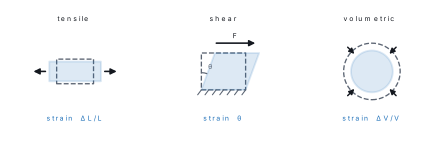
| Shear (tangential) | parallel to the surface | a book pushed sideways on a table; a rivet | modulus of rigidity G |
| Volumetric (hydraulic) | perpendicular, from all sides | a ball sunk deep in water | bulk modulus K |
Strain
Strain is the fractional change in dimension produced by the stress. It has no unit and no dimensions.
| Type of strain | Definition | Written as |
|---|---|---|
| Longitudinal (tensile) | change in length / original length | \Delta L/L |
| Volumetric | change in volume / original volume | \Delta V/V |
| Shear | displacement of one face / distance between faces | \Delta x/L=\tan\theta\approx\theta |
For small angles \tan\theta\approx\theta in radians, so shear strain is numerically the angle of shear in radians. Being a ratio of two lengths, strain is dimensionless — a point the paper tests often.
Hooke's law
Within the elastic limit, the stress produced in a body is directly proportional to the strain: \text{stress}\propto\text{strain}, or \text{stress}=E\times\text{strain}, where E is the modulus of elasticity of the material.
For a spring or a wire, the same law is written in terms of force and extension:
where k is the force constant (spring constant), N m⁻¹. For a wire, k=YA/L — a short, thick wire is stiff, a long, thin one is soft.
The constant of proportionality between stress and strain is the modulus of elasticity. Its value is large for a stiff material (steel) and small for a soft one (rubber). Because strain has no unit, the modulus has the same unit as stress, the pascal.
Stress is force per unit area inside the material; strain is a ratio. A strain of 10^{-3} means the wire grew by 0.1 % — not by 1 mm, unless you multiply by the original length. Options that give strain a unit (m, m m⁻¹, rad) are always wrong; only shear strain can be quoted in radians, and even then it is dimensionless.
The stress–strain curve
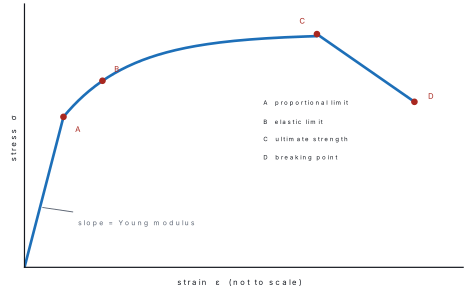
Stretch a wire slowly, recording stress against strain. The shape of the graph is the material's signature.
| Point on the graph | What happens |
|---|---|
| O to A — straight line | stress \propto strain; Hooke's law holds; the slope is the modulus |
| A — proportional limit | the straight line ends; proportionality stops, elasticity may not |
| B — elastic limit (yield point) | beyond this the wire does not return to its original length |
| B to C — plastic region | large strain for little extra stress; the material flows |
| C — ultimate tensile strength | the greatest stress the material can bear |
| C to D — necking | the wire thins locally and stress falls |
| D — breaking point | the wire snaps |
The curve above is for a ductile metal. A brittle material such as glass or cast iron has almost no plastic region: the line stays straight nearly to the breaking point, so a glass rod gives no warning before it snaps. An elastomer behaves differently again — it stretches a long way at low stress and then stiffens as the polymer chains line up.
Ductile, brittle and elastomeric materials
| Behaviour | Description | Examples |
|---|---|---|
| Ductile | long plastic region; can be drawn into wires | copper, mild steel, aluminium |
| Brittle | breaks soon after the elastic limit, almost no plastic region | glass, cast iron, concrete, chalk |
| Elastomer | stretches enormously, is not Hookean, and does not retrace its curve | rubber, silicone |
Rubber's curve does not come back along the same path: the unloading curve lies below the loading curve, and the area between them is energy converted to heat. This is elastic hysteresis; it is why a rubber ball bounces lower each time and why car tyres warm up.
Elastic fatigue and elastic after-effect
A material that is loaded and unloaded many times becomes weaker: its elastic limit falls, and it may break under a load it once carried easily. This is elastic fatigue — the reason a piece of wire snaps after being bent to and fro at the same place, and the reason a bridge is never designed to work near its breaking stress.
Some materials also do not recover instantly when the load is removed; the strain lags behind the stress. This slow recovery is the elastic after-effect (anelasticity), shown clearly by glass and lead.
What changes the modulus
| Change | Effect on elasticity |
|---|---|
| Rise in temperature | elasticity usually decreases (metals soften); rubber is the exception and stiffens on heating |
| Adding an impurity | usually increases the modulus — carbon in steel makes it stiffer |
| Annealing (slow cooling) | softens the metal, lowers the modulus, increases ductility |
| Hammering and cold working | hardens the metal and raises the elastic limit, but makes it more brittle |
Factor of safety
No structure is designed to work at its breaking stress. Engineers divide the breaking stress by a number — the factor of safety:
For bridges, lifts and pressure vessels it is typically 5 to 10. A steel cable whose breaking stress is 1.0\times10^9 Pa, used at a working stress of 1.0\times10^8 Pa, has a factor of safety of 10. A factor below 1 would mean the working stress already exceeds the breaking stress, so the part would fail as soon as it carried its design load.
1\ \text{mm} = 10^{-3} m, 1\ \text{mm}^2 = 10^{-6} m², 1\ \text{cm}^2 = 10^{-4} m². A diameter of 2 mm is a radius of 1\times10^{-3} m, so the area is \pi(10^{-3})^2 = 3.1\times10^{-6} m². Nearly every wrong option in this chapter comes from using the diameter as the radius, or mm² as m².
7.2 Young's modulus, bulk modulus and modulus of rigidity; Poisson's ratio
Young's modulus
For a wire of original length L, area A, stretched by \Delta L under a force F, the tensile stress is F/A and the longitudinal strain is \Delta L/L. Their ratio is Young's modulus:
Rearranged, the extension is
so for the same material and load,
- double the length → double the extension;
- double the diameter → one quarter of the extension;
- double both → half the extension.
Young's modulus is a property of the material (and of its temperature), not of the particular wire. A long thin wire and a short thick one cut from the same steel have the same Y; only their extensions differ.
| Material | Y (10¹⁰ Pa) |
|---|---|
| Steel | 20 |
| Copper | 11 |
| Brass | 9.1 |
| Aluminium | 7.0 |
| Glass | 6.5 |
| Bone | 1.5 |
| Rubber | 0.01–0.1 |
A question may say "a wire of twice the length and half the diameter is made of the same material — what happens to Young's modulus?" The answer is nothing. Y is fixed by the material. What changes is the extension, and it changes by (2)/(1/2)^2 = 8 times.
A wire hanging under its own weight
A vertical wire of length L, area A and density \rho stretches under its own weight. At a distance x above the free end the tension is the weight of the wire below that point, \rho A g x. A slice of thickness dx therefore extends by
Integrating from x=0 to x=L:
where M=\rho AL is the mass of the wire. This is half the extension the same wire would have if its whole weight hung from its end, because the tension grows from zero at the bottom to Mg at the top.
Bulk modulus and compressibility
When a body is subjected to a uniform pressure change \Delta P from all sides, its volume changes by \Delta V. The bulk modulus is
The minus sign keeps K positive: an increase in pressure decreases the volume, so \Delta V is negative. K applies to solids, liquids and gases — it is the one modulus every state of matter has.
The reciprocal of the bulk modulus is the compressibility:
A large K means a stiff, hard-to-compress material: steel K\approx1.6\times10^{11} Pa, water 2.2\times10^9 Pa, air about 1.0\times10^5 Pa. Water's bulk modulus is large, which is why a depth of 100 m changes its volume by less than 0.05 %.
For a gas, K is not a single number: - isothermal change (temperature held constant): K=P; - adiabatic change (no heat exchanged): K=\gamma P, where \gamma=C_P/C_V.
For air \gamma=1.4, so the adiabatic value is 1.4 times the isothermal one. Sound waves compress the air so quickly that no heat has time to flow, so the speed of sound uses v=\sqrt{\gamma P/\rho}, not \sqrt{P/\rho}. If a question says "isothermal", use P; if it says "adiabatic" or "sound", use \gamma P.
Modulus of rigidity (shear modulus)
A shear deformation changes the shape but not the volume: one face of a solid is displaced sideways relative to the opposite face, which is held fixed.
where \theta is the angle of shear in radians. The unit is the pascal. G is also called the shear modulus or modulus of rigidity.
Only solids have rigidity. A liquid or a gas cannot sustain a permanent shear stress — it flows — so G=0 for liquids and gases. Steel has G\approx8\times10^{10} Pa, about 40 % of its Young's modulus.
Stretch a rod — Young. Squash a volume — Bulk. Slide a face — Rigidity. Shrink a waist — Poisson.
For the same material and the same load, \Delta L_2/\Delta L_1 = (L_2/L_1)(d_1/d_2)^2. Write that ratio down before touching any numbers: most of these questions need no arithmetic beyond a square.
Problem. A rivet of cross-section 2.0 cm² and thickness 8.0 mm is sheared sideways by a force of 4000 N, and the sheared face is displaced by 0.020 mm. Find the shear stress, the shear strain and the modulus of rigidity.
Solution. A = 2.0\ \text{cm}^2 = 2.0\times10^{-4} m².
Shear stress = F/A = 4000/2.0\times10^{-4} = 2.0\times10^7 Pa.
Shear strain = \Delta x/L = 0.020/8.0 = 2.5\times10^{-3} rad.
The two displacements are in the same unit (mm), so the strain is a pure ratio — no conversion is needed for it.
Poisson's ratio
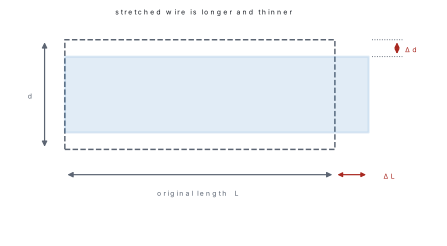
When a wire is stretched, it gets longer and thinner. The lateral contraction is a real strain, and its ratio to the longitudinal strain is Poisson's ratio:
The minus sign makes \sigma positive for ordinary materials, because \Delta d and \Delta L have opposite signs. \sigma is dimensionless.
| Value of \sigma | Meaning | Example |
|---|---|---|
| 0 | no lateral contraction at all | cork |
| 0.2–0.4 | typical metals | steel 0.28–0.30, copper 0.33 |
| 0.5 | volume stays constant while stretching | rubber |
The theoretical range is -1 to 0.5; ordinary materials lie between 0 and 0.5. Cork's near-zero value is why it is used for bottle stoppers — it can be pushed into a neck without swelling sideways.
Relations between the moduli
For an isotropic material (the same in all directions) the three moduli are not independent:
These let a question give two and ask for the third. They also explain the limits on \sigma: if \sigma were 0.5, Y=3K(1-1)=0 and the material would be infinitely compressible; if \sigma were -1, Y=0. Real materials sit safely inside.
| Modulus | Symbol | Formula | Resistance to | Applies to | Steel |
|---|---|---|---|---|---|
| Young's | Y | \frac{F/A}{\Delta L/L} | change of length | solids | 2.0\times10^{11} Pa |
| Bulk | K | -\frac{\Delta P}{\Delta V/V} | change of volume | solids, liquids, gases | 1.6\times10^{11} Pa |
| Rigidity | G | \frac{F/A}{\theta} | change of shape | solids only | 8.0\times10^{10} Pa |
Problem. A steel wire 2.0 m long and of cross-section 1.0 mm² extends by 1.0 mm under a load of 100 N. Find the stress, the strain and Young's modulus.
Solution. A = 1.0\ \text{mm}^2 = 1.0\times10^{-6} m².
Stress = F/A = 100/1.0\times10^{-6} = 1.0\times10^8 Pa.
Strain = \Delta L/L = 1.0\times10^{-3}/2.0 = 5.0\times10^{-4}.
Y = \text{stress}/\text{strain} = 1.0\times10^8/5.0\times10^{-4} = 2.0\times10^{11} Pa, the standard value for steel.
Problem. Two wires are made of the same material. Wire 2 is twice as long as wire 1 and has half its diameter. The same load is hung on each. Find the ratio \Delta L_2/\Delta L_1.
Solution. \Delta L = 4FL/(\pi d^2Y), and F, Y and \pi are the same, so
Wire 2 stretches eight times as much. The diameter matters twice over because the area depends on d^2.
Problem. A sphere of water of volume 1.0 litre is taken 100 m below the surface of a lake. Taking \rho = 1000 kg m⁻³, g = 9.8 m s⁻² and K = 2.2\times10^9 Pa, find the fractional change in its volume.
Solution. \Delta P = \rho g h = (1000)(9.8)(100) = 9.8\times10^5 Pa.
The volume falls by 0.045 %, about 0.45 cm³ in a litre. Water is hard to compress — that is why the bulk modulus is large.
Problem. A wire 1.5 m long and 2.0 mm in diameter stretches by 1.5 mm when loaded. Its diameter decreases by 6.0\times10^{-4} mm. Find Poisson's ratio.
Solution. Longitudinal strain = 1.5\times10^{-3}/1.5 = 1.0\times10^{-3}.
Lateral strain = 6.0\times10^{-4}/2.0 = 3.0\times10^{-4}.
The value is typical of steel. Note that both strains are dimensionless, so the ratio is a pure number.
7.3 Elastic potential energy and energy density
Work done in stretching
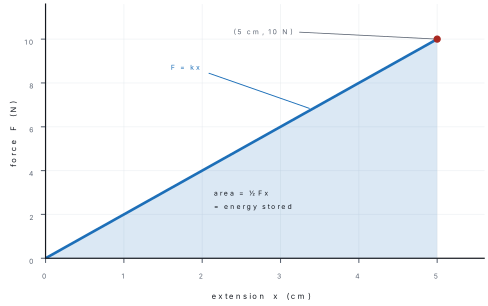
To stretch a spring or a wire, an external force must do work against the restoring force. Because the force grows from zero to F=kx as the extension grows, the work is the area under the force–extension graph — a triangle:
Using F=kx, this is also
This energy is stored in the stretched body as elastic potential energy and is returned when the force is removed (for a perfectly elastic body).
For a wire of length L, area A, Young's modulus Y, with extension \Delta L:
Energy density
The energy density is the elastic energy stored per unit volume:
Multiplying by the volume gives the total energy: U=uAL=\frac{1}{2}\sigma\varepsilon AL. A wire twice as long stores twice the energy at the same stress, because it has twice the volume.
The unit is J m⁻³, which is the same as Pa. This is the quantity a materials engineer compares when choosing a spring material: a good spring stores a lot of energy per kilogram without exceeding its elastic limit.
This is why a bow, a catapult and a vehicle suspension are built from materials with a high elastic limit as well as a high modulus — they must store a large energy per unit volume and still return it. Rubber stores more energy per unit mass than steel, which is why a rubber catapult works at all, even though steel has the larger Y.
The energy is \frac{1}{2}F\Delta L, not F\Delta L. The force is not constant while the wire stretches: it rises from 0 to F. Using the final force for the whole distance overcounts by a factor of 2 — the most common wrong option in this topic.
Problem. For the wire of Worked example 7.2 (load 100 N, extension 1.0 mm, length 2.0 m, area 1.0 mm²), find the energy stored and the energy density.
Solution. U = \frac{1}{2}F\Delta L = \frac{1}{2}(100)(1.0\times10^{-3}) = 0.050 J.
Volume = AL = (1.0\times10^{-6})(2.0) = 2.0\times10^{-6} m³.
Check with \frac{1}{2}\sigma\varepsilon: \frac{1}{2}(1.0\times10^8)(5.0\times10^{-4}) = 2.5\times10^4 J m⁻³ — the same, as it must be.
Formula and fact sheet
| Topic | Formula or fact |
|---|---|
| Stress | \sigma = F/A; Pa = N m⁻²; [ML^{-1}T^{-2}] |
| Strain | \Delta L/L, \Delta V/V, \theta; dimensionless |
| Hooke's law | stress \propto strain up to the proportional limit; F=kx |
| Young's modulus | Y=\frac{FL}{A\Delta L}; unit Pa; material property only |
| Extension | \Delta L=\frac{4FL}{\pi d^2Y}, so \Delta L\propto L/d^2 |
| Bulk modulus | K=-\frac{\Delta P}{\Delta V/V}; all states; compressibility =1/K |
| Gas bulk modulus | isothermal K=P; adiabatic K=\gamma P |
| Rigidity | G=\frac{F/A}{\theta}; solids only; zero for liquids and gases |
| Poisson's ratio | \sigma=-\frac{\Delta d/d}{\Delta L/L}; dimensionless; 0 to 0.5 |
| Moduli relations | Y=2G(1+\sigma); Y=3K(1-2\sigma) |
| Elastic energy | U=\frac{1}{2}kx^2=\frac{1}{2}F\Delta L=\frac{YA(\Delta L)^2}{2L} |
| Energy density | u=\frac{1}{2}\sigma\varepsilon=\frac{1}{2}Y\varepsilon^2=\frac{\sigma^2}{2Y}; J m⁻³ |
| Stress–strain points | proportional limit, elastic limit, ultimate strength, breaking point |
| Typical values | steel Y=2\times10^{11} Pa, G=8\times10^{10} Pa, K=1.6\times10^{11} Pa; water K=2.2\times10^{9} Pa |
Chapter summary
- Elasticity is the recovery of shape after a deforming force is removed; beyond the elastic limit the deformation is plastic and permanent.
- Stress is force per unit area inside the material (Pa); strain is a fractional change of length, volume or angle and has no unit.
- Hooke's law — stress proportional to strain — holds only up to the proportional limit; the constant is the modulus of elasticity.
- Y=\frac{FL}{A\Delta L} applies to stretching and compressing solids. It depends on the material, not on the wire's dimensions; the extension itself obeys \Delta L\propto L/d^2.
- K=-\frac{\Delta P}{\Delta V/V} applies to every state of matter; for a gas it is P isothermally and \gamma P adiabatically.
- G=\frac{F/A}{\theta} applies to solids only; liquids and gases have no rigidity.
- Poisson's ratio \sigma=-\frac{\Delta d/d}{\Delta L/L} is dimensionless, 0 for cork, about 0.3 for steel and 0.5 for rubber.
- The three moduli are linked: Y=2G(1+\sigma) and Y=3K(1-2\sigma).
- A stretched wire stores \frac{1}{2}F\Delta L=\frac{1}{2}kx^2; per unit volume the energy density is \frac{1}{2}\sigma\varepsilon=\frac{\sigma^2}{2Y}.
Practice questions
Set A — Recall (20 questions)
- The SI unit of stress isaN mbJ m⁻²cN m⁻²dN m²
- The strain produced when a force acts parallel to the surface of a body is calledashear strainblongitudinal straincvolumetric straindtensile strain
- Hooke's law is obeyed up to theaproportional limitbyield pointcbreaking pointdultimate strength
- Young's modulus is defined asastress × strainbstrain ÷ stresscstress ÷ straindforce × extension
- The dimensional formula of Young's modulus isa[MLT⁻²]b[ML²T⁻²]cdimensionlessd[ML⁻¹T⁻²]
- Which of the following has no modulus of rigidity?asteelbwaterccopperdglass
- The bulk modulus is defined asa\frac{\Delta V/V}{\Delta P}b\Delta P\times\frac{\Delta V}{V}c-\frac{\Delta P}{\Delta V/V}d-\frac{\Delta V}{V\Delta P}
- Compressibility is the reciprocal ofaYoung's modulusbmodulus of rigiditycPoisson's ratiodbulk modulus
- Poisson's ratio is the ratio ofalateral strain to longitudinal strainblongitudinal strain to lateral straincstress to straindchange in volume to original volume
- Poisson's ratio isameasured in mbmeasured in Pacdimensionlessdmeasured in m²
- The SI unit of energy density isaJbJ m⁻³cN m⁻¹dPa m²
- The elastic potential energy stored in a stretched wire isa½FΔLbFΔLc2FΔLdF/ΔL
- The slope of the linear part of a stress–strain graph givesathe elastic limitbthe modulus of elasticitycthe breaking stressdthe strain energy
- The ratio of shear stress to shear strain is calledaYoung's modulusbbulk moduluscmodulus of rigiditydPoisson's ratio
- A body that regains its original shape completely when the deforming force is removed isaplasticbbrittlecductiledperfectly elastic
- For the same stress, a steel wire stretches less than a rubber band because steel hasaa smaller Young's modulusba larger Young's modulusca larger Poisson's ratioda smaller density
- Young's modulus has the same dimensions asaforcebenergycpressuredmomentum
- In F = kx for a spring, k is called theastressbstraincmodulusdforce constant
- Bulk modulus applies toasolids onlybliquids onlycgases onlydsolids, liquids and gases
- The modulus of rigidity of a liquid isazerobinfinitecequal to its bulk modulusdequal to its Young's modulus
Answers and explanations — Set A
1. (c) — stress is force per unit area, N m⁻² = Pa. N m is a torque, and J m⁻² equals N m⁻¹, which is surface tension, not stress.
2. (a) — a force along the surface produces shear, measured by the angle θ through which a face is displaced. Tensile and longitudinal strains come from forces perpendicular to the surface.
3. (a) — the straight part of the stress–strain graph ends at the proportional limit; the elastic limit is slightly beyond it.
4. (c) — Y=\frac{\text{stress}}{\text{strain}}. Multiplying them would give energy per volume.
5. (d) — stress and strain have the same dimensions as pressure: [ML^{-1}T^{-2}].
6. (b) — a liquid cannot sustain a shear stress; it flows, so G=0. Glass is a solid and has rigidity.
7. (c) — the minus sign keeps K positive when pressure rises and volume falls.
8. (d) — compressibility =1/K; a large bulk modulus means low compressibility.
9. (a) — lateral strain over longitudinal strain, with a minus sign in the definition to make it positive.
10. (c) — it is a ratio of two strains, so it is a pure number.
11. (b) — energy per unit volume, J m⁻³, which equals Pa.
12. (a) — the force rises linearly from zero, so the work is the area of a triangle, \frac{1}{2}F\Delta L.
13. (b) — slope =\frac{\text{stress}}{\text{strain}}=Y (or the relevant modulus).
14. (c) — shear stress over shear strain is the modulus of rigidity, G.
15. (d) — that is the definition of perfect elasticity. A ductile body deforms permanently; a brittle one breaks.
16. (b) — the same stress gives strain =\text{stress}/Y; a larger Y means a smaller strain. Steel is "more elastic" in this technical sense.
17. (c) — Y is stress per unit strain, and strain is dimensionless, so Y has the dimensions of stress, the same as pressure.
18. (d) — k is the force constant or spring constant, in N m⁻¹.
19. (d) — every state of matter resists a change of volume, so K is defined for solids, liquids and gases.
20. (a) — a liquid flows under shear, so it offers no elastic resistance to shape change: G=0.
Set B — Understanding (13 questions)
- A wire extends by 1 mm under a load of 50 N. Within the elastic limit, the extension under 150 N isa1.5 mmb3 mmc6 mmd9 mm
- Two wires of the same material and length have radii r and 2r. Under the same load, the ratio of their extensions (thin : thick) isa4 : 1b1 : 4c2 : 1d1 : 2
- A wire of length L and diameter d is replaced by one of length 2L and diameter 2d, of the same material, under the same load. Its extension becomesadoublebthe samechalfdone quarter
- Young's modulus of a wire depends onaits lengthbits diametercthe applied loaddthe material only
- Steel is said to be more elastic than rubber becauseasteel is strongerbsteel returns to shape and rubber does notcfor the same stress steel produces less straindsteel has a smaller Young's modulus
- The area under a force–extension graph givesaenergy storedbstresscstraindYoung's modulus
- A material that can be drawn into long wires without breaking isabrittlebductilecperfectly elasticdan elastomer
- Glass breaks with almost no plastic deformation, so it isaductilebmalleablecbrittledelastic
- A wire stretched beyond its elastic limitareturns to its original lengthbbreaks at oncecbecomes perfectly elasticdis permanently deformed
- For a material whose volume does not change when it is stretched, Poisson's ratio isa0.5b0c0.25d1
- Cork has a Poisson's ratio close to zero, which is why itais very strongbdoes not bulge sideways when compressedcis a good conductordhas a large Young's modulus
- The bulk modulus of a gas in an adiabatic change isaPbγPcP/γdzero
- If the load on a wire is doubled, within the elastic limit, the energy stored becomesadoublebhalfcfour timesdunchanged
Answers and explanations — Set B
1. (b) — Hooke's law gives extension proportional to load: 3\times1 = 3 mm.
2. (a) — \Delta L\propto1/r^2, so the thin wire extends (2r/r)^2 = 4 times as much.
3. (c) — \Delta L\propto L/d^2: the length doubles but d^2 becomes four times, so the net factor is 2/4 = 1/2.
4. (d) — Y is a material constant (temperature aside). Length, diameter and load change the extension, not the modulus.
5. (c) — elasticity here means a small strain for a given stress, which is exactly a large Y. Strength (breaking stress) is a different property.
6. (a) — work =\int F\,dx is the area; that work is stored as elastic energy.
7. (b) — ductility is the ability to undergo large plastic deformation in tension.
8. (c) — brittleness is fracture with little or no plastic flow.
9. (d) — the deformation is no longer recoverable, so a permanent set remains.
10. (a) — zero volume change means the lateral contraction exactly compensates the stretching, which occurs at \sigma=0.5.
11. (b) — a near-zero Poisson's ratio means almost no lateral expansion, so a cork stays the same width when pushed into the neck.
12. (b) — K=\gamma P adiabatically and K=P isothermally. Sound uses the adiabatic value.
13. (c) — U=\frac{1}{2}kx^2 and x\propto F, so doubling F quadruples U.
Set C — Application (10 questions)
- A steel wire 2.0 m long and of cross-section 1.0 mm² extends by 1.0 mm under a load of 100 N. Young's modulus of the steel isa2 × 10¹⁰ Pab2 × 10¹¹ Pac2 × 10⁹ Pad5 × 10¹⁰ Pa
- The elastic energy stored in that wire isa0.05 Jb0.10 Jc0.50 Jd5.0 J
- Two wires of the same material have the same length but diameters d and d/2. Under the same load, the ratio of their extensions (thin : thick) isa2b4c8d16
- A wire of length L and radius r extends by x under a load F. Another wire of the same material, length 2L and radius 2r, under the same load extends byax/4bxc2xdx/2
- A sphere of water of volume 1 litre is taken 100 m deep in a lake (ρ = 1000 kg m⁻³, g = 9.8 m s⁻², K = 2.2 × 10⁹ Pa). The fractional change in volume isa4.5 × 10⁻⁶b2.2 × 10⁻⁴c4.5 × 10⁻²d4.5 × 10⁻⁴
- A wire has a stress of 1.0 × 10⁸ Pa and a strain of 5.0 × 10⁻⁴. The energy density isa2.5 × 10⁴ J m⁻³b5.0 × 10⁴ J m⁻³c2.5 × 10⁵ J m⁻³d1.0 × 10⁴ J m⁻³
- A wire 1.5 m long and 2.0 mm in diameter stretches by 1.5 mm, while its diameter shrinks by 6.0 × 10⁻⁴ mm. Poisson's ratio isa0.15b0.30c0.60d3.0
- A steel rod 1.0 m long and of cross-section 1.0 cm² is compressed by 0.01 mm (Y = 2 × 10¹¹ Pa). The force required isa20 Nb2000 Nc200 Nd2 × 10⁵ N
- A spring of force constant 200 N m⁻¹ is stretched by 5.0 cm. The energy stored isa0.025 Jb2.5 Jc0.25 Jd5.0 J
- A wire breaks under a stress of 1.0 × 10⁹ Pa. The greatest load it can carry if its cross-section is 0.50 mm² isa500 Nb50 Nc1000 Nd5 N
Answers and explanations — Set C
1. (b) — Y=\frac{FL}{A\Delta L} = \frac{(100)(2.0)}{(1.0\times10^{-6})(1.0\times10^{-3})} = 2\times10^{11} Pa.
2. (a) — U=\frac{1}{2}F\Delta L = \frac{1}{2}(100)(1.0\times10^{-3}) = 0.05 J. Option (b) forgets the ½.
3. (b) — the thin wire has area \pi(d/2)^2 = A/4, so for the same load its extension is 4 times larger: thin : thick = 4:1.
4. (d) — \Delta L\propto L/r^2; doubling both multiplies by 2/4 = 1/2.
5. (d) — \Delta P=\rho gh = 9.8\times10^5 Pa; \Delta V/V = \Delta P/K = 9.8\times10^5/2.2\times10^9 = 4.5\times10^{-4}.
6. (a) — u=\frac{1}{2}\sigma\varepsilon = \frac{1}{2}(1.0\times10^8)(5.0\times10^{-4}) = 2.5\times10^4 J m⁻³.
7. (b) — lateral strain =6.0\times10^{-4}/2.0 = 3.0\times10^{-4}; longitudinal =1.5\times10^{-3}/1.5 = 1.0\times10^{-3}; \sigma=0.30.
8. (c) — F=\frac{YA\Delta L}{L} = \frac{(2\times10^{11})(1.0\times10^{-4})(1.0\times10^{-5})}{1.0} = 200 N.
9. (c) — U=\frac{1}{2}kx^2 = \frac{1}{2}(200)(0.05)^2 = 0.25 J. Option (d) 5.0 J comes from using \frac{1}{2}kx and never squaring the extension.
10. (a) — F=\text{stress}\times A = (1.0\times10^9)(0.50\times10^{-6}) = 500 N.