Chapter 17 · Electrostatics and Capacitors · 4 questions in the paper · 37 min read
Electrostatics and Capacitors
What the syllabus asks for 3
- Electric charge, electrostatic induction and Coulomb's law
- Electric field of point charges; electric potential and potential energy; Gauss's law
- Capacitors: the parallel-plate capacitor, combinations, energy density and the effect of a dielectric
Electrostatics is the physics of charge at rest: how charge is transferred from one body to another, how it pushes and pulls other charge, and what it does to the space around it. The area carries 4 of the 50 Physics questions (official MEC weightage), and this one chapter supplies all four — the heaviest single chapter in the paper. The marks divide almost evenly between Coulomb's law and fields, potential and Gauss's law, and capacitors, so none of the three can be left out.
- Quantisation q = ne; charging by friction, conduction and induction; what a gold-leaf electroscope shows.
- Coulomb's law in vacuum and in a medium, and the net force on one charge due to several others.
- The zero-field point on a line of two charges, and the charge that holds a three-charge system in equilibrium.
- Field of a point charge and of a charged conducting sphere (zero inside); the rules field lines obey.
- Potential V = kq/r, potential energy U = qV = kq_1q_2/r, and E = -dV/dr.
- The three Gauss results: sphere kQ/r^2, line \lambda/(2\pi\varepsilon_0r), sheet \sigma/(2\varepsilon_0).
- C = Q/V; C = \varepsilon_0A/d and K\varepsilon_0A/d; series and parallel; U = \frac12CV^2; u = \frac12\varepsilon_0E^2.
- The dielectric table: battery connected against battery removed.
17.1 Electric charge, electrostatic induction and Coulomb's law
Charge and its four properties
There are two kinds of electric charge. Like charges repel, unlike charges attract. A body is charged when it gains or loses electrons; protons do not move from one body to another in ordinary charging.
- Quantisation. Every charge is a whole-number multiple of the elementary charge: q = ne, with e = 1.6\times10^{-19} C. So one coulomb is the charge of 1/1.6\times10^{-19} = 6.25\times10^{18} electrons. An electron carries -e, a proton +e.
- Conservation. Charge is neither created nor destroyed. When a glass rod is rubbed with silk, the rod loses electrons and becomes positive; the silk gains exactly the same number and becomes negative. The total charge stays zero.
- Additivity. Total charge is the algebraic sum of the individual charges — it is a scalar, although we speak of "positive" and "negative" charge.
- Invariance. Charge on a body does not change with its speed.
A conductor (metals, graphite, salt solution) has free electrons that move through it easily. An insulator (glass, rubber, dry wood, plastic) holds its electrons tightly; charge placed on it stays where it was put.
Three ways to charge a body
| Method | What is done | Charge acquired |
|---|---|---|
| Friction | two different insulators are rubbed together | equal and opposite charges on the two |
| Conduction | the body is touched with a charged conductor | same sign as the charging body |
| Induction | a charged body is held near, the body is earthed, then separated | opposite sign to the inducing charge |
Induction is the one the paper tests. Bring a positively charged rod near an uncharged metal sphere (no contact). Electrons in the metal are attracted towards the rod, so the near side becomes negative and the far side is left positive. The sphere as a whole is still neutral. If it is now earthed — even by a finger — electrons flow from the earth to neutralise the far side. Break the earth connection first, then remove the rod: the sphere is left with a net negative charge, opposite to the rod.
If you remove the rod before removing the earth connection, the separated charge simply flows back and the sphere ends up neutral. The sequence is: rod near → earth → remove earth → remove rod.
The gold-leaf electroscope
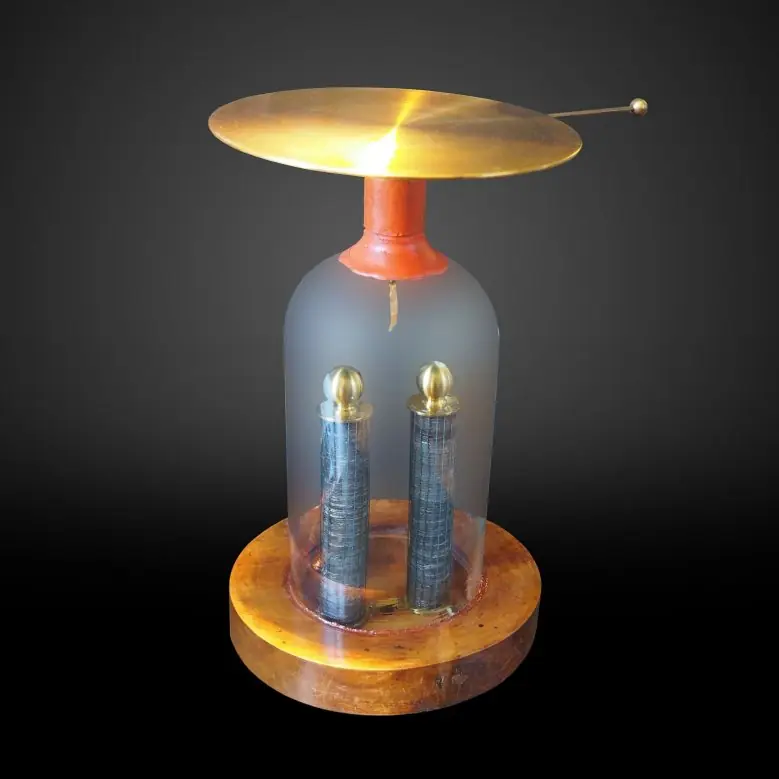
A metal rod carries a brass disc (or cap) at the top and two thin gold leaves at the bottom, all inside a glass case. The case is earthed (often by a metal coating) so that outside charges cannot interfere.
- Charged by conduction: touch the cap with a charged rod. Charge spreads over the cap, rod and leaves; both leaves get the same sign and repel, so they diverge. The electroscope now has the same sign as the rod.
- Charged by induction: hold a charged rod near the cap without touching. The cap gets the opposite charge and the leaves the same charge as the rod, so the leaves diverge. Touch the cap briefly (earth it): the leaves collapse. Remove the finger, then the rod: the leaves diverge again, now carrying the opposite charge to the rod.
- Testing the sign of an unknown charge: first charge the electroscope with a known sign. Bring the unknown body near the cap. If the divergence increases, the body has the same sign; if it decreases, the opposite sign.
- Testing whether a body is charged: bring it near an uncharged electroscope. Any divergence means it is charged.
The divergence measures neither the charge nor the potential exactly — it is a detector, not a meter.
Coulomb's law
The force between two point charges at rest in vacuum is proportional to the product of the charges and inversely proportional to the square of the distance between them:
where q_1, q_2 are in coulomb, r in metre, F in newton, and \varepsilon_0 = 8.85\times10^{-12} C² N⁻¹ m⁻² is the permittivity of free space. The constant k = 1/(4\pi\varepsilon_0) = 9\times10^{9} N m² C⁻².
In vector form, the force on q_1 due to q_2 is \vec F_{12} = k\,q_1q_2\,\hat r_{12}/r^2, where \hat r_{12} points from q_2 to q_1. A positive product gives a force along \hat r_{12} (repulsion); a negative product reverses it (attraction).
In a medium of dielectric constant (relative permittivity) K, the force is reduced:
For water K \approx 80, so two charges attract or repel 80 times more weakly in water than in air.
The law holds for point charges, for charges at rest, and for distances large compared with the size of the bodies. For spheres, r is measured between centres.
Superposition. The force between two charges is not changed by the presence of a third. The net force on a charge is the vector sum of the forces due to each of the others, taken one at a time.
| Feature | Electrostatic force | Gravitational force |
|---|---|---|
| Acts between | charges | masses |
| Direction | attract or repel | always attract |
| Formula | kq_1q_2/r^2 | Gm_1m_2/r^2 |
| Relative strength (two protons) | about 10^{36} times stronger | weakest force |
| Effect of medium | reduced by K | unchanged |
| Shielding | can be shielded | cannot be shielded |
Three charges in a line
Two fixed charges q_1 and q_2 a distance L apart create a point where the net field is zero — the null point. Its position follows from equating the two field magnitudes.
- If q_1 and q_2 have the same sign, the null point lies between them, nearer the smaller charge, at distance x from q_1 given by x = L/(1+\sqrt{q_2/q_1}).
- If they have opposite signs, the null point lies outside the pair, on the side of the smaller charge.
For the whole three-charge system to be in equilibrium, the third charge must be opposite in sign to the other two, and its magnitude is fixed by the condition that the net force on every charge is zero.
Problem. Charges +4\ \mu\text{C} and +1\ \mu\text{C} are fixed 30 cm apart in air. (a) Where on the line can a third charge be placed so that the force on it is zero? (b) What charge there would keep all three charges in equilibrium?
Solution. (a) The point is between them, nearer the 1\ \mu\text{C} charge. Let x be its distance from the 4\ \mu\text{C} charge:
So the point is 20 cm from the 4\ \mu\text{C} charge and 10 cm from the 1\ \mu\text{C} charge.
(b) The third charge q must be negative. For the 1\ \mu\text{C} charge to be in equilibrium, the pull from q at 10 cm must balance the push from the 4\ \mu\text{C} charge at 30 cm:
So q = -0.44\ \mu\text{C}. (Check the 4\ \mu\text{C} charge: the forces are k(4)(1)/0.30^2 and k(4)(4/9)/0.20^2, both equal to 44.4k.)
Charges at the corners of a triangle
Three equal charges q at the corners of an equilateral triangle of side a: the force on any one charge is the vector sum of two forces of magnitude kq^2/a^2 at 60°, so
directed away from the centre of the triangle. To hold the system in equilibrium, a charge q' = -q/\sqrt{3} is placed at the centre. For a square with equal charges at the corners, the field at the centre is zero by symmetry, but the potential there is not.
17.2 Electric field, potential and Gauss's law
Electric field
The electric field at a point is the force per unit positive charge placed there:
It is a vector, pointing the way a positive test charge would be pushed. The unit is N C⁻¹, which is the same as V m⁻¹. For a point charge,
directed radially outward for positive q and inward for negative q. Fields from several charges add as vectors.
Between two parallel plates with potential difference V a distance d apart, the field is uniform: E = V/d, directed from the positive plate to the negative one.
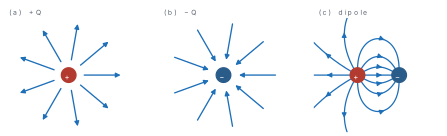
Rules for field lines.
- They start on positive charge and end on negative charge (or go to infinity).
- They never cross: at a crossing point the field would have two directions.
- Their density (lines per unit area perpendicular to them) is proportional to the field strength.
- They leave and enter a conductor perpendicular to its surface.
- There are no field lines inside a conductor in electrostatic equilibrium.
- They behave like stretched elastic strings: they pull charges together along their length and push them apart sideways.
A charged conducting sphere
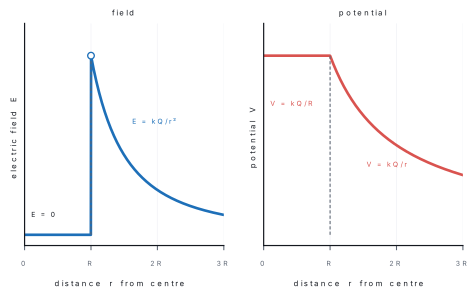
For a conducting sphere of radius R carrying charge Q:
| Region | Electric field | Potential |
|---|---|---|
| inside, r < R | 0 | kQ/R (constant) |
| at the surface, r = R | kQ/R^2 | kQ/R |
| outside, r > R | kQ/r^2 | kQ/r |
All the charge sits on the outer surface, and outside the sphere the field is exactly that of a point charge Q at the centre. This is why the sphere behaves like a point charge from outside.
A hollow conductor and its outer field. If a charge q is placed inside a hollow conductor, an induced charge -q appears on the inner surface and +q on the outer surface. The field inside the metal is zero, so the outside world feels only the +q on the outer surface, as if it sat at the centre. Conversely, a closed metal box with no charge inside has E = 0 in its cavity: it shields its contents from outside fields — a Faraday cage.
Inside a charged conducting sphere the field is zero, but the potential is kQ/R — the same as at the surface, not zero. Field is the slope of potential; zero slope does not mean zero height.
Electric potential and potential energy
The electric potential at a point is the work done by an external agent in bringing a unit positive charge from infinity to that point, without acceleration:
The unit is the volt: 1 V = 1 J C⁻¹. Potential is a scalar, so potentials add algebraically — much easier than adding fields. The zero is taken at infinity.
The potential energy of a charge q at potential V is U = qV. For a pair of point charges,
| Situation | Sign of U | Who does the work |
|---|---|---|
| two like charges brought together | positive | the external agent does positive work |
| two unlike charges brought together | negative | the field does positive work |
| positive charge moved along \vec E | falls | the field does positive work |
| positive charge moved against \vec E | rises | the external agent does positive work |
The field and the potential are linked by
The minus sign says that the field points downhill in potential. For a uniform field, E = V/d. Moving a charge through a potential difference \Delta V changes its energy by q\Delta V; this is the working principle of every accelerator, battery and cathode-ray tube.
For a system of several charges, the potential energy is the sum over every pair:
Four equal charges q at the corners of a square of side a therefore have U = 4kq^2/a + 2kq^2/(\sqrt{2}a): four side pairs and two diagonal pairs.
An equipotential surface is a surface on which V is constant. No work is done moving a charge along it, so equipotentials are always perpendicular to field lines. The surface of any conductor is an equipotential.
Problem. A conducting sphere of radius 10 cm carries 1\ \mu\text{C}. Find the field and the potential at (a) 5 cm and (b) 20 cm from the centre.
Solution. (a) 5 cm is inside the sphere, so E = 0. The potential is the surface value, V = kQ/R = 9\times10^9\times10^{-6}/0.10 = 9\times10^4 V. (b) E = kQ/r^2 = 9\times10^9\times10^{-6}/(0.20)^2 = 2.25\times10^5 N C⁻¹, and V = kQ/r = 9\times10^9\times10^{-6}/0.20 = 4.5\times10^4 V.
Gauss's law
The electric flux through a surface is \phi = \int \vec E\cdot d\vec A — the field times the area perpendicular to it. Gauss's law states:
The flux through any closed surface equals the net charge inside it divided by \varepsilon_0. The field \vec E in the integral is the total field from all charges, but charges outside the surface contribute zero net flux: every line that enters must also leave.
Three results must be known cold. Each comes from choosing a surface on which the field is constant and perpendicular.
| Charge distribution | Gaussian surface | Result |
|---|---|---|
| point charge, or outside a sphere Q | sphere of radius r | E = \dfrac{Q}{4\pi\varepsilon_0r^2} |
| long line charge, \lambda per metre | cylinder of radius r, length l | E = \dfrac{\lambda}{2\pi\varepsilon_0r} |
| infinite sheet, \sigma per m² | pillbox through the sheet | E = \dfrac{\sigma}{2\varepsilon_0} |
| two opposite plates, each \sigma | pillbox through one plate | E = \dfrac{\sigma}{\varepsilon_0} between them |
For the sphere: E(4\pi r^2) = Q/\varepsilon_0. For the line: E(2\pi rl) = \lambda l/\varepsilon_0. For the sheet, the flux leaves both faces of the pillbox: E(2A) = \sigma A/\varepsilon_0. In each case the area of the Gaussian surface cancels, which is why the answer depends only on the charge density.
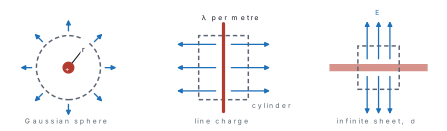
The flux through a closed surface depends only on the net charge enclosed. Move the charge around inside and the flux does not change. A charge outside gives zero net flux even though the field at the surface is not zero. Through one face of a cube with a charge at its centre, the flux is q/6\varepsilon_0 by symmetry.
17.3 Capacitors
Capacitance
A capacitor is a pair of conductors separated by an insulator. When a potential difference V is applied, the plates carry charges +Q and -Q. The capacitance is the charge on the positive plate per unit potential difference:
The unit is the farad, 1 F = 1 C V⁻¹. One farad is enormous; practical capacitors are marked in microfarads (1 µF = 10⁻⁶ F) or picofarads (1 pF = 10⁻¹² F).
The parallel-plate capacitor
For plates of area A separated by a distance d in vacuum (or air), the field between them is E = \sigma/\varepsilon_0 = Q/(\varepsilon_0A) and the potential difference is V = Ed = Qd/(\varepsilon_0A). Hence
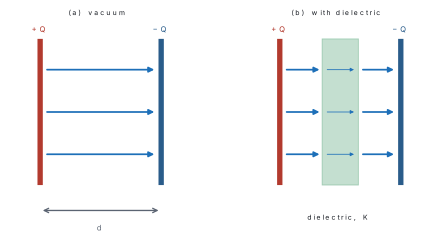
Setting up. Two parallel plates of area A, separation d, carrying +Q and -Q. The field between them is uniform and the plates are equipotentials.
Step 1 — the field from one plate. A single sheet of charge density \sigma gives E = \sigma/2\varepsilon_0 on each side. Two opposite plates add their fields between them and cancel them outside: E = \sigma/\varepsilon_0.
Step 2 — write \sigma in terms of Q. \sigma = Q/A, so E = Q/(\varepsilon_0A).
Step 3 — integrate the field. The potential difference between two points a distance d apart along a uniform field is V = Ed = Qd/(\varepsilon_0A).
Step 4 — divide. C = Q/V = \varepsilon_0A/d.
Result. C = \varepsilon_0A/d: capacitance grows with plate area and shrinks as the plates are separated. Condition: the plates are large compared with their separation, so edge effects can be ignored.
So C \propto A and C \propto 1/d. Doubling the separation halves the capacitance; doubling the area doubles it. Note that C does not depend on Q or V: it is a property of the geometry (and the dielectric).
Dielectrics
A dielectric is an insulating material placed between the plates. Its molecules polarise — in a polar material they already carry a dipole moment and line up; in a non-polar one the applied field separates the charge. Either way the face of the slab next to the positive plate becomes negative and the far face positive, and this induced field opposes the applied one. The net field inside is weaker, so the same charge needs a smaller potential difference, and the capacitance rises:
where K is the dielectric constant (relative permittivity), K = C/C_0.
| Material | K |
|---|---|
| vacuum | 1 (exactly) |
| air | 1.0006 ≈ 1 |
| paper | 3.7 |
| mica | 6 |
| glass | 5–10 |
| water | 80 |
| barium titanate | about 1200 |
If a slab of thickness t (less than d) is inserted, the two regions act like capacitors in series:
Combinations
| Series | Parallel | |
|---|---|---|
| Connection | end to end | side by side |
| Same for each | charge Q | potential difference V |
| Total | \dfrac{1}{C} = \dfrac{1}{C_1} + \dfrac{1}{C_2} + \cdots | C = C_1 + C_2 + \cdots |
| Two capacitors | C = \dfrac{C_1C_2}{C_1 + C_2} | C = C_1 + C_2 |
| Result | smaller than the smallest | larger than the largest |
In series the smallest capacitor takes the largest share of the voltage (V \propto 1/C). In parallel each capacitor takes the share of charge it can hold (Q \propto C).
Energy stored
Charging a capacitor means pushing charge against the growing potential. The work done, and the energy stored, is
The energy is stored in the field between the plates, not in the metal. For a parallel-plate capacitor, divide by the volume Ad:
This is the energy density of an electric field, in J m⁻³. With a dielectric it becomes \frac12K\varepsilon_0E^2.
The two plates attract each other with a force
At constant charge this force does not depend on the separation. To pull the plates apart you must do work F\,\Delta d, and that work is exactly the rise in stored energy — which is why U\propto d when Q is fixed.
Effect of a dielectric: battery connected or removed
This table is the single most examined idea in the chapter. Decide first whether the battery is still connected.
| Quantity | Battery connected (V fixed) | Battery removed (Q fixed) |
|---|---|---|
| Capacitance C | becomes KC | becomes KC |
| Charge Q | becomes KQ | unchanged |
| Potential difference V | unchanged | falls to V/K |
| Field E = V/d | unchanged | falls to E/K |
| Energy U | becomes KU | falls to U/K |
| Who supplies the energy | the battery | the field (it pulls the slab in) |
With the battery connected, inserting the slab draws extra charge Q(K-1) from the battery. The battery does work VQ(K-1), while the stored energy rises by only half that amount; the rest is dissipated as heat (or appears as mechanical work if the slab is free to move).
With the battery removed, the charge cannot change. The field pulls the slab in and does mechanical work; the stored energy falls by exactly that amount.
At constant charge, pulling the plates apart increases the potential difference and the stored energy: C falls as 1/d, so V = Q/C rises as d, and U = Q^2/2C rises as d. The work you do against the attraction of the plates is stored in the field. Students often say V falls because "the capacitor is weaker" — it is the charge that would fall if a battery were connected, not the potential difference of an isolated capacitor.
The dielectric table flips depending on the battery. Connected: V stays, Q rises, U rises. Disconnected: Q stays, V falls, U falls. Write "V fixed" or "Q fixed" at the top of your rough work before touching a formula.
Sharing charge between capacitors
When a charged capacitor C_1 at V_1 is connected to an uncharged (or differently charged) capacitor C_2, charge flows until both have the same potential:
The total charge is conserved, but the total energy is not: some is lost as heat in the connecting wire and as electromagnetic radiation. The loss is
For two equal capacitors, one charged and one empty, exactly half the initial energy is lost, whatever the voltage.
Problem. A parallel-plate capacitor has plates of area 0.02\ \text{m}^2 separated by 1 mm of air. (a) Find its capacitance. (b) A slab of dielectric constant 5 fills the gap and the capacitor is connected to 100 V. Find the charge and the stored energy. (c) The battery is then removed and the slab is pulled out. Find the new potential difference.
Solution. (a) C_0 = \varepsilon_0A/d = 8.85\times10^{-12}\times0.02/10^{-3} = 1.77\times10^{-10} F = 177 pF.
(b) With the dielectric, C = KC_0 = 5\times177 = 885 pF. Then Q = CV = 885\times10^{-12}\times100 = 8.85\times10^{-8} C = 88.5 nC, and U = \frac12CV^2 = \frac12\times885\times10^{-12}\times10^4 = 4.43\times10^{-6} J.
(c) The battery is removed, so Q stays 88.5 nC. Without the slab, C = 177 pF, so V = Q/C = 8.85\times10^{-8}/1.77\times10^{-10} = 500 V. Removing the dielectric at constant charge raises the voltage five times — the same factor K.
Problem. A 2\ \mu\text{F} capacitor charged to 100 V is connected to an uncharged 3\ \mu\text{F} capacitor. Find the common potential and the energy lost.
Solution. Total charge = 2\times10^{-6}\times100 = 200\ \mu\text{C}; total capacitance = 5\ \mu\text{F}. So V = 200\ \mu\text{C}/5\ \mu\text{F} = 40 V.
Initial energy = \frac12(2\times10^{-6})(100)^2 = 0.010 J. Final energy = \frac12(5\times10^{-6})(40)^2 = 0.004 J. Loss = 0.006 J = 6 mJ, which is 60 % of the initial energy.
Formula and fact sheet
| Item | Formula or fact |
|---|---|
| Quantisation | q = ne, e = 1.6\times10^{-19} C; 1 C = 6.25\times10^{18} electrons |
| Coulomb's law | F = kq_1q_2/r^2, k = 9\times10^9 N m² C⁻² |
| In a medium | F = F_0/K |
| Field of a point charge | E = kq/r^2, N C⁻¹ = V m⁻¹ |
| Uniform field | E = V/d |
| Force on a charge | F = qE |
| Potential | V = kq/r, J C⁻¹ = V; scalar |
| Potential energy | U = qV = kq_1q_2/r |
| Field and potential | E = -dV/dr |
| Conducting sphere | E = 0 inside; E = kQ/r^2 outside; V = kQ/R inside |
| Gauss's law | \oint \vec E\cdot d\vec A = q_{\text{enc}}/\varepsilon_0 |
| Line charge | E = \lambda/(2\pi\varepsilon_0r) |
| Sheet of charge | E = \sigma/(2\varepsilon_0) |
| Two plates | E = \sigma/\varepsilon_0 between them |
| Capacitance | C = Q/V; 1 F = 1 C V⁻¹ |
| Parallel plate | C = \varepsilon_0A/d; with dielectric C = K\varepsilon_0A/d |
| Partly filled gap | C = \varepsilon_0A/(d - t + t/K) |
| Series | 1/C = \Sigma 1/C_i; same Q |
| Parallel | C = \Sigma C_i; same V |
| Energy | U = \frac12QV = \frac12CV^2 = Q^2/2C |
| Energy density | u = \frac12\varepsilon_0E^2; \frac12K\varepsilon_0E^2 in a dielectric |
| Isolated sphere | C = 4\pi\varepsilon_0R |
| Sharing | V = (C_1V_1+C_2V_2)/(C_1+C_2) |
| Energy lost in sharing | \Delta U = C_1C_2(V_1-V_2)^2/[2(C_1+C_2)] |
| Constant Q, plates apart | C\propto1/d, V\propto d, U\propto d |
| Constant V, plates apart | C\propto1/d, Q\propto1/d, U\propto1/d |
| Null point, like charges | between them, nearer the smaller, x = L/(1+\sqrt{q_2/q_1}) |
| Triangle of three equal charges | F = \sqrt{3}\,kq^2/a^2 on each; centre charge -q/\sqrt{3} |
| Dielectric constants | air 1, paper 3.7, mica 6, glass 5–10, water 80 |
Chapter summary
- Charge is quantised (q = ne), conserved, and additive as a scalar. One coulomb is 6.25\times10^{18} electronic charges.
- Charging by conduction gives the same sign as the charging body; charging by induction gives the opposite sign, provided the earth is removed before the rod.
- Coulomb's law: F = kq_1q_2/r^2 in vacuum, divided by K in a medium. Forces superpose as vectors, so the net force is found one charge at a time.
- The null point of two like charges lies between them, nearer the smaller; for equilibrium of three charges the third is opposite in sign and fixed in magnitude.
- Field lines leave positive charge, end on negative charge, never cross, and are perpendicular to conductors. E = 0 inside a conductor, but V is constant there, not zero.
- V = kq/r is a scalar; U = qV; E = -dV/dr points downhill in potential.
- Gauss's law gives the three standard fields: kQ/r^2 for a sphere, \lambda/(2\pi\varepsilon_0r) for a line, \sigma/(2\varepsilon_0) for a sheet.
- C = Q/V = \varepsilon_0A/d, multiplied by K with a dielectric; series adds reciprocals, parallel adds directly.
- U = \frac12CV^2 = Q^2/2C and u = \frac12\varepsilon_0E^2. At constant charge, separating the plates raises V and U; at constant voltage, inserting a dielectric raises Q and U by K.
- Charge sharing conserves charge but not energy: the loss is C_1C_2(V_1-V_2)^2/[2(C_1+C_2)].
Practice questions
Set A — Recall (30 questions)
- One coulomb is the charge ona1.6\times10^{-19} electronsb6.25\times10^{-18} electronsc6.25\times10^{18} electronsd1.6\times10^{19} electrons
- The force between two point charges in a medium of dielectric constant K, at the same separation, isaK times the vacuum forceb1/K times the vacuum forcecK^2 times the vacuum forcedthe same as in vacuum
- The value of 1/(4\pi\varepsilon_0) isa9\times10^{9} N m² C⁻²b8.85\times10^{-12} N m² C⁻²c9\times10^{9} N C⁻²d1.6\times10^{-19} N m² C⁻²
- The electric field at a point is theaforce on any charge placed therebwork done in bringing a unit charge thereccharge per unit area theredforce per unit positive charge there
- The unit of electric field strength may be written asaN CbN C⁻¹ or V m⁻¹cJ C⁻¹dC m⁻²
- Inside a charged conductor in electrostatic equilibrium, the electric field isazerobmaximumcequal to the surface fieldddirected outward
- Electric potential is aavector along the fieldbvector against the fieldcscalardtensor
- The work done in moving a charge along an equipotential surface isaqVbmaximumcinfinitedzero
- The electric flux through a closed surface enclosing a charge q isaq\varepsilon_0bq/\varepsilon_0czerodq/4\pi\varepsilon_0
- The field due to an infinite plane sheet of charge density \sigma isa\sigma/\varepsilon_0b2\sigma/\varepsilon_0c\sigma/2\varepsilon_0d\sigma r/\varepsilon_0
- The field at distance r from a long line charge of density \lambda is proportional toa1/rb1/r^2crdr^2
- Outside a charged conducting sphere of radius R, the field at distance r>R isakQ/R^2bzerockQr/R^3dkQ/r^2
- Capacitance is defined asaenergy stored per unit chargebcharge stored per unit potential differencecpotential difference per unit chargedcharge per unit area
- The farad is equal toa1 C Vb1 V C⁻¹c1 C V⁻¹d1 J C⁻¹
- The capacitance of a parallel-plate capacitor is directly proportional toathe plate areabthe plate separationcthe potential differencedthe charge stored
- Capacitors in series all carry the sameapotential differencebenergyccapacitancedcharge
- Capacitors in parallel all have the sameachargebenergycpotential differencedcapacitance
- The energy stored in a capacitor C at potential difference V isaCVb\frac12CV^2cCV^2d\frac12C^2V
- The energy density in a field E in vacuum isa\frac12\varepsilon_0E^2b\varepsilon_0E^2c\frac12\varepsilon_0Ed\frac12E^2/\varepsilon_0
- The dielectric constant of a medium is the ratio ofacharge to potentialbfield to potentialc\varepsilon_0 to the medium's permittivitydthe capacitance with the dielectric to that without it
- Charge is said to be quantised because itais always positiveboccurs only in whole multiples of ecis conserveddcan be transferred
- In charging by induction, the conductor acquires a chargeaopposite in sign to the inducing chargebof the same sign as the inducing chargecthat is always positivedthat is always zero
- The leaves of a gold-leaf electroscope diverge becauseathe leaves are magnetisedbair pushes them apartcthey carry like charges and repeldthe glass case is charged
- Electric field linesacan cross at a neutral pointbstart on negative chargescare always straightdnever cross one another
- The electric potential at infinity is taken asazerobinfiniteckQ/Rdnegative
- The potential at distance r from a point charge q isakq/r^2bkqrckq/rdkq/r^3
- The relation between field and potential isaE = dV/drbE = -dV/drcE = VrdE = -V/r^2
- The capacitance of an isolated conducting sphere of radius R isa4\pi\varepsilon_0R^2b\varepsilon_0Rc4\pi\varepsilon_0/Rd4\pi\varepsilon_0R
- Three capacitors of 3\ \mu\text{F} each are joined in series. The equivalent capacitance isa9\ \mu\text{F}b3\ \mu\text{F}c1\ \mu\text{F}d0.33\ \mu\text{F}
- The charge on each plate of a 2\ \mu\text{F} capacitor charged to 100 V isa200\ \mu\text{C}b50\ \mu\text{C}c2\ \mu\text{C}d0.02 C
Answers and explanations — Set A
1. (c) — n = Q/e = 1/1.6\times10^{-19} = 6.25\times10^{18}. Option (a) is the magnitude of the charge on one electron.
2. (b) — the medium's polarisation weakens the force: F = F_0/K. K for air is about 1, for water about 80.
3. (a) — k = 9\times10^9 N m² C⁻². Option (b) is \varepsilon_0 itself, not 1/4\pi\varepsilon_0.
4. (d) — field is force per unit positive charge; a negative charge feels force opposite to \vec E.
5. (b) — N C⁻¹ and V m⁻¹ are the same unit, since V = J C⁻¹ = N m C⁻¹.
6. (a) — free electrons rearrange until the internal field is zero; the charge sits on the surface.
7. (c) — potential is a scalar; only the field is a vector.
8. (d) — no potential difference means no work, by W = q\Delta V.
9. (b) — Gauss's law: flux = q_{\text{enc}}/\varepsilon_0.
10. (c) — one sheet gives \sigma/2\varepsilon_0; the \sigma/\varepsilon_0 answer is for the field between two opposite plates.
11. (a) — E = \lambda/(2\pi\varepsilon_0r); the 1/r^2 law belongs to a point charge.
12. (d) — outside, the sphere acts as a point charge at its centre.
13. (b) — C = Q/V, charge per volt.
14. (c) — 1 F = 1 C V⁻¹.
15. (a) — C = \varepsilon_0A/d: up with area, down with separation.
16. (d) — the same charge passes through each capacitor in series; the voltages divide.
17. (c) — parallel branches share the same potential difference; the charges divide.
18. (b) — U = \frac12CV^2. Option (a) is the charge, not the energy.
19. (a) — u = \frac12\varepsilon_0E^2, in J m⁻³.
20. (d) — K = C/C_0 = \varepsilon/\varepsilon_0.
21. (b) — charge comes in packets of e; no fraction of e has ever been observed free.
22. (a) — induction leaves the opposite charge; the inducing charge is never transferred.
23. (c) — both leaves receive the same sign and repel; the divergence angle grows with charge.
24. (d) — two directions at one point is impossible; lines also start on positive charge.
25. (a) — the zero of potential is at infinity, by convention.
26. (c) — V = kq/r; the 1/r^2 form is the field.
27. (b) — the field points downhill in potential; the minus sign carries that meaning.
28. (d) — C = 4\pi\varepsilon_0R; a sphere of radius 9 km has C\approx1\ \mu\text{F}.
29. (c) — 1/C = 1/3+1/3+1/3 = 1, so C = 1\ \mu\text{F}.
30. (a) — Q = CV = 2\times10^{-6}\times100 = 2\times10^{-4} C = 200\ \mu\text{C}.
Set B — Understanding (18 questions)
- Two point charges are a distance d apart. If the distance is doubled, the force becomesa4FbF/4cF/2d2F
- Two charges are held at a fixed distance. If each charge is doubled, the forceais unchangedbdoubleschalvesdbecomes four times as large
- Two equal positive charges +q are 2a apart. At the midpointaE = 0 and V = 2kq/abE = 0 and V = 0cE = 2kq/a^2 and V = 0dE = kq/a^2 and V = 2kq/a
- Two equal and opposite charges +q and -q are 2a apart. At the midpointaE = 0 and V = 0bE = 2kq/a^2 and V = 2kq/acE = 2kq/a^2 and V = 0dE = 0 and V = 2kq/a
- A charge inside a closed surface is moved from one point to another inside it. The total flux through the surfaceachangesbstays the samecbecomes zeroddepends on the shape of the surface
- A charge is placed just outside a closed surface. The net flux through the surface isaq/\varepsilon_0bq/2\varepsilon_0cinfinitedzero
- A capacitor is charged and then disconnected from the battery. Its plates are pulled apart. The charge, potential difference and stored energy respectivelyastay the same, increase, increasebdecrease, increase, increasecstay the same, decrease, decreasedstay the same, increase, decrease
- A capacitor connected to a battery has a dielectric inserted between its plates. Which is correct?aQ same, V increasesbQ decreases, V samecQ increases, V samedQ same, U decreases
- A charged capacitor is disconnected, then a dielectric is inserted. The potential difference across itaincreases K timesbstays the samecbecomes zerodfalls to V/K
- Two capacitors of 2\ \mu\text{F} and 4\ \mu\text{F} are in series across 12 V. The charge on each isa8\ \mu\text{C}b16\ \mu\text{C}c4\ \mu\text{C}d48\ \mu\text{C}
- Two capacitors of 2\ \mu\text{F} and 4\ \mu\text{F} are in parallel across 12 V. Their charges area16\ \mu\text{C} eachb8\ \mu\text{C} and 16\ \mu\text{C}c24\ \mu\text{C} and 48\ \mu\text{C}d12\ \mu\text{C} and 24\ \mu\text{C}
- A 2\ \mu\text{F} capacitor charged to 100 V is connected to an uncharged 2\ \mu\text{F} capacitor. The common potential isa50 Vb100 Vc25 Vdzero
- A 2\ \mu\text{F} capacitor at 100 V shares its charge with an identical uncharged capacitor. The fraction of the initial energy lost isanoneb25 %c75 %d50 %
- The field inside a hollow charged conducting sphere is zero. The potential inside isazerobconstant and equal to the surface valuecincreasing outwardddecreasing outward
- An electron enters a uniform electric field moving along the field. Its path isacircularbparabolicca straight line with changing speedda straight line with constant speed
- A positive charge is moved from a point at 10 V to a point at 20 V. The work done by the external agent isapositivebnegativeczerodinfinite
- The electric field just outside a charged conductor isazerobparallel to the surfacecperpendicular to the surfacedat 45° to the surface
- Capacitors C and 2C are joined in series. The larger charge is onaneither; both have the same chargebCc2Cdit depends on the applied voltage
Answers and explanations — Set B
1. (b) — F\propto1/d^2; doubling d gives one quarter.
2. (d) — F\propto q_1q_2; doubling both multiplies the force by 4.
3. (a) — the two fields cancel at the midpoint, but the two potentials add: kq/a+kq/a.
4. (c) — both fields point from + to -, so they add to 2kq/a^2; the potentials cancel because they have opposite signs.
5. (b) — flux depends only on the enclosed charge, not on where it sits.
6. (d) — every line that enters the surface also leaves it; the net enclosed charge is zero.
7. (a) — isolated means Q fixed; C\propto1/d falls, so V = Q/C and U = Q^2/2C both rise.
8. (c) — the battery holds V fixed; C rises to KC, so Q = CV rises.
9. (d) — Q is fixed and C rises K times, so V = Q/C falls to V/K.
10. (b) — C = (2\times4)/6 = 1.33\ \mu\text{F}, so Q = 1.33\times12 = 16\ \mu\text{C} on each.
11. (c) — parallel means the same 12 V: 2\times12 = 24\ \mu\text{C} and 4\times12 = 48\ \mu\text{C}.
12. (a) — equal capacitors share the charge equally, so the voltage halves.
13. (d) — half the energy is lost for any two equal capacitors; the loss is C(V_1-V_2)^2/4.
14. (b) — E = 0 inside means V does not change with position; it keeps the surface value.
15. (c) — the force is along the velocity, so there is no sideways deflection; the electron speeds up or slows down.
16. (a) — the charge moves to a higher potential, so the agent must do positive work, q(20-10).
17. (c) — any tangential component would move surface charge, so the field must be normal to the surface.
18. (a) — series capacitors carry the same charge, whatever their capacitances.
Set C — Application (14 questions)
- Three charges of 1\ \mu\text{C} each sit at the corners of an equilateral triangle of side 10 cm. The net force on one charge is abouta0.90 Nb2.70 Nc1.56 Nd0.78 N
- Charges of 2\ \mu\text{C} and 3\ \mu\text{C} are 30 cm apart in air. The force between them isa0.60 Nb0.18 Nc1.80 Nd6.0 N
- The electric field 30 cm from a 2\ \mu\text{C} point charge isa6\times10^4 N C⁻¹b6\times10^5 N C⁻¹c2\times10^4 N C⁻¹d2\times10^5 N C⁻¹
- A charge of 2\ \mu\text{C} is moved from a point at 50 V to a point at 150 V. The work done by the external agent isa1\times10^{-4} Jb2\times10^{-4} Jc2\times10^{-6} Jd3\times10^{-4} J
- A cube encloses a charge of 1\ \mu\text{C} at its centre. The flux through one face is abouta1.9\times10^4 N m² C⁻¹b1.1\times10^5 N m² C⁻¹c6.8\times10^5 N m² C⁻¹d1.1\times10^4 N m² C⁻¹
- A conducting sphere of radius 10 cm carries 1\ \mu\text{C}. The field 5 cm from its centre isazerob9\times10^5 N C⁻¹c2.3\times10^5 N C⁻¹d1.8\times10^6 N C⁻¹
- A conducting sphere of radius 10 cm carries 1\ \mu\text{C}. The potential at its centre isazerob4.5\times10^4 Vc9\times10^5 Vd9\times10^4 V
- A parallel-plate capacitor has plates of area 0.02\ \text{m}^2 separated by 1 mm of air. Its capacitance is abouta17.7 pFb177 pFc885 pFd88.5 pF
- A parallel-plate capacitor of 177 pF in air is filled with a dielectric of constant 5 and connected to 100 V. The charge on its plates isa88.5 nCb17.7 nCc8.85 nCd177 nC
- A 2\ \mu\text{F} capacitor is charged to 100 V and disconnected. The plates are then pulled apart until their separation is doubled. The new potential difference isa200 Vb100 Vc50 Vd400 V
- A 2\ \mu\text{F} capacitor charged to 100 V is connected to an uncharged 3\ \mu\text{F} capacitor. The common potential isa60 Vb50 Vc20 Vd40 V
- A 2\ \mu\text{F} capacitor charged to 100 V is connected to an uncharged 3\ \mu\text{F} capacitor. The energy lost in the wire isa10 mJb6 mJc4 mJd2 mJ
- The energy density of a field of 10^6 V m⁻¹ in vacuum is abouta8.85 J m⁻³b4.43 J m⁻³c2.21 J m⁻³d4.43\times10^{-3} J m⁻³
- The energy stored in a 2\ \mu\text{F} capacitor charged to 100 V isa0.01 Jb0.2 Jc0.02 Jd1 J
Answers and explanations — Set C
1. (c) — two forces of kq^2/a^2 = 0.90 N at 60° give 2(0.90)\cos30^{\circ} = 1.56 N. Option (a) is one force alone; (d) is one force multiplied by \cos30^{\circ}.
2. (a) — F = 9\times10^9\times2\times10^{-6}\times3\times10^{-6}/(0.30)^2 = 0.60 N.
3. (d) — E = kq/r^2 = 9\times10^9\times2\times10^{-6}/0.09 = 2\times10^5 N C⁻¹. Option (a) is the potential, not the field.
4. (b) — W = q\Delta V = 2\times10^{-6}\times100 = 2\times10^{-4} J.
5. (a) — total flux = q/\varepsilon_0 = 1.13\times10^5; one of six faces gets 1.9\times10^4.
6. (a) — 5 cm is inside the conductor, where E is always zero.
7. (d) — inside, V is constant at the surface value kQ/R = 9\times10^4 V.
8. (b) — C = 8.85\times10^{-12}\times0.02/10^{-3} = 1.77\times10^{-10} F = 177 pF.
9. (a) — C = 5\times177 = 885 pF, so Q = CV = 885\times10^{-12}\times100 = 8.85\times10^{-8} C.
10. (a) — Q fixed, C halves, so V = Q/C doubles to 200 V.
11. (d) — V = (2\times100+0)/5 = 40 V.
12. (b) — initial 0.010 J, final \frac12(5\times10^{-6})(40)^2 = 0.004 J; loss 0.006 J.
13. (b) — u = \frac12\varepsilon_0E^2 = \frac12\times8.85\times10^{-12}\times10^{12} = 4.43 J m⁻³.
14. (a) — U = \frac12CV^2 = \frac12\times2\times10^{-6}\times10^4 = 0.01 J.