Chapter 9 · Heat and Thermodynamics · 2 questions in the paper · 43 min read
Thermal Expansion and Quantity of Heat
What the syllabus asks for 4
- Linear, superficial and cubical expansion and their relation
- Real and apparent expansion of liquids
- Heat capacity, specific heat capacity and the method of mixtures
- Latent heat of fusion and vaporization; the triple point
Heat and Thermodynamics carries 7 of the 50 Physics questions (official MEC weightage), and we estimate about 2 of them come from this chapter. The marks here are almost all numerical or definitional: a coefficient of expansion and its relation to the other two, a liquid that overflows a vessel, a mixture that settles at a final temperature, an ice–water–steam sum, or a clock that loses seconds on a hot day. Every one of them is a one-line formula provided the phase bookkeeping is done in the right order. That order is what this chapter teaches.
- \Delta L = L\alpha\Delta T, \Delta A = A\beta\Delta T, \Delta V = V\gamma\Delta T, with \beta = 2\alpha and \gamma = 3\alpha.
- A hole in a heated plate grows; a clamped rod develops stress Y\alpha\Delta T; a pendulum clock loses time \frac{1}{2}\alpha\Delta\theta per unit time.
- Real and apparent expansion: \gamma_r = \gamma_a + \gamma_v (real = apparent + vessel); the level in a vessel first dips, then rises.
- Q = mc\Delta T, Q = C\Delta T, and the method of mixtures m_1c_1(\theta_1-\theta) = (m_2c_2 + Wc_w)(\theta-\theta_2).
- Water equivalent W = m_c c_c / c_w; ignoring it makes the answer wrong in a predictable direction.
- Q = mL; L_f = 3.36\times10^5\ \text{J kg}^{-1}, L_v = 2.26\times10^6\ \text{J kg}^{-1}; temperature stays constant during a phase change.
- Newton's law of cooling: rate of loss of heat \propto excess temperature, so cooling is exponential.
- The triple point of water: 273.16 K at 611 Pa, the only state where ice, water and vapour coexist.
9.1 Linear, superficial and cubical expansion and their relation
Almost every substance expands when heated at constant pressure. The atoms vibrate about fixed mean positions; the vibration is not symmetric about the mean position — the repulsive side of the potential is steeper than the attractive side — so the average separation grows as the amplitude grows. Nothing in the solid is pushed apart by a "force of heat"; the spacing simply increases.
The three coefficients
For a rise in temperature \Delta T:
- Linear: \alpha = \dfrac{1}{L}\dfrac{\Delta L}{\Delta T} — fractional increase in length per kelvin.
- Superficial: \beta = \dfrac{1}{A}\dfrac{\Delta A}{\Delta T} — fractional increase in area per kelvin.
- Cubical (volume): \gamma = \dfrac{1}{V}\dfrac{\Delta V}{\Delta T} — fractional increase in volume per kelvin.
All three have SI unit K⁻¹ (numerically the same as °C⁻¹, because a temperature difference is the same on both scales). They are properties of the material, not of the size or shape of the body: a long rod and a short rod of copper have the same α.
| Quantity | Symbol | Formula | Unit |
|---|---|---|---|
| Change in length | \Delta L | L\alpha\Delta T | m |
| Change in area | \Delta A | A\beta\Delta T | m² |
| Change in volume | \Delta V | V\gamma\Delta T | m³ |
| New length | L' | L(1+\alpha\Delta T) | m |
Typical values at room temperature (K⁻¹):
| Material | \alpha | Material | \alpha |
|---|---|---|---|
| Quartz (fused) | 0.4\times10^{-6} | Copper | 1.7\times10^{-5} |
| Invar | 1.2\times10^{-6} | Brass | 1.9\times10^{-5} |
| Glass | 8\times10^{-6} | Aluminium | 2.4\times10^{-5} |
| Steel, iron | 1.2\times10^{-5} | Lead | 2.9\times10^{-5} |
Two things to read off this table. Invar was invented for pendulum rods and tape measures precisely because its α is ten times smaller than steel's. And liquids and gases expand far more than solids: for mercury \gamma = 1.8\times10^{-4} K⁻¹, for water about 2.1\times10^{-4} K⁻¹, for air at constant pressure \gamma = 1/273 \approx 3.7\times10^{-3} K⁻¹. A gas is some twenty times more expansive than a liquid and a few hundred times more than a solid.
Why β = 2α and γ = 3α
Starting point. A cube of side L is heated through \Delta T; every side grows by the same fraction \alpha\Delta T. We want the coefficients of area and volume.
Setting up. L' = L(1+\alpha\Delta T), area A = L^2, volume V = L^3.
Step 1 — square the new side. A' = L'^2 = L^2(1+\alpha\Delta T)^2 = A(1 + 2\alpha\Delta T + \alpha^2\Delta T^2).
Step 2 — throw away the squared term. For a metal, \alpha\Delta T is about 10^{-5}\times50 = 5\times10^{-4}; its square is 2.5\times10^{-7}, a thousandth of the linear term. Keeping only the first power, A' = A(1 + 2\alpha\Delta T), so \Delta A = A(2\alpha)\Delta T.
Step 3 — compare with the definition. \Delta A = A\beta\Delta T, hence \beta = 2\alpha.
Step 4 — cube the new side. V' = L'^3 = V(1+\alpha\Delta T)^3 = V(1 + 3\alpha\Delta T + 3\alpha^2\Delta T^2 + \alpha^3\Delta T^3), and again only the first power survives: \Delta V = V(3\alpha)\Delta T, hence \gamma = 3\alpha.
Result. \beta = 2\alpha and \gamma = 3\alpha.
What it means. The three coefficients are not independent: measure one and you have all three. The conditions are that the solid is isotropic (the same α in every direction — true for a metal, false for wood or a crystal) and that \alpha\Delta T \ll 1.
Area uses 2\alpha, volume uses 3\alpha. Students who write \gamma = 3\alpha for an area, or \beta = \frac{3}{2}\alpha, lose the mark every time. Fix the picture in your head: length is one dimension, area two, volume three.
The relation holds for any linear dimension of the body, including a hole. A plate with a circular hole is, geometrically, the same as a plate with a disc of the same material filling the hole — so on heating the disc grows and the hole grows with it. The hole does not close up. This single fact is asked in some form in almost every paper.
Bimetallic strip
Two different metals — usually brass and iron — are riveted or welded along their whole length. Brass has the larger α (about 1.9\times10^{-5} against 1.2\times10^{-5} K⁻¹).
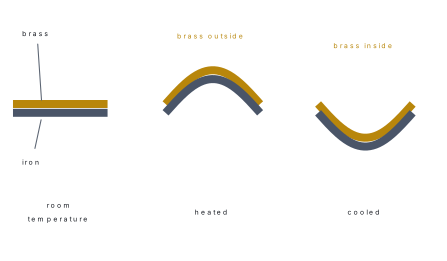
On heating, the brass side becomes longer than the iron side, so the strip can only stay joined by bending into an arc in which the brass is on the outside (the longer path). On cooling the brass contracts more, so it ends up on the inside. The strip therefore bends towards the metal with the smaller α when heated.
Uses: the thermostat in an electric iron, a geyser or a refrigerator (the strip curls, breaks a contact, the heater switches off, and it straightens again when the temperature falls); the bimetallic thermometer; and temperature compensation in watches.
Thermal stress
If a rod is clamped at both ends, it cannot expand, and the "lost" expansion appears as an elastic strain:
where Y is Young's modulus. The stress is compressive on heating (the rod would have grown, so it is squeezed) and tensile on cooling. This is why concrete roads are laid in slabs with tar-filled gaps, why railway rails are welded with expansion joints, and why a glass tumbler cracks when boiling water is poured into it: the inner surface tries to expand against a cold, unyielding outer surface.
Problem. Steel rails 20 m long are laid at 15 °C. What gap must be left between consecutive rails so that they just touch at 55 °C? (\alpha = 1.2\times10^{-5} K⁻¹.)
Solution. \Delta T = 40 K, so \Delta L = L\alpha\Delta T = 20\times1.2\times10^{-5}\times40 = 9.6\times10^{-3} m = 9.6 mm. So a gap of about 1 cm — the growth of one rail — is left at each joint, which is why a train crossing a joint sets up the familiar clickety-click.
Problem. A pendulum clock keeps correct time at 20 °C. Its rod is steel (\alpha = 2\times10^{-5} K⁻¹). How much time does it lose in one day at 35 °C?
Solution. The period is T_p = 2\pi\sqrt{L/g}, so \frac{\Delta T_p}{T_p} = \frac{1}{2}\frac{\Delta L}{L} = \frac{1}{2}\alpha\Delta\theta. With \Delta\theta = 15 K, the fractional change is \frac{1}{2}(2\times10^{-5})(15) = 1.5\times10^{-4}. In a day the clock runs slow by 1.5\times10^{-4}\times86400 = 12.96 s ≈ 13 s.
The pendulum is longer, so each swing takes longer, so the clock loses time. A cooling rod would make it gain.
For a heated body, ask "does the fractional change look like 10^{-4}?" — \alpha\Delta T for a metal and a 50 K rise is about 6\times10^{-4}, i.e. 0.06 %. If your answer is a few per cent, you have used the wrong coefficient or the wrong power of ten. For a clock, remember the factor \frac{1}{2}: the period depends on \sqrt{L}, not on L.
9.2 Real and apparent expansion of liquids
A liquid has no fixed shape, so it has only one coefficient — the cubical one, \gamma. (Writing "the linear expansion of water" is meaningless.) Its expansion is measured by watching the level in a narrow stem, and that is where the trouble starts: the vessel is expanding too, so the scale you read against is itself growing.
Apparent and real expansion
- Real (absolute) expansion is the true increase in the liquid's own volume.
- Apparent expansion is the increase measured relative to the vessel, i.e. the extra volume the liquid seems to gain as read on the vessel's own graduations.
The liquid that overflows a brim-full vessel is the apparent expansion; the real expansion is larger, because the vessel's capacity also grew and swallowed part of it.
Let the vessel be filled to the brim at the lower temperature, with volume V and coefficient \gamma_v; let the liquid's real coefficient be \gamma_r.
Vessel capacity at the higher temperature: V_v = V(1+\gamma_v\Delta T). Liquid volume at the higher temperature: V_l = V(1+\gamma_r\Delta T).
The liquid that overflows is the difference:
But the overflow is, by definition, the apparent expansion V\gamma_a\Delta T. Comparing the two:
So the real coefficient is always larger than the apparent one, and the gap is exactly the expansion of the vessel. For a glass vessel \gamma_v = 3\alpha_{glass} \approx 2.4\times10^{-5} K⁻¹, which is small beside mercury's 1.8\times10^{-4} but not negligible — it is about 13 % of it.
| Liquid in a glass vessel | \gamma_r (K⁻¹) | \gamma_a = \gamma_r - \gamma_v (K⁻¹) |
|---|---|---|
| Mercury | 1.82\times10^{-4} | 1.58\times10^{-4} |
| Water (around 20 °C) | 2.1\times10^{-4} | 1.86\times10^{-4} |
| Alcohol | 1.1\times10^{-3} | 1.08\times10^{-3} |
| Paraffin | 9.0\times10^{-4} | 8.8\times10^{-4} |
Problem. A glass flask is completely filled with 500 cm³ of a liquid at 20 °C. On heating to 70 °C, 4.0 cm³ overflows. If \gamma_v = 2.4\times10^{-5} K⁻¹, find the apparent and the real coefficients of the liquid.
Solution. \Delta T = 50 K and \gamma_a = \dfrac{\Delta V}{V\Delta T} = \dfrac{4.0}{500\times50} = 1.6\times10^{-4} K⁻¹. Then \gamma_r = \gamma_a + \gamma_v = 1.6\times10^{-4} + 0.24\times10^{-4} = 1.84\times10^{-4} K⁻¹. The 4 cm³ that spilled understates the liquid's real growth by 0.24 × 10⁻⁴ × 500 × 50 = 0.6 cm³, which the flask absorbed by growing.
\gamma_r = \gamma_a + \gamma_v, never \gamma_a - \gamma_v. If a question gives the real coefficient and asks for the overflow, subtract: the overflow is V(\gamma_r - \gamma_v)\Delta T. Reading the relation the wrong way round is the single commonest error in this topic.
Why the level first falls, then rises
Warm a flask of coloured water gently and watch the top of the liquid in the stem. It dips slightly, then climbs steadily past its starting mark.
The reason is a race between two expansions that start at the same moment but do not have the same size. The glass in contact with the warming liquid heats up first and quickly, so the flask's capacity grows early. The liquid as a whole is a poor conductor and warms slowly, so for the first few seconds its own expansion is still tiny. Capacity up, liquid not yet up → level down. Once the bulk liquid warms, its much larger \gamma takes over and the level rises.
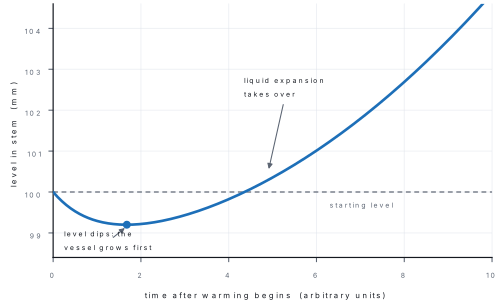
A second, quite different cause of a dip is anomalous expansion: between 0 °C and 4 °C water contracts as it warms, so its level genuinely falls.
Anomalous expansion of water
Water is not a normal liquid. From 0 °C to 4 °C it contracts; above 4 °C it expands in the ordinary way. Its density therefore peaks at 4 °C:
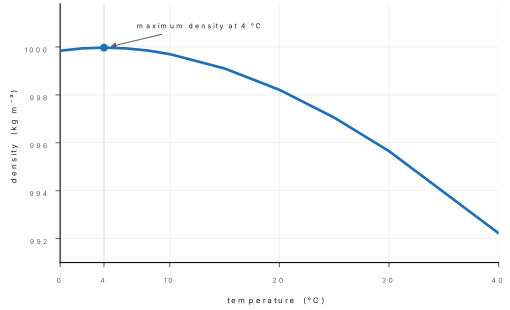
Consequences you can be asked to explain:
- Ice floats, because ice (917 kg m⁻³) is less dense than water.
- A pond freezes from the top down. The surface water cools to 4 °C and sinks; below 4 °C it is lighter and stays on top, where it freezes. The 4 °C water at the bottom lets fish survive the winter.
- Water in a closed pipe bursts when it freezes: the 8 % expansion is resisted by the pipe, and the pressure rise is enormous.
Density falls as the temperature rises. From V = V_0(1+\gamma\Delta T) and \rho = m/V,
so a rise of \Delta T lowers the density by the fraction \gamma\Delta T. A body's relative density falls on heating, and a solid floats a little deeper in hot water than in cold.
9.3 Heat capacity, specific heat capacity and the method of mixtures
The three quantities
Heat capacity C of a body is the heat needed to raise its temperature by 1 K: C = Q/\Delta T, unit J K⁻¹. It depends on the amount of material.
Specific heat capacity c is the heat needed to raise 1 kg of the substance by 1 K: c = \dfrac{Q}{m\Delta T}, unit J kg⁻¹ K⁻¹. It is a property of the material only.
Molar heat capacity is the heat needed to raise 1 mol by 1 K, unit J mol⁻¹ K⁻¹.
So Q = mc\Delta T = C\Delta T, and C = mc. A 2 kg block of copper has twice the heat capacity of a 1 kg block, but the same specific heat capacity.
| Substance | c (J kg⁻¹ K⁻¹) | Substance | c (J kg⁻¹ K⁻¹) |
|---|---|---|---|
| Water | 4200 | Brass | 380 |
| Ice | 2100 | Copper | 390 |
| Steam | 2010 | Iron, steel | 480 |
| Kerosene | 2100 | Aluminium | 900 |
| Mercury | 140 | Lead | 130 |
Water's specific heat is unusually large — about ten times that of copper. That one number explains why water is used as a coolant in vehicle radiators, why a hot-water bottle stays warm for hours, why coastal climates are milder than inland ones, and why a kettle of water takes so long to boil. It is also why water is the standard calorimetric liquid: a given mass of water changes temperature slowly, so a mixture experiment is easy to time.
Water equivalent
A calorimeter is a metal cup, and it takes heat too. Rather than carry its mass and specific heat through every calculation, we convert it into the mass of water that would take the same heat for the same temperature rise:
A copper calorimeter of mass 0.10 kg and c = 390 J kg⁻¹ K⁻¹ has water equivalent W = 0.10\times390/4200 = 0.0093 kg = 9.3 g. Its heat capacity is 9.3\times10^{-3}\times4200 = 39 J K⁻¹.
The method of mixtures
In an isolated system, heat lost by the hot bodies = heat gained by the cold bodies. No heat is created or destroyed; it only moves.
Put a hot solid of mass m_1, specific heat c_1, at temperature \theta_1 into water of mass m_2 at \theta_2, inside a calorimeter of water equivalent W. If the final temperature is \theta (with \theta_2 < \theta < \theta_1):
Every bracket is positive: a hot body falls from \theta_1 to \theta, so its change is \theta_1-\theta; a cold body rises from \theta_2 to \theta, so its change is \theta-\theta_2. Writing the two brackets the same way round is the source of most sign errors in this topic.
Problem. A 0.10 kg block of metal at 100 °C is dropped into 0.20 kg of water at 20 °C in a calorimeter of water equivalent 0.02 kg. The final temperature is 25 °C. Find the specific heat of the metal. (c_w = 4200 J kg⁻¹ K⁻¹.)
Solution. Heat gained by the water and calorimeter: (0.20 + 0.02)\times4200\times(25-20) = 0.22\times4200\times5 = 4620 J. Heat lost by the metal: 0.10\times c\times(100-25) = 7.5c. Equating: 7.5c = 4620, so c = 616 J kg⁻¹ K⁻¹ ≈ 6.2\times10^2 J kg⁻¹ K⁻¹.
If the calorimeter had been ignored, the heat gained would have been taken as 0.20\times4200\times5 = 4200 J and the answer would have come out as 560 J kg⁻¹ K⁻¹ — 9 % too low. That is the size of the error a 20 g water equivalent makes.
Three ways a mixture answer goes wrong
- Ignoring the calorimeter. Its water equivalent must be added to the water mass. Leaving it out always makes the hot body's specific heat come out too low (too little heat is credited to the cold side).
- Sign flip. Use (\theta_1-\theta) for the hot side and (\theta-\theta_2) for the cold side. A negative answer means you reversed one of them.
- Stopping at 0 °C. If ice is involved, check first whether all the ice can melt with the heat available. If it cannot, the final temperature is 0 °C with some ice left, and the water term must not be used at all.
Newton's law of cooling
The rate at which a body loses heat to its surroundings is directly proportional to the excess of its temperature over the surroundings, provided that excess is small and the surroundings are at a constant temperature:
Since dQ = -mc\,d\theta for the body, the same law can be written as a statement about the rate of fall of temperature:
Integrating from \theta_0 at t = 0:
so the excess temperature decays exponentially. Three consequences the paper uses:
- The hotter body cools faster. At 90 °C in a 25 °C room the body loses heat five times as fast as at 38 °C. This is why a cup of tea is drinkable in ten minutes but takes an hour to come down to room temperature.
- A plot of \ln(\theta-\theta_s) against t is a straight line of slope -K. That is the standard experimental verification of the law.
- The law is only a small-excess approximation to Stefan's law. For a body much hotter than its surroundings, radiation loss grows as T^4 and Newton's law fails.
Problem. A cup of coffee at 90 °C is left in a room at 25 °C. It cools to 70 °C in 5 minutes. How long will it take to reach 50 °C?
Solution. Excess temperatures: initially 90-25 = 65 K, after 5 min 70-25 = 45 K. From the exponential law, 45 = 65e^{-5K}, so K = \frac{1}{5}\ln(65/45) = 0.0734 min⁻¹. For 50 °C the excess is 25 K: 25 = 65e^{-Kt}, so t = \frac{\ln(65/25)}{0.0734} = \frac{0.9555}{0.0734} = 13 min.
The first 20 K took 5 min; the next 20 K takes 8 min — the cooling slows as the excess shrinks. Any answer that gives equal times for equal temperature drops has used a linear law by mistake.
Cooling correction. In a real mixture experiment the calorimeter loses heat to the room while the mixture settles. Newton's law supplies the fix: plot the temperature against time, and extrapolate the cooling curve backwards to the instant of mixing. The corrected final temperature is slightly higher than the highest reading, and the corrected initial rate is read from the same graph. This is why the experiment is stirred quickly, started close to room temperature, and finished fast.
9.4 Latent heat of fusion and vaporization; the triple point
Latent heat
While ice melts at 0 °C, its temperature does not rise, however hard you heat it. The heat is doing something else: it is pulling the molecules out of the rigid lattice and into the liquid. The energy goes into potential energy of the molecules, not into their kinetic energy — and temperature is a measure of the average kinetic energy. Only when the last crystal has melted does the thermometer start to climb again.
The specific latent heat L of a substance is the heat needed to change 1 kg of it from one phase to another at constant temperature:
- Latent heat of fusion L_f: solid → liquid (melting), or liquid → solid (freezing, same value released).
- Latent heat of vaporization L_v: liquid → vapour (boiling or evaporating), or vapour → liquid (condensing, same value released).
| Change | Substance | Specific latent heat |
|---|---|---|
| Fusion (melting) | Ice at 0 °C | 3.36\times10^5 J kg⁻¹ (80 cal g⁻¹) |
| Vaporization | Water at 100 °C | 2.26\times10^6 J kg⁻¹ (540 cal g⁻¹) |
| Sublimation | Ice → vapour at 0 °C | 2.83\times10^6 J kg⁻¹ |
Note how large L_v is: boiling 1 g of water takes about 5.4 times as much heat as heating it from 0 °C to 100 °C. That is why steam is such an effective heating medium, and why a burn from steam is far worse than a burn from boiling water: the steam first gives up 2260 J g⁻¹ of latent heat as it condenses on the skin, and only then does the resulting 100 °C water cool.
Evaporation versus boiling. Evaporation happens at any temperature, from the surface only, and cools the remaining liquid (the fastest molecules leave). Boiling happens at one fixed temperature for a given pressure, throughout the liquid, when the saturated vapour pressure equals the external pressure. That is why water boils at about 95 °C in Kathmandu (air pressure ≈ 0.88 atm) and at 71 °C on the summit of Sagarmatha — and why a pressure cooker, by raising the pressure, raises the boiling point and cooks dal faster.
The heating curve
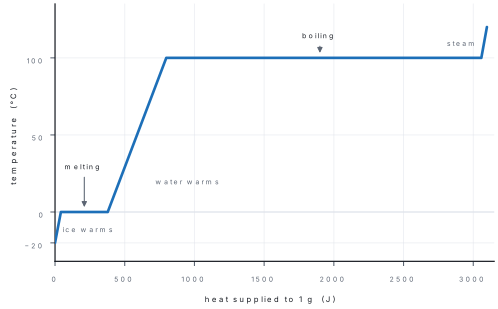
The curve is the whole of calorimetry in one picture. To find the heat to take a mass m from one point to another, add up the straight sloped pieces (mc\Delta T) and the flat pieces (mL) that lie between them.
Doing the phase bookkeeping
An ice problem is not one equation but a decision tree. Work in this order and never skip step 2:
- Heat available. How much heat would the warm bodies release if they cooled to 0 °C? (Include the calorimeter.)
- Heat needed to melt all the ice. Q = mL_f. Compare it with step 1. - If step 1 < step 2, the final temperature is 0 °C and some ice survives. The answer is "0 °C, with m_{left} = m - Q_1/L_f of ice remaining". - If step 1 > step 2, all the ice melts; go on.
- Leftover heat. Subtract the melting heat from the available heat. Use the remainder to warm the whole final mass — original water plus calorimeter plus melted ice — and solve for \Delta T.
Problem. 20 g of ice at 0 °C is dropped into 180 g of water at 30 °C in a calorimeter of water equivalent 20 g. Find the final temperature. (c_w = 4200 J kg⁻¹ K⁻¹, L_f = 3.36\times10^5 J kg⁻¹.)
Solution. Step 1 — heat available if everything cools to 0 °C. The water plus the calorimeter behave as 200 g of water: Q_1 = 0.200\times4200\times30 = 25\,200 J.
Step 2 — heat to melt all the ice. Q_2 = 0.020\times3.36\times10^5 = 6720 J. Since 6720 < 25\,200, all the ice melts and the mixture ends above 0 °C.
Step 3 — warm the final mixture. Leftover heat = 25\,200 - 6720 = 18\,480 J. The final mass that must be warmed is 180 + 20 + 20 = 220 g (original water, calorimeter equivalent, melted ice), so \Delta T = \dfrac{18\,480}{0.220\times4200} = \dfrac{18\,480}{924} = 20 K.
Answer. The final temperature is 20 °C.
Check the balance the other way: the water cools 30 → 20 °C, releasing 0.200\times4200\times10 = 8400 J; the ice absorbs 6720 J to melt and 0.020\times4200\times20 = 1680 J to warm to 20 °C, total 8400 J. It balances.
Problem. How much heat is needed to convert 10 g of ice at −10 °C into steam at 100 °C? (c_{ice} = 2100, c_w = 4200, L_f = 3.36\times10^5, L_v = 2.26\times10^6, all SI.)
Solution. Four separate stages, in order:
| Stage | Process | Heat (J) |
|---|---|---|
| 1 | warm the ice −10 → 0 °C | 0.010\times2100\times10 = 210 |
| 2 | melt the ice at 0 °C | 0.010\times3.36\times10^5 = 3360 |
| 3 | warm the water 0 → 100 °C | 0.010\times4200\times100 = 4200 |
| 4 | boil the water at 100 °C | 0.010\times2.26\times10^6 = 22\,600 |
| total | 30 370 J ≈ 3.04 × 10⁴ J |
Stage 4 alone is three-quarters of the total. The heat is not one mc\Delta T: each stage uses its own specific heat or its own latent heat, and the total is a sum of four numbers.
A gram of steam at 100 °C contains 2260 J more than a gram of water at 100 °C. Every statement about "which is hotter" must be about temperature; every statement about "which contains more heat" must count the latent heat. The two are different questions, and the paper asks both.
The triple point
The triple point of a substance is the unique temperature and pressure at which its solid, liquid and vapour phases coexist in equilibrium. For water it is
At any other pressure only two phases can be in equilibrium at a given temperature (ice and water at 0 °C and 1 atm, for example).
Why the paper cares about it:
- It is a single, reproducible fixed point — one temperature and one pressure — so it is far better as a thermometer calibration than the melting point, which depends on pressure. The kelvin was defined from the triple point of water from 1954 until the 2019 redefinition of the SI.
- Melting point ≠ triple point. Ice melts at 273.15 K (0.00 °C) under 1 atm, but at 273.16 K under 611 Pa. The two differ by 0.01 K because the melting point depends on pressure.
- The triple point pressure is below atmospheric, so ice does not sublime at 1 atm; it melts. Sublimation of ice is common in the dry, thin air of the high Himalayas, where the vapour pressure is very low.
The same idea applies to carbon dioxide, whose triple point is at 5.1 atm — above atmospheric pressure. That is why "dry ice" does not melt at room pressure: it sublimes straight to gas.
Formula and fact sheet
| Topic | Formula or fact |
|---|---|
| Linear expansion | \Delta L = L\alpha\Delta T; L' = L(1+\alpha\Delta T) |
| Area, volume | \Delta A = A\beta\Delta T, \Delta V = V\gamma\Delta T |
| The relation | \beta = 2\alpha, \gamma = 3\alpha (isotropic solid, \alpha\Delta T\ll1) |
| Units | all three in K⁻¹; α (solids) ~10⁻⁵, γ (liquids) ~10⁻⁴, γ (gases) ~10⁻³ |
| Hole in a plate | grows on heating, exactly as a disc of the same material would |
| Bimetallic strip | bends with the larger-α metal on the outside when heated; towards the smaller-α metal |
| Thermal stress | \sigma = Y\alpha\Delta T (compressive on heating), F = YA\alpha\Delta T |
| Pendulum clock | \dfrac{\Delta T_p}{T_p} = \dfrac{1}{2}\alpha\Delta\theta; loses time when hot |
| Time lost per day | \dfrac{1}{2}\alpha\Delta\theta\times86400 s |
| Real vs apparent | \gamma_r = \gamma_a + \gamma_v, with \gamma_v = 3\alpha_{vessel} |
| Overflow | \Delta V = V(\gamma_r - \gamma_v)\Delta T |
| Density on heating | \rho = \rho_0(1+\gamma\Delta T)^{-1}\approx\rho_0(1-\gamma\Delta T) |
| Water anomaly | maximum density 1000 kg m⁻³ at 4 °C; ice 917 kg m⁻³ |
| Heat capacity | C = Q/\Delta T (J K⁻¹); C = mc |
| Specific heat | Q = mc\Delta T (J kg⁻¹ K⁻¹) |
| Water equivalent | W = m_cc_c/c_w; heat capacity of calorimeter = Wc_w |
| Method of mixtures | m_1c_1(\theta_1-\theta) = (m_2c_w + Wc_w)(\theta-\theta_2) |
| Latent heat | Q = mL (J kg⁻¹); L_f = 3.36\times10^5, L_v = 2.26\times10^6 J kg⁻¹ |
| Sublimation | L_{sub}\approx L_f + L_v (with L_v at 0 °C) = 2.83\times10^6 J kg⁻¹ |
| Newton's cooling | \dfrac{dQ}{dt} = k(\theta-\theta_s); \theta-\theta_s = (\theta_0-\theta_s)e^{-Kt} |
| Cooling check | \ln(\theta-\theta_s) vs t is a straight line of slope -K |
| Triple point of water | 273.16 K (0.01 °C), 611 Pa (4.58 mm Hg); all three phases coexist |
| Useful constants | 1 cal = 4.2 J; c_w = 4200, c_{ice} = 2100, c_{steam} = 2010 J kg⁻¹ K⁻¹ |
Chapter summary
- \Delta L = L\alpha\Delta T, \Delta A = A\beta\Delta T, \Delta V = V\gamma\Delta T, with \beta = 2\alpha and \gamma = 3\alpha for an isotropic solid. Area takes 2\alpha, volume takes 3\alpha — never the other way round.
- A hole or a cavity in a heated plate grows by the same fraction as the metal itself; nothing shrinks on heating except water below 4 °C.
- A clamped rod develops \sigma = Y\alpha\Delta T, compressive on heating. A pendulum clock runs slow when hot, losing \frac{1}{2}\alpha\Delta\theta of its time.
- A liquid's real expansion exceeds its apparent expansion by the vessel's: \gamma_r = \gamma_a + \gamma_v. The level in a warmed vessel first dips (the glass grows first) and then rises.
- Water is densest at 4 °C; that is why ice floats, ponds freeze from the top, and pipes burst in a hard frost.
- Q = mc\Delta T raises temperature; Q = mL changes phase at constant temperature. Never use both for the same stage.
- The calorimeter's water equivalent W = m_cc_c/c_w must be added to the water mass. Ignoring it makes the hot body's specific heat come out too low.
- In an ice problem, first compare the heat available with mL_f. If the ice cannot all melt, the final temperature is 0 °C with ice left over.
- Newton's law of cooling gives exponential cooling; equal temperature drops take longer and longer, and the hotter body cools faster.
- The triple point of water is 273.16 K at 611 Pa — the one state where ice, water and vapour coexist, and the reason the melting point (273.15 K at 1 atm) is not the same number.
Practice questions
Set A — Recall (23 questions)
- For an isotropic solid, the coefficient of cubical expansion γ is related to the coefficient of linear expansion α byaγ = αbγ = 2αcγ = 3αdγ = α/3
- The SI unit of the coefficient of linear expansion isambm K⁻¹cJ K⁻¹dK⁻¹
- A circular hole is cut in a metal plate. When the plate is heated, the diameter of the holeadecreasesbincreasescstays the samedincreases only if the hole is at the centre
- A bimetallic strip of brass and iron is heated. Brass has the larger α. The strip bends withabrass on the outer (convex) sidebiron on the outer sidecbrass on the inner sidedno bending, since both expand
- Water has its maximum density ata0 °Cb2 °Cc10 °Cd4 °C
- The SI unit of specific heat capacity isaJ K⁻¹bJ kg⁻¹cJ kg⁻¹ K⁻¹dkg J⁻¹ K⁻¹
- The water equivalent of a calorimeter isathe mass of water with the same heat capacity as the calorimeterbthe mass of the calorimetercthe heat capacity of the calorimeterdthe mass of water in the calorimeter
- The specific latent heat of fusion of ice isa2.26 × 10⁶ J kg⁻¹b3.36 × 10⁵ J kg⁻¹c4.2 × 10³ J kg⁻¹d3.36 × 10⁴ J kg⁻¹
- The specific latent heat of vaporization of water at 100 °C is abouta3.36 × 10⁵ J kg⁻¹b2.26 × 10⁵ J kg⁻¹c4.2 × 10³ J kg⁻¹d2.26 × 10⁶ J kg⁻¹
- The triple point of water is ata273.15 K and 1 atmb273.16 K and 611 Pac373.15 K and 1 atmd273.16 K and 1 atm
- At the triple point of a substanceaonly the solid and liquid phases coexistbonly the liquid and vapour phases coexistcall three phases coexist in equilibriumdthe substance has no latent heat
- If γₐ is the apparent expansivity of a liquid and γᵥ that of its vessel, the real expansivity isaγₐ + γᵥbγₐ − γᵥcγₐγᵥdγᵥ − γₐ
- For the same rise in temperature, the cubical expansion is greatest inasolidsbliquidscgasesdall the same
- Newton's law of cooling states that the rate of loss of heat by a body is proportional toaits absolute temperaturebthe fourth power of its absolute temperaturecthe square of the excess temperaturedits excess temperature over the surroundings
- The dimensional formula of the coefficient of linear expansion isa[K⁻¹]b[K]c[L K⁻¹]d[L⁻¹ K⁻¹]
- The heat capacity of a body is the heat needed toaraise unit mass through 1 Kbraise its temperature by 1 Kcmelt it completelydraise it from 0 °C to 100 °C
- When a liquid in a glass vessel is warmed gently, the level first falls and then rises becauseathe liquid contracts at firstbthe liquid evaporatescglass has a larger γ than the liquiddthe vessel expands at first, before the liquid's expansion overtakes it
- The coefficient of superficial expansion β equalsaαb2αc3αdα/2
- A rod of length L and coefficient α is heated through ΔT. Its increase in length isaLαΔTbLα/ΔTc2LαΔTd3LαΔT
- A rod is clamped at both ends and then heated. The stress developed in it isazero, because it cannot expandbtensile, of magnitude YαΔTccompressive, of magnitude YαΔTdYΔT/α
- The principle of calorimetry states thatathe final temperature is the mean of the initial temperaturesbheat lost by the hot body equals heat gained by the cold body if none escapescthe total heat of the system is zerodheat flows from the colder to the hotter body
- Which of the following substances has the highest specific heat capacity?acopperbmercurycirondwater
- Two bodies of the same mass need the same heat for the same temperature rise when they have the sameadensitybvolumecspecific heat capacitydthermal conductivity
Answers and explanations — Set A
1. (c) — length is one dimension, area two, volume three, so the coefficients go as 1 : 2 : 3. Option (b) is the area coefficient.
2. (d) — α is a fractional change of length per kelvin, so the metre cancels and K⁻¹ is left.
3. (b) — every linear dimension of the plate grows by the fraction αΔT, and the hole is one of them. A hole behaves like a disc of the same metal.
4. (a) — brass lengthens more, so it must form the longer (outer) arc. The strip curves towards the metal with the smaller α.
5. (d) — between 0 °C and 4 °C water contracts, and above 4 °C it expands; the turning point is the density maximum.
6. (c) — heat per unit mass per kelvin: J/(kg K).
7. (a) — the water equivalent is a mass of water whose heat capacity equals the calorimeter's. Option (c) is the heat capacity itself, in J K⁻¹.
8. (b) — 80 cal g⁻¹ × 4.2 = 336 J g⁻¹ = 3.36 × 10⁵ J kg⁻¹. The 10⁶ value in (a) is the latent heat of vaporization.
9. (d) — 540 cal g⁻¹ × 4.2 ≈ 2.26 × 10⁶ J kg⁻¹, about seven times the latent heat of fusion.
10. (b) — 273.16 K at 611 Pa. Option (a) is the ordinary melting point at 1 atm.
11. (c) — that is the definition: solid, liquid and vapour in equilibrium at one temperature and pressure.
12. (a) — the vessel's growth hides part of the liquid's growth, so the real coefficient is the larger one.
13. (c) — gases have γ ≈ 3.7 × 10⁻³ K⁻¹, some twenty times a liquid's and a few hundred times a solid's.
14. (d) — the driving difference is the body's temperature minus the surroundings'. Option (b) is Stefan's law, which Newton's law approximates for small excess.
15. (a) — (1/L)(ΔL/ΔT) = [L]/[L][K] = [K⁻¹].
16. (b) — heat capacity is per kelvin for the whole body; per unit mass is the specific heat, option (a).
17. (d) — the glass in contact with the warm liquid heats first and its capacity grows before the bulk liquid has expanded much.
18. (b) — area is two-dimensional, so β = 2α. Option (c) belongs to volume.
19. (a) — the definition of α rearranged: ΔL = LαΔT.
20. (c) — the rod would have grown, so it is compressed; the strain αΔT multiplied by Y gives the stress.
21. (b) — conservation of energy for an isolated system. The final temperature is a weighted mean, not a simple mean, unless the masses and specific heats are equal.
22. (d) — water's 4200 J kg⁻¹ K⁻¹ is about ten times copper's and thirty times mercury's.
23. (c) — Q = mcΔT, so equal m, ΔT and Q requires equal c.
Set B — Understanding (15 questions)
- A pendulum clock keeps correct time at 20 °C. On a day when the temperature is 35 °C, the clockagains time, because the pendulum shortensbloses time, because the pendulum lengthensckeeps correct time, because g is unchangeddloses time, because g decreases
- Two rods of the same length are made of metals with α in the ratio 1 : 2. Heated through the same ΔT, the ratio of their increases in length isa2 : 1b1 : 4c4 : 1d1 : 2
- A cube is heated through ΔT. The fractional changes in its length, surface area and volume are in the ratioa1 : 2 : 3b1 : 3 : 2c3 : 2 : 1d1 : 1 : 1
- A bimetallic strip of brass and iron is cooled below room temperature. Compared with its behaviour on heating, it bendsathe same waybthe opposite way, with brass on the inner sidecthe opposite way, with brass on the outer sidednot at all
- The apparent expansion of a liquid in a vessel is found to be zero. This means thatathe liquid and the vessel expand equallybthe liquid does not expandcthe vessel does not expanddthe liquid contracts
- Ice at 0 °C cools a drink better than the same mass of water at 0 °C becauseaice is colder than waterbice has a lower specific heatcice absorbs latent heat as it meltsdice has a higher density
- Steam at 100 °C causes a worse burn than water at 100 °C because steamais at a higher temperaturebhas a higher specific heatcreleases latent heat when it condensesdis a gas and spreads faster
- In a mixture experiment the water equivalent of the calorimeter is ignored. The specific heat calculated for the hot solid will beatoo highbtoo lowcunaffecteddexactly zero
- A solid is heated and its volume increases by 0.3 %. Its densityaincreases by 0.3 %bdecreases by 0.3 %cdecreases by 0.1 %dis unchanged
- The rate of cooling of a hot body is greatestawhen it is hottestbwhen it is near room temperaturecat a steady rate throughoutdonly at the moment it reaches room temperature
- The steel rod of a pendulum clock is replaced by an invar rod of the same length. The clock is nowaalmost unaffected by temperature changesbmore affected by temperature changescslower at every temperaturedfaster at every temperature
- Two solid spheres of the same metal have radii in the ratio 1 : 2. Heated through the same ΔT, the ratio of the increases in their volumes isa1 : 2b1 : 4c1 : 6d1 : 8
- Water at 0 °C is warmed slowly. Its volumeaincreases steadilybdecreases steadilycdecreases until 4 °C, then increasesdincreases until 4 °C, then decreases
- The temperature of a body does not change while it melts, although heat is supplied. The heat suppliedais lost to the surroundingsbraises the kinetic energy of the moleculescis used only to expand the bodydraises the potential energy of the molecules
- Equal masses of water and kerosene (c = 2100 J kg⁻¹ K⁻¹) absorb equal amounts of heat. The rise in temperature of the kerosene isahalf that of the waterbtwice that of the watercthe same as that of the waterdfour times that of the water
Answers and explanations — Set B
1. (b) — a longer pendulum has a longer period T = 2π√(L/g), so each swing takes more time and the clock falls behind. g does not change measurably with the weather.
2. (d) — ΔL = LαΔT with L and ΔT the same, so ΔL ∝ α: the ratio is 1 : 2.
3. (a) — ΔL/L = αΔT, ΔA/A = 2αΔT, ΔV/V = 3αΔT, so the fractional changes are in the ratio of the dimensions, 1 : 2 : 3.
4. (b) — on cooling, brass contracts more than iron, so brass becomes the shorter (inner) surface. The bend reverses direction.
5. (a) — γₐ = γᵣ − γᵥ = 0 means γᵣ = γᵥ. The liquid does expand; the vessel expands by exactly as much, so nothing seems to change.
6. (c) — melting takes 336 J g⁻¹ of latent heat from the drink before the ice water can warm at all. The temperature of both is 0 °C, so (a) is wrong.
7. (c) — condensing steam gives up 2260 J g⁻¹ before the 100 °C water even starts to cool. Both are at the same temperature.
8. (b) — the heat actually gained by the cold side is larger than m_w c_w Δθ; ignoring W makes the numerator too small, so c comes out too low.
9. (b) — ρ = m/V, so a fractional rise γΔT in volume gives the same fractional fall in density.
10. (a) — the rate is proportional to the excess temperature, which is largest at the start. That is why the cooling curve is steepest at the beginning.
11. (a) — invar's α is about 1.2 × 10⁻⁶ K⁻¹, ten times smaller than steel's, so the length hardly changes and the clock keeps time in all weathers.
12. (d) — volumes go as the cube of the radius, 1 : 8, and ΔV = VγΔT with the same γ and ΔT.
13. (c) — water contracts from 0 °C to 4 °C (the anomalous region) and expands above 4 °C, so the volume is least at 4 °C.
14. (d) — the heat breaks the bonds of the lattice, increasing the molecules' potential energy. The average kinetic energy, and therefore the temperature, stays the same.
15. (b) — Δθ = Q/(mc), so with Q and m equal, Δθ ∝ 1/c: kerosene's c is half of water's, so its rise is twice as large.
Set C — Application (9 questions)
- A steel rail is 1.0 m long at 20 °C (α = 1.2 × 10⁻⁵ K⁻¹). Its increase in length at 70 °C isa0.6 mmb0.06 mmc6 mmd0.3 mm
- A pendulum clock with a steel rod (α = 2 × 10⁻⁵ K⁻¹) keeps correct time at 20 °C. The time it loses in a day at 35 °C is abouta26 sb6.5 sc1.3 sd13 s
- A glass vessel (γ = 2.4 × 10⁻⁵ K⁻¹) is filled with a liquid whose apparent expansivity is 1.6 × 10⁻⁴ K⁻¹. The real expansivity of the liquid isa1.36 × 10⁻⁴ K⁻¹b1.6 × 10⁻⁴ K⁻¹c1.84 × 10⁻⁴ K⁻¹d4.0 × 10⁻⁵ K⁻¹
- 100 g of water at 60 °C is mixed with 50 g of water at 20 °C in a calorimeter of water equivalent 10 g. The final temperature isa40 °Cb45 °Cc46.7 °Cd50 °C
- 20 g of ice at 0 °C is dropped into 100 g of water at 40 °C. Neglecting the calorimeter, the final temperature is (L_f = 3.36\times10^5 J kg⁻¹)a0 °Cb10 °Cc20 °Cd24 °C
- The heat needed to convert 10 g of ice at −10 °C into steam at 100 °C is (c_{ice} = 2100, c_w = 4200, L_f = 3.36\times10^5, L_v = 2.26\times10^6, all SI)a7.8 × 10³ Jb3.04 × 10⁴ Jc2.6 × 10⁴ Jd3.0 × 10⁵ J
- A steel rod (Y = 2 × 10¹¹ Pa, α = 1.2 × 10⁻⁵ K⁻¹) is clamped at both ends and heated through 100 K. The stress set up isa1.2 × 10⁸ Pab2.4 × 10⁶ Pac4.8 × 10⁸ Pad2.4 × 10⁸ Pa
- A body cools from 60 °C to 50 °C in 10 minutes in surroundings at 25 °C. The time it takes to cool from 50 °C to 45 °C is abouta6.7 minb5.0 minc8.0 mind10 min
- The mass of ice at 0 °C needed to cool 200 g of water from 50 °C to 0 °C is (L_f = 3.36\times10^5 J kg⁻¹)a100 gb125 gc150 gd200 g
Answers and explanations — Set C
1. (a) — ΔL = 1.0 × 1.2 × 10⁻⁵ × 50 = 6.0 × 10⁻⁴ m = 0.6 mm. Option (b) uses ΔT = 5 K.
2. (d) — fractional loss ½αΔθ = ½(2 × 10⁻⁵)(15) = 1.5 × 10⁻⁴; per day 1.5 × 10⁻⁴ × 86400 ≈ 13 s. Option (a) forgets the ½.
3. (c) — γᵣ = γₐ + γᵥ = 1.6 × 10⁻⁴ + 0.24 × 10⁻⁴ = 1.84 × 10⁻⁴ K⁻¹. Option (a) subtracts instead of adding.
4. (b) — (100 × 60 + 60 × 20)/(100 + 60) = 7200/160 = 45 °C. The 10 g water equivalent must be added to the cold water, not to the hot.
5. (c) — heat available = 0.100 × 4200 × 40 = 16 800 J; melting 20 g needs 6720 J, so all the ice melts. Remaining 10 080 J warms 120 g: Δθ = 10 080/(0.120 × 4200) = 20 K, final 20 °C.
6. (b) — 210 + 3360 + 4200 + 22 600 = 30 370 J ≈ 3.04 × 10⁴ J. Option (a) omits the boiling stage; (c) counts only the melting and boiling stages.
7. (d) — σ = YαΔT = 2 × 10¹¹ × 1.2 × 10⁻⁵ × 100 = 2.4 × 10⁸ Pa, compressive.
8. (a) — mean excess 30 K gives 10 K in 10 min; for the next 5 K the mean excess is 22.5 K, so the rate is 0.75 K min⁻¹ and the time is 5/0.75 ≈ 6.7 min. The exponential law gives 6.6 min.
9. (b) — heat to remove = 0.200 × 4200 × 50 = 42 000 J; m = 42 000/(3.36 × 10⁵) = 0.125 kg = 125 g.