Chapter 4 · Mechanics · 1 question in the paper · 32 min read
Fluid Statics and Dynamics
What the syllabus asks for 3
- Pressure in a fluid; surface tension, surface energy and capillary action
- Viscosity: Newton's law of viscous flow, Stokes' law and terminal velocity, Poiseuille's formula
- Equation of continuity and Bernoulli's principle with applications
Fluids — liquids and gases — carry the blood in our arteries, the water in our pipes and the air over an aeroplane wing. Of the 10 Mechanics questions (official weightage), we estimate about 1 comes from this chapter. It is a formula-rich chapter, so the question is usually a quick ratio: how a capillary rise, a terminal velocity or a flow rate changes when a radius changes, an excess pressure inside a bubble, or a speed or pressure from the continuity and Bernoulli equations.
- P = P_0 + h\rho g; Pascal's law and the hydraulic lift; floating and Archimedes' principle.
- Surface tension T = F/l and surface energy (same number, J m⁻² = N m⁻¹); effect of temperature and impurities.
- Excess pressure 2T/r in a drop or an air bubble, 4T/r in a soap bubble; work to make a film counts both surfaces.
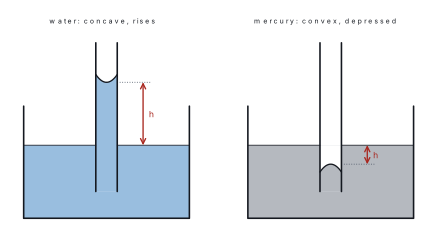
- Capillary rise h = 2T\cos\theta/(r\rho g): h \propto 1/r; angle of contact; mercury is depressed.
- Viscosity: F = \eta A\,dv/dx; Stokes' law 6\pi\eta rv; terminal velocity \propto r^2; Poiseuille Q \propto r^4.
- Continuity A_1v_1 = A_2v_2; Bernoulli P + \frac{1}{2}\rho v^2 + \rho gh = constant; Torricelli v = \sqrt{2gh}; lift, venturi, atomiser.
4.1 Pressure in a fluid; surface tension, surface energy and capillary action
Pressure in a fluid at rest
Pressure is the normal force per unit area: P = F/A. It is a scalar; SI unit pascal (1 Pa = 1 N m⁻²), dimensions [ML^{-1}T^{-2}]. Other units: 1 atm = 1.013 × 10⁵ Pa = 76 cm of mercury = 760 torr; 1 bar = 10⁵ Pa; 1 mm Hg ≈ 133 Pa (blood pressure of 120 mm Hg is about 16 kPa above atmospheric).
In a fluid at rest:
- pressure at a point acts equally in all directions;
- pressure is the same at all points at the same level in a connected body of the same liquid;
- pressure increases with depth: at depth h below the free surface P = P_0 + h\rho g, where P_0 is the atmospheric pressure. h\rho g alone is the gauge pressure; P is the absolute pressure;
- pressure at the bottom does not depend on the shape or the cross-section of the vessel, only on the depth (the hydrostatic paradox).
The atmosphere supports a column of 76 cm of mercury, or about 10.3 m of water.
A pressure applied to an enclosed fluid is transmitted undiminished to every part of the fluid and to the walls of the container.
In a hydraulic lift, press or brake, a small force F_1 on a small piston A_1 gives a large force F_2 = F_1A_2/A_1 on a large piston — but the large piston moves a correspondingly smaller distance, so no work is gained.
Archimedes' principle: a body wholly or partly immersed in a fluid feels an upward buoyant force (upthrust) equal to the weight of the fluid it displaces. A floating body displaces its own weight of fluid, so the fraction of its volume submerged is \rho_{body}/\rho_{fluid} (ice, 917 kg m⁻³, floats about nine-tenths submerged in fresh water). Relative density = weight in air / loss of weight in water.
Problem. (a) Find the absolute pressure on a diver 10 m below the surface of Phewa Lake (P_0 = 1.01\times10^5 Pa, \rho = 1000 kg m⁻³, g = 9.8 m s⁻²). (b) The pistons of a car-service lift have areas 10 cm² and 1000 cm². What force on the small piston lifts a 2000 kg car?
Solution. (a) P = 1.01\times10^5 + 1000(9.8)(10) = 1.99\times10^5 Pa — about 2 atm: every 10 m of water adds roughly one atmosphere. (b) F_1 = F_2A_1/A_2 = 2000(9.8)/100 = 196 N.
Surface tension
Molecules attract one another over a very short molecular range (about 10⁻⁹ m). A molecule deep in a liquid is pulled equally on all sides; a molecule in the surface is pulled inward only. The surface therefore behaves like a stretched elastic membrane and tends to contract to the least area — which is why free drops and bubbles are spherical (a sphere has the least surface for a given volume), why a greased needle can float on water, and why wet hairs of a paint brush cling together.
Attraction between like molecules is cohesion; between unlike molecules (liquid and solid), adhesion.
The surface tension T of a liquid is the force per unit length acting on an imaginary line drawn in the liquid surface, perpendicular to the line and tangential to the surface: T = F/l. SI unit N m⁻¹; dimensions [MT^{-2}].
Surface energy. To increase the area of a surface, molecules must be brought up from the interior against the inward pull, so work is needed. The work done per unit increase in surface area (at constant temperature) is the surface energy, and it is numerically equal to the surface tension: W = T\,\Delta A (1 J m⁻² = 1 N m⁻¹).
| Situation | Change of area to use in W = T\Delta A |
|---|---|
| Liquid drop of radius r (one surface) | 4\pi r^2 |
| Soap bubble of radius r (two surfaces, inside and outside) | 2\times4\pi r^2 = 8\pi r^2 |
| Soap film on a frame, area increased by \Delta A | 2\Delta A |
| Drop of radius R split into n equal droplets | 4\pi R^2(n^{1/3} - 1) — energy must be supplied |
When small drops merge into one big drop the total area falls and energy is released (the big drop is slightly warmer).
Excess pressure inside a curved surface (the inside of the curve is at the higher pressure):
| Surface | Excess pressure |
|---|---|
| Liquid drop, or air bubble inside a liquid (one surface) | \Delta P = \frac{2T}{r} |
| Soap bubble in air (two surfaces) | \Delta P = \frac{4T}{r} |
The smaller the bubble, the larger the excess pressure. Two soap bubbles of different sizes joined by a tube: air flows from the smaller into the larger, so the small one shrinks and the large one grows.
What changes surface tension.
| Factor | Effect on T |
|---|---|
| Rise in temperature | decreases (almost linearly); zero at the critical temperature |
| Highly soluble impurity (common salt in water) | increases slightly |
| Sparingly soluble or surface-active impurity (soap, detergent, phenol) | decreases strongly |
| Oil or grease film on water | decreases (oil spread on ponds kills mosquito larvae, which can no longer hang from the surface) |
Detergents lower the surface tension of water so that it spreads into and wets the fine gaps of cloth; hot soapy water washes better than cold, plain water.
Angle of contact and capillary action
The angle of contact is the angle between the tangent to the liquid surface at the point of contact and the solid surface, measured inside the liquid.
| Pure water and clean glass | Mercury and glass | |
|---|---|---|
| Angle of contact | acute, nearly 0° (often quoted as about 8°) | obtuse, about 140° |
| Adhesion vs cohesion | adhesion > cohesion | cohesion > adhesion |
| Wets the glass? | yes | no |
| Meniscus | concave (curves up at the walls) | convex (curves down at the walls) |
| In a capillary tube | rises | is depressed |
At exactly 90° (water on silver) there is neither rise nor fall.
Capillarity is the rise or fall of a liquid in a tube of very fine bore. Balancing the upward surface-tension pull around the rim, 2\pi rT\cos\theta, against the weight of the raised column, \pi r^2h\rho g (Jurin's law):
So h \propto 1/r (hr = constant for a given liquid): halve the bore and the liquid rises twice as high. For \theta > 90^{\circ}, \cos\theta < 0 and h is negative (depression).
Applications. Oil rises in a lamp wick; ink in blotting paper; water in a towel and in the soil (ploughing breaks the fine soil capillaries and keeps moisture from reaching the surface and evaporating); surface tension and capillarity help move water in the xylem of plants.
If the tube above the water is shorter than h, the water rises to the top and stops — it does not spill over like a fountain. The meniscus flattens instead: its radius of curvature R grows so that hR stays constant. In a freely falling lift (g_{eff} = 0) water rises to fill the whole length of any capillary.
Problem. (a) Water (T = 0.07 N m⁻¹, \theta = 0^{\circ}) stands in a glass capillary of internal diameter 0.5 mm. Find the rise (g = 9.8 m s⁻²). (b) Find the excess pressure inside a soap bubble of radius 2 cm, and the work done in blowing a bubble of radius 1 cm, for a soap solution with T = 0.03 N m⁻¹.
Solution. (a) r = 0.25 mm: h = \frac{2(0.07)}{(0.25\times10^{-3})(1000)(9.8)} = 0.057 m = 5.7 cm. (b) \Delta P = 4T/r = 4(0.03)/0.02 = 6 Pa. Work = T\times8\pi r^2 = 0.03\times8\pi\times10^{-4} = 7.5\times10^{-5} J.
4.2 Viscosity: Newton's law of viscous flow, Stokes' law and terminal velocity, Poiseuille's formula
Viscosity and Newton's law
In streamline (laminar) flow a liquid moves in layers that slide over one another: the layer touching a fixed surface is at rest, and the speed increases layer by layer away from it. Viscosity is the property of a fluid by which it opposes the relative motion between its adjacent layers — internal friction of the fluid.
The tangential viscous force between two layers is proportional to the area A of the layers and to the velocity gradient dv/dx (rate of change of velocity with distance perpendicular to the flow): F = \eta A\frac{dv}{dx}. The constant \eta is the coefficient of viscosity. SI unit N s m⁻² = Pa s (sometimes called the decapoise); CGS unit the poise; 1 Pa s = 10 poise. Dimensions [ML^{-1}T^{-1}].
| Liquids | Gases | |
|---|---|---|
| Origin of viscosity | cohesive forces between molecules | transfer of momentum by molecules moving between layers |
| On heating | viscosity decreases (honey and engine oil run more freely) | viscosity increases |
Viscosity is different from density: honey is far more viscous than mercury, though much less dense. Blood is about three to four times as viscous as water.
Reynolds number R_e = \rho vD/\eta (dimensionless) decides the type of flow in a pipe of diameter D: small values (below about 2000) mean laminar flow, large values turbulent flow. The speed at which laminar flow breaks down is the critical velocity v_c = R_e\eta/(\rho D) — high for thick, viscous liquids in narrow tubes.
Stokes' law and terminal velocity
A small sphere of radius r moving slowly with speed v through a viscous fluid of viscosity \eta feels a viscous drag F = 6\pi\eta rv.
It holds for a small, smooth, rigid sphere, moving slowly (streamline flow) through a uniform fluid of large extent. Dimensional check: [ML^{-1}T^{-1}][L][LT^{-1}] = [MLT^{-2}].
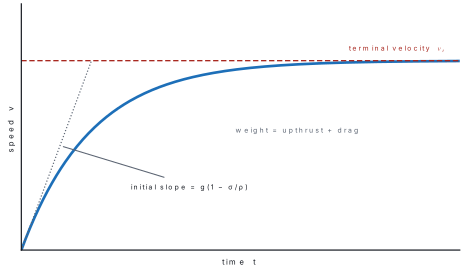
A sphere of density \rho dropped in a fluid of density \sigma accelerates until the drag plus the upthrust balance its weight. Then it falls at a constant terminal velocity:
- v_t \propto r^2: double the radius, four times the terminal velocity.
- If \sigma > \rho (an air bubble in water), v_t is negative: the body rises at a steady speed.
- Tiny water droplets in clouds and fog have very small v_t, so they seem to float; a parachute has a small terminal velocity because its drag is large.
- Uses: Millikan's oil-drop experiment (Chapter 18); measuring the viscosity of oils; settling (sedimentation) of particles. In medicine, the erythrocyte sedimentation rate (ESR) is the rate at which red cells settle in a column of blood — clumped cells behave as larger spheres and settle faster.
Problem. Find the terminal velocity of a cloud droplet of radius 10 μm falling through air (\eta = 1.8\times10^{-5} Pa s, density of water 1000 kg m⁻³; neglect the density of air; g = 9.8 m s⁻²). How fast would a droplet of radius 30 μm fall?
Solution. v_t = \frac{2(10^{-5})^2(1000)(9.8)}{9(1.8\times10^{-5})} = 1.2\times10^{-2} m s⁻¹ — about 1 cm per second, so air currents easily hold it up. Three times the radius gives 3^2 = 9 times the speed: about 11 cm s⁻¹.
Poiseuille's formula
For steady laminar flow of a liquid through a narrow horizontal tube of radius r and length l, with a pressure difference P between its ends, the volume of liquid flowing per second is
The formula can be checked (apart from the \pi/8) by dimensions. The key is the fourth power of the radius: halve the radius and the flow drops to \frac{1}{16}. Writing Q = P/R, the tube has a fluid resistance R = \frac{8\eta l}{\pi r^4}; tubes in series add resistances and tubes in parallel add flows, exactly like electrical resistors.
Problem. Fatty deposits reduce the radius of an artery by 20 %. For the same pressure difference, by what factor does the blood flow fall? By what factor must the pressure difference rise to restore the flow?
Solution. Q \propto r^4: 0.8^4 = 0.41, so the flow falls to 41 % of normal. To restore it, P must rise by 1/0.41 \approx 2.4 times — one reason narrowed arteries raise blood pressure and load the heart.
4.3 Equation of continuity and Bernoulli's principle with applications
An ideal fluid is incompressible and non-viscous, and its flow is steady and irrotational. In steady (streamline) flow the velocity at each point does not change with time; the path of a fluid particle is a streamline, the tangent to it gives the velocity there, and two streamlines never cross. Crowded streamlines mean fast flow.
Equation of continuity
For an incompressible fluid flowing steadily through a tube, the mass (and volume) entering one end per second equals that leaving the other:
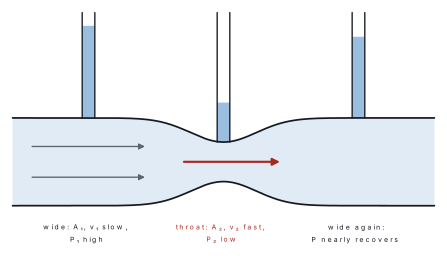
Q is the volume flow rate (m³ s⁻¹). Where the tube is narrow, the flow is fast: water speeds up through the rapids of a gorge and out of a nozzle; a thumb over the end of a hose makes the jet fly farther. It is the law of conservation of mass. In the body, the total cross-section of all the capillaries is far larger than that of the aorta, so blood moves much more slowly in the capillaries — giving time for exchange with the tissues.
Bernoulli's principle
For the steady flow of an ideal fluid, the sum of the pressure, the kinetic energy per unit volume and the potential energy per unit volume is the same at every point of a streamline: P + \frac{1}{2}\rho v^2 + \rho gh = constant.
Dividing by \rho g: \frac{P}{\rho g} + \frac{v^2}{2g} + h = constant — the sum of the pressure head, velocity head and gravitational head. Bernoulli's theorem is the law of conservation of energy for a moving fluid. In a horizontal pipe it says: where the speed is high, the pressure is low.
Applications.
| Device or effect | How Bernoulli and continuity explain it |
|---|---|
| Venturimeter | the pressure drop between the wide part and the throat gives the flow speed: P_1 - P_2 = \frac{1}{2}\rho(v_2^2 - v_1^2) with A_1v_1 = A_2v_2 |
| Torricelli's theorem | liquid leaves a hole at depth h below the free surface of a wide open tank with speed v = \sqrt{2gh} — the speed of a free fall from that height |
| Lift on an aeroplane wing (aerofoil) | air flows faster over the curved upper surface, so the pressure above is lower than below |
| Roofs lifted off in a storm | fast wind over the roof lowers the pressure above it; the still air inside pushes up |
| Two boats or trains moving side by side | fast flow in the narrow gap lowers the pressure there; they are pushed together |
| Atomiser, sprayer, Bunsen burner, carburettor | a fast jet past the top of a tube lowers the pressure there and draws the liquid (or air) in |
| Swing of a spinning ball (Magnus effect) | the spin makes the air faster on one side; the ball is pushed toward the low-pressure side |
Jet from a hole: for a tank filled to height H with a hole at depth h below the surface, the jet lands at a horizontal distance R = 2\sqrt{h(H - h)} from the foot of the tank — greatest (R = H) for a hole halfway down, and the same for holes at depths h and H - h.
Problem. (a) Water flows through a horizontal pipe whose cross-section narrows from 4 cm² to 1 cm². The speed in the wide part is 1 m s⁻¹. Find the speed in the narrow part and the pressure difference. (b) Water stands 5 m above a small hole in the side of a large open tank. Find the speed of efflux (g = 10 m s⁻²).
Solution. (a) v_2 = A_1v_1/A_2 = 4 m s⁻¹; P_1 - P_2 = \frac{1}{2}(1000)(4^2 - 1^2) = 7500 Pa (a water column of about 0.77 m). (b) v = \sqrt{2gh} = \sqrt{100} = 10 m s⁻¹.
A pipe narrowing from 4 cm to 2 cm diameter has one quarter of the area, so the speed becomes four times, not two. And in Bernoulli's equation use v^2: doubling the speed quadruples the kinetic-energy term.
Learn the power of r in each formula and most questions are one line: capillary rise h \propto r^{-1}; excess pressure \propto r^{-1}; Stokes' drag \propto r; terminal velocity \propto r^2; Poiseuille flow \propto r^4; speed in a pipe \propto r^{-2} (continuity).
Formula and fact sheet
| Topic | Formula or fact |
|---|---|
| Pressure | P = F/A; P = P_0 + h\rho g; 1 atm = 1.013 × 10⁵ Pa = 76 cm Hg |
| Pascal's law | F_2/F_1 = A_2/A_1 (hydraulic lift, brakes) |
| Archimedes | upthrust = weight of fluid displaced; floating: fraction submerged = \rho_{body}/\rho_{fluid} |
| Surface tension | T = F/l (N m⁻¹, [MT^{-2}]) = surface energy per unit area (J m⁻²) |
| Work on surfaces | drop T\cdot4\pi r^2; soap bubble T\cdot8\pi r^2; splitting into n drops 4\pi R^2T(n^{1/3} - 1) |
| Excess pressure | drop or air bubble in liquid 2T/r; soap bubble 4T/r |
| Capillary rise | h = 2T\cos\theta/(r\rho g); hr constant; mercury (\theta \approx 140^{\circ}) depressed |
| Effect of temperature | T falls; viscosity of liquids falls, of gases rises |
| Newton's law of viscosity | F = \eta A\,dv/dx; \eta in Pa s ([ML^{-1}T^{-1}]); 1 Pa s = 10 poise |
| Stokes' law | F = 6\pi\eta rv |
| Terminal velocity | v_t = 2r^2(\rho - \sigma)g/9\eta; \propto r^2 |
| Poiseuille | Q = \pi Pr^4/(8\eta l); \propto r^4; resistance 8\eta l/\pi r^4 |
| Reynolds number | R_e = \rho vD/\eta; low → laminar, high → turbulent |
| Continuity | A_1v_1 = A_2v_2 (mass conservation) |
| Bernoulli | P + \frac{1}{2}\rho v^2 + \rho gh = constant (energy conservation) |
| Torricelli | v = \sqrt{2gh}; jet range 2\sqrt{h(H - h)}, maximum H at h = H/2 |
| Venturi | P_1 - P_2 = \frac{1}{2}\rho(v_2^2 - v_1^2) |
Chapter summary
- Pressure in a liquid is P_0 + h\rho g, the same at one level, independent of the vessel's shape; Pascal's law multiplies force in a hydraulic lift; upthrust equals the weight of fluid displaced.
- Surface tension (N m⁻¹) equals surface energy per unit area (J m⁻²); it falls with temperature and with soap or detergent; a soap film has two surfaces.
- Excess pressure is 2T/r in a drop and 4T/r in a soap bubble — the smaller the bubble, the higher the pressure.
- Capillary rise h = 2T\cos\theta/(r\rho g): liquids that wet glass (acute angle, concave meniscus) rise; mercury (obtuse, convex) is depressed; a short tube never overflows.
- Viscous force F = \eta A\,dv/dx; viscosity of liquids falls and of gases rises on heating; SI unit Pa s.
- Stokes' drag 6\pi\eta rv leads to the terminal velocity 2r^2(\rho - \sigma)g/9\eta, proportional to r^2.
- Poiseuille's flow Q = \pi Pr^4/8\eta l depends on the fourth power of the radius.
- Continuity A_1v_1 = A_2v_2 and Bernoulli P + \frac{1}{2}\rho v^2 + \rho gh = constant: faster flow means lower pressure — venturimeter, Torricelli's \sqrt{2gh}, wing lift, atomisers.
Practice questions
Set A — Recall (21 questions)
- The SI unit of pressure, the pascal, is equal toaN mbN m⁻²cN m⁻¹dN m²
- The pressure at a depth h in a liquid of density ρ, whose surface is open to an atmospheric pressure P_0, isah\rho gbP_0 - h\rho gcP_0 + h\rho gdP_0/h\rho g
- A hydraulic lift works on the principle ofaBernoulli's theorembArchimedes' principlecStokes' lawdPascal's law
- The dimensional formula of surface tension isa[MT⁻²]b[MLT⁻²]c[ML⁻¹T⁻²]d[ML²T⁻²]
- When the temperature of a liquid rises, its surface tensionaincreasesbdecreasescstays the samedfirst increases and then decreases
- The excess pressure inside a soap bubble of radius r made from a solution of surface tension T isa2T/rbT/rc4T/rd8T/r
- The angle of contact between mercury and clean glass isazerobacutecexactly 90°dobtuse
- A liquid rises in a glass capillary tube when the angle of contact isaacutebobtusec90°d180°
- For a given liquid, the height of capillary rise h and the radius r of the tube are related byah \propto rbh \propto r^{2}ch \propto 1/r^{2}dh \propto 1/r
- The SI unit of the coefficient of viscosity isapoisebPa scN s mdN m⁻² s⁻¹
- According to Stokes' law, the viscous drag on a sphere of radius r moving with speed v through a fluid of viscosity η isa6\pi\eta rvb6\pi\eta r^{2}vc4\pi\eta rvd6\pi\eta v/r
- The terminal velocity of a small sphere falling through a viscous liquid is proportional toarbr^{3}cr^{2}d1/r
- According to Poiseuille's formula, the volume of liquid flowing per second through a narrow tube is proportional toar^{4}br^{2}cr^{3}dr
- When a gas is heated, its viscosityadecreasesbincreasescdoes not changedbecomes zero
- The equation of continuity for fluid flow follows from the conservation ofaenergybmomentumcmassdangular momentum
- Bernoulli's theorem is a statement of the conservation ofaenergybmasscmomentumdvolume
- Liquid flows out of a small hole at depth h below the free surface of a large open tank with a speed ofaghb\sqrt{gh}c2ghd\sqrt{2gh}
- A venturimeter is used to measureathe surface tension of a liquidbthe rate of flow of a liquid in a pipecthe viscosity of a liquiddatmospheric pressure
- The surface energy per unit area of a liquid surface is numerically equal to itsaviscositybsurface tensioncdensitydvapour pressure
- The dimensional formula of the coefficient of viscosity isa[MLT⁻¹]b[ML⁻¹T⁻²]c[ML⁻¹T⁻¹]d[ML²T⁻¹]
- Small free drops of a liquid are spherical because ofaviscositybgravitycbuoyancydsurface tension
Answers and explanations — Set A
1. (b) — pressure is force per unit area: 1 Pa = 1 N m⁻². N m⁻¹ is the unit of surface tension.
2. (c) — the atmosphere presses on the surface and the liquid column adds h\rho g; h\rho g alone is the gauge pressure.
3. (d) — the pressure applied at the small piston is transmitted undiminished to the large one, so F_2 = F_1A_2/A_1.
4. (a) — T = F/l: [MLT^{-2}]/[L] = [MT^{-2}]. (c) is pressure.
5. (b) — surface tension falls (almost linearly) with temperature and vanishes at the critical temperature.
6. (c) — a soap bubble has two surfaces, so the excess pressure is 2\times2T/r = 4T/r. 2T/r is for a drop or an air bubble inside a liquid.
7. (d) — about 140°: mercury does not wet glass, its meniscus is convex and it is depressed in a capillary.
8. (a) — with \theta < 90^{\circ}, \cos\theta > 0 and h = 2T\cos\theta/(r\rho g) is positive.
9. (d) — Jurin's law: h = 2T\cos\theta/(r\rho g), so hr is constant.
10. (b) — \eta = F/(A\,dv/dx) has unit N s m⁻² = Pa s. The poise is the CGS unit (1 Pa s = 10 poise).
11. (a) — Stokes' law, F = 6\pi\eta rv, valid for small spheres in slow (streamline) motion.
12. (c) — v_t = 2r^2(\rho - \sigma)g/9\eta: weight and upthrust go as r^3, drag as rv, so v \propto r^2.
13. (a) — Q = \pi Pr^4/(8\eta l); the fourth power is the point examiners test.
14. (b) — gas viscosity comes from molecules carrying momentum between layers; faster molecules at higher temperature carry more. Liquids behave oppositely.
15. (c) — what enters a tube per second must leave it: \rho A_1v_1 = \rho A_2v_2.
16. (a) — P, \frac{1}{2}\rho v^2 and \rho gh are energies per unit volume; their sum stays constant.
17. (d) — Torricelli's theorem: the efflux speed equals the speed of free fall through the height h.
18. (b) — the pressure difference between its wide part and its throat gives the flow speed and hence the rate of flow.
19. (b) — surface energy (J m⁻²) and surface tension (N m⁻¹) have the same dimensions and the same numerical value.
20. (c) — \eta = F/(A\,dv/dx): [MLT^{-2}]/([L^2][T^{-1}]) = [ML^{-1}T^{-1}].
21. (d) — surface tension makes the surface contract to the least area, and a sphere has the least area for its volume.
Set B — Understanding (14 questions)
- Water rises 6 cm in a capillary tube, but only 4 cm of the tube is above the water surface. The wateraoverflows from the top in a fountainbrises to 4 cm and its meniscus becomes flattercdoes not rise at alldrises to 4 cm and its meniscus becomes more curved
- A capillary tube stands in water inside a freely falling lift. The water in the tubeadoes not rise at allbrises to the same height as on the groundcrises to half the usual heightdrises to fill the whole length of the tube
- Two soap bubbles of radii 1 cm and 2 cm are joined by a narrow tube. Air then flowsafrom the smaller bubble into the largerbfrom the larger bubble into the smallercin neither directiondback and forth until the sizes are equal
- The radius of a capillary tube is halved. The height to which water rises in it becomesahalfbone quarterctwicedfour times
- The radius of a narrow tube is halved while the pressure difference and length stay the same. The rate of flow of water through it becomesaone halfbone quartercone eighthdone sixteenth
- Water flows through a horizontal pipe from a wide section into a narrow section. In the narrow sectionathe speed is higher and the pressure is lowerbthe speed and the pressure are both highercthe speed is lower and the pressure is higherdthe speed and the pressure are both lower
- Many tiny mercury droplets merge to form one big drop. In this processaenergy is absorbed and the drop coolsbenergy is released and the drop warms slightlycno energy change takes placedthe surface area increases
- Soap or detergent helps water to clean greasy clothes mainly because itaincreases the surface tension of waterbincreases the viscosity of waterclowers the surface tension of waterdraises the boiling point of water
- A small steel ball falls through glycerine with terminal velocity v. A ball of the same steel with twice the radius would have a terminal velocity ofa2vbv/2c8vd4v
- During a storm, the roof of a house is lifted off. This happens becauseathe fast wind above the roof lowers the pressure therebthe wind raises the pressure above the roofcthe air inside the house heats updthe roof becomes lighter when wet
- Honey flows much more easily when it is warmed becauseaits density increasesbits surface tension increasescits viscosity decreasesdits viscosity increases
- Blood flows more slowly in the capillaries than in the aorta becauseathe capillaries are narrower than the aortabthe capillaries together have a much larger total cross-sectioncblood is more viscous in the capillariesdthe pressure in the capillaries is higher
- Ice of density 900 kg m⁻³ floats in water of density 1000 kg m⁻³. The fraction of its volume above the water surface isa9/10b1/9c1/10d1/2
- An air bubble released at the bottom of a pond of water risesawith a constant acceleration equal to gbwith a speed that keeps increasing without limitconly if the water is warmdat a terminal velocity, once viscous drag balances the net upthrust
Answers and explanations — Set B
1. (b) — a capillary never overflows; the water stops at the top and the meniscus radius grows (hR constant), so the meniscus becomes flatter.
2. (d) — in free fall the effective g is zero, so nothing pulls the column down: h = 2T\cos\theta/(r\rho g) grows without limit and the water fills the tube.
3. (a) — excess pressure 4T/r is greater in the smaller bubble, so air is pushed into the larger one; the small bubble shrinks further.
4. (c) — h \propto 1/r: half the radius gives twice the rise.
5. (d) — Poiseuille: Q \propto r^4; (1/2)^4 = 1/16.
6. (a) — continuity: smaller area, higher speed; Bernoulli (horizontal pipe): higher speed, lower pressure.
7. (b) — the total surface area decreases, so surface energy is released as heat and the drop warms slightly.
8. (c) — lowering the surface tension lets water spread into and wet the fine gaps of the cloth and lift off the grease.
9. (d) — v_t \propto r^2: twice the radius, four times the terminal velocity. (c) uses r^3 (the weight alone).
10. (a) — Bernoulli: fast-moving air above has lower pressure than the still air inside, so there is a net upward force on the roof.
11. (c) — the viscosity of a liquid falls quickly with rising temperature; density hardly changes.
12. (b) — continuity applies to the total flow: A_{total}v is the same, and the capillaries together have a far larger cross-section, so v is smaller. A single narrow tube (a) would give faster flow.
13. (c) — fraction submerged = 900/1000 = 9/10, so one-tenth is above the surface. (a) is the submerged fraction.
14. (d) — the bubble is less dense than water, so the upthrust exceeds its weight; it speeds up only until the viscous drag balances this net upward force, then rises at a steady terminal velocity (\rho - \sigma is negative in Stokes' formula, so v_t points up). It grows slightly as the pressure falls near the top, but it never accelerates freely.
Set C — Application (12 questions)
- The absolute pressure 10 m below the surface of a lake is (P_0 = 1.01 \times 10^{5} Pa, \rho = 1000 kg m⁻³, g = 9.8 m s⁻²)a0.98 × 10⁵ Pab1.99 × 10⁵ Pac1.01 × 10⁵ Pad2.98 × 10⁵ Pa
- The pistons of a hydraulic lift have areas of 10 cm² and 1000 cm². The force on the small piston needed to lift a 2000 kg car (g = 9.8 m s⁻²) isa196 Nb19.6 Nc1960 Nd1.96 × 10⁶ N
- Water (surface tension 0.072 N m⁻¹, angle of contact 0°, density 1000 kg m⁻³) rises in a glass capillary of radius 0.1 mm. The height of rise is about (g = 9.8 m s⁻²)a1.5 cmb7.3 cmc29 cmd14.7 cm
- The excess pressure inside a soap bubble of radius 2 cm, if the surface tension of the solution is 0.03 N m⁻¹, isa3 Pab1.5 Pac6 Pad12 Pa
- The work done in blowing a soap bubble of radius 1 cm with a soap solution of surface tension 0.03 N m⁻¹ is abouta3.8 × 10⁻⁵ Jb7.5 × 10⁻⁵ Jc1.5 × 10⁻⁴ Jd1.9 × 10⁻⁵ J
- A drop of water of radius 1 mm splits into 1000 identical droplets. Compared with the surface energy of the drop, the total surface energy of the droplets isathe sameb100 timesc1000 timesd10 times
- Water flows at 2 m s⁻¹ in a pipe of diameter 4 cm. The pipe narrows to a diameter of 2 cm. The speed in the narrow part isa4 m s⁻¹b1 m s⁻¹c8 m s⁻¹d16 m s⁻¹
- In a horizontal pipe, water (density 1000 kg m⁻³) moves at 2 m s⁻¹ in one section and at 4 m s⁻¹ in another. The pressure difference between the sections isa6000 Pab2000 Pac1000 Pad12000 Pa
- A small hole is made in the side of a large open water tank, 5 m below the water surface. The speed of the emerging water is (g = 10 m s⁻²)a5 m s⁻¹b7.1 m s⁻¹c50 m s⁻¹d10 m s⁻¹
- Water flows through a narrow tube at 60 cm³ s⁻¹. If the tube is replaced by one of half the radius, with the same length and pressure difference, the flow becomesa30 cm³ s⁻¹b15 cm³ s⁻¹c3.75 cm³ s⁻¹d7.5 cm³ s⁻¹
- A plate of area 0.1 m² moves at 0.2 m s⁻¹ over a fixed parallel plate, separated by an oil film 1 mm thick of viscosity 0.5 Pa s. The force needed to keep it moving isa0.01 Nb10 Nc1 Nd100 N
- A cloud droplet of radius 10 μm falls through air of viscosity 1.8 × 10⁻⁵ Pa s (water density 1000 kg m⁻³; neglect air density; g = 9.8 m s⁻²). Its terminal velocity is abouta1.2 cm s⁻¹b1.2 m s⁻¹c0.12 cm s⁻¹d12 cm s⁻¹
Answers and explanations — Set C
1. (b) — P = P_0 + h\rho g = 1.01\times10^5 + 1000(9.8)(10) = 1.99\times10^5 Pa. (a) is the gauge pressure alone.
2. (a) — F_1 = F_2A_1/A_2 = 2000(9.8)(10/1000) = 196 N.
3. (d) — h = 2T/(r\rho g) = 2(0.072)/(10^{-4}\times1000\times9.8) = 0.147 m = 14.7 cm. (b) forgets the factor 2.
4. (c) — two surfaces: \Delta P = 4T/r = 4(0.03)/0.02 = 6 Pa. (a) is 2T/r, the value for a single surface.
5. (b) — two surfaces: W = T\times2\times4\pi r^2 = 0.03\times8\pi\times10^{-4} = 7.5\times10^{-5} J. (a) counts only one surface.
6. (d) — volume conserved: 1000r^3 = R^3, so r = R/10; total area = 1000\times4\pi(R/10)^2 = 10\times4\pi R^2. Energy is proportional to area: 10 times.
7. (c) — v \propto 1/A \propto 1/d^2: half the diameter, one quarter of the area, four times the speed: 8 m s⁻¹. (a) uses the diameter instead of the area.
8. (a) — \Delta P = \frac{1}{2}\rho(v_2^2 - v_1^2) = 500(16 - 4) = 6000 Pa; the pressure is lower where the water is faster. (b) squares the difference of the speeds; (c) forgets to square them.
9. (d) — v = \sqrt{2gh} = \sqrt{2(10)(5)} = 10 m s⁻¹.
10. (c) — Q \propto r^4: 60/16 = 3.75 cm³ s⁻¹.
11. (b) — F = \eta A\,v/d = 0.5(0.1)(0.2)/0.001 = 10 N.
12. (a) — v_t = \frac{2r^2\rho g}{9\eta} = \frac{2(10^{-5})^2(1000)(9.8)}{9(1.8\times10^{-5})} = 0.012 m s⁻¹ = 1.2 cm s⁻¹; so small a speed that rising air holds clouds up.