Chapter 13 · Waves and Optics · 2 questions in the paper · 38 min read
Wave Optics: Interference, Diffraction and Polarization
What the syllabus asks for 3
- Coherent sources and the conditions for interference; Young's double-slit experiment
- Diffraction at a single slit and at a grating; resolving power of optical instruments
- Polarization and Brewster's law
Light behaves as a wave in three experiments that no particle model explains: two beams that add to darkness (interference), light that spreads into the shadow of an edge (diffraction), and light that refuses to pass through two crossed sheets (polarization). The Waves and Optics area carries 8 of the 50 Physics questions (official MEC weightage); we estimate about 2 come from this chapter — usually one numerical on a fringe or a slit and one short conceptual item. The whole chapter turns on a single question asked at a point on a screen: what is the path difference here, and is it a whole number of wavelengths?
- What makes two sources coherent, and the two ways of producing coherent beams (wavefront and amplitude).
- The interference conditions: path difference n\lambda for bright, (2n-1)\lambda/2 for dark; and \phi = 2\pi\Delta/\lambda.
- Young's double slit: \beta = \lambda D/d, its three proportionalities, \beta in a liquid, and the shift made by a slab.
- Intensity: I = I_1 + I_2 + 2\sqrt{I_1I_2}\cos\phi and I_{max}/I_{min} = (a_1+a_2)^2/(a_1-a_2)^2.
- Single slit: minima at a\sin\theta = n\lambda; central maximum width 2D\lambda/a.
- Grating: (a+b)\sin\theta = n\lambda; how many orders fit; resolving power of a telescope and a microscope.
- Malus's law I = I_0\cos^2\theta; Brewster's law \tan\theta_p = \mu; why reflected light is partly polarized.
13.1 Coherent sources and the conditions for interference; Young's double-slit experiment
13.1.1 Superposition, and what interference actually is
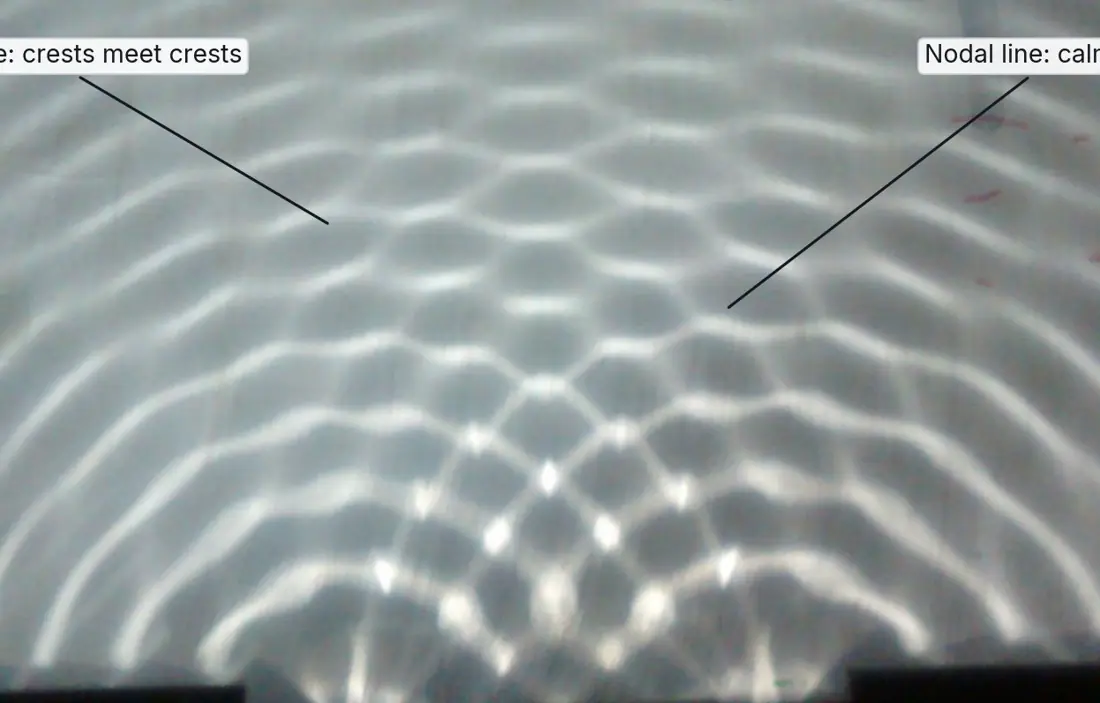
When two waves reach the same point, the resultant displacement is the vector sum of the two displacements. The waves pass through one another and separate again unchanged. What we see on a screen is not the displacement but the intensity, which is proportional to the square of the resultant amplitude:
where I_1 and I_2 are the intensities the waves would have separately and \phi is the phase difference between them at that point. Three cases matter:
| Phase difference | Path difference | Intensity | Name |
|---|---|---|---|
| 0, 2\pi, 4\pi, \dots | 0, \lambda, 2\lambda, \dots | (\sqrt{I_1}+\sqrt{I_2})^2, maximum | constructive |
| \pi, 3\pi, 5\pi, \dots | \lambda/2, 3\lambda/2, \dots | (\sqrt{I_1}-\sqrt{I_2})^2, minimum | destructive |
| \pi/2 | \lambda/4 | I_1 + I_2 | neither |
For two equal sources, I_1 = I_2 = I_0: the maximum is 4I_0 (not 2I_0 — amplitudes add, and 2^2 = 4) and the minimum is exactly zero. Energy is not destroyed; it is redistributed from the dark fringes into the bright ones, and the average intensity over the pattern is still 2I_0.
Two identical lamps lighting a wall give 2I. Two coherent beams of the same intensity give 4I at a bright fringe and 0 at a dark one. Whenever a question says "coherent", add amplitudes first and then square; never add intensities unless the sources are incoherent.
The contrast of a pattern is measured by its visibility,
which is 1 for equal amplitudes and falls as the amplitudes become unequal. Writing the amplitude ratio as a_1/a_2,
This one formula generates a whole family of paper questions, and the trap is always the same: an intensity ratio must be square-rooted before it is put into the amplitude formula.
13.1.2 Coherent sources
Two sources are coherent if they emit waves of the same frequency whose phase difference at any point remains constant in time. Only then is the interference pattern stationary and visible.
Two independent lamps, even two identical sodium lamps, are not coherent. Each atom emits a wave train lasting about 10^{-8} s, and the phase of the next train is random; the pattern from one pair of trains is wiped out by the next, long before the eye or a photographic plate can record it. A laser is different: stimulated emission keeps the phase fixed over a coherence length of metres, so two beams from one laser interfere easily.
Since independent sources will not do, one source must be split and the two parts recombined. There are two ways:
| Method | What is divided | Examples |
|---|---|---|
| Division of wavefront | one wavefront is cut into two parts by slits, mirrors or a prism | Young's double slit, Fresnel biprism, Lloyd's mirror |
| Division of amplitude | one beam is partly reflected and partly transmitted at a surface | thin films, Newton's rings, Michelson interferometer |
13.1.3 The conditions for sustained interference
For a pattern that can be seen and measured, all of the following must hold:
- The two sources must be coherent — same frequency, constant phase difference.
- They must have the same wavelength (monochromatic light gives clean fringes).
- Their amplitudes must be comparable; if one beam is much weaker the minima are only slightly darker than the maxima and the fringes are washed out.
- The two waves must have the same (or nearly the same) plane of polarization; perpendicularly polarized beams do not interfere at all.
- The source must be narrow. A wide source behaves as many independent point sources whose patterns are displaced from one another and overlap into uniform brightness.
- The path difference must be within the coherence length of the light; beyond it the phase relationship is lost.
13.1.4 Path difference and phase difference
A path difference \Delta means one wave has travelled a distance \Delta further than the other. One whole wavelength corresponds to a phase change of 2\pi, so
| Path difference \Delta | Phase difference \phi | Result with equal sources |
|---|---|---|
| 0 | 0 | bright, 4I_0 |
| \lambda/4 | \pi/2 | 2I_0 |
| \lambda/2 | \pi | dark, zero |
| 3\lambda/4 | 3\pi/2 | 2I_0 |
| n\lambda | 2n\pi | bright |
| (2n-1)\lambda/2 | (2n-1)\pi | dark |
Optical path. In a medium of refractive index \mu the wavelength is \lambda/\mu while the frequency is unchanged, so the same geometrical distance contains \mu times as many wavelengths. The optical path is \mu \times (geometrical path), and it is optical paths that are compared when the two beams pass through different media.
13.1.5 Young's double slit: where the fringes come from
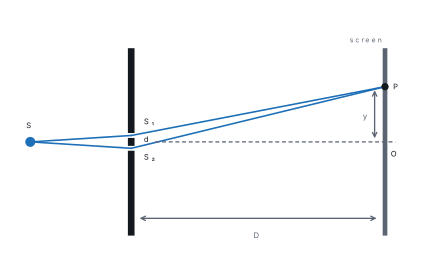
A single slit S is placed in front of two narrow slits S_1 and S_2 a distance d apart, and a screen stands a distance D beyond them, with D \gg d. Light from S reaches S_1 and S_2 in phase, so they act as two coherent sources. At a point P on the screen, at distance y from the centre O, the two beams have travelled slightly different distances and interfere.
We start from the geometry of the two paths and want the spacing between neighbouring bright fringes.
Setting up. Slits S_1, S_2 separated by d; screen at distance D \gg d; P at height y above the centre O.
Step 1 — write the two path lengths by Pythagoras.
Step 2 — subtract, so that D^2 cancels.
Step 3 — factor the left side.
Step 4 — use D \gg d and D \gg y, so that S_2P + S_1P \approx 2D. Then
Step 5 — bright fringes need \Delta = n\lambda.
Step 6 — the spacing is the difference between consecutive orders.
Result.
What it means. Every bright fringe is the same distance \beta from the next — the pattern is a comb of equally spaced lines. \beta grows with \lambda and D and shrinks as the slits are moved apart. The result assumes D \gg d, small angles (\sin\theta \approx \tan\theta \approx \theta), a monochromatic coherent source and one medium throughout.
The Pythagoras step, the difference-of-squares factorisation, and the explicit approximation S_2P + S_1P \approx 2D. Write the reason for the approximation in words; that sentence usually carries a mark.
| Quantity | Formula |
|---|---|
| Position of the nth bright fringe | y_n = n\lambda D/d, n = 0, 1, 2, \dots |
| Position of the nth dark fringe | y_n = (2n-1)\lambda D/d, n = 1, 2, \dots |
| Fringe width | \beta = \lambda D/d |
| Angular fringe width | \theta = \lambda/d |
| Path difference at P | \Delta = yd/D |
The central fringe (n = 0) is bright because the paths are equal. The first dark fringe is at half a fringe width from the centre, the first bright fringe at one full fringe width.
13.1.6 What changes the fringe width — and what does not
| Change made | Effect on \beta | Reason |
|---|---|---|
| Longer wavelength (red instead of violet) | increases | \beta \propto \lambda |
| Screen moved further away | increases | \beta \propto D |
| Slits moved further apart | decreases | \beta \propto 1/d |
| Whole apparatus immersed in a liquid of index \mu | falls to \beta/\mu | \lambda_{liquid} = \lambda/\mu |
| A slab of thickness t, index \mu, over one slit | unchanged; the pattern shifts by (\mu-1)t/\beta fringes towards that slit | extra optical path (\mu-1)t |
| White light instead of monochromatic | central fringe white, coloured fringes either side, red outermost | \beta \propto \lambda |
| One slit covered | fringes disappear, only a broad diffraction pattern remains | one source only |
| Order n of the fringe | no effect | \beta is independent of n |
Why the pattern shifts with a slab. The slab adds (\mu-1)t to the optical path of one beam. To bring the paths back to equality the point P must move towards the covered slit, so the whole pattern — including the white central fringe — moves that way. The number of fringes through which it moves is the extra optical path divided by one fringe width.
- \beta \propto 1/d, not 1/d^2 and not 1/D.
- Immersing the apparatus in water changes \lambda, not the frequency, and not D or d; so \beta falls by the factor \mu — it does not rise.
- The fringe width is unchanged by a slab; only the position of the pattern moves. Many students wrongly say the fringes get wider.
Problem. Light of wavelength 600 nm falls on two slits 0.5 mm apart; the screen is 1.0 m away. Find the fringe width. What does it become if the whole set-up is immersed in water of refractive index 4/3?
Solution. \beta = \lambda D/d = (600\times10^{-9})(1.0)/(0.5\times10^{-3}) = 1.2\times10^{-3} m = 1.2 mm. In water \lambda' = 600/1.333 = 450 nm, so \beta' = \beta/\mu = 1.2/(4/3) = 0.9 mm. The frequency is unchanged; only the wavelength in the medium matters.
Problem. In a double-slit experiment \beta = 0.1 mm. A glass sheet 0.2 mm thick and of refractive index 1.5 is placed in front of one slit. Through how many fringes does the pattern shift, and in which direction?
Solution. Extra optical path = (\mu-1)t = 0.5\times0.2 = 0.1 mm. Number of fringes = 0.1/0.1 = 1. The pattern shifts by one fringe towards the covered slit, because that beam has been delayed.
Problem. Two coherent beams of intensities I and 4I interfere. Find I_{max}/I_{min}.
Solution. Amplitudes are proportional to \sqrt{I}, so a_1:a_2 = 1:2. Then I_{max}/I_{min} = (3/1)^2 = 9. Answer 9 : 1. Note that the intensity ratio 1 : 4 becomes an amplitude ratio 1 : 2 before it is used — the commonest slip is to write (4+1)/(4-1).
13.1.7 Thin films and Newton's rings
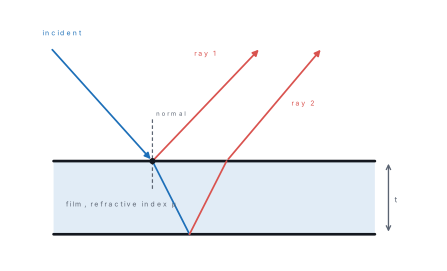
A soap film or a thin oil slick shows coloured bands in daylight. The two interfering beams here are the reflection from the top surface and the reflection from the bottom surface of the film, so this is division of amplitude.
For a film of thickness t and refractive index \mu, with light travelling at angle r inside the film, the second beam covers a distance 2t/\cos r in the film; but the extra optical path, measured between wavefronts of the two emerging rays, works out to 2\mu t\cos r (the \cos r appears because the rays leave along the same direction). In addition, the reflection at the top surface is from a denser medium (air to film), which changes the phase by \pi, equivalent to an extra \lambda/2. Hence
| Reflected light from a film in air | Condition |
|---|---|
| Bright | 2\mu t\cos r = (2n-1)\lambda/2 |
| Dark | 2\mu t\cos r = n\lambda |
At near-normal incidence \cos r \approx 1. This is why a soap film appears black just before it bursts: as t \to 0 the condition 2\mu t = 0 = n\lambda with n = 0 is a dark condition.
Anti-reflection coating. A coating whose refractive index lies between those of air and glass gives a \pi phase change at both surfaces, so the two shifts cancel. Destruction then needs 2\mu t = \lambda/2, i.e. t = \lambda/(4\mu) — a quarter-wavelength layer.
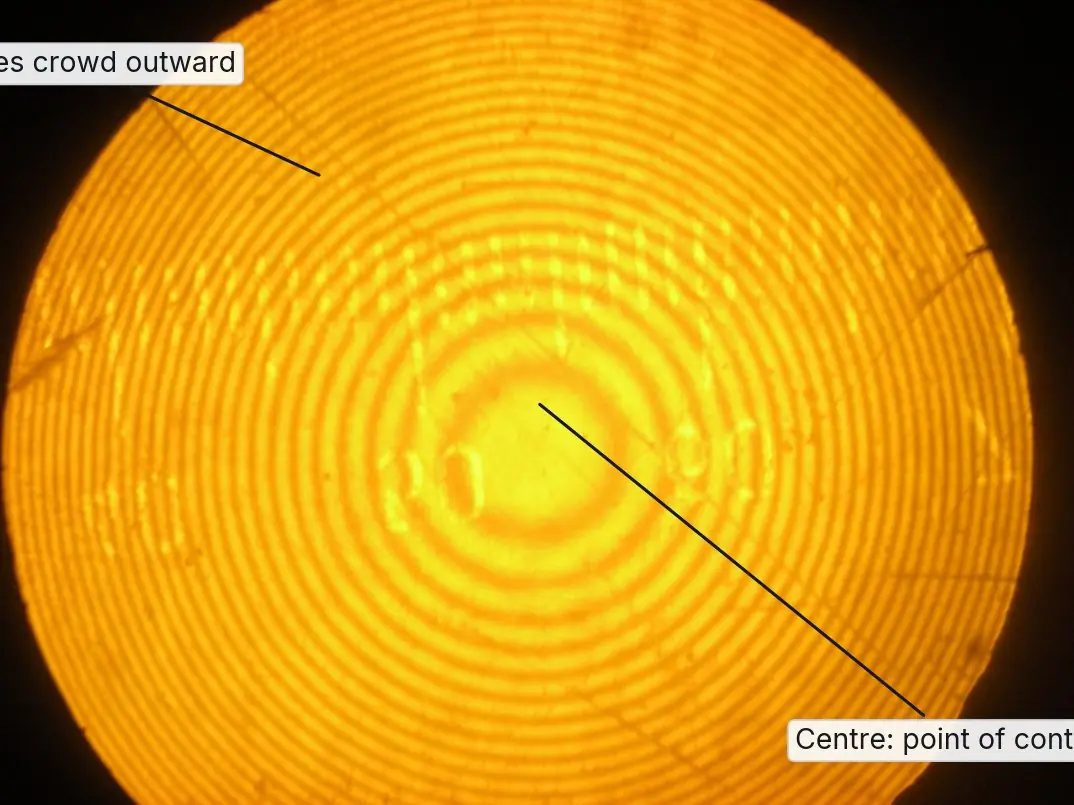
Newton's rings. A plano-convex lens of radius of curvature R rests on a flat glass plate, trapping a thin air film whose thickness at radius r is t = r^2/(2R). With \mu = 1 and normal incidence:
| Feature (reflected light) | Result |
|---|---|
| Centre | dark, because t = 0 gives the dark condition |
| Dark rings | r_n = \sqrt{n\lambda R}, n = 1, 2, 3, \dots (the centre is n = 0) |
| Bright rings | r_n = \sqrt{(2n-1)\lambda R/2}, n = 1, 2, 3, \dots |
| Spacing | rings crowd together as r grows, since r \propto \sqrt{n} |
| In transmitted light | centre bright, pattern complementary to the reflected one |
| Gap filled with liquid of index \mu | rings shrink, r \propto 1/\sqrt{\mu} |
Problem. A plano-convex lens of radius of curvature 1.0 m rests on a glass plate and is viewed in reflected light of wavelength 600 nm. Find the radius of the third dark ring.
Solution. r_3 = \sqrt{3\lambda R} = \sqrt{3(600\times10^{-9})(1.0)} = \sqrt{1.8\times10^{-6}} = 1.34\times10^{-3} m = 1.34 mm.
13.2 Diffraction at a single slit and at a grating; resolving power of optical instruments
13.2.1 What diffraction is
Diffraction is the spreading of a wave after it passes an obstacle or an aperture, so that light appears inside the geometrical shadow. It becomes noticeable when the size of the obstacle or slit is comparable with the wavelength. Sound bends round doorways easily because its wavelength is about a metre; light does not noticeably bend round a door because its wavelength is a fraction of a micrometre — but round a razor edge or through a narrow slit the fringes are clear.
| Fresnel diffraction | Fraunhofer diffraction | |
|---|---|---|
| Source and screen | at finite distances | effectively at infinity (lenses used) |
| Wavefronts at the aperture | spherical or cylindrical | plane |
| Treatment | complicated | simple; the standard school case |
13.2.2 Single slit: where the minima fall
Let parallel rays fall on a slit of width a. Consider the secondary wavelets leaving the slit at angle \theta to the straight-through direction. The ray from the top edge and the ray from the bottom edge differ in path by a\sin\theta.
The first minimum. Divide the slit into two halves. The ray from the top edge and the ray from the centre of the slit differ by \frac{a}{2}\sin\theta. If that equals \lambda/2, each pair of points (one in each half) cancels, and the whole slit cancels itself:
The same pairing argument, with the slit divided into 2n parts, gives the nth minimum:
Between the minima lie secondary maxima, approximately at
but they are much weaker than the central maximum, and their exact positions are slightly displaced from this formula.
For a single slit, a\sin\theta = n\lambda gives minima (dark). For a double slit or grating, d\sin\theta = n\lambda gives maxima (bright). The same-looking equation describes opposite things, because in the single slit the n\lambda is the path difference between the two edges of one slit, while in the grating it is between corresponding points of two neighbouring slits. Examiners build a distractor on exactly this swap.
13.2.3 The central maximum
The first minimum is at \sin\theta_1 = \lambda/a, so for small angles \theta_1 \approx \lambda/a. The central maximum therefore has
| Quantity | Value |
|---|---|
| Angular half-width | \theta_1 = \lambda/a |
| Full angular width | 2\lambda/a |
| Linear width on a screen at distance D | 2D\lambda/a |
| Width of each secondary maximum | D\lambda/a (half the central one) |
So the central maximum is twice as wide as any secondary maximum and far brighter. A narrower slit (a smaller) gives a wider central maximum — the opposite of what the word "narrow" suggests, and a favourite question.
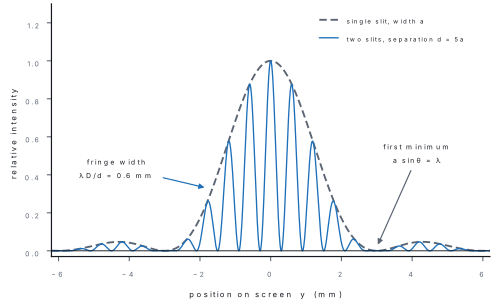
Problem. Light of wavelength 600 nm passes through a slit 0.2 mm wide and falls on a screen 1.0 m away. Find the width of the central maximum.
Solution. 2D\lambda/a = 2(1.0)(600\times10^{-9})/(0.2\times10^{-3}) = 6.0\times10^{-3} m = 6 mm. The half-width, 3 mm, is the distance to the first minimum.
13.2.4 Interference and diffraction compared
| Interference | Diffraction | |
|---|---|---|
| Origin | two separate coherent sources | secondary wavelets from different parts of one wavefront |
| Fringe widths | all equal | central maximum twice as wide as the others |
| Intensity of maxima | equal, if the sources are equally bright | falls off rapidly away from the centre |
| Minima | perfectly dark for equal amplitudes | not perfectly dark |
| Number of fringes | few, and they are broad | many, crowding together |
13.2.5 The diffraction grating
A grating is a plate ruled with N parallel slits per metre. The distance between the centres of neighbouring slits is the grating element
where a is the slit width and b the opaque width. Parallel rays diffracted at angle \theta from neighbouring slits differ in path by d\sin\theta, and they add in phase when
n is the order of the spectrum; n = 0 is the central white image. Because hundreds of slits contribute, the maxima are extremely sharp and bright (intensity proportional to N^2) while the space between them is almost dark. That is why a grating, not a double slit, is used to measure wavelengths.
How many orders fit. Since \sin\theta cannot exceed 1,
rounded down to a whole number. The highest order appears on each side of the centre, so the total number of principal maxima is 2n_{max} + 1 including the central one.
Missing orders. If d/a is a whole number, the diffraction minimum of each individual slit falls on the n = d/a interference maximum and that order is missing.
Problem. A grating has 5000 lines per cm and is used with light of wavelength 500 nm. Find the grating element and the highest order visible.
Solution. d = 1/(5000\ \text{cm}^{-1}) = 1/(5\times10^{5}\ \text{m}^{-1}) = 2\times10^{-6} m. n_{max} = d/\lambda = 2\times10^{-6}/500\times10^{-9} = 4. Orders 1 to 4 appear on each side, so 9 principal maxima are seen in all.
13.2.6 Resolving power of optical instruments
Two stars, or two nearby points of a specimen, are not point images: each is spread by diffraction into a disc with a ring around it. The Rayleigh criterion says they are just resolved when the centre of one diffraction pattern falls on the first minimum of the other.
| Instrument | Limit of resolution | Resolving power |
|---|---|---|
| Telescope (objective diameter D) | \theta_{min} = 1.22\lambda/D | D/(1.22\lambda) |
| Microscope (numerical aperture \mu\sin\theta) | d_{min} = \lambda/(2\mu\sin\theta) | 2\mu\sin\theta/\lambda |
| Grating (N lines, order n) | — | nN |
For the telescope, only the diameter of the objective matters — not its focal length, not the magnification. A larger objective collects more light and resolves finer detail, which is why research telescopes are built large. For the microscope, the numerical aperture \text{NA} = \mu\sin\theta is what counts; immersion oil raises \mu from 1 to about 1.5 and so improves resolution by that factor. Some books quote the same limit in Rayleigh's form, 0.61\lambda/(\mu\sin\theta); use whichever form the numbers in the question fit.
Worked example 13.7 — resolution of a telescope
Problem. A telescope has an objective of diameter 10 cm and is used at wavelength 600 nm. What is the smallest angular separation it can resolve?
Solution. \theta_{min} = 1.22\lambda/D = 1.22(600\times10^{-9})/(0.10) = 7.3\times10^{-6} rad. Doubling the diameter would halve this angle.
13.3 Polarization and Brewster's law
13.3.1 Unpolarized and plane-polarized light
Light is a transverse wave: the electric field oscillates perpendicular to the direction of travel. In unpolarized light the direction of that oscillation changes at random from instant to instant, so on average all directions across the beam are equally represented. In plane-polarized light the electric field is confined to one plane containing the ray.
- The plane of vibration is the plane containing the electric vector and the ray.
- The plane of polarization is perpendicular to the plane of vibration and also contains the ray.
Only transverse waves can be polarized. Sound, a longitudinal wave, cannot be, and this is the experimental proof that light is transverse — a fact that interference and diffraction alone cannot establish.
13.3.2 How light is polarized
| Method | What happens |
|---|---|
| Selective absorption | a Polaroid absorbs the component along its long molecular chains and transmits the perpendicular one |
| Reflection | at one particular angle (Brewster's) the reflected beam is completely polarized |
| Refraction | a pile of glass plates transmits a beam that is partially, and after many plates almost completely, polarized |
| Scattering | light scattered at 90° by air molecules is strongly polarized |
| Double refraction | calcite splits a beam into ordinary and extraordinary rays, polarized at right angles |
A Polaroid is a sheet of aligned long-chain molecules. Light with its electric vector along the chains drives electrons along them and is absorbed; light perpendicular to the chains passes. The first sheet is called the polarizer, the second (used to examine the light) the analyser.
13.3.3 Malus's law
If plane-polarized light of intensity I_0 falls on an analyser whose transmission axis makes an angle \theta with the plane of polarization, the transmitted intensity is
The transmitted beam remains plane-polarized, with its plane along the analyser's axis.
| Situation | Transmitted intensity |
|---|---|
| Unpolarized light I_0 through one Polaroid | I_0/2 |
| Plane-polarized I_0 through an analyser at \theta | I_0\cos^2\theta |
| Unpolarized I_0 through two Polaroids at \theta | (I_0/2)\cos^2\theta |
| Two Polaroids crossed (\theta = 90^{\circ}) | zero |
| Three sheets, first and third crossed, middle at 45° | (I_0/2)(\cos^2 45^{\circ})(\cos^2 45^{\circ}) = I_0/8 |
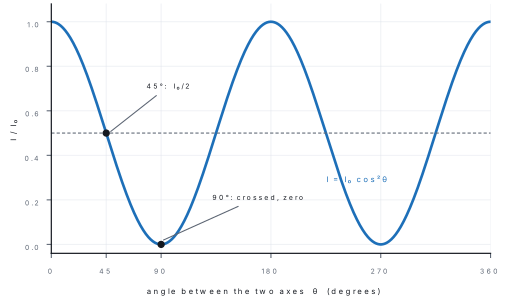
Unpolarized light through a single Polaroid comes out at half intensity, not at full intensity: the sheet removes the component perpendicular to its axis. Students who forget the factor 1/2 get twice the right answer for every stacked-sheet question. And a crossed pair gives zero no matter how bright the source is.
Problem. Unpolarized light of intensity I_0 passes through two Polaroids whose axes are at 60° to each other. Find the emergent intensity.
Solution. The first sheet halves it: I_0/2. Malus then gives (I_0/2)\cos^2 60^{\circ} = (I_0/2)(1/4) = I_0/8. The answer I_0/4 comes from forgetting the halving; 3I_0/8 from using \sin^2 instead of \cos^2.
13.3.4 Polarization by reflection: Brewster's law
When unpolarized light strikes a transparent surface, both the reflected and the refracted beams are partially polarized. At one particular angle of incidence — the polarizing angle or Brewster angle \theta_p — the reflected beam is completely plane-polarized, with its electric vector perpendicular to the plane of incidence. Brewster found that
where \mu is the refractive index of the reflecting medium relative to the medium the light comes from. At this angle the reflected and refracted rays are at right angles:
| Medium (from air) | \mu | \theta_p |
|---|---|---|
| Water | 1.33 | 53° |
| Glass | 1.50 | 56.3° |
| A medium with \mu = \sqrt{3} | 1.732 | 60° |
Problem. Light is incident from air on a medium of refractive index \sqrt{3}. Find the polarizing angle and the angle of refraction.
Solution. \tan\theta_p = \sqrt{3}, so \theta_p = 60^{\circ}. Then r = 90^{\circ} - 60^{\circ} = 30^{\circ}. Check with Snell's law: \sin 60^{\circ}/\sin 30^{\circ} = 0.866/0.5 = 1.732 = \sqrt{3}. ✓
13.3.5 Why reflected light is partially polarized
The reflected beam is the radiation of the electric dipoles that the incident wave sets oscillating in the medium. A dipole does not radiate along its own axis of oscillation.
- Dipoles oscillating perpendicular to the plane of incidence (parallel to the surface) can always radiate back into the reflected direction.
- Dipoles oscillating in the plane of incidence cannot radiate along their axis. At the Brewster angle the refracted ray is at 90° to the reflected ray, so those dipoles point exactly along the direction in which the reflected beam would travel — and they radiate nothing into it.
So at \theta_p only the perpendicular component is reflected: the reflected beam is 100 % polarized. At any other angle the in-plane component is only partly suppressed, so the reflected beam is partially polarized. The refracted beam is also partially polarized, but in the complementary sense (it is richer in the in-plane component).
13.3.6 Where polarization is used
- Sunglasses. Glare from a horizontal road or water surface is largely horizontally polarized; a Polaroid with a vertical transmission axis blocks it while passing about half of the rest of the scene.
- Photography. A rotating polarizing filter removes reflections from glass and water and darkens the sky, because scattered skylight is polarized.
- Liquid-crystal displays work by switching the polarization of light between crossed polaroids.
- 3-D cinema projects two images with perpendicular polarizations, and each eyepiece passes only one.
- Stress analysis in transparent models, and the study of optically active substances (a sugar solution rotates the plane of polarization).
Formula and fact sheet
| Topic | Formula or fact |
|---|---|
| Superposition | I = I_1 + I_2 + 2\sqrt{I_1I_2}\cos\phi |
| Phase from path | \phi = 2\pi\Delta/\lambda |
| Bright / dark | \Delta = n\lambda / \Delta = (2n-1)\lambda/2 |
| Amplitude and intensity | I \propto a^2; equal sources: I_{max} = 4I_0, I_{min} = 0 |
| Intensity ratio | I_{max}/I_{min} = (a_1+a_2)^2/(a_1-a_2)^2 |
| Visibility | V = (I_{max}-I_{min})/(I_{max}+I_{min}) |
| YDSE bright | y_n = n\lambda D/d |
| YDSE dark | y_n = (2n-1)\lambda D/d |
| Fringe width | \beta = \lambda D/d; in a medium \beta/\mu; angular width \lambda/d |
| Slab in one path | shift = (\mu-1)t/\beta fringes, towards the slab |
| Thin film, reflected | 2\mu t\cos r + \lambda/2 = n\lambda (bright), = (2n-1)\lambda/2 (dark) |
| Anti-reflection coating | t = \lambda/(4\mu) |
| Newton's rings | dark r_n = \sqrt{n\lambda R}; bright r_n = \sqrt{(2n-1)\lambda R/2}; centre dark in reflection |
| Single-slit minima | a\sin\theta = n\lambda |
| Single-slit secondary maxima | a\sin\theta \approx (2n+1)\lambda/2 |
| Central maximum width | 2D\lambda/a; secondary maximum D\lambda/a |
| Grating | (a+b)\sin\theta = n\lambda; d = 1/N; n_{max} = d/\lambda |
| Grating resolving power | nN |
| Telescope | \theta_{min} = 1.22\lambda/D; RP = D/(1.22\lambda) |
| Microscope | d_{min} = \lambda/(2\mu\sin\theta); RP = 2\mu\sin\theta/\lambda |
| Malus | I = I_0\cos^2\theta; one Polaroid halves unpolarized light |
| Brewster | \tan\theta_p = \mu; \theta_p + r = 90^{\circ} |
| Standard values | glass \mu = 1.5, \theta_p \approx 56.3^{\circ}; water \mu = 4/3, \theta_p \approx 53^{\circ} |
Chapter summary
- Interference is superposition of coherent waves; intensity is I_1+I_2+2\sqrt{I_1I_2}\cos\phi with \phi = 2\pi\Delta/\lambda. Equal sources give 4I_0 bright and zero dark.
- Bright fringes need \Delta = n\lambda; dark fringes need \Delta = (2n-1)\lambda/2. Optical path is \mu times geometrical path.
- Coherent beams are made by dividing a wavefront (double slit) or an amplitude (thin film). Two independent lamps never interfere.
- Young's double slit: y_n = n\lambda D/d for bright fringes and \beta = \lambda D/d for the spacing — independent of the order, proportional to \lambda and D, inversely proportional to d, and divided by \mu in a liquid.
- A slab of thickness t shifts the whole pattern by (\mu-1)t/\beta fringes towards the covered slit without changing \beta.
- In a thin film the reflected beams differ by 2\mu t\cos r + \lambda/2; in Newton's rings the reflected centre is dark and r_n = \sqrt{n\lambda R} for dark rings.
- Single slit: minima at a\sin\theta = n\lambda, central maximum of width 2D\lambda/a, twice the width of the secondary maxima.
- Grating: (a+b)\sin\theta = n\lambda; highest order n_{max} = d/\lambda; the maxima are sharp because many slits contribute.
- Resolving power: telescope D/(1.22\lambda), microscope 2\mu\sin\theta/\lambda — bigger aperture or higher refractive index resolves finer detail.
- Polarization proves light is transverse. Malus: I = I_0\cos^2\theta, with one Polaroid halving unpolarized light. Brewster: \tan\theta_p = \mu, and at that angle the reflected and refracted rays are perpendicular and the reflected beam is fully polarized.
Practice questions
Set A — Recall (24 questions)
- Two light sources are coherent when they emit waves ofathe same amplitudebequal intensitycthe same frequency with a constant phase differencedthe same wavelength with rapidly changing phase
- In Young's double-slit experiment the fringe width is given bya\lambda d/Db\lambda D/dc2\lambda D/dd\lambda D/d^2
- The path difference required for constructive interference isa(2n-1)\lambda/2bn\lambda/2c(2n+1)\lambdadn\lambda
- A path difference of one wavelength corresponds to a phase difference ofa2\pib\pic\pi/2d4\pi
- When the whole double-slit apparatus is immersed in water, the fringe widthaincreasesbdecreasescis unchangeddbecomes zero
- In single-slit diffraction the first minimum occurs whereaa\sin\theta = \lambda/2ba\sin\theta = 3\lambda/2ca\sin\theta = \lambdada\sin\theta = 2\lambda
- The width of the central maximum in single-slit diffraction, on a screen at distance D, isa2\lambda D/ab\lambda D/ac\lambda D/2ad2aD/\lambda
- The grating equation for the nth principal maximum isaa\sin\theta = n\lambdab(a+b)\sin\theta = (2n-1)\lambdacd\cos\theta = n\lambdad(a+b)\sin\theta = n\lambda
- The resolving power of a telescope of objective diameter D at wavelength \lambda isa1.22\lambda/Db\lambda/DcD/1.22\lambdad1.22D/\lambda
- Malus's law gives the intensity transmitted through an analyser asaI_0\cos\thetabI_0\cos^2\thetacI_0\sin^2\thetadI_0/2
- Brewster's law states that the polarizing angle satisfiesa\tan\theta_p = \mub\sin\theta_p = \muc\cos\theta_p = \mud\tan\theta_p = 1/\mu
- At the polarizing angle the reflected and refracted rays areaparallelbat 45°cat 60°dat 90°
- Two independent sodium lamps cannot give a sustained interference pattern becauseathey are too dimbtheir wavelengths differ too muchctheir phase difference changes at randomdthey emit white light
- For fixed slit separation and screen distance, the fringe width is directly proportional toathe intensitybthe wavelengthcthe frequencydthe square of the wavelength
- A Polaroid produces plane-polarized light from unpolarized light byadouble refractionbscatteringcreflection at the Brewster angledselective absorption
- In Newton's rings seen in reflected light, the centre of the pattern isadarkbbrightccoloureddequally bright and dark
- Two waves of equal intensity I_0 meet in phase. The resultant intensity isaI_0b2I_0c4I_0dzero
- The angular fringe width in Young's double-slit experiment isa\lambda D/db\lambda/dcd/\lambdad\lambda D/d^2
- The path difference at the third dark fringe in Young's experiment isa3\lambdab2\lambdac3\lambda/2d5\lambda/2
- Diffraction of light is most noticeable when the obstacle isacomparable in size with the wavelengthbmuch larger than the wavelengthcmuch smaller than the wavelengthdof any size, independent of wavelength
- The phenomenon that shows light is a transverse wave isainterferencebdiffractioncpolarizationddispersion
- A grating has N lines per metre. Its grating element isaNb1/NcN/2d2/N
- In Young's experiment with white light, the central fringe isaredbvioletcdarkdwhite
- The fringe width in Young's experiment does NOT depend onathe order n of the fringebthe wavelength usedcthe slit separationdthe distance to the screen
Answers and explanations — Set A
1. (c) — coherence means a fixed phase relationship, which requires the same frequency. Equal amplitude or equal intensity alone gives no stable pattern.
2. (b) — \beta = \lambda D/d. Option (a) is the reciprocal arrangement and (c) is the central-maximum width of a single slit.
3. (d) — constructive interference needs a whole number of wavelengths, \Delta = n\lambda; (2n-1)\lambda/2 is the destructive condition.
4. (a) — one wavelength is one full cycle, so \phi = 2\pi\Delta/\lambda = 2\pi.
5. (b) — in water \lambda falls to \lambda/\mu, and \beta \propto \lambda, so the fringes get closer together.
6. (c) — pairing the slit into halves gives \frac{a}{2}\sin\theta = \lambda/2, hence a\sin\theta = \lambda. (a) is the double-slit path-difference condition misapplied.
7. (a) — the first minimum is at y = \lambda D/a, and the central maximum extends symmetrically to both sides, so its full width is 2\lambda D/a.
8. (d) — the path difference between neighbouring slits is (a+b)\sin\theta, set equal to n\lambda for a maximum.
9. (c) — resolving power is the reciprocal of the angular limit 1.22\lambda/D. Option (a) is the limit of resolution itself, not the power.
10. (b) — the transmitted amplitude is a_0\cos\theta, so the intensity is I_0\cos^2\theta.
11. (a) — \tan\theta_p = \mu. At this angle \theta_p + r = 90^{\circ}.
12. (d) — the two rays are perpendicular at the polarizing angle; this is what allows the dipoles to radiate nothing into the reflected direction.
13. (c) — each atom emits a train of about 10^{-8} s with random phase, so the phase difference is not constant.
14. (b) — \beta = \lambda D/d, so \beta \propto \lambda. Frequency is inversely related to wavelength, so (c) is wrong.
15. (d) — a Polaroid absorbs the component along its aligned molecules and transmits the perpendicular one: selective absorption.
16. (a) — at the centre the air film has zero thickness, which satisfies the dark condition, so the centre is dark.
17. (c) — amplitudes add to 2a, and intensity goes as amplitude squared: 4I_0.
18. (b) — the angle subtended at the slits by one fringe is \beta/D = \lambda/d.
19. (d) — the nth dark fringe needs \Delta = (2n-1)\lambda/2; with n = 3 this is 5\lambda/2.
20. (a) — diffraction is strong only when the obstacle or aperture is of the order of a wavelength.
21. (c) — only transverse waves can be polarized, so polarization proves light is transverse. Interference and diffraction occur for longitudinal waves too.
22. (b) — the grating element is the slit spacing, d = 1/N when N is in lines per metre.
23. (d) — all wavelengths have zero path difference at the centre, so all colours arrive in phase and the central fringe is white.
24. (a) — \beta = \lambda D/d contains no n; every fringe is the same distance from the next.
Set B — Understanding (14 questions)
- In Young's experiment both the slit separation and the screen distance are doubled. The fringe widthadoublesbis unchangedchalvesdbecomes four times as large
- The fringes disappear when the source slit is made wide becauseadifferent parts of the source give overlapping patterns of different phasebthe light becomes monochromaticcthe wavelength changesddiffraction stops
- A thin glass plate is placed in front of the upper slit. The fringe patternadisappearsbbecomes widercshifts downward, away from the platedshifts upward, towards the plate
- Two coherent beams of intensities I and 4I interfere. The ratio I_{max}:I_{min} isa4 : 1b5 : 1c9 : 1d25 : 1
- The width of a single slit is increased. Its central diffraction maximumabecomes narrowerbbecomes widerckeeps the same widthdbecomes wider and brighter
- Compared with double-slit fringes, the principal maxima of a grating areawider and dimmerbof the same widthcnarrower and brighterdnarrower and dimmer
- Two crossed Polaroids transmit no light. A third Polaroid, with its axis at 45° to both, is inserted between them. The transmitted intensity is nowazerobI_0/8cI_0/4dI_0/2
- Light reflected from a glass surface at the polarizing angle isaunpolarizedbcircularly polarizedcpartially polarizeddcompletely plane-polarized
- A telescope's objective is replaced by one of larger diameter, other things unchanged. Its resolving poweraincreasesbdecreasescis unchangeddbecomes zero
- The resolving power of a microscope is increased byausing light of longer wavelengthbreducing the numerical aperturecincreasing only the tube lengthdimmersing the objective and specimen in oil
- With white light in Young's experiment only a few coloured fringes are seen becauseawhite light is incoherentbthe central fringe absorbs the colourscfringes of different wavelengths overlap and wash outdglass absorbs most colours
- The source slit in Young's experiment is moved slightly upward. The fringe pattern on the screenastays where it wasbshifts downwardcbecomes widerddisappears
- Red light replaces violet light in the same double-slit set-up. The fringesabecome widerbbecome narrowerckeep the same widthddisappear
- Interference and diffraction both come from superposition, but in diffraction the superposing waves come fromatwo independent sourcesbtwo images of one sourcecdifferent parts of the same wavefrontdtwo perpendicular polarizations
Answers and explanations — Set B
1. (b) — \beta = \lambda D/d; doubling both D and d leaves the ratio unchanged.
2. (a) — a wide source is many independent point sources side by side, each giving its own pattern displaced sideways; the patterns overlap into uniform brightness.
3. (d) — the plate adds optical path to the upper beam, so equality is restored only when P moves up, towards the plate. The whole pattern, central fringe included, shifts that way.
4. (c) — amplitudes are 1 : 2, so I_{max}/I_{min} = (1+2)^2/(1-2)^2 = 9. Option (d) uses the intensities directly and is the classic error.
5. (a) — the half-width is \lambda/a, so a wider slit gives a narrower central maximum.
6. (c) — with hundreds of slits the maxima are very sharp (intensity \propto N^2), so they are narrower and much brighter.
7. (b) — the first sheet halves the light; each of the two 45° steps multiplies by \cos^2 45^{\circ} = 1/2: (I_0/2)(1/2)(1/2) = I_0/8.
8. (d) — at the polarizing angle the in-plane component is not reflected at all, so the reflected beam is completely plane-polarized.
9. (a) — resolving power is D/(1.22\lambda), which rises with the diameter.
10. (d) — oil raises \mu and hence the numerical aperture \mu\sin\theta, improving resolution. Longer wavelength and a smaller aperture both make it worse.
11. (c) — \beta \propto \lambda, so each colour has its own fringe spacing; after a few orders the bright fringes of one colour fall on the dark fringes of another and the pattern becomes white again.
12. (b) — the central fringe lies on the straight line joining the source to the midpoint of the slits; raising the source tilts that line downward at the screen.
13. (a) — \beta \propto \lambda and red has the longer wavelength, so the fringes spread out.
14. (c) — diffraction uses many secondary wavelets from one wavefront; interference uses two (or a few) separate coherent sources.
Set C — Application (10 questions)
- Light of wavelength 600 nm falls on two slits 0.5 mm apart, with the screen 1 m away. The fringe width isa0.6 mmb2.4 mmc1.2 mmd0.3 mm
- The same set-up is immersed in water of refractive index 4/3. The fringe width becomesa0.9 mmb1.6 mmc0.45 mmd1.2 mm
- In a double-slit experiment the fringe width is 0.1 mm. A glass sheet 0.2 mm thick (μ = 1.5) covers one slit. The pattern shifts bya0.5 fringeb1 fringec2 fringesd4 fringes
- Two coherent sources give I_{max}/I_{min} = 25/9. The ratio of their intensities isa25 : 9b5 : 3c9 : 4d16 : 1
- Light of 600 nm passes through a slit 0.2 mm wide; the screen is 1 m away. The width of the central maximum isa3 mmb1.5 mmc6 mmd12 mm
- A grating has 5000 lines per cm and is used with light of 500 nm. The highest order visible isa4b5c10d2
- A telescope has an objective 10 cm in diameter and works at 600 nm. The smallest resolvable angular separation is abouta7.3\times10^{-4} radb7.3\times10^{-6} radc1.2\times10^{-5} radd6.0\times10^{-7} rad
- Unpolarized light of intensity I_0 passes through two Polaroids whose axes are at 60°. The emergent intensity isaI_0/2bI_0/4c3I_0/8dI_0/8
- Light is incident from air on a medium of refractive index \sqrt{3}. The polarizing angle isa30°b45°c60°d56°
- A plano-convex lens of radius of curvature 1 m rests on a glass plate and is viewed in reflected light of 600 nm. The radius of the third dark ring isa1.34 mmb0.77 mmc2.68 mmd0.60 mm
Answers and explanations — Set C
1. (c) — \beta = \lambda D/d = (600\times10^{-9})(1)/(0.5\times10^{-3}) = 1.2\times10^{-3} m = 1.2 mm. Option (a) divides by 2 twice.
2. (a) — \beta' = \beta/\mu = 1.2/(4/3) = 0.9 mm. The frequency does not change, but the wavelength in water does.
3. (b) — extra optical path = (\mu-1)t = 0.5\times0.2 = 0.1 mm; dividing by \beta = 0.1 mm gives 1 fringe.
4. (d) — amplitude ratio = (\sqrt{25/9}+1)/(\sqrt{25/9}-1) = (5/3+1)/(5/3-1) = 4, so the intensity ratio is 4^2 = 16. Option (a) is the given ratio, not the answer.
5. (c) — 2D\lambda/a = 2(1)(600\times10^{-9})/(0.2\times10^{-3}) = 6 mm. Option (a) is only the half-width.
6. (a) — d = 1/(5\times10^{5}) = 2\ \mum; n_{max} = d/\lambda = 2\times10^{-6}/5\times10^{-7} = 4.
7. (b) — \theta_{min} = 1.22\lambda/D = 1.22(600\times10^{-9})/0.1 = 7.3\times10^{-6} rad. Option (a) has the decimal point one place out.
8. (d) — the first sheet halves the intensity, then Malus gives (I_0/2)\cos^2 60^{\circ} = I_0/8. Option (b) omits the \cos^2 and (c) uses \sin^2.
9. (c) — \tan\theta_p = \sqrt{3} gives \theta_p = 60^{\circ}; the refracted ray is then at 30° and the two are perpendicular.
10. (a) — r_3 = \sqrt{3\lambda R} = \sqrt{3(600\times10^{-9})(1)} = 1.34\times10^{-3} m. Option (b) is the first dark ring.