Chapter 2 · Mechanics · 2 questions in the paper · 34 min read
Dynamics: Force, Momentum, Work, Energy and Power
What the syllabus asks for 5
- Newton's laws of motion and the conditions of equilibrium
- Impulse, linear momentum and its conservation
- Work, energy and power; the work–energy theorem; conservation of energy
- Elastic and inelastic collisions
- Solid friction: laws, coefficient, angle of friction and angle of repose
Dynamics asks why bodies move as they do: forces change momentum, forces do work, and work changes energy. Of the 10 Mechanics questions in the Physics paper (official), we estimate about 2 come from this chapter. They are built on a few patterns that repeat year after year: the reading of a weighing machine in a lift, recoil of a gun, impulse from a force–time graph, the link K = p^2/2m, power of a pump or a vehicle, velocities after a collision, and friction on a level road or an inclined plane.
- Newton's laws: inertia, F = dp/dt, action–reaction on different bodies; free-body diagrams.
- Apparent weight in a lift, connected bodies and the Atwood machine; Lami's theorem for three forces in equilibrium.
- Impulse = change in momentum = area under the F–t graph; conservation of momentum (recoil, explosions, rockets).
- W = Fs\cos\theta; work–energy theorem; K = p^2/2m; conservation of mechanical energy; P = Fv.
- Collisions: elastic and inelastic, coefficient of restitution, equal-mass exchange, kinetic-energy loss.
- Friction: f \le \mu_sN, f_k = \mu_kN, \mu_s = \tan\theta_{repose}, motion on rough inclines.
2.1 Newton's laws of motion and the conditions of equilibrium
The three laws
| Law | Statement | What it gives |
|---|---|---|
| First (law of inertia) | A body stays at rest or in uniform motion in a straight line unless an external net force acts on it. | The idea of inertia and a qualitative definition of force; defines inertial frames |
| Second | The rate of change of momentum is proportional to the net external force and takes place in its direction: \vec F = \frac{d\vec p}{dt}. | F = ma for constant mass; 1 N gives 1 kg an acceleration of 1 m s⁻² |
| Third | To every action there is an equal and opposite reaction. | Forces come in pairs, acting on two different bodies |
Inertia is the tendency of a body to resist a change in its state of rest or uniform motion; mass is its measure. There is inertia of rest (passengers jerk back when a bus starts), of motion (they lurch forward when it brakes) and of direction (they lean outward on a bend).
The first law is contained in the second (put F = 0, then a = 0), and the second contains the third's consequence, conservation of momentum. For a system whose mass changes at a steady speed, F = v\,\frac{dm}{dt} — the force needed to keep a conveyor belt moving at speed v while sand drops onto it, or the thrust of a rocket that ejects gas at relative speed u: F = u\,\frac{dm}{dt}.
They act on different bodies. A book on a table: the weight of the book (Earth pulls book) and the normal reaction (table pushes book) are equal and opposite and act on the same body — they balance, but they are not an action–reaction pair. The reaction to the book's weight is the book pulling the Earth upward.
Standard applications
| Situation | Result |
|---|---|
| Lift accelerating up at a (or moving down and slowing) | apparent weight R = m(g + a) |
| Lift accelerating down at a (or moving up and slowing) | R = m(g - a) |
| Lift at rest or moving at constant velocity | R = mg |
| Lift falling freely (a = g) | R = 0 — weightlessness |
| Atwood machine, masses m_1 > m_2 over a light frictionless pulley | a = \frac{(m_1 - m_2)g}{m_1 + m_2}, T = \frac{2m_1m_2g}{m_1 + m_2} |
| Two blocks in contact on a smooth floor, force F on m_1 | a = \frac{F}{m_1 + m_2}; contact force = \frac{m_2F}{m_1 + m_2} |
| Block on a smooth incline of angle \theta | a = g\sin\theta down the slope; N = mg\cos\theta |
The direction of velocity never matters for a weighing machine; only the direction of the acceleration does.
Problem. (a) A 60 kg student stands on a weighing machine in a lift that accelerates upward at 2 m s⁻². What does the machine read? (b) Masses of 3 kg and 2 kg hang over a light frictionless pulley. Find the acceleration and the tension (g = 9.8\ \text{m s}^{-2}).
Solution. (a) R = m(g + a) = 60(9.8 + 2) = 708\ \text{N} (it "reads" 72.2 kg). (b) a = (3 - 2)(9.8)/5 = 1.96\ \text{m s}^{-2}; T = 2(3)(2)(9.8)/5 = 23.5\ \text{N} — between the two weights (19.6 N and 29.4 N), as it must be.
Conditions of equilibrium
A body is in equilibrium when it has no linear acceleration and no angular acceleration.
- Translational equilibrium: the vector sum of all external forces is zero, \sum\vec F = 0 (so \sum F_x = 0, \sum F_y = 0).
- Rotational equilibrium: the sum of the moments (torques) about any point is zero, \sum\tau = 0 — the principle of moments: clockwise moments = anticlockwise moments.
A point object needs only the first; a rigid body needs both. A couple (two equal, opposite, parallel forces not in line) has zero resultant force but a non-zero torque, so it rotates the body without translating it.
Lami's theorem. If three concurrent, coplanar forces P, Q, R keep a body in equilibrium, each force is proportional to the sine of the angle between the other two:
where \alpha is the angle between Q and R, and so on. Three forces in equilibrium can be drawn as a closed triangle (forces 3 N, 4 N and 5 N in equilibrium: the 3 N and 4 N forces are at 90°).
Problem. A 20 N lamp hangs from the midpoint of a wire; the two halves of the wire make 120° with each other. Find the tension in each half.
Solution. Each half makes 60° with the vertical. Vertical balance: 2T\cos60^{\circ} = 20, so T = 20\ \text{N}. (As the wire is pulled straighter, the angle approaches 180°, \cos of the half-angle approaches zero and T grows without limit — a wire carrying a load can never be made perfectly horizontal.)
| Type of equilibrium | After a small displacement | Potential energy | Example |
|---|---|---|---|
| Stable | returns | minimum | cone on its base, ball in a bowl |
| Unstable | moves further away | maximum | cone on its tip |
| Neutral | stays in the new position | constant | cone on its side, ball on a level floor |
2.2 Impulse, linear momentum and its conservation
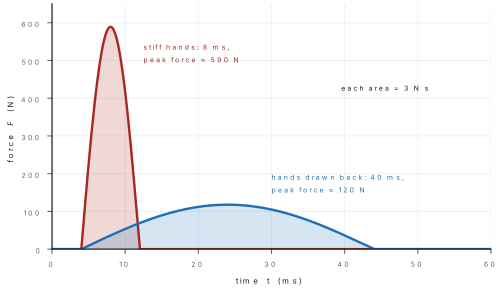
Linear momentum \vec p = m\vec v (vector, kg m s⁻¹). Impulse of a force is \vec J = \vec F\,\Delta t for a constant force, or \int\vec F\,dt in general; by the second law it equals the change in momentum:
Impulse is the area under the force–time graph; its unit, N s, equals kg m s⁻¹. For a given change of momentum, a longer contact time means a smaller average force — the physics of a cricketer drawing the hands back, airbags, crumple zones, the sand pit for long jump, and shock absorbers.
Useful results.
- A ball of mass m hitting a wall normally at speed v and rebounding at the same speed: |\Delta p| = 2mv (not zero). At angle \theta to the wall's normal: 2mv\cos\theta.
- A machine gun firing n bullets per second, each of mass m at speed v, pushes back on the gunner with force F = nmv.
- Kinetic energy and momentum: K = \frac{p^2}{2m}, p = \sqrt{2mK}. For the same momentum the lighter body has more KE; for the same KE the heavier body has more momentum.
If the net external force on a system is zero, its total linear momentum stays constant: m_1\vec u_1 + m_2\vec u_2 = m_1\vec v_1 + m_2\vec v_2. Internal forces (action–reaction pairs inside the system) cannot change the total.
| Application | What is conserved and what follows |
|---|---|
| Recoil of a gun | 0 = mv + MV, so V = -mv/M; the bullet carries far more KE (K_b/K_g = M/m) |
| Explosion of a shell at rest | fragments fly apart with momenta that add to zero |
| Rocket and jet propulsion | gases pushed backward, rocket pushed forward; thrust = u\,dm/dt |
| Person jumping off a boat | boat moves backward |
| Collisions | total momentum before = total momentum after (Section 2.4) |
Problem. (a) A 5 kg rifle fires a 20 g bullet at 500 m s⁻¹. Find the recoil speed and the ratio of the kinetic energies of bullet and rifle. (b) A 0.15 kg ball reaches a bat at 20 m s⁻¹ and leaves along the same line at 30 m s⁻¹; contact lasts 0.01 s. Find the average force.
Solution. (a) V = mv/M = 0.02(500)/5 = 2\ \text{m s}^{-1}, backward. Equal momenta, so K \propto 1/m: K_b/K_g = 5/0.02 = 250. (b) Take the final direction as positive: \Delta p = 0.15(30) - 0.15(-20) = 7.5\ \text{N s}; F = 7.5/0.01 = 750\ \text{N}. Forgetting the reversal (using 30 - 20) gives the wrong 150 N.
2.3 Work, energy and power; the work–energy theorem; conservation of energy
Work
The work done by a constant force is the scalar product of force and displacement:
Unit: joule (1 J = 1 N m); dimensions [ML^2T^{-2}].
| Sign | When | Examples |
|---|---|---|
| Positive (0 \le \theta < 90^{\circ}) | force has a component along the motion | gravity on a falling body; the engine force on a car |
| Zero (\theta = 90^{\circ}, or no displacement) | force perpendicular to motion | centripetal force in a circle; a porter carrying a load on a level road (against gravity); pushing a wall |
| Negative (90^{\circ} < \theta \le 180^{\circ}) | force opposes the motion | kinetic friction; gravity on a body being lifted; brakes |
For a variable force, W = \int F\,dx = area under the force–displacement graph. For a spring obeying F = kx, the work to stretch it from x_1 to x_2 is \frac{1}{2}k(x_2^2 - x_1^2) — from 0 to x it is \frac{1}{2}kx^2.
Energy and the work–energy theorem
Kinetic energy K = \frac{1}{2}mv^2; gravitational potential energy near the Earth U = mgh; elastic potential energy of a spring U = \frac{1}{2}kx^2.
The work done by the net force on a body equals the change in its kinetic energy: W_{net} = K_f - K_i = \frac{1}{2}mv^2 - \frac{1}{2}mu^2. It holds for any force, constant or variable, conservative or not.
A conservative force does work that depends only on the start and end points, not on the path; its work round any closed path is zero, and a potential energy can be defined for it (gravity, the spring force, the electrostatic force). Friction, air drag and viscous forces are non-conservative (dissipative): their work depends on the path and turns mechanical energy into heat.
Conservation of mechanical energy. If only conservative forces do work, K + U = constant. A body sliding down any smooth track of height h reaches the bottom with v = \sqrt{2gh}, whatever the shape of the track. With friction, K_i + U_i = K_f + U_f + (\text{work against friction}). The law of conservation of energy — energy is neither created nor destroyed, only changed from one form to another — has no exceptions (mass is a form of energy, E = mc^2).
Power
Power is the rate of doing work: P = \frac{dW}{dt}; for a force on a moving body P = \vec F\cdot\vec v = Fv\cos\theta. Unit: watt (1 W = 1 J s⁻¹); dimensions [ML^2T^{-3}]. 1 horsepower (hp) ≈ 746 W. The kilowatt hour is a unit of energy: 1 kWh = 1000 W × 3600 s = 3.6 × 10⁶ J (one "unit" on an NEA bill). Efficiency = useful output / input.
Problem. (a) A motor pumps 600 kg of water into a tank 20 m above it in 2 min. Find the minimum power (g = 9.8\ \text{m s}^{-2}). (b) A car's engine delivers 30 kW. The total resistance on a level road is 1500 N. Find the car's top speed.
Solution. (a) P = mgh/t = 600(9.8)(20)/120 = 980\ \text{W} (more in practice, since the water also leaves with kinetic energy and the motor is not 100 % efficient). (b) At top speed the driving force equals the resistance, so v = P/F = 30\,000/1500 = 20\ \text{m s}^{-1} = 72\ \text{km h}^{-1}.
K = p^2/2m, so K \propto p^2. If p increases by 50 %, K becomes 1.5^2 = 2.25 times — an increase of 125 %, not 50 % or 100 %. If K increases by 300 % (four times), p doubles — an increase of 100 %.
2.4 Elastic and inelastic collisions
In every collision of an isolated system linear momentum is conserved and total energy is conserved; what may not be conserved is kinetic energy (part can become heat, sound or deformation).
| Elastic | Inelastic | Perfectly inelastic | |
|---|---|---|---|
| Momentum | conserved | conserved | conserved |
| Kinetic energy | conserved | not conserved (some lost) | not conserved (maximum loss) |
| After impact | separate | separate | move together (stick) |
| Coefficient of restitution e | e = 1 | 0 < e < 1 | e = 0 |
| Examples | collisions of atoms, molecules; nearly, of steel or billiard balls | most real collisions | bullet embedding in a block, mud on a wall |
The coefficient of restitution is the ratio of the relative speed of separation to the relative speed of approach (head-on):
Elastic collision in one dimension
For m_1 at u_1 striking m_2 at u_2 head-on and elastically:
| Special case (target at rest, u_2 = 0) | Result |
|---|---|
| Equal masses | the bodies exchange velocities: v_1 = 0, v_2 = u_1 |
| Very heavy body hits a very light one | heavy continues at \approx u_1; light flies off at \approx 2u_1 |
| Very light body hits a very heavy one | light rebounds at \approx -u_1; heavy hardly moves |
| Fraction of KE given to the target | \frac{4m_1m_2}{(m_1 + m_2)^2} — 100 % when m_1 = m_2 |
This last row is why a moderator in a reactor uses light nuclei (hydrogen in water, deuterium in heavy water, carbon in graphite) to slow neutrons: a neutron loses most energy when it hits a nucleus of nearly its own mass. In an oblique elastic collision of two equal masses, one at rest, the two move off at 90° to each other.
Perfectly inelastic collision
The bodies move off together with v = \frac{m_1u_1 + m_2u_2}{m_1 + m_2}. The kinetic energy lost is \frac{m_1m_2(u_1 - u_2)^2}{2(m_1 + m_2)}; with the target at rest the fraction lost is \frac{m_2}{m_1 + m_2} (one half for equal masses).
Ballistic pendulum: a bullet of mass m embeds in a block of mass M that then swings up a height h: v_{bullet} = \frac{m + M}{m}\sqrt{2gh} (momentum conserved in the impact, energy conserved in the swing — never energy in the impact).
Bouncing ball: dropped from height h onto a floor with coefficient e, it rises to e^2h; after n bounces, e^{2n}h; and e = \sqrt{h_2/h_1}.
Problem. A 2 kg trolley at 3 m s⁻¹ hits a 1 kg trolley at rest. Find the velocities after impact if the collision is (a) elastic, (b) perfectly inelastic, and (c) the kinetic energy lost in (b).
Solution. (a) v_1 = \frac{(2 - 1)3}{3} = 1\ \text{m s}^{-1} and v_2 = \frac{2(2)(3)}{3} = 4\ \text{m s}^{-1}. Check: momentum 6 = 2 + 4; KE 9 = 1 + 8 J. (b) v = 6/3 = 2\ \text{m s}^{-1}. (c) KE before 9 J, after \frac{1}{2}(3)(2^2) = 6 J: 3 J lost, which is the fraction \frac{m_2}{m_1 + m_2} = \frac{1}{3}.
2.5 Solid friction: laws, coefficient, angle of friction and angle of repose
Friction is the force that opposes relative motion (or attempted motion) between two surfaces in contact; it acts along the surfaces. It arises from the interlocking of surface irregularities and the adhesion at the tiny points of true contact.
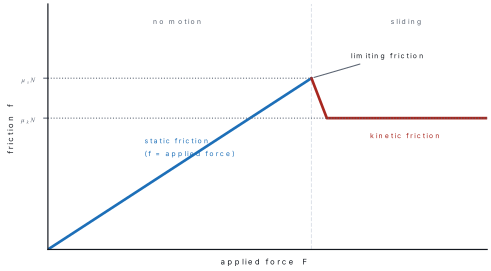
- Static friction acts when there is no sliding. It is self-adjusting: it is exactly as large as needed to prevent slipping, up to a maximum.
- Limiting friction is that maximum, reached just as sliding begins: f_s = \mu_sN.
- Kinetic (dynamic) friction acts during sliding: f_k = \mu_kN, with \mu_k < \mu_s.
- Rolling friction is much smaller than sliding friction — the reason for wheels and ball bearings.
Laws of limiting friction
- Friction acts along the common surface, opposite to the (attempted) relative motion.
- Limiting friction is proportional to the normal reaction: f_s = \mu_sN.
- It is independent of the apparent area of contact (for the same normal reaction).
- It depends on the nature and condition of the surfaces (material, roughness, lubrication).
- Kinetic friction is nearly independent of the speed (for moderate speeds) and is less than limiting friction.
The coefficient of friction \mu = f/N is a dimensionless ratio. It is usually below 1 but can exceed 1 for very clean or sticky surfaces (rubber on dry road).
Angle of friction and angle of repose
- Angle of friction \lambda: the angle that the resultant of the limiting friction and the normal reaction makes with the normal reaction: \tan\lambda = \frac{f_s}{N} = \mu_s.
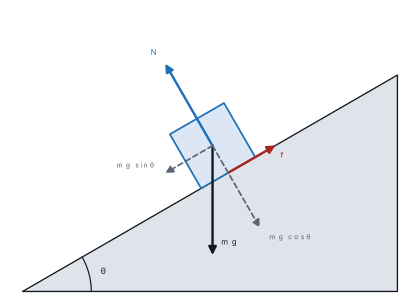
- Angle of repose \theta_r: the smallest angle of an inclined plane at which a body placed on it just begins to slide down. At that angle mg\sin\theta_r = \mu_s\,mg\cos\theta_r, so \mu_s = \tan\theta_r.
Hence angle of repose = angle of friction, and neither depends on the mass of the body. (Sand piles, scree slopes in the hills and grain heaps settle at their angle of repose.)
Friction in calculations
| Situation | Result |
|---|---|
| Block sliding on a rough level floor | deceleration \mu_kg; stopping distance \frac{u^2}{2\mu_kg} (independent of mass) |
| Block sliding down a rough incline (\theta > \theta_r) | a = g(\sin\theta - \mu_k\cos\theta) |
| Block slides down at constant velocity | \mu_k = \tan\theta |
| Pushing a block up an incline at steady speed | F = mg(\sin\theta + \mu\cos\theta) |
| Least force (along the incline) that stops it sliding down | F = mg(\sin\theta - \mu\cos\theta) |
| Pulling at angle \alpha above the horizontal | N = mg - F\sin\alpha (less friction) |
| Pushing at angle \alpha below the horizontal | N = mg + F\sin\alpha (more friction) |
So it is easier to pull a lawn roller than to push it. Friction is not only a nuisance: walking, the grip of tyres, brakes, belts on pulleys and writing all depend on it. It is reduced by polishing, lubrication, ball bearings and streamlining.
Problem. (a) A block slides down an incline with \sin\theta = 0.6 and \mu_k = 0.25. Find its acceleration (g = 10\ \text{m s}^{-2}). (b) A car at 20 m s⁻¹ brakes with its wheels locked on a road with \mu_k = 0.5. Find the stopping distance.
Solution. (a) \cos\theta = 0.8; a = 10(0.6 - 0.25\times0.8) = 4\ \text{m s}^{-2}. (b) s = u^2/(2\mu_kg) = 400/10 = 40\ \text{m}. Double the speed and it becomes 160 m.
First decide whether the body moves. Compare the applied force (or mg\sin\theta) with the limiting friction \mu_sN. If it is smaller, the body stays at rest and the friction equals the applied force — not \mu N. A 10 kg box with \mu_s = 0.5 pushed with 20 N on a level floor feels 20 N of friction, not 49 N.
The third-law pair always acts on two different bodies, so the forces never appear in the same free-body diagram and never "cancel out". A horse pulls a cart because the ground pushes the horse (reaction to the horse pushing the ground backwards). Neighbouring traps: the normal reaction of a surface is not the reaction to the body's weight (weight is the Earth pulling the body; its pair is the body pulling the Earth), and in an inelastic collision kinetic energy is lost but momentum is still conserved provided no external impulse acts.
Formula and fact sheet
| Topic | Formula or fact |
|---|---|
| Second law | \vec F = d\vec p/dt = m\vec a; variable mass F = v\,dm/dt; rocket thrust u\,dm/dt |
| Lift | up-acceleration m(g + a); down-acceleration m(g - a); free fall 0; constant velocity mg |
| Atwood | a = (m_1 - m_2)g/(m_1 + m_2); T = 2m_1m_2g/(m_1 + m_2) |
| Equilibrium | \sum\vec F = 0 and \sum\tau = 0; Lami: P/\sin\alpha = Q/\sin\beta = R/\sin\gamma |
| Impulse | J = F\Delta t = \Delta p = area under F–t; rebound from a wall 2mv |
| Momentum–KE | K = p^2/2m; p = \sqrt{2mK} |
| Recoil | V = -mv/M; K_{bullet}/K_{gun} = M/m |
| Machine gun | F = nmv |
| Work | W = Fs\cos\theta; spring \frac{1}{2}k(x_2^2 - x_1^2); area under F–x |
| Work–energy | W_{net} = \Delta K |
| Power | P = W/t = Fv; 1 hp = 746 W; 1 kWh = 3.6 × 10⁶ J |
| Restitution | e = (v_2 - v_1)/(u_1 - u_2); elastic 1, perfectly inelastic 0 |
| Elastic 1-D | v_1 = [(m_1 - m_2)u_1 + 2m_2u_2]/(m_1 + m_2); v_2 = [(m_2 - m_1)u_2 + 2m_1u_1]/(m_1 + m_2) |
| Elastic, target at rest | equal masses exchange velocities; KE fraction transferred 4m_1m_2/(m_1 + m_2)^2 |
| Perfectly inelastic | v = (m_1u_1 + m_2u_2)/(m_1 + m_2); KE lost m_1m_2(u_1 - u_2)^2/[2(m_1 + m_2)] |
| Bouncing ball | height after n bounces e^{2n}h |
| Friction | f_s \le \mu_sN; f_k = \mu_kN; \mu_k < \mu_s; \mu_s = \tan\lambda = \tan\theta_{repose} |
| Incline | sliding down a = g(\sin\theta - \mu\cos\theta); stopping distance on level u^2/2\mu g |
Chapter summary
- Inertia is resistance to change of motion, measured by mass; \vec F = d\vec p/dt; action and reaction are equal, opposite and act on different bodies, so they never cancel.
- A weighing machine reads m(g \pm a) according to the direction of the acceleration; zero in free fall, mg at constant velocity.
- Equilibrium of a rigid body needs zero net force and zero net torque; three concurrent forces in equilibrium obey Lami's theorem.
- Impulse = change in momentum = area under the force–time graph; spreading the same impulse over more time lowers the force.
- With no external force, total momentum is conserved: recoil, explosions, rockets and every collision.
- W = Fs\cos\theta; the net work equals the change in kinetic energy; K = p^2/2m; P = Fv.
- Elastic collisions conserve KE (e = 1); perfectly inelastic ones stick together (e = 0) and lose the most KE; equal masses in an elastic head-on collision exchange velocities.
- Limiting friction \mu_sN is independent of area of contact; \mu_k < \mu_s; angle of repose = angle of friction, \mu_s = \tan\theta_r.
Practice questions
Set A — Recall (21 questions)
- Newton's first law of motion gives the concept ofainertiabenergycpowerdmomentum
- The SI unit of impulse isaNbN scN mdN s⁻¹
- Action and reaction forcesaact on the same body and cancel each otherbare unequal when the bodies acceleratecact on different bodies and never cancel each otherdact one after the other
- A rigid body is in complete (translational and rotational) equilibrium whenathe net force on it is zerobthe net torque on it is zerocit moves with constant speeddboth the net force and the net torque on it are zero
- The work done by the centripetal force on a body moving uniformly in a circle isazerobpositivecnegativedequal to its kinetic energy
- The area under a force–displacement graph givesaimpulsebwork donecpowerdmomentum
- The area under a force–time graph givesawork donebpowercchange in momentumdchange in kinetic energy
- The kinetic energy K and momentum p of a body of mass m are related byaK = p^{2}/mbK = 2mp^{2}cK = p/2mdK = p^{2}/2m
- Which of the following is a conservative force?agravitational forcebkinetic frictioncair resistancedviscous force
- One kilowatt hour is equal toa3.6 × 10³ Jb3.6 × 10⁶ Jc1000 Jd3.6 × 10⁵ J
- In a perfectly inelastic collisionaboth momentum and kinetic energy are conservedbneither momentum nor kinetic energy is conservedcmomentum is conserved and the bodies move together afterwardsdkinetic energy is conserved but momentum is not
- The coefficient of restitution for a perfectly elastic collision isa0b0.5cbetween 0 and 1d1
- Two equal masses collide head-on elastically, one of them initially at rest. After the collisionaboth move togetherbthey exchange velocitiescboth come to restdthe moving one rebounds with its own speed
- The coefficient of static friction \mu_s and the angle of repose \theta are related bya\mu_s = \sin\thetab\mu_s = \cos\thetac\mu_s = \tan\thetad\mu_s = \cot\theta
- For the same normal reaction, limiting friction between two surfaces is independent ofathe nature of the surfacesbthe apparent area of contactcthe roughness of the surfacesdthe normal reaction
- Compared with the coefficient of static friction, the coefficient of kinetic friction for the same pair of surfaces isasmallerbequalclargerdzero
- Ball bearings are used in machines becauseathey increase the normal reactionbthey increase the area of contactcrolling friction is much smaller than sliding frictiondthey remove friction completely
- The work–energy theorem states that the work done by the net force on a body equals the change in itsapotential energybmomentumctotal energydkinetic energy
- A man stands on a weighing machine in a lift that falls freely. The machine readsazerobhis true weightctwice his weightdhalf his weight
- Rocket propulsion is an application ofaNewton's first lawbconservation of linear momentumcconservation of kinetic energydPascal's law
- One horsepower is approximatelya500 Wb1000 Wc100 Wd746 W
Answers and explanations — Set A
1. (a) — the first law says a body keeps its state unless a net force acts: the property of resisting change is inertia (measured by mass).
2. (b) — impulse = force × time, N s, the same as kg m s⁻¹ (the unit of momentum). N m is the unit of work or torque.
3. (c) — the third-law pair acts on two different bodies, so the forces cannot cancel; they are equal at every instant, whatever the motion.
4. (d) — zero net force gives no linear acceleration; zero net torque gives no angular acceleration. A rigid body needs both.
5. (a) — the centripetal force is perpendicular to the velocity at every instant, so W = Fs\cos90^{\circ} = 0; the speed does not change.
6. (b) — W = \int F\,dx is the area under F–x. Impulse is the area under F–t.
7. (c) — \int F\,dt = impulse = change in momentum.
8. (d) — K = \frac{1}{2}mv^2 = \frac{(mv)^2}{2m} = \frac{p^2}{2m}.
9. (a) — the work of gravity depends only on the change in height, not on the path; friction, air drag and viscous forces dissipate energy.
10. (b) — 1 kWh = 1000 W × 3600 s = 3.6 × 10⁶ J; the kWh is a unit of energy, not power.
11. (c) — momentum is conserved in every collision; in a perfectly inelastic one the bodies stick together and the loss of KE is the greatest.
12. (d) — e = relative speed of separation / relative speed of approach = 1 when no KE is lost.
13. (b) — with m_1 = m_2 and u_2 = 0, the formulas give v_1 = 0 and v_2 = u_1: the velocities are exchanged (as in billiards).
14. (c) — at the angle of repose mg\sin\theta = \mu_s mg\cos\theta, so \mu_s = \tan\theta.
15. (b) — the third law of friction: for the same normal reaction, the area of contact does not matter. Friction is proportional to N, so (d) is wrong.
16. (a) — \mu_k < \mu_s: it takes more force to start sliding than to keep sliding.
17. (c) — bearings replace sliding with rolling, and rolling friction is far smaller; friction is reduced, not removed.
18. (d) — W_{net} = \Delta K. Work by conservative forces alone equals -\Delta U, which is a different statement.
19. (a) — in free fall both the man and the machine accelerate at g, so R = m(g - g) = 0: apparent weightlessness.
20. (b) — the exhaust gases are pushed backward and the rocket gains equal forward momentum (equivalently, Newton's third law); kinetic energy is not conserved.
21. (d) — 1 hp ≈ 746 W.
Set B — Understanding (14 questions)
- A boy stands on a weighing machine in a lift that is moving upward with a uniform velocity. Compared with his true weight W, the reading isamore than Wbless than Wcequal to Wdzero
- A cricketer moves his hands backward while catching a fast ball. He does so toareduce the change in momentumbincrease the time of impact and so reduce the forcecreduce the impulse to zerodincrease the force on the ball
- Two bodies of masses 1 kg and 4 kg have equal kinetic energies. The ratio of their momenta p_1 : p_2 isa1 : 2b1 : 4c4 : 1d1 : 16
- A ball of mass m strikes a wall normally with speed v and rebounds with the same speed. The magnitude of the change in its momentum isazerobmvcmv/2d2mv
- A gun fires a bullet. Just after firing, compared with the gun, the bullet hasaequal momentum in magnitude and much more kinetic energybmore momentum and more kinetic energycequal momentum and equal kinetic energydless momentum and less kinetic energy
- Pulling a lawn roller at an angle above the horizontal is easier than pushing it at the same angle below the horizontal, because pullingaincreases the normal reactionbdecreases the normal reaction and hence the frictioncchanges the coefficient of frictiondreduces the weight of the roller
- A very heavy ball moving at speed u collides head-on and elastically with a very light ball at rest. The light ball moves off with a speed of aboutau/2buc2udzero
- A porter carries a load on his head and walks along a level road at constant speed. The work he does on the load against gravity isazerobpositivecnegativedequal to the weight × distance walked
- The momentum of a body increases by 50 %. Its kinetic energy increases bya50 %b100 %c125 %d150 %
- A block placed on a rough plane just begins to slide when the plane is tilted to 30°. The coefficient of static friction isa0.50b0.87c1.73d0.58
- A block slides down a rough inclined plane of inclination θ at constant velocity. The coefficient of kinetic friction isatan θbsin θccos θdcot θ
- A ball dropped from height h bounces on a floor for which the coefficient of restitution is 0.5. It rises to a height ofah/2bh/8ch/4dh/√2
- Sand drops steadily at a rate dm/dt onto a conveyor belt moving at constant speed v. The extra force needed to keep the belt moving at that speed isazerob½ v dm/dtc2v dm/dtdv dm/dt
- Three forces of 3 N, 4 N and 5 N acting at a point keep it in equilibrium. The angle between the 3 N and 4 N forces isa60°b90°c120°d180°
Answers and explanations — Set B
1. (c) — uniform velocity means zero acceleration, so R = mg. Only acceleration changes the reading, never the direction of motion alone.
2. (b) — the change in momentum (impulse) is fixed by the catch; lengthening the contact time reduces the average force F = \Delta p/\Delta t.
3. (a) — p = \sqrt{2mK}; with equal K, p \propto \sqrt{m}: \sqrt{1} : \sqrt{4} = 1 : 2.
4. (d) — momentum goes from +mv to -mv, a change of 2mv; it is zero only for speed, not for the vector momentum.
5. (a) — total momentum stays zero, so the momenta are equal and opposite; with equal p, K = p^2/2m is larger for the lighter bullet (by the ratio M/m).
6. (b) — the upward component of the pull reduces the normal reaction (N = mg - F\sin\alpha), so the friction \mu N is less; pushing adds to N.
7. (c) — with m_1 \gg m_2, v_2 = 2m_1u_1/(m_1 + m_2) \approx 2u.
8. (a) — his upward force on the load is perpendicular to the horizontal displacement, so the work against gravity is zero (he still tires, but that is not work on the load).
9. (c) — K \propto p^2: 1.5^2 = 2.25, so K rises by 125 %.
10. (d) — \mu_s = \tan30^{\circ} = 1/\sqrt{3} \approx 0.58. 0.50 is \sin30^{\circ} and 0.87 is \cos30^{\circ}.
11. (a) — constant velocity means zero net force: mg\sin\theta = \mu_kmg\cos\theta, so \mu_k = \tan\theta.
12. (c) — the rebound speed is e times the impact speed, and height \propto v^2: h' = e^2h = 0.25h.
13. (d) — the belt must give the arriving sand momentum at the rate v\,dm/dt, so F = dp/dt = v\,dm/dt.
14. (b) — in equilibrium the three forces form a closed triangle with sides 3, 4, 5, a right-angled triangle, so the 3 N and 4 N forces are perpendicular.
Set C — Application (12 questions)
- A 0.15 kg ball reaches a bat at 20 m s⁻¹ and is hit straight back at 30 m s⁻¹. The contact lasts 0.01 s. The average force on the ball isa150 Nb300 Nc450 Nd750 N
- A 4 kg gun fires a 10 g bullet with a muzzle speed of 400 m s⁻¹. The recoil speed of the gun isa1 m s⁻¹b0.1 m s⁻¹c4 m s⁻¹d10 m s⁻¹
- A 50 kg person stands in a lift that is moving downward and slowing down at 2 m s⁻² (g = 10 m s⁻²). The normal force on the person isa400 Nb600 Nc500 Nd100 N
- Masses of 5 kg and 3 kg hang from the two ends of a light string over a frictionless pulley (g = 9.8 m s⁻²). Their acceleration isa1.96 m s⁻²b3.27 m s⁻²c2.45 m s⁻²d4.9 m s⁻²
- A 2 kg ball moving at 3 m s⁻¹ collides head-on and elastically with a 1 kg ball at rest. Their velocities after the collision area0 and 6 m s⁻¹b1 m s⁻¹ and 4 m s⁻¹c2 m s⁻¹ and 2 m s⁻¹d1.5 m s⁻¹ and 3 m s⁻¹
- A 10 g bullet moving at 300 m s⁻¹ embeds itself in a 990 g wooden block at rest on a smooth floor. The block moves off ata30 m s⁻¹b0.3 m s⁻¹c3.03 m s⁻¹d3 m s⁻¹
- A motor pumps 600 kg of water into a tank 20 m above it in 2 minutes (g = 9.8 m s⁻²). The minimum power of the motor isa98 Wb980 Wc1960 Wd117.6 kW
- A car's engine delivers 30 kW. If the total resistance on a level road is 1500 N, the greatest steady speed of the car isa20 km h⁻¹b45 km h⁻¹c72 km h⁻¹d50 km h⁻¹
- A car moving at 20 m s⁻¹ skids to rest with locked wheels on a road where \mu_k = 0.5 (g = 10 m s⁻²). The skid isa20 m longb80 m longc4 m longd40 m long
- A spring of force constant 200 N m⁻¹ is already stretched by 10 cm. The extra work needed to stretch it further, from 10 cm to 20 cm, isa1 Jb3 Jc4 Jd2 J
- A 20 N lamp hangs from the midpoint of a wire whose two halves make an angle of 120° with each other. The tension in each half isa20 Nb10 Nc11.5 Nd40 N
- A machine gun fires 10 bullets per second, each of mass 20 g, at 500 m s⁻¹. The average force needed to hold the gun steady isa10 Nb1000 Nc100 Nd50 N
Answers and explanations — Set C
1. (d) — the velocity reverses: \Delta p = 0.15(30 + 20) = 7.5 N s; F = 7.5/0.01 = 750 N. (a) forgets the reversal (uses 30 − 20).
2. (a) — momentum conservation: V = mv/M = 0.010(400)/4 = 1 m s⁻¹, opposite to the bullet.
3. (b) — moving down and slowing down means the acceleration is upward: R = m(g + a) = 50(12) = 600 N. (a) wrongly uses g - a.
4. (c) — a = (m_1 - m_2)g/(m_1 + m_2) = 2(9.8)/8 = 2.45 m s⁻².
5. (b) — v_1 = (2 - 1)(3)/3 = 1 m s⁻¹; v_2 = 2(2)(3)/3 = 4 m s⁻¹. Check: momentum 6 = 2 + 4 and KE 9 = 1 + 8 J. (c) is the perfectly inelastic answer.
6. (d) — perfectly inelastic: v = mu/(m + M) = 0.01(300)/1.00 = 3 m s⁻¹. (c) forgets to add the bullet's mass to the block.
7. (b) — P = mgh/t = 600(9.8)(20)/120 = 980 W. (d) is the energy, 117 600 J, mistaken for power (no division by the time); (c) uses 60 s for 2 min.
8. (c) — at top speed the driving force equals the resistance: v = P/F = 30\,000/1500 = 20 m s⁻¹ = 72 km h⁻¹. (a) is the right number with the wrong unit.
9. (d) — deceleration \mu_kg = 5 m s⁻²; s = u^2/2a = 400/10 = 40 m.
10. (b) — W = \frac{1}{2}k(x_2^2 - x_1^2) = 100(0.04 - 0.01) = 3 J. (a) is the work for the first 10 cm, and (c) the work from 0 to 20 cm.
11. (a) — each half makes 60° with the vertical: 2T\cos60^{\circ} = 20 N gives T = 20 N.
12. (c) — force = momentum delivered per second = nmv = 10(0.020)(500) = 100 N.