Chapter 8 · Heat and Thermodynamics · 2 questions in the paper · 31 min read
Heat, Temperature and Heat Transfer
What the syllabus asks for 3
- Thermal energy, heat and temperature; thermal equilibrium and the zeroth law
- Thermometers: liquid-in-glass, resistance and radiation thermometers — principle, advantages and limitations
- Conduction, convection and radiation; black-body radiation and the Stefan–Boltzmann law
Heat is the first idea in physics that everyone thinks they understand and almost everyone gets slightly wrong. Heat is not temperature, temperature is not "how hot something feels", and a bathtub of warm water contains far more thermal energy than a cup of boiling tea. Of the 7 Heat and Thermodynamics questions in the paper (official weightage), we estimate about 2 come from this chapter. They are usually one definition (the zeroth law, a thermometric property), one comparison (which thermometer for which job), and one calculation — a Stefan-law ratio, a composite slab, or a cooling curve.
- Heat is energy in transit because of a temperature difference (J); temperature measures the average molecular kinetic energy; thermal energy is the total internal energy.
- Zeroth law: if A is in equilibrium with B and B with C, then A is in equilibrium with C — the basis of thermometry.
- T(\text{K}) = \theta(^\circ\text{C}) + 273, \theta_F = \frac{9}{5}\theta_C + 32; -40^\circ is the same on both scales.
- Thermometers: liquid-in-glass (apparent expansion), resistance (R=R_0(1+\alpha\theta)), thermocouple (Seebeck emf), radiation (Stefan–Boltzmann). Know one advantage and one limitation of each.
- Conduction: H=\frac{Q}{t}=\frac{kA(\theta_1-\theta_2)}{L}; thermal resistance L/kA adds in series.
- Stefan–Boltzmann: P=\varepsilon\sigma AT^4, \sigma=5.67\times10^{-8} W m⁻² K⁻⁴; net loss \varepsilon\sigma A(T^4-T_s^4).
- Wien's law: \lambda_{max}T=2.9\times10^{-3} m K.
- Newton's law of cooling: rate of loss \propto (body temperature − surroundings), giving an exponential fall.
8.1 Thermal energy, heat and temperature; thermal equilibrium and the zeroth law
Three words that are not the same
| Quantity | What it is | Unit | Depends on |
|---|---|---|---|
| Temperature | a measure of the average kinetic energy of the molecules of a body | K (or °C) | how fast the molecules move |
| Thermal energy | the total internal energy of the body — the sum of the kinetic and potential energies of all its molecules | J | temperature, mass, state |
| Heat | energy in transit from one body to another because of a temperature difference | J | the process, not the body |
Temperature is a state variable: a body "has" a temperature. Heat is not something a body contains — it is energy crossing a boundary, so a body "gains" or "loses" heat, it does not "have" heat. What a body contains is internal (thermal) energy.
This is why a bathtub of water at 40 °C has far more thermal energy than a cup of tea at 90 °C: it has many more molecules, even though each molecule moves more slowly.
For a gas, temperature is directly tied to molecular motion:
so the root-mean-square speed grows as \sqrt{T}. Doubling the absolute temperature multiplies the average kinetic energy per molecule by 2, and the rms speed by \sqrt{2}.
Two statements that are wrong and appear as options every year: - "A body contains heat." No — it contains internal energy; heat is energy being transferred. - "Temperature is the total kinetic energy." No — it is the average kinetic energy per molecule.
Thermal contact and thermal equilibrium
When two bodies at different temperatures are placed in thermal contact (so energy can pass between them), energy flows from the hotter to the colder one until both reach the same temperature. At that point there is no net transfer of energy and the bodies are in thermal equilibrium. The molecules are still moving and energy is still exchanged at the microscopic level — the exchange rates are simply equal in both directions.
If body A is in thermal equilibrium with body B, and body B is in thermal equilibrium with body C, then A is in thermal equilibrium with C.
The law looks obvious, but it is what makes temperature a meaningful quantity: it says that "being at the same temperature" is transitive. Its practical use is thermometry — a thermometer (B) placed in contact with a patient (A) reaches equilibrium with the patient; the thermometer's reading then tells us the patient's temperature, and two patients that both match the same thermometer match each other.
Temperature scales
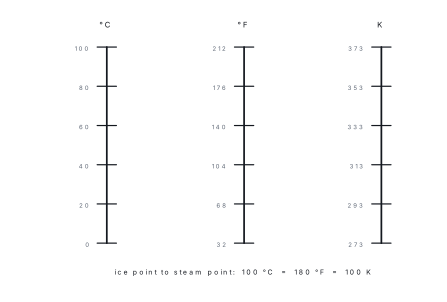
| Scale | Ice point | Steam point | Absolute zero | Size of one degree |
|---|---|---|---|---|
| Celsius | 0 °C | 100 °C | −273.15 °C | 1 °C |
| Fahrenheit | 32 °F | 212 °F | −459.67 °F | 1 °F = 5/9 °C |
| Kelvin | 273.15 K | 373.15 K | 0 K | 1 K = 1 °C |
The two fixed points give the conversion by proportion:
Only one temperature is numerically the same on the Celsius and Fahrenheit scales: put \theta_C = \theta_F = x in the conversion:
so −40 °C = −40 °F.
Absolute zero and the Kelvin scale
Cooling a gas at constant volume lowers its pressure in proportion to the temperature on the Celsius scale. Extrapolating to zero pressure gives −273.15 °C, the lowest temperature possible — absolute zero. On the Kelvin scale this is 0 K, and no temperature can be lower because a negative absolute temperature would mean negative molecular kinetic energy.
The Kelvin scale is the SI scale because its zero is a true zero: ratios of temperatures are meaningful, which is exactly what the Stefan and Wien laws need. "The temperature doubled" only has a meaning in kelvin.
The triple point of water — the temperature and pressure at which ice, water and vapour coexist — is 273.16 K, and it is the modern fixed point that defines the kelvin.
Problem. Normal body temperature is 37 °C. Express it in °F and in K. At what temperature do the Celsius and Fahrenheit readings agree?
Solution. \theta_F = \frac{9}{5}(37) + 32 = 66.6 + 32 = 98.6 °F. T = 37 + 273 = 310 K.
For equal readings, \theta_F = \theta_C: \theta = \frac{9}{5}\theta + 32, so \theta = -40. The two scales agree at −40 degrees.
8.2 Thermometers
What a thermometer must do
A thermometer works through a thermometric property — a physical property that changes steadily and reproducibly with temperature. The common ones are the length of a liquid column, the electrical resistance of a metal, the emf of a thermocouple, the pressure of a gas at constant volume, and the radiation emitted by a surface.
A good thermometer should be:
- sensitive — a large change in the property for a small change in temperature;
- accurate and reproducible — the same temperature gives the same reading every time;
- linear — equal temperature steps give equal scale steps, or the non-linearity must be calibrated out;
- quick — a small heat capacity and good thermal contact, so it does not disturb what it measures;
- wide in range, robust, and safe.
No single instrument has all of these, which is why the paper asks "which thermometer would you use for …".
Liquid-in-glass thermometer
Principle. A liquid expands more than the glass that contains it. What we read is the apparent expansion of the liquid, which is its real expansion minus the expansion of the glass bulb and tube. Because the glass also expands, two thermometers made of different glasses can read slightly differently at the same temperature — a real limitation.
| Liquid | Range | Advantages | Limitations |
|---|---|---|---|
| Mercury | −39 °C to 357 °C | opaque, does not wet glass, good conductor, wide range | toxic, expensive, freezes at −39 °C, cannot read low temperatures |
| Alcohol | −115 °C to 78 °C | cheap, very low freezing point, large expansion | coloured (needs dye), wets the glass, evaporates, cannot read high temperatures |
Other limitations of any liquid-in-glass thermometer: fragile; slow to respond; must be read where it is (no remote reading); parallax error; the stem must be immersed to the correct depth; a large bulb takes heat from a small sample.
The clinical thermometer is a special mercury thermometer with a range of only 35–42 °C, a constriction just above the bulb so that the mercury does not run back when it is removed from the patient, and a least count of 0.1 °C. It must be shaken down before use.
Resistance thermometer
Principle. The electrical resistance of a metal rises with temperature:
where R_0 is the resistance at 0 °C and \alpha the temperature coefficient of resistance. Platinum is used because it is chemically stable and its resistance changes very reproducibly over a wide range.
- Range: about −200 °C to 850 °C.
- Advantages: very accurate and reproducible; wide range; the reading can be sent down a cable and recorded automatically; no parallax; can be made very stable over years.
- Limitations: needs a power supply and a bridge circuit; the current heats the element slightly (self-heating); slower than a thermocouple; more expensive; \alpha is not perfectly constant over the whole range.
Thermocouple thermometer
Principle. Join two different metals at both ends. If the two junctions are at different temperatures, a small emf appears in the circuit — the Seebeck effect. The emf is roughly proportional to the temperature difference between the junctions:
- Range: about −200 °C to 1600 °C, depending on the metal pair.
- Advantages: the junction can be tiny, so it responds quickly, has a very small heat capacity and can measure the temperature of a single point; it is rugged, cheap, and can be read remotely.
- Limitations: the emf is only a few tens of microvolts per degree, so amplification is needed; the cold junction must be kept at a known temperature (or electronically compensated); the relation is non-linear; the calibration drifts as the metals age.
Radiation thermometer (pyrometer)
Principle. Every hot body radiates energy at a rate that grows very rapidly with temperature. A pyrometer measures the radiation received and converts it to a temperature using the Stefan–Boltzmann law (total radiation pyrometer) or by comparing the intensities at two wavelengths (ratio pyrometer).
- Range: about 800 °C to 3000 °C and beyond.
- Advantages: no contact, so it can measure a moving furnace belt, molten metal, a rotating shaft or a distant star; it does not disturb the object; it can be very fast.
- Limitations: it needs the emissivity of the surface to be known (a shiny surface reads too low); it needs a clear line of sight (smoke, dust and steam interfere); it is not usable at low temperatures where the radiated power is small; it is expensive.
Comparison
| Thermometer | Principle | Typical range | Main advantage | Main limitation |
|---|---|---|---|---|
| Mercury in glass | apparent expansion | −39 to 357 °C | simple, cheap, direct reading | fragile, limited range, not remote |
| Alcohol in glass | apparent expansion | −115 to 78 °C | works at very low temperatures | wets glass, cannot go high |
| Platinum resistance | R=R_0(1+\alpha\theta) | −200 to 850 °C | very accurate and reproducible | needs power, slow, self-heating |
| Thermocouple | Seebeck emf | −200 to 1600 °C | tiny junction, fast, wide range | needs cold-junction compensation, small emf |
| Radiation pyrometer | Stefan–Boltzmann | 800 to 3000 °C | no contact, very high temperatures | depends on emissivity, line of sight |
Ask three questions in order: How hot? (range), Can I touch it? (contact or not), How fast and how small? (response). A furnace wall that is moving → pyrometer. The temperature inside a grain store, logged for a month → resistance. The temperature at one point inside a running engine → thermocouple. A patient → clinical mercury thermometer.
8.3 Conduction, convection and radiation; black-body radiation and the Stefan–Boltzmann law
Heat always moves from a hotter region to a colder one, and it does so by three mechanisms that can act together.
| Mode | What moves | Needs a medium? | Example |
|---|---|---|---|
| Conduction | energy passed from molecule to molecule (and by free electrons in metals) | yes | a metal spoon in hot tea |
| Convection | the hot fluid itself moves | yes, a fluid | sea breeze, boiling water |
| Radiation | electromagnetic waves | no | heat from the Sun reaching the Earth |
Conduction and the temperature gradient
In steady state, the temperature at each point of a rod no longer changes with time, and the rate of heat flow is
where k is the thermal conductivity of the material (W m⁻¹ K⁻¹), A the cross-section, L the length and \theta_1-\theta_2 the temperature difference between the ends.
The quantity (\theta_1-\theta_2)/L is the temperature gradient; in the limit of a thin slice,
The minus sign says heat flows down the temperature gradient, from hot to cold.
| Material | k (W m⁻¹ K⁻¹) |
|---|---|
| Silver | 406 |
| Copper | 385 |
| Aluminium | 205 |
| Steel | 50 |
| Glass | 0.8 |
| Water | 0.6 |
| Wood | 0.15 |
| Air | 0.024 |
Metals conduct well because their free electrons carry energy quickly through the lattice as well as the vibrating ions. Air conducts very poorly, which is why wool, feathers, thermocol and double glazing — all of which trap air — are good insulators.
Composite slabs and thermal resistance
A slab of thickness L and conductivity k has a thermal resistance
and the conduction equation becomes H = \Delta\theta/R_{th} — exactly the form of Ohm's law, with H playing the part of current and \Delta\theta of voltage. For slabs in series (heat crosses them one after another) the resistances add:
For rods in parallel, the conductances kA/L add.
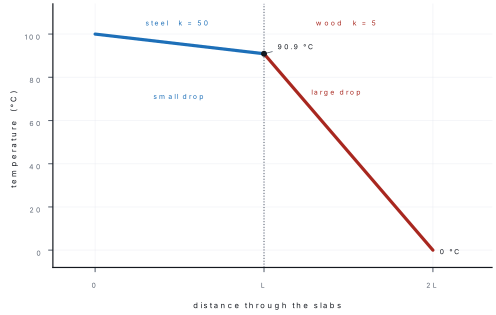
Problem. A wall consists of a 2.0 cm copper layer (k=400 W m⁻¹ K⁻¹) and a 2.0 cm insulating layer (k=0.40 W m⁻¹ K⁻¹), each of area 1.0 m². The outside faces are at 100 °C and 0 °C. Find the heat current and the temperature at the interface.
Solution. In series,
Across the copper the drop is H L_1/(k_1A) = 2000\times5.0\times10^{-5} = 0.10 °C, so the interface is at 99.9 °C. Almost the whole 100 °C falls across the insulator: the temperature profile is steepest in the poorer conductor.
Convection
In convection the fluid itself moves and carries its thermal energy with it.
- Natural convection occurs because a warmed fluid expands, becomes less dense and rises, while cooler, denser fluid sinks to take its place. It needs gravity (or an equivalent acceleration); in a freely falling lift or an orbiting spacecraft there is no natural convection.
- Forced convection uses a pump or a fan: central heating, a car radiator, blood circulation.
| Example | What happens |
|---|---|
| Sea breeze (day) | land heats faster than the sea; air over the land rises; cooler air flows in from the sea |
| Land breeze (night) | the sea stays warmer; air over the sea rises; air flows out from the land |
| Room heater | placed low, so warm air rises and circulates through the room |
| Air conditioner | placed high, so cool dense air sinks through the room |
| Chimney | hot smoke rises, drawing fresh air in at the bottom |
| Monsoon | summer heating of the land draws moist air in from the Indian Ocean |
Newton's law of cooling
For a body cooling in air, when the excess temperature over the surroundings is small, the rate of loss of heat is proportional to that excess:
Since dQ = mc\,d\theta for the body,
The temperature falls exponentially towards the surroundings' temperature, never quite reaching it. Equal time intervals remove equal fractions of the remaining excess, not equal numbers of degrees.
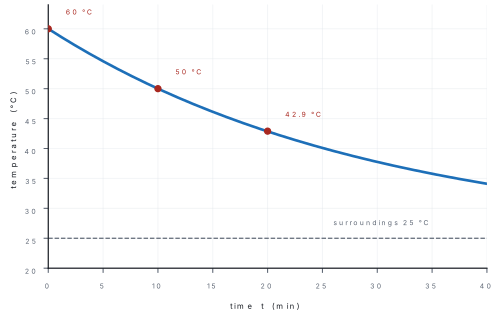
The law assumes the heat is carried away by natural convection and radiation together in a way that is roughly linear in the excess temperature. At large excess temperatures radiation dominates (and goes as T^4), so the simple exponential fails. It also assumes the surroundings do not warm up, and no evaporation.
Radiation
Thermal radiation is electromagnetic radiation emitted by every body because of its temperature. Its properties:
- it needs no medium — it crosses a vacuum, which is how the Sun's energy reaches us;
- it travels at the speed of light and obeys the same laws as light (reflection, refraction, polarisation);
- at everyday temperatures it is mostly infrared; above about 500 °C a body glows dull red, and at about 1500 °C it is white-hot.
Prevost's theory: every body emits radiation at all times, whatever its temperature, and also absorbs radiation from its surroundings. If it emits faster than it absorbs, it cools; if it absorbs faster, it warms; at equal temperatures the two rates are equal.
Black body and emissivity
A black body is an ideal body that absorbs all radiation of every wavelength falling on it — its absorptivity is 1 — and, at a given temperature, emits more energy than any other body.
A small hole in a hollow cavity is the closest practical black body: radiation that enters the hole is reflected many times inside and is almost completely absorbed. Soot and lampblack come close (\varepsilon\approx0.95).
The emissivity \varepsilon of a real surface is the ratio of the energy it emits to the energy a black body of the same area and temperature would emit:
Kirchhoff's law: at a given temperature and wavelength, a good absorber is also a good emitter, so \varepsilon=\alpha. A blackened surface (high \varepsilon, high \alpha) heats quickly in sunshine and cools quickly at night. A shiny white surface (low \varepsilon, low \alpha) stays cooler in the sun and cools slowly after sunset. Do not mix the two: absorptivity is about radiation arriving, emissivity about radiation leaving.
Stefan–Boltzmann law
The total energy radiated per second by a black body of area A at absolute temperature T is
and for a real surface
with the Stefan constant
A body at temperature T in surroundings at T_s both emits and absorbs, so its net loss is
The fourth power makes the law dramatic: doubling the absolute temperature multiplies the radiated power by 2^4=16; trebling it multiplies it by 81.
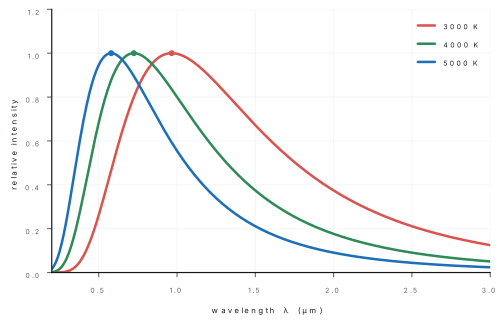
Note that the curves are drawn normalised to their own peaks so that the shapes can be compared. In reality the total area under the 5000 K curve is (5/3)^4 = 7.7 times larger than under the 3000 K curve, and the peak intensity itself grows even faster, as T^5.
Wien's law
The wavelength at which the emission is strongest is inversely proportional to the absolute temperature:
| Body | T (K) | \lambda_{max} | Region |
|---|---|---|---|
| Sun's surface | 5800 | 500 nm | visible (green-blue) |
| Tungsten filament | 2800 | 1.0 μm | near infrared |
| Human skin | 310 | 9.4 μm | infrared |
| Earth's surface | 288 | 10 μm | infrared |
This is why the Sun looks white-yellow while a warm radiator glows dull red, and why infrared cameras can see people in the dark. It is also the basis of the greenhouse effect: the Sun's visible light passes through glass and the atmosphere, but the Earth's 10 μm infrared is absorbed by water vapour and carbon dioxide.
Problem. The Sun's surface is at about 5800 K. At what wavelength does it radiate most strongly?
Solution. \lambda_{max} = 2.9\times10^{-3}/5800 = 5.0\times10^{-7} m = 500 nm — green light, in the middle of the visible spectrum. Our eyes have evolved to be most sensitive near the peak of sunlight.
Problem. A person of surface area 1.5 m² and skin temperature 37 °C (310 K) stands in a room at 17 °C (290 K). Taking the emissivity of skin as 0.80, find the net rate of radiative heat loss.
Solution.
310^4 = 9.24\times10^9 and 290^4 = 7.07\times10^9, so the bracket is 2.16\times10^9 K⁴.
P = 0.80\times5.67\times10^{-8}\times1.5\times2.16\times10^9 \approx 1.5\times10^2 W.
About 150 W — a useful check on why a room full of people warms up.
Putting the three modes to work
| Device | How it works |
|---|---|
| Thermos flask | vacuum between the walls stops conduction and convection; the silvered walls have low emissivity, so radiation is reflected back |
| Double glazing | the trapped air conducts poorly and the narrow gap suppresses convection |
| Solar cooker | black absorbing surface, glass cover to trap radiation, insulation below |
| White clothes in summer | low absorptivity, so most sunlight is reflected |
| Dark clothes in winter | high absorptivity, so more solar energy is absorbed |
| Greenhouses | glass transmits visible light but absorbs the outgoing infrared |
Formula and fact sheet
| Topic | Formula or fact |
|---|---|
| Temperature conversion | \theta_F=\frac{9}{5}\theta_C+32; T=\theta_C+273; \frac{\theta_C}{100}=\frac{\theta_F-32}{180} |
| Fixed points | ice 0 °C = 32 °F = 273 K; steam 100 °C = 212 °F = 373 K; absolute zero −273.15 °C |
| Same reading | −40 °C = −40 °F |
| Molecular energy | \frac{1}{2}m\overline{v^2}=\frac{3}{2}kT |
| Zeroth law | A~B and B~C \Rightarrow A~C; the basis of thermometry |
| Resistance thermometer | R=R_0(1+\alpha\theta); range −200 to 850 °C |
| Thermocouple | emf \approx\alpha(T_{hot}-T_{cold}); Seebeck effect; range to 1600 °C |
| Pyrometer | uses Stefan–Boltzmann; 800–3000 °C; no contact |
| Conduction | H=\frac{kA(\theta_1-\theta_2)}{L}=-kA\frac{d\theta}{dx} |
| Thermal resistance | R_{th}=\frac{L}{kA}; series: add L/k; parallel: add kA/L |
| Conductivity values | silver 406, copper 385, steel 50, glass 0.8, wood 0.15, air 0.024 W m⁻¹ K⁻¹ |
| Newton's cooling | \frac{d\theta}{dt}\propto-(\theta-\theta_s); \theta=\theta_s+(\theta_0-\theta_s)e^{-kt/mc} |
| Stefan–Boltzmann | P=\varepsilon\sigma AT^4; \sigma=5.67\times10^{-8} W m⁻² K⁻⁴ |
| Net radiation | P_{net}=\varepsilon\sigma A(T^4-T_s^4) |
| Wien | \lambda_{max}T=2.9\times10^{-3} m K |
| Emissivity | 0\le\varepsilon\le1; \varepsilon=\alpha at the same temperature and wavelength |
| Black body | absorptivity 1, emissivity 1; a cavity with a small hole is a good approximation |
Chapter summary
- Temperature measures the average kinetic energy of molecules; thermal energy is the total internal energy (so it depends on mass); heat is energy in transit because of a temperature difference.
- Two bodies in thermal contact reach the same temperature — thermal equilibrium — with no net heat flow. The zeroth law makes "same temperature" transitive and so makes thermometry possible.
- T=\theta_C+273 and \theta_F=\frac{9}{5}\theta_C+32; the scales agree at −40°; absolute zero is −273.15 °C.
- Liquid-in-glass thermometers read the apparent expansion of the liquid; mercury covers −39 to 357 °C, alcohol −115 to 78 °C.
- Resistance thermometers use R=R_0(1+\alpha\theta) and are the most accurate over a wide range; thermocouples use the Seebeck emf and are small, fast and wide-ranging; pyrometers measure radiation without contact.
- Conduction obeys H=kA\Delta\theta/L; the temperature gradient is steepest in the poorer conductor, and thermal resistances L/kA add in series.
- Convection is heat carried by a moving fluid; it needs gravity for the natural case.
- Newton's law of cooling gives an exponential approach to the surroundings' temperature, with equal fractions of the excess lost in equal times.
- A black body absorbs everything and is the best emitter; \varepsilon=\alpha. P=\varepsilon\sigma AT^4, and doubling T multiplies the power by 16.
- Wien's law \lambda_{max}T=2.9\times10^{-3} m K puts the Sun's peak at 500 nm and a human's at about 9 μm.
Practice questions
Set A — Recall (23 questions)
- The SI unit of heat isaJbWcKdJ kg⁻¹
- One calorie is equal toa0.239 Jb42 Jc4.186 Jd4186 J
- The temperature of a body is a measure of theatotal heat in itbtotal internal energycmass of its moleculesdaverage kinetic energy of its molecules
- If body A is in thermal equilibrium with B, and B with C, then the zeroth law saysaA and C are at different temperaturesbA and C are in thermal equilibriumcB is hotter than bothdheat flows from A to C
- Absolute zero on the Celsius scale isa0 °Cb−100 °Cc−273.15 °Cd−373 °C
- The ice point of water on the Kelvin scale isa273 Kb373 Kc0 Kd100 K
- The steam point of water on the Fahrenheit scale isa100 °Fb212 °Fc273 °Fd32 °F
- The temperature at which the Celsius and Fahrenheit readings are equal isa40°b0°c−32°d−40°
- The range of a clinical thermometer is abouta0–100 °Cb35–42 °Cc30–50 °Cd32–45 °C
- Mercury freezes at abouta−39 °Cb0 °Cc−115 °Cd357 °C
- A liquid-in-glass thermometer works on theaexpansion of the glass onlybcontraction of the liquidcapparent expansion of the liquiddchange in air pressure
- A resistance thermometer uses the change ofalength with temperaturebcolour with temperaturecpressure with temperaturedresistance with temperature
- A thermocouple thermometer works on theaSeebeck effectbPeltier effectcJoule effectdThomson effect
- A radiation pyrometer measures temperature using theaOhm's lawbWien's displacement law onlycStefan–Boltzmann lawdBoyle's law
- The SI unit of thermal conductivity isaJ K⁻¹bW m⁻¹ K⁻¹cW m⁻² K⁻⁴dJ kg⁻¹ K⁻¹
- Which of the following is the best conductor of heat?asilverbcoppercirondwater
- The absorptivity of a perfect black body isa0b0.5c2d1
- The emissivity of a perfect black body isa0b0.5c1dinfinite
- The SI unit of Stefan's constant isaW m⁻² K⁻⁴bW m⁻¹ K⁻¹cJ K⁻¹dW m⁻²
- Wien's constant is abouta2.9 × 10⁻² m Kb2.9 × 10⁻³ m Kc3 × 10⁸ m Kd6.6 × 10⁻³⁴ m K
- Heat can travel through a vacuum byaconductionbconvectioncboth conduction and convectiondradiation
- Newton's law of cooling states that the rate of loss of heat is proportional to theatemperature of the bodybtimecexcess temperature over the surroundingsdsurface area alone
- Convection in a liquid is caused mainly by theadifference in densitybsurface tensioncradiation from the wallsdconduction along the container
Answers and explanations — Set A
1. (a) — heat is energy, so its unit is the joule. The watt is power and the kelvin is temperature.
2. (c) — 1 cal = 4.186 J; the calorie is the older unit of heat.
3. (d) — temperature measures the mean kinetic energy per molecule; the total internal energy also depends on the number of molecules.
4. (b) — the zeroth law makes thermal equilibrium transitive, so A and C must be at the same temperature.
5. (c) — absolute zero is 0 K, which is −273.15 °C.
6. (a) — 0 °C + 273 = 273 K.
7. (b) — 100 °C corresponds to 212 °F.
8. (d) — solving x=\frac{9}{5}x+32 gives x=-40.
9. (b) — a clinical thermometer covers only the narrow range of body temperature, 35–42 °C.
10. (a) — mercury solidifies at about −39 °C, which is why it cannot be used in very cold places; −115 °C is alcohol's freezing point.
11. (c) — the liquid expands more than the glass, so the thread rises; the reading is the apparent expansion.
12. (d) — R=R_0(1+\alpha\theta); the resistance is the thermometric property.
13. (a) — two junctions at different temperatures produce an emf by the Seebeck effect.
14. (c) — the total radiated power depends on T^4, so measuring it gives the temperature without contact.
15. (b) — from H=kA\Delta\theta/L, k has units W m⁻¹ K⁻¹.
16. (a) — silver has the highest thermal conductivity of the four, about 406 W m⁻¹ K⁻¹.
17. (d) — a black body absorbs all radiation of every wavelength.
18. (c) — it is also the perfect emitter, by definition.
19. (a) — from P=\sigma AT^4, \sigma=P/(AT^4), W m⁻² K⁻⁴.
20. (b) — \lambda_{max}T=2.9\times10^{-3} m K.
21. (d) — radiation needs no medium; conduction and convection both need matter.
22. (c) — the rate is proportional to (\theta-\theta_s), not to the temperature itself.
23. (a) — the warmer liquid expands, becomes less dense and rises, and the cooler liquid sinks.
Set B — Understanding (15 questions)
- The same quantity of heat is given to 1 kg and to 2 kg of water. Thenaboth rise by the same temperaturebthe 2 kg rises twice as muchcneither risesdthe 1 kg rises twice as much
- The zeroth law of thermodynamics is the basis ofathermometrybcalorimetrycconductiondradiation
- Two bodies are in thermal equilibrium. It follows thatathey have equal thermal energybthey have equal masscthere is no net heat flow between themdthey have equal specific heat
- A bathtub of water at 40 °C and a cup of tea at 90 °C are compared. The greater thermal energy is inathe cupbboth the samecthe bathtubdimpossible to compare
- Mercury is preferred to alcohol in a thermometer because mercuryais cheaperbdoes not wet glasscfreezes at −115 °Cdis coloured
- Alcohol is used in thermometers in very cold places because it hasaa low freezing pointba high boiling pointca dark colourda low cost
- A platinum resistance thermometer is used for precise work becauseait is cheapbit needs no power supplycits resistance changes reproducibly over a wide rangedit responds instantly
- A thermocouple is best suited forasmall, fast measurements at a pointbvery high accuracy at fixed pointscmeasurement without contactdtemperatures below −200 °C
- A radiation pyrometer is best suited foramoving or inaccessible hot objectsbclinical usecocean depthsdvery low temperatures
- Metals conduct heat better than wood mainly because metals haveafree electronsbgreater densitycshiny surfacesdlarger atoms
- Double-glazed windows reduce heat loss becauseaglass is a good conductorbthe air gap conducts poorly and suppresses convectioncglass reflects all heatdthe gap radiates heat away
- In a composite slab in steady state, the temperature falls most rapidly inathe better conductorbthe thicker layer onlycthe poorer conductordboth equally
- A black body at 600 K radiates compared with the same body at 300 Katwice as muchbfour times as muchceight times as muchdsixteen times as much
- A good absorber of radiation isaa poor emitterbneither a good nor a poor emitterca good emitterda perfect reflector
- White clothes are preferred in summer because theyaabsorb more radiationbconduct heat away quicklycemit more radiationdreflect most of the radiation
Answers and explanations — Set B
1. (d) — the same heat gives \Delta\theta=Q/mc, so the smaller mass has the larger rise; 1 kg rises twice as much.
2. (a) — it guarantees that a thermometer in equilibrium with a body reads that body's temperature.
3. (c) — equilibrium means equal temperatures, so the exchange rates are equal and there is no net flow; thermal energies can differ.
4. (c) — thermal energy depends on mass as well as temperature, and the bathtub has far more water.
5. (b) — mercury does not wet glass, so its thread stays clean and reads clearly. Alcohol wets glass and needs a dye.
6. (a) — alcohol freezes at about −115 °C, well below mercury's −39 °C.
7. (c) — platinum's resistance is stable and reproducible, so it can be calibrated to high accuracy over a wide range.
8. (a) — the junction is tiny, so it has a small heat capacity and responds quickly.
9. (a) — it needs no contact, so it can measure a moving belt or molten metal.
10. (a) — free electrons carry energy through the metal far faster than molecular vibration alone.
11. (b) — air has a very low conductivity, and a narrow gap prevents convection currents.
12. (c) — the heat current is the same through both, so \Delta\theta=HL/(kA) is largest where k is smallest.
13. (d) — P\propto T^4, and (600/300)^4=16.
14. (c) — Kirchhoff's law: at the same temperature and wavelength, absorptivity equals emissivity.
15. (d) — a white surface has low absorptivity, so it reflects most sunlight and stays cooler.
Set C — Application (9 questions)
- Normal body temperature 37 °C, expressed in °F and in K, isa98.6 °F and 310 Kb98.6 °F and 236 Kc37 °F and 310 Kd100 °F and 310 K
- A body cools from 60 °C to 50 °C in 10 minutes in a room at 25 °C. Its temperature after another 10 minutes is abouta45 °Cb43 °Cc40 °Cd35 °C
- A wall has a 2.0 cm copper layer (k = 400 W m⁻¹ K⁻¹) and a 2.0 cm insulating layer (k = 0.40 W m⁻¹ K⁻¹), area 1.0 m², with faces at 100 °C and 0 °C. The heat current is abouta20 Wb2.0 kWc200 Wd20 kW
- For that wall, the temperature at the copper–insulator interface is abouta50 °Cb90.9 °Cc99.9 °Cd0 °C
- A black body of area 0.50 m² at 300 K radiates a power of abouta115 Wb460 Wc2.3 kWd230 W
- A person of area 1.5 m², skin temperature 310 K, emissivity 0.80, stands in a room at 290 K. The net radiative loss is abouta147 Wb184 Wc74 Wd1.5 kW
- The Sun's surface is at about 5800 K. Its radiation peaks at abouta500 nmb290 nmc5 μmd58 nm
- A star's radiation peaks at 290 nm. Its surface temperature is abouta1000 Kb5000 Kc10,000 Kd100,000 K
- A glass window of area 2.0 m² and thickness 5.0 mm has k = 0.80 W m⁻¹ K⁻¹. With a temperature difference of 20 °C across it, the heat current is abouta64 Wb640 Wc64 kWd6.4 kW
Answers and explanations — Set C
1. (a) — \theta_F=\frac{9}{5}(37)+32=98.6 °F and T=37+273=310 K. Option (b) uses 273 − 37 by mistake.
2. (b) — the excess falls from 35 to 25 in 10 min, a factor 5/7. Another 10 min takes it to 25\times5/7=17.9, so \theta=25+17.9=42.9\approx43 °C.
3. (b) — H=\frac{A\Delta\theta}{L_1/k_1+L_2/k_2}=\frac{100}{5.0\times10^{-5}+0.050}\approx2.0\times10^3 W.
4. (c) — the drop across the copper is H L_1/(k_1A)=2000\times5.0\times10^{-5}=0.1 °C, so the interface is at 99.9 °C. Nearly all the drop is across the insulator.
5. (d) — P=\sigma AT^4=(5.67\times10^{-8})(0.50)(300)^4=2.3\times10^2 W.
6. (a) — P=\varepsilon\sigma A(T^4-T_s^4)=0.80(5.67\times10^{-8})(1.5)(2.16\times10^9)\approx147 W.
7. (a) — \lambda_{max}=2.9\times10^{-3}/5800=5.0\times10^{-7} m = 500 nm, in the visible.
8. (c) — T=2.9\times10^{-3}/290\times10^{-9}=1.0\times10^4 K.
9. (d) — H=kA\Delta\theta/L=(0.80)(2.0)(20)/0.005=6.4\times10^3 W. Real windows do better only because of the air films on both surfaces.