Chapter 11 · Waves and Optics · 3 questions in the paper · 41 min read
Waves and Sound
What the syllabus asks for 5
- Progressive waves and the wave equation
- Speed of sound in solids, liquids and gases, and the factors that affect it
- Stationary waves: harmonics and overtones in strings and pipes
- Pressure amplitude, intensity and loudness, pitch and quality
- Doppler effect
Sound is the wave you can hear, and almost every question on it is a ratio or a sign. The Waves and Optics area carries 8 of the 50 Physics questions (official MEC weightage), and we estimate about 3 of them come from this chapter. They cluster on five things: reading y = A\sin(\omega t - kx), the speed of sound in a gas, the harmonic series of a pipe, the decibel, and the Doppler formula — with the sign in the Doppler formula the single most common place to lose the mark.
- y = A\sin(\omega t - kx): read off A, \omega, k, then f = \omega/2\pi, \lambda = 2\pi/k, v = \omega/k = f\lambda.
- Particle velocity against wave velocity: v_p = -v\times(\text{slope of the wave profile}); maximum particle speed A\omega, not v.
- v = \sqrt{\gamma P/\rho} = \sqrt{\gamma RT/M}: independent of pressure, v \propto \sqrt{T}, v \propto 1/\sqrt{M}; solids \sqrt{Y/\rho}, liquids \sqrt{B/\rho}.
- Strings: f = \frac{n}{2L}\sqrt{T/\mu}. Open pipe: all harmonics, f_n = nv/2L. Closed pipe: odd harmonics only, f_n = (2n-1)v/4L.
- Intensity I = 2\pi^2\rho v f^2A^2 = p_m^2/2\rho v; I \propto 1/r^2; L = 10\log_{10}(I/I_0) with I_0 = 10^{-12}\ \text{W m}^{-2}.
- Doppler: f' = f\frac{v \pm v_o}{v \mp v_s} — upper sign for approach; the source in the denominator, the observer in the numerator.
- Beats: f_b = |f_1 - f_2|; beats are heard only when the two frequencies are close.
11.1 Progressive waves and the wave equation
A wave is a disturbance that carries energy and momentum from one place to another without carrying matter. A mechanical wave needs a material medium (sound, waves on a string, ripples); an electromagnetic wave does not (light, radio). In a transverse wave the particles vibrate perpendicular to the direction of travel; in a longitudinal wave they vibrate along it.
| Transverse | Longitudinal | |
|---|---|---|
| Particle motion | perpendicular to the wave direction | parallel to the wave direction |
| Form | crests and troughs | compressions and rarefactions |
| Can be polarized | yes | no |
| Can travel in a solid | yes | yes |
| Can travel in a liquid or gas | no (no shear) | yes |
| Examples | light, wave on a string, ripple | sound in air, sound in steel |
Sound in air is longitudinal: the air layers vibrate back and forth along the direction the sound travels, producing alternate regions of high pressure (compression) and low pressure (rarefaction).
The wave quantities
| Quantity | Symbol | Definition | SI unit |
|---|---|---|---|
| Amplitude | A | maximum displacement of a particle from its mean position | m |
| Wavelength | \lambda | distance between two nearest particles in the same phase | m |
| Frequency | f | number of complete waves passing a point per second | Hz |
| Period | T | time for one complete wave; T = 1/f | s |
| Wave speed | v | distance travelled by a given phase per second | m s⁻¹ |
| Angular frequency | \omega | \omega = 2\pi f = 2\pi/T | rad s⁻¹ |
| Angular wave number | k | k = 2\pi/\lambda | rad m⁻¹ |
One complete wave passes a point in one period and occupies one wavelength, so
The progressive wave equation
For a wave of amplitude A travelling in the positive x direction,
Every symbol: y is the displacement of the particle at position x at time t; A is the amplitude; \omega = 2\pi f is the angular frequency; k = 2\pi/\lambda is the angular wave number; and (\omega t - kx) is the phase of that particle, measured in radians.
Why the minus sign means "towards +x": follow a point of constant phase. If \omega t - kx = constant, then differentiating gives \omega - k\,dx/dt = 0, so dx/dt = \omega/k = v > 0 — the phase pattern moves to the right. With a plus sign, y = A\sin(\omega t + kx), the same argument gives dx/dt = -v: the wave travels towards -x. y = A\sin(kx - \omega t) is the same wave as the first, since \sin(-\theta) = -\sin\theta only flips the sign of y.
Phase difference. Two points a distance \Delta x apart differ in phase by \Delta\phi = \frac{2\pi}{\lambda}\Delta x; one point at two times \Delta t apart differs by \frac{2\pi}{T}\Delta t. A path difference of \lambda is a phase difference of 2\pi; a path difference of \lambda/2 is \pi.
Particle velocity is not wave velocity
This is the single most examined distinction in the chapter. Differentiate y = A\sin(\omega t - kx):
and the slope of the wave profile at that instant is
Dividing, \dfrac{\partial y/\partial t}{\partial y/\partial x} = -\dfrac{\omega}{k} = -v, so
The minus sign is the physics: where the profile slopes up to the right, the particle is moving down, because the wave is arriving from the left and the crest has not reached it yet.
| Wave speed v | Particle speed v_p | |
|---|---|---|
| What moves | the phase pattern (energy) | the medium's particles |
| Value | \omega/k, fixed by the medium | A\omega\cos(\omega t - kx), changes with time |
| Maximum | v | A\omega |
| Direction | along the wave | along the vibration (perpendicular for a transverse wave) |
| Depends on | medium only | amplitude and frequency as well |
The ratio of the two maxima is \dfrac{A\omega}{v} = Ak = \dfrac{2\pi A}{\lambda} — usually a small number. In a sound wave in air the particles move a few millimetres per second while the wave moves at 340 m s⁻¹.
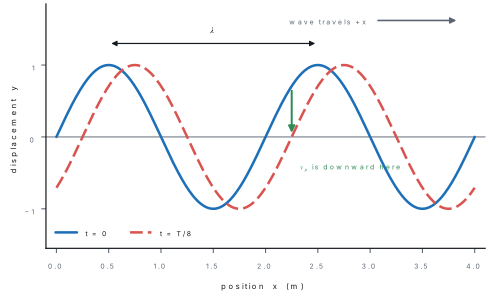
Problem. A wave is described by y = 0.02\sin(100t - 2x) (SI units). Find its amplitude, frequency, wavelength, speed and maximum particle speed.
Solution. Compare with y = A\sin(\omega t - kx): A = 0.02 m, \omega = 100 rad s⁻¹, k = 2 rad m⁻¹. f = \omega/2\pi = 100/6.28 = 15.9 Hz; \lambda = 2\pi/k = 3.14 m; v = \omega/k = 50 m s⁻¹. Maximum particle speed = A\omega = 0.02\times100 = 2 m s⁻¹.
- \omega is not the frequency; f = \omega/2\pi.
- The particle speed is not the wave speed. Here the wave crosses 50 m every second while a particle never moves faster than 2 m s⁻¹.
- In y = A\sin(\omega t - kx) the coefficient of t is \omega and the coefficient of x is k — but only if the equation is written that way. If the bracket is (kx - \omega t) the coefficients swap places, and v = \omega/k still, not k/\omega.
Superposition and reflection
The principle of superposition states that when two or more waves arrive at a point, the resultant displacement is the algebraic sum of the separate displacements. Waves pass through one another unchanged.
When a wave meets a boundary:
- at a rigid (fixed) end it reflects with a phase change of \pi — a crest comes back as a trough, and the displacement at the boundary is always zero;
- at a free (open) end it reflects with no phase change — a crest comes back as a crest, and the displacement at the boundary is maximum.
This difference is exactly why a string fixed at both ends and a pipe open at both ends have different harmonic series, and why a pipe closed at one end has none of the even harmonics.
11.2 Speed of sound in solids, liquids and gases
Sound is an elastic wave, so its speed is fixed by two properties of the medium: how stiff it is (the elastic modulus E) and how heavy it is (the density \rho):
Stiffness pushes the disturbed layer back quickly; inertia slows it down. That one formula explains every comparison in the table below.
| Medium | Modulus to use | Formula | Typical speed (m s⁻¹) |
|---|---|---|---|
| Solid (long thin rod) | Young's modulus Y | v = \sqrt{Y/\rho} | steel 5000, aluminium 5100, glass 5000 |
| Liquid | Bulk modulus B | v = \sqrt{B/\rho} | water 1480 (20 °C), sea water 1530 |
| Gas | Bulk modulus, adiabatic | v = \sqrt{\gamma P/\rho} | air 331 (0 °C), 343 (20 °C) |
Solids are fastest because their elastic moduli are enormous compared with their densities; gases are slowest because a gas is easy to squeeze.
Newton's value and Laplace's correction
Start from v = \sqrt{B/\rho} and ask what the bulk modulus of a gas actually is.
Step 1 — Newton's assumption. Newton supposed the compressions and rarefactions pass so gently that the temperature stays constant. Then Boyle's law holds, PV = constant, and the bulk modulus is just the pressure: B = P.
Step 2 — the number it gives. At STP, P = 1.013\times10^5 Pa and \rho = 1.293 kg m⁻³, so v = \sqrt{1.013\times10^5/1.293} = 280 m s⁻¹. The measured value is 331 m s⁻¹ — 15 % higher. Newton's formula fails.
Step 3 — Laplace's correction. A sound wave compresses and rarefies the air hundreds of times a second. Heat has no time to flow from a compression to the neighbouring rarefaction, so the process is adiabatic, not isothermal: PV^{\gamma} = constant, with \gamma = C_P/C_V.
Step 4 — the adiabatic bulk modulus. Differentiate: \gamma P V^{\gamma-1}\,dV + V^{\gamma}\,dP = 0, so \dfrac{dP}{dV} = -\gamma\dfrac{P}{V} and B = -V\dfrac{dP}{dV} = \gamma P.
Step 5 — the result.
Step 6 — the working form. For one mole, P = \rho RT/M, so
What it means. Sound travels faster in a gas that is lighter (smaller M) or hotter (larger T), and the ratio \gamma matters: monatomic gases (\gamma = 1.67) beat diatomic ones (\gamma = 1.4) at the same temperature and molar mass.
The words adiabatic, PV^{\gamma} = constant, B = \gamma P, and the final \sqrt{\gamma P/\rho}. A derivation that says "Laplace assumed adiabatic" without producing B = \gamma P loses the marks that carry the result.
The factors that change the speed of sound
| Factor | Effect on v in a gas | Reason |
|---|---|---|
| Temperature | increases; v \propto \sqrt{T} (kelvin) | v = \sqrt{\gamma RT/M} |
| Pressure | none, at constant temperature | \rho \propto P, so P/\rho is unchanged |
| Molar mass | decreases as M rises; v \propto 1/\sqrt{M} | lighter gas, faster sound |
| Humidity | increases slightly in air | water vapour (M = 18) is lighter than air (M \approx 29) |
| Wind | adds vectorially to v | the medium itself is moving |
| Frequency | none (in air, over the audible range) | air is non-dispersive for sound |
| Amplitude | none, for ordinary sounds | small-amplitude elasticity is linear |
Near 0 °C, v = 331\sqrt{1 + t/273} \approx 331 + 0.61t, so the speed rises by about 0.61 m s⁻¹ for each °C.
Doubling the pressure of a gas at constant temperature doubles its density too, and P/\rho stays the same. Students who answer "it increases" are thinking of the density alone. Temperature is the variable that matters, and it must be in kelvin: going from 27 °C to 54 °C does not double the speed — T goes from 300 K to 327 K, and v rises by only \sqrt{327/300} = 1.04, about 4 %.
Problem. The speed of sound in air at 0 °C is 331 m s⁻¹. Find it at 27 °C.
Solution. v \propto \sqrt{T} with T in kelvin: v = 331\sqrt{\dfrac{273+27}{273}} = 331\sqrt{\dfrac{300}{273}} = 331(1.048) = 347 m s⁻¹. The temperature has risen by 10 % in kelvin, so the speed rises by about 5 % — the square root halves the effect.
Problem. Find the ratio of the speed of sound in hydrogen (M = 2 g mol⁻¹) to that in oxygen (M = 32 g mol⁻¹) at the same temperature.
Solution. Both are diatomic, so \gamma is the same and cancels: \dfrac{v_{H_2}}{v_{O_2}} = \sqrt{\dfrac{M_{O_2}}{M_{H_2}}} = \sqrt{\dfrac{32}{2}} = 4. Sound travels four times faster in hydrogen.
11.3 Stationary waves: harmonics and overtones in strings and pipes
How a stationary wave is made
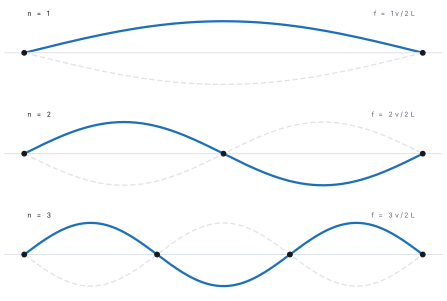
Send a wave along a string and let it reflect at the fixed end. The incident and reflected waves have the same amplitude and frequency and travel in opposite directions, so they superpose:
The result is a stationary (standing) wave. It is no longer a travelling wave: the x and t parts have separated, so every particle vibrates with the same frequency \cos(\omega t) but with an amplitude 2A\sin(kx) that depends on where it is.
| Feature | Where | What happens there |
|---|---|---|
| Node | \sin(kx) = 0, i.e. x = 0, \lambda/2, \lambda,\dots | permanently at rest |
| Antinode | \sin(kx) = \pm1, i.e. x = \lambda/4, 3\lambda/4,\dots | vibrates with amplitude 2A |
Distance between two neighbouring nodes = \lambda/2; between a node and the next antinode = \lambda/4. All particles between two consecutive nodes vibrate in phase; particles in adjacent loops vibrate in opposite phase. Energy shuttles back and forth between the loops but there is no net transfer of energy along the wave — that is what "stationary" means.
Strings fixed at both ends
Both ends are nodes, so the string holds a whole number of half-wavelengths:
All harmonics are present. The fundamental f_1 = v/2L is the first harmonic; 2f_1 is the second harmonic or first overtone; 3f_1 the third harmonic or second overtone. For a string of mass per unit length \mu under tension T, v = \sqrt{T/\mu}, so
The three laws of the vibrating string follow at once: f \propto 1/L (length), f \propto \sqrt{T} (tension), f \propto 1/\sqrt{\mu} (mass per unit length).
Pipes
A pipe has a node of displacement at a closed end (the air cannot move against the solid cap) and an antinode at an open end (the air is free to swing).
| Open pipe (both ends open) | Closed pipe (one end closed) | |
|---|---|---|
| Boundary conditions | antinode at each end | node at the closed end, antinode at the open end |
| Length in the nth mode | L = n\lambda/2 | L = (2n-1)\lambda/4 |
| Wavelength | \lambda_n = 2L/n | \lambda_n = 4L/(2n-1) |
| Frequency | f_n = nv/2L | f_n = (2n-1)v/4L |
| Harmonics present | all: f_1, 2f_1, 3f_1,\dots | odd only: f_1, 3f_1, 5f_1,\dots |
| Fundamental | v/2L | v/4L |
| First overtone | 2v/2L (2nd harmonic) | 3v/4L (3rd harmonic) |
| Second overtone | 3v/2L (3rd harmonic) | 5v/4L (5th harmonic) |
| Nodes / antinodes in the nth mode | n+1 nodes, n antinodes | n nodes, n antinodes |
| Effective length with end correction | L + 2e | L + e |
For a 0.5 m pipe with v = 340 m s⁻¹ the numbers are:
| Mode | Open pipe | Closed pipe |
|---|---|---|
| Fundamental | 340 Hz | 170 Hz |
| 1st overtone | 680 Hz | 510 Hz |
| 2nd overtone | 1020 Hz | 850 Hz |
Notice the closed pipe has half the fundamental of the open pipe of the same length, and every second harmonic is missing.
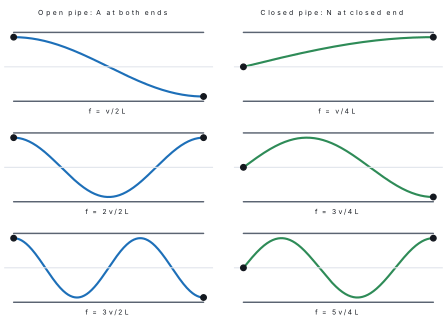
- A closed pipe has no even harmonics. Its "first overtone" is the third harmonic (three times the fundamental), not the second. So a 100 Hz closed pipe sounds 100, 300, 500 Hz — never 200 Hz.
- The closed pipe fundamental is half that of an open pipe of the same length, not the same. Ratio open : closed = 2 : 1.
End correction
The antinode at an open end does not sit exactly at the cut edge — the air just outside the pipe moves too, so the effective length is slightly longer. For a pipe of diameter d, each open end adds
so a closed pipe has effective length L + e and an open pipe L + 2e. End correction lowers every frequency slightly.
The resonance tube measures it. A tuning fork of frequency f is held over a tube whose water level can be raised. Resonance (loudest sound) occurs when the air column is a quarter-wavelength, then three-quarters:
Subtracting, l_2 - l_1 = \lambda/2, so
The subtraction kills e, which is why the tube gives a good value of v even though the end correction is unknown.
Problem. A pipe closed at one end has a fundamental frequency of 100 Hz. What are the next two frequencies it can produce?
Solution. A closed pipe gives odd multiples only: f_n = (2n-1)\times100 Hz. So 100, 300, 500 Hz. The 300 Hz note is the first overtone and the third harmonic; 200 Hz is impossible in this pipe.
Problem. A tuning fork of 500 Hz gives resonance at air-column lengths of 17 cm and 51 cm. Find the speed of sound and the end correction.
Solution. v = 2f(l_2 - l_1) = 2(500)(0.51 - 0.17) = 2(500)(0.34) = 340 m s⁻¹. e = \dfrac{l_2 - 3l_1}{2} = \dfrac{0.51 - 0.51}{2} = 0. A zero end correction is unusual but consistent: the numbers were chosen so that l_2 = 3l_1, which happens only when e = 0.
Beats
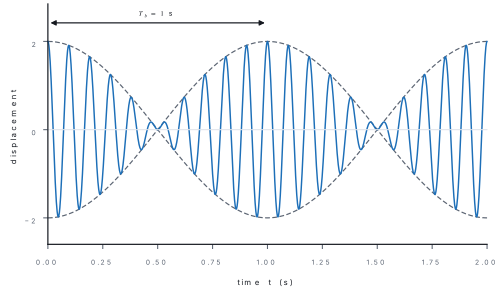
Two waves of slightly different frequencies travelling in the same direction superpose. At a point the two displacements are A\cos(2\pi f_1 t) and A\cos(2\pi f_2 t); their sum is
a wave of the average frequency whose amplitude is slowly modulated. The amplitude is maximum twice per modulation cycle, so the beat frequency is
Beats are heard only when f_b is small — below about 10 Hz the ear hears separate pulses; above about 15 Hz it hears a rough, dissonant note instead.
Loading a fork with wax lowers its frequency; filing it raises it. So if loading the unknown fork reduces the beat rate, the unknown was the higher of the two; if loading increases it, the unknown was the lower. Work out which fork moved in which direction before doing any arithmetic.
11.4 Pressure amplitude, intensity and loudness, pitch and quality
The pressure wave
A sound wave can be described either by the displacement of the air particles, y = A\sin(\omega t - kx), or by the excess pressure it creates. The two are a quarter-cycle out of phase: where the particles are crowded together (displacement zero, changing fastest) the pressure is greatest.
p_m is the pressure amplitude, in pascal. Because p_m \propto \omega A = 2\pi fA, a high-frequency wave of the same displacement carries far more pressure variation — and far more energy.
A consequence worth memorising: at a closed end the air cannot move, so it is a displacement node and a pressure antinode; at an open end the air swings freely, a displacement antinode and a pressure node.
Intensity
Intensity is the energy crossing unit area per second, perpendicular to the direction of travel: I = P/A, unit W m⁻².
So for the same medium and frequency, I \propto A^2; for the same amplitude, I \propto f^2.
Inverse-square law. A point source radiating power P equally in all directions spreads it over a sphere of area 4\pi r^2:
Double the distance and the intensity falls to a quarter; the amplitude falls to a half, because A \propto \sqrt{I}.
Loudness in decibels
The ear responds to intensity over about thirteen powers of ten, so a logarithmic scale is used. The loudness level in decibels is
I_0 is the threshold of hearing at 1 kHz. Some landmarks:
| Source | L (dB) | I (W m⁻²) |
|---|---|---|
| threshold of hearing | 0 | 10^{-12} |
| rustling leaves | 10 | 10^{-11} |
| whisper | 20 | 10^{-10} |
| normal conversation | 60 | 10^{-6} |
| busy street in Kathmandu | 80 | 10^{-4} |
| rock concert | 110 | 10^{-1} |
| jet engine at 30 m | 130 | 10 |
Two rules that answer most dB questions:
- +10 dB means ten times the intensity; +20 dB means a hundred times, and also ten times the pressure amplitude and ten times the displacement amplitude.
- Two identical sources sounding together give +3 dB, because the intensities add (2I), not the amplitudes.
A level of 60 dB plus a level of 60 dB is 63 dB, not 120 dB. And a sound of 80 dB is not "twice as loud" as 40 dB in the everyday sense — it is ten thousand times the intensity. To combine two sources, add their intensities and convert back to decibels; never add the decibel numbers themselves.
Problem. A loudspeaker radiates 1 W uniformly. Find the intensity and the loudness level at 10 m, and the change in level when you move to 100 m.
Solution. I = P/4\pi r^2 = 1/(4\pi\times100) = 7.96\times10^{-4} W m⁻²; L = 10\log(7.96\times10^{-4}/10^{-12}) = 10\log(7.96\times10^8) = 89 dB. At 100 m the distance is ten times larger, so I falls by 10^2 and L falls by 10\log 100 = 20 dB, to 69 dB.
Pitch, loudness and quality
| Sensation | Physical quantity it follows | How it changes |
|---|---|---|
| Pitch | frequency | higher frequency → higher pitch |
| Loudness | intensity (and frequency, through the ear's response) | more intensity → louder |
| Quality (timbre) | the number and relative strength of the overtones | same pitch, different waveform → different instrument |
A violin and a flute playing the same 440 Hz note have the same pitch and can have the same loudness, but they sound different because their overtone mixtures differ. That mixture is the quality of the note.
Every factor of 10 in intensity is 10 dB; every factor of 2 is 3 dB; every factor of 4 is 6 dB. To find a level, write the intensity as a power of ten times a small factor and add the pieces: 2\times10^{-6} W m⁻² is 60 + 3 = 63 dB.
11.5 Doppler effect
The Doppler effect is the apparent change in the frequency of a wave when the source, the observer, or both, move relative to the medium.
v is the speed of sound in the medium (not relative to the ground), v_o the speed of the observer, v_s the speed of the source.
The rule: choose the sign that increases f' when the motion brings the source and observer closer. So the numerator takes + for an observer moving towards the source and - for away; the denominator takes - for a source moving towards the observer and + for away. The observer is on top, the source below.
| Source | Observer | Apparent frequency |
|---|---|---|
| at rest | at rest | f |
| at rest | moving towards, v_o | f\dfrac{v + v_o}{v} (higher) |
| at rest | moving away, v_o | f\dfrac{v - v_o}{v} (lower) |
| moving towards, v_s | at rest | f\dfrac{v}{v - v_s} (higher) |
| moving away, v_s | at rest | f\dfrac{v}{v + v_s} (lower) |
| moving towards, v_s | moving towards, v_o | f\dfrac{v + v_o}{v - v_s} |
| moving away, v_s | moving away, v_o | f\dfrac{v - v_o}{v + v_s} |
Where the formula comes from
Moving source. The source emits f waves per second and at the same time moves towards the observer at v_s. During one period T = 1/f it advances v_sT, so the waves it has emitted are squeezed into the shorter distance
These waves still travel at v through the air, so the observer receives
Moving observer. The source is at rest, so the wavelength in the air is the normal \lambda = v/f. The observer meets the waves at the relative speed v + v_o, so
Both. Put the two together: the wavelength is set by the source's motion and the rate of meeting is set by the observer's motion, giving the combined formula above.
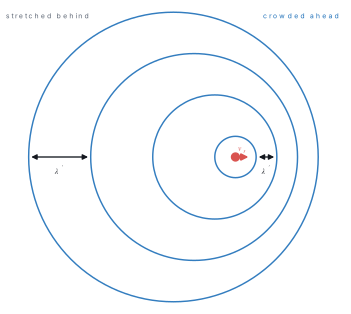
Problem. A train sounding a 640 Hz horn moves at 20 m s⁻¹ towards a station. A porter runs towards the train at 10 m s⁻¹. What frequency does he hear? (v = 340 m s⁻¹)
Solution. Both are approaching, so the numerator takes + and the denominator -: f' = 640\times\dfrac{340 + 10}{340 - 20} = 640\times\dfrac{350}{320} = 700 Hz. Check the size: 640 → 700 is a rise of 9 %, about 1.5 semitones — clearly audible. The same shift runs the other way once the train has passed, and that sudden fall is what makes a passing siren so recognisable.
- Source moving away puts v + v_s in the denominator, not v - v_s. If your answer comes out higher than f for a receding source, you have the sign backwards.
- v is the speed of sound in still air, not relative to the source or the observer. Only f' changes; the sound still travels at 340 m s⁻¹ through the air.
- Motion across the line of sight gives no shift to first order. An ambulance crossing in front of you at constant distance has the same pitch as when it is standing still.
Echoes and reflections
When the sound reflects from a wall, treat the problem in two steps: first the wall is an observer receiving f_1; then the wall is a stationary source re-emitting f_1. If the source itself moves towards the wall at v_s, the wave arriving at the wall has f_1 = f\dfrac{v}{v - v_s}, and the source (still moving) hears the echo as
so the beat frequency between the emitted note and its echo is f'' - f = f\dfrac{2v_s}{v - v_s}.
Where it is used
- Ambulance and train sirens: the pitch drops abruptly as the vehicle passes.
- Police speed radar and weather radar: the shift in the reflected signal gives the speed of the target (for light, the same idea with c).
- Doppler echocardiography: ultrasound reflected from moving blood measures flow speed and direction.
- Astronomical redshift: light from receding galaxies is shifted to longer wavelengths — evidence that the universe is expanding.
Formula and fact sheet
| Topic | Formula or fact |
|---|---|
| Wave equation | y = A\sin(\omega t - kx) travels +x; \omega = 2\pi f, k = 2\pi/\lambda |
| Wave speed | v = f\lambda = \omega/k |
| Phase difference | \Delta\phi = 2\pi\Delta x/\lambda = 2\pi\Delta t/T |
| Particle velocity | v_p = A\omega\cos(\omega t - kx) = -v\times\text{slope}; maximum A\omega |
| Speed in a medium | v = \sqrt{E/\rho}: solid \sqrt{Y/\rho}, liquid \sqrt{B/\rho}, gas \sqrt{\gamma P/\rho} |
| Gas | v = \sqrt{\gamma RT/M}; v \propto \sqrt{T}, v \propto 1/\sqrt{M}; independent of P at constant T |
| Air | 331 m s⁻¹ at 0 °C, 343 at 20 °C, +0.61 m s⁻¹ per °C |
| String | v = \sqrt{T/\mu}; f_n = \frac{n}{2L}\sqrt{T/\mu}, all n |
| Open pipe | f_n = nv/2L; fundamental v/2L; all harmonics |
| Closed pipe | f_n = (2n-1)v/4L; fundamental v/4L; odd harmonics only |
| End correction | e = 0.3d per open end; closed L+e, open L+2e |
| Resonance tube | v = 2f(l_2 - l_1); e = (l_2 - 3l_1)/2 |
| Beats | f_b = f_1 - f_2 (the difference, taken positive); T_b = 1/f_b; heard for f_b < 10 Hz |
| Pressure amplitude | p_m = \rho v\omega A = BAk; \Delta p leads displacement by 90^{\circ} |
| Intensity | I = \frac{1}{2}\rho v\omega^2A^2 = 2\pi^2\rho vf^2A^2 = p_m^2/2\rho v |
| Inverse square | I \propto 1/r^2, A \propto 1/r |
| Decibel | L = 10\log_{10}(I/I_0), I_0 = 10^{-12} W m⁻²; +10 dB = 10\times I; +3 dB = 2\times I |
| Doppler | f' = f\frac{v \pm v_o}{v \mp v_s}; upper sign for approach |
| Echo | f'' = f\frac{v + v_s}{v - v_s}; beat = f\frac{2v_s}{v - v_s} |
| Node / antinode | node–node \lambda/2; node–antinode \lambda/4 |
Chapter summary
- A progressive wave is y = A\sin(\omega t - kx), with v = \omega/k = f\lambda; the minus sign means it travels towards +x.
- Particle velocity is v_p = -v\times\text{slope} of the profile, with maximum A\omega — a completely different number from the wave speed.
- Sound speed is set by stiffness and density: \sqrt{Y/\rho} in solids, \sqrt{B/\rho} in liquids, \sqrt{\gamma P/\rho} = \sqrt{\gamma RT/M} in gases. It rises with temperature, falls with molar mass, and does not change with pressure at constant temperature.
- A string fixed at both ends and an open pipe give every harmonic, f_n = nv/2L; a closed pipe gives odd harmonics only, f_n = (2n-1)v/4L, and has half the fundamental of the open pipe of the same length.
- End correction e = 0.3d per open end; the resonance tube removes it by using l_2 - l_1 = \lambda/2.
- Beats: f_b = |f_1 - f_2|, audible only for small differences; waxing a fork lowers its frequency, filing raises it.
- Intensity is 2\pi^2\rho vf^2A^2, falls as 1/r^2, and converts to loudness by L = 10\log(I/I_0); +10 dB is ten times the intensity, +3 dB is two sources.
- Doppler: f' = f(v \pm v_o)/(v \mp v_s) with the upper sign for approach; a source moving away lowers the pitch, and motion across the line of sight gives no shift.
Practice questions
Set A — Recall (28 questions)
- In y = A\sin(\omega t - kx), the quantity \omega/k is theawave speedbparticle speedcfrequencydwavelength
- The SI unit of the intensity of a wave isaWbW m⁻¹cW m⁻²dJ m⁻²
- Sound cannot travel throughasteelbvacuumcwaterdhydrogen
- A pipe closed at one end can produceaall harmonicsbonly even harmonicsconly the fundamentaldonly odd harmonics
- The beat frequency of two waves of frequencies f_1 and f_2 isa|f_1 - f_2|bf_1 + f_2c(f_1 + f_2)/2d\sqrt{f_1f_2}
- The loudness level in decibels is defined with the reference intensitya1 W m⁻²b10⁻⁶ W m⁻²c10⁻¹² W m⁻²d10⁻¹⁶ W m⁻²
- The pitch of a musical note is determined by itsaintensitybfrequencycwaveformdspeed
- The number of nodes in the nth harmonic of a string fixed at both ends isanbn - 1c2ndn + 1
- At constant temperature, the speed of sound in a gas isaindependent of pressurebproportional to pressurecproportional to \sqrt{P}dinversely proportional to pressure
- Laplace corrected Newton's formula by treating the propagation of sound asaisothermalbisobariccadiabaticdisochoric
- For a gas at absolute temperature T, the speed of sound isa\sqrt{RT/M}b\sqrt{\gamma RT/M}c\gamma\sqrt{RT/M}d\sqrt{\gamma M/RT}
- An observer moving towards a stationary source with speed v_o hears a frequencyaf(v - v_o)/vbfv/(v + v_o)cfv/(v - v_o)df(v + v_o)/v
- The distance between two consecutive nodes in a stationary wave isa\lambda/2b\lambdac\lambda/4d2\lambda
- Two points on a wave separated by \lambda/4 differ in phase bya\pib2\pic\pi/2d\pi/4
- The relation between wave speed, frequency and wavelength isav = f/\lambdabv = f\lambdacv = \lambda/fdv = f^2\lambda
- In a stationary waveaenergy is carried at speed vball particles have equal amplitudecthe wave travels in one directiondthere is no net transfer of energy
- The end correction of a pipe of diameter d, open at one end, is abouta0.3db0.6dc0.15ddd
- The intensity of a wave is proportional toathe amplitudebthe square root of the amplitudecthe square of the amplitudedthe wavelength
- The unit of loudness level is theawattbdecibelchertzdpascal
- A sound wave of frequency 170 Hz travels at 340 m s⁻¹. Its wavelength isa0.5 mb1 mc4 md2 m
- Which of the following is a longitudinal wave?asound in airblight in vacuumca wave on a stringda ripple on water
- In a pipe open at both ends, the frequencies produced areaodd multiples of the fundamental onlybeven multiples onlycall integral multiples of the fundamentaldunrelated to the fundamental
- The frequency of a stretched string is proportional toathe tensionbthe square root of the tensioncthe lengthdthe square root of the length
- When a source of sound moves away from a stationary observer, the frequency heard isahigherbthe samecdoubleddlower
- The speed of sound is greatest inaairbwatercsteeldvacuum
- Beats are clearly heard when the frequencies of the two sources differ by less than abouta10 Hzb100 Hzc1000 Hzd10000 Hz
- The third harmonic of a closed pipe containsa1 node and 1 antinodeb2 nodes and 2 antinodesc3 nodes and 3 antinodesd2 nodes and 3 antinodes
- The speed of a wave is determined byaits frequencybits amplitudecits wavelengthdthe medium
Answers and explanations — Set A
1. (a) — v = \omega/k; multiplying \omega by t and k by x leaves a phase, and \omega/k has the unit rad s⁻¹ ÷ rad m⁻¹ = m s⁻¹.
2. (c) — intensity is power per unit area, W m⁻². The watt alone is power; J m⁻² is energy per area, not per area per second.
3. (b) — sound is a mechanical wave and needs particles to compress; in vacuum there is nothing to vibrate, so no sound (light still passes).
4. (d) — the closed end forces a node and the open end an antinode, which fits an odd number of quarter-wavelengths: L = (2n-1)\lambda/4. Even harmonics would need a node at both ends.
5. (a) — the envelope repeats |f_1 - f_2| times a second. The sum f_1 + f_2 is the frequency you would hear inside the beats, not the beat rate.
6. (c) — I_0 = 10^{-12} W m⁻² is the threshold of hearing at 1 kHz, the zero of the dB scale.
7. (b) — pitch is the ear's judgement of frequency. Intensity gives loudness and waveform gives quality.
8. (d) — n half-wavelengths need n+1 nodes: two ends plus n-1 interior nodes.
9. (a) — doubling P doubles \rho as well, so P/\rho and hence v = \sqrt{\gamma P/\rho} are unchanged. Only temperature (or molar mass) changes the speed.
10. (c) — compressions follow too quickly for heat to flow, so PV^{\gamma} is constant and B = \gamma P; that raises 280 m s⁻¹ to 331 m s⁻¹.
11. (b) — v = \sqrt{\gamma P/\rho} and P = \rho RT/M give v = \sqrt{\gamma RT/M}. Option (a) omits \gamma, which is about 1.4 for air.
12. (d) — the observer meets the waves at relative speed v + v_o while the wavelength stays v/f, so f' = f(v + v_o)/v. Option (c) is the moving-source formula.
13. (a) — the displacement repeats every half-wavelength, so nodes are \lambda/2 apart; node to antinode is \lambda/4.
14. (c) — a quarter of a wavelength is a quarter of 2\pi, that is \pi/2.
15. (b) — one wave passes per period and occupies one wavelength, so v = f\lambda.
16. (d) — the two travelling waves carry equal energy in opposite directions; energy oscillates between kinetic and elastic forms but does not travel.
17. (a) — the standard value is e = 0.3d (equivalently 0.6r) for each open end.
18. (c) — I = 2\pi^2\rho vf^2A^2, so doubling the amplitude quadruples the intensity.
19. (b) — the decibel. The watt is power, the hertz frequency and the pascal pressure.
20. (d) — \lambda = v/f = 340/170 = 2 m.
21. (a) — sound in air is a pressure (compression) wave; light is transverse, and so are waves on a string and water ripples.
22. (c) — an open pipe holds any number of half-wavelengths, so every harmonic nv/2L appears.
23. (b) — f = \frac{1}{2L}\sqrt{T/\mu}, so f \propto \sqrt{T}; quadrupling the tension only doubles the frequency.
24. (d) — a receding source stretches the wavelength, f' = fv/(v + v_s) < f.
25. (c) — steel has by far the largest elastic modulus for its density; gases are slowest because they are easy to compress.
26. (a) — above about 10–15 Hz the separate pulses merge into a rough note and the beats are no longer heard as beats.
27. (b) — the third harmonic is 3\lambda/4 long: nodes at the closed end and at 2L/3, antinodes at L/3 and at the open end — two of each.
28. (d) — v is fixed by the elasticity and inertia of the medium; f and \lambda can change, but their product stays at the value the medium allows.
Set B — Understanding (17 questions)
- A wave y = A\sin(\omega t - kx) travels towards +x. At a point where the profile slopes upward, the particle there is movingaupwardbtowards +xcdownwarddwith the wave
- Sound passes from air into water. Which quantity is unchanged?afrequencybspeedcwavelengthdamplitude
- Two pipes of equal length, one open at both ends and one closed at one end, have fundamental frequencies in the ratio (open : closed)a1 : 2b1 : 1c4 : 1d2 : 1
- The first overtone of a closed pipe is theasecond harmonicbthird harmoniccfourth harmonicdfifth harmonic
- The tension in a sonometer wire is made four times larger. The frequency of the wire becomesa4 timesbhalfc2 timesd\sqrt{2} times
- An unknown fork gives 4 beats per second with a 256 Hz fork. On loading the unknown fork with wax the beat rate falls to 2 per second. Its frequency isa260 Hzb252 Hzc254 Hzd264 Hz
- A source moves away from a stationary observer at half the speed of sound. The frequency heard isaf/2b3f/2cfd2f/3
- An observer moves away from a stationary source at half the speed of sound. The frequency heard isa2f/3bf/2c3f/2df
- The intensity of sound 2 m from a point source is I. At 8 m from the same source it isaI/16bI/4cI/8dI/64
- An increase of 10 dB in the loudness level means the intensity has increased by a factor ofa2b5c10d100
- An increase of 20 dB means the pressure amplitude has increased by a factor ofa2b20c100d10
- Two identical sources sounding together give a level 3 dB above one alone. Their combined intensity isa3 timesb2 timesc1.5 timesd10 times
- The speed of sound in a gas doubles when the absolute temperature isaincreased four timesbdoubledchalveddincreased eight times
- On a humid day the speed of sound in airadecreasesbstays the samecincreasesdbecomes zero
- At a point where the displacement of a sound wave is zero, the pressure variation isazerobmaximumchalf its maximumdalways negative
- In a stationary wave, particles in two adjacent loopsavibrate in phasebare at restchave different frequenciesdvibrate in opposite phase
- The second resonance length in a resonance tube is aboutathree times the firstbtwice the firstcfour times the firstdhalf the first
Answers and explanations — Set B
1. (c) — v_p = -v\times\text{slope}; a positive slope with a wave moving towards +x gives a negative (downward) particle velocity. The crest is still to the left, so the particle is on its way down.
2. (a) — the frequency is fixed by the source and cannot change at a boundary; the higher speed in water forces a longer wavelength (\lambda = v/f).
3. (d) — open v/2L, closed v/4L, so the ratio is 2 : 1. The closed pipe sounds an octave lower.
4. (b) — closed pipes skip the second harmonic, so the first overtone is the third harmonic, 3v/4L.
5. (c) — f \propto \sqrt{T}, and \sqrt{4} = 2. Quadrupling the tension doubles the frequency, not quadruples it.
6. (a) — wax lowers the unknown frequency. If it was 260 Hz it falls to about 258 and the beats with 256 fall from 4 to 2, as stated. Had it been 252, waxing would have taken it further from 256 and the beats would have risen.
7. (d) — f' = f\dfrac{v}{v + v/2} = \dfrac{2}{3}f. The denominator grows, so the frequency falls.
8. (b) — the observer meets fewer waves: f' = f\dfrac{v - v/2}{v} = \dfrac{f}{2}.
9. (a) — I \propto 1/r^2; the distance is four times larger, so the intensity is 1/16.
10. (c) — 10\log_{10}x = 10 gives x = 10. Option (d) would be 20 dB.
11. (d) — 20 dB is a factor 10^2 in intensity, and amplitude goes as the square root of intensity, so a factor 10.
12. (b) — two incoherent identical sources add their intensities, 2I, which is 10\log 2 = 3 dB.
13. (a) — v \propto \sqrt{T}, so doubling v needs T four times larger. Doubling T only multiplies v by \sqrt{2}.
14. (c) — water vapour has molar mass 18 against about 29 for dry air, so humid air is less dense and sound travels slightly faster.
15. (b) — displacement and pressure are a quarter-cycle apart: a displacement node (particles crowded, zero displacement but maximum compression change) is a pressure antinode.
16. (d) — the loops on either side of a node move in opposite directions at every instant; particles inside one loop are in phase.
17. (a) — l_2 \approx 3l_1, because the second resonance is at three quarter-wavelengths against one at the first.
Set C — Application (12 questions)
- A wave is y = 0.02\sin(100t - 2x) in SI units. Its speed isa2 m s⁻¹b50 m s⁻¹c100 m s⁻¹d200 m s⁻¹
- For the same wave, the maximum speed of a particle of the medium isa50 m s⁻¹b0.04 m s⁻¹c100 m s⁻¹d2 m s⁻¹
- The speed of sound in air at 0 °C is 331 m s⁻¹. At 27 °C it is abouta347 m s⁻¹b331 m s⁻¹c356 m s⁻¹d363 m s⁻¹
- The ratio of the speed of sound in hydrogen to that in oxygen at the same temperature isa2b2.8c4d16
- A pipe closed at one end is 0.5 m long. Taking v = 340 m s⁻¹, its fundamental frequency isa85 Hzb170 Hzc340 Hzd510 Hz
- A pipe open at both ends is 0.5 m long. Taking v = 340 m s⁻¹, its fundamental frequency isa85 Hzb170 Hzc680 Hzd340 Hz
- A train sounding a 500 Hz horn approaches a stationary listener at 34 m s⁻¹ (v = 340 m s⁻¹). The frequency heard isa556 Hzb550 Hzc455 Hzd444 Hz
- The same train, now receding at 34 m s⁻¹, is heard ata556 Hzb545 Hzc455 Hzd500 Hz
- A source of 680 Hz moves at 20 m s⁻¹ directly towards a wall. A listener standing at the source hears the echo with a beat frequency of (v = 340 m s⁻¹)a20 Hzb40 Hzc42 Hzd85 Hz
- The intensity of a sound is 10^{-8} W m⁻². Its loudness level isa8 dBb40 dBc80 dBd120 dB
- Two tuning forks of 512 Hz and 516 Hz are sounded together. The beat frequency isa2 Hzb8 Hzc4 Hzd514 Hz
- A 500 Hz fork resonates with air columns of 17 cm and 51 cm in a resonance tube. The speed of sound isa340 m s⁻¹b330 m s⁻¹c350 m s⁻¹d170 m s⁻¹
Answers and explanations — Set C
1. (b) — v = \omega/k = 100/2 = 50 m s⁻¹. The amplitude 0.02 plays no part in the wave speed.
2. (d) — v_{p,\max} = A\omega = 0.02\times100 = 2 m s⁻¹. Option (a) is the wave speed, which is 25 times larger.
3. (a) — v = 331\sqrt{300/273} = 331(1.048) = 347 m s⁻¹. Adding 27 to the Celsius reading is not the same as increasing T by 10 %.
4. (c) — both diatomic, so \gamma cancels: \sqrt{M_{O_2}/M_{H_2}} = \sqrt{32/2} = 4.
5. (b) — closed pipe: f_1 = v/4L = 340/(4\times0.5) = 170 Hz.
6. (d) — open pipe: f_1 = v/2L = 340/(2\times0.5) = 340 Hz, twice the closed-pipe value.
7. (a) — f' = 500\times\dfrac{340}{340 - 34} = 500\times\dfrac{340}{306} = 556 Hz. Option (b) is the observer-moving answer, not the source-moving one.
8. (c) — f' = 500\times\dfrac{340}{340 + 34} = 500\times\dfrac{340}{374} = 455 Hz.
9. (d) — the wall receives 680\times340/320 = 722.5 Hz and re-emits it; the moving source hears 722.5\times360/340 = 765 Hz. The beat with the emitted 680 Hz is 85 Hz.
10. (b) — L = 10\log(10^{-8}/10^{-12}) = 10\log 10^4 = 40 dB.
11. (c) — f_b = |512 - 516| = 4 Hz.
12. (a) — v = 2f(l_2 - l_1) = 2(500)(0.34) = 340 m s⁻¹. The end correction cancels in the subtraction, which is why the tube works.