Chapter 3 · Mechanics · 1 question in the paper · 27 min read
Rotational Dynamics
What the syllabus asks for 3
- Moment of inertia of a uniform rod and radius of gyration
- Torque, rotational work, kinetic energy and power
- Angular momentum and its conservation
Rotational dynamics is linear dynamics re-written for turning: force becomes torque, mass becomes moment of inertia, momentum becomes angular momentum. Of the 10 Mechanics questions (official weightage), we estimate about 1 comes from this chapter. The MEC syllabus limits moment of inertia to the uniform rigid rod, so expect a rod about its centre or its end, a radius of gyration, a torque or rotational-power calculation, or a conservation-of-angular-momentum situation such as a spinning skater.
- Rod: I = ML^2/12 about a perpendicular axis through the centre, ML^2/3 through an end; the ratio is 4.
- Radius of gyration k = \sqrt{I/M}: L/(2\sqrt{3}) about the centre, L/\sqrt{3} about an end.
- Parallel-axis theorem I = I_{cm} + Md^2; what I depends on (and that it does not depend on \omega).
- Torque \tau = rF\sin\theta and \tau = I\alpha; rotational work \tau\theta, power \tau\omega, kinetic energy \frac{1}{2}I\omega^2.
- Angular momentum L = I\omega, \tau = dL/dt; with no external torque I_1\omega_1 = I_2\omega_2.
- K = L^2/2I: when a skater pulls in, \omega and K rise while L stays the same.
3.1 Moment of inertia of a uniform rod and radius of gyration
Moment of inertia
The moment of inertia of a body about an axis is the sum of the products of the mass of each particle and the square of its perpendicular distance from the axis: I = \sum m_ir_i^2 (or \int r^2\,dm). It measures the body's opposition to a change in its rotational motion about that axis. SI unit kg m²; dimensions [ML^2].
I plays in rotation the part that mass plays in translation. Unlike mass, it is not fixed for a body: it depends on
- the mass of the body,
- how that mass is distributed about the axis (mass far from the axis counts much more, because of r^2),
- the position and orientation of the axis.
It does not depend on the angular velocity or on the torque applied (for a rigid body).
The uniform rod
Take a thin uniform rod of mass M and length L, so its mass per unit length is M/L. A slice of length dx at distance x from the axis has mass dm = (M/L)\,dx and contributes x^2\,dm.
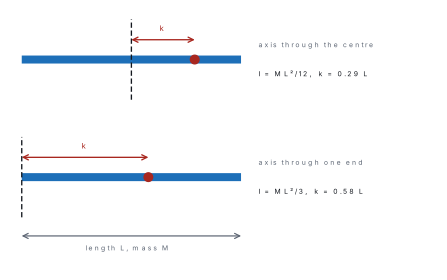
- Axis through the centre, perpendicular to the rod: x runs from -L/2 to +L/2, and I = \frac{M}{L}\int x^2\,dx = \frac{M}{L}\cdot\frac{L^3}{12}.
- Axis through one end, perpendicular to the rod: x runs from 0 to L, and I = \frac{M}{L}\cdot\frac{L^3}{3}.
| Axis of the rod (mass M, length L) | Moment of inertia | Radius of gyration k |
|---|---|---|
| Perpendicular, through the centre | ML^2/12 (the least for a perpendicular axis) | L/(2\sqrt{3}) \approx 0.289L |
| Perpendicular, through one end | ML^2/3 | L/\sqrt{3} \approx 0.577L |
| Perpendicular, at distance d from the centre | ML^2/12 + Md^2 | \sqrt{L^2/12 + d^2} |
| Through the centre, at angle \theta to the rod | (ML^2/12)\sin^2\theta | (L\sin\theta)/(2\sqrt{3}) |
| Along the rod itself (thin rod) | \approx 0 | \approx 0 |
Two theorems
- Parallel-axis theorem: I = I_{cm} + Md^2, where I_{cm} is about a parallel axis through the centre of mass and d is the distance between the axes. The centre-of-mass axis therefore gives the least moment of inertia of all parallel axes. Check: \frac{ML^2}{12} + M\left(\frac{L}{2}\right)^2 = \frac{ML^2}{3}.
- Perpendicular-axis theorem (plane lamina only): I_z = I_x + I_y, where x and y lie in the plane of the lamina and z is perpendicular to it, all three meeting at one point.
Radius of gyration
The radius of gyration k of a body about an axis is the distance from the axis at which, if the whole mass of the body were concentrated, it would have the same moment of inertia: I = Mk^2, so k = \sqrt{I/M}. It is the root-mean-square distance of the body's particles from the axis. SI unit: metre.
k depends on the axis and on the distribution of mass, but not on the total mass (doubling the mass of a rod doubles I and leaves k the same).
For reference, when a question gives a wheel instead of a rod: ring about its axis MR^2 (k = R), disc MR^2/2, solid sphere about a diameter \frac{2}{5}MR^2, thin spherical shell \frac{2}{3}MR^2. For the same mass and radius a ring has a larger I than a disc, because all its mass is at the rim — the reason a flywheel has a heavy rim.
Problem. (a) A uniform rod of mass 1 kg and length 1.2 m. Find I about perpendicular axes through its centre and through one end, and k about the end. (b) Two 2 kg balls are fixed at the ends of a light rod 1 m long. Find I about a perpendicular axis through the centre.
Solution. (a) I_c = 1(1.2)^2/12 = 0.12\ \text{kg m}^2; I_e = 4I_c = 0.48\ \text{kg m}^2; k_e = L/\sqrt{3} = 1.2/1.732 = 0.69\ \text{m}. (b) Each ball is 0.5 m from the axis: I = 2\times2(0.5)^2 = 1.0\ \text{kg m}^2. A uniform rod of the same total mass (4 kg) would have only 4(1)^2/12 = 0.33\ \text{kg m}^2 — mass at the ends counts more.
I_{end} = 4I_{centre}, but k_{end} = 2k_{centre} (because k \propto \sqrt{I}). And the parallel-axis theorem adds Md^2 only from the centre-of-mass axis: you cannot go from the end axis to another axis by adding Md^2 — go back to the centre first.
3.2 Torque, rotational work, kinetic energy and power
Torque
The torque (moment of a force) about an axis is the turning effect of the force: \vec\tau = \vec r\times\vec F, of magnitude \tau = rF\sin\theta = F\,r_\perp, where r_\perp = r\sin\theta is the perpendicular distance of the line of action of the force from the axis (the moment arm). SI unit N m; dimensions [ML^2T^{-2}].
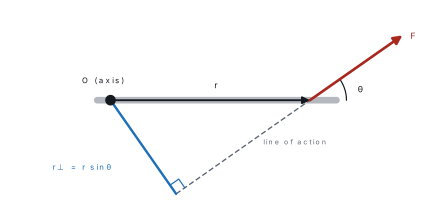
- The direction of \vec\tau is along the axis, given by the right-hand rule (anticlockwise torque is taken positive by convention).
- A force through the axis, or along \vec r, gives zero torque. A door handle is far from the hinges so that a small force gives a large torque.
- A couple (two equal, opposite, parallel forces F a distance d apart) has zero net force and torque Fd about every point: it turns without translating.
- Torque and work share the unit N m and the dimensions [ML^2T^{-2}], but torque is a vector and is never written in joules.
Newton's second law for rotation
For a rigid body turning about a fixed axis, \tau = I\alpha — the rotational form of F = ma. For constant \alpha the rotational equations of motion are exact copies of the linear ones:
| Linear | Rotational | Link |
|---|---|---|
| displacement s | angle \theta (rad) | s = r\theta |
| velocity v | angular velocity \omega | v = r\omega |
| acceleration a | angular acceleration \alpha | a_t = r\alpha |
| mass m | moment of inertia I | I = \sum mr^2 |
| force F = ma | torque \tau = I\alpha | \tau = rF\sin\theta |
| momentum p = mv | angular momentum L = I\omega | L = rp\sin\theta |
| v = u + at | \omega = \omega_0 + \alpha t | |
| s = ut + \frac{1}{2}at^2 | \theta = \omega_0t + \frac{1}{2}\alpha t^2 | |
| v^2 = u^2 + 2as | \omega^2 = \omega_0^2 + 2\alpha\theta | |
| work W = Fs | work W = \tau\theta | |
| kinetic energy \frac{1}{2}mv^2 | kinetic energy \frac{1}{2}I\omega^2 | |
| power P = Fv | power P = \tau\omega |
Number of revolutions n = \theta/2\pi; \omega = 2\pi f = 2\pi N/60 for N rpm.
Rotational work, kinetic energy and power
- Work done by a constant torque turning a body through angle \theta: W = \tau\theta (in radians).
- Rotational kinetic energy: K = \frac{1}{2}I\omega^2 — the sum of \frac{1}{2}mv^2 over all particles, with v = r\omega.
- Work–energy theorem for rotation: net work by torques = \frac{1}{2}I\omega^2 - \frac{1}{2}I\omega_0^2.
- Power: P = \tau\omega. A motor that gives torque 20 N m at 300 rpm delivers 20\times2\pi\times5 = 628\ \text{W}.
- Rolling without slipping (wheel, ball): v = R\omega and K = \frac{1}{2}mv^2 + \frac{1}{2}I\omega^2 = \frac{1}{2}mv^2\left(1 + \frac{k^2}{R^2}\right). Part of the energy is always rotational, so a rolling body accelerates down a slope more slowly than one sliding without friction.
Problem. A constant torque of 10 N m acts for 5 s on a wheel with I = 2\ \text{kg m}^2, starting from rest. Find the angular acceleration, the final angular velocity, the angle turned and the kinetic energy gained.
Solution. \alpha = \tau/I = 5\ \text{rad s}^{-2}; \omega = \alpha t = 25\ \text{rad s}^{-1}; \theta = \frac{1}{2}\alpha t^2 = 62.5\ \text{rad}; K = \frac{1}{2}I\omega^2 = \frac{1}{2}(2)(625) = 625\ \text{J}. Check by work: \tau\theta = 10\times62.5 = 625\ \text{J}.
Problem. A uniform rod of length 1.2 m is pivoted freely at one end and released from rest in the horizontal position (g = 10\ \text{m s}^{-2}). Find (a) its angular acceleration just after release and (b) its angular velocity as it passes the vertical.
Solution. (a) The weight acts at the centre, L/2 from the pivot: \alpha = \frac{Mg(L/2)}{ML^2/3} = \frac{3g}{2L} = 12.5\ \text{rad s}^{-2}. (The free end then starts with acceleration \alpha L = \frac{3}{2}g — more than g.) (b) The centre falls L/2: Mg\frac{L}{2} = \frac{1}{2}\cdot\frac{ML^2}{3}\omega^2, so \omega = \sqrt{3g/L} = \sqrt{25} = 5\ \text{rad s}^{-1}; the tip moves at \omega L = 6\ \text{m s}^{-1}.
Rod about its end: I = ML^2/3, weight acting at L/2. Released from horizontal: \alpha = 3g/2L, \omega_{bottom} = \sqrt{3g/L}, tip speed \sqrt{3gL}. The mass cancels in all three — if an option contains M, it is wrong.
3.3 Angular momentum and its conservation
The angular momentum of a particle about a point is the moment of its linear momentum: \vec L = \vec r\times\vec p, of magnitude L = mvr\sin\theta = mv\,r_\perp. For a rigid body rotating about a fixed axis, L = I\omega. SI unit kg m² s⁻¹ = J s; dimensions [ML^2T^{-1}], the same as Planck's constant.
Even a particle moving in a straight line has angular momentum about a point not on that line: L = mvd, where d is the perpendicular distance of the line from the point. If no force acts, v and d stay fixed, so L is constant.
Torque and angular momentum. Newton's second law for rotation in its general form is
A torque acting for a time \Delta t gives an angular impulse \tau\,\Delta t = \Delta L.
If the net external torque on a system is zero, its total angular momentum is constant: I_1\omega_1 = I_2\omega_2. A body that changes its own shape (and so its I) changes its angular velocity in inverse proportion.
| Situation | What happens and why |
|---|---|
| Ice skater or ballet dancer pulls the arms in | I falls, so \omega rises; arms out again slows the spin |
| Diver or gymnast tucks the body | I falls, more somersaults in the air; opens out to slow before entering the water |
| Person on a rotating stool pulls dumb-bells inward | the stool spins faster |
| Planet nearer the Sun moves faster | gravity is a central force (zero torque about the Sun); mvr constant — this is Kepler's second law (equal areas in equal times) |
| A star collapses into a neutron star | its radius shrinks enormously, so it spins very fast |
| If the Earth shrank with no change of mass | I \propto R^2, so the day would shorten as R^2 |
| Helicopter tail rotor | its sideways thrust supplies the torque that stops the body spinning opposite to the main rotor |
Energy is not conserved in the same way. Since K = \frac{L^2}{2I}, with L fixed the kinetic energy is inversely proportional to I. When the skater pulls in, K increases — the extra energy is the work her muscles do pulling the arms in. When a non-rotating disc is dropped onto a spinning one and they turn together, L is conserved but kinetic energy is lost (to friction between the discs), just as in a perfectly inelastic collision.
Problem. (a) A skater spinning at 2 rad s⁻¹ with I = 4\ \text{kg m}^2 pulls her arms in to make I = 1.6\ \text{kg m}^2. Find the new angular velocity and the ratio of final to initial kinetic energy. (b) If the Earth contracted to half its radius with no change of mass, how long would a day be?
Solution. (a) \omega_2 = I_1\omega_1/I_2 = 4(2)/1.6 = 5\ \text{rad s}^{-1}. K_2/K_1 = I_1/I_2 = 2.5 (from 8 J to 20 J). (b) I \propto R^2 falls to \frac{1}{4}, so \omega becomes 4 times and the period T = 24/4 = 6 hours.
Problem. A disc with I_1 = 2\ \text{kg m}^2 spins at 10 rad s⁻¹. A second disc, I_2 = 3\ \text{kg m}^2, at rest, is dropped onto it on the same axle and they turn together. Find the common angular velocity and the kinetic energy lost.
Solution. \omega = I_1\omega_1/(I_1 + I_2) = 20/5 = 4\ \text{rad s}^{-1}. K_1 = \frac{1}{2}(2)(100) = 100\ \text{J}; K_2 = \frac{1}{2}(5)(16) = 40\ \text{J}: 60 J is lost — the fraction I_2/(I_1 + I_2) = 0.6.
In a spin with no external torque, L is constant but \omega and K both change whenever I changes. Options that say "angular velocity unchanged" or "kinetic energy unchanged" for a skater pulling in her arms are the classic distractors.
About an axis through the centre: ring MR² > disc ½MR² > solid sphere (2/5)MR². What matters is how far the mass sits from the axis, not merely how much mass there is — hence in a race down an incline the solid sphere wins and the ring comes last, all with the same M and R. Also keep separate: radius of gyration (k, defined by I = Mk²) is not a physical radius of the body.
Formula and fact sheet
| Quantity | Formula | SI unit and dimensions |
|---|---|---|
| Moment of inertia | I = \sum mr^2 = Mk^2 | kg m², [ML^2] |
| Rod, centre (perpendicular) | ML^2/12; k = L/(2\sqrt{3}) = 0.289L | |
| Rod, end (perpendicular) | ML^2/3; k = L/\sqrt{3} = 0.577L | |
| Rod, distance d from centre | ML^2/12 + Md^2 | |
| Rod through centre at angle \theta | (ML^2/12)\sin^2\theta | |
| Parallel / perpendicular axes | I = I_{cm} + Md^2; lamina I_z = I_x + I_y | |
| Torque | \tau = rF\sin\theta = Fr_\perp = I\alpha; couple Fd | N m, [ML^2T^{-2}] |
| Rotational kinematics | \omega = \omega_0 + \alpha t; \theta = \omega_0t + \frac{1}{2}\alpha t^2; \omega^2 = \omega_0^2 + 2\alpha\theta | rad s⁻¹, rad s⁻² |
| Rotational work and power | W = \tau\theta; P = \tau\omega | J; W |
| Rotational KE | K = \frac{1}{2}I\omega^2 = L^2/2I | J |
| Rolling | K = \frac{1}{2}mv^2(1 + k^2/R^2), v = R\omega | |
| Angular momentum | L = I\omega = mvr\sin\theta; \tau = dL/dt; \tau\Delta t = \Delta L | J s, [ML^2T^{-1}] |
| Conservation | \tau_{ext} = 0: I_1\omega_1 = I_2\omega_2 | |
| Rod released from horizontal, pivot at end | \alpha_0 = 3g/2L; \omega_{vertical} = \sqrt{3g/L}; tip speed \sqrt{3gL} | |
| Coupled discs | \omega = I_1\omega_1/(I_1 + I_2); KE fraction lost I_2/(I_1 + I_2) |
Chapter summary
- Moment of inertia I = \sum mr^2 depends on the mass, its distribution and the axis — not on the angular velocity; it is the rotational analogue of mass.
- Uniform rod: ML^2/12 about the centre, ML^2/3 about an end; the centre gives the least I of all parallel axes (I = I_{cm} + Md^2).
- Radius of gyration k = \sqrt{I/M}: L/(2\sqrt{3}) about the centre and L/\sqrt{3} about an end; k doubles when I quadruples.
- Torque \tau = rF\sin\theta (unit N m, never joule) and \tau = I\alpha; a force through the axis gives no torque; a couple turns without translating.
- Rotational work \tau\theta, power \tau\omega, kinetic energy \frac{1}{2}I\omega^2; rotational equations of motion mirror the linear ones.
- Angular momentum L = I\omega = mvr\sin\theta (J s); \tau = dL/dt.
- With zero external torque I\omega is constant: the skater, the diver, planets moving faster near the Sun; K = L^2/2I rises when I falls.
Practice questions
Set A — Recall (21 questions)
- The SI unit of moment of inertia isakg m⁻²bkg m²ckg m s⁻¹dN m
- The moment of inertia of a thin uniform rod of mass M and length L about an axis perpendicular to it through its centre isaML^{2}/12bML^{2}/3cML^{2}/2dML^{2}
- The moment of inertia of a thin uniform rod of mass M and length L about an axis perpendicular to it through one end isaML^{2}/12bML^{2}/4cML^{2}/3dML^{2}/6
- The radius of gyration of a thin uniform rod of length L about a perpendicular axis through its centre isaL/\sqrt{3}bL/12cL/2dL/(2\sqrt{3})
- The moment of inertia of a rigid body does NOT depend onaits angular velocitybits masscthe distribution of its massdthe position of the axis of rotation
- According to the parallel-axis theorem, the moment of inertia about an axis at distance d from a parallel axis through the centre of mass isaI_{cm} - Md^{2}bI_{cm} + Md^{2}cI_{cm} + MddI_{cm}Md^{2}
- In rotational motion, the quantity that plays the part of mass isatorquebangular momentumcmoment of inertiadangular velocity
- Torque is the rotational analogue ofaforcebmomentumcworkdpower
- The dimensional formula of torque isa[MLT⁻²]b[ML²T⁻¹]c[ML²T⁻³]d[ML²T⁻²]
- The SI unit of angular momentum isaN mbJ s⁻¹cJ sdkg m s⁻¹
- The rotational kinetic energy of a body of moment of inertia I and angular velocity ω isa\frac{1}{2}I\omega^{2}bI\omega^{2}c\frac{1}{2}I^{2}\omegad\frac{1}{2}I\omega
- The power delivered by a torque τ to a body rotating at angular velocity ω isa\tau/\omegab\frac{1}{2}\tau\omega^{2}c\tau\omegad\tau\omega^{2}
- The work done by a constant torque τ in turning a body through an angle θ isa\tau/\thetab\tau\thetac\frac{1}{2}\tau\theta^{2}d\tau\theta^{2}
- The angular momentum of a system is conserved whenathe net external torque on it is zerobthe net external force on it is zerocits kinetic energy is constantdits moment of inertia is constant
- The rate of change of angular momentum of a body equalsaits moment of inertiabits angular velocitycthe net external torque on itdits rotational kinetic energy
- An ice skater spinning on one toe pulls her arms close to her body. Her angular velocityadecreasesbstays the samecbecomes zerodincreases
- The direction of the torque \vec{\tau} = \vec{r}\times\vec{F} isaalong \vec{r}balong \vec{F}cperpendicular to both \vec{r} and \vec{F}dalong \vec{r}+\vec{F}
- A couple acting on a rigid body producesatranslation onlybrotation without translationcboth rotation and translationdneither rotation nor translation
- A body has angular momentum L and moment of inertia I. Its rotational kinetic energy isaL^{2}/2IbL/2Ic2L^{2}/IdIL^{2}/2
- The radius of gyration of a body about a given axis depends onaits total mass onlybits angular velocitycthe torque applieddthe distribution of its mass about the axis
- The relation L = I\omega in rotation corresponds, in linear motion, toaF = mabp = mvcK = \frac{1}{2}mv^{2}dW = Fs
Answers and explanations — Set A
1. (b) — I = \sum mr^2: kilogram × metre². N m is the unit of torque.
2. (a) — I = \frac{M}{L}\int_{-L/2}^{L/2}x^2\,dx = ML^2/12.
3. (c) — ML^2/12 + M(L/2)^2 = ML^2/3, four times the value about the centre.
4. (d) — k = \sqrt{I/M} = \sqrt{L^2/12} = L/(2\sqrt{3}) \approx 0.29L. L/\sqrt{3} is the value about an end.
5. (a) — I depends on the mass, its distribution and the axis; for a rigid body it is the same at any angular velocity.
6. (b) — I = I_{cm} + Md^2; the term is always added, so the centre-of-mass axis gives the least value.
7. (c) — I resists angular acceleration (\tau = I\alpha) as mass resists linear acceleration (F = ma).
8. (a) — \tau = I\alpha is the rotational form of F = ma; angular momentum is the analogue of momentum.
9. (d) — \tau = rF: [L][MLT^{-2}] = [ML^2T^{-2}], the same as work, though torque is a vector.
10. (c) — L = I\omega: kg m² s⁻¹ = (kg m² s⁻²) s = J s. J s⁻¹ is the watt.
11. (a) — summing \frac{1}{2}mv^2 with v = r\omega gives \frac{1}{2}(\sum mr^2)\omega^2 = \frac{1}{2}I\omega^2.
12. (c) — P = dW/dt = \tau\,d\theta/dt = \tau\omega, the analogue of P = Fv.
13. (b) — W = \tau\theta with \theta in radians, the analogue of W = Fs.
14. (a) — \tau_{ext} = dL/dt, so zero external torque keeps L constant. Zero net force conserves linear momentum.
15. (c) — \tau = dL/dt is the general form of Newton's second law for rotation.
16. (d) — I\omega stays constant (no external torque about the vertical axis); pulling the arms in lowers I, so \omega rises.
17. (c) — a cross product is perpendicular to the plane containing \vec r and \vec F (right-hand rule); it lies along the axis of rotation.
18. (b) — the two forces of a couple add to zero (no translation) but their torque Fd is not zero.
19. (a) — K = \frac{1}{2}I\omega^2 = \frac{(I\omega)^2}{2I} = \frac{L^2}{2I}, like K = p^2/2m.
20. (d) — k = \sqrt{I/M}; the mass cancels, so k depends only on how the mass is spread about the chosen axis.
21. (b) — angular momentum I\omega corresponds to linear momentum mv.
Set B — Understanding (13 questions)
- For a thin uniform rod, the ratio of its moment of inertia about a perpendicular axis through one end to that about a parallel axis through its centre isa2b4c3d12
- For a thin uniform rod, the ratio of its radius of gyration about a perpendicular axis through one end to that about a parallel axis through its centre isa4b√3c2d√2
- A thin uniform rod is turned about each of the axes below. Its moment of inertia is greatest aboutaa perpendicular axis through its centreba perpendicular axis through a point L/4 from its centrecthe axis along its own lengthda perpendicular axis through one end
- The angular momentum of a body is doubled while its moment of inertia stays the same. Its rotational kinetic energy becomesafour timesbtwicechalfdunchanged
- A skater pulls her arms in while spinning freely. Which statement is correct?aHer angular momentum increases.bHer angular momentum stays the same and her kinetic energy increases.cHer kinetic energy stays the same.dHer angular velocity decreases.
- A door handle is fixed far from the hinges because thisareduces the weight of the doorbreduces the moment of inertia of the doorcgives a larger torque for the same forcedreduces friction at the hinges
- A force whose line of action passes through the axis of rotation producesamaximum torquebzero torqueca coupleda torque equal to the force times the length of the body
- A diver curls into a tuck in mid-air. Thisadecreases her moment of inertia and increases her rate of spinbincreases her angular momentumcincreases her moment of inertiaddecreases her angular momentum
- The net force on a rigid body is zero, but the net torque on it is not zero. The bodyastays in complete equilibriumbhas a linear acceleration but no angular accelerationchas an angular acceleration but no linear accelerationdmust be at rest
- A planet sweeps out equal areas in equal times, moving faster when it is nearer the Sun. This follows from the conservation ofalinear momentumbkinetic energycmassdangular momentum
- Two uniform rods of the same length have masses M and 2M. About perpendicular axes through their centres, their radii of gyration are in the ratioa1 : 1b1 : 2c2 : 1d1 : √2
- If the Earth shrank to half its present radius with no change in mass, the length of a day would becomea48 hb12 hc6 hd3 h
- A uniform rod rotates with the same angular velocity first about a perpendicular axis through its centre and then about a parallel axis through one end. The ratio of its kinetic energies (end : centre) isa1 : 4b2 : 1c1 : 1d4 : 1
Answers and explanations — Set B
1. (b) — \frac{ML^2/3}{ML^2/12} = 4.
2. (c) — k \propto \sqrt{I}, so the ratio is \sqrt{4} = 2 (L/\sqrt{3} against L/2\sqrt{3}). The tempting 4 is the ratio of the moments of inertia.
3. (d) — by the parallel-axis theorem I = ML^2/12 + Md^2 grows with d; the end (d = L/2) is farthest. About its own length a thin rod has almost no I.
4. (a) — K = L^2/2I; with I fixed, doubling L makes K four times.
5. (b) — no external torque, so L is constant; I falls, so \omega rises and K = L^2/2I increases (her muscles do the work).
6. (c) — \tau = Fr_\perp; a larger moment arm gives more torque from the same push.
7. (b) — the moment arm r_\perp is zero, so \tau = Fr_\perp = 0 (e.g. pulling a door straight toward the hinge).
8. (a) — tucking brings mass close to the axis, lowering I; with L constant, \omega increases. L itself cannot change in mid-air (no external torque about the centre of mass).
9. (c) — zero net force means no acceleration of the centre of mass; a non-zero torque gives \alpha = \tau/I. A couple is the example.
10. (d) — the Sun's pull is central, so it exerts no torque about the Sun; L = mvr_\perp stays constant, which is the equal-areas law (areal speed = L/2m), and v rises as r falls. Kinetic energy is not constant — it changes as the planet speeds up.
11. (a) — k = L/(2\sqrt{3}) for both: the radius of gyration does not depend on the mass.
12. (c) — I \propto R^2 falls to one quarter, so \omega rises four times and the period falls from 24 h to 6 h. (b) uses I \propto R.
13. (d) — K = \frac{1}{2}I\omega^2 with the same \omega, so K \propto I: \frac{ML^2/3}{ML^2/12} = 4.
Set C — Application (10 questions)
- A uniform rod of mass 1 kg and length 1.2 m rotates about a perpendicular axis through one end. Its moment of inertia isa0.12 kg m²b0.24 kg m²c0.48 kg m²d1.44 kg m²
- Two small balls (point masses) of 2 kg each are fixed at the ends of a light rod 1 m long. The moment of inertia of the system about a perpendicular axis through the centre of the rod isa1.0 kg m²b0.5 kg m²c2.0 kg m²d4.0 kg m²
- A constant torque of 10 N m acts on a wheel of moment of inertia 2 kg m², initially at rest, for 5 s. The kinetic energy gained by the wheel isa125 Jb250 Jc1250 Jd625 J
- A uniform rod 1.2 m long, freely pivoted at one end, is released from rest in the horizontal position (g = 10 m s⁻²). Its angular velocity as it passes through the vertical position isa2.9 rad s⁻¹b5 rad s⁻¹c6 rad s⁻¹d25 rad s⁻¹
- An electric motor exerts a torque of 20 N m on a shaft turning at 300 revolutions per minute. The power delivered is abouta100 Wb6000 Wc628 Wd15 W
- A skater spinning at 2 rad s⁻¹ with moment of inertia 4 kg m² pulls in her arms and her moment of inertia becomes 1.6 kg m². Her new angular velocity isa0.8 rad s⁻¹b3.2 rad s⁻¹c2 rad s⁻¹d5 rad s⁻¹
- A force of 50 N is applied at the end of a spanner 0.4 m long, at 30° to the length of the spanner. The torque about the nut isa10 N mb17.3 N mc20 N md125 N m
- The radius of gyration of a uniform rod 60 cm long about a perpendicular axis through one end is abouta17.3 cmb34.6 cmc30 cmd20 cm
- A disc of moment of inertia 2 kg m² spins at 10 rad s⁻¹. A second disc of moment of inertia 3 kg m², at rest, is dropped onto it on the same axle and they rotate together. The kinetic energy lost isazerob40 Jc100 Jd60 J
- A uniform rod, freely pivoted at one end, is released from rest in the horizontal position (g = 10 m s⁻²). Just after release, the linear acceleration of its free end isa5 m s⁻²b10 m s⁻²c15 m s⁻²d20 m s⁻²
Answers and explanations — Set C
1. (c) — I = ML^2/3 = 1(1.44)/3 = 0.48 kg m². 0.12 kg m² is the value about the centre.
2. (a) — each ball is 0.5 m from the axis: I = 2\times2\times0.5^2 = 1.0 kg m². (d) uses 1 m instead of 0.5 m.
3. (d) — \alpha = \tau/I = 5 rad s⁻²; \omega = \alpha t = 25 rad s⁻¹; K = \frac{1}{2}(2)(25)^2 = 625 J (equals \tau\theta = 10\times62.5).
4. (b) — Mg\frac{L}{2} = \frac{1}{2}\cdot\frac{ML^2}{3}\omega^2 gives \omega = \sqrt{3g/L} = \sqrt{30/1.2} = 5 rad s⁻¹. 6 is the tip speed in m s⁻¹.
5. (c) — \omega = 2\pi(300/60) = 10\pi rad s⁻¹; P = \tau\omega = 20\times31.4 = 628 W. (b) multiplies by rpm without converting.
6. (d) — \omega_2 = I_1\omega_1/I_2 = 8/1.6 = 5 rad s⁻¹. (a) inverts the ratio.
7. (a) — \tau = rF\sin\theta = 0.4\times50\times\sin30^{\circ} = 10 N m. (b) uses \cos30^{\circ}; (c) assumes the force is perpendicular.
8. (b) — k = L/\sqrt{3} = 60/1.732 = 34.6 cm. 17.3 cm is the value about the centre.
9. (d) — \omega = 20/5 = 4 rad s⁻¹; KE falls from \frac{1}{2}(2)(100) = 100 J to \frac{1}{2}(5)(16) = 40 J, a loss of 60 J. (b) is the final KE, not the loss.
10. (c) — \alpha = \frac{Mg(L/2)}{ML^2/3} = \frac{3g}{2L}, so the end has a = \alpha L = \frac{3}{2}g = 15 m s⁻² — more than g, which is why (b) is the trap.