Chapter 15 · Current Electricity and Magnetism · 3 questions in the paper · 36 min read
Magnetic Field and Magnetic Properties of Materials
What the syllabus asks for 3
- Magnetic field of a straight conductor, a circular coil and a long solenoid
- Force on a moving charge and on a current-carrying conductor; torque on a coil; Hall effect
- Dia-, para- and ferromagnetism: domains, relative permeability, susceptibility and hysteresis
This chapter is the magnetic half of Current Electricity and Magnetism, an area that carries 9 of the 50 Physics questions (official MEC weightage). We estimate that 3 of them come from here. The questions are short and formula-shaped: a field at a point near a wire or on the axis of a coil, the radius of a charged particle's circle, a torque on a coil, a Hall voltage, or one fact about domains and hysteresis. Most lost marks come from two habits — using the centre-of-coil formula on the axis, and forgetting that parallel currents attract.
- B=\mu_0I/2\pi r near a long straight wire; B=\mu_0NI/2R at the centre of a coil; B=\mu_0NIR^2/2(R^2+x^2)^{3/2} on its axis; B=\mu_0nI inside a long solenoid and B/2 at its ends.
- Parallel currents attract, antiparallel currents repel; F/L=\mu_0I_1I_2/2\pi d.
- F=qvB\sin\theta is always perpendicular to \vec v, so it does no work; r=mv/qB; T=2\pi m/qB is independent of speed; a component of \vec v along \vec B turns the circle into a helix.
- F=BIL\sin\theta; \tau=NIAB\sin\theta=MB\sin\theta; the moving-coil galvanometer and why its field is radial.
- Hall voltage V_H=BI/net; its sign gives the sign of the charge carriers.
- \mu_r=1+\chi; dia-, para- and ferromagnetism; domains; Curie's law and the Curie point.
- Hysteresis: retentivity, coercivity, and loop area = energy lost per cycle per unit volume. Soft iron for cores, steel for permanent magnets.
15.1 Magnetic field of a straight conductor, a circular coil and a long solenoid
15.1.1 The magnetic field and its field lines
A magnetic field is a region in which a moving charge or a current-carrying conductor experiences a force. It is a vector \vec B, called the magnetic flux density (or simply the magnetic field), measured in tesla (T): 1 T = 1 N A⁻¹ m⁻¹ = 1 Wb m⁻². For scale, the Earth's field is about 5\times10^{-5} T, a strong laboratory electromagnet about 1 T.
Magnetic field lines:
- are closed loops — they have no start and no end, because there are no magnetic monopoles;
- never cross (the field has one direction at each point);
- are drawn closer together where the field is stronger;
- run from the north pole to the south pole outside a magnet, and from south to north inside it.
The direction of \vec B at any point is the direction in which the north pole of a small compass needle points there.
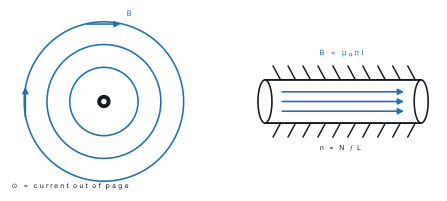
Right-hand grip rule for a wire. Grasp the wire with the right hand, thumb along the current; the curled fingers give the direction of the field circles. Reversing the current reverses the field.
15.1.2 The long straight wire
For a long straight wire carrying current I, the field at perpendicular distance r from the wire has magnitude
where \mu_0=4\pi\times10^{-7}\ \text{T m A}^{-1} is the permeability of free space. The field lines are concentric circles around the wire, in the plane perpendicular to it.
The formula follows from Ampère's circuital law, \oint \vec B\cdot d\vec l=\mu_0I: take a circular path of radius r round the wire. By symmetry B is the same all along it and parallel to d\vec l, so B(2\pi r)=\mu_0I.
Two proportionalities carry most of the marks: B\propto I and B\propto 1/r. Double the current and the field doubles; double the distance and it halves.
The 1/r fall-off is not the 1/r^2 of Coulomb's law. A wire is an extended source, and the contributions of its elements add to a 1/r field. Using 1/r^2 is the single commonest error in this section.
Force between two parallel wires. Wire 1 makes a field B_1=\mu_0I_1/2\pi d at wire 2. The force on a length L of wire 2 is F=B_1I_2L, so
The direction is the surprise: currents in the same direction attract; currents in opposite directions repel. This is the opposite of the rule for electric charges, and it is a favourite distractor.
Why? Take two parallel wires with current in the same direction. The field of wire 1 at wire 2 points perpendicular to both the wire and the line joining them; the force \vec F=I_2\vec L\times\vec B_1 then points towards wire 1. Reverse either current and the force reverses.
Problem. Two long parallel wires 20 cm apart carry 5 A and 8 A in the same direction. (a) Find the field produced by the 5 A wire at the position of the other. (b) Find the force per metre between them.
Solution. (a) B=\dfrac{\mu_0I}{2\pi r}=\dfrac{(4\pi\times10^{-7})(5)}{2\pi(0.20)} =5.0\times10^{-6}\ \text{T}.
(b) \dfrac{F}{L}=BI_2=(5.0\times10^{-6})(8)=4.0\times10^{-5}\ \text{N m}^{-1}, attractive because the currents are in the same direction.
15.1.3 The circular coil
At the centre of a circular coil of N turns, radius R, carrying current I,
Each element d\vec l of the coil is at the same distance R from the centre and its field there points along the axis, so the contributions simply add: the field of one turn is \mu_0I/2R, and N turns give N times as much.
On the axis, at distance x from the centre,
Setting x=0 recovers the centre value. Two limits are worth memorising:
| Position on the axis | Field | As a fraction of the centre field |
|---|---|---|
| x=0 (centre) | \mu_0NI/2R | 1 |
| x=R | \mu_0NI/(4\sqrt{2}\,R) | 1/(2\sqrt{2})=0.354 |
| x\gg R | \mu_0NIR^2/2x^3 | falls as 1/x^3 |
Far from the coil the field falls as 1/x^3, like a magnetic dipole, not as 1/x^2.
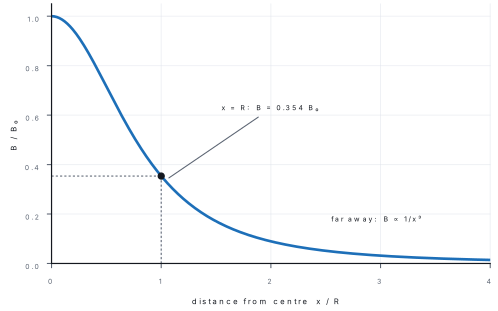
B=\mu_0NI/2R holds only at the centre. On the axis use the full (R^2+x^2)^{3/2} form. At x=R the field is not B/2 (that is the solenoid's end value) but B/(2\sqrt{2})\approx0.35B.
Problem. A coil of 100 turns and radius 10 cm carries 2 A. Find the field at its centre and at a point on its axis 20 cm from the centre.
Solution. Centre: B_0=\dfrac{(4\pi\times10^{-7})(100)(2)}{2(0.10)} =1.26\times10^{-3}\ \text{T}.
Axis: R^2+x^2=0.01+0.04=0.05\ \text{m}^2, so B=\dfrac{(4\pi\times10^{-7})(100)(2)(0.01)}{2(0.05)^{3/2}} =\dfrac{2.51\times10^{-6}}{0.0224}=1.1\times10^{-4}\ \text{T}.
The field has dropped by a factor of about 11 in only two radii — the 1/x^3 fall is steep.
15.1.4 The long solenoid
A solenoid is a long coil wound on a cylinder. If it has N turns over length L, the number of turns per unit length is n=N/L. Inside a long solenoid, well away from the ends,
The field inside is uniform — parallel straight lines of equal spacing — and the field outside is practically zero. At the two ends, on the axis, the field is half the interior value.
Apply Ampère's law to a rectangular loop with one side inside the solenoid parallel to the axis and one side far outside, where B\approx0: the only contribution is from the inside side, of length \ell, so B\ell=\mu_0(n\ell)I.
Note the difference from the coil: for a solenoid B depends on the turns per unit length n, not on the radius, and it does not fall off along the inside.
| Source | Formula | Where it holds | Direction |
|---|---|---|---|
| Long straight wire | B=\mu_0I/2\pi r | distance r\ll length | circles round the wire |
| Circular coil, centre | B=\mu_0NI/2R | at the centre only | along the axis |
| Circular coil, axis | B=\mu_0NIR^2/2(R^2+x^2)^{3/2} | any point on the axis | along the axis |
| Long solenoid | B=\mu_0nI | inside, away from the ends | along the axis |
| Solenoid end | B=\mu_0nI/2 | on the axis at the end | along the axis |
Problem. A solenoid 40 cm long has 800 turns and carries 3 A. Find the field at its centre and at one end on the axis.
Solution. n=N/L=800/0.40=2000\ \text{m}^{-1}.
B=\mu_0nI=(4\pi\times10^{-7})(2000)(3)=7.5\times10^{-3}\ \text{T} at the centre, and 3.8\times10^{-3}\ \text{T} at the end.
Write each formula once and then compare ratios. Wire: B\propto I/r. Coil centre: B\propto NI/R. Solenoid: B\propto NI/L. In an MCQ with two setups, the constants \mu_0 and \pi cancel, and the answer is a ratio of two or three numbers.
15.2 Force on a moving charge and on a current-carrying conductor; torque on a coil; Hall effect
15.2.1 Force on a moving charge
A charge q moving with velocity \vec v in a magnetic field \vec B experiences
where \theta is the angle between \vec v and \vec B. The direction is given by the right-hand rule for a positive charge (fingers from \vec v to \vec B, thumb gives \vec F); for an electron the force is opposite.
| Angle \theta | Force |
|---|---|
| 0^{\circ} or 180^{\circ} (along the field) | zero |
| 90^{\circ} (across the field) | maximum, qvB |
| any \theta | qvB\sin\theta |
Because \vec F is perpendicular to \vec v at every instant, the magnetic force does no work: W=\int\vec F\cdot d\vec s=0. The speed and the kinetic energy of the charge stay constant; only the direction of motion changes. This is why a magnetic field can bend a beam of electrons into a circle without speeding it up.
A common error is to draw \vec F along \vec B. It is perpendicular to both \vec v and \vec B. And a charge at rest, or moving exactly along the field, feels no magnetic force at all.
15.2.2 Circular and helical paths
If \vec v is perpendicular to a uniform \vec B, the force is always perpendicular to \vec v and has constant magnitude qvB: the path is a circle. The magnetic force supplies the centripetal force:
The period follows from T=2\pi r/v:
The period does not contain v or r. A faster particle travels a larger circle in the same time. This is the principle of the cyclotron, and it is the most examined single fact in this section.
If the velocity has a component v_\parallel along \vec B as well as v_\perp across it, the two motions add: a circle in the plane perpendicular to \vec B, plus constant motion along \vec B. The path is a helix (a corkscrew). Only the perpendicular component bends:
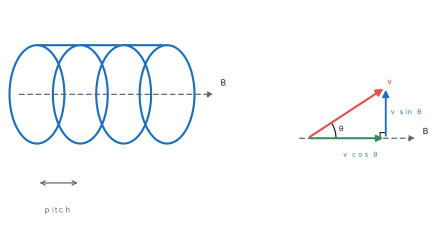
Problem. A proton (m=1.67\times10^{-27} kg, q=1.6\times10^{-19} C) moves at 1.0\times10^{6} m s⁻¹ perpendicular to a field of 0.50 T. Find the radius and the period of its path.
Solution. r=\dfrac{mv}{qB}=\dfrac{(1.67\times10^{-27})(10^{6})}{(1.6\times10^{-19})(0.50)} =2.1\times10^{-2}\ \text{m}.
T=\dfrac{2\pi m}{qB}=\dfrac{2\pi(1.67\times10^{-27})}{8.0\times10^{-20}} =1.3\times10^{-7}\ \text{s}.
Check: 2\pi r/T=2\pi(0.021)/(1.3\times10^{-7})\approx10^{6} m s⁻¹ ✓.
15.2.3 Force on a current-carrying conductor
A wire of length L carrying current I in a field \vec B feels
where \vec L points along the current. The force is greatest when the wire is perpendicular to the field and zero when it is parallel.
The formula is just F=qvB applied to all the drifting charges: if there are n per unit volume, each with drift speed v_d, the number in length L is nAL and the total force is (nAL)(ev_dB\sin\theta)=BIL\sin\theta, using I=nAev_d.
Problem. A straight wire 0.50 m long carries 4.0 A at 30° to a uniform field of 0.30 T. Find the force on it.
Solution. F=BIL\sin\theta=(0.30)(4.0)(0.50)\sin30^{\circ}=0.30\ \text{N}.
The component of the wire along the field (L\cos30^{\circ}) contributes nothing; only the perpendicular component matters.
15.2.4 Torque on a coil and the moving-coil galvanometer
A rectangular coil of N turns, area A, carrying current I in a uniform field \vec B behaves as a magnetic dipole of moment
The two sides perpendicular to the field carry current in opposite directions and feel equal and opposite forces, which form a couple. If \theta is the angle between \vec B and the normal to the coil,
Setting up. A rectangular coil of sides a and b, so A=ab, with N turns, carrying current I. The field \vec B lies in the plane of the page; the normal to the coil makes an angle \theta with \vec B.
Step 1 — which sides feel a force. The two sides of length a are perpendicular to \vec B, so each feels F=BIa per turn. The two sides of length b are parallel to \vec B, so they feel no force.
Step 2 — the forces form a couple. The two BIa forces are equal, opposite and not in the same line. Their perpendicular separation is b\sin\theta.
Step 3 — multiply force by separation.
Step 4 — allow for N turns. Each turn carries the same current, so the torques add:
Result. \tau=NIAB\sin\theta=MB\sin\theta, where M=NIA.
What it means. The torque is maximum when the plane of the coil is parallel to \vec B (normal perpendicular to \vec B, \theta=90^{\circ}) and zero when the plane is perpendicular to \vec B. A coil in a uniform field therefore rotates until its normal lies along the field — the position a compass needle takes.
NIAB\sin\theta uses \theta between \vec B and the normal. "The plane of the coil is parallel to the field" means \theta=90^{\circ} and the torque is maximum. Students who use the angle to the plane get every such question backwards.
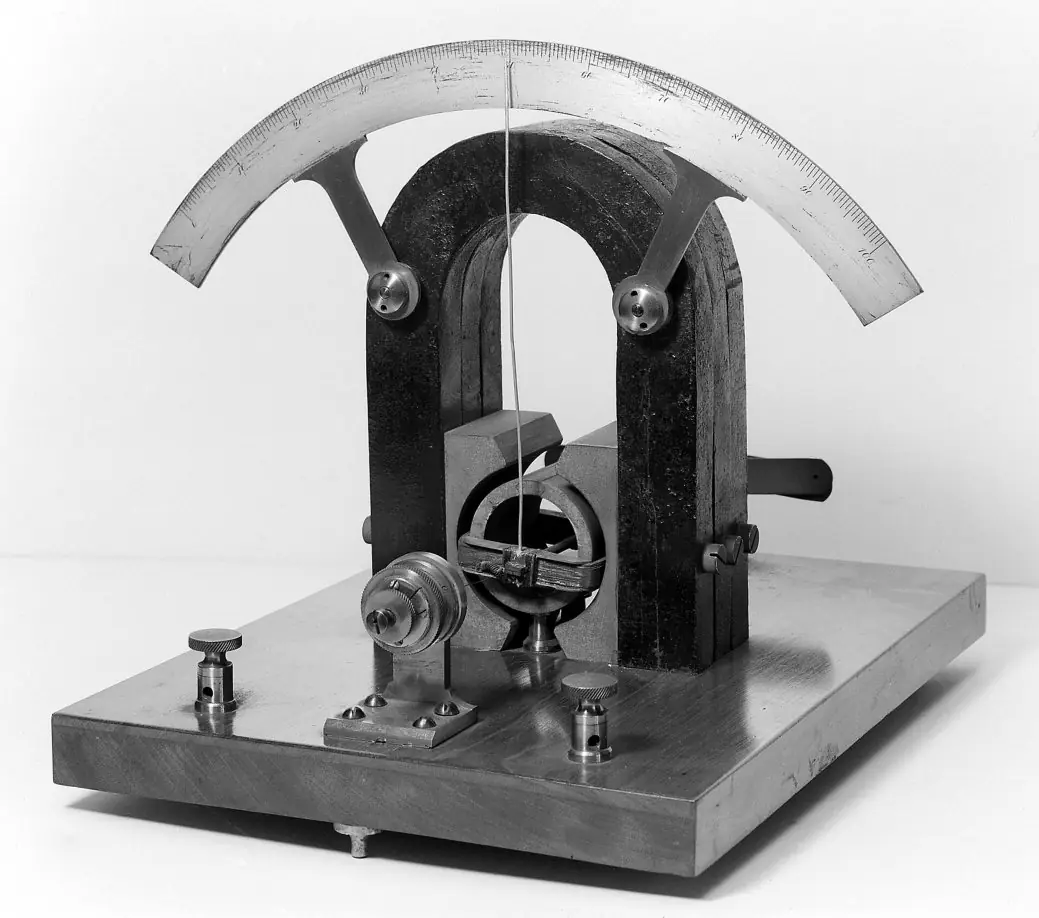
The moving-coil galvanometer. A small coil is suspended between the poles of a permanent magnet shaped so that the field is radial: at every coil position the plane of the coil is parallel to the field. Then \sin\theta=1 always, and
independent of the coil's angle. A hairspring provides a restoring torque \tau=k\phi, where \phi is the deflection. At equilibrium,
so the deflection is directly proportional to the current and the scale is linear.
| Quantity | Expression | Meaning |
|---|---|---|
| Current sensitivity | NAB/k | deflection per unit current (rad A⁻¹) |
| Voltage sensitivity | NAB/(kG) | deflection per unit voltage, G = coil resistance |
| Full-scale current | I_g=k\phi_{max}/NAB | the current that gives the largest reading |
The galvanometer is the parent instrument of the ammeter and the voltmeter (Chapter 14): a shunt in parallel makes an ammeter, a multiplier in series makes a voltmeter.
15.2.5 The Hall effect
Send a current I along a thin conducting strip of thickness t, with a magnetic field B perpendicular to the face of the strip. The charge carriers are pushed to one side by the magnetic force. Charge collects there until the transverse electric field E_H is strong enough to cancel the magnetic force. A Hall voltage V_H then appears across the width of the strip.
Setting up. A strip of thickness t and width d, current I along its length, field B perpendicular to its face. Carriers of charge q and drift speed v_d.
Step 1 — balance of forces at equilibrium. The magnetic force qv_dB sideways is balanced by the electric force qE_H from the piled-up charge:
Step 2 — convert field to voltage. The field is uniform across the width d, so
Step 3 — express v_d through the current. The current crosses the area dt, so I=nq\,v_d\,dt and v_d=\dfrac{I}{nqdt}.
Step 4 — substitute.
Result. V_H=\dfrac{BI}{net} for electrons (q=e).
What it means. The width d cancels: a thinner strip gives a larger Hall voltage, which is why Hall probes are made as thin films. A larger carrier density n gives a smaller voltage, so the effect is strong in semiconductors and weak in metals.
The sign of the Hall voltage. Reverse the reasoning and it becomes a test:
- If the carriers are negative (electrons), they drift opposite to the conventional current, and the magnetic force pushes them to one side, making that side negative.
- If the carriers are positive (holes), they drift along the current, and the same magnetic force pushes them to the same side, making that side positive.
The two cases give opposite polarity. So the sign of V_H tells you the sign of the charge carriers — the experiment that proved that current in a metal is carried by negative electrons.
The Hall coefficient is
Its magnitude gives the carrier density and its sign gives the carrier type. In a semiconductor, R_H is negative for an n-type and positive for a p-type sample.
| Use of the Hall effect | What it relies on |
|---|---|
| Identifying the carrier sign | polarity of V_H |
| Measuring carrier density | n=BI/(eV_Ht) |
| Hall probe magnetometer | V_H\propto B at fixed current |
| Multiplying (analogue computers) | V_H\propto IB |
V_H=BI/net: the voltage is inversely proportional to the thickness t and does not depend on the width. Doubling the thickness halves the Hall voltage. A distractor that offers "doubles" is testing exactly this.
Problem. A copper strip 0.10 mm thick carries 10 A in a field of 1.5 T perpendicular to its face. Taking n=8.5\times10^{28} m⁻³, find the Hall voltage.
Solution. V_H=\dfrac{BI}{net}=\dfrac{(1.5)(10)}{(8.5\times10^{28})(1.6\times10^{-19})(1.0\times10^{-4})} =\dfrac{15}{1.36\times10^{6}}=1.1\times10^{-5}\ \text{V}.
That is only 11 μV — measurable, but a reminder of why the effect is more useful in semiconductors, where n is a thousand times smaller and V_H a thousand times larger.
15.3 Dia-, para- and ferromagnetism: domains, relative permeability, susceptibility and hysteresis
15.3.1 Magnetisation, permeability and susceptibility
When a material is placed in a magnetic field, its atomic currents give it a magnetisation \vec M — the magnetic moment per unit volume (A m⁻¹). The applied field is described by \vec H=nI (A m⁻¹), and the field inside the material is
| Quantity | Symbol | Definition | Unit |
|---|---|---|---|
| Relative permeability | \mu_r | B/(\mu_0H)=\mu/\mu_0 | none |
| Susceptibility | \chi | M/H | none |
| Relation | \mu_r=1+\chi |
So a material with \chi=599 has \mu_r=600 and multiplies the field of a solenoid 600 times. Since \mu_r=1+\chi, a small negative \chi gives \mu_r just below 1.
15.3.2 The three classes of magnetic material
| Property | Diamagnetic | Paramagnetic | Ferromagnetic |
|---|---|---|---|
| Atomic dipoles | none; induced only | permanent, randomly oriented | permanent, in domains |
| \chi | small negative, about -10^{-5} | small positive, 10^{-5}–10^{-3} | large positive, 10^{2}–10^{5} |
| \mu_r | slightly less than 1 | slightly more than 1 | much greater than 1 |
| Temperature | independent of T | \chi=C/T (Curie's law) | \chi=C/(T-T_C) above T_C |
| In a non-uniform field | weakly repelled from the strong region | weakly attracted to the strong region | strongly attracted |
| Examples | Bi, Cu, Ag, Au, water, N₂, CO₂ | Al, Na, Pt, O₂, CuCl₂ | Fe, Co, Ni, Gd, alnico |
Diamagnetism arises in every material but is usually masked. The applied field changes the orbital motion of the electrons so that a small moment is induced opposite to the field — the atomic version of Lenz's law. There are no permanent dipoles, so thermal agitation has nothing to randomise and \chi hardly depends on temperature. A superconductor is a perfect diamagnet, with \chi=-1 and \mu_r=0: it expels the field completely (the Meissner effect).
Paramagnetism comes from atoms with a permanent magnetic moment. In zero field the moments point in all directions and cancel. A field aligns them partially, but thermal motion opposes the alignment, so the effect is weak and increases as the material is cooled: Curie's law, \chi=C/T.
Ferromagnetism is different in kind, not degree. The moments are not independent: they lock together in large regions called domains, so a modest field can produce a very large magnetisation. \chi can reach 10^{5}.
15.3.3 Domain theory
A ferromagnetic solid is divided into domains — regions of microscopic size (order 10^{-5} m, containing many thousands of atoms) in each of which the atomic moments are already perfectly aligned. The domains point along a few easy directions of the crystal.
- In an unmagnetised sample the domains point in random directions, so their moments cancel and the net magnetisation is zero.
- In an increasing field, domains whose moment is close to the field grow at the expense of the others (the domain walls move), and then the moments rotate into the field direction.
- At saturation the whole sample is one domain pointing along the field, and a further increase of H produces almost no increase in B.
The Curie point T_C is the temperature above which thermal agitation destroys the domain alignment. The material then becomes paramagnetic, with \chi=C/(T-T_C). Typical values: iron 770 °C, cobalt 1115 °C, nickel 358 °C. Heating a steel magnet above its Curie point and cooling it in zero field leaves it unmagnetised — the standard way to demagnetise a magnet.
A domain is a region of a crystal in which the moments are aligned; it is not a particle and it does not move through the material as a whole. Magnetisation proceeds by the growth of favourably oriented domains and by rotation of the moments, not by domains physically travelling.
15.3.4 Hysteresis
Plot B inside a ferromagnetic material against the applied field H as H is taken round a cycle. The curve does not retrace itself: it forms a hysteresis loop.
| Feature of the loop | Meaning |
|---|---|
| Saturation | the flat top, where all domains are aligned |
| Retentivity (remanence) B_r | the B left when H is reduced to zero — how strong a permanent magnet the material makes |
| Coercivity H_c | the reverse field needed to bring B back to zero — how hard the material is to demagnetise |
| Area of the loop | energy dissipated as heat per cycle per unit volume (J m⁻³) |
The area matters in machines. In a transformer core the material is taken round the loop 50 times a second, so the hysteresis power loss is
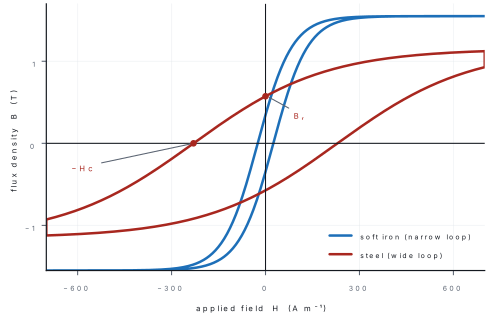
Soft iron versus steel. The choice of material is decided by the loop:
| Soft iron | Steel | |
|---|---|---|
| Loop | narrow, steep | wide |
| Retentivity B_r | small | large |
| Coercivity H_c | small | large |
| Permeability \mu_r | very high | moderate |
| Hysteresis loss | small | large |
| Best use | transformer cores, electromagnets, relays, generator armatures | permanent magnets, loudspeakers, magnetic chucks, memory devices |
A transformer core is magnetised and demagnetised 100 times a second (twice per cycle). Any area inside its loop is energy turned into heat, so the core must be soft: easy to magnetise, easy to demagnetise, narrow loop. A permanent magnet must keep its magnetisation after the field is removed and must resist demagnetising fields, so it must be hard: large retentivity and large coercivity — steel, and in practice alnico or ferrite.
Soft iron makes a strong temporary magnet and a poor permanent magnet; steel makes a weaker but lasting magnet. Exam questions often ask which is used where, and the answer follows from the loop, not from which material is "more magnetic".
Problem. A ferromagnetic sample has \mu_r=600 at a field H=200 A m⁻¹. Find B, M and \chi.
Solution. \chi=\mu_r-1=599.
B=\mu_0\mu_rH=(4\pi\times10^{-7})(600)(200)=1.51\times10^{-1}\ \text{T}.
M=\chi H=599(200)=1.20\times10^{5}\ \text{A m}^{-1}.
Check: \mu_0(H+M)=4\pi\times10^{-7}(200+1.2\times10^{5})=0.151 T ✓ — the magnetisation, not the applied field, supplies almost all of B.
Formula and fact sheet
| Topic | Formula or fact |
|---|---|
| Permeability of free space | \mu_0=4\pi\times10^{-7}\ \text{T m A}^{-1} |
| Straight wire | B=\mu_0I/2\pi r, circles round the wire, right-hand grip rule |
| Parallel wires | F/L=\mu_0I_1I_2/2\pi d; same direction attract, opposite repel |
| Coil, centre | B=\mu_0NI/2R |
| Coil, axis | B=\mu_0NIR^2/2(R^2+x^2)^{3/2}; at x=R, B=0.354B_0; far away B\propto1/x^3 |
| Solenoid | B=\mu_0nI=\mu_0NI/L inside; B/2 at the ends; B\approx0 outside |
| Magnetic force on a charge | F=qvB\sin\theta; perpendicular to \vec v; does no work |
| Circular path | r=mv/qB=p/qB; T=2\pi m/qB; f=qB/2\pi m |
| Helix | r=mv\sin\theta/qB; pitch =2\pi mv\cos\theta/qB |
| Force on a wire | F=BIL\sin\theta |
| Coil torque | \tau=NIAB\sin\theta=MB\sin\theta; M=NIA |
| Galvanometer | radial field gives \tau=NIAB; \phi=(NAB/k)I |
| Hall voltage | V_H=BI/net; R_H=1/nq=V_Ht/BI |
| Magnetic properties | \mu_r=\mu/\mu_0=1+\chi; \chi=M/H |
| Diamagnetic | \chi\approx-10^{-5}, \mu_r<1, repelled, T-independent (Bi, Cu, water) |
| Paramagnetic | \chi\approx10^{-5}–10^{-3}, \mu_r>1, attracted, \chi=C/T (Al, O₂) |
| Ferromagnetic | domains, \chi\gg1, Curie point, \chi=C/(T-T_C) above T_C (Fe, Co, Ni) |
| Curie points | Fe 770 °C, Co 1115 °C, Ni 358 °C |
| Hysteresis | B_r retentivity, H_c coercivity; loop area = energy per cycle per unit volume |
| Core versus magnet | soft iron: narrow loop, transformer cores; steel: wide loop, permanent magnets |
Chapter summary
- A long straight wire gives B=\mu_0I/2\pi r, with circular field lines; two parallel wires with currents in the same direction attract, with F/L=\mu_0I_1I_2/2\pi d.
- At the centre of a coil B=\mu_0NI/2R; on the axis B=\mu_0NIR^2/2(R^2+x^2)^{3/2}, which is 0.354 of the centre value at x=R and falls as 1/x^3 far away.
- Inside a long solenoid B=\mu_0nI is uniform, outside it is nearly zero, and at the ends it is half the interior value.
- The magnetic force F=qvB\sin\theta is perpendicular to \vec v and does no work, so speed and kinetic energy stay constant; r=mv/qB and T=2\pi m/qB, independent of speed. A velocity component along \vec B turns the circle into a helix of pitch v_\parallel T.
- A wire feels F=BIL\sin\theta; a coil feels \tau=NIAB\sin\theta, maximum when its plane is parallel to the field. A radial field makes a galvanometer's deflection proportional to current.
- The Hall voltage V_H=BI/net is inversely proportional to thickness, independent of width, and its polarity reveals whether the carriers are positive or negative.
- \mu_r=1+\chi. Diamagnets have a tiny negative \chi and are repelled; paramagnets a tiny positive \chi obeying \chi=C/T and are attracted; ferromagnets have domains and a very large \chi below the Curie point.
- The hysteresis loop gives retentivity (residual B), coercivity (field to erase B) and, through its area, the energy lost per cycle. Soft iron's narrow loop suits transformer cores; steel's wide loop suits permanent magnets.
Practice questions
Set A — Recall (28 questions)
- The SI unit of magnetic flux density isaweberbteslachenrydnewton per ampere
- The magnetic field at a perpendicular distance r from a long straight wire carrying current I isa\mu_0I/2\pi rb\mu_0I/2rc\mu_0I/4\pi r^2d\mu_0I/2\pi r^2
- The field at the centre of a circular coil of N turns, radius R, carrying current I isa\mu_0NI/Rb\mu_0NI/4Rc\mu_0NI/2\pi Rd\mu_0NI/2R
- Inside a long solenoid with n turns per metre carrying current I, the field isa\mu_0NIb\mu_0nI/2c\mu_0nId\mu_0I/2\pi n
- The permeability of free space isa4\pi\times10^{-7}\ \text{T m A}^{-1}b4\pi\times10^{-7}\ \text{T m}^2\text{A}^{-1}c8.85\times10^{-12}\ \text{F m}^{-1}d9\times10^{9}\ \text{N m}^2\text{C}^{-2}
- The magnetic force on a moving charge is zero when the angle between its velocity and the field isa90°b45°c0°d60°
- A charged particle moves in a circle of radius r in a uniform field B. Its radius isaqB/mvbmv/qBcmv^2/qBdqvB/m
- The force per unit length between two long parallel wires carrying currents I_1 and I_2 at separation d isa\mu_0I_1I_2/2\pi db\mu_0I_1I_2/4\pi dc\mu_0I_1I_2/2\pi d^2d\mu_0(I_1+I_2)/2\pi d
- Two long parallel wires carry currents in the same direction. Theyarepel each otherbexert no forcecrotate about each otherdattract each other
- The torque on a coil in a magnetic field is maximum when the plane of the coil isaperpendicular to the fieldbparallel to the fieldcat 45° to the fielddat 60° to the field
- The deflection of a moving-coil galvanometer is proportional to the current becauseathe radial field keeps the torque proportional to the currentbthe coil has a large moment of inertiacthe field is very strongdthe coil turns at constant speed
- The Hall voltage across a strip of thickness t carrying current I in field B isanet/IBbIBt/necIB/netdneIB/t
- The sign of the Hall voltage tells usathe magnitude of the currentbthe sign of the charge carrierscthe resistance of the materialdthe field strength only
- A material whose relative permeability is slightly less than 1 isaparamagneticbferromagneticcnon-magneticddiamagnetic
- The susceptibility of a ferromagnetic material isasmall and negativebsmall and positivecvery large and positivedexactly zero
- The relation between relative permeability and susceptibility isa\mu_r=1+\chib\mu_r=1-\chic\mu_r=\chid\mu_r=\chi-1
- Curie's law for a paramagnetic material states that its susceptibility isaproportional to Tbinversely proportional to Tcindependent of Tdproportional to T²
- Above the Curie point, a ferromagnetic material becomesadiamagneticbsuperconductingcan insulatordparamagnetic
- The area of a hysteresis loop representsathe retentivitybthe coercivitycthe energy lost per cycle per unit volumedthe saturation magnetisation
- Soft iron is preferred for transformer cores because it hasahigh retentivity and high coercivityba narrow loop and high permeabilityca large hysteresis lossdlow permeability
- Steel is preferred for permanent magnets because it hasalow retentivityblow coercivityca narrow hysteresis loopdhigh retentivity and high coercivity
- The field on the axis of a circular coil at distance x from the centre varies asa1/(R^2+x^2)^{3/2}b1/(R^2+x^2)c1/(R^2+x^2)^{1/2}d(R^2+x^2)^{3/2}
- At the end of a long solenoid, the field on the axis isaequal to the field at the centrebhalf the field at the centrectwice the field at the centredzero
- The magnetic force on a current-carrying conductor is greatest when the conductor isaparallel to the fieldbat 45° to the fieldcperpendicular to the fielddat 60° to the field
- The magnetic moment of a coil of N turns, area A and current I isaNIAbNI/AcNIA²dIA/N
- When a ferromagnetic material is heated above its Curie temperature, its domainsagrow largerbbecome perfectly alignedcreverse permanentlydare destroyed and it becomes paramagnetic
- Which of the following is diamagnetic?aironbaluminiumcbismuthdnickel
- The magnetic field lines inside a long solenoid areaconcentric circlesbparallel straight linescradialdcurved outwards
Answers and explanations — Set A
1. (b) — 1 T = 1 N A⁻¹ m⁻¹ = 1 Wb m⁻². The weber is the unit of flux, the henry of inductance.
2. (a) — Ampère's law round a circle of radius r gives B(2\pi r)=\mu_0I, so B=\mu_0I/2\pi r; the 1/r^2 forms belong to point charges.
3. (d) — each turn contributes \mu_0I/2R at the centre and N turns add, giving \mu_0NI/2R.
4. (c) — B=\mu_0nI with n the turns per metre; N alone is not enough without the length.
5. (a) — \mu_0=4\pi\times10^{-7} T m A⁻¹. (c) is \varepsilon_0 and (d) is 1/4\pi\varepsilon_0.
6. (c) — F=qvB\sin\theta vanishes when \theta=0^{\circ} (or 180°), i.e. when the velocity is along the field.
7. (b) — qvB=mv^2/r gives r=mv/qB. Option (a) is the reciprocal and (c) is dimensionally wrong.
8. (a) — B_1=\mu_0I_1/2\pi d at the second wire, and F/L=B_1I_2.
9. (d) — parallel currents attract. It is the opposite of the rule for like charges, which repel.
10. (b) — the torque is NIAB\sin\theta with \theta measured from the normal; the plane parallel to the field means the normal is perpendicular, so \sin\theta=1.
11. (a) — the radial field keeps \sin\theta=1, so \tau=NIAB whatever the coil's angle, and the spring gives \phi\propto I.
12. (c) — balancing qE_H=qv_dB and using I=ne v_d t d gives V_H=BI/net; the width cancels.
13. (b) — electrons and holes are deflected to the same side but have opposite charge, so the polarity of V_H reverses.
14. (d) — diamagnets have a small negative \chi, so \mu_r=1+\chi is just below 1.
15. (c) — domain alignment gives \chi of order 10^{2}–10^{5}, positive.
16. (a) — B=\mu_0(H+M) and M=\chi H give B=\mu_0(1+\chi)H, so \mu_r=1+\chi.
17. (b) — thermal agitation opposes alignment, so \chi=C/T: cooling a paramagnet strengthens its response.
18. (d) — above T_C the domains break up and the material behaves as a paramagnet with \chi=C/(T-T_C).
19. (c) — the area is the work done per unit volume per cycle, dissipated as heat.
20. (b) — a narrow loop means little hysteresis loss each cycle, and high permeability means a strong flux for a small current.
21. (d) — a large retentivity keeps the magnetism after magnetisation and a large coercivity resists demagnetisation.
22. (a) — B=\mu_0NIR^2/2(R^2+x^2)^{3/2}; the numerator is constant on the axis, so B\propto(R^2+x^2)^{-3/2}.
23. (b) — half the interior value: the field lines spread out at the end.
24. (c) — F=BIL\sin\theta is maximum at \theta=90^{\circ}.
25. (a) — M=NIA, in A m².
26. (d) — thermal energy overcomes the domain alignment; the material becomes paramagnetic.
27. (c) — bismuth is the standard diamagnetic example; iron and nickel are ferromagnetic and aluminium paramagnetic.
28. (b) — inside a long solenoid the field is uniform, with parallel straight lines.
Set B — Understanding (17 questions)
- Two long parallel wires carry currents in opposite directions. The force between them isaattractive, proportional to 1/dbattractive, proportional to 1/d²crepulsive, proportional to 1/ddrepulsive, proportional to 1/d²
- A charged particle enters a uniform field with its velocity perpendicular to the field. Which pair stays constant?aspeed and kinetic energybvelocity and momentumcspeed and momentumdkinetic energy and velocity
- The period of circular motion of a charge in a uniform magnetic field is independent ofathe chargebthe masscthe fielddthe speed
- A proton and an alpha particle enter the same field with the same speed, perpendicular to it. The ratio of their radii r_p:r_\alpha isa1 : 4b1 : 2c2 : 1d1 : 1
- A long straight vertical wire carries current upward. At a point due south of the wire, the field pointsaupwardbdownwardceastdwest
- The current in a circular coil is doubled and its radius is halved. The field at its centre becomesa4 timesb2 timescunchangeddhalf
- A charged particle moves with its velocity parallel to a uniform magnetic field. Its path isaa circleba parabolaca helixda straight line
- An electron moves at 30° to a uniform field and follows a helix. The pitch of the helix isa2\pi mv/qBb2\pi mv\cos30^{\circ}/qBc2\pi mv\sin30^{\circ}/qBdmv\cos30^{\circ}/qB
- A diamagnetic substance is placed in a strong non-uniform field. It movesafrom the stronger to the weaker partbfrom the weaker to the stronger partcnot at alldalong the field lines only
- A paramagnetic substance is placed in a magnetic field. Its atomic dipolesaare unaffectedbalign opposite to the fieldcalign along the field but are randomised by thermal motiondlock permanently along the field
- A material has relative permeability 1.0002. It isadiamagneticbparamagneticcferromagneticdnon-magnetic
- As the temperature rises above the Curie point, the susceptibility of a ferromagnetastays constantbrises without limitcbecomes large and negativedfalls, following a Curie–Weiss law
- The field at the centre of a circular coil is B. At a point on its axis at distance equal to the radius, the field isaB/2bB/4cB/(2\sqrt{2})dB/\sqrt{2}
- Two solenoids of the same length have turns in the ratio 1 : 2 and carry the same current. The ratio of their interior fields isa1 : 2b2 : 1c1 : 4d1 : 1
- A soft iron core inside a solenoid increases the field becauseait carries an extra currentbits domains align and add a large magnetisationcit reduces the currentdit makes the field non-uniform
- Hysteresis loss in a transformer core is reduced byaincreasing the frequencybincreasing the flux densitycusing steeldusing a soft magnetic material with a narrow loop
- The Hall voltage in a strip is zero whenathe current is perpendicular to the fieldbthe current is parallel to the fieldcthe material is a metaldthe field is strong
Answers and explanations — Set B
1. (c) — antiparallel currents repel, and the force per unit length falls as 1/d, not 1/d^2.
2. (a) — the magnetic force is always perpendicular to the velocity, so it does no work; the speed and kinetic energy are constant while the direction, and hence the velocity and momentum, change.
3. (d) — T=2\pi m/qB contains only mass, charge and field. A faster particle simply moves on a larger circle.
4. (b) — r=mv/qB, so r\propto m/q; the alpha particle has 4m and 2e, giving twice the radius.
5. (c) — with the current upward, the field circles anticlockwise seen from above. At a point due south of the wire the tangent points east.
6. (a) — B\propto I/R: doubling I doubles B and halving R doubles it again, so 4 times.
7. (d) — \sin\theta=0, so there is no magnetic force and the particle continues in a straight line at constant speed.
8. (b) — the pitch is v_\parallel T with v_\parallel=v\cos30^{\circ} and T=2\pi m/qB; the \sin form gives the radius instead.
9. (a) — a diamagnet is repelled, so it drifts towards the weaker part of the field.
10. (c) — the moments have a preferred direction along the field, but thermal agitation prevents complete alignment, which is why the effect is weak and temperature-dependent.
11. (b) — \chi=\mu_r-1=2\times10^{-4}, a small positive value: paramagnetic. A diamagnet would be just below 1.
12. (d) — above T_C the domains are gone and \chi=C/(T-T_C) decreases as T rises.
13. (c) — put x=R: B=B_0/(1+1)^{3/2}=B_0/(2\sqrt{2})=0.354B_0. B/2 is the solenoid-end value, not this one.
14. (a) — B=\mu_0NI/L with the same L, so B\propto N: 1 : 2.
15. (b) — the iron becomes magnetised; its aligned domains add \mu_0M to \mu_0H, multiplying the field by \mu_r.
16. (d) — the loss per cycle is the loop area, so a narrow loop in a soft material is what matters; frequency and flux density make it worse, and steel's loop is wide.
17. (b) — the magnetic force qvB\sin\theta is zero when the drift velocity (along the current) is parallel to the field, so no charge is pushed sideways.
Set C — Application (11 questions)
- A long straight wire carries 10 A. The field at a point 5 cm from the wire isa2\times10^{-5} Tb4\times10^{-5} Tc4\times10^{-7} Td8\times10^{-5} T
- A circular coil of 50 turns and radius 10 cm carries 2 A. The field at its centre isa6.3\times10^{-5} Tb1.3\times10^{-3} Tc6.3\times10^{-4} Td3.1\times10^{-4} T
- A solenoid 0.50 m long has 500 turns and carries 2 A. The field inside it isa2.5\times10^{-3} Tb5.0\times10^{-3} Tc2.5\times10^{-4} Td1.3\times10^{-3} T
- An electron (m=9.1\times10^{-31} kg) moves at 2\times10^{6} m s⁻¹ perpendicular to a field of 0.5 T. The radius of its path isa4.6\times10^{-5} mb1.1\times10^{-5} mc2.3\times10^{-4} md2.3\times10^{-5} m
- A wire 0.20 m long carrying 5 A lies perpendicular to a field of 0.40 T. The force on it isa0.20 Nb0.40 Nc4.0 Nd0.04 N
- A coil of 100 turns and area 2\times10^{-3} m² carries 0.5 A. Its plane is parallel to a field of 0.20 T. The torque on it isa0.20 N mb2\times10^{-3} N mc2\times10^{-2} N md2\times10^{-4} N m
- A silver strip 0.10 mm thick carries 2 A in a field of 1.5 T. Taking n=5.9\times10^{28} m⁻³, the Hall voltage isa3.2\times10^{-6} Vb3.2\times10^{-5} Vc6.4\times10^{-6} Vd1.6\times10^{-6} V
- A magnetic material has susceptibility 599. Its relative permeability isa599b0.998c60d600
- A solenoid with an air core has a field of 2.0\times10^{-3} T. With a core of relative permeability 500, the field becomesa4.0\times10^{-6} Tb2.0\times10^{-3} Tc1.0 Td0.50 T
- Two long parallel wires 10 cm apart carry 5 A and 10 A in the same direction. The force per metre between them isa5\times10^{-5} N m⁻¹b1\times10^{-4} N m⁻¹c2\times10^{-4} N m⁻¹d1\times10^{-5} N m⁻¹
- A proton moves in a circle of radius 0.10 m in a field of 0.20 T. Its speed isa1.9\times10^{6} m s⁻¹b3.8\times10^{6} m s⁻¹c9.6\times10^{5} m s⁻¹d1.9\times10^{5} m s⁻¹
Answers and explanations — Set C
1. (b) — B=\dfrac{\mu_0I}{2\pi r}=\dfrac{(4\pi\times10^{-7})(10)}{2\pi(0.05)}=4.0\times10^{-5} T. Option (a) forgets the factor 2 in the denominator.
2. (c) — B=\dfrac{\mu_0NI}{2R}=\dfrac{(4\pi\times10^{-7})(50)(2)}{2(0.10)}=6.3\times10^{-4} T. Option (d) halves it again by using R instead of 2R.
3. (a) — n=N/L=500/0.50=1000 m⁻¹, so B=\mu_0nI=(4\pi\times10^{-7})(1000)(2)=2.5\times10^{-3} T. Option (b) uses 500 m⁻¹ without dividing by the length.
4. (d) — r=\dfrac{mv}{qB}=\dfrac{(9.1\times10^{-31})(2\times10^{6})}{(1.6\times10^{-19})(0.5)}=2.3\times10^{-5} m.
5. (b) — F=BIL=(0.40)(5)(0.20)=0.40 N, since \sin90^{\circ}=1.
6. (c) — the plane is parallel to the field, so \theta=90^{\circ} and \tau=NIAB=(100)(0.5)(2\times10^{-3})(0.20)=2\times10^{-2} N m. Option (b) forgets a factor of 10.
7. (a) — V_H=\dfrac{BI}{net}=\dfrac{(1.5)(2)}{(5.9\times10^{28})(1.6\times10^{-19})(10^{-4})}=3.2\times10^{-6} V.
8. (d) — \mu_r=1+\chi=1+599=600. Option (a) confuses \chi with \mu_r.
9. (c) — B'=\mu_rB=500(2.0\times10^{-3})=1.0 T; the core multiplies the field, it does not divide it.
10. (b) — \dfrac{F}{L}=\dfrac{\mu_0I_1I_2}{2\pi d}=\dfrac{(4\pi\times10^{-7})(50)}{2\pi(0.10)}=1.0\times10^{-4} N m⁻¹, attractive.
11. (a) — v=\dfrac{qBr}{m}=\dfrac{(1.6\times10^{-19})(0.20)(0.10)}{1.67\times10^{-27}}=1.9\times10^{6} m s⁻¹. Option (b) doubles it by using the diameter.