Question bank · 64 min read
Physics: Unit-wise Objective Question Bank
Group A of the NEB Grade 11 Physics paper is eleven one-mark multiple-choice questions — eleven marks, and the only eleven marks in the paper you can secure in under fifteen minutes. This chapter drills all twenty-six syllabus units in order. Each section opens with a high-yield facts table (the constants and formulae the objective questions keep returning to), then gives eight MCQs, then an answer key in which every answer carries a one-line reason and, where a wrong option encodes a real misconception, names it.
Almost nothing in Group A is a long calculation. It tests four things: a definition, a unit or dimension, a direct substitution into one formula, or a misconception deliberately offered as a distractor. If an MCQ is taking you more than ninety seconds, you have misread it.
Coaching sites circulate lists labelled "NEB 2078", "NEB 2081" and so on, but NEB does not publish its Grade 11 question papers, and we could not verify a single item against an official released paper. Rather than print a year we cannot stand behind, we print none. What we can stand behind is the syllabus weighting, which is public, and every question below is built from it. Treat this as a bank of exam-shaped questions, not a leaked paper.
2.1 Physical Quantities
| High-yield fact | Value / form |
|---|---|
| Force | [MLT^{-2}], newton |
| Work, energy, torque | [ML^{2}T^{-2}] |
| Power | [ML^{2}T^{-3}], watt |
| Pressure, stress, all elastic moduli, energy density | [ML^{-1}T^{-2}], pascal |
| Planck constant, angular momentum | [ML^{2}T^{-1}] |
| Gravitational constant G | [M^{-1}L^{3}T^{-2}] |
| Dimensionless quantities | strain, refractive index, relative density, angle, \mu, Poisson's ratio, dielectric constant |
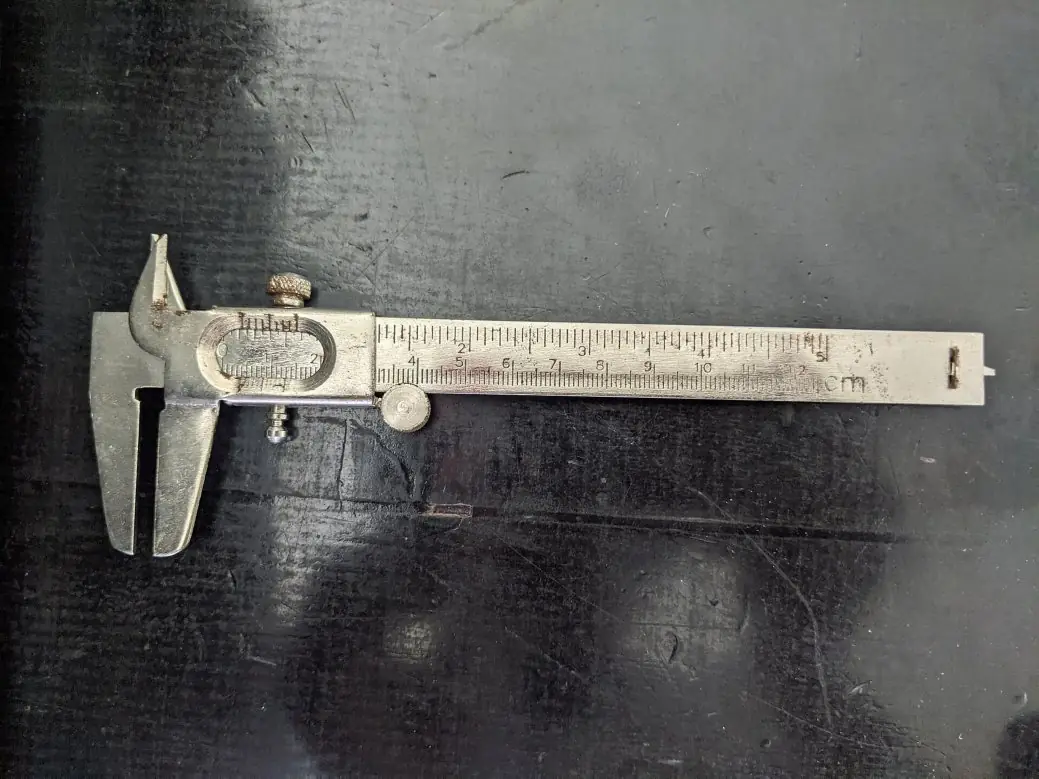
| Vernier least count | \text{L.C.} = 1\ \text{MSD} - 1\ \text{VSD} |
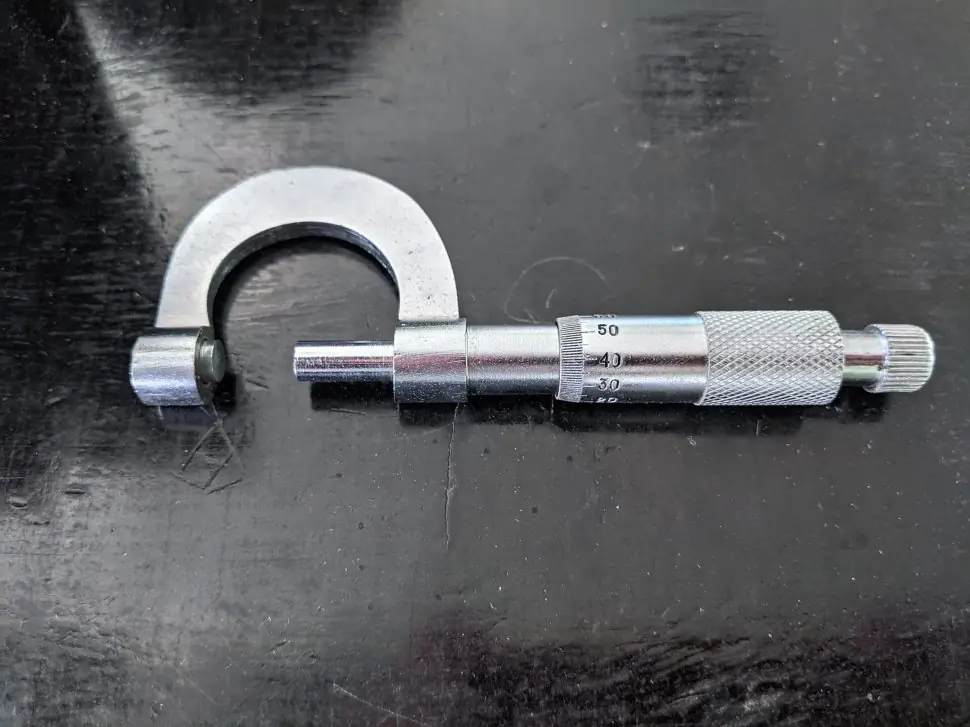
| Screw gauge least count | pitch \div number of circular-scale divisions |
| Error in Z = A^{p}B^{q}/C^{r} | \frac{\Delta Z}{Z} = p\frac{\Delta A}{A} + q\frac{\Delta B}{B} + r\frac{\Delta C}{C} |
- The dimensional formula of the universal gravitational constant G is [1]a[M^{-1}L^{3}T^{-2}]b[ML^{3}T^{-2}]c[M^{-1}L^{2}T^{-2}]d[ML^{2}T^{-2}]
- Which pair does not have the same dimensions? [1]awork and torquebimpulse and momentumcstress and pressuredforce and power
- The number of significant figures in 0.002340 is [1]a7b6c4d3
- Ten divisions of a vernier scale coincide with nine divisions of the main scale, and 1\ \text{MSD} = 1\ \text{mm}. The least count is [1]a0.1\ \text{mm}b0.01\ \text{mm}c1\ \text{mm}d0.05\ \text{mm}
- Which quantity is dimensionless yet is given a unit? [1]aplane anglebstraincrefractive indexdrelative density
- Dimensional analysis cannot be used to find [1]awhether an equation is dimensionally correctbthe value of a dimensionless constantcthe conversion factor between two systems of unitsdthe dimensions of a derived quantity
- If Z = A^{2}B^{3}/C and the percentage errors in A, B and C are 1\%, 2\% and 3\%, the percentage error in Z is [1]a6\%b8\%c10\%d11\%
- The dimensional formula [ML^{-1}T^{-2}] belongs to [1]asurface tensionbpressurecforce constantdlinear momentum
Answers — 2.1
1. (a) — from F = Gm_1m_2/r^2, G = Fr^2/m^2 gives [MLT^{-2}][L^2][M^{-2}] = [M^{-1}L^{3}T^{-2}].
2. (d) — force is [MLT^{-2}], power is [ML^{2}T^{-3}]. Distractor (a) tempts students who think "torque is not energy so its dimensions must differ"; they are identical, only the physical meaning differs.
3. (c) — leading zeros are never significant, the trailing zero after the decimal point is; so 2, 3, 4, 0 = four.
4. (a) — 10\ \text{VSD} = 9\ \text{MSD}, so 1\ \text{VSD} = 0.9\ \text{mm} and \text{L.C.} = 1 - 0.9 = 0.1\ \text{mm}. Option (b) is the screw-gauge least count, quoted from memory.
5. (a) — angle is length/length, so dimensionless, but SI still names the radian for it.
6. (b) — the method matches powers of M, L, T; a pure number carries none, so it survives undetermined.
7. (d) — 2(1) + 3(2) + 1(3) = 11\%. Option (a) comes from adding the errors without their powers; (c) from forgetting the C term.
8. (b) — pressure is force per area. Surface tension and force constant are both [MT^{-2}], momentum is [MLT^{-1}].
2.2 Vectors
| High-yield fact | Value / form |
|---|---|
| Resultant (parallelogram law) | R = \sqrt{P^{2}+Q^{2}+2PQ\cos\theta} |
| Direction of resultant | \tan\alpha = \dfrac{Q\sin\theta}{P+Q\cos\theta} |
| Maximum, minimum resultant | P+Q at \theta = 0^{\circ}; |P-Q| at \theta = 180^{\circ} |
| Scalar product | \vec A\cdot\vec B = AB\cos\theta — a scalar |
| Vector product | |\vec A\times\vec B| = AB\sin\theta — a vector, \perp to both |
| Unit-vector rules | \hat i\cdot\hat i = 1, \hat i\times\hat i = 0, \hat i\times\hat j = \hat k |
| Resolution | A_x = A\cos\theta, A_y = A\sin\theta |
- Two equal vectors of magnitude P act at 120^{\circ} to each other. Their resultant has magnitude [1]a2PbP\sqrt{3}cPdzero
- Forces of 3\ \text{N} and 4\ \text{N} act at right angles. The resultant is [1]a1\ \text{N}b5\ \text{N}c7\ \text{N}d12\ \text{N}
- The minimum number of coplanar vectors of unequal magnitude whose resultant can be zero is [1]a2b3c4d5
- If \vec A\cdot\vec B = 0 and neither vector is zero, the angle between them is [1]a0^{\circ}b45^{\circ}c90^{\circ}d180^{\circ}
- \hat i\times\hat j is equal to [1]a0b1c\hat kd-\hat k
- The vector product of two parallel vectors is [1]amaximumbzerocunitydinfinite
- A vector of magnitude 10 units makes 60^{\circ} with the x-axis. Its x-component is [1]a5 unitsb5\sqrt{3} unitsc10 unitsd8.66 units
- Which of the following is a scalar quantity? [1]atorquebimpulsecworkdangular velocity
Answers — 2.2
1. (c) — R = \sqrt{P^2+P^2+2P^2\cos120^{\circ}} = \sqrt{2P^2-P^2} = P. Option (a) is the answer for 0^{\circ}; students who forget that \cos120^{\circ} is negative pick it.
2. (b) — \sqrt{3^2+4^2}=5. Option (c) adds the magnitudes, the commonest vector error of all.
3. (b) — two unequal vectors can never cancel; three can, if they close a triangle.
4. (c) — AB\cos\theta = 0 with A,B \ne 0 forces \cos\theta = 0.
5. (c) — right-hand rule, in cyclic order \hat i\to\hat j\to\hat k. Option (d) is \hat j\times\hat i, the order reversed.
6. (b) — \sin 0^{\circ} = 0. Option (a) is true of the scalar product; that swap is the classic confusion.
7. (a) — A_x = 10\cos60^{\circ} = 5. Option (d) is 10\sin60^{\circ}, sine and cosine swapped.
8. (c) — work is \vec F\cdot\vec s, a scalar product. The other three are vectors.
2.3 Kinematics
| High-yield fact | Value / form |
|---|---|
| Equations of motion | v = u+at, s = ut+\tfrac12at^{2}, v^{2} = u^{2}+2as |
| Distance in the n^{\text{th}} second | s_n = u + \dfrac{a}{2}(2n-1) — a distance, unit metre |
| Slope and area | x–t slope = v; v–t slope = a, v–t area = s |
| Projectile | T = \dfrac{2u\sin\theta}{g}, H = \dfrac{u^{2}\sin^{2}\theta}{2g}, R = \dfrac{u^{2}\sin2\theta}{g} |
| Maximum range | R_{\max} = u^{2}/g at \theta = 45^{\circ}; \theta and 90^{\circ}-\theta give equal range |
| Speed at the top | u\cos\theta, not zero |
| Horizontal projection | t = \sqrt{2h/g}, independent of u |
| Relative velocity | \vec v_{AB} = \vec v_A - \vec v_B |
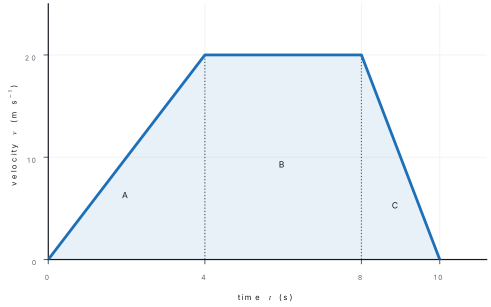
- From the velocity–time graph above, the total displacement of the body in 10\ \text{s} is [1]a100\ \text{m}b120\ \text{m}c140\ \text{m}d200\ \text{m}
- The area under an acceleration–time graph gives [1]adisplacementbchange in velocitycaverage velocitydjerk
- At the highest point of its trajectory, the velocity of a projectile is [1]azerobvertical and equal to u\sin\thetachorizontal and equal to u\cos\thetadequal to u
- A stone is dropped from a height and another is thrown horizontally from the same height at the same instant. They [1]areach the ground togetherbthe dropped one lands firstcthe thrown one lands firstdit depends on the mass
- For a freely falling body starting from rest, the distances covered in the first, second and third seconds are in the ratio [1]a1:2:3b1:3:5c1:4:9d1:1:1
- Two cars move towards each other at 10\ \text{m s}^{-1} and 20\ \text{m s}^{-1}. The speed of one relative to the other is [1]a10\ \text{m s}^{-1}b15\ \text{m s}^{-1}c30\ \text{m s}^{-1}d200\ \text{m s}^{-1}
- A body is projected with speed u at 30^{\circ}. Another has the same range with the same speed at [1]a45^{\circ}b60^{\circ}c75^{\circ}d120^{\circ}
- The quantity s_n = u + \frac{a}{2}(2n-1) has the SI unit [1]a\text{m s}^{-1}b\text{m s}^{-2}c\text{m}d\text{m s}
Answers — 2.3
1. (c) — triangle A = \tfrac12(4)(20) = 40, rectangle B = 4\times20 = 80, triangle C = \tfrac12(2)(20) = 20; total 140\ \text{m}. Option (d) is 20\times10, the area of the whole rectangle — the error of treating a varying velocity as constant.
2. (b) — area = \int a\,dt = \Delta v. Option (a) is the area under a velocity–time graph; mixing the two graphs up is the standard slip.
3. (c) — only the vertical component vanishes.
4. (a) — vertical motion is identical and independent of the horizontal motion; t = \sqrt{2h/g} contains no u.
5. (b) — s_n \propto (2n-1), giving 1:3:5. Option (c) is the ratio of total distances after 1, 2, 3 s.
6. (c) — opposite directions, so v_{AB} = 10-(-20) = 30\ \text{m s}^{-1}. Option (a) subtracts the speeds, which is right only for the same direction.
7. (b) — complementary angles give equal range, and 90^{\circ}-30^{\circ} = 60^{\circ}.
8. (c) — it is the distance travelled during one particular second, so a metre. The "per second" in the wording tempts (a).
Problem. A ball thrown at 20\ \text{m s}^{-1} at 30^{\circ} (g = 10\ \text{m s}^{-2}) has range (a) 20\ \text{m} (b) 34.6\ \text{m} (c) 40\ \text{m} (d) 10\ \text{m}.
Solution. Do not compute components. Go straight to R = u^{2}\sin2\theta/g with 2\theta = 60^{\circ}:
Answer (b). Option (c) is u^{2}/g, the maximum range — offered to anyone who reaches for 45^{\circ} out of habit.
2.4 Dynamics
| High-yield fact | Value / form |
|---|---|
| Newton's second law | \vec F = \dfrac{d\vec p}{dt} = m\vec a |
| Impulse | \vec J = \vec F_{av}\Delta t = m\vec v - m\vec u, unit N s = kg m s⁻¹ |
| Conservation of momentum | m_1u_1+m_2u_2 = m_1v_1+m_2v_2 (no external force) |
| Torque | \tau = F\,d_\perp = rF\sin\theta, unit N m |
| Friction | \mu_s = f_{lim}/N, \mu_k = f_k/N, and \mu_k < \mu_s |
| Angle of repose | \mu_s = \tan\theta — equals the angle of friction \lambda |
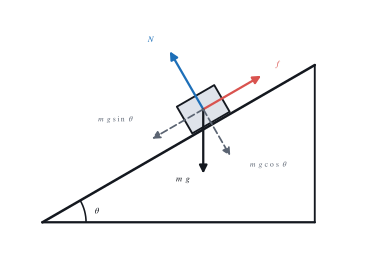
| Body on a smooth incline | a = g\sin\theta, N = mg\cos\theta |
| Lift | apparent weight = m(g+a) going up, m(g-a) going down |
- Newton's second law of motion in its most general form is [1]aF = mvbF = dp/dtcF = ma onlydF = mg
- The SI unit of impulse is the same as that of [1]aforcebenergyclinear momentumdpower
- A rocket moves forward because [1]athe exhaust gases push against the airbof conservation of linear momentumcof the buoyancy of the gasesdthe Earth attracts it less
- A body of mass 2\ \text{kg} at rest is acted on by a force of 10\ \text{N} for 3\ \text{s}. The impulse is [1]a6\ \text{N s}b15\ \text{N s}c30\ \text{N s}d60\ \text{N s}
- In the free-body diagram above, the block is on the point of sliding. The coefficient of static friction is [1]a\sin\thetab\cos\thetac\tan\thetad1/\tan\theta
- Which statement about action and reaction is correct? [1]athey act on the same body and cancelbthey act on different bodies and never cancelcthe action is always largerdthey act at different instants
- A man of mass 60\ \text{kg} stands in a lift accelerating upwards at 2\ \text{m s}^{-2} (g = 10\ \text{m s}^{-2}). The reading of the weighing machine is [1]a480\ \text{N}b600\ \text{N}c720\ \text{N}d120\ \text{N}
- The coefficient of kinetic friction is [1]agreater than the coefficient of static frictionbequal to itcless than itdalways equal to 1
Answers — 2.4
1. (b) — F = ma follows from F = dp/dt only when the mass is constant, which fails for a rocket.
2. (c) — impulse is the change in momentum, so N s = kg m s⁻¹. Option (a) tempts students who read "impulse" as "a big force".
3. (b) — the gas carries momentum backwards, so the rocket carries an equal momentum forwards. Option (a) is the classic error: a rocket works in vacuum, where there is nothing to push against.
4. (c) — J = F\Delta t = 10\times3 = 30\ \text{N s}.
5. (c) — on the point of sliding, f = \mu N, with f = mg\sin\theta and N = mg\cos\theta, so \mu = \tan\theta. This is the angle of repose.
6. (b) — they are equal and opposite but act on different bodies, so they can never be added together to cancel.
7. (c) — N = m(g+a) = 60(12) = 720\ \text{N}. Option (b) is the true weight, chosen by anyone who forgets the lift is accelerating; the machine reads the normal reaction, not the weight.
8. (c) — it always takes a larger force to start sliding than to keep it going.
2.5 Work, energy and power
| High-yield fact | Value / form |
|---|---|
| Work | W = Fs\cos\theta = \vec F\cdot\vec s; variable force W = \int F\,dx |
| Power | P = W/t = \vec F\cdot\vec v; 1\ \text{hp} = 746\ \text{W} |
| Work–energy theorem | W_{net} = \Delta K |
| Kinetic energy | K = \tfrac12mv^{2} = \dfrac{p^{2}}{2m}, so p = \sqrt{2mK} |
| Spring | W = \tfrac12kx^{2} |
| 1\ \text{kW h} | 3.6\times10^{6}\ \text{J} — a unit of energy |
| Elastic collision | momentum and kinetic energy conserved; equal masses exchange velocities |
| Perfectly inelastic | v = \dfrac{m_1u_1+m_2u_2}{m_1+m_2}; KE is lost, momentum is not |
- The work done by the centripetal force on a body in uniform circular motion is [1]amaximumbzerocnegativedequal to mv^{2}/r
- One kilowatt-hour is equal to [1]a1000\ \text{J}b3600\ \text{J}c3.6\times10^{6}\ \text{J}d3.6\times10^{3}\ \text{W}
- If the momentum of a body is doubled, its kinetic energy becomes [1]ahalfbdoublecfour timesdunchanged
- In a perfectly elastic head-on collision between two bodies of equal mass, one at rest, [1]aboth move togetherbthey exchange velocitiescboth stopdthe moving one rebounds
- The work done by a conservative force around any closed path is [1]aalways positivebalways negativeczerodequal to the kinetic energy
- A man of mass 60\ \text{kg} climbs a 5\ \text{m} staircase in 10\ \text{s} (g = 10\ \text{m s}^{-2}). His power output is [1]a30\ \text{W}b300\ \text{W}c3000\ \text{W}d600\ \text{W}
- In an inelastic collision, the quantity that is not conserved is [1]alinear momentumbtotal energyckinetic energydmass
- A body of mass m and kinetic energy K has linear momentum [1]a\sqrt{2mK}b2mKc\sqrt{mK}dmK^{2}
Answers — 2.5
1. (b) — the force is always perpendicular to the velocity, so \cos90^{\circ} = 0. Option (d) is the magnitude of the force, offered to anyone who reads "work" and reaches for the nearest formula.
2. (c) — 1000\ \text{W}\times3600\ \text{s}. Option (d) is the trap: kW h is energy, not power.
3. (c) — K = p^{2}/2m, so K \propto p^{2}. Option (b) comes from assuming K \propto p.
4. (b) — put m_1 = m_2 and u_2 = 0 in the elastic-collision result: v_1 = 0, v_2 = u_1. Option (a) describes a perfectly inelastic collision.
5. (c) — that is the definition of a conservative force.
6. (b) — W = mgh = 60\times10\times5 = 3000\ \text{J}, so P = 3000/10 = 300\ \text{W}. Option (c) is the work, not the power.
7. (c) — momentum and total energy always survive; the missing kinetic energy has become heat, sound and deformation.
8. (a) — invert K = p^2/2m.
2.6 Circular Motion
| High-yield fact | Value / form |
|---|---|
| Angular relations | v = r\omega, a_t = r\alpha, \omega = 2\pi/T = 2\pi f |
| Centripetal acceleration | a_c = v^{2}/r = r\omega^{2} |
| Centripetal force | F_c = mv^{2}/r = mr\omega^{2} |
| Conical pendulum | \tan\theta = v^{2}/rg; T_p = 2\pi\sqrt{h/g} |
| Vertical circle | v_{top}^{\min} = \sqrt{gr}, v_{bottom}^{\min} = \sqrt{5gr}, T_2 - T_1 = 6mg |
| Banking | \tan\theta = v^{2}/rg; level road v_{\max} = \sqrt{\mu rg} |
| 1\ \text{rpm} | 2\pi/60\ \text{rad s}^{-1} |
- In uniform circular motion, which quantity stays constant? [1]avelocitybspeedcaccelerationdmomentum
- The minimum speed at the highest point of a vertical circle of radius r is [1]a\sqrt{gr}b\sqrt{2gr}c\sqrt{5gr}dzero
- The difference between the tensions at the lowest and the highest point of a vertical circle is [1]a2mgb3mgc5mgd6mg
- A body completes 60 revolutions per minute. Its angular velocity is [1]a\pi\ \text{rad s}^{-1}b2\pi\ \text{rad s}^{-1}c60\ \text{rad s}^{-1}d120\pi\ \text{rad s}^{-1}
- The angle of banking of a road of radius r for a design speed v is given by [1]a\tan\theta = rg/v^{2}b\tan\theta = v^{2}/rgc\sin\theta = v^{2}/rgd\tan\theta = v/rg
- The period of a conical pendulum of vertical depth h is [1]a2\pi\sqrt{L/g}b2\pi\sqrt{h/g}c2\pi\sqrt{g/h}d2\pi\sqrt{L\cos\theta/h}
- Centrifugal force is [1]athe reaction to the centripetal forceba pseudo-force that appears only in a rotating framecalways greater than the centripetal forceddirected towards the centre
- A stone of mass 0.5\ \text{kg} moves in a circle of radius 2\ \text{m} at 4\ \text{m s}^{-1}. The centripetal force is [1]a1\ \text{N}b2\ \text{N}c4\ \text{N}d8\ \text{N}
Answers — 2.6
1. (b) — the direction of velocity changes continuously, so velocity, acceleration and momentum all change; only the magnitude of the velocity is fixed.
2. (a) — at the top, gravity alone supplies the centripetal force when the string goes slack: mg = mv^2/r.
3. (d) — subtracting the two force equations and using v_2^2 = v_1^2 + 4gr gives 6mg, independent of the speed.
4. (b) — 60\ \text{rpm} = 1\ \text{rev s}^{-1} = 2\pi\ \text{rad s}^{-1}. Option (c) is the trap: rpm read straight off as rad s⁻¹.
5. (b) — from N\sin\theta = mv^2/r and N\cos\theta = mg.
6. (b) — T_p = 2\pi\sqrt{L\cos\theta/g}, and L\cos\theta is exactly the depth h below the support.
7. (b) — it is not a real force and has no reaction partner. Option (a) is the commonest wrong answer: the reaction to the centripetal force acts on a different body.
8. (c) — F = mv^2/r = 0.5\times16/2 = 4\ \text{N}.
2.7 Gravitation
| High-yield fact | Value / form |
|---|---|
| G | 6.67\times10^{-11}\ \text{N m}^{2}\text{kg}^{-2} |
| Surface value | g = GM/R^{2}, so M = gR^{2}/G |
| Altitude, depth | g_h = g\left(1-\dfrac{2h}{R}\right) for h\ll R; g_d = g\left(1-\dfrac{d}{R}\right), zero at the centre |
| Potential, potential energy | V = -GM/r (J kg⁻¹), U = -GMm/r |
| Orbital speed | v_o = \sqrt{GM/(R+h)} |
| Escape velocity | v_e = \sqrt{2GM/R} = \sqrt{2gR} = \sqrt{2}\,v_o = 11.2\ \text{km s}^{-1} |
| Satellite energy | K = +\dfrac{GMm}{2r}, U = -\dfrac{GMm}{r}, E = -\dfrac{GMm}{2r} |
| Geostationary satellite | T = 24\ \text{h}, h \approx 36\,000\ \text{km}, equatorial, west to east |
- The value of g at the centre of the Earth is [1]amaximumbequal to the surface valueczerodinfinite
- The escape velocity from the surface of the Earth is approximately [1]a8\ \text{km s}^{-1}b11.2\ \text{km s}^{-1}c22.4\ \text{km s}^{-1}d3\times10^{8}\ \text{m s}^{-1}
- The escape velocity and the orbital velocity close to the Earth's surface are related by [1]av_e = v_obv_e = 2v_ocv_e = \sqrt{2}\,v_odv_e = v_o/\sqrt{2}
- An astronaut inside an orbiting satellite feels weightless because [1]athere is no gravity at that heightbthe astronaut and the satellite are in free fall togethercthe satellite is beyond the atmospheredthe astronaut's mass has become zero
- The total energy of a satellite of mass m in a circular orbit of radius r is [1]a+GMm/rb-GMm/rc-GMm/2rd+GMm/2r
- Escape velocity from a planet does not depend on [1]athe mass of the planetbthe radius of the planetcthe mass of the escaping bodydthe density of the planet
- The time period of a geostationary satellite is [1]a1\ \text{h}b12\ \text{h}c24\ \text{h}d365\ \text{days}
- Gravitational potential at a point is [1]aalways positivebalways negativeczero everywheredpositive near a mass and negative far from it
Answers — 2.7
1. (c) — g_d = g(1-d/R) gives zero at d = R; only the shell inside your radius pulls you, and at the centre there is none.
2. (b) — v_e = \sqrt{2gR} = \sqrt{2\times9.8\times6.4\times10^{6}} \approx 11.2\ \text{km s}^{-1}.
3. (c) — v_e = \sqrt{2GM/R} and v_o = \sqrt{GM/R}.
4. (b) — gravity is still about 89\% of its surface value at 400\ \text{km}; what vanishes is the normal reaction. Option (a) is the single commonest misconception in this unit.
5. (c) — E = K+U = \frac{GMm}{2r} - \frac{GMm}{r} = -\frac{GMm}{2r}; it is negative because the satellite is bound.
6. (c) — m cancels out of \tfrac12mv_e^2 = GMm/R.
7. (c) — it must match the Earth's rotation period to stay above the same point.
8. (b) — with V = 0 chosen at infinity and gravity always attractive, V = -GM/r is negative everywhere.
2.8 Elasticity
| High-yield fact | Value / form |
|---|---|
| Hooke's law | F = kx; k = YA/L, unit N m⁻¹ |
| Young modulus | Y = \dfrac{FL}{Ae}, unit Pa = \text{N m}^{-2} |
| Bulk modulus | B = -\dfrac{pV}{\Delta V}; compressibility K = 1/B |
| Shear modulus | \eta = \dfrac{F/A}{\theta} |
| Poisson's ratio | \sigma = \dfrac{\text{lateral strain}}{\text{longitudinal strain}}; limits -1 to 0.5; real solids 0.2–0.4 |
| Elastic energy | U = \tfrac12Fe; energy density u = \tfrac12\times stress \times strain |
| Only modulus for fluids | bulk modulus |
- The SI unit of Young modulus is the same as that of [1]aforcebpressurecstraindenergy
- Strain has [1]athe unit metrebthe unit newtoncno unit and no dimensionsdthe unit pascal
- Which elastic modulus is defined for liquids and gases? [1]aYoung modulusbshear moduluscbulk modulusdall three
- The theoretical limits of Poisson's ratio are [1]a0 to 1b-1 to 0.5c-0.5 to 1d0 to \infty
- The energy stored per unit volume of a stretched wire is [1]astress \times strainb\tfrac12\times stress \times strainc\tfrac12 Y\times stressd\tfrac12\times stress / strain
- Breaking stress of a wire depends on [1]aits length onlybits area of cross-section onlycthe material onlydboth its length and its area
- Steel is said to be more elastic than rubber because for the same stress steel [1]astretches morebstretches lesscbreaks soonerdis heavier
- Hooke's law is obeyed only up to the [1]abreaking pointbyield pointcproportional limitdultimate stress
Answers — 2.8
1. (b) — Y is a stress divided by a dimensionless strain, so it carries the unit of stress, the pascal.
2. (c) — it is a ratio of two lengths (or two volumes). Option (d) is the unit of stress; swapping stress and strain is the classic slip.
3. (c) — fluids have no fixed shape, so they cannot sustain a shear or a tensile stress.
4. (b) — practical materials sit in 0.2–0.4; the negative half of the range belongs to rare auxetic materials.
5. (b) — from U = \tfrac12Fe divided by the volume AL.
6. (c) — breaking stress is a material property; breaking force is what depends on the area.
7. (b) — "more elastic" means a larger Y, i.e. a greater stress is needed per unit strain. Students routinely pick (a) because rubber "stretches more and springs back".
8. (c) — beyond the proportional limit the stress–strain graph is no longer a straight line, even though the wire may still return to its original length up to the elastic limit.
2.9 Heat and Temperature
| High-yield fact | Value / form |
|---|---|
| Mean translational KE per molecule | \bar E_k = \tfrac32 k_BT — depends on T only |
| Boltzmann constant | k_B = 1.38\times10^{-23}\ \text{J K}^{-1} |
| Scale conversion | \dfrac{C}{100} = \dfrac{F-32}{180} = \dfrac{K-273.15}{100} |
| Zeroth law | if A \sim C and B \sim C then A \sim B — this is what defines temperature |
| Thermometric formula | t = \dfrac{X_t - X_0}{X_{100} - X_0}\times100\ ^{\circ}\text{C} |
| Triple point of water | 273.16\ \text{K} = 0.01\ ^{\circ}\text{C} |
- The zeroth law of thermodynamics gives a physical basis for the concept of [1]aheatbinternal energyctemperaturedentropy
- The mean translational kinetic energy of a gas molecule depends only on [1]aits massbthe absolute temperaturecthe pressuredthe volume
- The temperature at which the Celsius and Fahrenheit readings are numerically equal is [1]a0^{\circ}b32^{\circ}c-40^{\circ}d100^{\circ}
- Mercury is preferred to water as a thermometric liquid mainly because [1]ait is cheapbit expands uniformly and does not wet glasscit is transparentdit has a high specific heat capacity
- Heat flows between two bodies in contact because of a difference in their [1]atotal thermal energiesbmassesctemperaturesdspecific heat capacities
- The thermometric property used in a constant-volume gas thermometer is [1]avolumebpressureclength of a mercury threaddelectrical resistance
- A body at 27\ ^{\circ}\text{C} has an absolute temperature of [1]a300.15\ \text{K}b273\ \text{K}c27\ \text{K}d246\ \text{K}
- Two bodies are in thermal equilibrium when they have the same [1]aheat contentbtemperaturecmassdinternal energy
Answers — 2.9
1. (c) — it guarantees that "same temperature" is a consistent labelling of bodies.
2. (b) — \bar E_k = \tfrac32k_BT contains no mass term, so at the same temperature a heavy and a light molecule have the same mean translational energy (the heavy one simply moves more slowly).
3. (c) — set C = F in C/100 = (F-32)/180; both scales read -40.
4. (b) — plus a wide liquid range and good visibility. Option (d) is wrong twice over: mercury's specific heat capacity is low, which is an advantage.
5. (c) — a large cold lake holds far more thermal energy than a matchstick flame, yet heat still flows from the flame to the lake.
6. (b) — the volume is held fixed by definition, so pressure is the quantity that varies.
7. (a) — K = C + 273.15. Option (b) is 273 + 0, a careless subtraction.
8. (b) — equal temperature is the definition; equal heat content is neither necessary nor sufficient.
2.10 Thermal Expansion
| High-yield fact | Value / form |
|---|---|
| Coefficients | \beta = 2\alpha, \gamma = 3\alpha, so \alpha:\beta:\gamma = 1:2:3; unit K⁻¹ |
| Linear expansion | l_2 = l_1[1+\alpha\Delta\theta] |
| Liquid expansivities | \gamma_r = \gamma_a + \gamma_g = \gamma_a + 3\alpha_g |
| Dulong and Petit | \gamma = \dfrac{h_\theta - h_0}{h_0\,\theta} — gives the real expansivity, no vessel correction |
| Anomalous expansion of water | contracts from 0 to 4\ ^{\circ}\text{C}; maximum density at 4\ ^{\circ}\text{C} |
| Pendulum clock | \Delta t = \tfrac12\alpha\Delta\theta\times86400\ \text{s per day} |
- The ratio \alpha:\beta:\gamma for an isotropic solid is [1]a1:1:1b1:2:3c3:2:1d1:3:2
- When a metal plate with a circular hole is heated, the hole [1]abecomes smallerbbecomes largercstays the same sizedbecomes oval
- The real expansivity of a liquid is related to the apparent expansivity by [1]a\gamma_r = \gamma_a - \gamma_gb\gamma_r = \gamma_a + \gamma_gc\gamma_r = \gamma_a\gamma_gd\gamma_r = \gamma_a/\gamma_g
- Water has its maximum density at [1]a0\ ^{\circ}\text{C}b4\ ^{\circ}\text{C}c100\ ^{\circ}\text{C}d-4\ ^{\circ}\text{C}
- Dulong and Petit's method is preferred for a liquid because it [1]ais quickerbneeds no correction for the expansion of the vesselcuses less liquiddworks at any pressure
- The SI unit of the coefficient of linear expansion is [1]a\text{m K}^{-1}b\text{K}^{-1}c\text{m}^{-1}d\text{m}^{3}\text{K}^{-1}
- A brass rod 1\ \text{m} long (\alpha = 1.9\times10^{-5}\ \text{K}^{-1}) is heated through 100\ \text{K}. Its increase in length is [1]a0.19\ \text{mm}b1.9\ \text{mm}c19\ \text{mm}d1.9\ \text{cm}
- A pendulum clock with a metal rod is taken from winter to summer. It will [1]again timeblose timeckeep correct timedstop
Answers — 2.10
1. (b) — one, two and three dimensions of the same linear stretch.
2. (b) — every linear dimension of the plate, including the diameter of the hole, is multiplied by (1+\alpha\Delta\theta). Option (a) is the standard misconception: students picture the metal "closing in".
3. (b) — the liquid's true expansion is the overflow plus the expansion of the vessel that held it.
4. (b) — which is why a lake freezes from the top down and fish survive the winter.
5. (b) — the two liquid columns balance in a single U-tube, so the glass cancels out.
6. (b) — a fractional change in length per kelvin; the metres cancel.
7. (b) — \Delta l = l\alpha\Delta\theta = 1\times1.9\times10^{-5}\times100 = 1.9\times10^{-3}\ \text{m}.
8. (b) — the rod lengthens, so T = 2\pi\sqrt{l/g} increases and the clock ticks too slowly.
2.11 Quantity of Heat
| High-yield fact | Value / form |
|---|---|
| Heat and phase change | Q = mc\Delta\theta; Q = mL |
| Water | c_w = 4200\ \text{J kg}^{-1}\text{K}^{-1} |
| Latent heats of water | L_f = 3.34\times10^{5}\ \text{J kg}^{-1}, L_v = 2.26\times10^{6}\ \text{J kg}^{-1} |
| Newton's law of cooling | \dfrac{d\theta}{dt} = -k(\theta-\theta_0) — small excess temperature only |
| Working form | \dfrac{\theta_1-\theta_2}{t} = k\left(\dfrac{\theta_1+\theta_2}{2} - \theta_0\right) |
| Water equivalent | W = mc/c_w, measured in kg |
| Triple point | the single (p,T) at which solid, liquid and vapour coexist |
- The SI unit of specific heat capacity is [1]a\text{J kg}^{-1}b\text{J kg}^{-1}\text{K}^{-1}c\text{J K}^{-1}d\text{J}
- The specific latent heat of fusion of ice is about [1]a3.34\times10^{5}\ \text{J kg}^{-1}b2.26\times10^{6}\ \text{J kg}^{-1}c4200\ \text{J kg}^{-1}d336\ \text{J kg}^{-1}
- Newton's law of cooling holds well only when [1]athe body is very hotbthe excess of temperature over the surroundings is smallcthe body is in vacuumdthe surroundings are also cooling
- While ice at 0\ ^{\circ}\text{C} is melting, the heat supplied [1]araises the temperaturebbreaks the bonds of the solid lattice at constant temperaturecis lost to the surroundingsddoes nothing
- The heat needed to melt 100\ \text{g} of ice at 0\ ^{\circ}\text{C} into water at 0\ ^{\circ}\text{C} is [1]a3.34\times10^{3}\ \text{J}b3.34\times10^{4}\ \text{J}c3.34\times10^{5}\ \text{J}d4.2\times10^{4}\ \text{J}
- The unit of water equivalent is [1]ajoulebkilogramc\text{J K}^{-1}dkelvin
- Steam at 100\ ^{\circ}\text{C} causes a worse burn than water at 100\ ^{\circ}\text{C} because [1]asteam is hotterbsteam releases its latent heat of vaporisation on condensingcsteam has a higher specific heat capacitydsteam moves faster
- At the triple point of water [1]aonly ice and water coexistbonly water and vapour coexistcice, water and vapour coexistdwater boils and freezes at different pressures
Answers — 2.11
1. (b) — energy per kilogram per kelvin. Option (a) is the unit of specific latent heat; the two are swapped constantly.
2. (a) — option (b) is L_v; option (d) is the old value in cal g⁻¹ misread as SI.
3. (b) — for large excess temperatures the loss follows Stefan's T^4 law instead.
4. (b) — the temperature stays fixed during a phase change, which is why "heat always raises temperature" is false.
5. (b) — Q = mL_f = 0.1\times3.34\times10^{5} = 3.34\times10^{4}\ \text{J}. Option (c) forgets to convert 100\ \text{g} to 0.1\ \text{kg}.
6. (b) — it is the mass of water that would absorb the same heat for the same rise, so it is a mass.
7. (b) — each kilogram of steam gives up 2.26\times10^{6}\ \text{J} before its temperature even starts to fall.
8. (c) — a single point on the phase diagram, at 273.16\ \text{K} and 611.66\ \text{Pa}.
2.12 Rate of heat flow
| High-yield fact | Value / form |
|---|---|
| Conduction | H = \dfrac{kA(\theta_1-\theta_2)}{L}; k in W m⁻¹ K⁻¹ |
| Thermal resistance | R = L/kA |
| Black body | absorptance a = 1, emissivity e = 1 |
| Kirchhoff's law of radiation | a good absorber is an equally good emitter |
| Stefan–Boltzmann law | E = \sigma T^{4}; P_{net} = e\sigma A(T^{4}-T_0^{4}) |
| Stefan constant | \sigma = 5.67\times10^{-8}\ \text{W m}^{-2}\text{K}^{-4} |
| Wien's displacement law | \lambda_m T = b = 2.898\times10^{-3}\ \text{m K} |
| Searle's method | good conductors; Lee's disc for bad conductors |
- The SI unit of thermal conductivity is [1]a\text{W m}^{-1}\text{K}^{-1}b\text{W m}^{-2}\text{K}^{-4}c\text{J s}^{-1}d\text{W m}^{-2}
- Heat transfer across the vacuum between the Sun and the Earth takes place by [1]aconductionbconvectioncradiationdall three
- If the absolute temperature of a black body is doubled, the power it radiates becomes [1]a2 timesb4 timesc8 timesd16 times
- Wien's displacement law states that [1]a\lambda_m \propto Tb\lambda_m T = constantcE \propto T^{4}d\lambda_m \propto T^{4}
- According to Kirchhoff's law of radiation, a good absorber is [1]aa poor emitterba good emitterca good reflectorda good transmitter
- The value of Stefan's constant is [1]a5.67\times10^{-8}\ \text{W m}^{-2}\text{K}^{-4}b1.38\times10^{-23}\ \text{J K}^{-1}c6.67\times10^{-11}d2.898\times10^{-3}\ \text{m K}
- Searle's method is used to measure the thermal conductivity of [1]agood conductorsbbad conductorscliquidsdgases
- A body radiates most when it is [1]apolished and silverybdull and blackcwhite and smoothdtransparent
Answers — 2.12
1. (a) — from H = kA\Delta\theta/L, k has units \text{W}\times\text{m}/(\text{m}^2\text{K}). Option (b) is Stefan's constant.
2. (c) — radiation needs no material medium.
3. (d) — E \propto T^{4}, so 2^{4} = 16.
4. (b) — the peak wavelength shifts inversely with temperature; option (a) is the sign of the relation reversed.
5. (b) — at a given temperature the emissivity equals the absorptance.
6. (a) — option (d) is Wien's constant, the usual mix-up in this unit.
7. (a) — a good conductor needs a long bar and a large temperature gradient; a bad conductor needs the thin disc of Lee's apparatus.
8. (b) — a dull black surface has e close to 1; a polished surface reflects and barely emits.
2.13 Ideal gas
| High-yield fact | Value / form |
|---|---|
| Ideal gas equation | pV = nRT = NkT; R = 8.314\ \text{J mol}^{-1}\text{K}^{-1} |
| Kinetic pressure | p = \tfrac13\rho\,\overline{c^{2}}, i.e. pV = \tfrac13mN\overline{c^{2}} |
| Mean translational energy | \overline{E} = \tfrac12 m\overline{c^{2}} = \tfrac32 kT |
| Boltzmann constant | k = R/N_A = 1.38\times10^{-23}\ \text{J K}^{-1} |
| Root-mean-square speed | c_{rms} = \sqrt{\dfrac{3RT}{M}} = \sqrt{\dfrac{3kT}{m}} = \sqrt{\dfrac{3p}{\rho}} |
| Mayer's relation | C_p - C_v = R |
| Ratio of heat capacities | \gamma = 1.67 monatomic, 1.40 diatomic |
| Dulong and Petit for solids | C \approx 3R \approx 25\ \text{J mol}^{-1}\text{K}^{-1} |
- The value of the universal gas constant in SI units is [1]a8.314\ \text{J mol}^{-1}\text{K}^{-1}b0.0821\ \text{J mol}^{-1}\text{K}^{-1}c1.38\times10^{-23}d6.022\times10^{23}
- According to kinetic theory, the pressure exerted by an ideal gas is [1]a\rho\overline{c^{2}}b\tfrac13\rho\overline{c^{2}}c\tfrac12\rho\overline{c^{2}}d\tfrac23\rho\overline{c^{2}}
- If the absolute temperature of a gas is made four times, the rms speed of its molecules becomes [1]a2 timesb4 timesc8 timesd16 times
- Mayer's relation for an ideal gas is [1]aC_p + C_v = RbC_p - C_v = RcC_p C_v = RdC_p/C_v = R
- The ratio \gamma = C_p/C_v for a monatomic ideal gas is [1]a1.40b1.33c1.67d1.00
- The mean kinetic energy of a molecule of an ideal gas at temperature T is [1]akTb\tfrac32kTc\tfrac32RTd\tfrac12kT
- At the same temperature, hydrogen and oxygen molecules have the same [1]arms speedbmean translational kinetic energycmomentumddensity
- The Boltzmann constant is equal to [1]aRN_AbR/N_AcN_A/RdR + N_A
Answers — 2.13
1. (a) — option (b) is R in \text{L atm mol}^{-1}\text{K}^{-1} with the wrong unit label attached.
2. (b) — the factor \tfrac13 comes from \overline{u^2} = \tfrac13\overline{c^2}, the three equivalent directions.
3. (a) — c_{rms} \propto \sqrt{T}, and \sqrt{4} = 2. Option (b) is the trap of reading the relation as linear.
4. (b) — the extra heat at constant pressure is exactly the work R\,\Delta T done in expanding.
5. (c) — three translational degrees of freedom only.
6. (b) — per molecule; option (c) is the value per mole, the commonest confusion here.
7. (b) — \overline{E} = \tfrac32 kT has no mass in it. Their rms speeds differ by \sqrt{32/2} = 4.
8. (b) — the gas constant shared out among the molecules of one mole.
2.14 Reflection at curved mirror
| High-yield fact | Value / form |
|---|---|
| Focal length | f = R/2 |
| Mirror formula | \dfrac{1}{v} + \dfrac{1}{u} = \dfrac{1}{f} |
| Magnification | m = -\dfrac{v}{u} = \dfrac{h_i}{h_o} |
| Sign convention | distances measured from the pole, against the incident light are negative; for a concave mirror f is negative, for a convex mirror f is positive |
| Convex mirror | image always virtual, erect and diminished, whatever the object distance |
| Concave, object at C | image at C, real, inverted, same size |
| Concave, object between F and P | image virtual, erect, magnified — the shaving mirror |
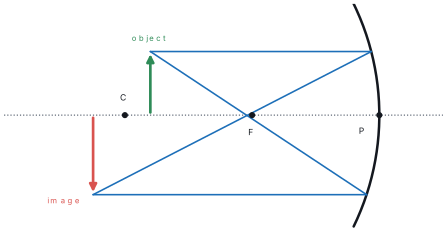
- The focal length of a spherical mirror of radius of curvature R is [1]aRbR/2c2RdR/4
- The image formed by a convex mirror is always [1]areal, inverted and magnifiedbvirtual, erect and diminishedcreal, erect and diminisheddvirtual, inverted and magnified
- The mirror formula is [1]a\dfrac1v - \dfrac1u = \dfrac1fb\dfrac1v + \dfrac1u = \dfrac1fc\dfrac1u - \dfrac1v = \dfrac1fd\dfrac1v + \dfrac1u = \dfrac2f
- The linear magnification produced by a mirror is [1]am = v/ubm = -v/ucm = u/vdm = -u/v
- A concave mirror forms an image of the same size as the object when the object is placed at [1]athe focusbthe polecthe centre of curvaturedinfinity
- An object is placed 15\ \text{cm} from a concave mirror of focal length 10\ \text{cm}. The image distance is [1]a6\ \text{cm} in frontb30\ \text{cm} in frontc30\ \text{cm} behindd6\ \text{cm} behind
- In the figure above, the object lies between C and F, so the image is [1]avirtual and diminishedbreal, inverted and magnified, beyond Ccreal and at Fdvirtual and magnified
- A convex mirror is used as a driver's rear-view mirror because it [1]aforms a real imagebgives a wide field of view with an erect imagecmagnifies distant vehiclesdremoves chromatic aberration
Answers — 2.14
1. (b) — paraxial rays from infinity cross the axis half way to the centre of curvature.
2. (b) — the reflected rays always diverge, so the image is caught behind the mirror; no object position changes this.
3. (b) — the plus sign is the mirror formula, the minus sign belongs to the lens formula. Option (a) is the single most costly mix-up in the whole optics section.
4. (b) — the minus sign is what tells you a real image is inverted. Option (a) is the lens magnification.
5. (c) — u = -R gives v = -R and m = -1.
6. (b) — with u = -15\ \text{cm}, f = -10\ \text{cm}: 1/v = 1/f - 1/u = -1/10 + 1/15 = -1/30, so v = -30\ \text{cm}, i.e. 30\ \text{cm} in front of the mirror and real.
7. (b) — read the ray diagram: the two construction rays meet in front of the mirror, past C.
8. (b) — the diminished virtual image packs a wider scene into the same glass, at the price of making cars look further away than they are.
2.15 Refraction at plane surfaces
| High-yield fact | Value / form |
|---|---|
| Snell's law | \dfrac{\sin i}{\sin r} = {}_1n_2 = \dfrac{n_2}{n_1} = \dfrac{v_1}{v_2} |
| Absolute refractive index | n = c/v; n_{water} = 1.33, n_{glass} = 1.5 |
| Unchanged on refraction | frequency (colour); wavelength and speed both change |
| Real and apparent depth | n = \dfrac{\text{real depth}}{\text{apparent depth}}; shift = t\left(1-\dfrac1n\right) |
| Critical angle | \sin C = \dfrac{1}{n}; glass C \approx 41.8^{\circ}, water C \approx 48.8^{\circ} |
| Total internal reflection | needs denser \to rarer and i > C |
| Lateral shift | d = \dfrac{t\sin(i-r)}{\cos r} |
- The refractive index of a medium is defined as [1]av/cbc/vccvdc - v
- When light passes from air into glass, the quantity that does not change is its [1]aspeedbwavelengthcfrequencyddirection
- The critical angle for a medium of refractive index n is given by [1]a\sin C = nb\sin C = 1/nc\tan C = nd\cos C = 1/n
- For glass of refractive index 1.5, the critical angle is about [1]a30^{\circ}b41.8^{\circ}c48.8^{\circ}d60^{\circ}
- A pond is 4\ \text{m} deep. To an observer looking vertically down, its apparent depth (n = 4/3) is [1]a5.33\ \text{m}b3\ \text{m}c2\ \text{m}d4\ \text{m}
- A mirage in a desert is caused by [1]adiffractionbdispersionctotal internal reflection in layers of air of different densitydinterference
- A ray entering an optically denser medium bends [1]aaway from the normalbtowards the normalcalong the normaldnot at all
- Total internal reflection can occur when light travels from [1]aair to glassbglass to air at any anglecglass to air at an angle greater than the critical angledair to water at grazing incidence
Answers — 2.15
1. (b) — light slows down in a medium, so n > 1 always. Option (a) inverts the ratio and would make n < 1.
2. (c) — the source sets the frequency; the medium sets the speed, and therefore the wavelength through v = f\lambda.
3. (b) — put r = 90^{\circ} in Snell's law.
4. (b) — C = \sin^{-1}(1/1.5) = 41.8^{\circ}. Option (c) is the value for water, a frequent swap.
5. (b) — apparent depth = 4/(4/3) = 3\ \text{m}. Option (a) multiplies by n instead of dividing.
6. (c) — hot air near the ground is rarer, so rays curve and are totally internally reflected.
7. (b) — into the slower medium, the wavefront turns towards the normal.
8. (c) — both conditions are needed; option (b) drops the angle condition, option (a) has the media the wrong way round.
2.16 Refraction through prisms
| High-yield fact | Value / form |
|---|---|
| Angle relations | A = r_1 + r_2 and \delta = i_1 + i_2 - A |
| At minimum deviation | i_1 = i_2, r_1 = r_2 = A/2, ray inside is parallel to the base |
| Prism formula | n = \dfrac{\sin\left(\dfrac{A+\delta_m}{2}\right)}{\sin\left(\dfrac{A}{2}\right)} |
| Thin prism | \delta = (n-1)A |
| Grazing emergence condition | maximum A for emergence is 2C |
- For a prism, the relation between the angle of the prism and the angles of refraction is [1]aA = r_1 - r_2bA = r_1 + r_2cA = i_1 + i_2dA = \delta + i_1
- At the position of minimum deviation, the ray inside the prism is [1]aperpendicular to the basebparallel to the basecalong the basedat the critical angle
- The deviation produced by a thin prism is [1]anAb(n-1)Ac(n+1)AdA/(n-1)
- For a prism of angle 60^{\circ} with a minimum deviation of 30^{\circ}, the refractive index is [1]a1.33b1.414c1.50d1.73
- A thin prism of angle 5^{\circ} and refractive index 1.5 produces a deviation of [1]a2.5^{\circ}b5^{\circ}c7.5^{\circ}d1.5^{\circ}
- A ray will emerge from the second face of a prism only if the angle of the prism is [1]aless than Cbless than or equal to 2Ccgreater than 2Cdexactly 90^{\circ}
- The deviation produced by a prism is [1]ai_1 + i_2 - Abi_1 - i_2 + AcA - i_1 - i_2di_1 + i_2 + A
- As the angle of incidence on a prism is increased from a small value, the deviation [1]aincreases steadilybdecreases steadilycfirst decreases to a minimum then increasesdstays constant
Answers — 2.16
1. (b) — from the quadrilateral formed by the two normals and the two faces.
2. (b) — the symmetry r_1 = r_2 is exactly what makes the internal ray parallel to the base.
3. (b) — the (n-1) factor; option (a) forgets that a prism of n = 1 would deviate nothing.
4. (b) — n = \sin45^{\circ}/\sin30^{\circ} = 0.7071/0.5 = 1.414.
5. (a) — \delta = (1.5-1)\times5^{\circ} = 2.5^{\circ}.
6. (b) — if A > 2C then r_2 > C at the second face and the ray is totally internally reflected instead.
7. (a) — the two deviations at the two faces, less the prism angle.
8. (c) — the deviation curve is U-shaped, which is why \delta_m exists at all.
2.17 Lenses
| High-yield fact | Value / form |
|---|---|
| Lens formula | \dfrac{1}{v} - \dfrac{1}{u} = \dfrac{1}{f} (note the minus) |
| Magnification | m = \dfrac{v}{u} |
| Lens maker's formula | \dfrac1f = (n-1)\left(\dfrac{1}{R_1} - \dfrac{1}{R_2}\right) |
| Power | P = \dfrac{1}{f\ \text{in metres}}, in dioptre (D); convex +, concave - |
| Lenses in contact | \dfrac{1}{F} = \dfrac{1}{f_1}+\dfrac{1}{f_2}, P = P_1 + P_2 |
| Lenses separated by d | \dfrac{1}{F} = \dfrac{1}{f_1}+\dfrac{1}{f_2}-\dfrac{d}{f_1f_2} |
| Simple microscope | M = 1 + \dfrac{D}{f} with D = 25\ \text{cm} |
- The SI unit of the power of a lens is [1]awattbdioptrecmetredlumen
- The lens formula is [1]a\dfrac1v + \dfrac1u = \dfrac1fb\dfrac1v - \dfrac1u = \dfrac1fc\dfrac1u - \dfrac1v = \dfrac1fd\dfrac1f = \dfrac1v\dfrac1u
- A convex lens of focal length 20\ \text{cm} is placed in contact with a concave lens of focal length 30\ \text{cm}. The power of the combination is [1]a+1.67\ \text{D}b-1.67\ \text{D}c+8.33\ \text{D}d-0.6\ \text{D}
- When a convex glass lens is immersed in water, its focal length [1]aincreasesbdecreasescstays the samedbecomes negative
- The magnification produced by a lens is [1]a-v/ubv/ucu/vdf/u
- An object is 15\ \text{cm} from a convex lens of focal length 10\ \text{cm}. The image is formed at [1]a6\ \text{cm}b30\ \text{cm}c-30\ \text{cm}d25\ \text{cm}
- The angular magnification of a simple microscope for an image at the near point is [1]aD/fb1 + D/fcD/f - 1df/D
- A lens of focal length -50\ \text{cm} has a power of [1]a-2\ \text{D}b+2\ \text{D}c-0.02\ \text{D}d-50\ \text{D}
Answers — 2.17
1. (b) — one dioptre is one reciprocal metre of focal length.
2. (b) — the minus sign distinguishes it from the mirror formula.
3. (a) — 1/F = 1/20 - 1/30 = 1/60, so F = 60\ \text{cm} = 0.6\ \text{m} and P = 1/0.6 = +1.67\ \text{D}. Option (c) adds the powers as 5 + 3.33 with the wrong sign on the concave lens.
4. (a) — the lens maker's formula uses the relative index n_{glass}/n_{water} \approx 1.13, so (n-1) shrinks and f grows.
5. (b) — no minus sign here; a negative m still comes out automatically from the signs of u and v.
6. (b) — u = -15, f = +10: 1/v = 1/10 - 1/15 = 1/30, so v = +30\ \text{cm}, real and on the far side.
7. (b) — the +1 appears only for the near-point setting; D/f is the relaxed-eye value.
8. (a) — P = 1/(-0.5\ \text{m}) = -2\ \text{D}. Option (d) forgets to convert centimetres to metres.
2.18 Dispersion
| High-yield fact | Value / form |
|---|---|
| Angular dispersion | \theta = \delta_V - \delta_R = (n_V - n_R)A |
| Dispersive power | \omega = \dfrac{n_V - n_R}{n_Y - 1} = \dfrac{\delta_V-\delta_R}{\delta_Y} — dimensionless, no unit |
| Cause of dispersion | n depends on wavelength; violet has the largest n, so it deviates most |
| Deviation without dispersion | \omega_1\delta_1 + \omega_2\delta_2 = 0 |
| Achromatic doublet | \dfrac{\omega_1}{f_1} + \dfrac{\omega_2}{f_2} = 0 |
| Chromatic aberration | coloured fringes; cured by an achromatic combination |
| Spherical aberration | blurring from marginal rays; reduced by stops or parabolic surfaces |
- Dispersive power has the unit [1]adioptrebradiancno unitdmetre
- Which colour is deviated most by a glass prism? [1]aredbyellowcgreendviolet
- Dispersion of white light by a prism occurs because [1]athe speed of light in glass depends on wavelengthbglass absorbs some colourscthe prism has two facesdlight is transverse
- The condition for an achromatic combination of two thin lenses in contact is [1]a\omega_1 f_1 = \omega_2 f_2b\dfrac{\omega_1}{f_1} + \dfrac{\omega_2}{f_2} = 0cf_1 = f_2d\omega_1 = \omega_2
- For a thin prism of angle 5^{\circ} with n_V = 1.52 and n_R = 1.50, the angular dispersion is [1]a0.02^{\circ}b0.1^{\circ}c1^{\circ}d2.5^{\circ}
- The defect by which a lens forms coloured images of a white object is called [1]aspherical aberrationbchromatic aberrationcastigmatismdcoma
- Spherical aberration in a lens can be reduced by [1]ausing a combination of two different glassesbusing a stop to block marginal rayscincreasing the aperturedusing monochromatic light
- Dispersive power of a prism material depends on [1]athe angle of the prismbthe material of the prism onlycthe angle of incidencedthe size of the prism
Answers — 2.18
1. (c) — it is a ratio of two angles (or of two refractive-index differences).
2. (d) — violet has the shortest wavelength and the largest n.
3. (a) — a wavelength-dependent speed means a wavelength-dependent n, hence a wavelength-dependent deviation. Option (b) is the classic wrong picture: the prism does not create or filter the colours.
4. (b) — the two dispersions cancel while some net power survives.
5. (b) — \theta = (1.52-1.50)\times5^{\circ} = 0.02\times5 = 0.1^{\circ}. Option (a) drops the factor A.
6. (b) — colour is in the name.
7. (b) — spherical aberration is a geometry problem, not a colour problem, so an achromatic doublet (option a) is the answer to the other defect.
8. (b) — \omega contains only refractive indices; A cancels out of the ratio.
2.19 Electric Charges
| High-yield fact | Value / form |
|---|---|
| Coulomb's law | F = \dfrac{1}{4\pi\varepsilon_0}\dfrac{q_1q_2}{r^{2}} |
| Constant | k = \dfrac{1}{4\pi\varepsilon_0} = 9\times10^{9}\ \text{N m}^{2}\text{C}^{-2} |
| Permittivity of free space | \varepsilon_0 = 8.85\times10^{-12}\ \text{C}^{2}\text{N}^{-1}\text{m}^{-2} |
| In a medium | F_{med} = \dfrac{F_{vac}}{\varepsilon_r} |
| Quantisation | q = ne, e = 1.6\times10^{-19}\ \text{C} |
| 1\ \text{C} | 6.25\times10^{18} electronic charges |
- The value of 1/4\pi\varepsilon_0 in SI units is [1]a9\times10^{9}b8.85\times10^{-12}c6.67\times10^{-11}d1.6\times10^{-19}
- The force between two point charges is inversely proportional to [1]arbr^{2}cr^{3}d\sqrt{r}
- If the distance between two charges is halved, the force between them becomes [1]ahalfbdoublecfour timesdone quarter
- When a charged body is brought near an uncharged conductor, the near face of the conductor acquires [1]athe same kind of chargebthe opposite kind of chargecno chargedtwice the charge
- Two charges of 1\ \mu\text{C} each are placed 1\ \text{m} apart in air. The force between them is [1]a9\times10^{-3}\ \text{N}b9\times10^{3}\ \text{N}c9\times10^{-9}\ \text{N}d9\ \text{N}
- The charge on a body is always an integral multiple of e. This is called [1]aconservation of chargebquantisation of chargecadditivity of chargedinduction
- Coulomb's law in a medium of relative permittivity \varepsilon_r gives a force that is [1]a\varepsilon_r times the vacuum valueb1/\varepsilon_r times the vacuum valuecunchangedd\varepsilon_r^{2} times the vacuum value
- One coulomb of charge is equivalent to [1]a1.6\times10^{-19} electronsb6.25\times10^{18} electronsc6.022\times10^{23} electronsd9\times10^{9} electrons
Answers — 2.19
1. (a) — option (b) is \varepsilon_0 itself, which is what the 9\times10^{9} is built from.
2. (b) — the inverse-square law, like gravitation.
3. (c) — F \propto 1/r^2, so halving r multiplies F by 4. Option (b) treats the law as 1/r.
4. (b) — charging by induction; the far face takes the like charge.
5. (a) — F = 9\times10^{9}\times(10^{-6})^{2}/1^{2} = 9\times10^{-3}\ \text{N}. Option (b) drops the micro prefix.
6. (b) — no free charge smaller than e has ever been isolated.
7. (b) — the medium screens the field, so the force is always reduced.
8. (b) — 1/1.6\times10^{-19}.
2.20 Electric field
| High-yield fact | Value / form |
|---|---|
| Field strength | \vec E = \vec F/q; unit \text{N C}^{-1} = \text{V m}^{-1} |
| Point charge | E = \dfrac{kQ}{r^{2}} |
| Gauss's law | \oint \vec E\cdot d\vec A = \dfrac{q_{enc}}{\varepsilon_0}; flux in \text{N m}^{2}\text{C}^{-1} |
| Inside a conductor | E = 0; all excess charge sits on the surface |
| Charged conducting surface | E = \dfrac{\sigma}{\varepsilon_0}; isolated non-conducting sheet E = \dfrac{\sigma}{2\varepsilon_0} |
| Infinite line charge | E = \dfrac{\lambda}{2\pi\varepsilon_0 r} \propto \dfrac1r |
| Field lines | start on +, end on -, never cross, never form closed loops in electrostatics |
- The SI unit of electric field strength is [1]a\text{N C}^{-1} onlyb\text{V m}^{-1} onlycboth \text{N C}^{-1} and \text{V m}^{-1}d\text{J C}^{-1}
- The electric field inside a charged hollow conductor in equilibrium is [1]azerob\sigma/\varepsilon_0cmaximum at the centreduniform and non-zero
- The electric field due to an infinitely long straight charged wire varies as [1]a1/rb1/r^{2}c1/r^{3}dindependent of r
- The total electric flux through a closed surface enclosing a charge q is [1]aq\varepsilon_0bq/\varepsilon_0c\varepsilon_0/qdq/4\pi\varepsilon_0
- Two electric lines of force can never intersect because [1]athey are parallelbthe field would then have two directions at one pointcthey repeldthey are imaginary
- The electric field at 3\ \text{m} from a point charge of 1\ \mu\text{C} is [1]a1000\ \text{N C}^{-1}b3000\ \text{N C}^{-1}c9000\ \text{N C}^{-1}d300\ \text{N C}^{-1}
- The SI unit of electric flux is [1]a\text{N C}^{-1}b\text{N m}^{2}\text{C}^{-1}c\text{C m}^{-2}d\text{V}
- Just outside the surface of a charged conductor with surface charge density \sigma, the field is [1]a\sigma/\varepsilon_0b\sigma/2\varepsilon_0czerod\sigma\varepsilon_0
Answers — 2.20
1. (c) — \text{N C}^{-1} and \text{V m}^{-1} are the same combination of base units. Option (d) is the unit of potential.
2. (a) — free charges rearrange until the interior field vanishes; this is electrostatic shielding.
3. (a) — a cylindrical Gaussian surface has area \propto r, so E \propto 1/r; only a point charge gives 1/r^2.
4. (b) — Gauss's law, and it does not depend on the shape of the surface or where the charge sits inside it.
5. (b) — the tangent at a point gives the unique direction of \vec E there.
6. (a) — E = 9\times10^{9}\times10^{-6}/9 = 1000\ \text{N C}^{-1}.
7. (b) — field strength times area.
8. (a) — the factor of two that appears for a thin non-conducting sheet is absent here, because all the charge lies on one face and there is no field inside the metal.
2.21 Potential, potential difference and potential energy
| High-yield fact | Value / form |
|---|---|
| Potential | V = W/q, a scalar; unit volt = \text{J C}^{-1} |
| Point charge | V = \dfrac{kQ}{r} — note 1/r, not 1/r^{2} |
| Field from potential | E = -\dfrac{dV}{dx} |
| Potential energy of a pair | U = \dfrac{kq_1q_2}{r} |
| Electronvolt | 1\ \text{eV} = 1.6\times10^{-19}\ \text{J} |
| Equipotential surface | V constant; no work to move a charge along it; always perpendicular to \vec E |
| Charged conducting sphere | inside, V = V_{surface} = kQ/R and E = 0 |
- Electric potential is a [1]avector quantitybscalar quantityctensorddimensionless number
- The potential at a distance r from a point charge Q varies as [1]a1/rb1/r^{2}crdr^{2}
- One electronvolt equals [1]a1.6\times10^{-19}\ \text{J}b1\ \text{J}c1.6\times10^{19}\ \text{J}d9\times10^{9}\ \text{J}
- The relation between the electric field and the potential gradient is [1]aE = +dV/dxbE = -dV/dxcE = V xdE = V/x^{2}
- The work done in moving a charge from one point to another on an equipotential surface is [1]amaximumbzerocqVdinfinite
- Inside a charged hollow conducting sphere, the potential is [1]azerobequal to the value on the surfacecinfinitedgreater than on the surface
- The potential at 0.3\ \text{m} from a charge of 3\ \text{nC} is [1]a9\ \text{V}b90\ \text{V}c900\ \text{V}d0.9\ \text{V}
- A potential difference of 200\ \text{V} is applied across two plates 2\ \text{mm} apart. The field between them is [1]a100\ \text{V m}^{-1}b1\times10^{4}\ \text{V m}^{-1}c1\times10^{5}\ \text{V m}^{-1}d400\ \text{V m}^{-1}
Answers — 2.21
1. (b) — which is why potentials add algebraically while fields must be added as vectors. That single fact makes most potential problems easier than the matching field problem.
2. (a) — one power of r less than the field, because potential is the integral of the field.
3. (a) — the energy an electron gains falling through one volt.
4. (b) — the field points from high to low potential, hence the minus sign.
5. (b) — V does not change, so W = q\Delta V = 0.
6. (b) — E = 0 inside means V cannot change, so it holds the surface value. Option (a) confuses zero field with zero potential.
7. (b) — V = 9\times10^{9}\times3\times10^{-9}/0.3 = 27/0.3 = 90\ \text{V}.
8. (c) — E = V/d = 200/0.002 = 1\times10^{5}\ \text{V m}^{-1}. Option (a) forgets to convert millimetres.
2.22 Capacitor
| High-yield fact | Value / form |
|---|---|
| Capacitance | C = Q/V; unit farad = \text{C V}^{-1} |
| Parallel-plate | C = \dfrac{\varepsilon_0 A}{d}, with dielectric C = \dfrac{\varepsilon_0\varepsilon_r A}{d} |
| In series | \dfrac{1}{C} = \dfrac{1}{C_1}+\dfrac{1}{C_2}+\dots — total is less than the smallest |
| In parallel | C = C_1+C_2+\dots |
| Energy stored | U = \tfrac12CV^{2} = \tfrac12QV = \dfrac{Q^{2}}{2C} |
| Dielectric inserted, battery connected | V fixed, C up, so Q and U both rise |
| Dielectric inserted, battery removed | Q fixed, C up, so V and U both fall |
| \varepsilon_r of vacuum | exactly 1 |
- The SI unit of capacitance is the [1]acoulombbvoltcfaraddhenry
- The capacitance of a parallel-plate capacitor is [1]a\varepsilon_0 A db\varepsilon_0 A/dc\varepsilon_0 d/AdA/\varepsilon_0 d
- Three capacitors of 3\ \mu\text{F} each are joined in series. The equivalent capacitance is [1]a9\ \mu\text{F}b3\ \mu\text{F}c1\ \mu\text{F}d0.33\ \mu\text{F}
- The energy stored in a capacitor of capacitance C charged to a potential difference V is [1]aCVb\tfrac12CVc\tfrac12CV^{2}dCV^{2}
- A 2\ \mu\text{F} capacitor is charged to 100\ \text{V}. The energy stored is [1]a0.01\ \text{J}b0.02\ \text{J}c1\ \text{J}d200\ \text{J}
- A dielectric slab is inserted into a parallel-plate capacitor that stays connected to a battery. The charge on the plates [1]aincreasesbdecreasescstays the samedbecomes zero
- The relative permittivity of free space is [1]a0b1c8.85\times10^{-12}d9\times10^{9}
- Capacitors are connected in parallel to obtain [1]aa smaller capacitanceba larger capacitanceca larger working voltageda smaller charge
Answers — 2.22
1. (c) — one farad is one coulomb per volt, an enormous unit, which is why real capacitors are in μF and pF.
2. (b) — bigger plates and a smaller gap both raise C.
3. (c) — 1/C = 3/3, so C = 1\ \mu\text{F}. Option (a) applies the parallel rule; capacitor combination rules are the exact mirror image of the resistor rules, and that inversion is the commonest error in this unit.
4. (c) — the \tfrac12 comes from integrating V\,dq as the capacitor charges up.
5. (a) — U = \tfrac12\times2\times10^{-6}\times100^{2} = 0.01\ \text{J}.
6. (a) — V is held fixed by the battery and C has increased, so Q = CV must rise. With the battery removed the answer would be (c).
7. (b) — by definition; 8.85\times10^{-12} is the absolute permittivity \varepsilon_0.
8. (b) — parallel adds plate area in effect. Series is used to share a high voltage.
2.23 DC Circuits
| High-yield fact | Value / form |
|---|---|
| Ohm's law | V = IR; resistivity \rho = RA/L, unit \Omega\ \text{m} |
| Drift | I = nAv_de; drift speed is only about 10^{-4}\ \text{m s}^{-1} |
| Series / parallel | R_s = R_1+R_2; \dfrac{1}{R_p} = \dfrac{1}{R_1}+\dfrac{1}{R_2} |
| Internal resistance | V = E - Ir; E = I(R+r) |
| Power | P = VI = I^{2}R = \dfrac{V^{2}}{R} |
| Wheatstone bridge, balanced | \dfrac{P}{Q} = \dfrac{R}{S}; no current through the galvanometer |
| Metre bridge | \dfrac{R}{S} = \dfrac{l}{100-l} |
- The SI unit of resistivity is [1]a\Omegab\Omega\ \text{m}c\Omega\ \text{m}^{-1}d\Omega^{-1}\text{m}^{-1}
- The drift velocity of free electrons in a metallic conductor carrying a normal current is of the order of [1]a10^{8}\ \text{m s}^{-1}b10^{6}\ \text{m s}^{-1}c10^{-4}\ \text{m s}^{-1}d10^{-10}\ \text{m s}^{-1}
- Three resistors of 6\ \Omega each are joined in parallel. The equivalent resistance is [1]a18\ \Omegab6\ \Omegac3\ \Omegad2\ \Omega
- The terminal potential difference of a cell of emf E and internal resistance r delivering a current I is [1]aE + IrbE - IrcIr - EdE/Ir
- The balance condition of a Wheatstone bridge with arms P, Q, R, S is [1]aPQ = RSbP/Q = R/ScP/R = S/QdP + Q = R + S
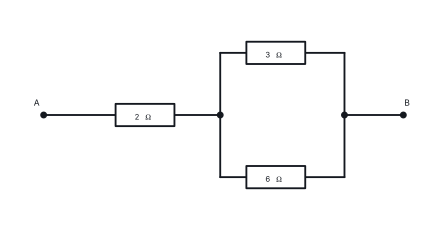
- In the network shown, the resistance between A and B is [1]a2\ \Omegab4\ \Omegac9\ \Omegad11\ \Omega
- Two bulbs are rated 100\ \text{W} and 60\ \text{W} at the same voltage. Compared with the 60\ \text{W} bulb, the 100\ \text{W} bulb has [1]aa higher resistanceba lower resistancecthe same resistancedzero resistance
- The current in a conductor is given by [1]aI = nAv_debI = nAv_d/ecI = nA/v_dedI = Av_de/n
Answers — 2.23
1. (b) — from \rho = RA/L, the units are \Omega\times\text{m}^2/\text{m}.
2. (c) — slower than a walking ant; the signal travels near the speed of light, which is what option (a) is fishing for.
3. (d) — 6/3 = 2\ \Omega; n equal resistors in parallel give R/n.
4. (b) — the cell loses Ir inside itself while discharging.
5. (b) — the ratio of adjacent arms on the two sides.
6. (b) — 3\ \Omega in parallel with 6\ \Omega is 18/9 = 2\ \Omega; add the series 2\ \Omega to get 4\ \Omega. Option (d) adds all three in series.
7. (b) — P = V^2/R at fixed V, so more power means less resistance. Students reliably answer (a) because "brighter feels like more resistance".
8. (a) — number density times area times drift speed times charge per carrier.
2.24 Nuclear physics
| High-yield fact | Value / form |
|---|---|
| Nuclear radius | R = R_0A^{1/3}, R_0 = 1.2\times10^{-15}\ \text{m} |
| Nuclear density | about 2.3\times10^{17}\ \text{kg m}^{-3}, the same for all nuclei |
| Mass–energy | 1\ \text{u} = 931.5\ \text{MeV} = 1.66\times10^{-27}\ \text{kg} |
| Mass defect | \Delta m = [Zm_p + (A-Z)m_n] - M_{nucleus} |
| Binding energy per nucleon | peaks near 8.8\ \text{MeV} at A \approx 56 (iron) |
| Fission of U-235 | about 200\ \text{MeV} released per fission |
| Pair production | needs at least 1.02\ \text{MeV} |
| Isotopes / isobars / isotones | same Z / same A / same N |
- The radius of a nucleus of mass number A is proportional to [1]aAbA^{1/3}cA^{2/3}dA^{2}
- Nuclear density is [1]aproportional to Abproportional to A^{1/3}cnearly the same for all nucleidinversely proportional to A
- The energy equivalent of one atomic mass unit is [1]a931.5\ \text{MeV}b1.6\times10^{-19}\ \text{J}c13.6\ \text{eV}d200\ \text{MeV}
- The difference between the sum of the masses of the free nucleons and the mass of the nucleus is called the [1]abinding energybmass defectcpacking fractiondatomic mass
- The binding energy per nucleon is maximum for nuclei of mass number about [1]a2b56c138d235
- The energy released in the fission of one uranium-235 nucleus is about [1]a2\ \text{MeV}b20\ \text{MeV}c200\ \text{MeV}d2000\ \text{MeV}
- Isotopes of an element have the same [1]amass numberbatomic numbercnumber of neutronsdnuclear radius
- The minimum photon energy needed for electron–positron pair production is [1]a0.51\ \text{MeV}b1.02\ \text{MeV}c931.5\ \text{MeV}d13.6\ \text{eV}
Answers — 2.24
1. (b) — volume is proportional to A, so radius goes as the cube root.
2. (c) — mass \propto A and volume \propto A, so the ratio is constant; that constancy is the evidence that nuclear matter is incompressible.
3. (a) — from E = mc^{2} with m = 1.66\times10^{-27}\ \text{kg}.
4. (b) — the binding energy is that defect multiplied by c^{2}; options (a) and (b) are the classic swap, and marks are lost every year for naming the energy when the question asked for the mass.
5. (b) — iron and nickel, which is why both fusion below and fission above release energy.
6. (c) — the number worth memorising for reactor numericals.
7. (b) — same Z, different A.
8. (b) — twice the rest energy of an electron, 2\times0.51\ \text{MeV}. Option (a) forgets that two particles must be made.
2.25 Solids
| High-yield fact | Value / form |
|---|---|
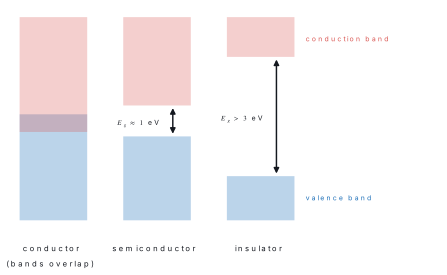
| Band gap | conductor: bands overlap; semiconductor E_g \approx 1\ \text{eV}; insulator E_g > 3\ \text{eV} |
| Silicon and germanium | E_g = 1.1\ \text{eV} and 0.7\ \text{eV} |
| n-type | pentavalent dopant (P, As, Sb); majority carriers electrons |
| p-type | trivalent dopant (B, Al, In); majority carriers holes |
| Mass-action law | n_e n_h = n_i^{2} |
| Temperature coefficient | semiconductors are negative; metals positive |
| Doped crystal | electrically neutral overall |
- The forbidden energy gap of silicon at room temperature is about [1]a0.7\ \text{eV}b1.1\ \text{eV}c3.2\ \text{eV}d5.4\ \text{eV}
- Germanium is doped with a pentavalent impurity. The resulting semiconductor is [1]ap-typebn-typecintrinsicdan insulator
- The resistance of a pure semiconductor with rising temperature [1]aincreasesbdecreasescstays constantdfirst rises then falls
- In an extrinsic semiconductor at equilibrium [1]an_e = n_hbn_en_h = n_i^{2}cn_e + n_h = n_idn_e = n_i^{2}
- A material with a forbidden gap greater than about 3\ \text{eV} behaves as [1]aa conductorba semiconductorcan insulatorda superconductor
- An n-type semiconductor crystal is [1]anegatively chargedbpositively chargedcelectrically neutraldcharged only when heated
- In the band diagram of a conductor [1]athe valence and conduction bands overlapbthe gap is about 1\ \text{eV}cthe gap is greater than 3\ \text{eV}dthere is no valence band
- The majority charge carriers in a p-type semiconductor are [1]aelectronsbholescprotonsdnegative ions
Answers — 2.25
1. (b) — option (a) is germanium, the standard mix-up.
2. (b) — the fifth electron is loosely bound and becomes a free carrier; "n" is for the negative carrier, not for a negative crystal.
3. (b) — more electrons are thermally excited across the gap; semiconductors have a negative temperature coefficient of resistance, unlike metals.
4. (b) — the mass-action law holds for both types; option (a) is true only for an intrinsic sample.
5. (c) — see the figure: the gap is too wide for thermal excitation at room temperature.
6. (c) — each donor atom contributes one electron and one fixed positive ion core, so the crystal stays neutral. Option (a) is the most popular wrong answer in this unit.
7. (a) — there is no gap at all, so electrons move under the smallest field.
8. (b) — a trivalent dopant leaves a vacancy in the bonding, which behaves as a mobile positive carrier.
2.26 Recent trends in physics
| High-yield fact | Value / form |
|---|---|
| Quark content | proton = uud, neutron = udd |
| Quark charges | up, charm, top = +\tfrac23e; down, strange, bottom = -\tfrac13e |
| Baryon / meson | three quarks / one quark and one antiquark |
| Leptons | electron, muon, tau and their neutrinos |
| Hubble's law | v = H_0d |
| Age of the universe | about 13.8 billion years |
| Cosmic microwave background | about 2.7\ \text{K} |
| Schwarzschild radius | R_s = \dfrac{2GM}{c^{2}} |
- The quark composition of a proton is [1]auudbuddcuuudddd
- The charge on an up quark is [1]a+\tfrac13eb-\tfrac13ec+\tfrac23ed-\tfrac23e
- A baryon is made of [1]atwo quarksbthree quarksca quark and an antiquarkdno quarks
- Hubble's law states that the recession speed of a galaxy is [1]aindependent of distancebproportional to its distancecinversely proportional to its distancedproportional to its mass
- The temperature of the cosmic microwave background radiation is about [1]a0\ \text{K}b2.7\ \text{K}c300\ \text{K}d5800\ \text{K}
- The present estimate of the age of the universe is about [1]a4.5 billion yearsb13.8 billion yearsc100 billion yearsd1 million years
- The Schwarzschild radius of a body of mass M is [1]aGM/c^{2}b2GM/c^{2}cGM/2c^{2}d2GM/c
- The neutrino belongs to the family of [1]abaryonsbmesonscleptonsdgauge bosons
Answers — 2.26
1. (a) — \tfrac23+\tfrac23-\tfrac13 = +1; option (b) is the neutron, whose charges sum to zero.
2. (c) — the two-thirds family.
3. (b) — protons and neutrons are the familiar examples; option (c) defines a meson.
4. (b) — the linear law that is the observational basis of the expanding universe.
5. (b) — the cooled relic of the hot early universe.
6. (b) — option (a) is the age of the Earth, offered to catch a hurried reader.
7. (b) — set the escape velocity equal to c in v_e = \sqrt{2GM/R}.
8. (c) — it feels only the weak and gravitational interactions and has no quark content.
Look at question 3 of section 2.22 — three 3\ \mu\text{F} capacitors in series — and notice the shape of the options: 9, 3, 1, 0.33. Those four numbers are not random. 9\ \mu\text{F} is the answer you get with the parallel rule, 3\ \mu\text{F} is what you get if you do nothing at all, 1\ \mu\text{F} is the series answer, and 0.33\ \mu\text{F} is 1/3 of the series answer, i.e. one extra reciprocal step. The examiner has written one option for each of the three commonest errors and one for the truth.
This is worth knowing because it works in reverse. If you can see that the four options are "parallel answer / do-nothing answer / series answer / over-reciprocated answer", you have identified the question as a combination question before you have read a word of the stem, and you know which single fact decides it: for capacitors, series means reciprocals. Spend your twenty seconds confirming that one fact rather than re-deriving the whole thing.
Estimating your way to an optics answer
Question 6 of section 2.17 — a 10\ \text{cm} convex lens with an object at 15\ \text{cm} — has options 6, 30, -30 and 25\ \text{cm}. You can eliminate three of them without touching the lens formula.
The object is between f and 2f, so the standard result applies at once: the image is real, inverted, magnified and lies beyond 2f, that is beyond 20\ \text{cm}. That kills 6\ \text{cm} (too near), kills -30\ \text{cm} (real means positive v for a lens) and leaves 30\ \text{cm} against 25\ \text{cm}. Now one line of arithmetic settles it: 1/v = 1/10 - 1/15 = 1/30.
Option 6\ \text{cm} is not an accident either — it is the answer to 1/v = 1/10 + 1/15, i.e. the mirror formula applied to a lens. The examiner put it there for exactly the student who has the two formulas the wrong way round.
Do not learn the answer letters
Reorder the options and every letter in this chapter changes. What you are meant to carry out of a section is the fact in the high-yield table and the reason in the answer key, not "2.14 question 3 is (b)". If you find yourself recognising a question by its position on the page rather than by its physics, shuffle your revision: work the sections in reverse order, or cover the options and answer from memory before you look.
Chapter summary
- Group A of the NEB Physics paper is eleven one-mark objective items drawn from across all twenty-six units, so no unit is safe to skip; the whole of this chapter is built one section per syllabus unit for exactly that reason.
- Every section opens with a high-yield facts table. Those tables are the smallest thing you can revise that still covers the objective paper: constants, defining formulae, standard values and the one or two named results that MCQs keep returning to.
- The answer keys give a reason, not a letter. Where an option encodes a standard misconception — mass for weight, the mirror formula for the lens formula, the resistor rule for the capacitor rule, zero field for zero potential, mass defect for binding energy — the key names it, because recognising your own error is worth more than recognising the right answer.
- Recurring traps to carry into the hall: unit prefixes (μ, m, k) left unconverted; \text{kW h} treated as a power; c_{rms} \propto \sqrt{T} read as linear; the \tfrac12 in capacitor energy; the sign convention in mirror and lens problems; \tfrac32kT per molecule versus \tfrac32RT per mole; weightlessness explained as "no gravity".
- Objective marks are the cheapest marks in the paper and the easiest to throw away. One minute per item is the budget; if an item resists for longer, mark it, move on, and come back after Group C.
Practice questions
Group A
- The dimensional formula of surface tension is [1]a[MT^{-2}]b[MLT^{-2}]c[ML^{-1}T^{-2}]d[ML^{2}T^{-2}]
- A body thrown vertically upwards has, at the highest point, [1]azero velocity and zero accelerationbzero velocity and acceleration g downwardscmaximum velocitydacceleration zero and velocity g
- The work done in moving a charge along an equipotential surface is [1]aqVbzerocV/qdinfinite
- The escape velocity of a body from the Earth's surface is \sqrt{2} times its [1]aorbital velocity near the surfacebterminal velocitycrms speedddrift velocity
- Two resistors of 4\ \Omega and 12\ \Omega are joined in parallel. The equivalent resistance is [1]a16\ \Omegab8\ \Omegac3\ \Omegad48\ \Omega
- The focal length of a plane mirror is [1]azerobinfinitecequal to the object distancedR/2 with R finite
- The specific latent heat of vaporisation of water is about [1]a3.34\times10^{5}\ \text{J kg}^{-1}b2.26\times10^{6}\ \text{J kg}^{-1}c4200\ \text{J kg}^{-1}d1\times10^{3}\ \text{J kg}^{-1}
- Which of the following is a scalar? [1]aelectric fieldbelectric potentialctorquedimpulse
- The energy equivalent of a mass defect of 1\ \text{u} is [1]a931.5\ \text{MeV}b200\ \text{MeV}c1.02\ \text{MeV}d13.6\ \text{eV}
- If the temperature of a black body is halved, the energy it radiates per second becomes [1]a1/2b1/4c1/8d1/16
- A p-type semiconductor is obtained by doping silicon with [1]aphosphorusbarseniccborondantimony
Answers to Group A
1. (a) — surface tension is force per unit length, [MLT^{-2}]/[L].
2. (b) — the velocity is instantaneously zero but gravity never switches off.
3. (b) — \Delta V = 0 on an equipotential.
4. (a) — v_e = \sqrt{2}\,v_o.
5. (c) — 4\times12/16 = 3\ \Omega; the parallel value is always smaller than the smaller resistor.
6. (b) — a plane mirror is a spherical mirror of infinite radius, so f = R/2 \to \infty.
7. (b) — option (a) is the latent heat of fusion.
8. (b) — potential is energy per unit charge, with no direction.
9. (a) — the standard conversion.
10. (d) — E \propto T^{4}, so halving T gives (1/2)^{4}.
11. (c) — boron is trivalent; the other three are pentavalent and would give n-type.
Group B
- State the sign convention used for spherical mirrors and use it to explain why the image in a convex mirror is always virtual, erect and diminished. Support your answer with a ray diagram. [5]
- Distinguish between the real and the apparent expansivity of a liquid, derive the relation between them and explain why Dulong and Petit's method needs no correction for the vessel. [5]
- Define electric field strength and electric potential. Show that E = -dV/dx, and explain why the potential inside a charged hollow conductor equals the surface value. [5]
- Explain, using the band theory of solids, the difference between a conductor, a semiconductor and an insulator. Why does the resistance of a semiconductor fall with rising temperature while that of a metal rises? [5]
Group C
- Derive an expression for the pressure exerted by an ideal gas on the basis of kinetic theory, hence show that the mean translational kinetic energy of a molecule is \tfrac32kT. A gas at 300\ \text{K} has a molar mass of 32\ \text{g mol}^{-1}; calculate the rms speed of its molecules. [8]
- State Coulomb's law and define the farad. Derive an expression for the capacitance of a parallel-plate capacitor with a dielectric slab of thickness t and relative permittivity \varepsilon_r between the plates. A 2\ \mu\text{F} capacitor is charged to 200\ \text{V} and then connected across an uncharged 3\ \mu\text{F} capacitor; find the common potential difference and the energy lost. [8]