Unit 4 · Mechanics · 6 teaching hours · 29 min read
Dynamics
What the syllabus asks for 5
- Linear momentum, Impulse
- Conservation of linear momentum
- Application of Newton's laws
- Moment, torque and equilibrium
- Solid friction: Laws of solid friction and their verifications
Kinematics described motion; dynamics explains it. The explanation lies in Newton's three laws, and the quantity that makes them work is linear momentum. From it come force and impulse; from the third law comes the conservation of momentum; from careful bookkeeping of forces come the free-body diagrams that solve most mechanics problems. The unit closes with two effects present in every real machine — torque and friction.
Draw the body alone. Mark every force acting on it. Choose axes. Write \sum F = ma along each axis and, if the body can turn, \sum \tau = 0 about a convenient point. Most marks in this unit are earned by that sequence.
4.1 Linear momentum, Impulse
A body stays at rest or in uniform motion unless an external force acts — Newton's first law. It defines force as that which changes the state of motion, and names the resistance to that change inertia, measured by mass.
The linear momentum of a body is the product of its mass and its velocity,
It is a vector along the velocity. Its SI unit is kg m s⁻¹ (equivalently N s) and its dimensional formula is [MLT^{-1}].
Newton's second law states that the rate of change of linear momentum of a body is directly proportional to the applied force and takes place in the direction of the force:
We start from the statement of the second law — force is proportional to the rate of change of momentum — and reach the familiar working formula F = ma.
Step 1 — write the law as an equation. "Proportional to" means "equal to, apart from a constant". Call that constant k:
Step 2 — put in the definition of momentum, p = mv:
Step 3 — take the mass outside the differentiation. This step needs the mass to be constant; a constant multiplier can always be moved outside a derivative:
Step 4 — recognise the derivative. By definition dv/dt is the acceleration a:
Step 5 — fix the constant k by choosing the unit of force. We define one newton as the force that gives a mass of 1 kg an acceleration of 1 m s⁻². Putting F = 1, m = 1, a = 1 into Step 4:
Step 6 — substitute k = 1:
Result. \vec{F} = m\vec{a}, with the acceleration in the same direction as the force.
What it means. The same force gives a small mass a big acceleration and a big mass a small one — mass is the measure of inertia.
Condition used. Step 3 assumed the mass does not change. For a rocket burning fuel or a raindrop collecting water, go back to F = dp/dt and differentiate the product properly. The law also holds only in an inertial (non-accelerating) frame.
Impulse
Impulse is the product of a force and the time for which it acts. For a constant force \vec{J} = \vec{F}\,\Delta t; for a varying force,
We start from Newton's second law in its momentum form and reach the statement that the impulse of a force equals the change in momentum it produces.
Step 1 — the second law. Force is the rate of change of momentum:
Step 2 — multiply both sides by dt. This just moves dt to the other side, so that we have "force times a tiny time" on the left:
Step 3 — add up all the tiny bits. The contact lasts from t_1 to t_2, during which the momentum goes from \vec{p}_1 to \vec{p}_2. Adding up tiny pieces is what integration does, so we integrate both sides between matching limits:
Step 4 — do the right-hand integral. Integrating d\vec{p} simply gives \vec{p}, so we evaluate it at the two limits:
Step 5 — name the left-hand side. By definition, that integral is the impulse \vec{J}:
Step 6 — put in p = mv. With initial velocity \vec{u} and final velocity \vec{v}:
Step 7 — the constant-force version. If we replace the real changing force by its average value F_{av} acting for the whole time \Delta t = t_2 - t_1, the integral becomes a simple product:
Result.
What it means. The area under a force–time graph is the momentum handed over. For a fixed change of momentum, a longer contact time means a smaller force — which is the whole idea behind airbags, crumple zones and a cricketer drawing his hands back while catching.
Condition used. The mass is constant, and \vec{F} is the net force on the body. Impulse is a vector, so in a rebound problem you must give u and v opposite signs.
(i) F = dp/dt quoted as the starting point; (ii) the step F\,dt = dp; (iii) integration with both sets of limits written in; (iv) the final statement in words — "impulse = change in momentum"; (v) the unit N s = kg m s⁻¹. In numerical parts, signs: a rebound needs v and u with opposite signs.
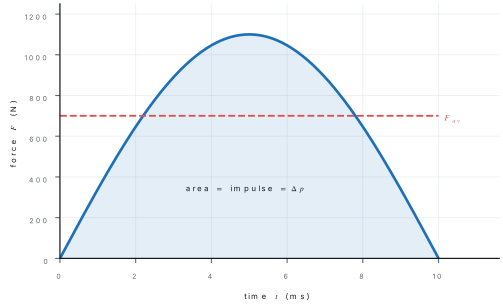
For a given collision \Delta p is fixed. Since F_{av} = \Delta p/\Delta t, the only way to cut the force is to stretch the time — the physics of airbags, crumple zones, helmet padding and the long-jump sand pit.
Problem. A ball of mass 0.2\ \text{kg} moving at 20\ \text{m s}^{-1} strikes a wall normally and rebounds at 15\ \text{m s}^{-1}. If the contact lasts 0.01\ \text{s}, find the impulse and the average force on the ball.
Solution. Take the direction away from the wall as positive, so u = -20\ \text{m s}^{-1} and v = +15\ \text{m s}^{-1}.
4.2 Conservation of linear momentum
Newton's third law: to every action there is an equal and opposite reaction. The two forces act on different bodies, along the same line, and appear and vanish together.
We start from Newton's third law applied to two colliding bodies and reach the statement that their total momentum is the same before and after the collision.
Setting up. Two smooth spheres A and B of masses m_1 and m_2 move along the same straight line with velocities u_1 and u_2, where u_1 > u_2 so that A catches up with B. They touch for a short time t and then separate with velocities v_1 and v_2. No outside force (no friction, no push) acts on the pair.
Step 1 — name the two contact forces. While they touch, B pushes A with a force F_{12} and A pushes B with a force F_{21}.
Step 2 — apply the third law. Action and reaction are equal in size and opposite in direction:
Step 3 — write each force as a rate of change of momentum. By the second law, the force on a body equals its change in momentum divided by the time. For A the momentum changes from m_1u_1 to m_1v_1:
and for B, from m_2u_2 to m_2v_2:
Step 4 — substitute both into Step 2:
Step 5 — multiply both sides by t. The contact time is the same for both bodies — they touch and separate together — so it cancels:
Step 6 — open the bracket on the right:
Step 7 — collect the "before" terms on one side and the "after" terms on the other. Add m_1u_1 to both sides and add m_2v_2 to both sides:
Result.
What it means. Whatever violence happens during the contact — however the bodies squash, heat up or break — the total momentum of the pair is unchanged. Momentum is only passed from one body to the other.
Conditions used. (i) No net external force acts on the pair during the collision; this is why the third-law pair could cancel. (ii) The contact time is the same for both bodies. (iii) Momentum is a vector: in one dimension you must give leftward velocities a minus sign, and in two dimensions you conserve the x and y components separately. Note that kinetic energy is not assumed to be conserved — this proof works for inelastic collisions too.
(i) A "before and after" diagram with m_1, m_2, u_1, u_2, v_1, v_2 labelled; (ii) the third-law statement F_{12} = -F_{21}; (iii) each force written as change of momentum over time; (iv) the cancelling of t with the reason; (v) the final equation and the sentence "total momentum before = total momentum after, provided no external force acts". The condition in (v) carries a mark on its own.
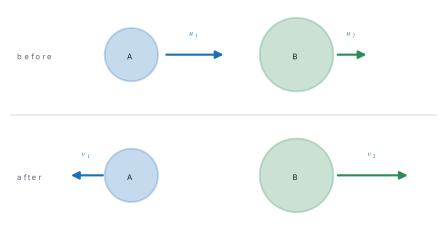
It also follows directly from \vec{F} = d\vec{p}/dt: zero net external force means d\vec{p}/dt = 0.
If no net external force acts on a system, its total linear momentum stays constant in magnitude and direction, however the bodies inside it interact.
| Situation | How momentum is conserved |
|---|---|
| Recoil of a gun | forward momentum of bullet = backward momentum of gun |
| Explosion of a shell at rest | vector sum of the fragment momenta is zero |
| Rocket and jet propulsion | gases ejected backwards; rocket gains equal forward momentum |
The two third-law forces act on different bodies, so they never add to zero on one body. A horse pulls a cart because the forward force on the cart and the backward force on the horse act on different objects.
Problem. A bullet of mass 20\ \text{g} is fired from a gun of mass 4\ \text{kg} with a muzzle velocity of 400\ \text{m s}^{-1}. Find the recoil velocity of the gun.
Solution. Before firing the system is at rest, so the total momentum is zero. With V the recoil velocity,
The gun recoils at 2\ \text{m s}^{-1}, opposite to the bullet and far slower because it is 200 times more massive.
4.3 Application of Newton's laws
The routine is always the same: isolate one body, draw its free-body diagram, choose axes along and across the motion, and write \sum F = ma for each axis.
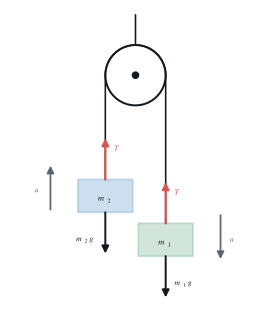
We start from F = ma written separately for each hanging mass, and reach formulas for the acceleration of the system and the tension in the string.
Setting up. Two masses m_1 and m_2, with m_1 > m_2, hang from the two ends of a light inextensible string passing over a smooth pulley. Two facts follow from those words, and they are worth marks:
- Inextensible string: the string cannot stretch, so when m_1 goes down by 1 cm, m_2 goes up by 1 cm. Both masses therefore have the same acceleration a.
- Light string over a smooth pulley: no force is needed to accelerate the string itself and none is lost to friction, so the tension T is the same everywhere in the string.
Since m_1 > m_2, common sense says m_1 goes down and m_2 goes up.
Step 1 — free-body equation for m_1. Two forces act on it: its weight m_1g downwards and the tension T upwards. It accelerates downwards, so take downwards as positive for this mass. Net force = mass \times acceleration:
Step 2 — free-body equation for m_2. The same two forces act, but this mass accelerates upwards, so take upwards as positive for it:
Step 3 — add the two equations. We add them because T appears with a minus sign in one and a plus sign in the other, so it will disappear:
Step 4 — cancel T and collect terms. On the left -T + T = 0; on the right take out the common factor a:
Step 5 — take out g on the left:
Step 6 — divide both sides by (m_1 + m_2) to get a alone:
Step 7 — now find T. Go back to Step 2 and make T the subject by adding m_2g to both sides:
Step 8 — substitute the a we just found:
Step 9 — put the bracket over one common denominator (m_1+m_2):
Step 10 — expand the top line:
Step 11 — the two m_2g terms cancel, leaving 2m_1g:
Step 12 — write it tidily:
Result.
What it means. The unbalanced force is only the difference in weights (m_1-m_2)g, but it has to move the total mass (m_1+m_2) — so the machine slows gravity down, which is exactly why Atwood used it to measure g. If m_1 = m_2 then a = 0 and T = m_1g, as expected. Also note m_2g < T < m_1g: the tension always lies between the two weights.
Assumptions used. Light inextensible string, frictionless and massless pulley, no air resistance. If the pulley had mass, part of the torque would go into spinning it and a would be smaller.
Apparent weight in a lift. A weighing machine reads the normal reaction R it exerts, not the true weight.
| Motion of the lift | Equation | Apparent weight R |
|---|---|---|
| At rest or uniform velocity | R - mg = 0 | mg |
| Accelerating upward with a | R - mg = ma | m(g + a) — feels heavier |
| Accelerating downward with a | mg - R = ma | m(g - a) — feels lighter |
| Cable breaks, free fall a = g | mg - R = mg | 0 — weightlessness |
Smooth inclined plane. Resolving the weight along and perpendicular to a plane inclined at \theta gives
Problem. Masses of 5\ \text{kg} and 3\ \text{kg} hang from the ends of a light string over a frictionless pulley. Find the acceleration of the system and the tension in the string. Take g = 10\ \text{m s}^{-2}.
Solution.
Check: T - m_2g = 37.5 - 30 = 7.5\ \text{N} = (3)(2.5). ✓
4.4 Moment, torque and equilibrium
The moment, or torque, of a force about a point is the product of the force and the perpendicular distance of its line of action from that point:
Its SI unit is the newton metre (N m) and its dimensional formula is [ML^{2}T^{-2}]. It is a vector directed along the axis of rotation.
A torque is positive when it turns the body anticlockwise. A force whose line of action passes through the point has zero moment, and a force at right angles to the arm has the largest moment — hence the door handle far from the hinge.
A couple is a pair of equal, opposite, parallel forces on different lines. Their resultant is zero, so a couple gives pure rotation. Its moment, \tau = F \times (perpendicular distance between them), is the same about every point.
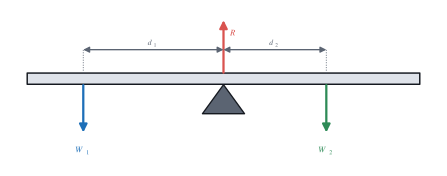
A rigid body under coplanar forces is in equilibrium when both:
- \sum \vec{F} = 0, i.e. \sum F_x = 0 and \sum F_y = 0 (no translation);
- \sum \tau = 0 about any point (no rotation).
Condition 2 alone is the principle of moments: clockwise moments equal anticlockwise moments.
| Type of equilibrium | On slight displacement | Centre of gravity | Example |
|---|---|---|---|
| Stable | returns to its original position | rises | cone on its base |
| Unstable | moves further away | falls | cone on its apex |
| Neutral | stays in the new position | height unchanged | cone on its side |
Problem. A uniform plank 4\ \text{m} long and of weight 200\ \text{N} rests on supports at its two ends. A boy of weight 500\ \text{N} stands 1\ \text{m} from the left-hand support. Find the reaction at each support.
Solution. Let R_1 and R_2 be the left and right reactions. The weight of the uniform plank acts at its centre, 2\ \text{m} from either end.
Vertical equilibrium: R_1 + R_2 = 200 + 500 = 700\ \text{N}.
Taking moments about the left-hand support:
The support nearer the boy carries the larger share.
4.5 Solid friction: Laws of solid friction and their verifications
Friction is the force acting along the surface of contact between two solid bodies that opposes their relative motion, or the tendency to it. It arises from interlocking and adhesion between the microscopic high points of the surfaces.
Push a resting block gently and it does not move: friction has grown to match the push exactly. This self-adjusting force is static friction. At some push the block just begins to slide, and the friction then is the limiting friction. Once sliding, the resistance settles at a smaller, nearly constant kinetic (dynamic) friction.
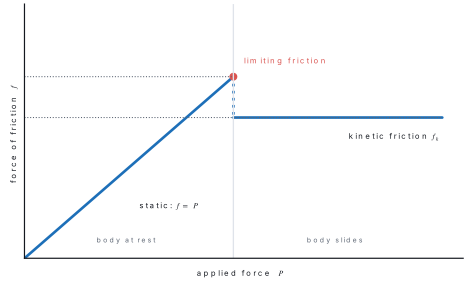
The coefficients of friction are ratios to the normal reaction N:
A ratio of two forces, \mu has no units: about 0.6 for rubber on concrete, 0.3 for wood on wood, 0.04 for steel on ice.
Laws of solid friction
Static friction
- Limiting friction is directly proportional to the normal reaction: f_{limiting} = \mu_s N.
- It is independent of the apparent area of contact, provided the normal reaction is unchanged.
- It depends on the nature, material and roughness of the two surfaces.
Kinetic friction
- Kinetic friction is directly proportional to the normal reaction, f_k = \mu_k N.
- It is independent of the apparent area of contact.
- It is independent of the relative velocity at moderate speeds.
- It depends on the nature of the surfaces and is always less than the limiting friction.
Angle of friction and angle of repose
The angle of friction \lambda is the angle between the normal reaction and the resultant of the normal reaction and the limiting friction, so
The angle of repose \theta is the smallest inclination of a plane at which a body placed on it just begins to slide.
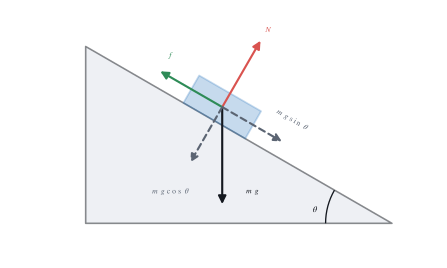
We start from a block that is just about to slide down a rough slope, and reach the result \mu_s = \tan\theta — which also proves that the angle of repose and the angle of friction are the same angle.
Setting up. A block of mass m rests on a rough plane whose tilt \theta is slowly increased. At the angle of repose the block is on the very point of sliding: it is still in equilibrium, but the friction has reached its largest possible value, f_{limiting} = \mu_s N.
Choose axes along the slope and perpendicular to the slope — not horizontal and vertical. Then the only force needing to be resolved is the weight mg, which acts vertically downwards.
Step 1 — resolve the weight. The angle between the weight and the perpendicular to the slope is also \theta (simple geometry of the tilted plane). So the weight splits into a part pressing into the slope and a part pulling down the slope:
Step 2 — balance perpendicular to the slope. The block does not sink into the plane or lift off it, so the normal reaction N exactly balances the pressing component:
Step 3 — balance along the slope. The block is not yet moving, so the friction up the slope exactly balances the component pulling it down:
Step 4 — divide Step 3 by Step 2. Dividing one true equation by another is allowed as long as we are not dividing by zero, and N \ne 0 here:
Step 5 — cancel mg, which appears on top and bottom:
Step 6 — use \sin\theta/\cos\theta = \tan\theta:
Step 7 — identify the left-hand side. By definition, limiting friction divided by normal reaction is the coefficient of static friction:
Step 8 — compare with the angle of friction. The angle of friction \lambda is defined by \mu_s = \tan\lambda. Two tangents are equal, so for angles between 0^{\circ} and 90^{\circ} the angles themselves are equal:
Result.
What it means. mg cancelled in Step 5, so the angle of repose does not depend on the mass of the block — only on what the two surfaces are made of. This is why a heap of dry sand always settles to the same slope, whether the heap is small or huge, and it gives a one-line laboratory method for \mu_s: tilt until it slides, then measure \tan\theta = h/b.
Conditions used. The block is on the point of sliding (so friction is at its limiting value — not before, not after), the plane is straight, and no other force such as a push or a string tension acts on the block.
(i) A labelled diagram with mg, N, f and the slope angle \theta marked; (ii) axes taken along and perpendicular to the plane; (iii) the two equilibrium equations N = mg\cos\theta and f = mg\sin\theta; (iv) the division step; (v) the sentence "the mass cancels, so the angle of repose is independent of mass". Students who resolve horizontally and vertically instead usually get lost — resolve along the plane.
Verifying the laws
(a) Horizontal board, pulley and scale pan. A block on a horizontal board is joined by a light string passing over a smooth pulley at the edge to a scale pan. Weights are added slowly until the block just begins to move; the pan weight then equals the limiting friction.
- Add known weights on top of the block to change N. The graph of limiting friction against N is a straight line through the origin of slope \mu_s — the first law.
- Rest the same block on a face of different area under the same load: the pan weight is unchanged — the second law.
- Change the material, or polish the board: the reading changes — the third law.
(b) Inclined-plane method. Raise one end of a hinged plane until the block just slides and measure the height h and base b: \mu_s = \tan\theta = h/b. Different masses give the same angle, so \mu is independent of mass and area.
- Friction is not always \mu N — that is only its limiting or kinetic value. A block at rest under a 5 N push feels 5 N of friction, even if \mu N = 20\ \text{N}.
- Friction opposes relative motion. The friction driving a walking person or a car forwards acts forwards.
- \mu can exceed 1, and it has no units.
Friction makes walking, gripping and braking possible, but wastes energy as heat and wears parts away; it is reduced by lubricants, bearings and polishing.
Problem. A block of mass 10\ \text{kg} rests on a horizontal floor for which \mu_s = 0.4 and \mu_k = 0.3. Take g = 10\ \text{m s}^{-2}. (a) What least horizontal force starts it moving? (b) What is its acceleration if that force keeps acting?
Solution. The normal reaction is N = mg = 100\ \text{N}.
(a) f_{limiting} = \mu_s N = 0.4 \times 100 = 40\ \text{N}, so the least force is 40\ \text{N}.
(b) Once sliding, friction falls to f_k = \mu_k N = 0.3 \times 100 = 30\ \text{N}:
The block jerks into motion — the reason a heavy crate shoots forward the moment it starts to slide.
Chapter summary
- \vec{p} = m\vec{v} (kg m s⁻¹, [MLT^{-1}]); \vec{F} = d\vec{p}/dt, becoming \vec{F} = m\vec{a} only for constant mass.
- Impulse \vec{J} = \vec{F}\Delta t = \int\vec{F}dt = m\vec{v} - m\vec{u}, the area under the F–t graph; a longer \Delta t means a smaller F_{av}.
- m_1u_1 + m_2u_2 = m_1v_1 + m_2v_2: momentum of an isolated system is conserved — recoil, explosions, rocket propulsion.
- Atwood: a = (m_1-m_2)g/(m_1+m_2), T = 2m_1m_2g/(m_1+m_2); apparent weight in a lift is m(g \pm a), zero in free fall.
- Torque \tau = rF\sin\theta = \vec{r}\times\vec{F} (N m); a couple has moment F \times d about every point.
- Equilibrium needs \sum\vec{F} = 0 and \sum\tau = 0 (principle of moments).
- Friction: f_{limiting} = \mu_s N, f_k = \mu_k N, \mu_k < \mu_s, independent of apparent area, and \mu_s = \tan\theta = \tan\lambda.
Practice questions
Group A — Multiple choice (1 mark each)
- The rate of change of linear momentum of a body is equal to [1]aimpulsebthe applied forcecwork donedpower
- A rigid body is in complete equilibrium when [1]a\sum F = 0 onlyb\sum \tau = 0 onlycboth \sum F = 0 and \sum \tau = 0dits velocity is zero
- The coefficient of friction [1]ahas the unit newtonbhas the unit N m⁻¹cis dimensionlessdhas dimension [MLT^{-2}]
- A body just slides down a plane inclined at 30^{\circ} to the horizontal. The coefficient of static friction is [1]a0.50b0.58c0.87d1.73
Answers to Group A
1. (b) — Newton's second law is F = dp/dt.
2. (c) — translational and rotational equilibrium are both needed.
3. (c) — it is a ratio of two forces.
4. (b) — \mu_s = \tan 30^{\circ} = 0.577.
Group B — Short answer (5 marks each)
- Define linear momentum and impulse. Show that the impulse of a force equals the change of momentum it produces, and explain why a long-jump pit is filled with sand. [5]
- State Newton's third law and hence prove the principle of conservation of linear momentum for two bodies colliding head-on. [5]
- A bullet of mass 10\ \text{g} is fired from a gun of mass 5\ \text{kg} with a muzzle velocity of 300\ \text{m s}^{-1}. Calculate the recoil velocity of the gun. [5]
- Two masses of 6\ \text{kg} and 4\ \text{kg} hang from the ends of a light string over a smooth pulley. Find the acceleration of the system and the tension in the string. Take g = 10\ \text{m s}^{-2}. [5]
- A uniform metre rule of weight 2\ \text{N} balances on a knife edge at the 30\ \text{cm} mark when a weight W hangs at the 10\ \text{cm} mark. Find W and the reaction at the knife edge. [5]
Answers to Group B
1. Outline: state both definitions, derive J = mv - mu from F = dp/dt, and note that sand lengthens \Delta t so F_{av} = \Delta p/\Delta t falls.
2. Outline: as in the derivation in §4.2.
3. Total momentum before firing is zero, so 0 = (0.010)(300) + 5V, giving V = -0.6\ \text{m s}^{-1}: the gun recoils at 0.6\ \text{m s}^{-1}.
4. a = \dfrac{(6-4)(10)}{6+4} = 2\ \text{m s}^{-2} and T = \dfrac{2(6)(4)(10)}{10} = 48\ \text{N}.
5. The weight of the uniform rule acts at the 50\ \text{cm} mark, 20\ \text{cm} right of the knife edge, while W hangs 20\ \text{cm} to the left. Moments about the knife edge give W \times 20 = 2 \times 20, so W = 2\ \text{N}, and the reaction is R = 2 + 2 = 4\ \text{N} upwards.
Group C — Long answer (8 marks each)
- (a) State Newton's second law of motion and use it to derive F = ma, explaining why this form fails for a body of changing mass. [4](b) A machine gun fires 20 bullets per second, each of mass 30\ \text{g}, with a muzzle speed of 400\ \text{m s}^{-1}. Find the force required to hold the gun steady. [4]
- (a) State the laws of solid friction and describe an experiment to verify that limiting friction is directly proportional to the normal reaction. [5](b) A block of mass 5\ \text{kg} rests on a horizontal surface with \mu_s = 0.5 and \mu_k = 0.4. Taking g = 10\ \text{m s}^{-2}, find (i) the least horizontal force that starts it moving and (ii) its acceleration if that force continues to act. [3]
Answers to Group C
1. (b) Each bullet carries momentum mv = 0.030 \times 400 = 12\ \text{kg m s}^{-1}, and 20 are fired per second, so
2. (b) N = mg = 50\ \text{N}. (i) f_{limiting} = 0.5 \times 50 = 25\ \text{N}. (ii) f_k = 0.4 \times 50 = 20\ \text{N}, so a = (25-20)/5 = 1\ \text{m s}^{-2}.
Practise more: Physics question bank