Unit 12 · Heat and Thermodynamics · 5 teaching hours · 22 min read
Rate of heat flow
What the syllabus asks for 5
- Conduction: Thermal conductivity and measurement
- Convection
- Radiation: Ideal radiator
- Black-body radiation
- Stefan-Boltzmann law
Unit 11 asked how much heat. This unit asks how fast. Heat travels from a hot place to a cold one by three mechanisms — conduction, convection and radiation — and each has its own law. Conduction passes energy along without moving the material, convection carries it bodily in a moving fluid, and radiation sends it across empty space as electromagnetic waves. A thermos flask is the standard exam object because it is designed to defeat all three at once.
| Mechanism | Needs matter? | Matter moves? | Governing law |
|---|---|---|---|
| Conduction | yes | no | H = kA\,\Delta\theta/L |
| Convection | yes (fluid only) | yes | H \propto \Delta\theta (Newton) |
| Radiation | no | no | H = e\sigma A T^{4} (Stefan) |
12.1 Conduction: Thermal conductivity and measurement
Hold one end of an iron rod in a fire and the other end soon becomes too hot to hold. The atoms at the hot end vibrate more violently, collide with their neighbours and pass the energy along the lattice; in a metal the free electrons carry most of it, which is why metals conduct far better than non-metals. No part of the rod moves as a whole.
We start from three facts that experiment gives us, and reach the single equation that governs all steady conduction.
Setting up. A slab has cross-sectional area A and thickness L. Its two faces are held at steady temperatures \theta_1 and \theta_2, with \theta_1 > \theta_2. Let H = dQ/dt be the heat current — the joules crossing the slab each second. We wait until the steady state: every cross-section then carries the same H, because no part of the slab is still warming up.
Step 1 — H depends on the area. Two identical slabs side by side conduct twice as much as one, and they are the same thing as one slab of double the area. So
Step 2 — H depends on the temperature difference. Nothing flows when the two faces are equally hot, and experiment shows the flow doubles when the difference doubles:
Step 3 — H depends inversely on the thickness. A thicker slab is a longer journey for the heat. Two slabs one behind the other (thickness 2L) carry half the current of one:
Step 4 — combine the three proportionalities. When a quantity is separately proportional to several others, it is proportional to their product:
Step 5 — replace "\propto" by an equals sign and a constant. Call that constant k; it depends only on the material:
Step 6 — the differential form. In the steady state the temperature falls evenly across the slab, so (\theta_1 - \theta_2)/L is just the size of the temperature gradient d\theta/dx. Writing the gradient with its own sign:
Result.
What it means. The minus sign in the last form says heat flows down the temperature gradient — from hot to cold, never the other way. The constant k is the thermal conductivity: a large k (copper) means a big heat current for a small temperature difference, a small k (wood, still air) means a good insulator.
Conditions used. The steady state has been reached (temperatures no longer changing); the flow is one-dimensional, i.e. no heat escapes from the sides, which is why rods are lagged; and the slab is made of one uniform material.
The thermal conductivity of a material is the rate of flow of heat per unit area per unit temperature gradient, in the steady state. Its SI unit is W m⁻¹ K⁻¹, and its dimensional formula is [MLT^{-3}\Theta^{-1}].
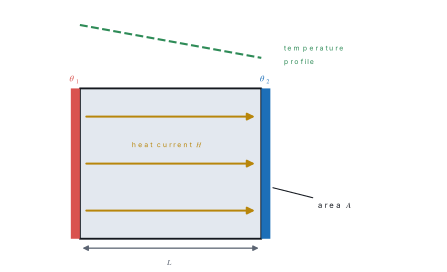
It is often convenient to write the law like Ohm's law. Defining the thermal resistance R = L/(kA),
so that temperature difference plays the part of potential difference and heat current the part of electric current. Slabs one behind the other are in series, and their thermal resistances simply add: R = R_1 + R_2 + \cdots. This single idea handles every composite-wall problem.
| Material | k / W m⁻¹ K⁻¹ | Material | k / W m⁻¹ K⁻¹ |
|---|---|---|---|
| Silver | 420 | Glass | 0.8 |
| Copper | 390 | Brick | 0.6 |
| Aluminium | 240 | Water | 0.6 |
| Brass | 110 | Wood | 0.15 |
| Steel | 50 | Air (still) | 0.024 |
Measuring k of a good conductor: Searle's method
A thick lagged bar of the metal is heated at one end by a steam chest and cooled at the other by water flowing steadily through a spiral. Two thermometers \theta_1 and \theta_2 sit in holes a measured distance x apart along the bar; two more read the inlet and outlet temperatures \theta_3 and \theta_4 of the water.
We start from the fact that in the steady state the water carries away exactly the heat the bar delivers, and reach a formula for k in terms of things we can measure.
Setting up. A is the cross-sectional area of the bar, x the distance between the two thermometers in it, c_w the specific heat capacity of water, and m the mass of water collected in time t.
Step 1 — the heat conducted along the bar between the two thermometers. Apply the conduction equation to the length x of bar between them:
Step 2 — the heat gained by the water. A mass m of water rises in temperature from \theta_3 to \theta_4, so it absorbs heat Q = mc_w(\theta_4 - \theta_3). Dividing by the time t gives the rate:
Step 3 — set them equal. In the steady state nothing in the bar is getting hotter, so none of the heat stays behind, and the lagging stops any escaping sideways. Everything conducted in is carried out by the water:
Step 4 — multiply both sides by x:
Step 5 — divide both sides by A(\theta_1 - \theta_2):
Result.
What it means. Every symbol on the right can be measured in the laboratory: m by weighing the collected water, t by a stopwatch, the four temperatures by thermometers, and x and A by a ruler and a micrometer. Note which temperature difference goes where — (\theta_1-\theta_2) belongs to the bar, (\theta_4-\theta_3) to the water.
Conditions used. A true steady state (all four thermometer readings constant), perfect lagging so no heat leaks from the sides, and a steady flow of water.
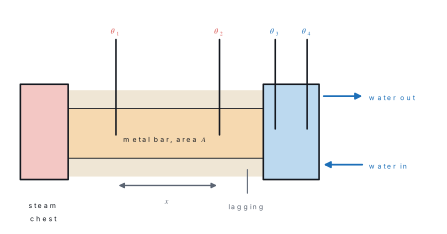
For a bad conductor such as glass, cardboard or rubber, Searle's bar is useless: the flow would be far too small to measure. Lee's disc method is used instead. The specimen is made a thin disc of large area sandwiched between a steam chamber and a thick brass disc, so that the heat flows through a short distance and a wide area.
The derivation of H = kA\Delta\theta/L assumes that all the heat entering one face leaves the other. If the bar is not lagged, heat escapes sideways, the temperature gradient stops being uniform, and k comes out too small. In every diagram you draw, show the lagging and say what it is for.
Problem. A glass window measures 1.5\ \text{m}\times1.0\ \text{m} and is 4.0 mm thick. The inner surface is at 25\ ^\circC and the outer at 5\ ^\circC. Taking k_{glass}=0.80\ \text{W m}^{-1}\text{K}^{-1}, find the rate of heat loss.
Solution. A = 1.5\times1.0 = 1.5\ \text{m}^2, L = 4.0\times10^{-3} m and \Delta\theta = 20 K.
Six kilowatts through one window is absurdly large, and it tells us the assumption is wrong: the glass surfaces are not at room and outdoor temperature. Thin films of still air on each side, with k only 0.024, provide nearly all the real thermal resistance.
Problem. A copper rod (k = 390) and a brass rod (k = 110\ \text{W m}^{-1} \text{K}^{-1}) of equal length and equal cross-section are joined end to end. The free end of the copper is kept at 100\ ^\circC and the free end of the brass at 0\ ^\circC. Find the steady temperature of the junction. The sides are perfectly lagged.
Solution. In the steady state the same heat current passes through both rods. With equal A and equal L, and junction temperature \theta:
In general \theta = (k_1\theta_1+k_2\theta_2)/(k_1+k_2) for equal rods: the junction sits closer to the temperature of the better conductor.
12.2 Convection
Convection is the transfer of heat through a fluid by the bulk movement of the heated fluid itself.
Warm a fluid from below and it expands, becomes less dense, and is pushed up by the denser cold fluid around it, which then takes its place and is warmed in turn. The resulting circulation is a convection current. Because the material itself has to move, convection is impossible in solids and impossible in a vacuum.
| Natural convection | Forced convection | |
|---|---|---|
| Cause of motion | density difference and gravity | pump, fan or blower |
| Speed | slow | fast |
| Example | air above a heater, boiling water | radiator fan, hair dryer, blood circulation |
The rate of convective loss from a surface is roughly proportional to the excess temperature, H = hA(\theta-\theta_0), where h is the convection coefficient. This is precisely Newton's law of cooling from Unit 11 — Newton's law is a law of convection, which is why it fails when radiation takes over at high temperature.
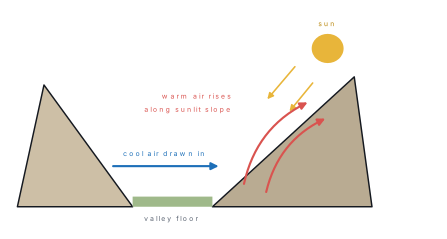
Convection explains a long list of everyday things: the up-valley wind that blows through Pokhara and Kathmandu on a sunny afternoon and reverses at night; land and sea breezes; the draught up a chimney; the circulation of water in a solar water heater on a rooftop, which needs no pump because hot water rises on its own; why a room heater is placed low and an air conditioner high; and why the trapped air in a woollen sweater keeps you warm — the wool stops the air from convecting away.
12.3 Radiation: Ideal radiator
The Earth receives energy from the Sun across 150 million kilometres of vacuum, so there must be a third mechanism that needs no matter at all.
Thermal radiation is energy emitted by every body on account of its temperature, carried by electromagnetic waves — mainly infrared for bodies near room temperature.
Radiation travels at 3\times10^{8}\ \text{m s}^{-1}, obeys the inverse-square law, and can be reflected and refracted like light. Prevost's theory of heat exchange states that every body above absolute zero radiates continuously, whatever its surroundings; a body appears to cool only because it emits more than it absorbs, and at thermal equilibrium the two rates are equal.
When radiation falls on a body, part is absorbed, part reflected and part transmitted. Writing each as a fraction of the incident energy,
A perfect black body is one that absorbs all the radiation of every wavelength falling on it, so that a = 1 and r = t = 0. At a given temperature it is also the best possible emitter at every wavelength.
That the best absorber is also the best emitter is Kirchhoff's law: at a given temperature and wavelength, the ratio of emissive power to absorptive power is the same for all bodies and equals the emissive power of a black body. The everyday proof is a glazed white cup with a coloured pattern: heat it in a furnace and the pattern, which absorbs best, glows brightest.
No real surface is perfectly black — lamp black absorbs about 96 %. A practical black body is made instead as a cavity: Ferry's black body is a double-walled copper sphere, blackened with lamp black inside, with a small hole and a conical projection opposite it. Radiation entering the hole is reflected many times inside and absorbed almost completely before it can find its way out, so the hole behaves as a black surface. Heat the sphere and the same hole becomes an ideal radiator.
The emissivity e of a real surface is the ratio of its emissive power to that of a black body at the same temperature, so 0 \le e \le 1, with e = 1 for a black body. By Kirchhoff's law e = a.
12.4 Black-body radiation
A black body does not radiate at one wavelength only. Measuring how the emitted power is distributed over wavelength gives the black-body spectrum, first measured accurately by Lummer and Pringsheim.
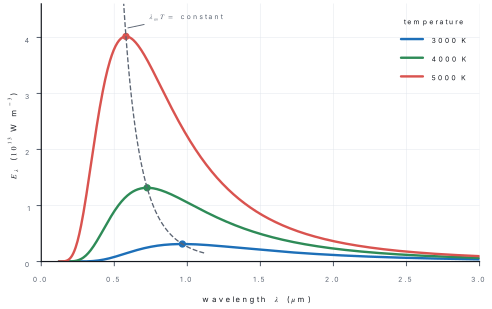
Four features of these curves must be quoted:
- The spectrum is continuous: energy is emitted at every wavelength.
- Each curve rises to a single maximum at a wavelength \lambda_m and falls away on both sides; the emission is very small at very short and very long wavelengths.
- As the temperature rises, \lambda_m shifts towards shorter wavelengths. This is Wien's displacement law:
- The area under a curve is the total power radiated per unit area, and it increases very rapidly with temperature — as T^4, which is the next section.
Wien's law is why a heated iron bar glows dull red, then orange, then white as it gets hotter, and why the blue star Rigel is hotter than the red star Betelgeuse. Classical physics could not reproduce these curves at all; it predicted that the emission should grow without limit at short wavelengths (the ultraviolet catastrophe). Planck fixed it in 1900 by assuming that energy is emitted in discrete quanta E = h\nu — the beginning of quantum theory.
Problem. The Sun radiates most strongly at \lambda_m = 500 nm. Treating it as a black body, find (a) its surface temperature and (b) the power radiated per square metre of its surface. Take b = 2.898\times10^{-3}\ \text{m K} and \sigma = 5.67\times10^{-8}\ \text{W m}^{-2}\text{K}^{-4}.
Solution. (a) From Wien's displacement law,
(b) From Stefan's law, with T = 5796 K,
12.5 Stefan-Boltzmann law
The total energy radiated per second per unit area by a perfect black body is directly proportional to the fourth power of its absolute temperature:
where \sigma = 5.67\times10^{-8}\ \text{W m}^{-2}\text{K}^{-4} is the Stefan-Boltzmann constant.
For a body of surface area A and emissivity e the total power radiated is P = e\sigma AT^{4}. But the body is also absorbing from its surroundings at T_0, at a rate e\sigma AT_0^{4} by Prevost's theory. The net rate of loss is therefore
T in Stefan's law is the absolute temperature. Putting degrees Celsius into T^4 is the single commonest error in this unit — and because of the fourth power, the answer is not slightly wrong, it is wrong by orders of magnitude. Convert first, every time.
We start from the net rate of radiation loss and reach Newton's law of cooling, valid when the body is only a little hotter than its surroundings.
Step 1 — write the body's temperature as surroundings plus a small excess. Let \Delta T = T - T_0 be that excess:
Step 2 — put this into the net-loss formula:
Step 3 — take T_0 outside the first bracket so we can use the binomial expansion:
Step 4 — expand by the binomial theorem. Since \Delta T/T_0 is small, we keep only the first power of it:
Step 5 — substitute that back. The two 1's cancel:
Step 6 — cancel one factor of T_0:
Step 7 — recognise that everything except \Delta T is constant. e, \sigma, A and T_0 all stay fixed while the body cools, so
Result. The rate of heat loss, and therefore the rate of fall of temperature, is proportional to the excess temperature — which is exactly Newton's law of cooling, with k identified as 4e\sigma A T_0^{3}/(mc).
What it means. Newton's law is not a separate law of nature; it is Stefan's T^{4} law seen through a narrow window of small temperature differences.
Condition used. \Delta T \ll T_0 — this is the only reason we were allowed to stop the binomial expansion after the first term. For a large excess temperature the T^{4} law must be used in full, and Newton's law fails.
Problem. A blackened metal sphere of radius 5.0 cm is maintained at 327\ ^\circC in a room at 27\ ^\circC. Taking it as a perfect black body, find the net rate at which it loses energy by radiation.
Solution. Convert to kelvin: T = 327+273 = 600 K and T_0 = 27+273 = 300 K.
Surface area of the sphere:
Fourth powers: T^4 = (600)^4 = 1.296\times10^{11} and T_0^4 = (300)^4 = 8.10\times10^{9}, so T^4 - T_0^4 = 1.215\times10^{11}\ \text{K}^4.
Note that doubling the absolute temperature multiplied the emission by 2^4 = 16: the surroundings contribute only about 6 % of what the sphere emits.
A vacuum flask now makes complete sense. The double wall with the space evacuated stops conduction and convection; the silvered surfaces have a very low emissivity and so radiate and absorb very little; and the narrow insulating stopper blocks the only remaining conduction path.
Chapter summary
- Steady conduction: H = kA(\theta_1-\theta_2)/L = -kA\,d\theta/dx; thermal conductivity k is in W m⁻¹ K⁻¹.
- Thermal resistance R = L/(kA); resistances of slabs in series add, and H = \Delta\theta/R.
- Searle's method measures k for good conductors: k = mc_w(\theta_4-\theta_3)x/[A(\theta_1-\theta_2)t]; Lee's disc is used for bad conductors.
- Convection needs a moving fluid; natural convection is driven by density differences, forced convection by a fan or pump. Newton's law of cooling is a convection law.
- Radiation needs no medium. a+r+t=1; a perfect black body has a = e = 1; Kirchhoff's law says good absorbers are good emitters; Prevost's theory says emission never stops.
- Black-body curves are continuous with one maximum; Wien's displacement law gives \lambda_m T = 2.898\times10^{-3} m K.
- Stefan-Boltzmann law: E = \sigma T^4 with \sigma = 5.67\times10^{-8}\ \text{W m}^{-2}\text{K}^{-4}; net loss P = e\sigma A(T^4-T_0^4), with T in kelvin.
Practice questions
Group A — Multiple choice (1 mark each)
- The SI unit of thermal conductivity is [1]aW m⁻¹ K⁻¹bW m⁻² K⁻⁴cJ kg⁻¹ K⁻¹dW m K
- If the absolute temperature of a black body is doubled, the energy it radiates per second becomes [1]a2 timesb4 timesc8 timesd16 times
- A good absorber of radiation is also a good emitter. This is [1]aStefan's lawbWien's lawcKirchhoff's lawdPrevost's theory
- Heat transfer by convection cannot take place in [1]awaterbairca soliddany fluid
- The wavelength of maximum emission from a black body at 2000 K is about 1450 nm. At 4000 K it will be about [1]a5800 nmb2900 nmc725 nmd1450 nm
Answers to Group A
1. (a) — from H = kA\Delta\theta/L, k has units W m⁻¹ K⁻¹.
2. (d) — E \propto T^4, and 2^4 = 16.
3. (c) — Kirchhoff's law, e = a.
4. (c) — convection needs the material itself to move, which a solid cannot do.
5. (c) — \lambda_m \propto 1/T, so doubling T halves \lambda_m.
Group B — Short answer (5 marks each)
- Define thermal conductivity and derive H = kA(\theta_1-\theta_2)/L for steady conduction through a slab. Why must the slab be lagged? [5]
- A wall of area 10\ \text{m}^2 is made of 12 cm of brick (k = 0.60\ \text{W m}^{-1}\text{K}^{-1}) covered on the outside with 4.0 cm of insulating board (k = 0.050\ \text{W m}^{-1}\text{K}^{-1}). The inside surface is at 25\ ^\circC and the outside surface at 5\ ^\circC. Find the rate of heat flow and the temperature of the junction. [5]
- Distinguish between natural and forced convection, and explain why a thermos flask has a vacuum between its walls and silvered surfaces. [5]
- A black body of surface area 20\ \text{cm}^2 is kept at 527\ ^\circC in surroundings at 27\ ^\circC. Find the net rate of loss of heat by radiation. [5]
Answers to Group B
1. Outline: define k as in §12.1; state H \propto A and H \propto \Delta\theta/L in the steady state; combine to H = kA\Delta\theta/L. Lagging ensures no heat escapes through the sides, so the heat current is the same at every cross-section and the gradient is uniform.
2. R_1 = L_1/(k_1A) = 0.12/(0.60\times10) = 0.020\ \text{K W}^{-1} and R_2 = 0.040/(0.050\times10) = 0.080\ \text{K W}^{-1}, so R = 0.100\ \text{K W}^{-1}. Then H = \Delta\theta/R = 20/0.100 = 200 W. Junction temperature \theta = 25 - HR_1 = 25 - 200\times0.020 = 21\ ^\circC. (Check: (21-5)/0.080 = 200 W.)
3. Natural convection is driven by the density change of the fluid itself in a gravitational field; forced convection is driven by an external pump or fan and is much faster. In a flask the vacuum removes the matter that conduction and convection need, and the silvering gives a very low emissivity so that little is radiated or absorbed.
4. A = 20\times10^{-4} = 2.0\times10^{-3}\ \text{m}^2, T = 800 K, T_0 = 300 K. T^4 - T_0^4 = 4.096\times10^{11} - 8.1\times10^{9} = 4.015\times10^{11}. So P = 5.67\times10^{-8}\times2.0\times10^{-3}\times4.015\times10^{11} = 45.5 W.
Group C — Long answer (8 marks each)
- (a) Describe Searle's method for determining the thermal conductivity of a good conductor, with a labelled diagram, and derive the working formula. [6](b) State two reasons why the method is unsuitable for glass. [2]
- (a) Draw the energy distribution curves of black-body radiation for three temperatures and state the conclusions drawn from them. [4](b) A star radiates most strongly at 350 nm and has a radius of 7.0\times10^{8} m. Find its surface temperature and its total power output, treating it as a black body. [4]
Answers to Group C
1. (a) Diagram and theory as in §12.1; the working formula is k = mc_w(\theta_4-\theta_3)x/[A(\theta_1-\theta_2)t], obtained by equating the heat conducted between the two bar thermometers to the heat carried away by the water. (b) Glass has a very small k, so the heat collected by the water in a reasonable time would be too small to measure, and the temperature difference \theta_4-\theta_3 would be lost in the experimental error; also, a long thin glass bar would lose most of the heat sideways despite lagging.
2. (a) Curves as in Figure 4, with the four conclusions of §12.4. (b) T = b/\lambda_m = 2.898\times10^{-3}/(350\times10^{-9}) = 8280 K. Surface area A = 4\pi R^2 = 4\pi(7.0\times10^{8})^2 = 6.16\times10^{18}\ \text{m}^2. With T^4 = (8280)^4 = 4.70\times10^{15}, P = \sigma AT^4 = 5.67\times10^{-8}\times6.16\times10^{18}\times4.70\times10^{15} = 1.6\times10^{27}\ \text{W}.
Practise more: Physics question bank