Unit 22 · Electricity and Magnetism · 7 teaching hours · 25 min read
Capacitor
What the syllabus asks for 5
- Capacitance and capacitor
- Parallel plate capacitor
- Combination of capacitors
- Energy of charged capacitor
- Effect of a dielectric: Polarization and displacement
A capacitor is the simplest device that stores electrical energy in a field rather than in a chemical reaction. Two conductors, a thin insulating gap, and you have something that can hold charge, smooth a power supply, time a circuit, or deliver the huge pulse that fires a camera flash. This is the longest unit in the electricity section, and it rewards careful work: the derivations are short, the network problems are routine once you know the two combination rules, and almost every NEB paper carries a capacitor numerical.
C = Q/V defines capacitance, C = \varepsilon_0 A/d describes the standard parallel-plate capacitor, and U = \frac{1}{2}CV^{2} gives the stored energy. Everything else in this unit is an application of one of these three.
22.1 Capacitance and capacitor
Give an isolated conductor a charge Q and its potential rises to V. Experiment shows the two are proportional, Q \propto V, so the ratio is a constant of the conductor:
The capacitance of a conductor is the charge required to raise its potential by one unit:
Its SI unit is the farad (F), where 1\ \text{F} = 1\ \text{C V}^{-1}.
The farad is enormous, so practical values are given in microfarad (1\ \mu\text{F} = 10^{-6}\ \text{F}), nanofarad (10^{-9}\ \text{F}) or picofarad (10^{-12}\ \text{F}).
For an isolated sphere of radius R we already know V = kQ/R, so
Capacitance therefore depends only on geometry and the surrounding medium, never on how much charge you happen to have put on. (As a scale check, the whole Earth, R = 6.4\times10^{6}\ \text{m}, has C = 6.4\times10^{6}/9\times10^{9} = 711\ \mu\text{F} — smaller than a capacitor you can buy in Kathmandu for a few rupees.)
A capacitor is an arrangement of two conductors separated by an insulator, designed to store charge and electrical energy. The conductors carry equal and opposite charges +Q and -Q, and Q means the magnitude on one plate.
Bringing an earthed conductor close to a charged plate lowers its potential without changing its charge, and so raises its capacitance. That is the whole idea of a practical capacitor: two plates close together hold far more charge per volt than either plate alone.
22.2 Parallel plate capacitor
Two flat metal plates of area A a distance d apart, with d small compared with the size of the plates, form the standard capacitor.
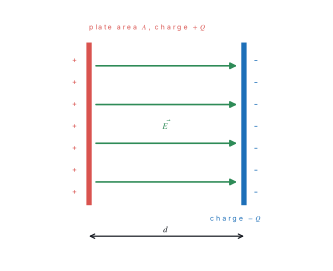
We start from the field of a charged sheet and reach a formula for the capacitance in terms of the plate area and the separation only.
Setting up. Two flat metal plates, each of area A, face each other a distance d apart with air (or vacuum) between them. One carries charge +Q, the other -Q. The plates are large and d is small, so we may treat the field between them as uniform and ignore the bulging of the field at the edges.
Step 1 — express the charge as a surface charge density. Spreading Q evenly over the area A gives
Step 2 — write the field of one plate alone. From Gauss's law, a thin sheet with charge density \sigma produces a field on each side of
Step 3 — add the two fields in the region between the plates. The positive plate pushes a test charge away from itself, and the negative plate pulls it towards itself. Between the plates both effects point the same way, from + to -, so the two fields add:
(Outside the plates the same two fields point in opposite directions and cancel, which is why a capacitor keeps its field neatly inside itself.)
Step 4 — add the fractions.
Step 5 — put back \sigma = Q/A from Step 1.
Step 6 — convert the field into a potential difference. The field is uniform, so the potential gradient E = V/d from Unit 21 applies, and
Step 7 — substitute the field found in Step 5.
Step 8 — use the definition of capacitance, C = Q/V.
Step 9 — dividing by a fraction is multiplying by its reciprocal.
Step 10 — cancel Q from top and bottom.
Result. The capacitance of a parallel plate air capacitor is C = \varepsilon_0 A/d.
What it means. The charge Q cancelled, so capacitance is a property of the shape and size of the capacitor, not of how much charge you happen to put on it. Bigger plates or a smaller gap store more charge per volt.
Conditions used. Uniform field (large plates, small separation, edge effects ignored) and vacuum or air between the plates.
So capacitance rises if you increase the plate area or decrease the separation, and it does not depend on Q or V. Filling the gap with an insulating material of relative permittivity \varepsilon_r multiplies it:
We start from the same two plates and reach the capacitance when a slab of dielectric of thickness t (with t < d) fills only part of the gap.
Setting up. The gap of width d now contains a slab of thickness t and dielectric constant \varepsilon_r; the remaining thickness d - t is still air. Let E_0 = \sigma/\varepsilon_0 be the field in the air part, which is the same as before because the charge on the plates is unchanged.
Step 1 — write the field inside the slab. The polarised molecules of the dielectric set up their own opposing field, which weakens the original field by the factor \varepsilon_r:
Step 2 — the total potential difference is the sum of the drops across the two regions. Potential drop equals field \times distance in each uniform region, so
Step 3 — substitute the slab field from Step 1.
Step 4 — take E_0 out as a common factor.
Step 5 — replace E_0 by Q/\varepsilon_0 A, using Step 5 of the previous derivation.
Step 6 — apply C = Q/V and cancel Q.
Result. With a partly filling slab,
What it means. The bracket in the denominator is smaller than d, because t/\varepsilon_r < t. A smaller denominator means a larger C, so inserting a dielectric always raises the capacitance. Two checks: putting t = 0 gives back \varepsilon_0 A/d, and putting t = d gives \varepsilon_0\varepsilon_r A/d, exactly as expected.
Conditions used. The slab lies parallel to the plates and fills the whole area A; the charge Q on the plates is unchanged; edge effects ignored.
- \sigma = Q/A and the field of a single sheet, \sigma/2\varepsilon_0.
- The reason the two fields add between the plates (and cancel outside).
- V = Ed, with a statement that the field is uniform.
- The definition C = Q/V and the cancellation of Q — this is the step that shows capacitance is independent of charge.
- For the slab: the potential difference written as a sum of two drops, V = E_0(d-t) + (E_0/\varepsilon_r)t.
Problem. A parallel plate capacitor has plates of area 100\ \text{cm}^{2} separated by 1\ \text{mm} of air. Find (a) its capacitance, (b) the charge stored at 100\ \text{V}, (c) the field between the plates, and (d) the new capacitance if the gap is filled with mica of \varepsilon_r = 6.
Solution. A = 100\ \text{cm}^{2} = 1.0\times10^{-2}\ \text{m}^{2} and d = 1.0\times10^{-3}\ \text{m}.
(a) C = \dfrac{\varepsilon_0 A}{d} = \dfrac{8.85\times10^{-12}\times1.0\times10^{-2}}{1.0\times10^{-3}} = 8.85\times10^{-11}\ \text{F} = 88.5\ \text{pF}.
(b) Q = CV = 8.85\times10^{-11}\times100 = 8.85\times10^{-9}\ \text{C} = 8.85\ \text{nC}.
(c) E = \dfrac{V}{d} = \dfrac{100}{1.0\times10^{-3}} = 1.0\times10^{5}\ \text{V m}^{-1}.
(d) C' = \varepsilon_r C = 6\times88.5 = 531\ \text{pF}.
22.3 Combination of capacitors
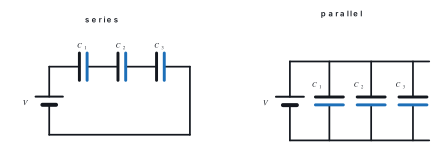
We start from the two facts that fix a series chain — same charge, shared voltage — and reach the rule for the single capacitor that could replace them.
Setting up. Three capacitors C_1, C_2, C_3 are joined end to end across a supply of potential difference V. Let the p.d. across them be V_1, V_2 and V_3.
Step 1 — state why the charge is the same on all three. The battery puts +Q on the first plate. Charge cannot jump across the insulating gap, so the facing plate gains -Q by induction, its partner on the next capacitor gains +Q, and so on down the chain. Hence every capacitor carries the same charge:
Step 2 — state why the voltages add. Going from one end of the chain to the other, the total drop in potential is the sum of the individual drops:
Step 3 — write each voltage using C = Q/V, rearranged as V = Q/C.
Step 4 — substitute these into Step 2.
Step 5 — write the same total voltage for the single equivalent capacitor. By definition C_{eq} is the one capacitor that would take the same charge Q at the same total voltage V:
Step 6 — set the two expressions for V equal.
Step 7 — divide every term by Q. The charge is the same everywhere (Step 1), so this one division clears it from the whole equation:
Result. For capacitors in series the reciprocals add: 1/C_{eq} = 1/C_1 + 1/C_2 + 1/C_3.
What it means. Adding another capacitor in series adds another positive term to the right-hand side, so 1/C_{eq} grows and C_{eq} shrinks. A series combination is therefore always smaller than the smallest capacitor in it — use it when you need the chain to withstand a high voltage, not to store more charge.
Conditions used. Step 1 needs the capacitors to be genuinely in series, with nothing else connected to the junctions between them, so that no charge can leak away sideways.
We start from the two facts that fix a parallel group — same voltage, shared charge — and reach the rule for the single replacement capacitor.
Setting up. Three capacitors C_1, C_2, C_3 have all their left plates joined to one terminal and all their right plates joined to the other. Let them carry charges Q_1, Q_2, Q_3.
Step 1 — state why the voltage is the same across all three. Each capacitor has its two plates connected directly to the two terminals of the supply, so each one feels the full supply voltage:
Step 2 — state why the charges add. The total charge the supply pushes out is shared among the three capacitors:
Step 3 — write each charge using C = Q/V, rearranged as Q = CV.
Step 4 — substitute these into Step 2.
Step 5 — write the same total charge for the single equivalent capacitor.
Step 6 — set the two expressions for Q equal.
Step 7 — divide every term by V. The voltage is the same everywhere (Step 1), so it cancels right through:
Result. For capacitors in parallel the capacitances simply add, C_{eq} = C_1 + C_2 + C_3.
What it means. Connecting capacitors in parallel is the same as building one capacitor with a bigger plate area, and C = \varepsilon_0 A/d says bigger area means bigger capacitance. The total is always larger than the largest member.
Conditions used. All the capacitors must share the same pair of nodes, and each must be able to withstand the full supply voltage.
- A clear statement, with a reason, of what is common: same Q in series (induction, charge cannot cross the gap), same V in parallel (both plates on the terminals).
- The matching sum: V = V_1+V_2+V_3 in series, Q = Q_1+Q_2+Q_3 in parallel.
- Substituting V = Q/C or Q = CV for each capacitor.
- The definition of C_{eq} as the single capacitor that behaves the same way.
- The final division by Q (series) or V (parallel).
| Series | Parallel | |
|---|---|---|
| Same for all | charge Q | potential difference V |
| Shared | potential difference | charge |
| Rule | 1/C_{eq} = \sum 1/C_i | C_{eq} = \sum C_i |
| Result | less than the smallest | more than the largest |
| Used to | withstand a higher voltage | obtain a larger capacitance |
For resistors the series rule is the simple sum; for capacitors it is the parallel rule. Students who learn DC circuits first regularly swap them. Check your answer: a series combination must always come out smaller than the smallest capacitor in it.
Problem. A 6\ \mu\text{F} capacitor is joined in series with a parallel pair of 3\ \mu\text{F} capacitors, and the combination is connected across 60\ \text{V}. Find the equivalent capacitance, the charge on each capacitor and the p.d. across each.
Solution. The parallel pair first: C_p = 3 + 3 = 6\ \mu\text{F}.
In series with the 6\ \mu\text{F}:
Total charge: Q = C_{eq}V = 3\times10^{-6}\times60 = 180\ \mu\text{C}.
This whole charge sits on the series 6\ \mu\text{F}, so its p.d. is V_1 = 180/6 = 30\ \text{V}. The remaining 60 - 30 = 30\ \text{V} appears across the parallel pair, and each 3\ \mu\text{F} there carries
As a check, 90 + 90 = 180\ \mu\text{C}, matching the series charge.
22.4 Energy of charged capacitor
Charging a capacitor is not free: each extra bit of charge must be pushed onto a plate that is already charged and repelling it.
We start from the work needed to move one more small piece of charge onto a partly charged capacitor, and we reach the total energy stored.
Setting up. The capacitor starts completely uncharged. The battery moves charge from one plate to the other a little at a time until the final charge is Q and the final p.d. is V.
Step 1 — write the p.d. at a moment when the charge so far is q. From the definition C = q/v:
Notice that v grows as q grows. Each extra bit of charge is harder to push on than the one before, so we cannot just write "work = QV".
Step 2 — write the work needed for one extra small charge dq. Work equals charge moved times the p.d. it is moved through, and dq is small enough that v does not change during it:
Step 3 — substitute v from Step 1.
Step 4 — add up all these small amounts of work, from empty to full. The charge on the plates runs from 0 to Q:
Step 5 — take the constant C outside the integral. The capacitance does not change while the capacitor charges:
Step 6 — integrate q.
Step 7 — substitute the limits, upper minus lower.
Step 8 — the second term is zero.
Step 9 — this work is not lost; it is stored in the field between the plates. So the energy stored is
Step 10 — get the second form. Replace one of the two Q factors using Q = CV:
Step 11 — cancel C.
Step 12 — get the third form. Replace Q by CV once more:
Result. The energy stored in a charged capacitor is
What it means. The three forms are the same energy; pick the one whose two quantities you already know. The factor \frac{1}{2} appears because the average p.d. during charging is only half the final value — the first charge is moved across almost no p.d., the last across the full V.
Conditions used. The capacitance C is constant during charging (no dielectric is moved, no plate separation changed), and none of the energy counted here includes the heat lost in the connecting wires and the battery.
The factor \frac{1}{2} is not arbitrary. On a graph of Q against V the energy is the area under the line, and the line is straight through the origin, so the area is a triangle.
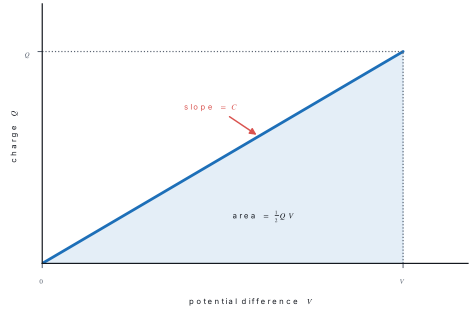
Energy density
Where is the energy? In the field. For a parallel plate capacitor, put C = \varepsilon_0A/d and V = Ed into U = \frac{1}{2}CV^{2}:
Since Ad is the volume between the plates, the energy stored per unit volume is
This turns out to be true of any electrostatic field, not just this one.
Energy lost in sharing charge
Connect a capacitor C_1 at V_1 to a capacitor C_2 at V_2. Charge is conserved, so the common final potential is
Comparing the energy before and after gives a loss of
which is always positive. The "missing" energy is dissipated as heat in the connecting wires and as a small amount of electromagnetic radiation — it is never recovered.
Problem. A 10\ \mu\text{F} capacitor is charged to 200\ \text{V} and then disconnected from the supply and joined to an uncharged 10\ \mu\text{F} capacitor. Find the common potential difference, the energy before and after, and the energy lost.
Solution. Initial charge: Q = 10\times10^{-6}\times200 = 2.0\times10^{-3}\ \text{C}.
Common p.d.:
Energy before: U_i = \tfrac{1}{2}(10\times10^{-6})(200)^{2} = 0.20\ \text{J}.
Energy after: U_f = \tfrac{1}{2}(20\times10^{-6})(100)^{2} = 0.10\ \text{J}.
Loss = 0.10\ \text{J}, i.e. half the original energy. The formula agrees:
22.5 Effect of a dielectric: Polarization and displacement
A dielectric is an insulator placed between the plates. It has no free electrons, but its molecules respond to the field.
- Non-polar molecules (H₂, O₂, CO₂) have no permanent dipole. The field pulls the electron cloud one way and the nucleus the other, inducing a dipole.
- Polar molecules (H₂O, HCl) already possess a dipole moment. The field simply turns them so that they line up with it, against the randomising effect of thermal motion.
Either way the slab acquires a net dipole moment per unit volume. This is called the polarization \vec{P}. Inside the bulk, neighbouring dipoles cancel, but on the two faces uncancelled bound charges appear — negative on the face towards the positive plate and positive on the other. Their surface density equals the polarization, \sigma_p = P.
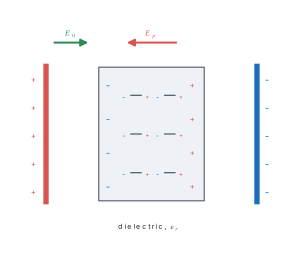
The bound charges produce their own field E_p opposing the original field E_0, so the net field inside the dielectric is reduced:
The number \varepsilon_r (also written K) is the dielectric constant or relative permittivity. Since V = Ed falls by the same factor while Q is unchanged, the capacitance rises:
| Material | \varepsilon_r | Material | \varepsilon_r |
|---|---|---|---|
| Vacuum | 1 (exactly) | Mica | 6 |
| Air | 1.0006 | Glass | 5–10 |
| Paper | 3.7 | Water | 80 |
Electric displacement
Inside a dielectric two kinds of charge exist: free charge on the plates and bound charge on the dielectric faces. It is convenient to define a vector that responds only to the free charge, the electric displacement:
Its magnitude equals the free surface charge density, D = \sigma_{free}, and its unit is C m⁻². Gauss's law then takes the compact form
so the bound charges never have to be counted explicitly.
Every dielectric also has a dielectric strength — the largest field it can withstand before it ionises and conducts. For air this is about 3\times10^{6}\ \text{V m}^{-1}, which is why a capacitor is rated for a maximum working voltage as well as a capacitance.
The effect of inserting a dielectric depends entirely on what is held fixed.
| Quantity | Battery still connected (V fixed) | Battery removed (Q fixed) |
|---|---|---|
| C | \times\varepsilon_r | \times\varepsilon_r |
| Q | \times\varepsilon_r | unchanged |
| V | unchanged | \div\varepsilon_r |
| E | unchanged | \div\varepsilon_r |
| U | \times\varepsilon_r | \div\varepsilon_r |
Decide which column applies before you start the arithmetic.
Problem. A parallel plate capacitor has plates of area 100\ \text{cm}^{2} separated by 5\ \text{mm}. A slab of thickness 3\ \text{mm} and dielectric constant 3 is inserted between the plates. Find the capacitance before and after insertion.
Solution. A = 1.0\times10^{-2}\ \text{m}^{2}, d = 5.0\times10^{-3}\ \text{m}.
Before:
After, with t = 3.0\times10^{-3}\ \text{m} and \varepsilon_r = 3, the effective separation is
The slab raises the capacitance by a factor of 5/3, not by \varepsilon_r = 3, because it fills only part of the gap.
Chapter summary
- C = Q/V, unit farad (C V⁻¹); capacitance depends on geometry and medium only.
- Isolated sphere: C = 4\pi\varepsilon_0R.
- Parallel plate capacitor: E = \sigma/\varepsilon_0, V = Ed, and C = \varepsilon_0\varepsilon_r A/d. With a partial slab, C = \varepsilon_0A/(d - t + t/\varepsilon_r).
- Series: same Q, 1/C_{eq} = \sum 1/C_i, result smaller than the smallest. Parallel: same V, C_{eq} = \sum C_i, result larger than the largest.
- Stored energy U = \frac{Q^{2}}{2C} = \frac{1}{2}QV = \frac{1}{2}CV^{2}; it is the area under the Q–V line.
- Energy per unit volume of any electric field: u = \frac{1}{2}\varepsilon_0E^{2}.
- Sharing charge always wastes energy: \Delta U = C_1C_2(V_1-V_2)^{2}/2(C_1+C_2).
- A dielectric polarizes, producing bound surface charge \sigma_p = P which reduces the field to E_0/\varepsilon_r and multiplies C by \varepsilon_r. Displacement \vec{D} = \varepsilon_0\vec{E} + \vec{P} responds to free charge only.
Practice questions
Group A — Multiple choice (1 mark each)
- The SI unit of capacitance, the farad, is equivalent to [1]a\text{C V}b\text{C V}^{-1}c\text{V C}^{-1}d\text{J C}^{-1}
- Three capacitors each of 3\ \mu\text{F} are connected in series. The equivalent capacitance is [1]a9\ \mu\text{F}b3\ \mu\text{F}c1\ \mu\text{F}d0.33\ \mu\text{F}
- The energy stored in a capacitor of capacitance C at a p.d. V is [1]aCVbCV^{2}c\frac{1}{2}CV^{2}d\frac{1}{2}C^{2}V
- A charged capacitor is disconnected from the battery and a dielectric of constant K is inserted. The potential difference [1]abecomes K timesbbecomes 1/K timescis unchangeddbecomes zero
- The capacitance of a parallel plate capacitor does not depend on [1]aplate areabplate separationcthe dielectricdthe charge on the plates
Answers to Group A
1. (b) — from C = Q/V, coulomb per volt.
2. (c) — 1/C = 3/3 = 1, so C = 1\ \mu\text{F}.
3. (c) — the area of the triangle under the Q–V line.
4. (b) — Q is fixed, C becomes KC, so V = Q/C falls by K.
5. (d) — C is fixed by geometry and medium alone.
Group B — Short answer (5 marks each)
- Define capacitance and the farad. Derive an expression for the capacitance of a parallel plate capacitor with air between the plates. [5]
- Derive expressions for the equivalent capacitance of three capacitors connected(a) in series and(b) in parallel. [5]
- Show that the energy stored in a capacitor is \frac{1}{2}CV^{2}, and hence obtain the energy density of an electric field. [5]
- Capacitors of 2\ \mu\text{F}, 3\ \mu\text{F} and 6\ \mu\text{F} are joined in series across a 100\ \text{V} supply. Find the equivalent capacitance, the charge on each and the p.d. across each. [5]
- A 2\ \mu\text{F} capacitor charged to 100\ \text{V} is connected across an uncharged 3\ \mu\text{F} capacitor. Find the common potential and the energy lost. [5]
Answers to Group B
4. \dfrac{1}{C} = \dfrac{1}{2} + \dfrac{1}{3} + \dfrac{1}{6} = 1, so C_{eq} = 1\ \mu\text{F}. The charge is the same on each: Q = 1\times10^{-6}\times100 = 100\ \mu\text{C}. The potential differences are V = Q/C: 100/2 = 50\ \text{V}, 100/3 = 33.3\ \text{V} and 100/6 = 16.7\ \text{V}, which add to 100\ \text{V} as required.
5. Charge is conserved: V = \dfrac{C_1V_1}{C_1+C_2} = \dfrac{2\times100}{5} = 40\ \text{V}. U_i = \frac12(2\times10^{-6})(100)^{2} = 1.0\times10^{-2}\ \text{J}; U_f = \frac12(5\times10^{-6})(40)^{2} = 4.0\times10^{-3}\ \text{J}. Energy lost = 6.0\times10^{-3}\ \text{J}, which agrees with C_1C_2(V_1-V_2)^{2}/2(C_1+C_2).
Group C — Long answer (8 marks each)
- (a) Derive an expression for the capacitance of a parallel plate capacitor and show that inserting a dielectric slab of thickness t and dielectric constant K changes it to C = \varepsilon_0A/(d - t + t/K). [5](b) Explain, in terms of polarization, why a dielectric increases the capacitance. [3]
- (a) Derive an expression for the energy stored in a charged capacitor. [3](b) A 2\ \mu\text{F} and a 3\ \mu\text{F} capacitor are connected in parallel, and this combination is joined in series with a 5\ \mu\text{F} capacitor across a 50\ \text{V} supply. Find the equivalent capacitance, the charge on each capacitor, and the total energy stored. [5]
Answer to Group C question 2
(a) With charge q on the plates the p.d. is q/C, so dW = (q/C)dq and W = \int_0^Q (q/C)\,dq = Q^{2}/2C = \frac12 CV^{2}.
(b) Parallel section: C_p = 2 + 3 = 5\ \mu\text{F}. In series with 5\ \mu\text{F}: 1/C_{eq} = 1/5 + 1/5 = 2/5, so C_{eq} = 2.5\ \mu\text{F}.
Total charge Q = 2.5\times10^{-6}\times50 = 125\ \mu\text{C}, which is the charge on the 5\ \mu\text{F} capacitor. Its p.d. is 125/5 = 25\ \text{V}, so the parallel pair also has 25\ \text{V} across it. Hence Q_1 = 2\times25 = 50\ \mu\text{C} and Q_2 = 3\times25 = 75\ \mu\text{C} (and 50 + 75 = 125\ \mu\text{C}, as it must).
Total energy U = \frac12 C_{eq}V^{2} = \frac12(2.5\times10^{-6})(50)^{2} = 3.125\times10^{-3}\ \text{J} = 3.125\ \text{mJ}.
Practise more: Physics question bank