Unit 21 · Electricity and Magnetism · 4 teaching hours · 23 min read
Potential, potential difference and potential energy
What the syllabus asks for 3
- Potential difference, Potential due to a point charge, potential energy, electron volt
- Equipotential lines and surfaces
- Potential gradient
The electric field tells you the force on a charge. This unit tells you the energy. Because the electrostatic force is conservative — the work it does between two points does not depend on the path taken — we can attach a single number, the potential, to every point in space. Potential is a scalar, so it adds by ordinary arithmetic, which makes it far easier to handle than the field vector. Almost every practical device, from a torch cell to a cathode-ray tube, is described in volts rather than in newtons per coulomb.
The one advantage you must exploit: potentials from several charges add as signed numbers, with no angles and no components. If a question can be done with V instead of \vec{E}, do it with V.
21.1 Potential difference, Potential due to a point charge, potential energy, electron volt
Move a charge q slowly from point A to point B in an electric field. The external work needed, W_{AB}, is the same for every path (this is what "conservative" means). Divide it by the charge and the result depends only on the two points:
The potential difference between two points is the work done per unit positive charge in carrying it from one point to the other without acceleration:
Its SI unit is the volt: 1\ \text{V} = 1\ \text{J C}^{-1}.
Taking A at infinity, where we agree the potential is zero, gives the absolute potential at a point: the work done per unit positive charge in bringing it from infinity to that point.
Potential due to a point charge
We start from Coulomb's law for the force on a test charge, and we reach a formula for the potential at a point a distance r from an isolated charge Q.
Setting up. A charge Q is fixed at the point O. The point P lies a distance r from O. We bring a small positive test charge q_0 from infinity (where we agree the potential is zero) up to P, moving it so slowly that it never picks up any kinetic energy. By definition, the potential at P is the work the outside agent must do, per unit charge.
Step 1 — Coulomb's law gives the force at every point on the way. When the test charge is at a distance x from O, the field of Q pushes it outward with a force
This force is not constant. It grows as x gets smaller, so we cannot use "work = force \times distance". We must add up the work in tiny steps, which means an integral.
Step 2 — write the work done by the field over one tiny step. Measure x outward from O. The force acts along the direction of increasing x, so for a small displacement dx the work done by the field is
Over a step this small the force does not change, so here "work = force \times distance" is safe.
Step 3 — add up all the tiny steps from infinity down to P. The charge travels from x = \infty to x = r, and those become the limits of the integral:
Step 4 — take the constants outside. The quantities k, Q and q_0 do not change while the charge moves, so only 1/x^{2} stays inside:
Step 5 — carry out the integration. The integral of x^{-2} is -x^{-1}:
Step 6 — substitute the limits: value at the top limit minus value at the bottom limit.
Step 7 — the infinity term is zero. One divided by a very large number is as good as zero, and this is exactly why infinity is a convenient place to call "zero potential":
The minus sign is correct and physical. Two positive charges repel, so the field pushes backwards during the inward journey and does negative work.
Step 8 — find the work done by the outside agent. The agent pushes with a force equal and opposite to the field's force at every instant, which is what keeps the charge from speeding up. Equal and opposite force along the same path means equal and opposite work:
Step 9 — use the definition of potential: work per unit charge.
Step 10 — cancel q_0 from top and bottom.
Result. The absolute potential a distance r from a point charge Q is V = kQ/r, where k = 1/4\pi\varepsilon_0 = 9\times10^{9}\ \text{N m}^{2} \text{ C}^{-2}.
What it means. The test charge q_0 has cancelled out, so V belongs to the source charge Q and the point P alone — it describes the space around Q whether or not anything is placed there. The potential is a scalar, so it carries the sign of Q and nothing else: positive around a positive charge, negative around a negative one.
Conditions used. The charge Q is a point charge (or a uniformly charged sphere, seen from outside) at rest in vacuum or air; the potential is taken as zero at infinity; and the test charge is moved slowly, so no kinetic energy is gained or lost.
- A statement of the definition being used: V = W_{ext}/q_0, with zero potential at infinity.
- Coulomb's law written for a general distance x, with a clear reason for integrating (the force varies).
- The integral with the correct limits \infty to r.
- The integration and substitution of limits, including 1/\infty = 0.
- The step from W_{field} to W_{ext} (opposite sign), and the cancellation of q_0 giving V = kQ/r.
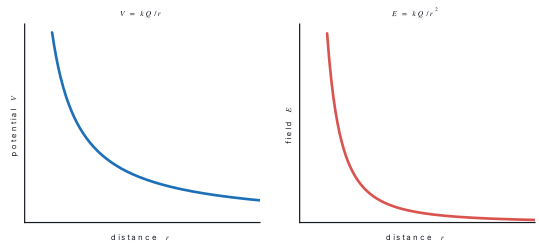
Note carefully: V \propto 1/r while E \propto 1/r^{2}. The potential is positive near a positive charge and negative near a negative charge, and it carries that sign into every sum. For several charges,
which is an ordinary algebraic sum — no resolution into components.
Electric potential energy
The potential energy of a charge q at a point where the potential is V is simply U = qV — the work stored in putting it there. For two point charges a distance r apart,
This is positive for like charges (you had to push them together, energy is stored) and negative for unlike charges (the field did the work for you, so you must supply energy to separate them). For a system of three charges, add the energy of each pair:
| Potential V | Potential energy U | |
|---|---|---|
| Belongs to | a point in space | a charge, or a system of charges |
| Defining relation | V = W/q | U = qV |
| SI unit | volt (J C⁻¹) | joule |
| Point charge | kQ/r | kq_1q_2/r (a pair) |
| Type | scalar | scalar |
Potential of a charged conducting sphere
A conducting sphere of radius R carrying charge Q behaves outside itself exactly like a point charge, so for r \geq R the potential is V = kQ/r. Inside the metal the field is zero, so by E = -dV/dr the potential cannot change: the whole sphere, surface and interior alike, sits at the single value
Two useful consequences follow. First, for a given charge a small sphere reaches a much higher potential than a large one, which is why charge sprayed onto a small conductor leaks away readily. Second, if two charged spheres are joined by a wire, charge flows until their potentials — not their charges — are equal. The smaller sphere ends with less charge but a larger surface density, and therefore a stronger surface field. This is the physics behind the pointed lightning conductors on the tall temples and towers of the Kathmandu valley: the sharp tip has a very small radius of curvature, so the field there becomes large enough to ionise the air and quietly discharge the cloud.
The electron volt
Charges on the atomic scale are tiny, so the joule is a clumsy unit.
One electron volt is the kinetic energy gained by an electron accelerated through a potential difference of one volt:
It is a unit of energy, not of potential. Useful multiples: 1 keV = 10³ eV, 1 MeV = 10⁶ eV. You will meet it again in nuclear physics.
"The potential at P is 100 J" is meaningless. Potential is measured in volts, potential energy in joules, and they are linked by U = qV. Likewise the electron volt is an energy, so never write "a p.d. of 5 eV".
Problem. Three charges of +2\ \mu\text{C} each are placed at the corners of an equilateral triangle of side 10\ \text{cm}. Find (a) the potential at the centroid and (b) the potential energy of the system.
Solution.
(a) The centroid is r = a/\sqrt{3} = 0.10/1.732 = 0.0577\ \text{m} from each charge. Potentials add algebraically:
(b) There are three identical pairs, each a distance a = 0.10\ \text{m} apart:
Problem. Charges +4\ \mu\text{C} and -4\ \mu\text{C} are fixed at A(0,0) and B(0.4\ \text{m}, 0). Find (a) the potential at P(0, 0.3\ \text{m}) and (b) the work needed to bring a charge of +2\ \mu\text{C} from infinity to P.
Solution.
(a) AP = 0.3\ \text{m} and BP = \sqrt{0.4^{2}+0.3^{2}} = 0.5\ \text{m}, so
(b) W = qV = 2\times10^{-6}\times4.8\times10^{4} = 9.6\times10^{-2}\ \text{J} = 0.096\ \text{J}.
Problem. An electron starting from rest is accelerated through a potential difference of 400\ \text{V}. Find its kinetic energy in eV and in joules, and its final speed. Take m_e = 9.1\times10^{-31}\ \text{kg}.
Solution. The work done on the electron is W = eV, so its kinetic energy is 400\ \text{eV}, that is
Then from KE = \tfrac{1}{2}m_ev^{2},
21.2 Equipotential lines and surfaces
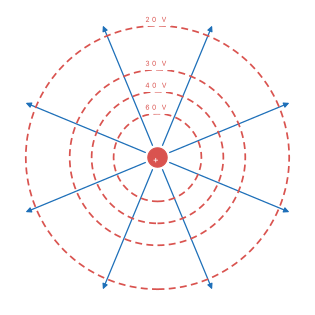
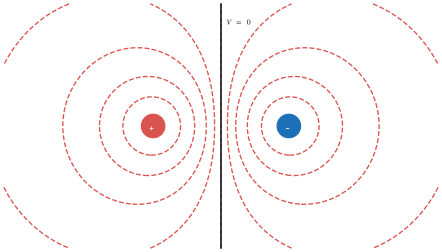
An equipotential surface is a surface on which the electric potential has the same value at every point. Its intersection with the plane of a diagram is an equipotential line.
Their properties follow directly from W = q(V_A - V_B):
- No work is done in moving a charge between two points of the same equipotential surface, because V_A - V_B = 0. This is true for any path on the surface.
- Equipotential surfaces are always perpendicular to field lines. If \vec{E} had a component along the surface, moving a charge along the surface would do work, contradicting the previous point.
- Two equipotential surfaces never intersect, since a point cannot have two potentials at once.
- Where the surfaces are closely spaced the field is strong, because the same drop in V occurs over a shorter distance.
- The surface of any charged conductor in equilibrium is an equipotential, and so is its whole interior volume, since E = 0 inside.
The first two properties are the ones examiners ask you to prove, so here they are in full.
We start from the definition of potential difference and reach two results: the work is zero for any path on the surface, and the field must meet the surface at a right angle.
Setting up. Let A and B be any two points lying on the same equipotential surface, with potentials V_A and V_B. A charge q is carried from A to B along any path that stays on the surface.
Step 1 — write the work in terms of potential difference. Potential difference is defined as work done per unit charge, so the work done against the field in taking q from A to B is
Step 2 — use the definition of an equipotential surface. Every point of the surface has the same potential, and A and B are both on it, so
Step 3 — substitute this into the expression for the work.
Step 4 — the bracket is zero, so the work is zero.
Nothing in Steps 1 to 4 mentioned the shape of the path, so the answer is zero for every path on the surface, long or short, straight or curved.
Step 5 — now write the same work the other way, using force and displacement. The field exerts a force qE on the charge. If the charge is moved a distance s along the surface and the angle between \vec{E} and that displacement is \theta, then
Step 6 — set this equal to zero, the answer from Step 4.
Step 7 — decide which factor is the zero one. We have a real charge (q \neq 0), a real field (E \neq 0) and a real displacement (s \neq 0), so the only factor left that can vanish is the cosine:
Step 8 — solve for the angle.
Result. No work is done in moving a charge between any two points of an equipotential surface, W = 0; and the electric field is everywhere perpendicular to the equipotential surface.
What it means. Moving along an equipotential is like walking around a hill at a fixed height — you neither climb nor descend, so gravity takes and gives nothing. The field, like gravity on the hillside, points straight "downhill", at right angles to the contour.
Conditions used. The charges producing the field are at rest (an electrostatic field), and the charge q is moved slowly, so no kinetic energy is gained. In Step 7 the field must be non-zero; where E = 0, as inside a conductor, the angle is simply undefined and the work is zero anyway.
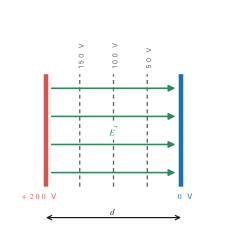
The shape follows the source: concentric spheres around a point charge, parallel planes in the uniform field between charged plates, and coaxial cylinders around a long charged wire.
21.3 Potential gradient
The rate at which potential changes with distance is the potential gradient. It is directly related to the field.
We start from the definition of potential difference as work per unit charge and reach a relation that connects the field at a point to how fast the potential is changing there. We then apply it to the uniform field between two plates.
Setting up. Take two nearby points A and B on a field line, a small distance dx apart, with B further along the direction of \vec{E}. Let the potential be V at A and V + dV at B. A positive charge q is moved from A to B. Because dx is small, the field is effectively constant over the journey.
Step 1 — write the force the field exerts on the charge. From the definition of electric field strength, force = charge \times field:
Step 2 — work out the work done by the field over this small step. The force and the displacement point the same way, so work = force \times distance:
Step 3 — write the same work again, this time from the definition of potential difference. Work done by the field = charge \times (potential at the start - potential at the end):
Step 4 — simplify the bracket. The V and +V cancel and only -dV survives:
Step 5 — the two expressions describe the same work, so set them equal.
Step 6 — cancel q from both sides. It is a real, non-zero charge, so this is allowed — and it shows the result does not depend on what we moved:
Step 7 — divide both sides by dx.
This is the general result. The rest applies it to parallel plates.
Step 8 — say what "uniform field" means for this equation. Between two large parallel plates the field E has the same value everywhere, so dV/dx is a constant. A constant rate of change means the potential falls linearly with distance, and the small changes dV and dx may be replaced by the total changes measured across the whole gap:
Step 9 — put in the values for the gap. Let the plates be a distance d apart, the positive plate at potential V and the earthed plate at 0. Going across the gap in the direction of the field, the potential changes from V to 0, so \Delta V = 0 - V = -V and \Delta x = d:
Step 10 — cancel the two minus signs.
Result. The field at a point equals minus the potential gradient there, E = -dV/dx; and for the uniform field between parallel plates a distance d apart with potential difference V, the magnitude is E = V/d.
What it means. The minus sign says \vec{E} points the way V decreases fastest, so a positive charge released from rest always slides "downhill" in potential. It also explains the unit: \text{V m}^{-1} and \text{N C}^{-1} are the same thing. Closely packed equipotentials mean a steep gradient, and therefore a strong field.
Conditions used. Static charges; dx small enough that E is constant over it; and for E = V/d the field must be uniform, which means large plates and a small separation so that the edge effects can be ignored.
- The two independent expressions for the same work: dW = qE\,dx from force \times distance, and dW = -q\,dV from the definition of potential difference.
- Equating them and cancelling q.
- The final form E = -dV/dx, with the minus sign and a sentence saying what it means.
- For the V/d part: a clear statement that the field is uniform, so the gradient is constant and dV/dx becomes -V/d.
For the uniform field between two parallel plates a distance d apart held at a potential difference V,
is the working formula for every parallel-plate and cathode-ray-tube problem. For a point charge you can check the general relation directly: V = kQ/r gives -dV/dr = kQ/r^{2} = E, as it must.
The same relation run backwards recovers the potential from the field: since dV = -E\,dx, the change in potential between two points is minus the area under the E–x graph between them. For a charged conducting sphere, for instance, E = 0 inside contributes no area, so V stays flat at kQ/R right up to the surface and only then begins to fall.
| Arrangement | Shape of equipotential surfaces | Field |
|---|---|---|
| Isolated point charge | concentric spheres | radial, kQ/r^{2} |
| Long charged wire | coaxial cylinders | radial, \lambda/2\pi\varepsilon_0 r |
| Parallel charged plates | parallel planes | uniform, V/d |
| Any charged conductor | its own surface, and every interior point | zero inside |
E is minus the slope of the V–r graph. Where the graph is flat (inside a charged hollow conductor, where V is constant) the field is zero; where the graph is steep, the field is large.
Problem. Two parallel plates 2\ \text{cm} apart are connected to a 200\ \text{V} supply. Find (a) the field between them, (b) the force on a charge of 5\ \text{nC} placed between them, and (c) the work done in moving that charge from one plate to the other.
Solution.
(a) E = \dfrac{V}{d} = \dfrac{200}{0.02} = 1.0\times10^{4}\ \text{V m}^{-1}.
(b) F = qE = 5\times10^{-9}\times1.0\times10^{4} = 5\times10^{-5}\ \text{N}.
(c) W = qV = 5\times10^{-9}\times200 = 1.0\times10^{-6}\ \text{J}.
Check: W = Fd = 5\times10^{-5}\times0.02 = 1.0\times10^{-6}\ \text{J}. The two routes agree, as they must in a uniform field.
Chapter summary
- Potential difference V_B - V_A = W_{AB}/q, in volts (J C⁻¹); absolute potential takes V = 0 at infinity.
- Point charge: V = kQ/r — a scalar that carries the sign of the charge, so potentials add algebraically.
- Potential energy: U = qV; for a pair of charges U = kq_1q_2/r; for a system add over all pairs.
- 1\ \text{eV} = 1.6\times10^{-19}\ \text{J} — a unit of energy, not of potential.
- An equipotential surface has constant V: no work is done moving a charge on it, and it is everywhere perpendicular to the field lines.
- Conductors in equilibrium are equipotential volumes; field lines meet their surfaces at right angles.
- E = -dV/dx: the field is the negative potential gradient, measured in V m⁻¹ = N C⁻¹. For parallel plates, E = V/d.
Practice questions
Group A — Multiple choice (1 mark each)
- The SI unit of electric potential is [1]aJ CbJ C⁻¹cN C⁻¹dC V⁻¹
- The work done in moving a charge between two points of an equipotential surface is [1]aqVbinfiniteczerodq/V
- One electron volt is equal to [1]a1.6\times10^{-19}\ \text{J}b1.6\times10^{-19}\ \text{V}c9\times10^{9}\ \text{J}d1\ \text{J}
- The electric field and the potential gradient are related by [1]aE = dV/dxbE = -dV/dxcV = -dE/dxdE = -V x
- At the midpoint of the line joining two equal and opposite charges, the potential and the field are respectively [1]azero and zerobzero and non-zerocnon-zero and zerodboth non-zero
Answers to Group A
1. (b) — V = W/q, so joule per coulomb.
2. (c) — V_A - V_B = 0, hence W = q(V_A - V_B) = 0.
3. (a) — 1\ \text{eV} = e\times1\ \text{V}.
4. (b) — the field points down the potential gradient.
5. (b) — the two potentials cancel, but the two fields point the same way and add.
Group B — Short answer (5 marks each)
- Define electric potential and potential difference. Derive an expression for the potential at a distance r from a point charge Q. [5]
- What is an equipotential surface? State four of its properties and show that it must be perpendicular to the electric field. [5]
- Establish the relation E = -dV/dx between electric field and potential gradient, and hence show that E = V/d for a parallel-plate arrangement. [5]
- Calculate the work done in moving a charge of 2\ \mu\text{C} from a point 10\ \text{cm} away from a charge of +3\ \mu\text{C} to a point 5\ \text{cm} away from it. [5]
- An electron initially at rest is accelerated through a potential difference of 1000\ \text{V}. Find its final kinetic energy in joules and its speed. [5]
Answers to Group B
4. V_1 = \dfrac{9\times10^{9}\times3\times10^{-6}}{0.10} = 2.7\times10^{5}\ \text{V} and V_2 = \dfrac{9\times10^{9}\times3\times10^{-6}}{0.05} = 5.4\times10^{5}\ \text{V}. The work done by the external agent is W = q(V_2 - V_1) = 2\times10^{-6}\times2.7\times10^{5} = 0.54\ \text{J}.
5. KE = eV = 1.6\times10^{-19}\times1000 = 1.6\times10^{-16}\ \text{J} (that is 1\ \text{keV}). Then v = \sqrt{2\times1.6\times10^{-16}/9.1\times10^{-31}} = \sqrt{3.52\times10^{14}} = 1.88\times10^{7}\ \text{m s}^{-1}.
Group C — Long answer (8 marks each)
- (a) Define absolute electric potential and derive V = kQ/r for a point charge. [4](b) Define an equipotential surface, prove that no work is done in moving a charge over it, and deduce the relation E = -dV/dr. [4]
- Two point charges +5\ \mu\text{C} and -3\ \mu\text{C} are placed 0.4\ \text{m} apart in air. Calculate(a) the potential at the midpoint of the line joining them,(b) the potential energy of the system, and(c) the work required to bring a charge of +2\ \mu\text{C} from infinity to that midpoint. [8]
Answer to Group C question 2
Each charge is 0.2\ \text{m} from the midpoint.
(a) V = 9\times10^{9}\left(\dfrac{5\times10^{-6}}{0.2} - \dfrac{3\times10^{-6}}{0.2}\right) = 9\times10^{9}\times1\times10^{-5} = 9\times10^{4}\ \text{V}.
(b) U = \dfrac{9\times10^{9}\times5\times10^{-6}\times(-3\times10^{-6})}{0.4} = -0.3375\ \text{J}. It is negative because the charges attract, so external work would be needed to pull them apart.
(c) W = qV = 2\times10^{-6}\times9\times10^{4} = 0.18\ \text{J}.
Practise more: Physics question bank