Unit 14 · Waves and Optics · 2 teaching hours · 19 min read
Reflection at curved mirror
What the syllabus asks for 2
- Real and Virtual images
- Mirror formula
A curved mirror is a polished part of a sphere. Because the surface curves, the normals at different points of it point in different directions, so a bundle of parallel rays is brought together at a point or spread out from a point. That one fact is behind the shaving mirror, the dentist's mirror, the headlight reflector and the wide-angle mirror on a Sajha bus. This unit fixes the language (pole, centre of curvature, focus), separates real images from virtual ones, and derives the single equation that ties object distance, image distance and focal length together.
Two things, almost every year: state the nature of the image for a given object position, and use the mirror formula with correct signs. Marks are lost on signs far more often than on arithmetic.
14.1 Real and virtual images
The words you must use correctly
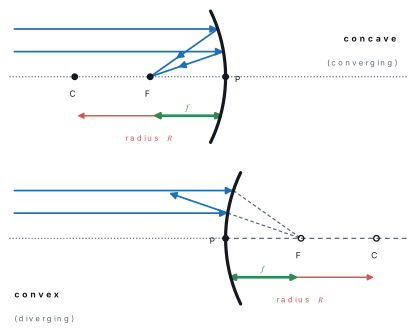
| Term | Meaning |
|---|---|
| Pole P | the geometrical centre of the reflecting surface |
| Centre of curvature C | the centre of the sphere of which the mirror is a part |
| Radius of curvature R | the distance PC |
| Principal axis | the straight line through P and C |
| Principal focus F | the point on the axis where paraxial rays parallel to the axis converge (concave) or from which they appear to diverge (convex) |
| Focal length f | the distance PF, and f = R/2 |
| Aperture | the effective diameter of the reflecting surface |
Paraxial rays are rays close to the principal axis and nearly parallel to it. Everything in this unit assumes paraxial rays and a small aperture; otherwise the mirror suffers from spherical aberration and the rays do not meet at one point.
We start from the law of reflection at one point on the mirror, and reach a relation between the focal length f = PF and the radius of curvature R = PC.
Setting up. P is the pole, C the centre of curvature and F the principal focus. A ray parallel to the axis strikes the mirror at M, a small height h above the axis, and after reflection passes through F.
Step 1 — identify the normal. The normal to a spherical surface at any point passes through the centre of curvature, so the normal at M is the line MC.
Step 2 — the angle of incidence. The incident ray is parallel to the axis PC, and MC cuts both. Alternate angles between parallel lines are equal, so if the angle of incidence is \theta, then
Step 3 — the angle of reflection. By the law of reflection the reflected ray makes the same angle \theta with the normal MC:
Step 4 — use the exterior-angle rule on triangle MCF. The exterior angle at F equals the sum of the two opposite interior angles, which are both \theta:
Step 5 — drop a perpendicular from M to the axis. Call the foot N, so MN = h. From the right-angled triangle MNC:
Step 6 — do the same for triangle MNF:
Step 7 — use the paraxial approximation. The ray is close to the axis, so \theta is small and, in radians, \tan\theta \approx \theta and \tan 2\theta \approx 2\theta. Also N lies practically at the pole P, so NC \approx PC and NF \approx PF:
Step 8 — divide the second by the first so that h and \theta both cancel:
Step 9 — simplify the left side:
Step 10 — rearrange, and rename PC = R, PF = f:
Result.
What it means. The focus sits exactly halfway between the pole and the centre of curvature. Notice that h dropped out in Step 8 — so every paraxial ray, whatever its height, crosses the axis at the same point F. That is precisely why a mirror forms a sharp image.
Conditions used. Only paraxial rays (small aperture, h \ll R). Rays far from the axis cross the axis nearer the mirror — the defect called spherical aberration — and for them f = R/2 is no longer true.
Real and virtual images
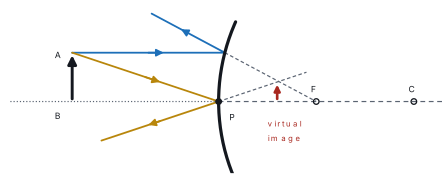
A real image is formed when reflected rays actually meet at a point. Light energy reaches that point, so a real image can be caught on a screen. A virtual image is formed when reflected rays only appear to come from a point, because their backward extensions meet there. No light reaches that point, so a virtual image cannot be caught on a screen — it can only be seen by an eye looking into the mirror.
| Real image | Virtual image | |
|---|---|---|
| Formed by | actual intersection of rays | intersection of backward extensions |
| Screen test | can be caught on a screen | cannot be caught on a screen |
| Orientation | inverted (for a single mirror) | erect |
| Position | in front of the mirror | behind the mirror |
| Sign of v | negative (new Cartesian) | positive |
| Sign of m | negative | positive |
To locate an image by drawing, use any two of these four standard rays:
- A ray parallel to the principal axis reflects through F (concave), or appears to come from F (convex).
- A ray through F reflects parallel to the principal axis.
- A ray through C strikes the mirror normally and retraces its path.
- A ray striking the pole P reflects making an equal angle with the axis.
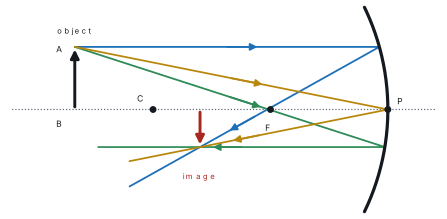
The same construction repeated for every object position gives the table every NEB candidate should know by heart.
| Object position (concave mirror) | Image position | Nature | Size |
|---|---|---|---|
| At infinity | At F | Real, inverted | Point-sized |
| Beyond C | Between F and C | Real, inverted | Diminished |
| At C | At C | Real, inverted | Same size |
| Between C and F | Beyond C | Real, inverted | Magnified |
| At F | At infinity | Real, inverted | Highly magnified |
| Between F and P | Behind the mirror | Virtual, erect | Magnified |
14.2 Mirror formula
The new Cartesian sign convention
Before any formula can be used, the signs must be fixed.
- All distances are measured from the pole P.
- Distances measured in the direction of the incident light are positive; those measured against it are negative.
- Heights above the principal axis are positive, heights below it are negative.
- Light is always drawn as travelling from left to right, so a real object in front of the mirror always has u negative.
It follows that for a concave mirror f and R are negative, and for a convex mirror they are positive. A real image has v negative; a virtual image has v positive.
Deriving the formula
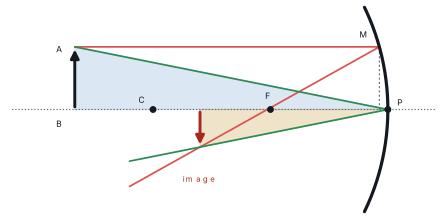
We start from two pairs of similar triangles in the ray diagram, and reach the relation between object distance, image distance and focal length.
Setting up. An object AB stands upright on the axis in front of a concave mirror, and its real inverted image is A'B'. The strategy is important: first do all the geometry with plain lengths, which are all positive numbers, and only at the end put in the signs of the Cartesian convention. Mixing the two is where most marks are lost.
Step 1 — the first pair of similar triangles. The ray AP hits the pole and reflects along PA', making equal angles with the axis (the axis is the normal at P). So the right-angled triangles ABP and A'B'P have equal angles at P, and are similar.
Step 2 — write the ratio of corresponding sides:
Step 3 — the second pair of similar triangles. The ray AM travels parallel to the axis and so reflects through the focus F, going on to A'. Triangles MPF and A'B'F are similar, because they have equal vertically opposite angles at F and a right angle each:
Step 4 — replace MP by AB. For paraxial rays the point M lies practically at the pole, so the vertical height MP is the same as the object height AB:
Step 5 — equate (1) and (2). Both are equal to the same ratio A'B'/AB:
Step 6 — split B'F into lengths we have names for. From the diagram, F lies between P and B', so
Step 7 — substitute that in:
Step 8 — now put in the signs. All three points B, B' and F lie in front of the mirror, i.e. on the side from which light comes, so all three distances are negative in the new Cartesian convention:
Step 9 — substitute these into (3):
Step 10 — tidy both sides. On the left the two minus signs cancel; on the right the numerator becomes -v + f:
Step 11 — take the minus sign out of the denominator on the right:
Step 12 — cross-multiply:
Step 13 — remove the bracket:
Step 14 — divide every single term by uvf:
Step 15 — cancel in each term:
Step 16 — move 1/v to the left:
Result.
What it means. This is the mirror formula. Although it was derived for one particular case — a concave mirror forming a real image — it holds for concave and convex mirrors and for images of either kind, provided the sign convention is obeyed throughout. That is the whole point of having a sign convention: one equation instead of four.
Conditions used. Paraxial rays only (Step 4 needs MP \approx AB), a mirror of small aperture, and all distances measured from the pole with the new Cartesian convention.
- A labelled ray diagram with P, F, C, the object and the image marked.
- The first similar-triangle pair and equation (1).
- The second similar-triangle pair, with the statement MP \approx AB for paraxial rays — a mark is usually reserved for this.
- The substitution B'F = B'P - PF.
- The sign-convention line BP = -u, B'P = -v, PF = -f, applied after the geometry.
- Division by uvf to reach the final form.
Since f = R/2, the formula may also be written
Linear magnification
From equation (1) above, A'B'/AB = B'P/BP. Putting in signs, the image height h_i is negative (image inverted) while h_o is positive, B'P = -v and BP = -u, so
Using the mirror formula to eliminate u or v gives two useful alternatives:
m = -v/u, not v/u. A negative m means the image is inverted, and for a single mirror that also means it is real. A positive m means erect and virtual. Students who drop the minus sign report a real image as erect and lose the "nature of image" mark even when the numbers are right.
Problem. An object 4\ \text{cm} tall is placed 25\ \text{cm} in front of a concave mirror of radius of curvature 30\ \text{cm}. Find the position, nature and size of the image.
Solution. Concave mirror: R = -30\ \text{cm}, so f = R/2 = -15\ \text{cm}. The object is in front, so u = -25\ \text{cm}.
so v = -37.5\ \text{cm}. The negative sign means the image is 37.5\ \text{cm} in front of the mirror, i.e. real.
The image is inverted and 1.5 times as large: h_i = m\,h_o = -1.5 \times 4 = -6\ \text{cm}, i.e. 6\ \text{cm} tall and below the axis.
Problem. The rear-view mirror of a bus is convex with radius of curvature 4.0\ \text{m}. A motorcycle is 6.0\ \text{m} behind the bus. Where is its image and how large is it compared with the motorcycle?
Solution. Convex mirror: R = +4.0\ \text{m}, f = +2.0\ \text{m}; u = -6.0\ \text{m}.
so v = +1.5\ \text{m}: the image is 1.5\ \text{m} behind the mirror and therefore virtual and erect.
The image is one quarter of the size of the motorcycle. This is exactly why convex mirrors are used on vehicles: a wide field of view, at the price of objects looking smaller (and so further away) than they really are.
Problem. A concave mirror forms, on a screen, a real image three times the size of the object. The screen and the object are 80\ \text{cm} apart. Find the focal length and the radius of curvature of the mirror.
Solution. The image is real and magnified three times, so m = -3:
Both object and image are in front of the mirror. If u = -d then v = -3d, and the object-to-screen separation is |v| - |u| = 3d - d = 2d = 80\ \text{cm}, giving d = 40\ \text{cm}. Hence u = -40\ \text{cm} and v = -120\ \text{cm}.
So f = -30\ \text{cm} and R = 2f = -60\ \text{cm}: a concave mirror of focal length 30\ \text{cm} and radius of curvature 60\ \text{cm}.
Checking an answer in one line
After solving, test the answer against the table in §14.1. Here the object at 40\ \text{cm} lies between C (60\ \text{cm}) and F (30\ \text{cm}), and the table says the image must be beyond C, real, inverted and magnified — which is exactly what v = -120\ \text{cm}, m = -3 says. If the two disagree, a sign has gone wrong.
Chapter summary
- For a spherical mirror the pole P, centre of curvature C and focus F lie on the principal axis, and f = R/2 (derived from the paraxial approximation).
- A real image is formed where reflected rays actually meet; it can be caught on a screen and is inverted. A virtual image is formed where the backward extensions meet; it cannot be caught on a screen and is erect.
- New Cartesian convention: distances from P, positive along the incident light. Concave f<0, convex f>0; real image v<0, virtual image v>0.
- Mirror formula: \dfrac{1}{v} + \dfrac{1}{u} = \dfrac{1}{f} = \dfrac{2}{R}.
- Magnification: m = \dfrac{h_i}{h_o} = -\dfrac{v}{u} = \dfrac{f-v}{f} = \dfrac{f}{f-u}. Negative m = inverted and real; positive m = erect and virtual.
- A concave mirror gives a real image for every object beyond F, and a magnified virtual image only when the object is between F and P.
- A convex mirror gives a virtual, erect, diminished image for every position of a real object.
Practice questions
Group A — Multiple choice (1 mark each)
- The focal length of a concave mirror of radius of curvature 40\ \text{cm} is [1]a10\ \text{cm}b20\ \text{cm}c40\ \text{cm}d80\ \text{cm}
- An object is placed between the focus and the pole of a concave mirror. The image is [1]areal, inverted, diminishedbreal, erect, magnifiedcvirtual, erect, magnifieddvirtual, inverted, diminished
- For a real image formed by a concave mirror, the linear magnification is [1]apositivebnegativecalways +1dalways zero
- A convex mirror of focal length f forms, of a real object, an image that is always [1]areal and invertedbreal and erectcvirtual and inverteddvirtual and erect
- An object is placed at the centre of curvature of a concave mirror. The image is formed [1]aat Fbat Ccat infinitydbehind the mirror
Answers to Group A
1. (b) — f = R/2 = 40/2 = 20\ \text{cm}.
2. (c) — inside the focus a concave mirror acts as a magnifying mirror.
3. (b) — a real image has v and u of the same sign, so m = -v/u < 0.
4. (d) — the reflected rays always diverge, so the image is virtual, erect and diminished.
5. (b) — the ray through C retraces itself; u = -R gives v = -R.
Group B — Short answer (5 marks each)
- Distinguish between a real image and a virtual image, giving one example of each from everyday life. [5]
- Show that the focal length of a spherical mirror is half its radius of curvature for paraxial rays. [5]
- An object 4\ \text{cm} tall is placed 20\ \text{cm} from a concave mirror of focal length 15\ \text{cm}. Find the position, nature and size of the image. [5]
- A convex rear-view mirror has a radius of curvature of 2.0\ \text{m}. A car is 4.0\ \text{m} behind it. Find the position of the image and the magnification. [5]
- State the new Cartesian sign convention and use it to explain why the focal length of a convex mirror is taken as positive. [5]
Answers to Group B
1. Real: rays actually meet, screen-catchable, inverted, formed in front of the mirror (the image on a cinema screen, or on the film of a reflecting telescope). Virtual: only the backward extensions meet, not screen-catchable, erect, formed behind the mirror (your face in a plane or convex mirror).
2. See the derivation in §14.1: PC \approx h/\theta, PF \approx h/2\theta, hence f = R/2.
3. u = -20\ \text{cm}, f = -15\ \text{cm}. \dfrac{1}{v} = \dfrac{1}{-15} + \dfrac{1}{20} = \dfrac{-4+3}{60} = -\dfrac{1}{60}, so v = -60\ \text{cm}: real, 60\ \text{cm} in front of the mirror. m = -v/u = -(-60)/(-20) = -3, so the image is inverted and 3 \times 4 = 12\ \text{cm} tall.
4. f = +1.0\ \text{m}, u = -4.0\ \text{m}. \dfrac{1}{v} = \dfrac{1}{1.0} + \dfrac{1}{4.0} = 1.25\ \text{m}^{-1}, so v = +0.8\ \text{m} — virtual, 0.8\ \text{m} behind the mirror. m = -0.8/(-4.0) = +0.2: erect and one-fifth the size.
5. Rules as in §14.2. Light is drawn travelling left to right and strikes the convex surface from the left; its focus lies behind the mirror, i.e. further along the direction of the incident light, so PF is a positive distance and f > 0.
Group C — Long answer (8 marks each)
- (a) Define real and virtual images and state the new Cartesian sign convention. [3](b) Derive the mirror formula \dfrac{1}{v}+\dfrac{1}{u}=\dfrac{1}{f} for a concave mirror forming a real image, and hence obtain an expression for the linear magnification. [5]
- A concave mirror throws on a wall an image of a lamp filament magnified four times. The wall is 3.0\ \text{m} from the mirror. Find(a) the distance of the filament from the mirror,(b) the focal length and radius of curvature of the mirror, and(c) the nature, position and magnification of the image if the filament is moved to 0.40\ \text{m} from the mirror. [8]
Answer to Group C question 2
(a) The image on a wall is real and magnified 4\times, so m = -4 = -v/u, giving v = 4u. With v = -3.0\ \text{m} we get u = -0.75\ \text{m}: the filament is 75\ \text{cm} from the mirror.
(b) \dfrac{1}{f} = \dfrac{1}{v} + \dfrac{1}{u} = -\dfrac{1}{3.0} - \dfrac{1}{0.75} = -\dfrac{1}{3} - \dfrac{4}{3} = -\dfrac{5}{3}\ \text{m}^{-1}, so f = -0.60\ \text{m} and R = 2f = -1.2\ \text{m}. The mirror has focal length 60\ \text{cm} and radius of curvature 1.2\ \text{m}.
(c) Now u = -0.40\ \text{m}, which is inside the focus. \dfrac{1}{v} = \dfrac{1}{-0.60} + \dfrac{1}{0.40} = -1.6667 + 2.5 = 0.8333\ \text{m}^{-1}, so v = +1.2\ \text{m}. The image is virtual, 1.2\ \text{m} behind the mirror, with m = -1.2/(-0.40) = +3 — erect and three times as large. It can no longer be caught on the wall.
Practise more: Physics question bank