Unit 19 · Electricity and Magnetism · 3 teaching hours · 17 min read
Electric Charges
What the syllabus asks for 4
- Electric charges
- Charging by induction
- Coulomb's law - Force between two point charges
- Force between multiple electric charges
Rub a plastic comb on dry hair in winter and it picks up small pieces of paper. That small experiment contains the whole of this unit: charge can be separated, it comes in two kinds, and charges exert forces on one another across empty space. Everything in the rest of electricity — fields, potential, capacitors, circuits — is built on the inverse-square force law we meet here.
One law, F = \dfrac{1}{4\pi\varepsilon_0}\dfrac{q_1q_2}{r^{2}}, plus one principle, superposition. Most Group B numericals are just these two applied to two or three charges with careful attention to direction.
19.1 Electric charges
Electric charge is the intrinsic property of matter because of which it experiences and exerts electrostatic force. There are two kinds, called positive and negative (the names are due to Benjamin Franklin). Like charges repel; unlike charges attract.
A neutral atom has equal numbers of protons and electrons. Charging a body means transferring electrons — never protons, which are locked in the nucleus. A body that has lost electrons is positively charged; one that has gained electrons is negatively charged.
Properties of charge
| Property | Statement |
|---|---|
| Quantisation | Charge exists only in integral multiples of the elementary charge: q = \pm ne, with e = 1.6\times10^{-19}\ \text{C} and n = 1,2,3,\dots |
| Conservation | The total charge of an isolated system never changes; charge can only be transferred, not created or destroyed |
| Additivity | Charge is a scalar; total charge is the algebraic sum of the individual charges |
| Invariance | The charge on a body does not change with its speed, unlike its mass |
The SI unit of charge is the coulomb (C): the charge carried past a point in one second by a steady current of one ampere, so 1\ \text{C} = 1\ \text{A s}. One coulomb is an enormous charge — it corresponds to
which is why laboratory charges are usually quoted in microcoulombs (1\ \mu\text{C} = 10^{-6}\ \text{C}) or nanocoulombs.
Conductors and insulators
| Conductor | Insulator (dielectric) | |
|---|---|---|
| Free electrons | many | practically none |
| Charge given to it | spreads over the whole outer surface | stays where it is put |
| Examples | metals, graphite, human body, earth, salt solutions | glass, dry wood, ebonite, plastic, dry air |
Three ways of charging a body: by friction (rubbing glass with silk, ebonite with fur), by conduction (touching it with an already charged body — it gains charge of the same sign), and by induction (§19.2 — it gains charge of the opposite sign).
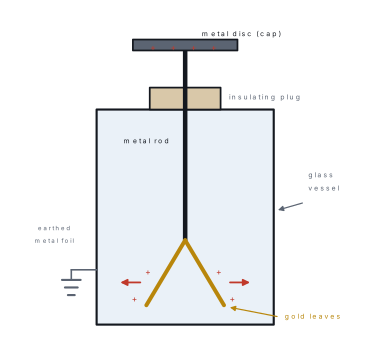
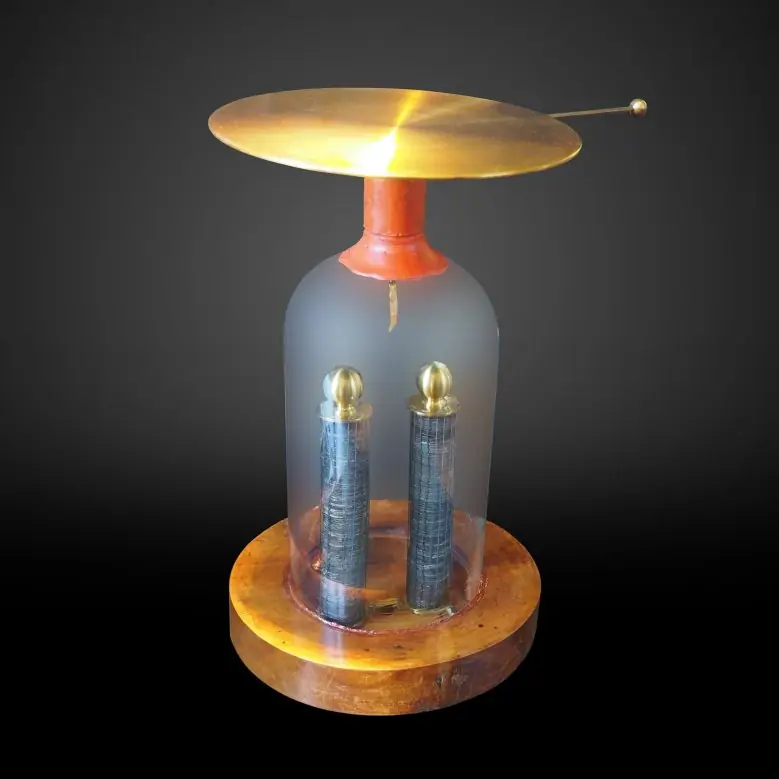
Problem. A polythene rod acquires a charge of -3.2\ \mu\text{C} when rubbed with wool. (a) How many electrons has it gained? (b) What is the charge on the wool? (c) By how much has the mass of the rod changed? Take e = 1.6\times10^{-19}\ \text{C} and m_e = 9.1\times10^{-31}\ \text{kg}.
Solution.
(a) By quantisation, q = ne, so
(b) By conservation of charge the wool must carry +3.2\ \mu\text{C}: the electrons were transferred from the wool to the rod, nothing was created.
(c) The rod gains the mass of those electrons:
— utterly unmeasurable, which is why we treat charging as a mass-free process.
19.2 Charging by induction
A charged body can produce a charge in a neutral conductor without touching it. The process is called electrostatic induction and it depends on the free electrons of the conductor being able to move.
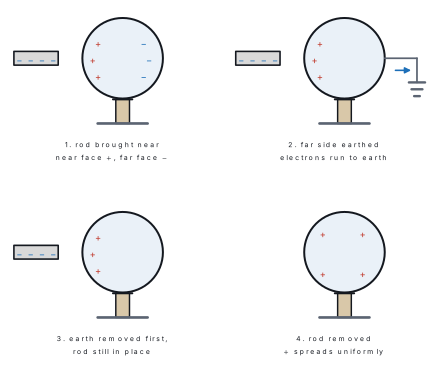
The four steps, in the order the examiner wants them:
- Bring the charged rod near. The free electrons of the sphere are repelled by the negative rod and collect on the far face, leaving the near face positive. The sphere as a whole is still neutral.
- Earth the sphere (touch the far side, or connect it to earth). Electrons on the far face are pushed down to earth. The near-face positive charge stays, held by the attraction of the rod.
- Remove the earth connection first, while the rod is still in place.
- Remove the rod. The positive charge, no longer bound, spreads uniformly over the sphere.
If you remove the rod before breaking the earth connection, electrons flow back up from the earth and the sphere ends up neutral. In the examination you lose marks for writing the steps in the wrong order.
Three points to notice:
- The induced charge is opposite in sign to the inducing charge.
- The inducing body loses no charge at all — the same rod can charge any number of spheres.
- The magnitude of the induced charge is at most equal to the inducing charge.
Induction also explains why a charged comb attracts neutral bits of paper: the comb induces an opposite charge on the near face of each piece and a like charge on the far face. The near charge is closer, so by the inverse-square law the attraction beats the repulsion and the paper jumps.
19.3 Coulomb's law — force between two point charges
Coulomb measured this force in 1785 with a torsion balance.
The force of attraction or repulsion between two stationary point charges is directly proportional to the product of the magnitudes of the charges, inversely proportional to the square of the distance between them, and acts along the line joining them.
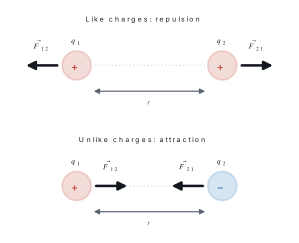
In SI units the constant is written k = \dfrac{1}{4\pi\varepsilon_0}, so
where \varepsilon_0 = 8.85\times10^{-12}\ \text{C}^2\text{N}^{-1}\text{m}^{-2} is the permittivity of free space and
One coulomb is that charge which, placed 1\ \text{m} from an equal charge in vacuum, repels it with a force of 9\times10^{9}\ \text{N}.
In a material medium of relative permittivity (dielectric constant) \varepsilon_r,
so a medium always weakens the force (\varepsilon_r \ge 1; for water \varepsilon_r \approx 80).
Vector form. If \hat{r}_{21} is the unit vector pointing from charge 1 to charge 2, the force on q_2 due to q_1 is
Substituting signed values of the charges automatically gives the right direction: q_1q_2 > 0 (like charges) makes \vec{F}_{21} point along \hat{r}_{21}, i.e. away from q_1. Newton's third law holds: \vec{F}_{12} = -\vec{F}_{21}.
| Coulomb force | Gravitational force | |
|---|---|---|
| Depends on | product of charges | product of masses |
| Distance dependence | 1/r^{2} | 1/r^{2} |
| Sign | attractive or repulsive | always attractive |
| Affected by medium | yes, reduced by \varepsilon_r | no |
| Relative strength | about 10^{36} times stronger | very weak |
Problem. Two point charges of +2\ \mu\text{C} and -3\ \mu\text{C} are placed 30\ \text{cm} apart in air. (a) Find the force between them. (b) What would the force become if the charges were immersed in a liquid of dielectric constant 4 at the same separation?
Solution.
(a) q_1 = 2\times10^{-6}\ \text{C}, q_2 = 3\times10^{-6}\ \text{C}, r = 0.30\ \text{m}.
Since the charges are unlike, the force is one of attraction.
(b) F_{med} = F_{vac}/\varepsilon_r = 0.6/4 = 0.15\ \text{N}, still attractive.
Problem. Compare the electrostatic and gravitational forces between two protons. Take e = 1.6\times10^{-19}\ \text{C}, m_p = 1.67\times10^{-27}\ \text{kg} and G = 6.67\times10^{-11}\ \text{N m}^{2}\text{kg}^{-2}.
Solution. Both forces vary as 1/r^{2}, so the separation cancels in the ratio:
Numerator: 9\times10^{9} \times (1.6\times10^{-19})^{2} = 9\times10^{9} \times 2.56\times10^{-38} = 2.304\times10^{-28}.
Denominator: 6.67\times10^{-11} \times (1.67\times10^{-27})^{2} = 6.67\times10^{-11} \times 2.789\times10^{-54} = 1.860\times10^{-64}.
Gravity is utterly negligible inside an atom — which is why we ignore it in every electrostatics problem.
19.4 Force between multiple electric charges
The force exerted on a charge by another charge is unaffected by the presence of any other charges. The resultant force on any one charge is therefore the vector sum of the forces exerted on it by each of the other charges taken one at a time:
Written out for n charges,
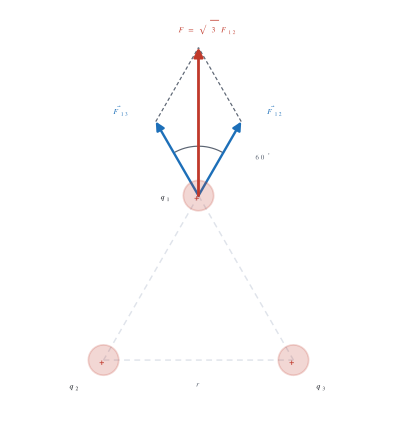
where \hat{r}_{1j} is the unit vector pointing from q_j towards q_1, in keeping with the notation of §19.3. For two forces F_a and F_b with angle \theta between them, the parallelogram law gives
- Draw the charges and mark each force on the chosen charge with an arrow, using only the signs to decide the direction.
- Compute each magnitude from F = kq_1q_2/r^{2}, ignoring signs.
- Resolve into x and y components, add, then recombine with F = \sqrt{F_x^{2}+F_y^{2}} and \tan\alpha = F_y/F_x.
Problem. Three charges of +2\ \mu\text{C} each are fixed at the corners of an equilateral triangle of side 20\ \text{cm}. Find the magnitude and direction of the resultant force on any one of them.
Solution. Each pair gives the same magnitude of force, with q = 2\times10^{-6}\ \text{C} and r = 0.20\ \text{m}:
Both are repulsive, and the angle between them is 60^{\circ}. By the parallelogram law,
Because the two forces are equal, the resultant bisects the angle between them, i.e. it points directly away from the centroid of the triangle.
Forces are vectors. Adding 0.9 + 0.9 = 1.8\ \text{N} in the example above is the single commonest error in this chapter; the correct answer, 0.9\sqrt{3} = 1.56\ \text{N}, is smaller because the forces are 60^{\circ} apart.
We start from the condition that two Coulomb forces balance, and reach a general formula for the position of the null point between two like charges.
Setting up. Charges q_1 and q_2 are fixed a distance d apart, both of the same sign. A test charge q_0 is placed on the line joining them, a distance x from q_1 and so (d - x) from q_2.
Step 1 — why the point must lie between them. Only between the two charges do the two forces on q_0 point in opposite directions. Outside, both push the same way and can never cancel. So 0 < x < d.
Step 2 — write the two force magnitudes from Coulomb's law:
Step 3 — set them equal. They already point opposite ways, so equal magnitudes means zero resultant:
Step 4 — cancel k and q_0, which appear on both sides. This is the key moment: the test charge has vanished, so the answer cannot depend on its size or its sign.
Step 5 — cross-multiply:
Step 6 — divide both sides by q_2 x^{2}:
Step 7 — take the positive square root. We keep only the positive root because Step 1 tells us x and (d-x) are both positive:
Step 8 — write \sqrt{q_1/q_2} = s for short, and cross-multiply:
Step 9 — collect the x terms:
Step 10 — take out x and divide:
Result.
What it means. The distances are in the ratio of the square roots of the charges, not the charges themselves. So the null point always lies nearer the smaller charge — it has to be closer to make up for being weaker. And because q_0 cancelled in Step 4, the same point works for any third charge, positive or negative, large or small.
Conditions used. Point charges, both of the same sign, and the test point on the straight line joining them. If the two charges have opposite signs the null point lies outside the pair, on the far side of the smaller charge, and Step 1 must be redone.
Problem. Charges of +9\ \mu\text{C} and +4\ \mu\text{C} are fixed 50\ \text{cm} apart. At what point on the line joining them is the resultant force on a third charge zero?
Solution. Between the two charges the forces on a third charge are in opposite directions, so the null point lies there. Let it be at a distance x from the 9\ \mu\text{C} charge, so that it is (0.50-x) from the 4\ \mu\text{C} charge. For the magnitudes to be equal,
(taking positive square roots, since 0 < x < 0.50)
The null point is 30\ \text{cm} from the 9\ \mu\text{C} charge and 20\ \text{cm} from the 4\ \mu\text{C} charge — nearer the smaller charge, as it must be. Note the answer does not depend on the third charge at all.
Chapter summary
- Charge is quantised (q = \pm ne, e = 1.6\times10^{-19}\ \text{C}), conserved, additive and independent of speed. Charging transfers electrons only.
- 1\ \text{C} = 1\ \text{A s} = 6.25\times10^{18} electronic charges.
- Charging by induction gives a charge opposite to the inducing charge; the earth connection must be broken before the rod is taken away.
- Coulomb's law: F = \dfrac{1}{4\pi\varepsilon_0}\dfrac{q_1q_2}{r^{2}} with \dfrac{1}{4\pi\varepsilon_0} = 9\times10^{9}\ \text{N m}^{2}\text{C}^{-2} and \varepsilon_0 = 8.85\times10^{-12}\ \text{C}^{2}\text{N}^{-1}\text{m}^{-2}.
- In a medium the force is reduced: F_{med} = F_{vac}/\varepsilon_r.
- Vector form \vec{F}_{21} = \dfrac{1}{4\pi\varepsilon_0}\dfrac{q_1q_2}{r^{2}}\hat{r}_{21}; the forces obey Newton's third law.
- Superposition: the resultant force is the vector sum of the individual pairwise forces, \vec{F}_1 = \sum_j \vec{F}_{1j}; combine two forces with F = \sqrt{F_a^{2}+F_b^{2}+2F_aF_b\cos\theta}.
Practice questions
Group A — Multiple choice (1 mark each)
- Which of the following is not a property of electric charge? [1]aquantisationbconservationcadditivitydvariation with speed
- The number of electronic charges in one coulomb is about [1]a1.6\times10^{19}b6.25\times10^{18}c6.02\times10^{23}d9\times10^{9}
- A body charged by induction acquires a charge [1]aof the same sign as the inducing chargebof the opposite signcthat is always zerodequal to twice the inducing charge
- Two charges repel each other with a force F in air. Placed at the same separation in a medium of dielectric constant 4, the force becomes [1]a4FbF/2cF/4dF/16
- If the distance between two point charges is halved, the force between them [1]ais halvedbis doubledcbecomes four timesdbecomes one fourth
Answers to Group A
1. (d) — charge is invariant; it is the mass that changes with speed.
2. (b) — 1/(1.6\times10^{-19}) = 6.25\times10^{18}.
3. (b) — electrons are driven away or attracted, leaving the opposite charge behind.
4. (c) — F_{med} = F_{vac}/\varepsilon_r.
5. (c) — F \propto 1/r^{2}, so halving r multiplies F by 4.
Group B — Short answer (5 marks each)
- State Coulomb's law and express it in vector form. Hence define the coulomb. [5]
- Explain, with labelled diagrams, how a metal sphere standing on an insulating base can be given a positive charge by induction. Why must the earth connection be removed before the charging rod? [5]
- Two point charges of +5\ \mu\text{C} and +10\ \mu\text{C} are placed 20\ \text{cm} apart in vacuum. Calculate the force between them, and state its nature. [5]
- State the principle of quantisation and conservation of charge. How many electrons must be removed from a body to give it a charge of +2\ \mu\text{C}? [5]
- Two identical metal spheres carrying charges of +6\ \mu\text{C} and -2\ \mu\text{C} are brought into contact and then separated to a distance of 10\ \text{cm}. Find the force between them. [5]
Answers to Group B
3. F = \dfrac{9\times10^{9}\times5\times10^{-6}\times10\times10^{-6}}{(0.20)^{2}} = \dfrac{9\times10^{9}\times5\times10^{-11}}{0.04} = \dfrac{0.45}{0.04} = 11.25\ \text{N}, repulsive (both charges positive).
4. n = \dfrac{q}{e} = \dfrac{2\times10^{-6}}{1.6\times10^{-19}} = 1.25\times10^{13} electrons must be removed.
5. Identical spheres in contact share the total charge equally. Total = +6 - 2 = +4\ \mu\text{C}, so each carries +2\ \mu\text{C}. Then
repulsive, since both spheres are now positive.
Group C — Long answer (8 marks each)
- (a) State Coulomb's law, write it in vector form, and state the principle of superposition of electrostatic forces. [4](b) Three point charges of +3\ \mu\text{C} each are placed at the corners of an equilateral triangle of side 30\ \text{cm}. Calculate the magnitude and direction of the resultant force on one of them. [4]
- (a) What is meant by charging by induction? Describe, with diagrams, how two metal spheres in contact can be given equal and opposite charges in a single operation. [4](b) Two point charges of +9\ \mu\text{C} and +4\ \mu\text{C} are fixed 50\ \text{cm} apart in air. Find the position on the line joining them at which a third charge would experience no resultant force, and explain why the answer does not depend on the size or sign of that third charge. [4]
Answers to Group C
1.(b) With q = 3\times10^{-6}\ \text{C} and r = 0.30\ \text{m}, each pairwise force is
The two forces on the chosen charge are each 0.9\ \text{N}, repulsive, with 60^{\circ} between them:
directed along the bisector, i.e. radially outward from the centroid of the triangle.
2.(a) Outline: place the two spheres in contact on insulating stands; bring a negatively charged rod near sphere A; electrons are repelled to sphere B; separate the spheres while the rod is still in position; then remove the rod. A is left positive and B negative, with equal magnitudes (charge is conserved, and the pair was neutral to begin with).
2.(b) Let the null point be x from the 9\ \mu\text{C} charge, on the line between the two charges. Equating magnitudes,
The point lies 30\ \text{cm} from the 9\ \mu\text{C} charge (and 20\ \text{cm} from the 4\ \mu\text{C} charge). The test charge q_0 appears as a common factor on both sides of the equation and cancels, so neither its magnitude nor its sign affects the position of the null point.
Practise more: Physics question bank