Unit 6 · Mechanics · 6 teaching hours · 30 min read
Circular Motion
What the syllabus asks for 7
- Angular displacement, velocity and acceleration
- Relation between angular and linear velocity and acceleration
- Centripetal acceleration
- Centripetal force
- Conical pendulum
- Motion in a vertical circle
- Applications of banking
A bus rounding a bend on the Prithvi Highway, a stone whirled on a string, the Moon going round the Earth and an electron in a magnetic field are all doing the same thing: moving on a curved path at a speed that may not change at all, yet accelerating every instant. This unit explains that apparent contradiction, builds the language of angular quantities, and applies it to three standard systems — the conical pendulum, the vertical circle and the banked road.
Velocity is a vector. A body going round a circle at constant speed is changing the direction of its velocity all the time, so it is accelerating. That acceleration points to the centre, and something real must supply the force that causes it.
6.1 Angular displacement, velocity and acceleration
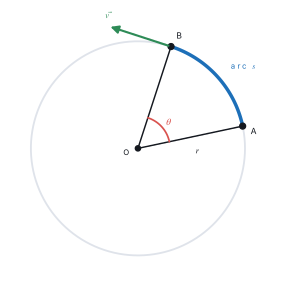
For a particle moving on a circle of radius r, it is easier to describe the position by the angle \theta swept out at the centre than by the arc length.
The angular displacement \theta is the angle turned through by the radius joining the particle to the centre. It is measured in radians:
One complete revolution is 2\pi\ \text{rad} = 360^{\circ}, so 1\ \text{rad} = 57.3^{\circ}. The radian is dimensionless.
Angular velocity \omega is the rate of change of angular displacement, and angular acceleration \alpha the rate of change of \omega:
Both are vectors directed along the axis of rotation, their sense given by the right-hand rule. For one revolution in a time T (the period), with frequency f = 1/T,
Because the equations \theta = \omega t and so on have exactly the same form as the linear ones, the kinematic equations carry over term by term:
| Linear motion | Angular motion |
|---|---|
| v = u + at | \omega = \omega_0 + \alpha t |
| s = ut + \frac{1}{2}at^{2} | \theta = \omega_0 t + \frac{1}{2}\alpha t^{2} |
| v^{2} = u^{2} + 2as | \omega^{2} = \omega_0^{2} + 2\alpha\theta |
| units m, m s⁻¹, m s⁻² | units rad, rad s⁻¹, rad s⁻² |
A speed quoted in revolutions per minute must be multiplied by 2\pi/60 before it goes into any formula. 300\ \text{rpm} = 300 \times 2\pi/60 = 10\pi \approx 31.4\ \text{rad s}^{-1}, not 300\ \text{rad s}^{-1}.
6.2 Relation between angular and linear velocity and acceleration
We start from the definition of angle in radians and reach the two formulas that connect the linear quantities of a point on a wheel to the angular quantities of the wheel itself.
Step 1 — the definition of the radian. If a point moves a distance s along a circle of radius r, the angle turned in radians is \theta = s/r. Multiply both sides by r:
Step 2 — differentiate both sides with respect to time. The radius r is a fixed number for a given circle, so it is a constant multiplier and stays outside the derivative:
Step 3 — name the two derivatives. ds/dt is the linear speed v along the circle, and d\theta/dt is the angular velocity \omega:
Step 4 — differentiate once more with respect to time. Same reasoning: r stays outside:
Step 5 — name these derivatives. dv/dt is the rate at which the speed changes — the tangential acceleration a_t — and d\omega/dt is the angular acceleration \alpha:
Result.
In vector form \vec{v} = \vec{\omega}\times\vec{r} and \vec{a}_t = \vec{\alpha}\times\vec{r}.
What it means. Every point on a rigid rotating body shares the same \omega and \alpha, but a point twice as far from the axis moves twice as fast and gains speed twice as quickly.
Conditions used. \theta must be in radians — in degrees, s = r\theta is simply false. The radius r must be constant (the body is rigid, the point does not spiral in or out). Also, a_t is only the part of the acceleration along the tangent; there is always a second, radial part as well, which the next section works out.
On a rotating wheel every point has the same \omega and \alpha, but v = r\omega means the rim moves faster than a point near the hub. This is why the outer gear-teeth of a bicycle wheel travel further per turn than the inner ones.
Problem. A flywheel of radius 0.40\ \text{m} rotates at 300\ \text{rpm}. It is then brought uniformly to rest in 10\ \text{s}. Find (a) the initial angular velocity, (b) the linear speed of a point on the rim, (c) the angular retardation, and (d) the number of revolutions made before stopping.
Solution.
(a) \omega_0 = \dfrac{2\pi N}{60} = \dfrac{2\pi \times 300}{60} = 10\pi = 31.4\ \text{rad s}^{-1}
(b) v = r\omega_0 = 0.40 \times 31.4 = 12.6\ \text{m s}^{-1}
(c) \alpha = \dfrac{\omega - \omega_0}{t} = \dfrac{0 - 31.4}{10} = -3.14\ \text{rad s}^{-2}
(d) \theta = \dfrac{\omega_0 + \omega}{2}t = \dfrac{31.4}{2}\times 10 = 157\ \text{rad}, so the number of revolutions is \dfrac{157}{2\pi} = 25.
6.3 Centripetal acceleration
We start from the fact that a body going round a circle at constant speed keeps changing the direction of its velocity, and we reach a formula for how big the resulting acceleration is and where it points.
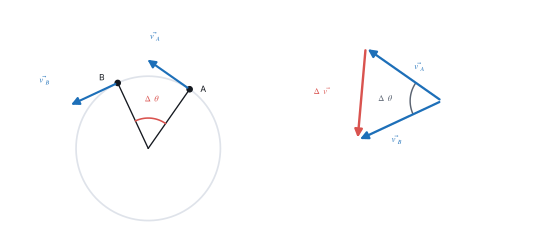
Setting up. A particle moves on a circle of radius r at constant speed v. In a short time \Delta t it travels from point A to point B, and the radius to it turns through a small angle \Delta\theta.
Step 1 — the angle turned. By the definition of angular velocity, \omega = \Delta\theta/\Delta t, so
Step 2 — the velocity turns through the same angle. The velocity is always along the tangent, and the tangent turns exactly as fast as the radius does. So \vec{v}_A and \vec{v}_B have the same length v but differ in direction by \Delta\theta.
Step 3 — find the change in velocity. Redraw \vec{v}_A and \vec{v}_B from one common point (right-hand figure). The change is the vector from the tip of \vec{v}_A to the tip of \vec{v}_B:
Step 4 — measure its length. The two vectors and \Delta\vec{v} form an isosceles triangle: two equal sides of length v with \Delta\theta between them. Splitting that triangle down the middle gives two right-angled triangles, each with angle \Delta\theta/2 and hypotenuse v, so half the base is v\sin(\Delta\theta/2) and the whole base is twice that:
Step 5 — use the small-angle approximation. When an angle in radians is very small, \sin x \approx x (try x = 0.01: \sin x = 0.0099998). Since we are about to let \Delta t \to 0, the angle is as small as we like:
Step 6 — divide by the time taken. Acceleration is change of velocity divided by time:
Step 7 — take the limit as \Delta t \to 0 so that the answer is the instantaneous acceleration. The constant v comes outside the limit:
Step 8 — recognise the limit as \omega:
Step 9 — get the first standard form. Substitute \omega = v/r (from v = r\omega):
Step 10 — get the second standard form. Instead substitute v = r\omega into a = v\omega:
Step 11 — get the third form in terms of the period. Since \omega = 2\pi/T:
Step 12 — the direction. In Step 4's isosceles triangle, the two base angles are each (180^{\circ} - \Delta\theta)/2. As \Delta\theta \to 0 each base angle approaches 90^{\circ} — so \Delta\vec{v} becomes perpendicular to the velocity, pointing inwards along the radius, i.e. towards the centre.
Result.
That inward direction is why it is called the centripetal ("centre-seeking") acceleration.
What it means. A body can accelerate without speeding up. Here the size of the velocity never changes, only its direction — and changing direction is itself an acceleration, which needs a force pointing at the centre.
Conditions used. The speed v is constant (uniform circular motion) and the radius r is constant. Step 5 needs the angle in radians. If the speed also changes there is an extra tangential part a_t = r\alpha, and the total acceleration is \sqrt{a_c^{2} + a_t^{2}}.
(i) Two diagrams — the circle with \vec{v}_A, \vec{v}_B and \Delta\theta, and the vector triangle; (ii) the statement that the magnitudes are equal but the directions differ by \Delta\theta; (iii) |\Delta v| = 2v\sin(\Delta\theta/2); (iv) the small-angle step, said out loud; (v) the limit, giving a = v\omega; (vi) all three final forms and, crucially, the sentence "directed towards the centre".
If the speed also changes, the total acceleration has two perpendicular parts:
In uniform circular motion a_t = 0, so the acceleration is purely radial.
6.4 Centripetal force
By Newton's second law an acceleration needs a force. The force required to keep a body of mass m moving on a circle of radius r at speed v is
No new force of nature is involved. Some existing force plays the part of the centripetal force in each situation, and it always points to the centre.
| Motion | Force acting as the centripetal force |
|---|---|
| Stone whirled on a string | tension in the string |
| Car on a level curve | friction between tyres and road |
| Car on a banked curve | horizontal component of the normal reaction |
| Moon round the Earth | gravitational attraction |
| Electron round a nucleus (Bohr model) | electrostatic attraction |
The outward "centrifugal force" a passenger feels on a bend is not a force at all; it is the passenger's inertia trying to continue in a straight line. It appears only in the rotating (non-inertial) frame. In an NEB answer, always resolve forces in the ground frame and put mv^2/r on the acceleration side.
Problem. A car of mass 1000\ \text{kg} takes an unbanked curve of radius 50\ \text{m} at 10\ \text{m s}^{-1}. Find the centripetal force needed and the minimum coefficient of friction required. Take g = 10\ \text{m s}^{-2}.
Solution.
Friction must supply this: \mu mg \geq \dfrac{mv^{2}}{r}, so
A wet road can drop below \mu = 0.2, which is why vehicles skid outwards on monsoon bends.
6.5 Conical pendulum
A conical pendulum is a bob on a string that moves in a horizontal circle while the string sweeps out a cone of semi-vertical angle \theta.
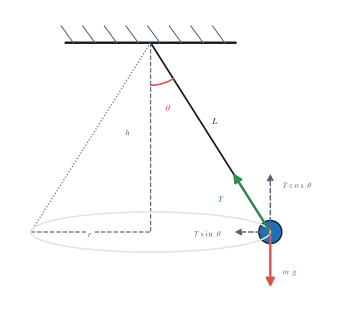
We start from the two force equations for the bob — one vertical, one horizontal — and reach an expression for the time of one revolution.
Setting up. A bob of mass m hangs from a string of length L fixed at a point, and it moves in a horizontal circle so that the string sweeps out a cone at a constant angle \theta to the vertical. From the geometry of that cone,
Only two forces act on the bob: its weight mg straight down, and the tension T along the string towards the support.
Step 1 — resolve the tension. The string makes angle \theta with the vertical, so the tension has a vertical part T\cos\theta (upwards) and a horizontal part T\sin\theta (pointing at the centre of the circle).
Step 2 — vertical equation. The bob stays at the same height, so it has no vertical acceleration and the vertical forces balance:
Step 3 — horizontal equation. Horizontally the bob is accelerating — it is going round a circle — and the only horizontal force is T\sin\theta. So this component must supply the whole centripetal force:
Step 4 — divide Step 3 by Step 2. We divide because both T and m then cancel, which is exactly what we want:
Step 5 — cancel and use \sin/\cos = \tan:
(The same division with mv^{2}/r instead gives the equally useful \tan\theta = v^{2}/rg.)
Step 6 — replace r by L\sin\theta:
Step 7 — write \tan\theta as \sin\theta/\cos\theta:
Step 8 — cancel \sin\theta from both sides. This is allowed because the bob is actually circling, so \theta \ne 0 and \sin\theta \ne 0:
Step 9 — make \omega^{2} the subject. Multiply both sides by g and divide by L:
Step 10 — take the square root:
Step 11 — convert to a period. One revolution takes T_p = 2\pi/\omega:
Step 12 — turn the divided root upside down. Dividing by \sqrt{g/x} is the same as multiplying by \sqrt{x/g}:
Step 13 — recognise L\cos\theta as the depth h:
Step 14 — the tension. Go back to Step 2 and divide both sides by \cos\theta:
Result.
What it means. The mass cancelled, so a heavy bob and a light bob on the same string at the same angle take the same time to go round. The period depends only on the depth h of the circle below the support — so as the bob spins faster, \theta grows, h shrinks and the period gets shorter. Because \cos\theta < 1, the tension mg/\cos\theta is always bigger than the weight, and it would become infinite at \theta = 90^{\circ} — which is why the string can never be truly horizontal.
Conditions used. The string is light and inextensible, the angle \theta stays constant (steady motion, not a wobble), air resistance is neglected, and the circle is horizontal so there is no vertical acceleration.
(i) A labelled diagram showing L, \theta, r, h, mg and T resolved into T\cos\theta and T\sin\theta; (ii) the vertical balance equation with the reason "no vertical acceleration"; (iii) the horizontal equation identified as the centripetal force; (iv) the division step; (v) r = L\sin\theta substituted and \sin\theta cancelled; (vi) the final period, plus the remark that it is independent of the mass.
The period depends on h, not on the mass of the bob — the same result as the simple pendulum, with h in place of L.
Problem. A bob of mass 0.50\ \text{kg} hangs from a string of length 1.0\ \text{m} and moves in a horizontal circle with the string making 60^{\circ} with the vertical. Taking g = 10\ \text{m s}^{-2}, find the tension, the speed of the bob and the period.
Solution. \cos 60^{\circ} = 0.5, \sin 60^{\circ} = 0.866, \tan 60^{\circ} = 1.732.
Radius: r = L\sin\theta = 1.0 \times 0.866 = 0.866\ \text{m}. From \tan\theta = v^{2}/rg:
6.6 Motion in a vertical circle
Whirl a bucket of water in a vertical circle and the water does not fall out at the top. Here gravity acts along the radius at the top and bottom, so the speed is not constant — the motion is non-uniform circular motion.
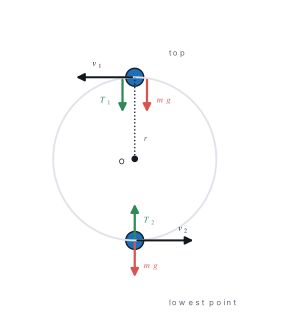
We start from F = mv^{2}/r applied at the top and at the bottom of the circle, add conservation of energy between those two points, and reach three results: the least speed at the top, the least speed at the bottom, and the fact that the tension difference is always 6mg.
Setting up. A mass m on a string of length r is whirled in a vertical circle. Let v_1 be its speed at the highest point and v_2 at the lowest point. At both of those two points the string is vertical, so the tension lies exactly along the radius — which is why these two points are the easy ones to analyse.
At the highest point
Step 1 — which way does each force point? At the top, the centre of the circle is below the mass. Both the weight mg and the tension T_1 (pulling towards the support, which is below) therefore point downwards, i.e. both point towards the centre.
Step 2 — write the centripetal equation. The sum of the inward forces equals mv^{2}/r:
Step 3 — make T_1 the subject by subtracting mg from both sides:
Step 4 — apply the physical limit. A string can pull but cannot push, so the tension can never be negative:
Step 5 — substitute Step 3 into that inequality:
Step 6 — add mg to both sides:
Step 7 — cancel m and multiply both sides by r:
Step 8 — take the square root. The smallest allowed speed is the boundary case:
At exactly this speed T_1 = 0: the string goes slack and gravity alone supplies the whole centripetal force.
At the lowest point
Step 9 — which way does each force point? At the bottom the centre is above the mass. The tension T_2 points up (towards the centre) and the weight points down (away from the centre), so the net inward force is T_2 - mg:
Step 10 — make T_2 the subject:
Linking top and bottom by energy
Step 11 — apply conservation of mechanical energy. The tension does no work (it is always perpendicular to the motion), so only gravity matters. Take the lowest point as the zero of potential energy; the highest point is a height 2r above it:
Step 12 — multiply every term by 2:
Step 13 — cancel m throughout:
Step 14 — put in the minimum top speed v_1^{2} = gr:
Step 15 — take the square root:
The tension difference
Step 16 — subtract the top equation (Step 3) from the bottom one (Step 10):
Step 17 — remove the brackets carefully; the two mg terms now add:
Step 18 — combine the first two terms over the common denominator r:
Step 19 — use Step 13, which says v_2^{2} - v_1^{2} = 4gr:
Step 20 — cancel r:
Result.
What it means. To keep the string taut all the way round you need a speed at the bottom of at least \sqrt{5gr} — that is why you must swing a bucket of water briskly. The 6mg result is remarkable: the speed cancelled out, so the tension difference between bottom and top is the same no matter how fast you whirl it (as long as it does get round).
Conditions used. The string is light and inextensible, air resistance is neglected, and Step 11 assumed no energy is lost to friction. The 6mg result and v_2^{2} = v_1^{2} + 4gr hold for any speed; only v_1 = \sqrt{gr} and v_2 = \sqrt{5gr} are the special minimum case. For a rod instead of a string the rod can push, so T_1 may be negative and the minimum top speed is zero.
(i) A diagram with the forces drawn at the top and at the bottom; (ii) the correct signs — both forces inward at the top, opposing at the bottom; (iii) the argument "a string cannot push, so T \ge 0" leading to v_1 = \sqrt{gr}; (iv) energy conservation over the height 2r, with the remark that the tension does no work; (v) the subtraction giving 6mg. Marks are most often lost on (ii) and on forgetting that the height difference is 2r, not r.
Problem. A body of mass 1\ \text{kg} tied to a string of length 1\ \text{m} is rotated in a vertical circle. Its speed at the highest point is 5\ \text{m s}^{-1}. Taking g = 10\ \text{m s}^{-2}, find the tension at the highest and lowest points, and the minimum speed needed at the top.
Solution. At the top:
Speed at the bottom: v_2^{2} = v_1^{2} + 4gr = 25 + 40 = 65\ \text{m}^{2}\text{s}^{-2}, so v_2 = 8.06\ \text{m s}^{-1}. Then
Check: T_2 - T_1 = 60\ \text{N} = 6mg ✓. The minimum speed at the top is v_1(\min) = \sqrt{gr} = \sqrt{10} = 3.16\ \text{m s}^{-1}; the actual 5\ \text{m s}^{-1} is comfortably above it.
6.7 Applications of banking
On a level road the centripetal force for a turn can only come from friction, which is unreliable when the surface is wet or dusty. So the outer edge of a curve is raised above the inner edge — the road is banked — and a component of the normal reaction does the job instead.
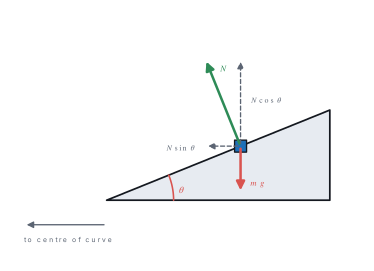
We start from the two force equations for a car on a frictionless banked road and reach a formula for the correct banking angle.
Setting up. The road surface is tilted at an angle \theta to the horizontal, with the outer edge raised. Take friction as negligible, so only two forces act on a car of mass m: its weight mg straight down, and the normal reaction N at right angles to the road surface. Because the surface is tilted by \theta, the normal N is tilted by \theta from the vertical.
Step 1 — resolve N into vertical and horizontal parts. Since N makes angle \theta with the vertical:
Step 2 — the vertical equation. The car stays on the road and does not rise or sink, so it has no vertical acceleration; the vertical forces must balance:
Step 3 — the horizontal equation. Horizontally the car is accelerating, because it is turning. The only horizontal force is N\sin\theta, so that component must be the whole centripetal force:
Step 4 — divide Step 3 by Step 2. We divide because both N and m then cancel:
Step 5 — cancel N on the left and m on the right:
Step 6 — use \sin\theta/\cos\theta = \tan\theta:
Step 7 — take the inverse tangent to get the angle:
Step 8 — or make v the subject instead. Multiply Step 6 by rg and take the square root:
Step 9 — the height of the outer edge. If the road is b wide, the raised edge is the "opposite" side of a right triangle whose hypotenuse is b:
Result.
What it means. The mass cancelled in Step 5, so one banking angle serves a motorcycle and a loaded truck equally — the engineer only has to choose the design speed v and the radius r. Sharper bends (small r) and faster roads (large v) need steeper banking. A cyclist leaning into a turn uses the identical relation.
Conditions used. Friction is neglected, so this gives the one speed at which no sideways friction is needed at all. The car is treated as a point mass (no toppling), the road is a circular arc of fixed radius, and \theta is the same across the whole width. At speeds away from the design speed, friction must make up the difference — which is where the v_{\max} formula below comes from.
(i) A diagram of the tilted surface with mg, N, and N resolved into N\cos\theta and N\sin\theta; (ii) the words "no vertical acceleration" beside the vertical equation; (iii) the horizontal component named as the centripetal force; (iv) the division step; (v) the final relation plus the statement "independent of the mass of the vehicle". A very common error is resolving mg along the slope instead of resolving N vertically — for banking, resolve N.
Including friction, the maximum safe speed on a banked road is
which reduces to v_{\max} = \sqrt{\mu rg} for a level road (\theta = 0).
- Roads. Highway bends such as those on the Mugling–Naubise section are banked for a chosen design speed.
- Railways. The outer rail on a curve is laid higher than the inner rail ("superelevation") so that the flanges do not grind against the rails.
- Aircraft. A turning aeroplane banks its wings so that the horizontal component of the lift becomes the centripetal force.
- Cyclists and bikers lean inwards at an angle \theta with \tan\theta = v^{2}/rg — exactly the same relation.
Problem. A curve of radius 100\ \text{m} on a highway is to be banked for a speed of 72\ \text{km h}^{-1}. Find the angle of banking and, if the road is 10\ \text{m} wide, the height of the outer edge above the inner edge. Take g = 10\ \text{m s}^{-2}.
Solution. First convert the speed: 72\ \text{km h}^{-1} = 72 \times \frac{5}{18} = 20\ \text{m s}^{-1}.
The outer edge must be raised by
Chapter summary
- \theta = s/r in radians; \omega = d\theta/dt = 2\pi/T = 2\pi f; \alpha = d\omega/dt. Angular kinematic equations mirror the linear ones.
- v = r\omega and a_t = r\alpha; all points of a rigid rotating body share \omega but not v.
- Centripetal acceleration a_c = v^{2}/r = r\omega^{2} = 4\pi^{2}r/T^{2}, directed towards the centre. Total acceleration = \sqrt{a_c^2 + a_t^2}.
- Centripetal force F_c = mv^{2}/r is supplied by tension, friction, gravity or a component of the normal reaction. Centrifugal force is a fictitious force.
- Conical pendulum: \tan\theta = v^{2}/rg, T = mg/\cos\theta, period T_p = 2\pi\sqrt{L\cos\theta/g} = 2\pi\sqrt{h/g}.
- Vertical circle: v_{\text{top}}(\min) = \sqrt{gr}, v_{\text{bottom}}(\min) = \sqrt{5gr}, v_2^2 = v_1^2 + 4gr, and T_2 - T_1 = 6mg always.
- Banking: \tan\theta = v^{2}/rg, independent of mass; v_{\max} = \sqrt{rg(\mu+\tan\theta)/(1-\mu\tan\theta)}; on a level road v_{\max} = \sqrt{\mu rg}.
Practice questions
Group A — Multiple choice (1 mark each)
- A body moves in a circle at constant speed. Which quantity remains constant? [1]avelocitybaccelerationckinetic energydmomentum
- The angular velocity of a body making 300 revolutions per minute is [1]a5\ \text{rad s}^{-1}b10\pi\ \text{rad s}^{-1}c300\ \text{rad s}^{-1}d60\pi\ \text{rad s}^{-1}
- The angle of banking of a road is independent of [1]aspeed of the vehiclebradius of the curvecmass of the vehicledacceleration due to gravity
- The minimum speed at the highest point of a vertical circle of radius r is [1]a\sqrt{5gr}b\sqrt{2gr}c\sqrt{gr}dzero
- The work done by the centripetal force in one complete revolution is [1]amv^{2}/rb2\pi r \cdot mv^{2}/rczerod\frac{1}{2}mv^{2}
Answers to Group A
1. (c) — the speed is constant, so \frac{1}{2}mv^2 is constant; velocity, acceleration and momentum all change direction.
2. (b) — \omega = 2\pi N/60 = 2\pi(300)/60 = 10\pi\ \text{rad s}^{-1}.
3. (c) — \tan\theta = v^2/rg contains no mass term.
4. (c) — at the limit the tension is zero and gravity alone gives mg = mv^2/r.
5. (c) — the force is always perpendicular to the displacement, so W = 0.
Group B — Short answer (5 marks each)
- Define angular velocity and angular acceleration. Derive the relations v = r\omega and a_t = r\alpha. [5]
- Derive an expression for the centripetal acceleration of a body moving uniformly in a circle of radius r with speed v. [5]
- What is a conical pendulum? Derive an expression for its period. [5]
- Show that for a body moving in a vertical circle the difference between the tensions at the lowest and the highest points is 6mg. [5]
- A stone of mass 0.20\ \text{kg} is whirled in a horizontal circle of radius 0.50\ \text{m} at 4\ \text{rev s}^{-1}. Calculate its linear speed and the tension in the string. [5]
Answers to Group B
5. \omega = 2\pi f = 2\pi(4) = 8\pi = 25.13\ \text{rad s}^{-1}. Linear speed v = r\omega = 0.50 \times 25.13 = 12.6\ \text{m s}^{-1}. Tension = mr\omega^{2} = 0.20 \times 0.50 \times (25.13)^{2} = 0.10 \times 631.7 = 63.2\ \text{N}.
1., 2., 3., 4. See §6.2, the derivation box in §6.3, §6.5 and §6.6 respectively.
Group C — Long answer (8 marks each)
- (a) What is meant by banking of a road? Derive an expression for the angle of banking of a curved road for a vehicle moving with speed v on a curve of radius r. [5](b) A cyclist rides round a circular track of radius 20\ \text{m} at 10\ \text{m s}^{-1}. Find the angle through which he must lean from the vertical. Take g = 10\ \text{m s}^{-2}. [3]
- (a) Derive expressions for the minimum speeds at the highest and lowest points for a body to just complete a vertical circle of radius r. [5](b) A bucket of water of mass 2\ \text{kg} is whirled in a vertical circle of radius 1\ \text{m}. Find the minimum speed at the top for the water not to spill, and the tension in the rope at the lowest point in that case (g = 10\ \text{m s}^{-2}). [3]
Answers to Group C
1. (b) A leaning cyclist obeys the same relation, \tan\theta = v^{2}/rg = 100/(20 \times 10) = 0.50, so \theta = 26.6^{\circ} from the vertical.
2. (b) Minimum speed at the top: v_1 = \sqrt{gr} = \sqrt{10 \times 1} = 3.16\ \text{m s}^{-1}. Then v_2^{2} = v_1^{2} + 4gr = 10 + 40 = 50, so T_2 = \dfrac{mv_2^{2}}{r} + mg = \dfrac{2 \times 50}{1} + 20 = 120\ \text{N} (which is 6mg, as expected when T_1 = 0).
Practise more: Physics question bank