Unit 24 · Modern Physics · 6 teaching hours · 28 min read
Nuclear physics
What the syllabus asks for 7
- Nucleus: Discovery of nucleus
- Nuclear density, Mass number, Atomic number
- Atomic mass, Isotopes
- Einstein's mass-energy relation
- Mass defect, packing fraction, BE per nucleon
- Creation and annihilation
- Nuclear fission and fusion; energy released
Almost the whole mass of an atom sits in a nucleus about 10^{5} times smaller than the atom itself. This unit is about that tiny object: how it was discovered, how we describe it, and why rearranging its nucleons releases a million times more energy per kilogram than burning coal. The single equation behind all of it is Einstein's E = mc^{2} — in nuclear physics, mass and energy are two ways of writing the same thing.
Two things appear every year: a numerical on mass defect, binding energy or energy released in fission/fusion (always via 1\ \text{u} = 931.5\ \text{MeV}), and a question on the binding-energy-per-nucleon curve. Learn the curve, its peak at A \approx 56, and what its two slopes mean.
24.1 Nucleus: Discovery of nucleus
In 1911 the accepted picture was J. J. Thomson's "plum pudding" atom: positive charge spread uniformly through the whole atom with electrons embedded in it. If that were true, a fast alpha particle fired at a thin foil would pass through almost undeflected, because the spread-out charge could never exert a large force.
Geiger and Marsden, working under Rutherford, fired alpha particles (helium nuclei, energy about 5\ \text{MeV}) from a radium source at a gold foil only \approx 10^{-7}\ \text{m} thick, and counted the flashes they produced on a movable zinc-sulphide screen.
| Observation | Conclusion |
|---|---|
| Most alpha particles passed through with no deflection | the atom is mostly empty space |
| A small fraction were deflected through large angles | there is a concentrated, positively charged core that repels them |
| About 1 in 8000 was turned back through more than 90^{\circ} | that core is very massive and very small |
Rutherford's conclusion (1911) was the nuclear model: all the positive charge and nearly all the mass of the atom are concentrated in a nucleus of radius about 10^{-14}\ \text{m}, while the electrons move around it at a distance of about 10^{-10}\ \text{m}. In his own words, the result was "as incredible as if you fired a 15-inch shell at a piece of tissue paper and it came back and hit you."
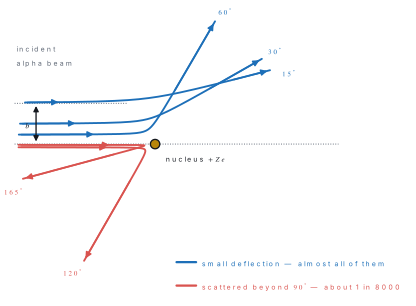
How big is the nucleus? An alpha particle fired straight at it never touches it: the electrostatic repulsion stops it first. The point where it stops gives an upper limit on the nuclear radius.
An alpha particle of kinetic energy E is fired head-on at a nucleus of atomic number Z. The alpha particle carries charge +2e, the nucleus carries +Ze, so the two repel. As the alpha particle comes closer it slows down, and at the closest point it has stopped completely for an instant. Call that separation r_0.
Step 1 — the energy far away. At a large distance the potential energy of the two charges is zero, so all the energy of the alpha particle is kinetic:
Step 2 — the energy at the closest point. Here the speed is zero, so the kinetic energy is zero. All the energy is now electrostatic potential energy of two charges 2e and Ze a distance r_0 apart:
Step 3 — energy is conserved, so the two expressions are equal:
Step 4 — multiply both sides by r_0:
Step 5 — divide both sides by E to make r_0 the subject:
r_0 is the distance of closest approach. Because the alpha particle is turned back before touching, the true nuclear radius must be smaller than r_0 — so this calculation puts an upper limit on the size of the nucleus. Later work completed the picture: Rutherford identified the proton in 1919, and Chadwick discovered the neutral neutron in 1932. Protons and neutrons together are called nucleons, and they are held together by the short-range, strongly attractive nuclear force, which acts only over about 10^{-15}\ \text{m} but is far stronger than the electrostatic repulsion between protons at that range.
24.2 Nuclear density, Mass number, Atomic number
The atomic number Z is the number of protons in the nucleus (and so the number of electrons in the neutral atom). The mass number A is the total number of nucleons, protons plus neutrons. The number of neutrons is N = A - Z.
A nuclide is written with the mass number as a left superscript and the atomic number as a left subscript, for example ²³⁵₉₂U — uranium with Z = 92, A = 235, hence N = 143 neutrons.
Experiments in which fast electrons are scattered from nuclei show that the nuclear radius depends only on the number of nucleons:
The volume of a nucleus is
so the volume is directly proportional to A. The mass of the nucleus is approximately A m_n, where m_n \approx 1.67\times10^{-27}\ \text{kg} is the mass of one nucleon. Hence
A cancels: nuclear density is independent of the mass number, the same for hydrogen and for uranium. Numerically \rho \approx 2.3\times10^{17}\ \text{kg m}^{-3}, about 10^{14} times the density of water. This constancy tells us that nucleons are packed like marbles in a bag — the nuclear force saturates, each nucleon binding only to its nearest neighbours.
Problem. Find the radius and the density of a nucleus with mass number A = 125. Take R_0 = 1.2\ \text{fm} and the mass of a nucleon as 1.67\times10^{-27}\ \text{kg}.
Solution. Since 125^{1/3} = 5,
Volume:
Mass = 125\times1.67\times10^{-27} = 2.09\times10^{-25}\ \text{kg}. Hence
24.3 Atomic mass, Isotopes
Nuclear masses are far too small for the kilogram, so we use the unified atomic mass unit (u), also called the amu.
One atomic mass unit is exactly one-twelfth of the mass of one neutral atom of carbon-12:
| Particle | Mass (u) | Mass (kg) | Charge |
|---|---|---|---|
| Proton | 1.007276 | 1.6726\times10^{-27} | +e |
| Neutron | 1.008665 | 1.6749\times10^{-27} | 0 |
| Electron | 0.000549 | 9.109\times10^{-31} | -e |
| ¹H atom | 1.007825 | — | neutral |
The atomic mass of an element is the mass of one of its atoms in u. It is close to, but never exactly equal to, the mass number A — partly because protons and neutrons are not exactly 1\ \text{u}, and mainly because some mass is "missing" as binding energy (§24.5).
Isotopes are atoms of the same element that have the same atomic number Z but different mass numbers A — that is, the same number of protons but different numbers of neutrons. They are chemically identical but physically different.
| Term | Same | Examples |
|---|---|---|
| Isotopes | Z | ¹H, ²H, ³H; ³⁵Cl, ³⁷Cl; ²³⁵U, ²³⁸U |
| Isobars | A | ⁴⁰Ar, ⁴⁰K, ⁴⁰Ca |
| Isotones | N = A - Z | ³⁶S, ³⁷Cl, ³⁸Ar (each N = 20) |
The atomic mass quoted in a data book is the weighted average over the naturally occurring isotopes, which is why chlorine is listed as 35.45 and not as a whole number.
Problem. Natural chlorine is 75.77\ \% ³⁵Cl (atomic mass 34.96885\ \text{u}) and 24.23\ \% ³⁷Cl (atomic mass 36.96590\ \text{u}). Find its average atomic mass.
Solution.
The two products are 2649.59 and 895.68, so
24.4 Einstein's mass-energy relation
Einstein's special theory of relativity (1905) showed that mass and energy are equivalent: a body of mass m possesses a rest energy
with c = 3.0\times10^{8}\ \text{m s}^{-1}. If a system loses mass \Delta m, it releases energy \Delta E = \Delta m\,c^{2}. Because c^{2} is enormous, a tiny mass change gives a huge energy: this is why nuclear reactions are millions of times more energetic than chemical ones, in which the mass change is far too small to detect.
Where E = mc^{2} comes from
Relativity says that mass is not a fixed property of a body. A body whose mass is m_0 when it is at rest — its rest mass — behaves, when it moves at speed v, as though its mass were
At everyday speeds v/c is so small that m and m_0 agree to many decimal places, which is why nobody noticed for two hundred years. As v approaches c the square root approaches zero and m grows without limit. The mass-energy relation follows from this one formula together with the ordinary work-energy theorem.
Step 1 — work done becomes kinetic energy. A force F acting through a small distance dx does work F\,dx, and all of that work goes into the kinetic energy of the body:
Step 2 — write the force as a rate of change of momentum. Newton's second law in its general form is F = \frac{d(mv)}{dt}, so
Step 3 — rearrange the differentials. dx and dt are just numbers, so we may group them as dx/dt, which is the speed v:
Step 4 — expand the product d(mv). Both m and v are changing now, so the product rule gives d(mv) = m\,dv + v\,dm:
Step 5 — go back to the mass formula and clear the square root. Squaring m = m_0/\sqrt{1-v^{2}/c^{2}} gives
Step 6 — multiply every term by c^{2} so there are no fractions left:
Step 7 — differentiate both sides. The right-hand side is a constant, so its differential is zero. Differentiating m^{2}c^{2} gives 2mc^{2}dm, and differentiating m^{2}v^{2} by the product rule gives 2mv^{2}dm + 2m^{2}v\,dv. Hence
Step 8 — divide every term by 2m:
Step 9 — move the last two terms across:
Step 10 — compare (1) and (2). Their right-hand sides are word for word the same, so their left-hand sides must be equal:
Step 11 — add up all the small bits. Integrate from rest, where the mass is m_0 and the kinetic energy is zero, up to speed v, where the mass is m and the kinetic energy is E_k:
Step 12 — read what this says. Giving the body kinetic energy E_k has increased its mass by exactly E_k/c^{2}. Energy has mass. Turning the statement round, the body already owned a hidden rest energy m_0c^{2} before it ever moved, and its total energy is
So a mass defect expressed in u is turned into energy simply by multiplying by 931.5 to get MeV. Also 1\ \text{eV} = 1.6\times10^{-19}\ \text{J} and 1\ \text{MeV} = 1.6\times10^{-13}\ \text{J}.
Problem. (a) Show that 1\ \text{u} is equivalent to about 931\ \text{MeV}. (b) How much energy would be released if 1.0\ \text{g} of matter were completely converted into energy?
Solution.
(a) E = mc^{2} = (1.6605\times10^{-27})(2.998\times10^{8})^{2} = 1.4924\times10^{-10}\ \text{J}. Converting to MeV,
(b) E = mc^{2} = (1.0\times10^{-3})(3.0\times10^{8})^{2} = 9.0\times10^{13}\ \text{J}.
For comparison, burning 1\ \text{g} of coal gives about 3\times10^{4}\ \text{J} — roughly three billion times less.
24.5 Mass defect, packing fraction, BE per nucleon
Measure the mass of a helium nucleus and compare it with the masses of the two protons and two neutrons it contains: the nucleus is lighter. The missing mass is called the mass defect.
The mass defect is the difference between the total mass of the free nucleons and the actual mass of the nucleus:
The binding energy is the energy equivalent of the mass defect, B = \Delta m\,c^{2}. It is the energy that must be supplied to break the nucleus completely into free nucleons — and the energy released when they come together.
If you use the mass of the ¹H atom (1.007825\ \text{u}) instead of the proton, you must also use the atomic mass of the nuclide, not the nuclear mass. The Z electron masses then cancel out. Mixing the two conventions is the commonest source of wrong binding energies in exams.
The packing fraction measures the mass defect per nucleon in a scaled form:
where M is the atomic mass in u and A the mass number; it is usually quoted after multiplying by 10^{4}. A negative packing fraction means the nuclide is lighter than A units and so is stable; nuclides near A \approx 56 have the most negative values. For ¹⁶O, M = 15.9949\ \text{u}, so f = (15.9949-16)/16 = -3.2\times10^{-4}.
The real measure of stability, however, is the binding energy per nucleon, B/A. Plotting it against A gives the most important graph in nuclear physics.
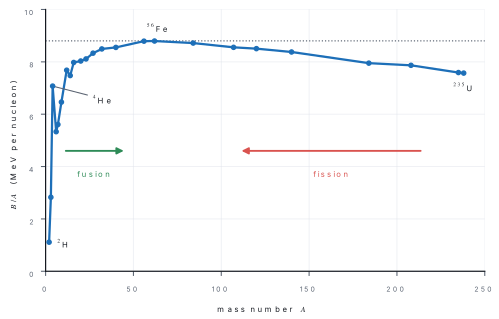
Read the curve carefully — four facts are examined again and again:
- B/A rises steeply for light nuclei, with sharp peaks at ⁴He, ¹²C and ¹⁶O (nuclei built of whole alpha particles are unusually stable).
- It is nearly flat at about 8.5 to 8.8\ \text{MeV} for 30 < A < 120; the maximum, 8.79\ \text{MeV}, is at ⁵⁶Fe. These nuclei are the most stable.
- It falls slowly for heavy nuclei (to 7.6\ \text{MeV} for ²³⁵U) because the long-range electrostatic repulsion between many protons grows faster than the short-range nuclear attraction.
- Therefore energy is released either by joining very light nuclei (fusion) or by splitting very heavy ones (fission) — both move the products towards the peak, so the total binding energy increases.
Problem. Calculate the mass defect, the binding energy, and the binding energy per nucleon of the helium nucleus ⁴He. Given: mass of ¹H atom = 1.007825\ \text{u}, mass of neutron = 1.008665\ \text{u}, atomic mass of ⁴He = 4.002603\ \text{u}.
Solution. Helium has Z = 2, A = 4, so N = 2.
Binding energy:
Binding energy per nucleon:
This is well above its neighbours on the curve, which is why the alpha particle is so stable and is emitted as a unit in radioactive decay.
24.6 Creation and annihilation
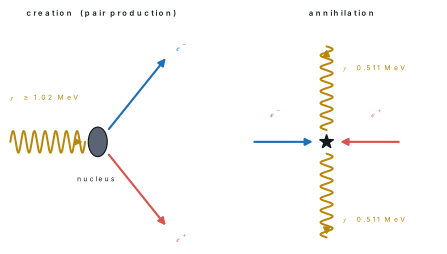
Because mass and energy are interchangeable, energy can turn into matter and matter back into energy — but only in particle–antiparticle pairs, so that charge is conserved.
Pair production (creation). A high-energy photon passing close to a heavy nucleus can vanish, creating an electron and a positron:
γ → e⁻ + e⁺
The photon must supply at least the rest energy of both particles. Each has rest energy m_ec^{2} = 0.511\ \text{MeV}, so the threshold energy is
Any extra photon energy appears as kinetic energy of the pair. The nearby nucleus is essential: it recoils and takes up momentum, because a lone photon cannot produce a pair and conserve energy and momentum at the same time.
Annihilation. The reverse process: when a positron meets an electron, both disappear and their entire mass becomes radiation. Two photons are produced, travelling in opposite directions,
e⁻ + e⁺ → γ + γ
each of energy 0.511\ \text{MeV} when the particles were nearly at rest. Two photons are needed, not one, so that the total momentum stays zero. This process is the basis of the PET scan used in hospitals.
24.7 Nuclear fission and fusion; energy released
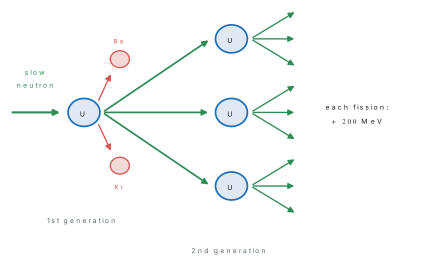
Nuclear fission is the splitting of a heavy nucleus into two nuclei of comparable size, together with two or three neutrons and a large release of energy, when it absorbs a slow (thermal) neutron.
A typical fission of uranium-235 is
²³⁵U + ¹n → ¹⁴¹Ba + ⁹²Kr + 3 ¹n + 200 MeV
The 200\ \text{MeV} is not a fact to be memorised — it can be read straight off the binding-energy-per-nucleon curve.
Step 1 — count the nucleons. The ²³⁵U nucleus absorbs one neutron, so the nucleus that actually splits has A = 235 + 1 = 236 nucleons. Nucleons are neither created nor destroyed, so the products between them also hold 236 nucleons.
Step 2 — total binding energy before the split. From the curve, uranium sits at about 7.6\ \text{MeV} per nucleon. Total binding energy is (binding energy per nucleon) \times (number of nucleons):
Step 3 — total binding energy after the split. The fragments have mass numbers near 141 and 92, which lie close to the top of the curve at about 8.5\ \text{MeV} per nucleon. Counting the same 236 nucleons,
Step 4 — subtract. The products are held together more tightly than the uranium was. Binding energy that the system did not have before must have been supplied from somewhere — it comes out of the rest mass, and appears as the energy released:
which is the familiar "about 200\ \text{MeV} per fission". The same sum is quicker per nucleon: each of the 236 nucleons gains 8.5 - 7.6 = 0.9\ \text{MeV}, and 236 \times 0.9 \approx 212\ \text{MeV}.
About 80\ \% of that energy appears immediately as kinetic energy of the two fragments, which is why the fuel gets hot; the rest is carried by the neutrons, by prompt gamma rays, and by the radiation from the fragments as they later decay.
Chain reaction and critical mass
Each fission releases two or three neutrons, and each of those can split another nucleus, which releases more neutrons still.
A chain reaction is a self-sustaining series of fissions in which neutrons produced by one fission go on to cause further fissions. Its state is measured by the neutron multiplication factor k:
- k < 1 — subcritical: each generation is smaller and the reaction dies out.
- k = 1 — critical: the rate is steady. This is how a power reactor is run.
- k > 1 — supercritical: the rate grows generation after generation. This is an atomic bomb.
The critical mass is the smallest mass of fissile material for which k can reach 1. Below it too many neutrons leak out through the surface before they meet a nucleus. The reason is geometric: volume grows as r^{3} but surface area only as r^{2}, so a bigger lump loses a smaller fraction of its neutrons. For pure ²³⁵U as a bare sphere the critical mass is about 52\ \text{kg}, and much less if a neutron reflector surrounds it.
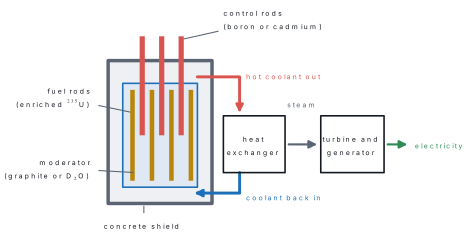
Parts of a nuclear reactor
A reactor is simply a chain reaction held permanently at k = 1 with its heat taken away and used.
| Part | Material | Function |
|---|---|---|
| Fuel rods | uranium enriched to 2–3 % ²³⁵U | supply the nuclei that fission |
| Moderator | graphite, heavy water (D₂O) or ordinary water | slows the fast neutrons (about 2 MeV) down to thermal speeds (about 0.025 eV), which ²³⁵U captures far more readily |
| Control rods | boron or cadmium | absorb surplus neutrons; pushed in to slow the chain, drawn out to speed it up, holding k at exactly 1 |
| Coolant | water, CO₂ or liquid sodium | carries heat from the core to the heat exchanger |
| Heat exchanger | — | boils water to steam, which drives a turbine and generator |
| Shielding | thick concrete and lead | absorbs escaping neutrons and gamma rays and protects the operators |
Both are "extra" materials in the core, so students mix them up. The moderator slows neutrons down so that more fissions happen; the control rods absorb neutrons so that fewer happen. Removing the moderator stops a thermal reactor just as surely as pushing the control rods all the way in.
In a bomb the chain is deliberately left uncontrolled: two subcritical pieces of almost pure ²³⁵U or ²³⁹Pu are slammed together to exceed the critical mass, and k jumps far above 1.
Nuclear fusion is the joining of two very light nuclei into a single heavier nucleus, with a release of energy. It requires extremely high temperature (\approx 10^{8}\ \text{K}) so that the nuclei approach fast enough to overcome their electrostatic repulsion; hence it is called a thermonuclear reaction.
The reaction used in fusion research is deuterium–tritium:
²H + ³H → ⁴He + ¹n + 17.6 MeV
In the Sun, four hydrogen nuclei are effectively converted into one helium nucleus through the proton–proton cycle, releasing 26.7\ \text{MeV} and consuming about 6\times10^{11}\ \text{kg} of hydrogen every second.
| Fission | Fusion | |
|---|---|---|
| Process | heavy nucleus splits | light nuclei join |
| Trigger | absorption of a slow neutron | very high temperature and pressure |
| Energy per event | \approx 200\ \text{MeV} | \approx 17.6\ \text{MeV} (D–T) |
| Energy per nucleon | \approx 0.85\ \text{MeV} | \approx 3.5\ \text{MeV} |
| Products | radioactive fragments | mostly non-radioactive |
| Controlled use | nuclear power reactors | not yet commercially achieved |
Problem. (a) Calculate the energy released in the fusion reaction ²H + ³H → ⁴He + ¹n, given the masses ²H = 2.014102\ \text{u}, ³H = 3.016049\ \text{u}, ⁴He = 4.002603\ \text{u}, ¹n = 1.008665\ \text{u}. (b) If each fission of ²³⁵U releases 200\ \text{MeV}, how much energy is obtainable from 1.0\ \text{kg} of ²³⁵U? (N_A = 6.022\times10^{23}\ \text{mol}^{-1}.)
Solution.
(a) Total mass before = 2.014102 + 3.016049 = 5.030151\ \text{u}. Total mass after = 4.002603 + 1.008665 = 5.011268\ \text{u}.
(b) Number of nuclei in 1.0\ \text{kg} = 1000\ \text{g}:
That single kilogram would run a 100\ \text{MW} power station for 8.2\times10^{13}/10^{8} = 8.2\times10^{5}\ \text{s}, about 9.5 days.
Chapter summary
- Rutherford's alpha-scattering experiment showed the atom is mostly empty with a tiny, massive, positively charged nucleus of radius about 10^{-14}\ \text{m}.
- Z = number of protons, A = number of nucleons, N = A - Z; R = R_0A^{1/3} with R_0 = 1.2\ \text{fm}, so nuclear density is constant at about 2.3\times10^{17}\ \text{kg m}^{-3}.
- 1\ \text{u} = 1.6605\times10^{-27}\ \text{kg} = 931.5\ \text{MeV}. Isotopes have the same Z and different A.
- Mass varies with speed, m = m_0/\sqrt{1-v^{2}/c^{2}}; from this and dE_k = v\,d(mv) follows E_k = (m-m_0)c^{2} and hence E = mc^{2}. A mass defect in u times 931.5 gives the energy in MeV.
- Mass defect \Delta m = [Zm_p + (A-Z)m_n] - M; binding energy B = \Delta mc^2; packing fraction f = (M-A)/A.
- The B/A curve peaks at about 8.8\ \text{MeV} near A = 56; light nuclei release energy by fusion, heavy nuclei by fission.
- Pair production needs E \ge 1.02\ \text{MeV} and a nearby nucleus; annihilation of e⁻ and e⁺ gives two 0.511\ \text{MeV} photons.
- Fission of ²³⁵U releases about 200\ \text{MeV} (read off the B/A curve as 236\times(8.5-7.6)) and 2–3 neutrons, which sustain a chain reaction above the critical mass (\approx 52\ \text{kg} for bare ²³⁵U). A reactor holds the multiplication factor at k = 1 using a moderator to slow neutrons and control rods to absorb them.
- D–T fusion releases 17.6\ \text{MeV} but needs about 10^{8}\ \text{K}.
Practice questions
Group A — Multiple choice (1 mark each)
- Rutherford's alpha-scattering experiment established that [1]athe electron is negatively chargedbthe nucleus is small, massive and positivecthe atom is a uniform sphere of chargedneutrons exist in the nucleus
- The density of a nucleus [1]aincreases with Abdecreases with Acis independent of Adis equal to that of water
- The energy equivalent of 1\ \text{u} is about [1]a0.511\ \text{MeV}b1.02\ \text{MeV}c931.5\ \text{MeV}d200\ \text{MeV}
- The binding energy per nucleon is maximum for nuclei with mass number near [1]a4b56c120d235
- The minimum photon energy needed for pair production is [1]a0.255\ \text{MeV}b0.511\ \text{MeV}c1.02\ \text{MeV}d1.44\ \text{MeV}
- Two nuclides with the same mass number but different atomic numbers are called [1]aisotopesbisobarscisotonesdisomers
- The moderator in a nuclear reactor is used to [1]aabsorb surplus neutronsbslow down fast neutronsccool the coredshield the operators
- A chain reaction is just self-sustaining when the multiplication factor is [1]ak < 1bk = 0ck = 1dk > 1
Answers to Group A
1. (b) — large-angle scattering can only come from a concentrated positive charge.
2. (c) — mass \propto A and volume \propto A, so A cancels.
3. (c) — (1.6605\times10^{-27})c^{2} = 1.49\times10^{-10}\ \text{J} = 931.5\ \text{MeV}.
4. (b) — the peak of the B/A curve is ⁵⁶Fe at 8.79\ \text{MeV}.
5. (c) — twice the electron rest energy, 2\times0.511\ \text{MeV}.
6. (b) — same A means isobars, e.g. ⁴⁰Ar and ⁴⁰Ca.
7. (b) — slow (thermal) neutrons are captured by ²³⁵U far more readily; the control rods, not the moderator, do the absorbing.
8. (c) — k = 1 means each generation is the same size as the one before.
Group B — Short answer (5 marks each)
- Describe Rutherford's alpha-particle scattering experiment. State three observations and the conclusion drawn from each. [5]
- Show that the density of a nucleus is independent of its mass number, and calculate its value. Take R_0 = 1.2\ \text{fm} and m_n = 1.67\times10^{-27}\ \text{kg}. [5]
- Define mass defect and binding energy. Calculate the binding energy per nucleon of ⁷Li, given atomic masses ⁷Li = 7.016004\ \text{u}, ¹H = 1.007825\ \text{u}, ¹n = 1.008665\ \text{u}. [5]
- An alpha particle of energy 5.0\ \text{MeV} is fired head-on at a gold nucleus (Z = 79). Find its distance of closest approach. Take 1/4\pi\varepsilon_0 = 9\times10^{9}\ \text{N m}^{2}\ \text{C}^{-2}. [5]
- What is meant by creation and annihilation of matter? Why does pair production need a minimum energy of 1.02\ \text{MeV}, and why must it occur near a nucleus? [5]
- Sketch the graph of binding energy per nucleon against mass number and use it to explain why both fission and fusion release energy. [5]
- Starting from the relativistic variation of mass with speed, derive Einstein's mass-energy relation E = mc^{2}. [5]
- With the help of a labelled diagram, describe the main parts of a nuclear reactor and state the function of each. [5]
Answers to Group B
2. \rho = 3m_n/4\pi R_0^{3}; numerically 3(1.67\times10^{-27})/[4\pi(1.2\times10^{-15})^{3}] = 5.01\times10^{-27}/7.24\times10^{-45} = 2.3\times10^{17}\ \text{kg m}^{-3}.
3. \Delta m = 3(1.007825) + 4(1.008665) - 7.016004 = 3.023475 + 4.034660 - 7.016004 = 0.042131\ \text{u}. B = 0.042131\times931.5 = 39.2\ \text{MeV}, so B/A = 39.2/7 = 5.6\ \text{MeV per nucleon}.
4. E = 5.0\ \text{MeV} = 5.0\times1.6\times10^{-13} = 8.0\times10^{-13}\ \text{J}.
The numerator is 9\times10^{9}\times158\times2.56\times10^{-38} = 3.64\times10^{-26}, so r_0 = 4.6\times10^{-14}\ \text{m}.
1., 5., 6. are bookwork: see §24.1, §24.6 and §24.5. For 6, marks are given for the labelled axes, the peak at A \approx 56 with B/A \approx 8.8\ \text{MeV}, and the statement that both processes move the products towards the peak, so binding energy increases and energy is released.
7. See the derivation in §24.4. One mark each for: dE_k = v\,d(mv); expanding it to mv\,dv + v^{2}dm; differentiating m^{2}c^{2} - m^{2}v^{2} = m_0^{2}c^{2} to reach c^{2}dm = mv\,dv + v^{2}dm; integrating dE_k = c^{2}dm to get E_k = (m - m_0)c^{2}; and concluding E = mc^{2}.
8. See §24.7. Marks for the labelled diagram plus fuel rods, moderator, control rods, coolant and shielding with one correct function each.
Group C — Long answer (8 marks each)
- (a) Define mass defect, binding energy and binding energy per nucleon. [3](b) Draw the binding-energy-per-nucleon curve and describe its main features. [2](c) Calculate the energy released in the reaction ²H + ³H → ⁴He + ¹n, given ²H = 2.014102\ \text{u}, ³H = 3.016049\ \text{u}, ⁴He = 4.002603\ \text{u} and ¹n = 1.008665\ \text{u}. [3]
- (a) What is nuclear fission? Explain chain reaction and critical mass, and state the function of a moderator and of control rods in a reactor. [4](b) Each fission of ²³⁵U releases 200\ \text{MeV}. Calculate the energy released by the complete fission of 0.50\ \text{kg} of ²³⁵U, and the mass that disappears in the process. [4]
Answers to Group C
1.(c) \Delta m = (2.014102+3.016049) - (4.002603+1.008665) = 5.030151 - 5.011268 = 0.018883\ \text{u}, so Q = 0.018883\times931.5 = 17.6\ \text{MeV}.
2.(b) N = (500/235)\times6.022\times10^{23} = 1.28\times10^{24} nuclei. E = 1.28\times10^{24}\times200\times1.6\times10^{-13} = 4.1\times10^{13}\ \text{J}. The mass lost follows from E = \Delta mc^{2}: \Delta m = 4.1\times10^{13}/(9\times10^{16}) = 4.6\times10^{-4}\ \text{kg}, i.e. about 0.46\ \text{g} — less than one part in a thousand of the fuel.
1.(a), 1.(b), 2.(a) are bookwork: see §24.5 and §24.7.
Practise more: Physics question bank