Unit 7 · Mechanics · 10 teaching hours · 35 min read
Gravitation
What the syllabus asks for 10
- Newton's law of gravitation
- Gravitational field strength
- Gravitational potential; Gravitational potential energy
- Variation in value of 'g' due to altitude and depth
- Centre of mass and centre of gravity
- Motion of a satellite: orbital velocity and time period
- Escape velocity
- Potential and kinetic energy of the satellite
- Geostationary satellite
- GPS
Gravitation is the weakest of the four fundamental interactions, yet it shapes the largest structures in the universe, because it is always attractive and never cancels out. One equation written by Newton in 1687 explains a falling apple in Lumbini, the orbit of the Moon, the tides, the period of a communication satellite over the equator and the reading on a GPS receiver in Kathmandu. This unit builds that equation, measures the Earth with it, and then flies satellites.
Two families of formulas, and knowing which family a question belongs to. The field family (F, g) is about forces and varies as 1/r^{2}. The energy family (V, U) is about work and varies as 1/r, and is always negative. Escape velocity, orbital energy and binding energy all come from the second family.
7.1 Newton's law of gravitation
Every particle in the universe attracts every other particle with a force that is directly proportional to the product of their masses and inversely proportional to the square of the distance between them. The force acts along the line joining them.
G is the universal gravitational constant. Its value, first measured by Henry Cavendish in 1798 with a torsion balance, is
with dimensions [M^{-1}L^{3}T^{-2}]. It is "universal" because it is the same everywhere, for every pair of masses, at every temperature.
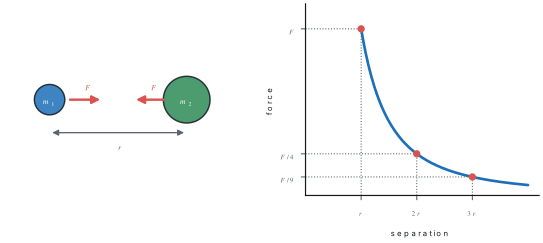
Three points that carry marks:
- The forces form a Newton's third law pair — equal in magnitude, opposite in direction — even when the masses are wildly different. The Earth pulls an apple with the same force with which the apple pulls the Earth.
- The law is stated for point masses. For a uniform solid sphere it still holds exactly, with r measured from the centre — Newton proved this.
- Gravitational force is independent of the medium between the bodies and of the presence of other masses. Forces from several masses simply add as vectors (the principle of superposition).
Problem. Taking g = 9.8\ \text{m s}^{-2} at the Earth's surface and R = 6.4 \times 10^{6}\ \text{m}, calculate the mass and the mean density of the Earth. (G = 6.67 \times 10^{-11}\ \text{N m}^{2}\text{ kg}^{-2}.)
Solution. For a body of mass m on the surface, its weight is the gravitational pull:
Mean density:
This is about twice the density of surface rock, which is the first clue that the Earth has a dense iron core. Cavendish called this "weighing the Earth".
7.2 Gravitational field strength
A mass changes the space around it so that any other mass placed there feels a force. That region is the gravitational field.
The gravitational field strength (or gravitational intensity) at a point is the force per unit mass experienced by a small test mass placed at that point:
It is a vector, measured in N kg⁻¹ (or m s⁻², the same thing), directed towards the attracting mass.
For a point mass (or outside a uniform sphere) of mass M, at distance r,
At the surface of the Earth r = R and the field strength is exactly what we call g:
So g is not a property of the falling body — it is a property of the Earth and of where you stand. Field lines point radially inwards; their crowding near the surface shows where the field is strong.
Mass (kg) is the amount of matter and is the same everywhere. Weight (N) is the gravitational force mg and changes with location. A 60 kg student has mass 60 kg on the Moon too, but weighs only about 60 \times 1.62 = 97\ \text{N} there instead of 588\ \text{N}.
7.3 Gravitational potential; gravitational potential energy
Gravity is a conservative force, so a potential energy can be defined. The natural zero is at infinite separation, where the force vanishes.
We start from the definition of potential energy as the work needed to bring a mass in from infinity, and reach the -GMm/r formula and the potential that follows from it.
Setting up. A mass M sits at the origin. We bring a small mass m from infinity (where we agree U = 0) slowly in to a distance r. "Slowly" means the body has no kinetic energy at either end, so all the work done shows up as stored energy.
Step 1 — the force at a general distance x. By Newton's law of gravitation the attraction on m when it is a distance x from M has magnitude
and it points inwards, towards M.
Step 2 — fix a sign convention. Measure x outwards from M, so "outwards" is positive. Gravity pulls inwards, i.e. in the direction of decreasing x, so as a signed quantity the gravitational force is
Step 3 — work done by gravity over a tiny displacement dx. Work is force times displacement:
Step 4 — add up all the tiny bits from x = \infty to x = r:
Step 5 — take the constants outside the integral. G, M and m do not change during the journey:
Step 6 — integrate x^{-2}. Using \int x^{-2}dx = -x^{-1}:
Step 7 — the two minus signs cancel:
Step 8 — put in the limits (value at the top limit minus value at the bottom limit):
Step 9 — use 1/\infty = 0:
This is the work done by gravity as the mass falls in from infinity, and it is positive — gravity helped, as you would expect.
Step 10 — convert that into potential energy. Whenever a conservative force does work W, the potential energy falls by the same amount:
Step 11 — put in U(\infty) = 0 (our chosen zero) and W = GMm/r:
so
Step 12 — get the potential. The gravitational potential V is defined as the potential energy per unit mass, so divide by m:
Result.
Both are scalars — there is no direction to worry about, which is what makes potential so much easier to work with than field.
What it means. The sign is not a mistake. We chose U = 0 at infinity, and gravity is always attractive, so every real point is a place you would have to do work to climb out of. Hence U is negative everywhere, deepest (most negative) close in and rising towards zero far away — a "potential well".
Conditions used. M is treated as a point mass (or a uniform sphere, for which this is exactly true outside it), the mass is moved slowly so no kinetic energy is involved, and the zero of potential is taken at infinity. U belongs to the pair of masses, not to either one alone.
(i) The statement that U = 0 at infinity — write it down; (ii) F = GMm/x^{2} at a general distance x; (iii) the integral with limits \infty to r; (iv) the integration of 1/x^{2} shown properly; (v) the negative sign explained in words; (vi) V = U/m with the unit J kg⁻¹. The explanation of the minus sign is worth a mark on its own and is almost always missing.
Zero potential is at infinity. Since gravity is always attractive, work must be done against it to take a mass out to infinity, so every finite point is at a lower energy than infinity, i.e. negative. The potential is most negative at the centre of the well and rises towards zero as r \to \infty.
Field and potential are linked by
— the field is the negative gradient (steepness) of the potential.
Near the surface, over heights small compared with R, the difference U_2 - U_1 reduces to the familiar mgh:
So U = mgh is not a different formula — it is the 1/r formula in disguise, valid only close to the ground.
7.4 Variation in the value of g due to altitude and depth
We start from g = GM/R^{2} at the surface and reach a formula for g at a height h above it.
Step 1 — g at the surface. A mass m on the surface is a distance R from the centre of the Earth, so its weight is GMm/R^{2}. But weight is also mg, so:
Step 2 — g at a height h. At height h the body is a distance R+h from the centre. The only change is the distance, so
Step 3 — form the ratio g_h/g. Divide Step 2 by Step 1. The GM cancels:
Step 4 — write it as a single squared bracket:
Step 5 — divide the top and bottom inside the bracket by R. Dividing top and bottom by the same thing does not change a fraction:
Step 6 — write the reciprocal as a negative power:
This formula is exact. The next two steps only simplify it for small heights.
Step 7 — use the binomial expansion. For small x, (1+x)^{n} \approx 1 + nx. Here x = h/R and n = -2:
Step 8 — tidy up:
Result.
What it means. g gets smaller as you climb, and for small heights the fractional drop is 2h/R — twice the fraction of the Earth's radius you have climbed. At the top of Sagarmatha (h \approx 8.8 km) this is about 0.28\%, so g falls from 9.800 to about 9.77 m s⁻². g only becomes zero at infinity.
Conditions used. The Earth is treated as a uniform sphere so that it acts like a point mass at its centre; rotation is ignored. Step 7 needs h \ll R — for a satellite at h = R you must use the exact form, which gives g/4, not g(1-2) = -g.
We start from the shell theorem and reach a formula for g at a depth d below the surface — and show that g becomes zero at the centre.
Setting up. Treat the Earth as a uniform sphere of radius R and density \rho. A body at depth d is at a distance (R - d) from the centre.
Step 1 — the shell theorem. A uniform spherical shell exerts no net gravitational force on anything inside it: the pulls from all sides cancel exactly. So the outer shell, of thickness d, can be ignored, and only the inner sphere of radius (R-d) attracts the body.
Step 2 — the mass of that inner sphere. Mass = density \times volume, and the volume of a sphere is \frac{4}{3}\pi(\text{radius})^{3}:
Step 3 — the field at the body's position. The inner sphere behaves like a point mass M' at the centre, a distance (R-d) away:
Step 4 — substitute M' from Step 2:
Step 5 — cancel (R-d)^{2} against two of the three factors in (R-d)^{3}, leaving one:
Step 6 — do the same thing at the surface. Putting d = 0 in Step 5 gives the surface value:
Step 7 — divide Step 5 by Step 6. All the constants \frac{4}{3}\pi G\rho cancel:
Step 8 — split the fraction on the right:
Step 9 — multiply both sides by g:
Step 10 — put d = R (the centre of the Earth):
Result.
What it means. Unlike the altitude case, g falls linearly with depth — and it reaches exactly zero at the centre, where a body would be weightless because the pulls from all directions cancel. Notice also that going up a small distance h costs 2h/R of g, while going down the same distance costs only d/R — twice as much is lost by climbing as by digging.
Conditions used. The Earth is assumed to be of uniform density, which is the only way Step 2 works. (In reality the core is far denser, so g actually rises slightly for the first 3000 km before falling.) Rotation and the non-spherical shape are ignored.
For the depth derivation: (i) the shell-theorem statement — "the shell above exerts no force" — in words; (ii) M' = \frac{4}{3}\pi(R-d)^{3}\rho; (iii) the cancellation in Step 5; (iv) the surface value with d=0; (v) the ratio, giving g_d = g(1 - d/R); (vi) the substitution d = R to show g = 0 at the centre. State the uniform-density assumption — it is frequently a listed mark.
Three consequences follow:
- g decreases linearly with depth and reaches zero at the centre (d = R). A body at the centre of the Earth is weightless.
- g decreases with altitude as 1/(R+h)^{2}, reaching zero only at infinity.
- Near the surface a given small distance costs twice as much g going up as going down (2h/R against d/R).

Two further effects change g over the Earth's surface, both worth a mark:
| Cause | Effect on g |
|---|---|
| Shape: the Earth bulges at the equator (R_{eq} > R_{pole}) | g is greatest at the poles (9.83), least at the equator (9.78) |
| Rotation: g' = g - R\omega^{2}\cos^{2}\lambda at latitude \lambda | reduces g most at the equator, no effect at the poles |
Problem. Take g = 9.8\ \text{m s}^{-2} and R = 6.4\times10^{6}\ \text{m}. Find g (a) at the summit of Sagarmatha (Mt. Everest), height 8849\ \text{m}, (b) at a height equal to the Earth's radius, and (c) at a depth of R/2.
Solution.
(a) Here h = 8849\ \text{m} \ll R, so use the approximation:
Climbing the highest mountain on Earth reduces your weight by only about 0.28\%.
(b) Here h = R is not small, so use the exact form:
(c) g_d = g\left(1 - \dfrac{d}{R}\right) = 9.8\left(1 - \dfrac{1}{2}\right) = 4.9\ \text{m s}^{-2}.
g_h = g(1-2h/R) is a first-order approximation. At h = R it would give g_h = -9.8\ \text{m s}^{-2}, which is nonsense. Use it only when h is a few per cent of R at most; otherwise use g(R/(R+h))^{2}.
7.5 Centre of mass and centre of gravity
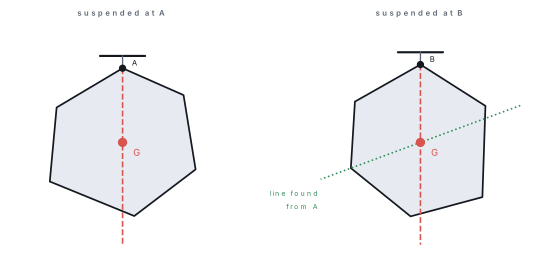
The centre of mass of a system is the point at which the whole mass may be considered concentrated for the purpose of describing translational motion:
The centre of gravity is the point through which the resultant weight of the body acts.
In a uniform gravitational field the two points coincide, because each mass element is weighted by the same g. They separate only when the body is so tall that g differs measurably across it — for a mountain or a long satellite, the centre of gravity lies slightly below the centre of mass, because the lower parts are pulled harder. For anything of laboratory size the distinction is academic, but NEB asks for it.
| Centre of mass | Centre of gravity | |
|---|---|---|
| Depends on | mass distribution only | mass distribution and the field |
| Exists in zero gravity? | Yes | No |
| Position for a uniform field | same point | same point |
| Position for a very large body | fixed | slightly towards the stronger field |
Problem. Three particles of masses 1\ \text{kg}, 2\ \text{kg} and 3\ \text{kg} are placed at the points (0,0), (6,0) and (0,6) metres. Locate their centre of mass.
Solution. Total mass M = 1+2+3 = 6\ \text{kg}.
The centre of mass is at (2, 3)\ \text{m}. Note it lies nearer the heavier masses, and it need not be at the position of any actual particle.
7.6 Motion of a satellite: orbital velocity and time period
A satellite in a circular orbit of radius r around a planet of mass M is held there because the gravitational attraction plays the part of the centripetal force.
We start from the single physical idea that gravity is the centripetal force for a satellite, and reach expressions for its orbital speed and its period — and Kepler's third law as a bonus.
Setting up. A satellite of mass m moves in a circle of radius r = R + h about a planet of mass M and radius R, at a height h above the surface, with orbital speed v_o.
Step 1 — the gravitational force on the satellite. By Newton's law of gravitation, at a distance r from the centre:
Step 2 — the centripetal force it needs. To move in a circle of radius r at speed v_o, a mass m needs an inward force
Step 3 — equate them. Gravity is the only force acting, so it must be exactly the force required — no more and no less:
Step 4 — cancel m from both sides. It appears once on each side, so the answer will not depend on the satellite's mass:
Step 5 — multiply both sides by r:
Step 6 — take the square root:
Step 7 — rewrite using surface quantities. At the surface g = GM/R^{2}, so GM = gR^{2}. Substitute:
Step 8 — take R^{2} out of the root as R:
Step 9 — the period. The satellite travels one circumference 2\pi r in one period T at steady speed v_o, so time = distance \div speed:
Step 10 — substitute v_o from Step 6:
Step 11 — dividing by \sqrt{GM/r} is the same as multiplying by \sqrt{r/GM}:
Step 12 — bring the r outside the root inside it, where it becomes r^{2}:
Step 13 — square both sides:
Step 14 — group the constants. 4\pi^{2}, G and M are all fixed for a given planet:
Result.
That last line is Kepler's third law — here derived from Newton's laws rather than assumed from observation.
What it means. The satellite's mass cancelled in Step 4, so a tiny cubesat and a space station at the same height orbit at the same speed and with the same period. A higher orbit is a slower orbit (v_o \propto 1/\sqrt{r}) with a longer period — which is why a geostationary satellite has to sit 36 000 km up. For a satellite skimming the surface, h \approx 0 and v_o = \sqrt{gR} \approx 7.9 km s⁻¹.
Conditions used. The orbit is circular (for an ellipse, r becomes the mean distance), there is no air resistance, the planet is a uniform sphere, and the satellite's mass is far smaller than the planet's so the planet does not move.
(i) The sentence "the gravitational force provides the centripetal force"; (ii) both force expressions written out; (iii) the cancellation of m, and a comment that the speed is therefore independent of the satellite's mass; (iv) the substitution GM = gR^{2} if the question gives g and R rather than G and M; (v) T = 2\pi r/v_o and the final T^{2} \propto r^{3} named as Kepler's third law.

Problem. A satellite orbits the Earth at a height of 300\ \text{km}. Taking g = 9.8\ \text{m s}^{-2} and R = 6.4\times10^{6}\ \text{m}, find its orbital speed and period.
Solution. Orbital radius r = R+h = 6.4\times10^{6} + 0.3\times10^{6} = 6.7\times10^{6}\ \text{m}, and GM = gR^{2} = 9.8 \times 4.096\times10^{13} = 4.01\times10^{14}\ \text{m}^{3}\text{s}^{-2}.
A low-Earth-orbit satellite therefore circles the planet about 16 times a day.
7.7 Escape velocity
The escape velocity is the minimum speed with which a body must be projected from the surface of a planet so that it escapes the planet's gravitational field and never returns — that is, it just reaches infinity with zero speed.
We start from conservation of energy between the planet's surface and infinity, and reach the minimum launch speed needed to get away and never come back.
Setting up. A body of mass m is fired straight up from the surface of a planet of mass M and radius R with speed v_e. Take the gravitational potential energy to be zero at infinity, as usual.
Step 1 — energy at the surface. The body has kinetic energy \frac{1}{2}mv_e^{2} and potential energy -GMm/R (using U = -GMm/r with r = R). The total is
Step 2 — energy at infinity. "Just escapes" means it arrives at infinity with no speed left over, so its kinetic energy there is zero. Its potential energy there is also zero, by our choice of zero level. So:
Step 3 — apply conservation of energy. Gravity is a conservative force and we neglect air resistance, so the total energy does not change:
Step 4 — move the second term to the right:
Step 5 — cancel m from both sides. It appears once on each side, so the answer does not depend on the body's mass:
Step 6 — multiply both sides by 2:
Step 7 — take the square root:
Step 8 — rewrite in terms of g. At the surface g = GM/R^{2}, so GM = gR^{2}:
Step 9 — cancel one R:
Step 10 — a third form, in terms of density. The planet's mass is M = \frac{4}{3}\pi R^{3}\rho. Putting this into Step 7:
Result.
For the Earth, v_e = \sqrt{2 \times 9.8 \times 6.4\times10^{6}} = 11.2 km s⁻¹.
What it means. m cancelled, so a pebble and a rocket need the same escape speed. There is also no angle in the answer — energy depends only on distance, so the direction of projection does not matter either. Escape speed depends only on the planet: its mass (or density) and its radius.
Conditions used. Air resistance is neglected (a real rocket needs more), the body is given all its speed at once at the surface (not continuously pushed), the planet does not rotate, and there are no other bodies pulling on it.
We start from the two results just obtained and reach the ratio between them.
Step 1 — orbital speed for an orbit close to the surface. Put h = 0, i.e. r = R, into v_o = \sqrt{GM/r}:
Step 2 — write down the escape speed:
Step 3 — split the root. Since \sqrt{ab} = \sqrt{a}\sqrt{b}:
Step 4 — recognise the second factor as v_o from Step 1:
Result. v_e = \sqrt{2}\,v_o \approx 1.41\,v_o.
What it means. A satellite in low orbit is already travelling at 7.9 km s⁻¹; only 41 % more speed would let it leave the Earth altogether. In energy terms, escaping needs exactly twice the kinetic energy of orbiting, because v_e^{2} = 2v_o^{2}.
Condition used. The orbit must be close to the surface (h \ll R), so that the same R appears in both formulas.
For the Earth, v_e = \sqrt{2 \times 9.8 \times 6.4\times10^{6}} = \sqrt{1.254\times10^{8}} = 11.2\ \text{km s}^{-1}.
| Body | g (m s⁻²) | R (km) | v_e (km s⁻¹) |
|---|---|---|---|
| Moon | 1.62 | 1738 | 2.4 |
| Earth | 9.8 | 6400 | 11.2 |
| Mars | 3.7 | 3390 | 5.0 |
| Jupiter | 24.8 | 71 500 | 59.5 |
| Sun | 274 | 696 000 | 618 |
The escape velocity of the Moon (2.4\ \text{km s}^{-1}) is comparable to the root-mean-square speed of ordinary gas molecules at its daytime temperature, so over geological time the gas molecules have all escaped. The Earth's 11.2\ \text{km s}^{-1} is far above molecular speeds, so our atmosphere stays — except for hydrogen and helium, the lightest and fastest, which do leak away.
v_e contains no angle, because the derivation uses only energy, and potential energy depends only on r. Nor does it depend on the mass of the projectile. It does depend on the mass and radius of the planet.
7.8 Potential and kinetic energy of the satellite
For a satellite of mass m in a circular orbit of radius r, the orbital condition GMm/r^{2} = mv_o^{2}/r gives mv_o^{2} = GMm/r, so
Three facts to remember:
- U = -2K, and E = -K = U/2. The total energy is negative, which is the signature of a bound orbit. If E were zero or positive the satellite would escape.
- The binding energy — the extra energy needed to send the satellite from its orbit to infinity — is |E| = GMm/2r.
- A satellite in a lower orbit has a more negative total energy but a higher speed. Losing energy to atmospheric drag makes a satellite spiral down and speed up, which is why decaying satellites burn up.

Problem. A satellite of mass 200\ \text{kg} orbits the Earth at a height equal to the Earth's radius. Find its orbital speed, kinetic energy, potential energy, total energy and binding energy. (g = 9.8\ \text{m s}^{-2}, R = 6.4\times10^{6}\ \text{m}.)
Solution. Orbital radius r = 2R = 1.28\times10^{7}\ \text{m} and GM = gR^{2} = 4.01\times10^{14}\ \text{m}^{3}\text{s}^{-2}.
The binding energy is |E| = 3.14\times10^{9}\ \text{J} — the energy that must be supplied to free the satellite completely.
7.9 Geostationary satellite
A geostationary satellite is one that appears permanently fixed above one point on the Earth's equator, because it revolves in the same sense as the Earth with a period exactly equal to the Earth's period of rotation, 24\ \text{hours}.
Four conditions must all be met:
- Its period must be 24\ \text{h} (86400\ \text{s}).
- Its orbit must lie in the equatorial plane.
- It must revolve west to east, the same sense as the Earth's spin.
- The orbit must be circular, so that the angular speed is constant.
The height follows from the period. From T^{2} = 4\pi^{2}r^{3}/GM,
so the height above the surface is
and the orbital speed is v = 2\pi r/T = 3.08\ \text{km s}^{-1}.
Geostationary satellites carry television broadcasts, telephone relays and weather imaging. Three of them, 120^{\circ} apart, cover almost the whole globe except the polar caps. Nepal's own communications satellite slot, at 123.3^{\circ}\text{E}, is a geostationary slot of exactly this kind; the INSAT and FengYun weather images used by the Department of Hydrology and Meteorology come from the same ring.
It moves at over 3\ \text{km s}^{-1}. It only appears stationary because the ground beneath it moves with the same angular velocity. Also, it cannot be placed over Kathmandu — the centre of any orbit must be the centre of the Earth, so a fixed-overhead satellite is only possible above the equator.
7.10 GPS
The Global Positioning System is a constellation of at least 24 satellites in six orbital planes at a height of about 20\,200\ \text{km}, each with a period of 11\ \text{h}\ 58\ \text{min} — half a sidereal day, so each satellite traces the same ground track twice daily. From anywhere on Earth at least four are above the horizon.
Each satellite continuously broadcasts its own position and the exact time of transmission, kept by an atomic clock. The receiver measures the delay \Delta t and computes the distance
where c = 3\times10^{8}\ \text{m s}^{-1}. One distance places the receiver on a sphere around that satellite; two spheres intersect in a circle; three fix it to two points, one of which is absurd (far out in space). This is trilateration. A fourth satellite is needed because the receiver's own cheap quartz clock has an unknown offset — four measurements solve for four unknowns (x, y, z and the clock error).

Two corrections matter. Because the satellites move fast, special relativity makes their clocks run slow by about 7\ \mu\text{s} per day; because they are high in a weaker gravitational field, general relativity makes them run fast by about 45\ \mu\text{s} per day. The net 38\ \mu\text{s} per day is corrected in the satellite clocks — without it, positions would drift by about 11\ \text{km} every day.
GPS is used in Nepal for land surveying and cadastral mapping, for tracking aircraft and trekking routes, for monitoring the slow northward creep of the Indian plate (about 2\ \text{cm} per year) that builds the Himalaya and causes earthquakes, and it was used in the 2019–2020 survey in which Nepal and China jointly re-measured the height of Sagarmatha as 8848.86\ \text{m}.
Chapter summary
- Newton's law: F = Gm_1m_2/r^{2} with G = 6.67\times10^{-11}\ \text{N m}^{2}\text{ kg}^{-2}; forces are an action–reaction pair, independent of the medium.
- Field strength E = GM/r^{2} (a vector, N kg⁻¹); at the surface g = GM/R^{2}, from which M = gR^{2}/G.
- Potential V = -GM/r (a scalar, J kg⁻¹) and potential energy U = -GMm/r; E = -dV/dr, and \Delta U \approx mgh near the surface.
- Altitude: g_h = g(R/(R+h))^{2} \approx g(1-2h/R). Depth: g_d = g(1-d/R), zero at the centre.
- Centre of mass x_{cm} = \sum m_ix_i/\sum m_i; it coincides with the centre of gravity only in a uniform field.
- Orbit: v_o = \sqrt{GM/r}, T = 2\pi\sqrt{r^{3}/GM}, hence T^{2} \propto r^{3} (Kepler's third law).
- Escape velocity v_e = \sqrt{2GM/R} = \sqrt{2gR} = \sqrt{2}\,v_o = 11.2\ \text{km s}^{-1} for the Earth; independent of mass and direction.
- Satellite energies: K = GMm/2r, U = -GMm/r, E = -GMm/2r = -K; binding energy = GMm/2r.
- Geostationary orbit: T = 24\ \text{h}, equatorial, west to east, circular, at r = 4.23\times10^{7}\ \text{m}, i.e. about 36\,000\ \text{km} up.
- GPS: 24+ satellites at 20\,200\ \text{km}, period 11\ \text{h}\ 58\ \text{min}; range d = c\Delta t; four satellites fix position and receiver clock error.
Practice questions
Group A — Multiple choice (1 mark each)
- The dimensional formula of the universal gravitational constant G is [1]a[ML^{2}T^{-2}]b[M^{-1}L^{3}T^{-2}]c[ML^{-3}T^{2}]d[M^{-1}L^{2}T^{-1}]
- The value of g at the centre of the Earth is [1]amaximumbequal to the surface valueczerodinfinite
- The gravitational potential at a distance r from a mass M is [1]aGM/r^{2}b-GM/rc-GM/r^{2}dGMm/r
- The escape velocity from the Earth's surface does not depend on [1]athe mass of the Earthbthe radius of the Earthcthe mass of the bodydthe value of g
- The total energy of a satellite in a circular orbit of radius r is [1]aGMm/rb-GMm/rc-GMm/2rd+GMm/2r
- A GPS receiver needs a minimum of how many satellites to fix its position and time? [1]a2b3c4d6
Answers to Group A
1. (b) — from G = Fr^2/m_1m_2, [MLT^{-2}][L^2]/[M^2] = [M^{-1}L^3T^{-2}].
2. (c) — g_d = g(1-d/R) gives zero at d = R; there is no mass below you.
3. (b) — potential is work per unit mass to bring the mass from infinity, and is negative.
4. (c) — v_e = \sqrt{2gR} contains no term for the mass of the escaping body.
5. (c) — K = GMm/2r and U = -GMm/r, so E = -GMm/2r.
6. (c) — three for the three spatial coordinates, a fourth for the receiver clock error.
Group B — Short answer (5 marks each)
- State Newton's law of gravitation. Define G and give its SI unit and dimensional formula. [5]
- Define gravitational potential and gravitational potential energy. Show that the gravitational potential at a distance r from a mass M is V = -GM/r. [5]
- Derive an expression for the variation of g with depth below the Earth's surface, and hence show that g is zero at the centre. [5]
- Distinguish between centre of mass and centre of gravity. Under what circumstances do they not coincide? [5]
- Calculate the height and orbital speed of a geostationary satellite. (g = 9.8\ \text{m s}^{-2}, R = 6.4\times10^{6}\ \text{m}.) [5]
- Two spheres, each of mass 100\ \text{kg}, have their centres 1.0\ \text{m} apart. Find the gravitational force between them and comment on its size. [5]
Answers to Group B
5. GM = gR^{2} = 4.01\times10^{14}. With T = 86400\ \text{s}, r = \left(GMT^{2}/4\pi^{2}\right)^{1/3} = \left(7.59\times10^{22}\right)^{1/3} = 4.23\times10^{7}\ \text{m}. Height h = r - R = 3.59\times10^{7}\ \text{m} \approx 36\,000\ \text{km}; speed v = 2\pi r/T = 3.08\times10^{3}\ \text{m s}^{-1}.
6. F = \dfrac{Gm_1m_2}{r^{2}} = \dfrac{6.67\times10^{-11}\times100\times100}{1.0^{2}} = 6.67\times10^{-7}\ \text{N} — about the weight of a grain of dust. Gravity is negligible between everyday objects and matters only when one mass is astronomically large.
1., 2., 3., 4. See §7.1, §7.3, the depth derivation in §7.4 and §7.5.
Group C — Long answer (8 marks each)
- (a) Define escape velocity and derive the expression v_e = \sqrt{2gR}. [4](b) Show that the escape velocity is \sqrt{2} times the orbital velocity of a satellite close to the planet's surface. [2](c) Calculate the escape velocity from the Moon, for which g_m = 1.62\ \text{m s}^{-2} and R_m = 1.74\times10^{6}\ \text{m}, and use your answer to explain why the Moon has no atmosphere. [2]
- (a) Derive expressions for the orbital velocity and the time period of a satellite revolving at a height h above the Earth's surface, and hence obtain Kepler's third law. [5](b) What is a geostationary satellite? State the conditions it must satisfy. [3]
- (a) Obtain expressions for the kinetic energy, potential energy and total energy of a satellite in a circular orbit of radius r, and explain the significance of the negative sign of the total energy. [5](b) A satellite of mass 500\ \text{kg} orbits at a height of 3.6\times10^{6}\ \text{m}. Find its binding energy. (g = 9.8\ \text{m s}^{-2}, R = 6.4\times10^{6}\ \text{m}.) [3]
Answers to Group C
1. (c) v_e = \sqrt{2g_mR_m} = \sqrt{2\times1.62\times1.74\times10^{6}} = \sqrt{5.64\times10^{6}} = 2.37\times10^{3}\ \text{m s}^{-1} = 2.37\ \text{km s}^{-1}. This is of the same order as the speeds of gas molecules at lunar surface temperatures, so over time all the gas has escaped.
2. See the derivation box in §7.6 and the four conditions listed in §7.9.
3. (b) r = R+h = 6.4\times10^{6} + 3.6\times10^{6} = 1.0\times10^{7}\ \text{m}, GM = gR^{2} = 4.01\times10^{14}. Binding energy = \dfrac{GMm}{2r} = \dfrac{4.01\times10^{14}\times500}{2\times1.0\times10^{7}} = 1.0\times10^{10}\ \text{J}.
Practise more: Physics question bank