Unit 2 · Mechanics · 4 teaching hours · 20 min read
Vectors
What the syllabus asks for 3
- Triangle, parallelogram and polygon laws of vectors
- Resolution of vectors; Unit vectors
- Scalar and vector products
Some physical quantities are fully described by a number and a unit — mass, time, temperature. Others are useless until you also say which way: a force of 10 N pushing north is not the force of 10 N pushing south. Quantities of the second kind are vectors, and they obey their own arithmetic. This unit builds that arithmetic: how vectors add, how they are broken into components, and the two ways of multiplying them. Every later unit — dynamics, circular motion, gravitation, fields — is written in this language.
Vectors never add arithmetically. 3 + 4 is 7 only if the two vectors point the same way; it is 5 if they are perpendicular and 1 if they are opposite. Adding vectors means adding displacements drawn head to tail, and the fastest safe way to do that is always to resolve into components.
2.1 Triangle, parallelogram and polygon laws of vectors
A scalar has magnitude only and obeys ordinary algebra (mass, speed, work, energy, charge, temperature). A vector has magnitude and direction and obeys the laws of this section (displacement, velocity, acceleration, force, momentum, torque). A vector is drawn as an arrow whose length, to some scale, is the magnitude and whose arrowhead gives the direction. It is written \vec{A}, and its magnitude as A or |\vec{A}|.
| Type of vector | Meaning |
|---|---|
| Equal vectors | same magnitude and same direction, wherever they are drawn |
| Negative vector | same magnitude, exactly opposite direction |
| Unit vector | magnitude exactly 1; only carries direction |
| Null (zero) vector | magnitude zero, direction indeterminate |
| Collinear vectors | act along the same line or parallel lines |
| Coplanar vectors | all lie in one plane |
| Position vector | drawn from a chosen origin to the point |
Triangle law of vector addition
If two vectors are represented in magnitude and direction by the two sides of a triangle taken in order, then their resultant is represented in magnitude and direction by the third side of the triangle taken in the opposite order.
So to add \vec{P} and \vec{Q} you draw \vec{P}, then start \vec{Q} at the head of \vec{P}; the arrow from the tail of \vec{P} to the head of \vec{Q} is \vec{R} = \vec{P} + \vec{Q}. Because the same third side results whichever vector is drawn first, vector addition is commutative, \vec{P} + \vec{Q} = \vec{Q} + \vec{P}, and it is also associative, (\vec{P} + \vec{Q}) + \vec{S} = \vec{P} + (\vec{Q} + \vec{S}).
Parallelogram law of vector addition
If two vectors acting simultaneously at a point are represented in magnitude and direction by the two adjacent sides of a parallelogram drawn from that point, their resultant is represented in magnitude and direction by the diagonal of the parallelogram drawn from the same point.

We start from the parallelogram of the figure — two vectors \vec{P} and \vec{Q} drawn from the same point O with angle \theta between them — and we finish with a formula for how long the diagonal is and which way it points.
Setting up. Let \vec{P} = \vec{OA} and \vec{Q} = \vec{OB}, with \angle AOB = \theta. Complete the parallelogram OACB, so the diagonal \vec{OC} = \vec{R} is the resultant. Extend the line OA forwards and drop a perpendicular from C onto it, meeting it at D. We now have two right-angled triangles to work with, ADC and ODC.
Step 1 — the side AC equals Q. In a parallelogram opposite sides are equal and parallel, so AC is equal in length to OB and points the same way:
Because AC is parallel to OB, the angle CAD that AC makes with the extended line OA is also \theta (corresponding angles).
Step 2 — split AC into its two perpendicular parts. Triangle ADC has a right angle at D, with hypotenuse AC = Q and angle \theta at A. Ordinary trigonometry (\cos = adjacent/hypotenuse, \sin = opposite/hypotenuse) gives
Step 3 — find the whole base OD. The point D lies beyond A, so the base is made of two pieces laid end to end:
Put in OA = P and AD = Q\cos\theta from Step 2:
Step 4 — use Pythagoras in triangle ODC. This triangle is right-angled at D and its hypotenuse is exactly the resultant OC = R:
Substitute the two sides we found:
Step 5 — expand the first bracket. Using (x+y)^{2} = x^{2} + 2xy + y^{2}:
Step 6 — collect the two Q^{2} terms. They share a factor Q^{2}:
Step 7 — use the identity. For any angle, \sin^{2}\theta + \cos^{2}\theta = 1, so the bracket is simply 1:
Step 8 — take the square root. A magnitude is never negative, so we keep the positive root:
Step 9 — the direction. Let \alpha be the angle between \vec{R} and \vec{P}, i.e. \angle COD in the right triangle ODC. Then \tan\alpha = opposite/adjacent:
Substitute DC = Q\sin\theta and OD = P + Q\cos\theta:
Finally take the inverse tangent of both sides:
Result.
What it means. The single vector \vec{R} has exactly the same effect as \vec{P} and \vec{Q} acting together. The whole answer depends on the angle between them, not on their magnitudes alone — so "3 N and 4 N" has no single resultant until you are told \theta.
Assumptions used. Both vectors act at the same point (they are concurrent) and they are the same kind of quantity (you may not add a force to a velocity). \alpha is measured from \vec{P}; measuring from \vec{Q} instead swaps P and Q in the direction formula.
We start from the result just derived and reach the two extreme cases NEB likes to ask about.
In R = \sqrt{P^{2}+Q^{2}+2PQ\cos\theta}, the only part that can change if P and Q are fixed is \cos\theta. So R is largest when \cos\theta is largest and smallest when \cos\theta is smallest.
For any angle, \cos\theta can never be more than +1 and never less than -1.
Largest. Put \cos\theta = +1, which happens at \theta = 0^{\circ} (the two vectors point the same way):
The quantity under the root is a perfect square, (P+Q)^{2}:
Smallest. Put \cos\theta = -1, which happens at \theta = 180^{\circ} (the vectors point in opposite directions):
Again the inside is a perfect square, (P-Q)^{2}:
Result. R always lies between |P-Q| and P+Q.
What it means. Two 3 N and 4 N pulls can give anything from 1 N to 7 N. The modulus sign matters: a magnitude cannot be negative, so if Q > P the answer is Q - P.
For the 5-mark parallelogram-law question: (i) statement of the law; (ii) a labelled parallelogram with the perpendicular CD drawn and O, A, B, C, D marked; (iii) AD = Q\cos\theta and DC = Q\sin\theta written down; (iv) Pythagoras in ODC; (v) the identity \sin^{2}\theta+\cos^{2}\theta=1 used visibly; (vi) both final boxed formulas — magnitude and direction. Leaving out the direction formula costs a full mark every time.
| Angle \theta between them | Resultant R | Note |
|---|---|---|
| 0^{\circ} | P + Q | maximum possible |
| 90^{\circ} | \sqrt{P^{2}+Q^{2}} | \tan\alpha = Q/P |
| 180^{\circ} | P - Q in magnitude | minimum possible |
| 120^{\circ} with P = Q | P | three equal vectors at 120^{\circ} give zero |
A body pulled by 3 N and 4 N does not feel 7 N unless the pulls are parallel. The resultant of 3 N and 4 N can be anything from 1 N to 7 N. Always ask for the angle first.
Problem. Two forces of 5\ \text{N} and 3\ \text{N} act at a point with an angle of 60^{\circ} between them. Find the magnitude and direction of their resultant.
Solution. With P = 5\ \text{N}, Q = 3\ \text{N}, \theta = 60^{\circ} and \cos 60^{\circ} = 0.5:
For the direction, with \sin 60^{\circ} = 0.866:
so \alpha = 21.8^{\circ}. The resultant is 7\ \text{N} acting at 21.8^{\circ} to the 5\ \text{N} force.
Polygon law and subtraction
If a number of vectors are represented in magnitude and direction by the sides of an open polygon taken in order, their resultant is represented by the closing side of the polygon taken in the opposite order.
It follows that if the polygon closes, the resultant is zero — which is exactly the condition for a set of concurrent forces to be in equilibrium.
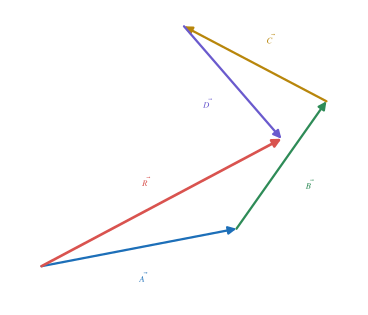
Subtraction is addition of the negative vector:
2.2 Resolution of vectors; Unit vectors
Resolution is the reverse of addition: replacing one vector by two (or three) vectors that together have the same effect. The useful choice is always two mutually perpendicular components, because perpendicular components never interfere with each other.
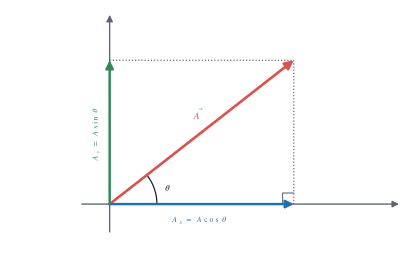
If \vec{A} makes an angle \theta with the x-axis, the right triangle gives
and going back the other way,
To add any number of vectors: resolve each one into x and y components, add the components separately to get R_x = \sum A_x and R_y = \sum A_y, then R = \sqrt{R_x^{2} + R_y^{2}} and \tan\theta = R_y/R_x. This method never fails, however many vectors there are.
Unit vectors
A unit vector is a vector of magnitude one that specifies a direction only. The unit vector along \vec{A} is
The unit vectors along the x, y and z axes of a right-handed set are written \hat{i}, \hat{j} and \hat{k}. Any vector in space is then
The cosines of the angles \alpha, \beta, \gamma that \vec{A} makes with the three axes are its direction cosines:
In component form addition is simply componentwise:
Problem. A vector is given by \vec{A} = 2\hat{i} + 3\hat{j} - 6\hat{k}. Find (a) its magnitude, (b) the unit vector along it, and (c) its direction cosines.
Solution.
(a) A = \sqrt{2^{2} + 3^{2} + (-6)^{2}} = \sqrt{4 + 9 + 36} = \sqrt{49} = 7.
(b) \hat{A} = \dfrac{2\hat{i} + 3\hat{j} - 6\hat{k}}{7} = \dfrac{2}{7}\hat{i} + \dfrac{3}{7}\hat{j} - \dfrac{6}{7}\hat{k}.
(c) l = 2/7 = 0.286, m = 3/7 = 0.429, n = -6/7 = -0.857.
Check: l^{2} + m^{2} + n^{2} = (4 + 9 + 36)/49 = 1, as it must be.
A standard application: a block of weight mg on a plane inclined at \theta has weight components mg\sin\theta down the slope and mg\cos\theta perpendicular into the slope. Almost every inclined-plane problem in the next four units starts from that one resolution.
2.3 Scalar and vector products
Scalar (dot) product
The scalar product of \vec{A} and \vec{B} is the scalar
where \theta is the angle between them when they are drawn from a common point.
Geometrically, \vec{A}\cdot\vec{B} is the magnitude of one vector times the projection of the other onto it. Its key properties:
- Commutative: \vec{A}\cdot\vec{B} = \vec{B}\cdot\vec{A}.
- Distributive: \vec{A}\cdot(\vec{B} + \vec{C}) = \vec{A}\cdot\vec{B} + \vec{A}\cdot\vec{C}.
- If the vectors are perpendicular, \vec{A}\cdot\vec{B} = 0; if parallel, AB; if antiparallel, -AB.
- \vec{A}\cdot\vec{A} = A^{2}.
- For the base unit vectors: \hat{i}\cdot\hat{i} = \hat{j}\cdot\hat{j} = \hat{k}\cdot\hat{k} = 1 and \hat{i}\cdot\hat{j} = \hat{j}\cdot\hat{k} = \hat{k}\cdot\hat{i} = 0.
Hence in component form
Physical examples: work W = \vec{F}\cdot\vec{s}, power P = \vec{F}\cdot\vec{v}, and magnetic flux \Phi = \vec{B}\cdot\vec{A}.
Vector (cross) product
The vector product of \vec{A} and \vec{B} is the vector
whose magnitude is AB\sin\theta and whose direction \hat{n} is perpendicular to the plane of \vec{A} and \vec{B}, given by the right-hand screw rule: turn \vec{A} into \vec{B} and the screw advances along \hat{n}.
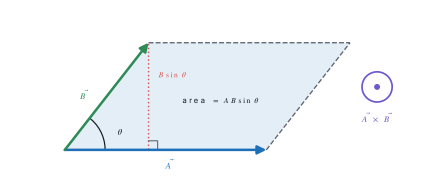
Properties:
- Anticommutative: \vec{A}\times\vec{B} = -\,\vec{B}\times\vec{A}.
- \vec{A}\times\vec{A} = \vec{0}, and the product of parallel or antiparallel vectors is zero.
- It is maximum, AB, when the vectors are perpendicular.
- \hat{i}\times\hat{i} = \hat{j}\times\hat{j} = \hat{k}\times\hat{k} = \vec{0}, while \hat{i}\times\hat{j} = \hat{k}, \hat{j}\times\hat{k} = \hat{i}, \hat{k}\times\hat{i} = \hat{j} (reverse the order and the sign flips).
In components,
The magnitude AB\sin\theta is the area of the parallelogram with the two vectors as adjacent sides; half of it is the area of the triangle. Physical examples: torque \vec{\tau} = \vec{r}\times\vec{F}, angular momentum \vec{L} = \vec{r}\times\vec{p}, and the magnetic force \vec{F} = q\,\vec{v}\times\vec{B}.
| Scalar product | Vector product | |
|---|---|---|
| Result | scalar | vector |
| Formula | AB\cos\theta | AB\sin\theta\,\hat{n} |
| Zero when | vectors are perpendicular | vectors are parallel |
| Maximum when | vectors are parallel | vectors are perpendicular |
| Order matters? | no | yes — reversing changes the sign |
| Example | work, power | torque, angular momentum |
The dot product uses \cos\theta, the cross product \sin\theta. So two perpendicular vectors have zero dot product but maximum cross product — which is why no work is done by a centripetal force, yet a force at right angles to the radius gives the largest torque.
Problem. For \vec{A} = \hat{i} + \hat{j} and \vec{B} = \hat{j} + \hat{k}, find (a) \vec{A}\cdot\vec{B} and the angle between the vectors, and (b) \vec{A}\times\vec{B} and its magnitude.
Solution. Here A = \sqrt{1^{2}+1^{2}+0^{2}} = \sqrt{2} and likewise B = \sqrt{2}.
(a) \vec{A}\cdot\vec{B} = (1)(0) + (1)(1) + (0)(1) = 1. So
(b) With \vec{A} = (1,1,0) and \vec{B} = (0,1,1),
Its magnitude is \sqrt{1 + 1 + 1} = \sqrt{3} = 1.73. As a check, AB\sin\theta = 2\sin60^{\circ} = 2(0.866) = 1.73. The two answers agree.
Problem. (a) A force \vec{F} = (3\hat{i} + 4\hat{j})\ \text{N} moves a body from the point (1, 1, 0)\ \text{m} to (4, 5, 0)\ \text{m}. Find the work done. (b) A force \vec{F} = (3\hat{i} + 2\hat{j} - 4\hat{k})\ \text{N} acts at the point \vec{r} = (2\hat{i} + \hat{j} - \hat{k})\ \text{m} from the origin. Find the torque about the origin.
Solution.
(a) Displacement \vec{s} = (4-1)\hat{i} + (5-1)\hat{j} = 3\hat{i} + 4\hat{j} m.
(b) \vec{\tau} = \vec{r}\times\vec{F} with \vec{r} = (2,1,-1) and \vec{F} = (3,2,-4):
with magnitude \sqrt{4 + 25 + 1} = \sqrt{30} = 5.48\ \text{N m}.
Chapter summary
- Scalars need a magnitude only; vectors need magnitude and direction and add by the triangle, parallelogram or polygon law.
- Parallelogram law: R = \sqrt{P^{2} + Q^{2} + 2PQ\cos\theta} and \tan\alpha = Q\sin\theta/(P + Q\cos\theta). Maximum P+Q at 0^{\circ}, minimum P-Q at 180^{\circ}.
- A closed polygon of vectors means zero resultant — the equilibrium condition.
- Resolution: A_x = A\cos\theta, A_y = A\sin\theta; recombine with A = \sqrt{A_x^{2} + A_y^{2}}, \tan\theta = A_y/A_x.
- \hat{A} = \vec{A}/A; \vec{A} = A_x\hat{i} + A_y\hat{j} + A_z\hat{k} with A = \sqrt{A_x^{2} + A_y^{2} + A_z^{2}} and l^{2}+m^{2}+n^{2}=1.
- Dot product \vec{A}\cdot\vec{B} = AB\cos\theta = A_xB_x + A_yB_y + A_zB_z; it is a scalar and vanishes for perpendicular vectors.
- Cross product \vec{A}\times\vec{B} = AB\sin\theta\,\hat{n}; it is a vector, vanishes for parallel vectors, reverses sign on swapping, and its magnitude is the area of the parallelogram formed by the two vectors.
Practice questions
Group A — Multiple choice (1 mark each)
- Which of the following is a vector quantity? [1]aworkbtemperaturectorquedelectric charge
- The resultant of two forces of 3\ \text{N} and 4\ \text{N} acting at right angles is [1]a1\ \text{N}b5\ \text{N}c7\ \text{N}d12\ \text{N}
- If \vec{A}\cdot\vec{B} = 0 for two non-zero vectors, then the angle between them is [1]a0^{\circ}b45^{\circ}c90^{\circ}d180^{\circ}
- The magnitude of \hat{i}\times\hat{j} is [1]a0b1c\sqrt{2}d2
- Two equal vectors of magnitude P give a resultant of magnitude P. The angle between them is [1]a60^{\circ}b90^{\circ}c120^{\circ}d180^{\circ}
- The area of the triangle formed by \vec{A} and \vec{B} as two of its sides is [1]aAB\sin\thetab\frac{1}{2}AB\sin\thetacAB\cos\thetad\frac{1}{2}AB\cos\theta
Answers to Group A
1. (c) — torque has a direction given by the right-hand rule; work and charge are scalars.
2. (b) — \sqrt{3^{2}+4^{2}} = 5\ \text{N}.
3. (c) — AB\cos\theta = 0 requires \cos\theta = 0.
4. (b) — \sin 90^{\circ} = 1 and both are unit vectors.
5. (c) — P^{2} = 2P^{2}(1 + \cos\theta) gives \cos\theta = -1/2.
6. (b) — the cross product gives the parallelogram area; the triangle is half of it.
Group B — Short answer (5 marks each)
- State the parallelogram law of vector addition and derive expressions for the magnitude and direction of the resultant of two vectors. [5]
- Define a unit vector. If \vec{A} = 3\hat{i} - 4\hat{j} + 12\hat{k}, find its magnitude, the unit vector along it and its direction cosines. [5]
- Two forces of 6\ \text{N} and 8\ \text{N} act on a body at right angles to each other. Find the magnitude and direction of the resultant force. [5]
- Distinguish between the scalar and the vector product of two vectors, giving one physical example of each. [5]
- Find the angle between the vectors \vec{A} = 2\hat{i} + 2\hat{j} - \hat{k} and \vec{B} = 6\hat{i} - 3\hat{j} + 2\hat{k}. [5]
Answers to Group B
1. Outline: state the law, then reproduce the derivation of R = \sqrt{P^{2}+Q^{2}+2PQ\cos\theta} and \tan\alpha = Q\sin\theta/(P+Q\cos\theta) given in §2.1.
2. A = \sqrt{9 + 16 + 144} = \sqrt{169} = 13. \hat{A} = (3\hat{i} - 4\hat{j} + 12\hat{k})/13; direction cosines l = 3/13 = 0.231, m = -4/13 = -0.308, n = 12/13 = 0.923.
3. R = \sqrt{6^{2}+8^{2}} = 10\ \text{N}; \tan\alpha = 8/6 = 1.333, so \alpha = 53.1^{\circ} from the 6\ \text{N} force.
4. Outline: use the comparison table in §2.3 — scalar versus vector result, \cos\theta versus \sin\theta, order dependence; work and torque as examples.
5. \vec{A}\cdot\vec{B} = 12 - 6 - 2 = 4; A = \sqrt{4+4+1} = 3 and B = \sqrt{36+9+4} = 7. So \cos\theta = 4/21 = 0.1905 and \theta = 79.0^{\circ}.
Group C — Long answer (8 marks each)
- (a) State and explain the triangle, parallelogram and polygon laws of vector addition. [4](b) Two forces P and Q act at a point. Show that the resultant is maximum when they are parallel and minimum when they are antiparallel. Hence find the two forces whose maximum resultant is 14\ \text{N} and whose minimum resultant is 2\ \text{N}. [4]
- (a) Define the scalar and vector products and state two properties of each. [4](b) Given \vec{A} = 4\hat{i} + 3\hat{j} and \vec{B} = 2\hat{i} + 5\hat{j}, find \vec{A}\cdot\vec{B}, \vec{A}\times\vec{B}, the angle between the vectors, and the area of the triangle having \vec{A} and \vec{B} as two of its sides. [4]
Answers to Group C
1. (b) R^{2} = P^{2}+Q^{2}+2PQ\cos\theta increases with \cos\theta, which is greatest (+1) at \theta = 0^{\circ}, giving R_{\max} = P+Q, and least (-1) at \theta = 180^{\circ}, giving R_{\min} = P-Q. Then P + Q = 14 and P - Q = 2, so P = 8\ \text{N} and Q = 6\ \text{N}.
2. (b) \vec{A}\cdot\vec{B} = (4)(2) + (3)(5) = 23. \vec{A}\times\vec{B} = (4\times5 - 3\times2)\hat{k} = 14\hat{k}, of magnitude 14. A = 5, B = \sqrt{29} = 5.385, so \cos\theta = 23/26.93 = 0.854 and \theta = 31.3^{\circ}. Area of the triangle = \frac{1}{2}(14) = 7 square units.
Practise more: Physics question bank